
Lopes H.S., Cruz L.M. (eds.) Computational Biology and Applied Bioinformatics
Подождите немного. Документ загружается.


MicroArray Technology - Expression Profiling of MRNA and MicroRNA in Breast Cancer
117
Mina L, Soule SE, Badve S, et al. (2007) Predicting response to primary chemotherapy: gene
expression profiling of paraffin-embedded core biopsy tissue. Breast Cancer Res
Treat ;103:197–208.
Mitchell PS, Parkin RK, Kroh EM, et al (2008).Circulating MiRNAs as stable blood- based
markers for cancer detection.PNAS;105(30):10513-8
Mook S, Schmidt MK, Viale G, et al (2009). The 70-gene prognosis signature predicts disease
outcome in breast cancer patients with 1–3 positive lymph nodes in an
independent validation study. Breast Cancer Res Treat;116:295–302.
Mootha VK, Lindgren CM, Eriksson KF, et al (2003). PGC-1alpha Responsive Genes
Involved in Oxidative Phosphorylation are Coordinately Downregulated in Human
Diabetes, Nature Genetics 34(3):267-73
Nielsen TO, Hsu FD, Jensen K et al (2004). Immunohistochemical and clinical
characterization of the basal-like subtype of invasive breast carcinoma. Clin Cancer
Res ;10:5367-74.
Oberley MJ, Tsao J, Yau P, Farnham PJ (2004). Highthroughput screening of chromatin
immunoprecipitates using CpG-island microarrays. Methods Enzymol;376: 315-
34.
Oostlander AE, Meijer GA, Ylstra B (2004). Microarraybased comparative genomic
hybridization and its applications in human genetics. Clin Genet, 66: 488-495.
Osborne CK(1998) Tamoxifen in the treatment of breast cancer. N Engl J Med;339(22):1609-
18.
Paik S, Shak S, Tang G, et al (2004). A multigene assay to predict recurrence of tamoxifen-
treated, node-negative breast cancer. N Engl J Med;351(27):2817-26.
Paik, S. Kim, C. Y, Song, Y. K. & Kim, W. S. (2005) Technology insight: application of
molecular techniques to formalin-fixed paraffin-embedded tissues from breast
cancer. Nat. Clin. Pract. Oncol;2:246–254
Paik S, Tang G, Shak S, , et al(2006). Gene expression and benefit of chemotherapy in women
with node-negative, estrogen receptor-positive breast cancer. J Clin Oncol; 24 (23) :
3726-34.
Parker JS, Mullins M, Cheang MC, et al (2009). Supervised risk predictor of breast cancer
based on intrinsic subtypes. J Clin Oncol;27:1160–1167.
Pedraza V, Gomez-Capilla JA, Escaramis G, et al (2010) Gene expression signatures in breast
cancer distinguish phenotype characteristics, histologic subtypes, and tumor
invasiveness. Cancer.;116(2):486-96.
Peppercorn J, Perou CM, Carey LA. (2008) Molecular subtypes in breast cancer evaluation
and management: divide and conquer. Cancer Invest;26:1–10.
Perou CM, Sorlie T, Eisen MB, et al (2000). Molecular portraits of human breast tumours.
Nature;406: 747-52.
Pusztai L, Mazouni C, Anderson K, et al (2006). Molecular classification of breast cancer:
limitations and potential. Oncologist;11:868–877.
Quackenbush J (2001). Computational analysis of microarray data. Nature Reviews Genetics
;2:418-27.

Computational Biology and Applied Bioinformatics
118
Raychaudhuri S, Stuart JM, Altman RB (2000). Principal components analysis to summarize
microarray experiments: application to sporulation time series. In Pacific
Symposium on Biocomputing, pp. 455–466.
Rifai N, Gillette MA, Carr SA (2006). Protein biomarker discovery and validation: the long
and uncertain path to clinical utility. Nature biotechnology;24:971-983
Rouzier R, Perou CM, Symmans WF et al (2005). Breast cancer molecular subtypes
respond differently to preoperative chemotherapy. Clin Cancer Res;11:5678 –
5685.
Schena M, Shalon D, Davis RW, Brown PO (1995). Quantitative monitoring of
gene expression patterns with a complementary DNA microarray. Science;270:467-
70.
Segura MF, Belitskaya-Lévy I, Rose A, et al (2010) Melanoma MicroRNA Signature Predicts
Post-Recurrence Survival. Clinical Cancer Research;16:1577.
Shak S, Baehner FL, Palmer G, et al (2006) Subtypes of breast cancer defined by
standardized quantitative RT–PCR analysis of 10 618 tumors. Breast Cancer Res
Treat 2006;100:S295–295.
Shi L, Reid LH, Jones WD, et al (2006)The microarray quality control (MAQC) project shows
inter- and intraplatform reproducibility of gene expression measurements. Nature
Biotechnologie;24:1151–1161.
Simon RM, Korn EL, McShane LM, et al (2003). Design and analysis of DNA microarray
investigations. Springer New York
Smith I, Procter M, Gelber RD, et al (2007). 2-year follow up of trastuzumab after adjuvant
chemotherapy in HER2-positive breast cancer: a randomised controlled trial.
Lancet. ;369(9555):29-36.
Sorlie T, Perou CM, Tibshirani R, et al (2001) Gene expression patterns of breast
carcinomas distinguish tumor subclasses with clinical implications.PNAS;98: 10869-
74.
Sorlie T, Tibshirani R, Parker J, et al (2003). Repeated observation of breast tumor subtypes
in independent gene expression data sets. PNAS;100:8418–8423.
Sorlie T, Perou CM, Fan C, et al (2006) Gene expression profiles do not consistently predict
the clinical treatment response in locally advanced breast cancer. Mol Cancer
Ther;5:2914–8.
Sotiriou C, Neo SY, McShane LM, et al (2003) Breast cancer classification and prognosis
based on gene expression profiles from a population based study.PNAS;100:10393–
10398
Sparano JA. (2006). TAILORx: Trial assigning individualized options for treatment (Rx). Clin
Breast Cancer;7:347–350.
Stekel D. (2003). Microarray bioinformatics. Cambrigde University Press,
Stoll D, Templin MF, Bachmann J, Joos TO (2005). Protein microarrays: applications and
future challenges. Curr Opin Drug Discov Devel, 8: 239-252.
Sun Y, Goodison S. Li J, Liu L., Farmerie W (2007). Improved breast cancer prognosis
through the combination of clinical and genetic markers, Bioinformatics;23:30–
37

MicroArray Technology - Expression Profiling of MRNA and MicroRNA in Breast Cancer
119
Tessel MA, Krett NL, Rosen ST (2010).Steroid receptor and microRNA regulation in cancer.
Curr Opin Oncol;22(6):592‐597
The FlyBase Consortium (1999). The FlyBase database of the Drosophila Genome Projects
and community literature. Nucleic Acids Res;27:85–88.
van de Vijver M, He Y, van’t Veer L, et al (2002). A gene-expression signature as a predictor
of survival in breast cancer. N Engl J Med;347:1999–2009.
van’t Veer L, Dai H, van de Vijver M, et al (2002). Gene expression profiling predicts clinical
outcome of breast cancer. Nature;415:530–6.
Vapnik V, Lerner A (1963). Pattern recognition using generalized portrait method.
Automation and Remote Control 1963;24:774-780.
Volinia S, Calin GA, Liu CG, et al (2006). A MiRNA expression signature of human solid
tumors defines cancer gene targets. PNAS.;103(7):2257-61.
Wadsworth JT, Somers KD, Cazares LH, et al (2004) Serum protein profiles to identify head
and neck cancer. Clinical Cancer Research;10:1625-1632.
Wang Y, Klijn JG, Zhang Y et al (2005). Gene-expression profiles to predict
distant metastasis of lymph-node-negative primary breast cancer. Lancet;365:671–
679.
Warnat P, Eils R, Brors B (2005). Cross-platform analysis of cancer microarray data
improves gene expression based classification of phenotypes. BMC
bioinformatics 2;6: 265.
Weigelt B, Geyer FC, Natrajan R, et al (2010) The molecular underpinning of lobular
histological growth pattern: a genome-wide transcriptomic analysis of invasive
lobular carcinomas and grade- and molecular subtype-matched invasive ductal
carcinomas of no special type. J Pathol;220(1):45-57
Wirapati P, Sotiriou C, Kunkel S, et al (2008). Meta-analysis of gene expression profiles in
breast cancer: toward a unified understanding of breast cancer subtyping and
prognosis signatures. Breast Cancer Res;10:R65.
Wong JWH, Cagney G, Cartwright HM (2005). SpecAlign—processing and alignment of
mass spectra datasets. Bioinformatics;21:2088-2090
Xi Y, Nakajima G, Gavin E, et al (2007). Systematic analysis of MiRNA expression of RNA
extracted from fresh frozen and formalin-fixed paraffin-embedded samples.
RNA;13(10):1668-74.
Xue C, Li F, He T, Liu GP, Li Y, Xuegong Z (2005). Classification of real and pseudo
microRNA precursors using local structure-sequence features and support vector
machine. BMC Bioinformatics;6:310.
Xu R, Xu J, Wunsch DC (2009). Using default ARTMAP for cancer classification with
MicroRNA expression signatures, International Joint Conference on Neural Networks,
pp.3398-3404,
Yan PS, Perry MR, Laux DE, et al (2000). CpG island arrays: an application toward
deciphering epigenetic signatures of breast cancer. Clinical Cancer Research; 6:
1432-38.
Yousef M, Najami N, Khalifa W (2010). A comparison study between one-class and two-
class machine learning for MicroRNA target detection. Journal of Biomedical
Science and Engineering ;3:247-252.

Computational Biology and Applied Bioinformatics
120
Zhao H, Langerod A, Ji Y, et al (2004) Different gene expression patterns in invasive lobular
and ductal carcinomas of the breast. Mol Biol Cell;15:2523–2536.
Zhao H, Shen J, Medico L, et al (2010). A Pilot Study of Circulating miRNAs as Potential
Biomarkers of Early Stage Breast Cancer. PLoS One;5(10),e137:5 , 2010
Zheng T, Wang J, Chen X, Liu L (2010) Role of microRNA in anticancer drug resistance. Int J
Cancer;126(1):2-10.
6
Computational Tools for Identification of
microRNAs in Deep Sequencing Data Sets
Manuel A. S. Santos and Ana Raquel Soares
University of Aveiro
Portugal
1. Introduction
MicroRNAs (miRNAs) are a class of small RNAs of approximately 22 nucleotides in length
that regulate eukaryotic gene expression at the post-transcriptional level (Ambros 2004;
Bartel 2004; Filipowicz et al. 2008). They are transcribed as long precursor RNA molecules
(pri-miRNAs) and are successively processed by two key RNAses, namely Drosha and
Dicer, into their mature forms of ~22 nucleotides (Kim 2005; Kim et al. 2009). These small
RNAs regulate gene expression by binding to target sites in the 3’ untranslated region of
mRNAs (3’UTR). Recognition of the 3’UTR by miRNAs is mediated through complementary
hybridization at least between nucleotides 2-8, numbered from the 5’ end (seed sequences)
of the small RNAs, and complementary sequences present in the 3’UTRs of mRNAs
(Ambros 2004; Bartel 2004; Zamore and Haley 2005). Perfect or nearly perfect
complementarities between miRNAs and their 3’UTRs induce mRNA cleavage by the RNA-
induced silencing complex (RISC), whereas imperfect base pair matching may induce
translational silencing through various molecular mechanisms, namely inhibition of
translation initiation and activation of mRNA storage in P-bodies and/or stress granules
(Pillai et al. 2007).
This class of small RNAs is well conserved between eukaryotic organisms, suggesting that
they appeared early in eukaryotic evolution and play fundamental roles in gene expression
control. Each miRNA may repress hundreds of mRNAs and regulate a wide variety of
biological processes, namely developmental timing (Feinbaum and Ambros 1999; Lau et al.
2001), cell differentiation (Tay et al. 2008), immune response (Ceppi et al. 2009) and infection
(Chang et al. 2008). For this reason, their identification is essential to understand eukaryotic
biology. Their small size, low abundance and high instability complicated early
identification, but these obstacles have been overcome by next generation sequencing
approaches, namely the Genome Sequencer
TM
FLX from Roche, the Solexa/Illumina
Genome Analyzer and the Applied Biosystems SOLiD
TM
Sequencer which are currently
being routinely used for rapid miRNA identification and quantification in many eukaryotes
(Burnside et al. 2008; Morin et al. 2008; Schulte et al. 2010).
As in other vertebrates, miRNAs control gene expression in zebrafish, since defective
miRNA processing arrest development (Wienholds et al. 2003). Also, a specific subset of
miRNAs is required for brain morphogenesis in zebrafish embryos, but not for cell fate
determination or axis formation (Giraldez et al. 2005). In other words, miRNAs play an

Computational Biology and Applied Bioinformatics
122
important role in zebrafish organogenesis and their expression at specific time points is
relevant to organ formation and differentiation. Since identification of the complete set of
miRNAs is fundamental to fully understand biological processes, we have used high
throughput 454 DNA pyrosequencing technologies to fully characterize the zebrafish
miRNA population (Soares et al. 2009). For this, a series of cDNA libraries were prepared
from miRNAs isolated at different embryonic time points and from fully developed organs
sequenced using the Genome Sequencer
TM
FLX. This platform yields reads of up to 200
bases each and can generate up to 1 million high quality reads per run, which provides
sufficient sequencing coverage for miRNA identification and quantification in most
organisms. However, deep sequencing of small RNAs may pose some problems that need to
be taken into consideration to avoid sequencing biases. For example, library preparation and
computational methodologies for miRNA identification from large pool of reads need to be
optimized. There are many variables to consider, namely biases in handling large sets of
data, sequencing errors and RNA editing or splicing. If used properly, deep sequencing
technologies have enormous analytical power and have been proven to be very robust in
retrieving novel small RNA molecules. One of the major challenges when analyzing deep
sequencing data is to differentiate miRNAs from other small RNAs and RNA degradation
products.
Different research groups are developing dedicated computational methods for the
identification of miRNAs from large sets of sequencing data generated by next
generation sequencing experiments. miRDeep (http://www.mdc-
berlin.de/en/research/research_teams/systems_biology_of_gene_regulatory_elements/pr
ojects/miRDeep/index.html) (Friedlander et al. 2008) and miRanalizer
(http://web.bioinformatics.cicbiogune.es/microRNA/miRanalyser.php) (Hackenberg et al.
2009) can both detect known miRNAs annotated in miRBase and predict new miRNAs
(although using different prediction algorithms) from small RNA datasets generated by
deep sequencing. Although these online algorithms are extremely useful for miRNA
identification, custom-made pipeline analysis of deep sequencing data may be performed in
parallel to uncover the maximum number of small non-coding RNA molecules present in
the RNA datasets.
In this chapter, we discuss the tools and computational pipelines used for miRNA
identification, discovery and expression from sequencing data, based on our own experience
of deep sequencing of zebrafish miRNAs, using the Genome Sequencer
TM
FLX from Roche.
We show how a combination of a public available, user-friendly algorithm, such as
miRDeep, with custom-built analysis pipelines can be used to identify non-coding RNAs
and uncover novel miRNAs. We also demonstrate that population statistics can be applied
to statistical analysis of miRNA populations identified during sequencing and we
demonstrate that robust computational analysis of the data is crucial for extracting the
maximum information from sequencing datasets.
2. miRNA identification by next-generation sequencing
2.1 Extraction of next-generation sequencing data
Next generation sequencing methods have been successfully applied in the last years to
miRNA identification in a variety of organisms. However, the enormous amount of data
generated represents bioinformatics challenges that researchers have to overcome in order
to extract relevant data from the datasets.

Computational Tools for Identification of microRNAs in Deep Sequencing Data Sets
123
We have used the Genome Sequencer
TM
FLX system (454 sequencing) to identify zebrafish
miRNAs from different developmental stages and from different tissues. For this, cDNA
libraries are prepared following commonly used protocols (Droege M and Hill B. 2008;
Soares et al. 2009). These libraries contain specific adaptors for the small RNA molecules
containing specific priming sites for sequencing. After sequencing, raw data filtration and
extraction is performed using specialist software incorporated into the Genome Sequencer
TM
FLX system (Droege M and Hill B. 2008). Raw images are processed to remove background
noise and the data is normalized. Quality of raw sequencing reads is based on complete read
through of the adaptors incorporated into the cDNA libraries. The 200 base pair of 454
sequencing reads provide enough sequencing data for complete read through of the
adaptors and miRNAs. During quality control, the adaptors are trimmed and the resulting
sequences are used for further analysis. Sequences ≥ 15 nucleotides are kept for miRNA
identification, and constitute the small RNA sequencing data.
Other sequencing platforms, such as Illumina/Solexa and SOLiD
TM
, also have specialist
software for raw data filtration. DSAP, for example, is an automated multiple-task web
service designed to analyze small RNA datasets generated by the Solexa platform (Huang et
al. 2010). This software filters raw data by removing sequencing adaptors and poly-
A/T/C/G/N nucleotides. In addition, it performs non-coding RNA matching by sequence
homology mapping against the non-coding RNA database Rfam (rfam.sanger.ac.uk/) and
detects known miRNAs in miRBase (Griffiths-Jones et al. 2008), based on sequence
homology.
The SOLiD
TM
platform has its own SOLiD™ System Small RNA Analysis Pipeline Tool
(RNA2MAP), which is available online (http://solidsoftwaretools.com/gf/project/
rna2map). This software is similar to DSAP, as it filters raw data and identifies known
miRNAs in the sequencing dataset by matching reads against miRBase sequences and
against a reference genome. Although these specialist software packages are oriented for
miRNA identification in sequencing datasets they are not able to identify novel miRNAs.
For this, datasets generated from any of the sequencing platforms available have to be
analyzed using tools that include algorithms to identify novel miRNAs.
2.2 miRNA identification from next generation sequencing databases
miRNA identification (of both known and novel molecules) from datasets generated by
deep-sequencing has been facilitated by the development of public user friendly algorithms,
such as miRDeep (Friedlander et al. 2008), miRanalyzer (Hackenberg et al. 2009) and
miRTools (Zhu et al. 2010).
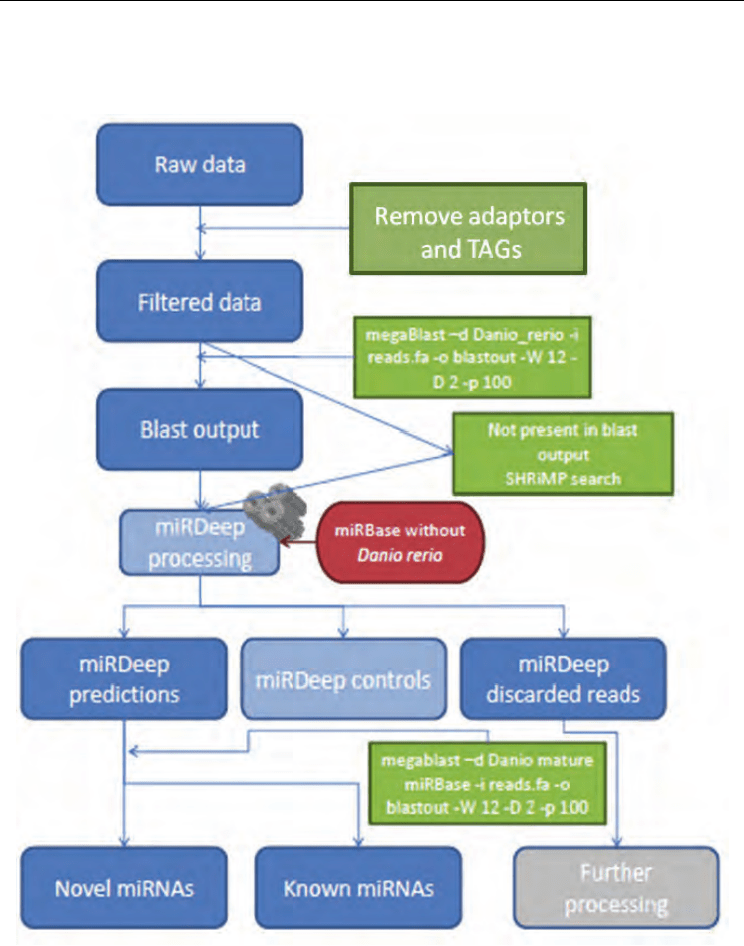
We used miRDeep to identify miRNAs in our sequencing datasets (Figure 1). miRDeep was
the first public tool available for the analysis of deep-sequencing miRNA data. This software
was developed to extract putative precursor structures and predict secondary structures
using RNAfold (Hofacker 2003) after genome alignment of the sequences retrieved by next-
generation sequencing. This algorithm relies on the miRNA biogenesis model. Pre-miRNAs
are processed by DICER, which originates three different fragments, namely the mature
miRNA, the star and the hairpin loop sequences (Kim et al. 2009). miRDeep scores the
compatibility of the position and frequency of the sequenced RNA with the secondary
structures of the miRNA precursors and identifies new, conserved and non-conserved
miRNAs with high confidence. It distinguishes between novel and known miRNAs, by
evaluating the presence or absence of alignments of a given sequence with the stem loop

Computational Biology and Applied Bioinformatics
124
sequences deposited in miRBase. The sequence with the highest expression is always
considered as the mature miRNA sequence by the miRDeep algorithm. All hairpins that are
not processed by DICER will not match a typical secondary miRNA structure and are
filtered out.
After aligning the sequences against the desired genome using megaBlast, the blast output is
parsed for miRDeep uploading. As sequencing errors, RNA editing and RNA splicing may
alter the original miRNA sequence, one can re-align reads that do not match the genome
using SHRiMP (http://compbio.cs.toronto.edu/shrimp/). The retrieved alignments are also
parsed for miRDeep for miRNA prediction. miRDeep itself allows up to 2 mismatches in the
3’ end of each sequence, which already accounts with some degree of sequencing errors that
might have occurred.
Reads matching more than 10 different genome loci are generally discarded, as they likely
constitute false positives. The remaining alignments are used as guidelines for excision of
the potential precursors from the genome. After secondary structure prediction of putative
precursors, signatures are created by retaining reads that align perfectly with those putative
precursors to generate the signature format. miRNAs are predicted by discarding non-
plausible DICER products and scoring plausible ones. The latter are blasted against mature
miRNAs deposited in miRBase, to extract known and conserved miRNAs. The remaining
reads are considered novel miRNAs.
In order to evaluate the sensitivity of the prediction and data quality, miRDeep calculates
the false positive rate, which should be below 10%. For this, the signature and the structure-
pairings in the input dataset are randomly permutated, to test the hypothesis that the
structure (hairpin) of true miRNAs is recognized by DICER and causes the signature.
miRanalizer (Hackenberg et al. 2009) is a recently developed web server tool that detects
both known miRNAs annotated in miRBase and other non-coding RNAs by mapping
sequences to non-coding RNA libraries, such as Rfam. This feature is important, as more
classes of small non coding RNAs are being unravelled and their identification can provide
clues about their functions. At the same time, by removing reads that match other non
coding RNA classes, it reduces the false positive rate in the prediction of novel miRNAs, as
these small non coding RNAs can be confused with miRNAs. For novel miRNA prediction,
miRanalizer implements a machine learning approach based on the random forest method,
with the number of trees set to 100 (Breiman 2001). miRanalyzer can be applied to miRNA
discovery in different models, namely human, mouse, rat, fruit-fly, round-worm, zebrafish
and dog, and uses datasets from different models to build the final prediction model. In
comparison to miRDeep, this is disadvantageous as the latter can predict novel miRNAs
from any model. All pre-miRNAs candidates that match known miRNAs are extracted from
the experimental dataset and labelled as positive instances. Next, an equal amount of pre-
miRNA candidates from the same dataset are selected by random selection with the known
miRNAs removed and labelled as negative. Pre-processing of reads corresponding to
putative new miRNAs includes clustering of all reads that overlap with the genome, testing
whether the start of the current read overlaps less than 3 nucleotides with the end position
of previous reads. This avoids DICER products grouping together and be considered non-
miRNAs products, which would increase false negatives. Besides, clusters of more than 25
base pairs in length are discarded and the secondary structure of the miRNA is predicted
via RNAfold (Hofacker 2003). Structures where the cluster sequence is not fully included
and where part of the stem cannot be identified as a DICER product are discarded.
Computational Tools for Identification of microRNAs in Deep Sequencing Data Sets
125
Fig. 1. Data pipeline analysis using miRDeep.

Computational Biology and Applied Bioinformatics
126
miRTools is a comprehensive web server that can be used for characterization of the small
RNA transcriptome (Zhu et al. 2010). It offers some advantages relative to miRDeep and
miRanalyzer, since it integrates multiple computational approaches including tools for raw
data filtration, identification of novel miRNAs and miRNA expression profile generation. In
order to detect novel miRNAs, miRTools analyze all sequences that are not annotated to
known miRNAs, other small non-coding RNAs and genomic repeats or mRNA that match the
reference genome. These sequences are extracted and their RNA secondary structures are
predicted using RNAfold (Hofacker 2003) and novel miRNAs are identified using miRDeep.
2.3 Analysis of discarded reads by miRNA identification algorithms can identify new
miRNAs
Since miRDeep and miRanalyzer are highly stringent algorithms, some miRNAs may escape
detection. The false negative discovery rate can, however be calculated by simply
performing a megaBlast search of the sequencing data against the miRNAs deposited in
miRBase. Perfect alignments are considered true positives. The list of known miRNAs
identified by this method is compared to the list of known miRNAs identified by miRDeep
or miRanalyzer. False negatives are those miRNAs present in the blast analysis, but which
were missed by the miRNA prediction algorithms. This is, in our opinion, an essential
control, as it gives information about the percentage of miRNAs that may have escaped
miRDeep or miRanalyzer analysis. We have detected ~19% of false negatives, which
prompted us to develop a parallel pipeline to analyze reads that may have been incorrectly
discarded by the original algorithm (Figure 2). This analysis can and should be performed
independently of the algorithm used to retrieve miRNAs from deep sequencing data.
To overcome the lack of sensitivity of miRDeep, our parallel bioinformatics pipeline
includes a megaBlast alignment between the dataset of discarded reads by miRDeep and
mature sequences deposited in miRBase. Besides, novel transcripts encoding miRNAs
predicted by computational tools can be retrieved from the latest Ensembl version using
BioMart and also from literature predictions. These sequences are then used to perform a
megaBlast search against the sequencing data. The transcripts with perfect matches and
alignment length > 18 nucleotides are kept for further processing. These transcripts are then
compared with the mature miRNAs deposited in miRBase and those that produce imperfect
alignments or do not produce alignments are considered novel miRNAs. Imperfect alignments
may identify conserved miRNAs if there is a perfect alignment in the seed region.
Complementary alignments of our dataset reads against the zebrafish genome with SHRiMP
alignments and complementary miRDeep analysis with an analysis of the reads discarded
by this algorithm, allowed us to identify 90% of the 192 zebrafish miRNAs previously
identified, plus 107 miRNA star sequences and 25 novel miRNAs.
2.4 Generation of miRNA profiles from deep sequencing data
Deep sequencing of miRNAs can also be used to generate miRNA expression profiles as the
absolute number of sequencing reads of each miRNA is directly proportional to their
relative abundance. miRNA profiles can be generated based on the number of reads of each
particular miRNA. However, a normalization step is essential to compare miRNA
expression levels between different samples. The variation in the total number of reads
between samples leads to erroneous interpretation of miRNA expression patterns by direct