
Lopes H.S., Cruz L.M. (eds.) Computational Biology and Applied Bioinformatics
Подождите немного. Документ загружается.

Preface XI
high-resolution methods are especially used for characterizing critical regions of the
systems under investigation. Vitale et al. present a thorough review of mass
spectrometry and the related computational methods for studying the three-
dimensional structure of proteins.
Rodrigues and Kluskens review synthetic biology approaches for the development of
alternatives for cancer diagnosis and drug development, providing several application
examples and pointing challenging directions of research.
Biological sequence alignment is an important and widely used task in bioinformatics.
It is essential to provide valuable and accurate information in the basic research, as
well as in daily use of the molecular biologist. The well-known Smith and Waterman
algorithm is an optimal sequence alignment method, but it is computationally
expensive for large instances. This fact fostered the research and development of
specialized hardware platforms to accelerate biological data analysis that use that
algorithm. Hasan and Al-Ars provide a thorough discussion and comparison of
available methods and hardware implementations for sequence alignment on different
platforms.
Exciting and updated issues are presented in Part II, where theoretical bases are
complemented with case studies, showing how bioinformatics analysis pipelines were
applied to answer a variety of biological issues.
During the last years we have witnessed an exponential growth of the biological data
and scientific articles. Consequently, retrieving and categorizing documents has
become a challenging task. The second part of the book starts with the chapter by
Addis et al. that propose a multiagent system for retrieving and categorizing
bioinformatics publications, with special focus on the information extraction task and
adopted hierarchical text categorization technique.
Computational immunology is a field of science that encompasses high-throughput
genomic and bioinformatic approaches to immunology. On the other hand, grid
computing is a powerful alternative for solving problems that are computationally
intensive. Pappalardo and Chiachio present two different studies of using
computational immunology approaches implemented in a grid infrastructure:
modeling atherosclerosis and optimal protocol searching for vaccine against
mammary carcinoma.
Despite the growing number of proteins discovered as sub-product of the many
genome sequencing projects, only a very few number of them have a known three-
dimensional structure. A possible way to infer the full structure of an unknown
protein is to identify potential secondary structures in it. Chidambaram et al. compare
the performance of several machine learning and evolutionary computing methods for
the classification of secondary structure of proteins, starting from their primary
structure.
XII Preface
Cancer is one of the most important public health problems worldwide. Breast and
cervical cancer are the most frequent in female population. Salcedo et al. present a
study about the functional analysis of the cervical carcinoma transcriptome, with focus
on the methods for unveiling networks and finding new genes associated to cervical
cancer.
In Sawada and Mitaku, the number distribution of transmembrane helices is
investigated to show that it is a feature under natural selection in prokaryotes and
how membrane proteins with high number of transmembrane helices disappeared in
random mutations by simulation data.
In Chu et al., an alignment approach using the pure best hit strategy is proposed to
classify TIM barrel protein domain structures in terms of the superfamily and family
categories with high accuracy.
Jamil and Sabeena use classic bioinformatic tools, such as ClustalW for Multiple
Sequence Alignment, SCI-PHY server for superfamily determination, ExPASy tools for
pattern matching, and visualization softwares for residue recognition and functional
elucidation to determine the functional diversity of the enolase enzyme superfamily.
Quality assessment of structure predictions is an important problem in bioinformatics
because quality determines the application range of predictions. Piedra et al. briefly
review some applications used in protein structure prediction field, were they are used
to evaluate overall prediction quality, and show how structure comparison methods
can also be used to identify the more reliable parts in “de novo” analysis and how this
information can help to refine/improve these models.
In Fu, a new method is presented that explores potential genes in intergenic regions of
an annotated genome on the basis of their gene expression activity. The method was
applied to the M. tuberculosis genome where potential protein-coding genes were
found, based on bioinformatics analysis in conjunction with transcriptional evidence
obtained using the Affymetrix GeneChip. The study revealed potential genes in the
intergenic regions, such as DNA-binding protein in the CopG family and a nickel
binding GTPase, as well as hypothetical proteins.
Cai et al. present a new method for developmental studies. It combines experimental
studies and computational analysis to predict the trans-acting factors and
transcriptional regulatory networks for mouse embryonic retinal development.
The chapter by Roberts shows how advances in bioinformatics can be applied to the
development of improved therapeutic strategies. The chapter describes how functional
genomics experimentation and bioinformatics tools could be applied to the design of
synthetic promoters for therapeutic and diagnostic applications or adapted across the
biotech industry. Designed synthetic gene promoters can than be incorporated in
novel gene transfer vectors to promote safer and more efficient expression of
therapeutic genes for the treatment of various pathological conditions. Tools used to
Preface XIII
analyze data obtained from large-scale gene expression analyses, which are
subsequently used in the smart design of synthetic promoters are also presented.
Bruskin et al. describe how candidate genes commonly involved in psoriasis and
Crohn's disease were detected using lists of differentially expressed genes from
microarrays experiments with different numbers of probes. These gene codes for
proteins are particular targets for elaborating new approaches to treating these
pathologies. A comprehensive meta-analysis of proteomics and transcriptomics of
psoriatic lesions from independent studies is performed. Network-based analysis
revealed similarities in regulation at both proteomics and transcriptomics level.
Some eukaryotic mRNAs have multiple ORFs, which are recognized as polycistronic
mRNAs. One of the well-known extra ORFs is the upstream ORF (uORF), that
functions as a regulator of mRNA translation. In Ao-Kondo et al., this issue is
addressed and an introduction to the mechanism of translation initiation and
functional roles of uORF in translational regulation is given, followed by a review of
how the authors identified novel small proteins with Mass Spectrometry and a
discussion on the progress of bioinformatics analyses for elucidating the
diversification of short coding regions defined by the transcriptome.
Acrylamide might feature toxic properties, including neurotoxicity and
carcinogenicity in both mice and rats, but no consistent effect on cancer incidence in
humans could be identified. In the chapter written by Lima and Carloni, the authors
report the use of bioinformatics tools, by means of molecular docking and molecular
simulation procedures, to predict and explore the structural determinants of
acrylamide and its derivative in complex with all of their known cellular target
proteins in human and mice.
Professor Heitor Silvério Lopes
Bioinformatics Laboratory, Federal University of Technology – Paraná,
Brazil
Professor Leonardo Magalhães Cruz
Biochemistry Department, Federal University of Paraná,
Brazil
Part 1
Reviews
1
Molecular Evolution & Phylogeny:
What, When, Why & How?
Pandurang Kolekar
1
, Mohan Kale
2
and Urmila Kulkarni-Kale
1
1
Bioinformatics Centre, University of Pune
2
Department of Statistics, University of Pune
India
1. Introduction
The endeavour for the classification and study of evolution of organisms, pioneered by
Linneaus and Darwin on the basis of morphological and behavioural features of organisms,
is now being propelled by the availability of molecular data. The field of evolutionary
biology has experienced a paradigm shift with the advent of sequencing technologies and
availability of molecular sequence data in the public domain databases. The post-genomic
era provides unprecedented opportunities to study the process of molecular evolution,
which is marked with the changes organisms acquire and inherit. The species are
continuously subjected to evolutionary pressures and evolve suitably. These changes are
observed in terms of variations in the sequence data that are collected over a period of time.
Thus, the molecular sequence data archived in various databases are the snapshots of the
evolutionary process and help to decipher the evolutionary relationships of genes/proteins
and genomes/proteomes for a group of organisms. It is known that the individual genes
may evolve with varying rates and the evolutionary history of a gene may or may not
coincide with the evolution of the species as a whole. One should always refrain from
discussing the evolutionary relationship between organisms when analyses are performed
using limited/partial data. Thorough understanding of the principles and methods of
phylogeny help the users not only to use the available software packages in an efficient
manner, but also to make appropriate choices of methods of analysis and parameters so that
attempts can be made to maximize the gain on huge amount of available sequence data.
As compared to classical phylogeny based on morphological data, molecular phylogeny has
distinct advantages, for instance, it is based on sequences (as descrete characters) unlike the
morphological data, which is qualitative in nature. While the tree of life is depicted to have
three major branches as bacteria, archaea and eukaryotes (it excludes viruses), the trees
based on molecular data accounts for the process of evolution of bio-macromolecules (DNA,
RNA and protein). The trees generated using molecular data are thus referred to as ‘inferred
trees’, which present a hypothesized version of what might have happened in the process of
evolution using the available data and a model. Therefore, many trees can be generated
using a dataset and each tree conveys a story of evolution. The two main types of
information inherent in any phylogenetic tree are the topology (branching pattern) and the
branch lengths.

Computational Biology and Applied Bioinformatics
4
Before getting into the actual process of molecular phylogeny analysis (MPA), it will be
helpful to get familiar with the concepts and terminologies frequently used in MPA.
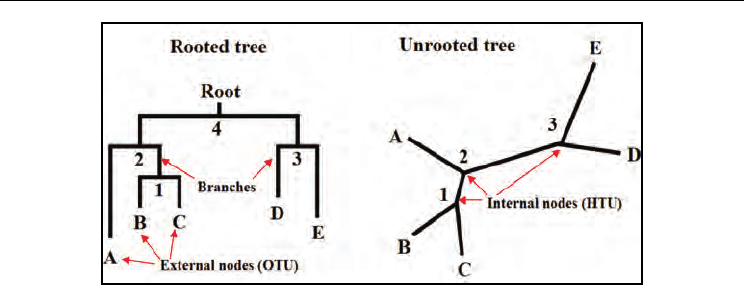
Phylogenetic tree: A two-dimensional graph depicting nodes and branches that illustrates
evolutionary relationships between molecules or organisms.
Nodes: The points that connect branches and usually represent the taxonomic units.
Branches: A branch (also called an edge) connects any two nodes. It is an evolutionary
lineage between or at the end of nodes. Branch length represents the number of
evolutionary changes that have occurred in between or at the end of nodes. Trees with
uniform branch length (cladograms), branch lengths proportional to the changes or distance
(phylograms) are derived based on the purpose of analysis.
Operational taxonomic units (OTUs): The known external/terminal nodes in the
phylogenetic tree are termed as OTU.
Hypothetical taxonomic units (HTUs): The internal nodes in the phylogenetic tree that are
treated as common ancestors to OTUs. An internal node is said to be bifurcating if it has
only two immediate descendant lineages or branches. Such trees are also called binary or
dichotomous as any dividing branch splits into two daughter branches. A tree is called a
‘multifurcating’ or ‘polytomous’ if any of its nodes splits into more than two immediate
descendants.
Monophyletic: A group of OTUs that are derived from a single common ancestor
containing all the descendents of single common ancestor.
Polyphyletic: A group of OTUs that are derived from more than one common ancestor.
Paraphyletic: A group of OTUs that are derived from a common ancestor but the group
doesn’t include all the descendents of the most recent common ancestor.
Clade: A monophyletic group of related OTUs containing all the descendants of the
common ancestor along with the ancestor itself.
Ingroup: A monophyletic group of all the OTUs that are of primary interest in the
phylogenetic study.
Outgroup: One or more OTUs that are phylogenetically outside the ingroup and known to
have branched off prior to the taxa included in a study.
Cladogram: The phylogenetic tree with branches having uniform lengths. It only depicts the
relationship between OTUs and does not help estimate the extent of divergence.
Phylogram: The phylogenetic tree with branches having variable lengths that are
proportional to evolutionary changes.
Species tree: The phylogenetic tree representing the evolutionary pathways of species.
Gene tree: The phylogenetic tree reconstructed using a single gene from each species. The
topology of the gene tree may differ from ‘species tree’ and it may be difficult to reconstruct
a species tree from a gene tree.
Unrooted tree: It illustrates the network of relationship of OTUs without the assumption of
common ancestry. Most trees generated using molecular data are unrooted and they can be
rooted subsequently by identifying an outgroup. Total number of bifurcating unrooted trees
can be derived using the equation: Nu= (2n-5)!/2
n-3
(n-3)!
Rooted tree: An unrooted phylogenetic tree can be rooted with outgroup species, as a
common ancestor of all ingroup species. It has a defined origin with a unique path to each
ingroup species from the root. The total number of bifurcating rooted trees can be calculated
using the formula, Nr= (2n-3)!/2
n-2
(n-2)! (Cavalli-Sforza & Edwards, 1967). Concept of
unrooted and rooted trees is illustrated in Fig. 1.
Molecular Evolution & Phylogeny: What, When, Why & How?
5
Fig. 1. Sample rooted and unrooted phylogenetic trees drawn using 5 OTUs . The external
and internal nodes are labelled with alphabets and Arabic numbers respectively. Note that
the rooted and unrooted trees shown here are one of the many possible trees (105 rooted
and 15 unrooted) that can be obtained for 5 OTUs.
The MPA typically involves following steps
• Definition of problem and motivation to carry out MPA
• Compilation and curation of homologous sequences of nucleic acids or proteins
• Multiple sequence alignments (MSA)
• Selection of suitable model(s) of evolution
• Reconstruction of phylogenetic tree(s)
• Evaluation of tree topology
A brief account of each of these steps is provided below.
2. Definition of problem and motivation to carry out MPA
Just like any scientific experiment, it is necessary to define the objective of MPA to be carried
out using a set of molecular sequences. MPA has found diverse applications, which include
classification of organisms, DNA barcoding, subtyping of viruses, study the co-evolution of
genes and proteins, estimation of divergence time of species, study of the development of
pandemics and pattern of disease transmission, parasite-vector-host relationships etc. The
biological investigations where MPA constitute a major part of analyses are listed here. A
virus is isolated during an epidemic. Is it a new virus or an isolate of a known one? Can a
genotype/serotype be assigned to this isolate just by using the molecular sequence data? A
few strains of a bacterium are resistant to a drug and a few are sensitive. What and where
are the changes that are responsible for such a property? How do I choose the attenuated
strains, amongst available, such that protection will be offered against most of the wild type
strains of a given virus? Thus, in short, the objective of the MPA plays a vital role in
deciding the strategy for the selection of candidate sequences and adoption of the
appropriate phylogenetic methods.
3. Compilation and curation of homologous sequences
The compilation of nucleic acid or protein sequences, appropriate to undertake validation of
hypothesis using MPA, from the available resources of sequences is the next step in MPA.

Computational Biology and Applied Bioinformatics
6
At this stage, it is necessary to collate the dataset consisting of homologous sequences with the
appropriate coverage of OTUs and outgroup sequences, if needed. Care should be taken to
select the equivalent regions of sequences having comparable lengths (± 30 bases or amino
acids) to avoid the subsequent errors associated with incorrect alignments leading to incorrect
sampling of dataset, which may result in erroneous tree topology. Length differences of >30
might result in insertion of gaps by the alignment programs, unless the gap opening penalty is
suitably modified. Many comprehensive primary and derived databases of nucleic acid and
protein sequences are available in public domain, some of which are listed in Table 1. The
database issue published by the journal ‘Nucleic Acids research’ (NAR) in the month of
January every year is a useful resource for existing as well as upcoming databases. These
databases can be queried using the ‘text-based’ or ‘sequence-based’ database searches.
Database URL Reference
Nucleotide
GenBank http://www.ncbi.nlm.nih.gov/genbank/ Benson et al., 2011
EMBL http://www.ebi.ac.uk/embl/ Leinonen et al., 2011
DDBJ http://www.ddbj.nig.ac.jp/ Kaminuma et al., 2011
Protein
GenPept http://www.ncbi.nlm.nih.gov/protein Sayers et al., 2011
Swiss-Prot http://expasy.org/sprot/ The UniProt Consortium (2011)
UniProt http://www.uniprot.org/ The UniProt Consortium (2011)
Derived
RDP http://rdp.cme.msu.edu/ Cole et al., 2009
HIV http://www.hiv.lanl.gov/content/index Kuiken et al., 2009
HCV http://www.hcvdb.org/ http://www.hcvdb.org/
Table 1. List of some of the commonly used nucleotide, protein and molecule-/species-
specific databases.
Text-based queries are supported using search engines viz., Entrez and SRS, which are
available at NCBI and EBI respectively. The list of hits returned after the searches needs to
be curated very carefully to ensure that the data corresponds to the gene/protein of interest
and is devoid of partial sequences. It is advisable to refer to the feature-table section of every
entry to ensure that the data is extracted correctly and corresponds to the region of interest.
The sequence-based searches involve querying the databases using sequence as a probe and
are routinely used to compile a set of homologous sequences. Once the sequences are
compiled in FASTA or another format, as per the input requirements of MPA software, the
sequences are usually assigned with unique identifiers to facilitate their identification and
comparison in the phylogenetic trees. If the sequences posses any ambiguous characters or
low complexity regions, they could be carefully removed from sequences as they don’t
contribute to evolutionary analysis. The presence of such regions might create problems in
alignment, as it could lead to equiprobable alternate solutions to ‘local alignment’ as part of