
Lopes H.S., Cruz L.M. (eds.) Computational Biology and Applied Bioinformatics
Подождите немного. Документ загружается.


Retrieving and Categorizing Bioinformatics Publications through a MultiAgent System 3
Web is still difficult. To simplify this process, several frameworks and systems have been
developed to retrieve scientific publications from the Web.
Bollacker et al. (2000) developed CiteSeer
3
, the well-known automatic generator of digital
libraries of scientific literature. Being aimed at eliminating most of the manual effort of
finding useful publications on the Web, CiteSeer uses sophisticated acquisition, parsing, and
presentation methods. In particular, CiteSeer uses a three-stage process: database creation and
feature extraction; personalized filtering of new publications; and personalized adaptation
and discovery of interesting research and trends. These functions are interdependent:
information filtering affects what is discovered, whereas useful discoveries tune the
information filtering. In (McNee et al., 2002), the authors study how to recommend research
papers using the citation between papers to create the user-item matrix. In particular, they test
the ability of collaborative filtering to recommend citations that could be additional references
for a target research paper. Janssen & Popat (2003) developed UpLib, a personal digital library
system that consists of a full-text indexed repository accessed through an active agent via a
Web interface. UpLib is mainly concerned with the task of collecting personal collections
comprising tens of thousands of documents. In (Mahdavi et al., 2009), the authors start from
the assumption that trend detection in scientific publication retrieval systems helps scholars
to find relevant, new and popular special areas by visualizing the trend of the input topic. To
this end, they developed a semi-automatic system based on a semantic approach.
As for the specific task of retrieving information in the field of bioinformatics, a lot of
work has been done –some of it being recalled hereafter. Tanabe et al. (1999) developed
MedMiner, an Internet-based hypertext program able to filter and organize large amounts of
textual and structured information returned from public search engines –like GeneCards and
PubMed. Craven & Kumlien (1999) applied machine learning techniques to automatically
map information from text sources into structured representations, such as knowledge bases.
Friedman et al. (2001) propose GENIES, a system devised to extract information about cellular
pathways from the biological literature in accordance with a given domain knowledge. Ramu
(2003) developed a Web Server for SIR (Ramu, 2001), a simple indexing and retrieval system
that combines sequence motif search with keyword search. The Web Server, called SIRW, is
a generic tool used by the bioinformatics community for searching and analyzing biological
sequences of interest. Rocco & Critchlow (2003) propose a system aimed at finding classes
of bioinformatics data sources and integrating them behind a unified interface. The main
goal of the system is to eliminate the human effort required to maintain a repository of
information sources. Kiritchenko et al. (2004) propose a system aimed at retrieving Medline
articles that mention genes. After being retrieved, articles are categorized according to the
Gene Ontology (GO) codes. Delfs et al. (2004) developed and implemented GoPubMed, a
system that allows to submit keywords to PubMed, extracts GO terms from the retrieved
abstracts, and supplies the user with the relevant ontology for browsing. Corney et al. (2004)
propose BioRAT (Biological Research Assistant for Text mining), a new information extraction
tool specifically tailored for biomedical tasks. Able to access and analyze both abstracts and
full-length papers, it incorporates a domain specific document search ability.
2.2 Hierarchical text categorization
In recent years several researchers have investigated the use of hierarchies for text
categorization.
Until the mid-1990s researchers mostly ignored the hierarchical structure of categories that
occur in several domains. In 1997, Koller & Sahami (1997) carry out the first proper study
3
http://citeseer.ist.psu.edu/
207
Retrieving and Categorizing Bioinformatics Publications through a MultiAgent System

4 Will-be-set-by-IN-TECH
on HTC on the Reuters-22173 collection. Documents are classified according to the given
hierarchy by filtering them through the single best-matching first-level class and then sending
them to the appropriate second level. This approach shows that hierarchical models perform
well when a small number of features per class is used, as no advantages were found using
the hierarchical model for large numbers of features. McCallum et al. (1998) propose a method
based on naïve Bayes. The authors compare two techniques: (i) exploring all possible paths
in the given hierarchy and (ii) greedily selecting at most two branches according to their
probability, as done in (Koller & Sahami, 1997). Results show that the latter is more error
prone while computationally more efficient. Mladeni´c & Grobelnik (1998) use the hierarchical
structure to decompose a problem into a set of subproblems, corresponding to categories
(i.e., the nodes of the hierarchy). For each subproblem, a naïve Bayes classifier is generated,
considering examples belonging to the given category, including all examples classified in its
subtrees. The classification applies to all nodes in parallel; a document is passed down to
a category only if the posterior probability for that category is higher than a user-defined
threshold. D’Alessio et al. (2000) propose a system in which, for a given category, the
classification is based on a weighted sum of feature occurrences that should be greater than the
category threshold. Both single and multiple classifications are possible for each document to
be tested. The classification of a document proceeds top-down possibly through multiple
paths. An innovative contribution of this work is the possibility of restructuring a given
hierarchy or building a new one from scratch. Dumais & Chen (2000) use the hierarchical
structure for two purposes: (i) training several SVMs, one for each intermediate node and (ii)
classifying documents by combining scores from SVMs at different levels. The sets of positive
and negative examples are built considering documents that belong to categories at the same
level, and different feature sets are built, one for each category. Several combination rules
have also been assessed. In the work of Ruiz & Srinivasan (2002), a variant of the Hierarchical
Mixture of Experts model is used. A hierarchical classifier combining several neural networks
is also proposed in (Weigend et al., 1999). Gaussier et al. (2002) propose a hierarchical
generative model for textual data, i.e., a model for hierarchical clustering and categorization of
co-occurrence data, focused on documents organization. In (Rousu et al., 2005), a kernel-based
approach for hierarchical text classification in a multi-label context is presented. The work
demonstrates that the use of the dependency structure of microlabels (i.e., unions of partial
paths in the tree) in a Markovian Network framework leads to improved prediction accuracy
on deep hierarchies. Optimization is made feasible by utilizing decomposition of the
original problem and making incremental conditional gradient search in the subproblems.
Ceci & Malerba (2007) present a comprehensive study on hierarchical classification of Web
documents. They extend a previous work (Ceci & Malerba, 2003) considering hierarchical
feature selection mechanisms, a naïve Bayes algorithm aimed at avoiding problems related to
different document lengths, the validation of their framework for a probabilistic SVM-based
classifier, and (iv) an automated threshold selection algorithm. More recently, in (Esuli
et al., 2008), the authors propose a multi-label hierarchical text categorization algorithm
consisting of a hierarchical variant of ADABOOST.MH, a well-known member of the family
of “boosting” learning algorithms. Bennett & Nguyen (2009) study the problem of the error
propagation under the assumption that the higher the node in the hierarchy is the worse is the
mistake, as well as the problem of dealing with increasingly complex decision surfaces. Brank
et al. (2010) deal with the problem of classifying textual documents into a topical hierarchy of
categories. They construct a coding matrix gradually, one column at a time, each new column
being defined in a way that the corresponding binary classifier attempts to correct the most
common mistakes of the current ensemble of binary classifiers. The goal is to achieve good
performance while keeping reasonably low the number of binary classifiers.
208
Computational Biology and Applied Bioinformatics

Retrieving and Categorizing Bioinformatics Publications through a MultiAgent System 5
2.3 MultiAgent Systems in information retrieval
Autonomous agents and MAS have been successfully applied to a number of problems and
have been largely used in different application domains (Wooldridge & Jennings, 1995).
As for MAS in IR, in the literature, several centralized agent-based architectures aimed at
performing IR tasks have been proposed. Among others, let us recall NewT (Sheth & Maes,
1993), Letizia (Lieberman, 1995), WebWatcher (Armstrong et al., 1995), and SoftBots (Etzioni
& Weld, 1995). NewT is composed by a society of information-filtering interface agents,
which learn user preferences and act on her/his behalf. These information agents use a
keyword-based filtering algorithm, whereas adaptive techniques are relevance feedback and
genetic algorithms. Letizia is an intelligent user-interface agent able to assist a user while
browsing the Web. The search for information is performed through a cooperative venture
between the user and the software agent: both browse the same search space of linked
Web documents, looking for interesting ones. WebWatcher is an information search agent
that follows Web hyperlinks according to user interests, returning a list of links deemed
interesting. In contrast to systems for assisted browsing or IR, SoftBots accept high-level user
goals and dynamically synthesize the appropriate sequence of Internet commands according
to a suitable ad-hoc language.
Despite the fact that a centralized approach could have some advantages, in IR tasks it may
encompass several problems, in particular how to scale up the architectures to large numbers
of users, how to provide high availability in case of constant demand of the involved services,
and how to provide high trustability in case of sensitive information, such as personal data.
To overcome the above drawbacks, suitable MAS devoted to perform IR tasks have been
proposed. In particular, Sycara et al. (2001) propose Retsina, a MAS infrastructure applied
in many domains. Retsina is an open MAS infrastructure that supports communities of
heterogeneous agents. Three types of agents have been defined: (i) interface agents, able to
display the information to the users; (ii) task agents, able to assist the user in the process of
handling her/his information; and (iii) information agents, able to gather relevant information
from selected sources.
Among other MAS, let us recall IR-agents (Jirapanthong & Sunetnanta, 2000), CEMAS
(Bleyer, 1998) and the cooperative multiagent system for Web IR proposed in (Shaban et al.,
2004). IR-agents implement an XML-based multiagent model for IR. The corresponding
framework is composed of three kinds of agents: (i) managing agents, aimed at extracting
the semantics of information and at performing the actual tasks imposed by coordinator
agents, (ii) interface agents, devised to interact with the users, and (iii) search agents, aimed
at discovering relevant information on the Web. IR-agents do not take into account
personalization, while providing information in a structured form without the adoption of
specific classification mechanisms. In CEMAS, Concept Exchanging MultiAgent System, the
basic idea is to provide specialized agents for exchanging concepts and links, representing the
user, searching for new relevant documents matching existing concepts, and supporting agent
coordination. Although CEMAS provides personalization and classification mechanisms
based on a semantic approach, and it is mainly aimed at supporting scientists while looking
for comprehensive information about their research interests. Finally, in (Shaban et al.,
2004) the underlying idea is to adopt intelligent agents that mimic everyday-life activities of
information seekers. To this end, agents are also able to profile the user in order to anticipate
and achieve her/his preferred goals. Although interesting, the approach is mainly focused on
cooperation among agents rather than on IR issues.
209
Retrieving and Categorizing Bioinformatics Publications through a MultiAgent System
6 Will-be-set-by-IN-TECH
3. The proposed approach
A system for information retrieval must take into account several issues, the most relevant
being:
1. how to deal with different information sources and to integrate new information sources
without re-writing significant parts of it;
2. how to suitably encode data in order to put into evidence the informative content useful
to discriminate among categories;
3. how to control the imbalance between relevant and irrelevant articles (the latter being
usually much more numerous than the former);
4. how to allow the user to specify her/his preferences;
5. how to exploit the user’s feedback to improve the overall performance of the system.
The above issues are typically strongly interdependent in state-of-the-art systems. To better
concentrate on these aspects separately, we adopted a layered multiagent architecture, able to
promote the decoupling among all aspects deemed relevant.
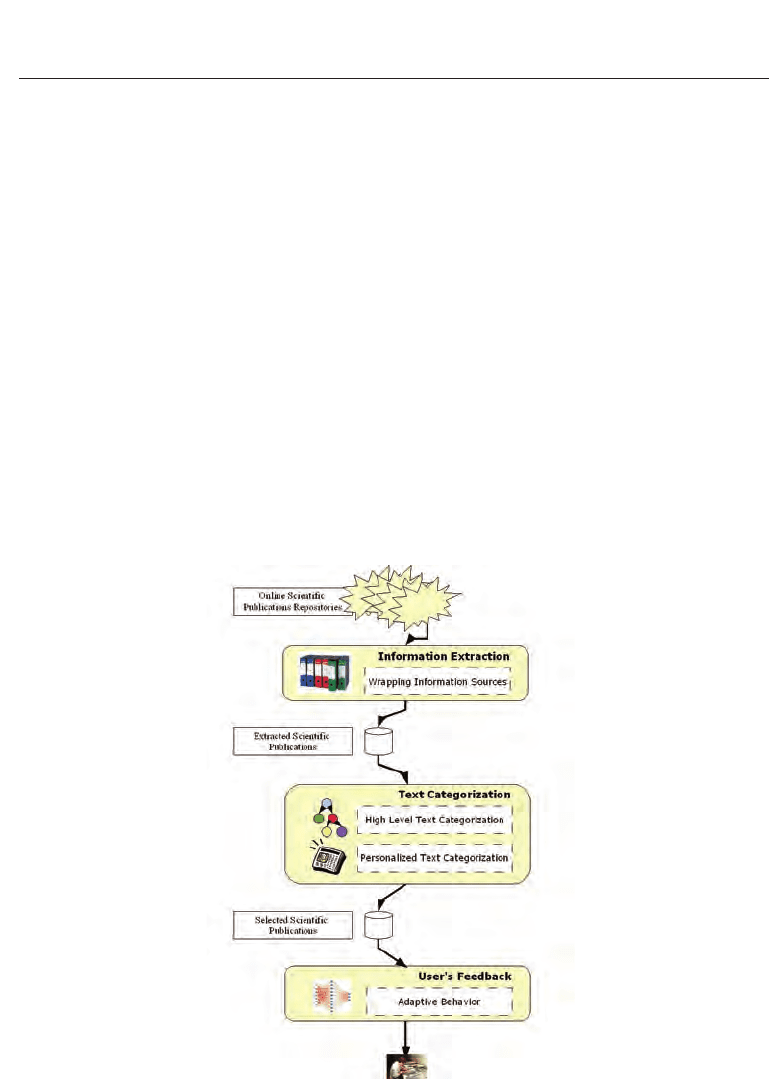
To perform the task of retrieving scientific publications, the actual system –sketched in Figure
1– involves three main activities: extracting the required information from selected online
sources, categorizing it according to a given taxonomy while taking into account also users
preferences, and providing suitable feedback mechanisms.
Fig. 1. PUB.MAS: the multiagent system devised for classifying bioinformatics publications.
210
Computational Biology and Applied Bioinformatics
Retrieving and Categorizing Bioinformatics Publications through a MultiAgent System 7
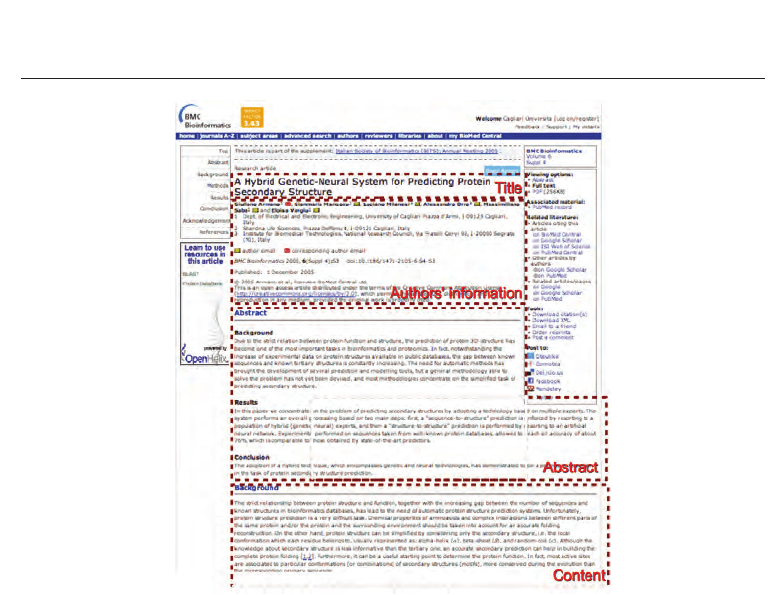
Fig. 2. The structure of a BMC Bioinformatics page.
3.1 Information extraction
This phase is devoted to deal with the huge amount of information provided by information
sources. To this end suitable wrappers have been implemented, able to handle the structure
of a document by saving the information about the corresponding metadata. In general,
given a Web source, a specific wrapper must be implemented, able to map each Web page,
designed according to the constraints imposed by the Web source, to a suitable description,
which contains relevant data in a structured form –such as title, text content, and references.
To make this point clearer, let us consider the structure of the BMC Bioinformatics page of
the paper “A Hybrid Genetic-Neural System for Predicting Protein Secondary Structure”
(Armano et al., 2005) reported in Figure 2. In this case, it is quite easy to implement the
mapping function, since, for each description field, a corresponding tag exists, making it very
simple to process the pages.
A suitable encoding of the text content has also been enforced during this phase: all
non-informative words such as prepositions, conjunctions, pronouns and very common verbs
are deleted using a stop-word list; after that, a standard stemming algorithm (Porter, 1980)
removes the most common morphological and inflexional suffixes. The subsequent step
requires the adoption of suitable domain knowledge. For each category of the underlying
taxonomy, feature selection (based on the information-gain heuristics) has been adopted to
reduce the dimensionality of the feature space.
3.2 Text categorization
Scientific publications are classified according to a high-level taxonomy, which is independent
from the specific user. To this end, classifiers are combined according to the links that hold
within the taxonomy, giving rise to “vertical” and “horizontal” combinations of classifiers.
211
Retrieving and Categorizing Bioinformatics Publications through a MultiAgent System
8 Will-be-set-by-IN-TECH
3.2.1 Vertical combination
The Approach
Vertical combination is currently performed by resorting to Progressively Filtering (PF), a
simple categorization technique framed within the local classifier per node approach, which
admits only binary decisions. In PF, each classifier is entrusted with deciding whether the
input in hand can be forwarded or not to its children. The first proposals in which sequential
boolean decisions are applied in combination with local classifiers per node can be found in
(D’Alessio et al., 2000), (Dumais & Chen, 2000), and (Sun & Lim, 2001). In Wu et al. (2005), the
idea of mirroring the taxonomy structure through binary classifiers is clearly highlighted; the
authors call this technique “binarized structured label learning”.
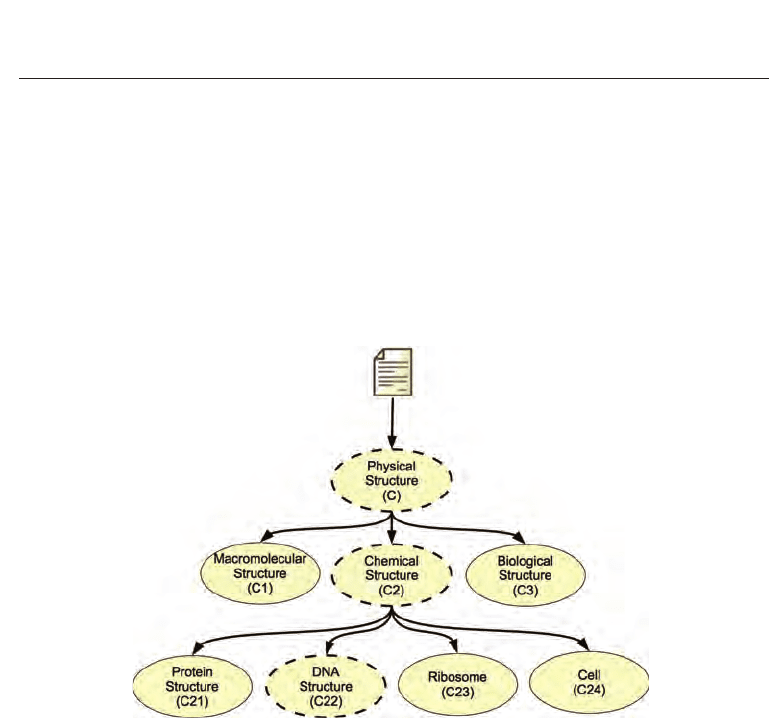
Fig. 3. An example of PF (highlighted with bold-dashed lines).
In PF, given a taxonomy, where each node represents a classifier entrusted with recognizing all
corresponding positive inputs (i.e., interesting documents), each input traverses the taxonomy
as a “token”, starting from the root. If the current classifier recognizes the token as positive,
it is passed on to all its children (if any), and so on. A typical result consists of activating one
or more branches within the taxonomy, in which the corresponding classifiers have accepted
the token. Figure 3 gives an example of how PF works. A theoretical study of the approach
is beyond the scope of this chapter, the interested reader could refer to (Armano, 2009) for
further details.
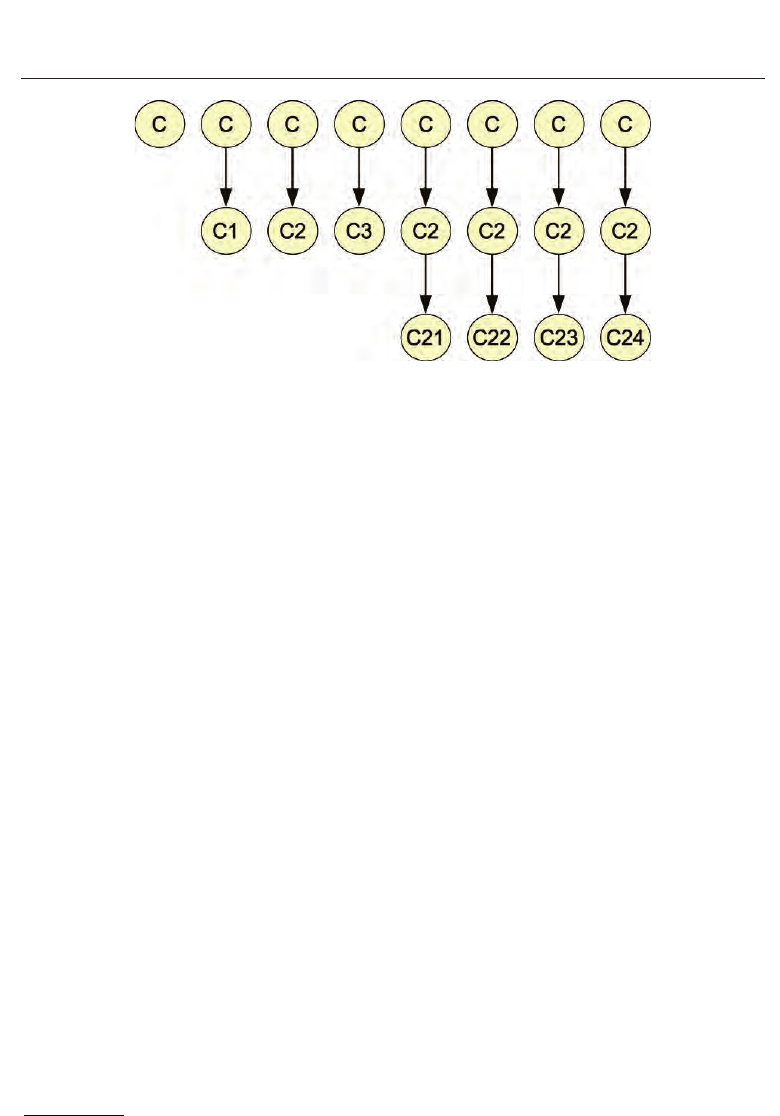
A simple way to implement PF consists of unfolding the given taxonomy into pipelines
of classifiers, as depicted in Figure 4. Each node of the pipeline is a binary classifier
able to recognize whether or not an input belongs to the corresponding class (i.e., to the
corresponding node of the taxonomy). Partitioning the taxonomy in pipelines gives rise to
a set of new classifiers, each represented by a pipeline.
Finally, let us note that the implementation of PF described in this chapter performs a sort of
“flattening” though preserving the information about the hierarchical relationships embedded
in a pipeline (Addis et al., 2010). For instance, the pipeline
C, C2, C21
actually represents
the classifier C21, although the information about the existing subsumption relationships (i.e.,
C21
≤ C2 ≤ C) is preserved.
212
Computational Biology and Applied Bioinformatics
Retrieving and Categorizing Bioinformatics Publications through a MultiAgent System 9
Fig. 4. The pipelines corresponding to the taxonomy in Figure 3.
The Threshold Selection Algorithm
As we know from classical text categorization, given a set of documents D and a set of labels
C, a function CSV
i
: D → [0, 1] exists for each c
i
∈ C. We assume that the behavior of c
i
is
controlled by a threshold θ
i
, responsible for relaxing or restricting the acceptance rate of the
corresponding classifier. Given d
∈ D , CSV
i
(d) ≥ θ
i
permits to categorize d under c
i
, whereas
CSV
i
(d) < θ
i
is interpreted as a decision not to categorize d under c
i
.
In PF, let us still assume that CSV
i
exists for each c
i
∈ C, with the same semantics adopted
in the classical case. Considering a pipeline π, composed of n classifiers, the acceptance
policy strictly depends on the vector θ
π
=
θ
1
, θ
2
, ··· , θ
n
that embodies the thresholds of
all classifiers in π. In order to categorize d under π, the following constraint must be satisfied:
∀k = 1...n, CSV
i
(d) ≥ θ
k
; otherwise, d is not categorized under c
i
.
A further simplification of the problem consists of allowing a classifier to have different
behaviors, depending on which pipeline it is embedded in. Each pipeline can be considered
in isolation from the others. For instance, given π
1
=
C, C2, C21
and π
2
=
C, C2, C22
, the
classifier C is not compelled to have the same threshold in π
1
and in π
2
(the same holds for
C2).
Given a utility function
4
, we are interested in finding an effective and computationally
“light” way to reach a sub-optimum in the task of determining the best vector of thresholds.
Unfortunately, finding the best acceptance thresholds is a difficult task. Exhaustively trying
each possible combination of thresholds (brute-force approach) is unfeasible, the number of
thresholds being virtually infinite. However, the brute-force approach can be approximated
by defining a granularity step that requires to check only a finite number of points in the
range
[0, 1], in which the thresholds are permitted to vary with step δ. Although potentially
useful, this “relaxed” brute force algorithm for calibrating thresholds (RBF for short) is still
too heavy from a computational point of view. On the contrary, the threshold selection
algorithm described in this chapter is characterized by low time complexity while maintaining
the capability of finding near-optimum solutions.
Bearing in mind that the lower the threshold the less restrictive is the classifier, we adopt
the greedy bottom-up algorithm for selecting decision threshold that relies on two functions
described in (Addis et al., 2011):
4
Different utility functions (e.g., precision, recall, F
β
, user-defined) can be adopted, depending on the
constraints imposed by the underlying scenario.
213
Retrieving and Categorizing Bioinformatics Publications through a MultiAgent System

10 Will-be-set-by-IN-TECH
• Repair (R), which operates on a classifier C by increasing or decreasing its threshold –i.e.,
R(up, C) and R(do wn, C), respectively– until the selected utility function reaches and
maintains a local maximum.
• Calibrate (
C), which operates going downwards from the given classifier to its offspring. It
is intrinsically recursive and, at each step, calls
R to calibrate the current classifier.
Given a pipeline π
=
C
1
, C
2
,...,C
L
, TSA is defined as follows (all thresholds are initially
set to 0):
TSA
(π) := for k = L downto 1 do C(up, C
k
) (1)
which asserts that
C is applied to each node of the pipeline, starting from the leaf (k = L).
The Calibrate function is defined as follows:
C(up, C
k
) := R(up, C
k
), k = L
C(up, C
k
) := R(up, C
k
); C(do wn, C
k+1
), k < L
(2)
and
C(do wn, C
k
) := R(do wn, C
k
), k = L
C(do wn, C
k
) := R(do wn, C
k
); C(up, C
k+1
), k < L
(3)
where the “;” denotes a sequence operator, meaning that in “a;b” action a is performed before
action b. The reason why the direction of threshold optimization changes at each call of
Calibrate (and hence of Repair) lies in the fact that increasing the threshold θ
k−1
is expected
to forward less false positives to C
k
, which allows to decrease θ
k
. Conversely, decreasing
the threshold θ
k−1
is expected to forward more false positives to C
k
, which must react by
increasing θ
k
.
It is worth pointing out that, as also noted in (Lewis, 1995), the sub-optimal combination of
thresholds depends on the adopted dataset, hence it needs to be recalculated for each dataset.
3.2.2 Horizontal combination
To express what the user is really interested in, we implemented suitable horizontal
composition strategies by using extended boolean models (Lee, 1994). In fact, a user is
typically not directly concerned with topics that coincide with classes of the given taxonomy.
Rather, a set of arguments of interest can be obtained by composing such generic topics with
suitable logical operators (i.e., and, or, and not). For instance, a user might be interested in
being kept informed about all articles that involve both “cell” and “nucleus”. This compound
topic can be dealt with by composing the cell and the nucleus classifiers. To address this issue,
we adopted a soft boolean perspective, in which the combination is evaluated using P-norms
(Golub & Loan, 1996).
3.3 Users’ feedback
So far, a simple solution based on the k-NN technology has been implemented and
experimented to deal with the problem of supporting the user’s feedback. When a irrelevant
article is evidenced by the user, it is immediately embedded in the training set of the k-NN
classifier that implements the feedback. A check performed on this training set after inserting
the negative example allows to trigger a procedure entrusted with keeping the number of
negative and positive examples balanced. In particular, when the ratio between negative
and positive examples exceeds a given threshold (by default set to 1.1), some examples are
randomly extracted from the set of “true” positive examples and embedded in the above
training set.
214
Computational Biology and Applied Bioinformatics

Retrieving and Categorizing Bioinformatics Publications through a MultiAgent System 11
4. PUB.MAS
To retrieve and categorize scientific publications, we customized X.MAS (Addis et al., 2008), a
generic multiagent architecture built upon JADE (Bellifemine et al., 2007) devised to facilitate
the implementation of information retrieval and information filtering applications. The
motivation for adopting a MAS lies in the fact that a centralized classification system might
be quickly overwhelmed by a large and dynamic document stream, such as daily-updated
online publications. Furthermore, the Web is intrinsically a pervasive system and offers the
opportunity to take advantage of distributed computing paradigms and spread knowledge
resources.
4.1 The system
PUB.MAS, is organized in the three “virtual” layers depicted in Figure 1, by customizing
X.MAS as follows:
• Information Level. Agents at this level are devoted to deal with the selected information
sources. A wrapper able to deal with the RSS (Really Simple Syndication) format has
been implemented, aimed at extracting publications from BMC Bioinformatics. It is
worth pointing out that the RSS format allows to easily process any given page, since a
corresponding RSS tag exists for each relevant item. Furthermore, the growing amount of
Web Services providing scientific publications requires the implementation of wrappers
explicitly devoted to extract information from them. In order to invoke Web Services
from our multiagent system, required to access the PubMed Central Web Service, we
implemented an ad-hoc wrapper by adopting WSIG (Greenwood & Calisti, 2004).
• Filter Level. Filter agents are devoted to select information deemed relevant to the users,
and to cooperate to prevent information from being overloaded and redundant. A suitable
encoding of the text content has been enforced at this level to facilitate the work of agents
belonging to the task level. As already pointed out, all non-informative words such
as prepositions, conjunctions, pronouns and very common verbs are removed using a
stop-word list. After that, a standard stemming algorithm removes the most common
morphological and inflexional suffixes. Then, for each category, feature selection, based
on the information-gain heuristics, has been adopted to reduce the dimensionality of the
feature space.
• Task Level. Task agents are devoted to identify relevant scientific publications, depending
on user interests. Agents belonging to this architectural level are devoted to perform
two kinds of actions: to classify any given input in accordance with the selected set of
categories, and to decide whether it may be of interest to the user or not. Each task agent
has been trained by resorting to a state-of-the-art technique, i.e. k-NN, in its “weighted”
variant (Cost & Salzberg, 1993). The choice of adopting weighted k-NN stems from the
fact that it does not require specific training and is very robust with respect to the impact
of noisy data. Furthermore, the adoption of weighted k-NN is related with the choice
of P-norms for implementing the “and” operation, as P-norms combination rules require
values in [0,1].
• Interface Level. Interface agents are devoted to perform the feedback that originates from
the users –which can be exploited to improve the overall ability of discriminating relevant
from irrelevant inputs. To this end, PUB.MAS uses the k-NN solution previously described.
215
Retrieving and Categorizing Bioinformatics Publications through a MultiAgent System
12 Will-be-set-by-IN-TECH
4.2 The prototype
Since our primary interest consists of classifying scientific articles for bioinformaticians or
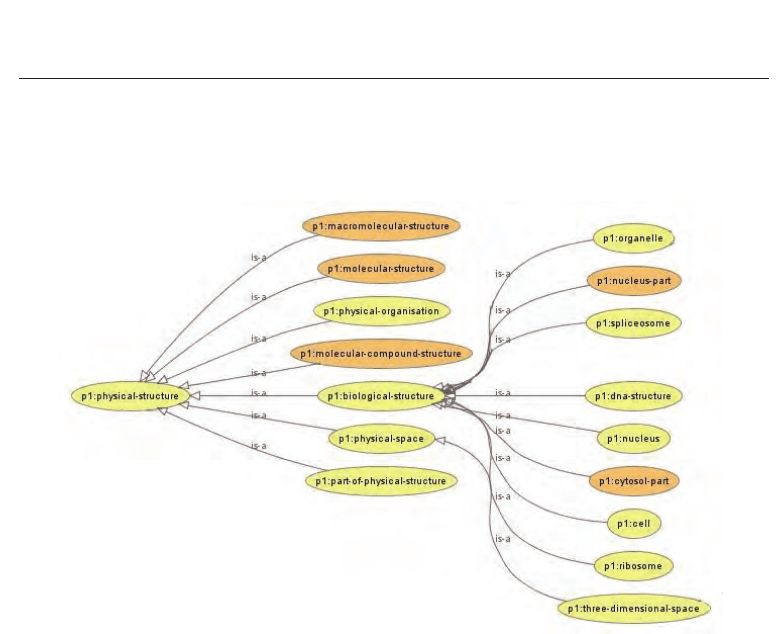
biologists, a high-level is-a taxonomy has been extracted from the TAMBIS ontology (Baker
et al., 1999). A fragment of the taxonomy is depicted in Figure 5.
Fig. 5. A fragment of the adopted taxonomy
Through a suitable user interface (see Figure 6), the user can set the sources from which
publications will be extracted and the topics s/he is interested in. As for the digital archives,
the user can choose between BMC Bioinformatics and PubMed Central. As for the topics of
interest, the user can select one or more categories in accordance with the adopted taxonomy
and compose them in order to build her/his personal document collection. For instance, in the
example reported in Figure 6, the user queries the system on (cell AND nucleus) OR (organelle).
The search for relevant documents is activated by clicking on the Start Search button.
First, information agents devoted to handle Web sources extract the documents. Then, all
agents that embody a classifier trained on the selected topics are involved to perform text
categorization. Finally, the system supplies the user with the selected articles through suitable
interface agents (see Figure 7).
4.3 Experimental results
To assess the system, different kinds of tests have been performed, each aimed at highlighting
(and getting information about) a specific issue. First, we estimated the normalized confusion
matrix for each classifier belonging to the highest level of the taxonomy. Afterwards, we
tested the importance of defining user’s interests by resorting to a relaxation of the logical
operators. Finally, we assessed the solution devised for implementing user’s feedback, based
on the k-NN technique.
Tests have been performed using selected publications extracted from the BMC Bioinformatics
site and from the PubMed Central digital archive. Publications have been classified by an
expert of the domain according to the proposed taxonomy. For each item of the taxonomy, a
216
Computational Biology and Applied Bioinformatics