
Lopes H.S., Cruz L.M. (eds.) Computational Biology and Applied Bioinformatics
Подождите немного. Документ загружается.


GRID Computing and Computational Immunology 5
grid with equal diffusion coefficient. In the present release of the simulator chemotaxis is not
implemented.
LDLs values can be fixed in order to simulate different patients both in normolipidic condition
and in hypercholesterolemic condition. The same applies to ox-LDLs. However human habits
change with time and personal life style. A normolipidic patient can change its attitude
becoming an hypercholesterolemic one and vice versa. For this reason we allow the simulator
to accept varying life style conditions and preventive actions to decrease risk factors.
2.2 Results
The model described include the possibility of mimicking biological diversity between
patients. The general behavior of a class of virtual patients arise from the results of a suitable
set of patients, i.e., the mean values of many runs of the simulator of different patients under
the same conditions. The class of virtual patients described by the model were tuned against
human data data collected by (Brizzi et al., 2003; 2004) where different conditions, normal and
hypercholesterolemic diabetic patients were analyzed.
In this section we analyze the behavior of the same patients in three broad class of clinical
conditions to show how SimAthero could be used in order to analyze and predict the effects
of various LDL levels in blood. The normal patient simulation is used as control experiment
for the other simulations. The differences among these four clinical conditions depend on
the LDL level and the time interval which occurs between the time in which concentration of
LDL rise above normal level and the time in which the patient take appropriate treatments
(lifestyle o drug) to reduce it to normal level.
Jobs were launched using the SimAthero simulator on the COMETA Grid. The
submission process was done through the web interface of the ImmunoGrid project
(http://www.immunogrid.eu).
A patient with a LDL level of roughly 950-970 ng/μl of blood is considered normal in clinical
practice and he has with very low risk of atheroslerotique plaque. The results of SimAthero
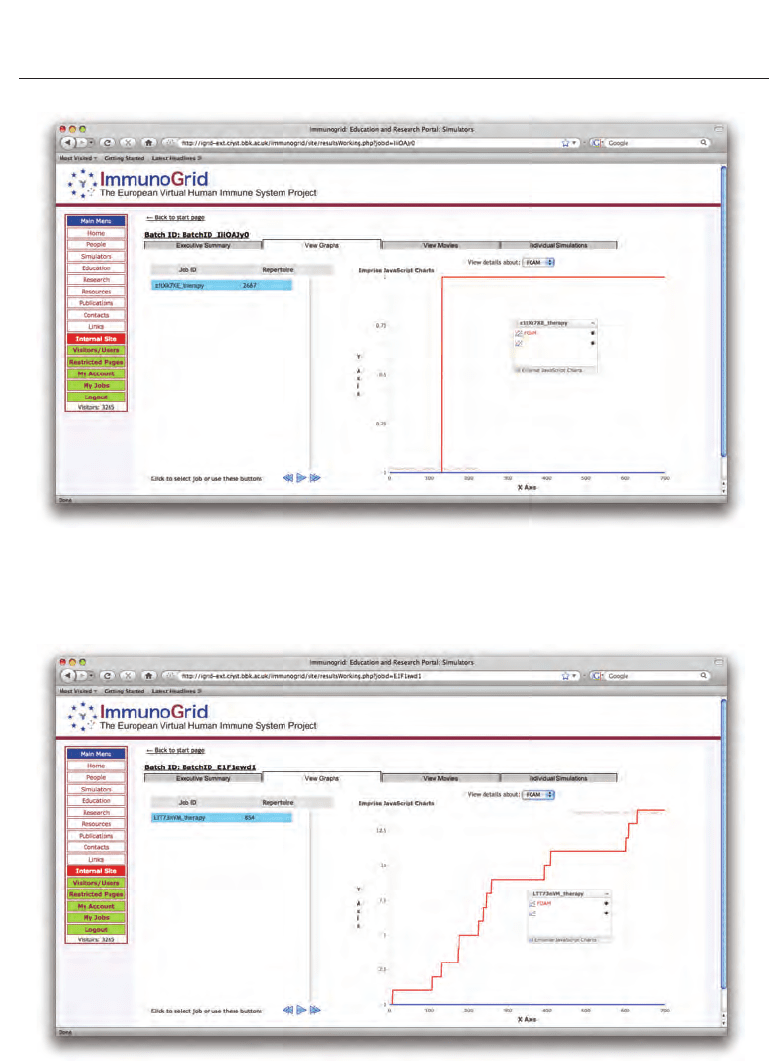
for a virtual normal patient (Figure 1) show that he will not support the formation of foam
cells and, as a consequence, the beginning of atherogenesis process is absent.
We then simulated a scenario in which a patient, due to several reasons (diet, life style,
oxidative agents and so on, so forth) leads its LDL level at 1300 ng/μl, taking it up to 1700
ng/mul. Looking at figure 2 one can observe about 12 foam cells per μl at the end of in silico
follow up. This leads to a small atherogenesis process due to the high level of LDL.
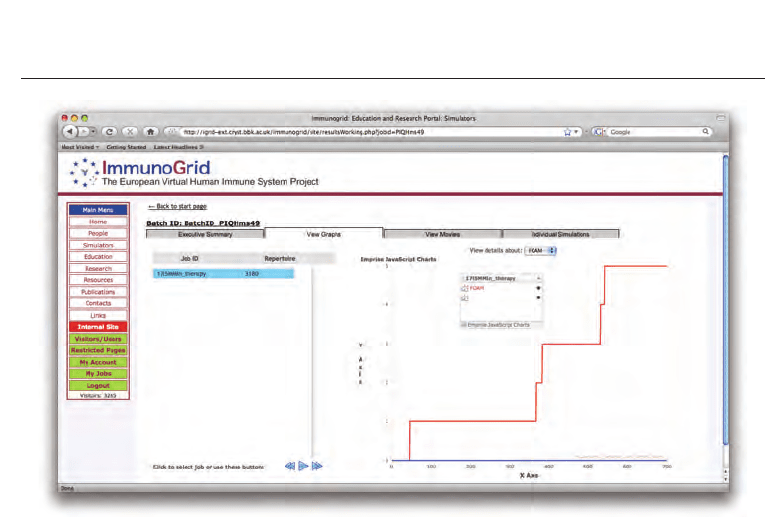
Lastly (figure 3), we analyzed a virtual patient that initially takes its LDL level to small peaks,
causing no damage. After that, he takes its LDL level to a hypercholesterolemic behavior,
generating a small damage, as shown. This shows that small LDL alteration are completely
taken under control by the normal behavior of the organism, but high LDL peaks lead to foam
cells formation and then to the beginning of the atherogenesis process.
2.3 Remarks on atherosclerosis modeling using GRID computing
Atherosclerosis is a pathology where the immune control plays a relevant role. We presented
studies on the increased atherosclerosis risk using an ABM model of atherogenesis and its
induced immune system response in humans. Very few mathematical models (Cobbold et
al., 2002; Ibragimov et al., 2005) and (to our best knowledge) no computational models of
atherogenesis have been developed to date.
It is well known that the major risk in atherosclerosis is persistent high level of LDL
concentration. However it is not known if short period of high LDL concentration can cause
227
GRID Computing and Computational Immunology
6 Will-be-set-by-IN-TECH
Fig. 1. Simulation results of a virtual patient with level of LDL considered normal. The
follow-up period is two years. The figure shows that foam cells formation is absent in this
patient.
Fig. 2. Simulation results of a virtual patient with level of LDL considered at high risk. The
follow-up period is two years. The figure shows that foam cells formation is present, leading
to an atherogenesis process.
228
Computational Biology and Applied Bioinformatics
GRID Computing and Computational Immunology 7
Fig. 3. Simulation results of a virtual patient with level of LDL considered quasi-normal at
the beginning and then at high risk. The follow-up period is two years. The figure shows that
foam cells formation is negligible in the first time, but becomes important soon after.
irreversible damage and if reduction of the LDL concentration (either by lfe style or drug) can
drastically or partially reduce the already acquired risk.
Using an ABM cellular model describing the initial phase of plaque formation (atherogenesis)
we are able to simulate the effect of life style which increases the risk of atherosclerosis.
3. Vaccine dosage optimization using GRID
As a second application, we show an example of how a physiological model in conjunction with
some optimization techniques can be used to speed-up the research of an opitmal vaccination
schedule for an immunopreventive vaccine, using the powerful of the GRID computing
paradigm.
A vaccination schedule is usually designed empirically using a combination of immunological
knowledge, vaccinological experience from previous endeavors, and practical constraints. In
subsequent trials, the schedule of vaccinations is then renewed on the basis of the protection
elicited in the first batch of subjects and their immunological responses e.g. kinetics of
antibody titers, cell mediated response, etc. The problem of defining optimal schedules is
particularly important in cancer immunopreventive approaches, which requires a sequence
of vaccine administrations to keep a high level of protective immunity against the constant
generation of cancer cells over very long periods, ideally for the entire lifetime of the host.
The Triplex vaccine represents a clear example of such immunopreventive approaches. It has
been designed to raise the immune response against the breast cancer for the prevention of
the mammary carcinoma formation in HER-2/Neu mouse models using a Chronic schedule in
a follow up time between 52 and 57 weeks.
However it is not known if the Chronic schedule schedule is minimal, i.e. if it can guarantee
survival for the mice population avoiding unnecessary/redoundant vaccine administrations.
229
GRID Computing and Computational Immunology

8 Will-be-set-by-IN-TECH
Shorter heuristic protocols failed, in in vivo experiments, in fulfilling this requirement, but
between the Chronic and the shorter schedules there is still a huge number of possibilities
which remain yet unexplored.
The SimTriplex () is a physiological computational model developed with the aim to answer
to this question. It demonstrated able to reproduce in silico the in vivo Immune System (IS) -
breast cancer competition elicted by the Triplex vaccine.
Optimal search strategy was biologically guided. Considering that Chronic proved to be
effective for tumor control, the optimal search tried to find a protocol with minimum number
of vaccine administrations able to reproduce, in silico, the time evolution of the chronic
schedule. This strategy was used in the GA optimal search. It is well known that GA are
slowly converging algorithms; the GA optimal search required several days using 32 nodes of
an High Performance Computing infrastructure.
To this end we decided to investigate the applicability of Simulated Annealing (SA), a global
optimization algorithm, widely tested and known for its computational speed and ability
to achieve optimal solutions. (Interested readers can found an extended description of SA
algorithm in (Van Laarhoven at al., 1987)). The combination of the Simulated Annealing
algorithm with biologically driven heuristic strategies, leads to a much faster algorithm and
better results for the optimal vaccination schedule problem for Triplex vaccine. In this context
we remark how the COMETA grid infrastructure demostrated an excellent framework for
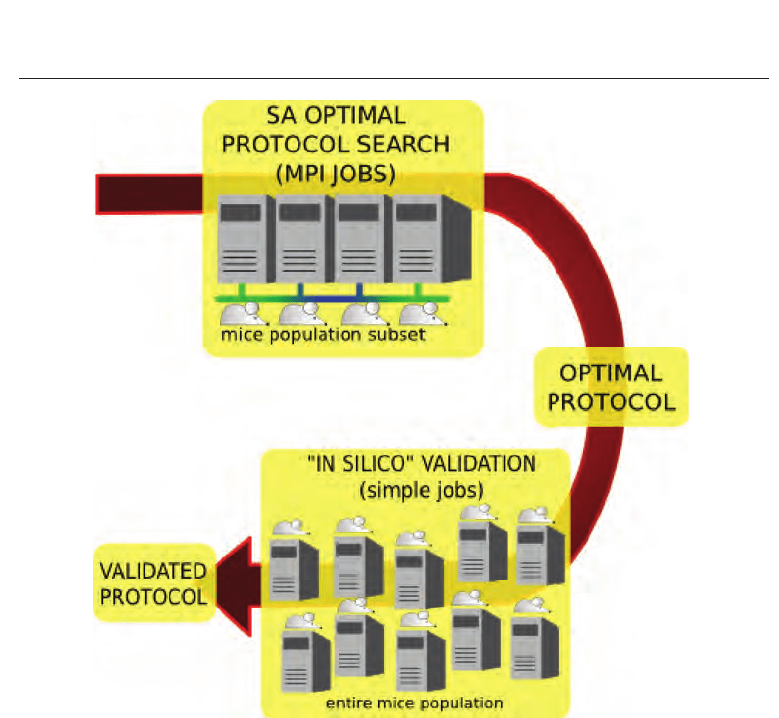
protocol search and validation. We first executed the SA algorithm on a subset of the virtual
mice population using MPI jobs. We therefore checked the protocol quality calculating (with
simple jobs) the survivals of the entire population.
3.1 The algorithm
The work done by Kirkpatrick (Kirkpatrick et al., 1983) opened the path to a deep analogy
between Statistical Mechanics (the behavior of systems with many degrees of freedom in
thermal equilibrium at a finite temperature) and Combinatorial Optimization (the method
of finding the minimum, if any, of a given function with respect to many parameters). There
is a close similarity, indeed, between the procedure of annealing in solids and the framework
required for optimization of complex systems.
3.1.1 The optimal vaccination schedule search problem
The SimTriplex model (Pappalardo et al., 2005) has been created with the aim to mimic the
behavior of the immune system stimulated by the Triplex vaccine. It simulates all the major
interactions of cells and molecules of the immune system in vaccinated as well as naive
HER-2/neu mice. In silico experiments showed an excellent agreement with the in vivo ones.
As previously said, a protocol is said to be optimal if it can maintain efficacy with a minimum
number of vaccine administrations. As in standard drug administration, the vaccination
protocol must assure survival for a high percentages of patients. Schedule design is usually
achieved using medical consensus, i.e. a public statement on a particular aspect of medical
knowledge available at the time it was written, and that is generally agreed upon as the
evidence-based, state-of-the-art (or state-of-science) knowledge by a representative group of
experts in that area. Our goal is to improve medical consensus, helping biologists in design
vaccine protocols with simulators and optimization techniques.
Let us consider a time interval
[0, T], in which we study the action of the vaccine on a set of
virtual mice S. We then discretize the given time interval in N
− 1 equally spaced subintervals
of width Δt (=8 hours), i.e.
{t
1
= 0, t
2
,...,t
i
,...,t
N
= T}.
230
Computational Biology and Applied Bioinformatics

GRID Computing and Computational Immunology 9
Let x = {x
1
, x
2
,...,x
i
,...x
N
} be a binary vector representing a vaccine schedule, where
x
i
= 0/1 means respectively administration/no administration of the vaccine at time t
i
. The
number of vaccine administrations is given by n
=
∑
N
i
=1
x
i
. With T = 400 days, and Δt = 8
hours the search space D has cardinality 2
400
, excluding any exhaustive search.
One of the wet biologists requirements imposes no more than two administrations a week
(monday and thursday) because this is already considered a very intensive schedule from an
immunological point of view. This reduces the cardinality of the search space D,from2
400
(∼ 10
120
)to2
114
(∼ 10
34
). We still have no chance for an exhaustive search.
The time of the carcinoma in situ (CIS) formation is computed through SimTriplex simulator.
It is defined by τ
(x, λ
j
), which is a function of the vaccination schedule x administered to the
mouse j
∈ S and a parameter λ
j
which represents the biological diversity. The vaccine will be
obviously effective if τ
≥ T.
As pointed out in § 1, any optimal protocol should try to reproduce , in silico, the chronic
time evolution of cancer cells. This leads us to the need to use two thresholds on the allowed
maximum number of cancer cells.
We also note here that, due to biological variability, a schedule found for a single mouse is not
immunologically effective as it usually does not reveal able to protect high percentages of the
treated patients. Having this in mind, we formulate our optimization problem as follows.
Let
{j
1
, j
2
,...,j
m
}⊂S, with m = 8, a random chosen subset of in silico mice, the problem is
defined as:
⎧
⎪
⎪
⎪
⎪
⎪
⎪
⎪
⎪
⎪
⎪
⎪
⎪
⎨
⎪
⎪
⎪
⎪
⎪
⎪
⎪
⎪
⎪
⎪
⎪
⎪
⎩
τ
(
¯
x, λ
j
1
)=max(τ(x, λ
j
1
))
τ(
¯
x, λ
j
2
)=max(τ(x, λ
j
2
))
.
.
.
.
.
.
τ
(
¯
x, λ
j
m
)=max(τ(x, λ
j
m
))
n( ¯x)=min(n(x))
subject to:
M
1
(
x) ≤ γ
1
, t ∈ [0, T
in
]
M
2
(x) ≤ γ
2
, t ∈ [T
in
, T]
(1)
where M
1
(x) and M
2
(x) are the maximum number of cancer cells in [0, T
in
] (cellular-mediated
controlled phase) and in
[T
in
, T] (humoral-mediated controlled phase) respectively, and T
in
∼
T/3, while γ
1
and γ
2
represent cancer cells threshold in [0, T
in
] and in [T
in
, T], respectively.
We deal with a multi-objective discrete and constrained optimization problem.
We modified this last formulation of the problem grouping all the τ
(x, λ
j
h
) (h = 1,...,m)bya
proper statistical indicator. We chose the harmonic mean H of the survivals:
H
(x, λ
j
1
,...,λ
j
m
)=
m
m
∑
i=1
1
τ(x , λ
j
i
)
(2)
since it is very frequently used when statistic measurements of time are involved.
Therefore, the system (1) translates as:
⎧
⎪
⎪
⎪
⎪
⎨
⎪
⎪
⎪
⎪
⎩
H
(
¯
x,
λ)=max (H(x,
λ))
n( ¯x)=min(n(x))
subject to:
M
1
(x) ≤ γ
1
, t ∈ [0, T
in
]
M
2
(x) ≤ γ
2
, t ∈ [T
in
, T]
(3)
231
GRID Computing and Computational Immunology

10 Will-be-set-by-IN-TECH
with
λ =(λ
j
1
,...,λ
j
m
).
3.1.2 Simulated annealing
An acclaimed Monte Carlo method, commonly referred as the Metropolis criterion, has been
designed by Metropolis (Metropolis et al., 1953) with the aim to mimic the evolution of
the complex systems towards equilibrium at a fixed temperature. This method randomly
perturbates the position of the particles of a solid modifying its configuration. If the energy
difference, ΔE, between the unperturbed and perturbed configurations is negative, the new
configuration has lower energy and it’s considered as the new one. Otherwise the probability
of acceptance of the new configuration is given by the Boltzmann factor (which expresses the
"probability" of a state with energy E relative to the probability of a state of zero energy).
After a large number of perturbations the probability distribution of the states should
approach the Boltzmann distribution.
The Metropolis algorithm can also be used in combinatorial optimization problems to
generate sequences of configurations of a system using a cost function C and control parameter
c respectively as the energy and temperature in the physical annealing.
The SA algorithm can be represented as a sequence of Metropolis algorithms evaluated at a
sequence of decreasing values of the control parameter c. A generalization of the method is
given as follows: a generation mechanism is defined so that, given a configuration i, another
configuration j can be obtained by choosing at random an element in the neighborhood of i.
If ΔC
ij
= C(j) − C(i) ≤ 0, then the probability that the next configuration is j is given by 1; if
ΔC
ij
> 0 the probability is given by e
−ΔC
ij
/c
(Metropolis criterion).
This process is continued until the probability distribution, P, of the configurations
approaches the Boltzmann distribution, which translates as:
P
{co nfigur ation = i} =
1
Q(c)
·
e
−C( i)/c
(4)
where Q
(c) is a normalization constant depending on the control parameter c.
The control parameter is then lowered in steps, with the system being allowed to reach
equilibrium by generating a chain of configurations at each step. The algorithm stops for
some fixed value of the control parameter c where virtually no deteriorations can be accepted
anymore.
At the end the final frozen configuration is assumed as a solution of the problem.
3.1.3 Implementation
In our in silico experiment, we select a population of 200 virtual mice and a simple random
sample of k
= 8 mice. To use the SA algorithm for the optimal vaccine schedule search
problem we tried to define the SA relevant concepts (the solid configuration, the temperature,
the energy and the semi-equilibrium condition) in terms of vaccine protocol and to describe
the main protocol elements (the number of injections, the mean survival age, the time
distribution of injections) in terms of a cooling process.
As previously said, we describe any candidate protocol as a binary vector x of cardinality
V
= 114. The total number of vaccine administrations n and the total number of possible
schedules with n vaccine administrations
M are given by:
232
Computational Biology and Applied Bioinformatics

GRID Computing and Computational Immunology 11
n =
V
∑
j=1
x
l
n
(j)
M =
V!/[n! (V − n)!]
The configuration distribution is defined by x
in
, n
in
, and the initial energy E
in
as defined later
on.
The temperature is slowly but constantly lowered to reach a state with minimum energy.
We coupled this entity with n, the number of vaccine administrations of a semi-equilibrium
configuration.
At a given temperature, a semi-equilibrium configuration is reached when its Energy is
minimal. Since we want to maximize survival times of a mice sample set, the concept of
Energy can be easily associated with the harmonic mean H of the survival times τ
i
, H(
¯
x,
λ) (i.e.
E ∝ H). As a matter of fact H decreases when the cumulative survival time of the sample
increases, in perfect accord with the energy definition.
The perturbation of a protocol has been initially implemented as random 1 bits reallocation
(Pennisi et al., 2008b). This perturbation has been heuristically improved using biological
knowledge. As we want to optimize mice survival, scheduling many vaccine administrations
after the death of a mouse makes nonsense. So, in moving from x
j
i
to x
j+1
i
, we improve random
bits reallocation also moving some “1” at a suitable time t
< mi n{τ
i
} , i = 1, k.
The SA algorithm for protocol optimization. i) starts from a randomly chosen initial vaccine
distribution and finds the initial semi-equilibrium configuration n
in
, x
l
in
n
in
, E
l
in
n
in
ii) Decrease the number of injections of 1 unit; iii) find a semi-equilibrium configuration x
i
,
E
i
according to Metropolis algorithm; iv) cycle on (ii). The algorithm stops when, once the
algorithm control parameter, i.e. the number of vaccine administrations, is decreased from
n to n
− 1, the Metropolis algorithm is not able to find a semi-equilibrium configuration, i.e.
an acceptable value of survivals, in λ iterations. The accepted protocol is the last found at
temperature n.
3.2 Computational results and conclusions
In silico optimal protocol search is a two-step process: search and validation. During the search
step, the optimization tecnique tries to find an optimal protocol. As pointed out in section
3.1.1, optimal search stragies have to be executed on a representative subset of the population
in order to guarantee significative survival percentages for the population.
The search technique therefore needs to test simultaneously every candidate protocol on
the mice subset to compute its fitness function. This process usually requires a relatively
small number of nodes with high communication throughputs, representing a typical massive
parrallel application. In our case it has been implemented using the MPI (Message passing
Interface) libraries.
Validation represents a completely different process. Here the protocol found by the search
technique is tested over the entire population to compute mean survival rates, requiring an
high number of CPUs with almost no need of communication. The “search and validation”
process is represented in figure 4.
In this context the Cometa grid revealed itself as an excellent tool for our needs. It
demonstrated to be highly flexible, giving us the opportunity to execute these so-different
processes on the same infrastructure. We only needed to define the first process as an MPI
233
GRID Computing and Computational Immunology
12 Will-be-set-by-IN-TECH
Fig. 4. The “in silico” search and validation optimal protocol representation.
job and the second as a sequence of simple jobs in a trasparent way, without worrying of the
hidden the architectures behind the job submission interface.
To compare the results with those obtained using GA optimization technique (Lollini et al.,
2006), we executed the SA algorithm on the same 8 random selected virtual mice sample used
by GA. The protocol was then validated on the same population set (200 virtual mice).
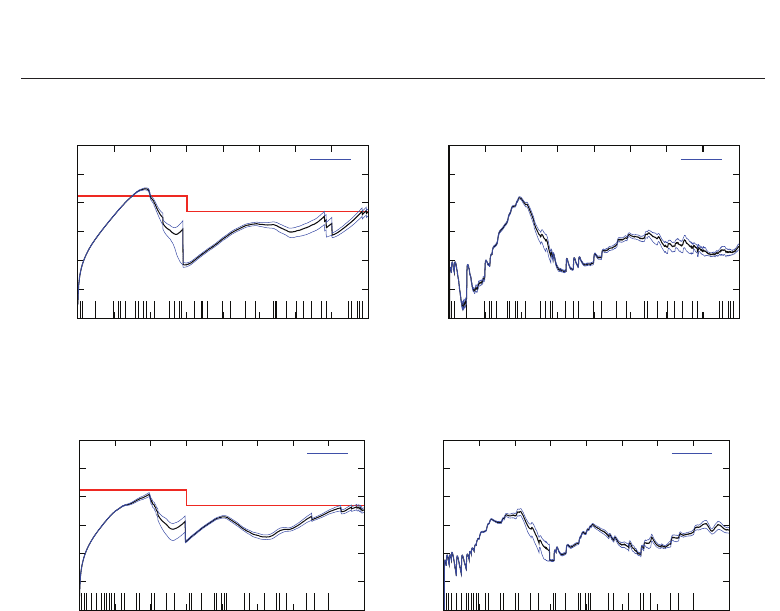
The SA in silico tumor free percentages of the mice population show no substantial difference
with GA results (87% for GA vs 86, 5% for SA). Figure 5 shows the mean number of cancer
cells, computed on the 200-mice set, for the GA-protocol (up lhs) and the SA-protocol (down
lhs). Only the SA-protocol is able to totally fulfill the safety threshold conditions (shown in
red).
Moreover the SA algorithm required a computational effort of about 2 hrs ona8processor
unit to find a protocol with 37 vaccine administrations, showing speed-up factor of
∼ 1.4 · 10
2
in respect to previous GA experiments (Pennisi et al., 2008a).
234
Computational Biology and Applied Bioinformatics
GRID Computing and Computational Immunology 13
10
0
10
1
10
2
10
3
10
4
10
5
10
6
0 50 100 150 200 250 300 350 400
number of entities
days
Cancer Cells
Error
10
0
10
1
10
2
10
3
10
4
10
5
10
6
0 50 100 150 200 250 300 350 400
number of entities
days
Tumor Associated Antigens
Error
10
0
10
1
10
2
10
3
10
4
10
5
10
6
0 50 100 150 200 250 300 350 400
number of entities
days
Cancer Cells
Error
10
0
10
1
10
2
10
3
10
4
10
5
10
6
0 50 100 150 200 250 300 350 400
number of entities
days
Tumor Associated Antigens
Error
Fig. 5. Cancer cells behaviors and thresholds in GA (top) and SA (bottom). Small vertical
bars on the x-axis represent vaccine administration times. Broken-line graphs on the lhs
represent safety thresholds.
4. Conclusions
Mathematical models and Cellular Automata are mostly used for cellular level simulations,
while a range of statistical modeling applications are suitable for the analysis of sequences at
molecular level of the immune system.
Grid computing technology brings the possibility of simulating the immune system at the
natural scale. In our opinion, a Grid solution is only as good as the interface provided to
the users. We presented two successful stories in which we have shown successful stories
in using computational immunology approaches that have been implemented using GRID
infrastructure.
We like to conclude by stressing the interdisciplinary nature of the experiences described
above and by noting that the contribution of life scientists needs to go beyond the only data
supply, as it is extremely important in defining the biological scenario and ultimately construct
a robust and validated mathematical or computational model. Only through a common effort
of life and computer scientists it is possible to turn software into a valuable tools in life
sciences.
235
GRID Computing and Computational Immunology

14 Will-be-set-by-IN-TECH
5. Acknowledgments
This work makes use of results produced by the PI2S2 Project managed by the Consorzio
COMETA, a project co-funded by the Italian Ministry of University and Research (MIUR)
within the Piano Operativo Nazionale "Ricerca Scientifica, Sviluppo Tecnologico, Alta
Formazione" (PON 2000-2006). More information is available at: http://www.pi2s2.it and
http://www.consorzio-cometa.it.
6. References
Abbas, A.K.; Lichtman, A.H.; Pillai, S. (2007) Cellular and molecular immunology, Saunders,
6th edition.
Artieda, M.; Cenarro, A.; Gañàn, A.; Jericó, I.; Gonzalvo, C.; Casado, J.M.; Vitoria, I.; Puzo,
J.; Pocoví,M.; Civeira,F. (2003) Serum chitotriosidase activity is increased in subjects
with atherosclerosis disease, Arterioscler. Thromb. Vasc. Biol., 23, 1645-1652.
Artieda, M.; Cenarro, A.; Ga´nàn, A.; Lukic, A.; Moreno, E.; Puzo, J.; Pocoví, M.; Civeira, F.
(2007) Serum chitotriosidase activity, a marker of activated macrophages, predicts
new cardiovascular events independently of C-Reactive Protein, Cardiology, 108,
297-306.
Berliner, J.A.; Heinecke, J.W. (1996) The role of oxidized lipoproteins in atherogenesis, Free
Radic. Biol. Med., 20(5), 707-727.
Brizzi, P.; Isaja, T.; D’Agata, A.; Malaguarnera, A.; Malaguarnera, M.; Musumeci, S.
(2002) Oxidized LDL antibodies (OLAB) in patients with beta-thalassemia major, J.
Atheroscler. Thromb., 9(3), 139-144.
Brizzi, P.; Tonolo, G.; Carusillo, F.; Malaguarnera, M.; Maioli, M.; Musumeci, S. (2003) Plasma
Lipid Composition and LDL Oxidation, Clin. Chem. Lab. Med., 41(1), 56-60.
Brizzi, P.; Tonolo, G.; Bertrand, G.; Carusillo, F.; Severino, C.; Maioli, M.; Malaguarnera,
L.; Musumeci, S. (2004) Autoantibodies against oxidized low-density lipoprotein
(ox-LDL) and LDL oxidation status, Clin. Chem. Lab. Med., 42(2), 164-170.
Celada, F.; Seiden, P.E. (1996) Affinity maturation and hypermutation in a simulation of the
humoral immune response, Eur. J. Immunol., 26, 1350.
Cobbold, C.A.; Sherratt, J.A.; Maxwell, S.R.J. (2002) Lipoprotein Oxidation and its Significance
for Atherosclerosis: a Mathematical Approach, Bulletin of Mathematical Biology, 64,
65-95.
Goldsby, R.A. et al. (2000) In Austen,K.F., Frank,M.M., Atkinson,J.P. and Cantor,H. (eds.) Kuby
Immunology. W.H. Freeman and Company, New York.
Hanson, G.K. (2002) Inflammation, atherosclerosis, and coronary artery disease, N. Engl. J.
Med., 352(16), 1685-1695.
Ibragimov, A.I.; McNeal, C.J.; Ritter, L.R.; Walton,J.R. (2005) A mathematical model of
atherogenesis as an inflammatory response, Math Med Biol., 22(4), 305-333.
Klimov, A.N.; Nikul’cheva, N.G. (1999) Lipid and Lipoprotein Metabolism and Its
Disturbances, St. Petersburg: Piter Kom.
Lollini,P.-L. (2008) Private communication.
Orem, C.; Orem, A.; Uydu, H.A.; Celik, S.; Erdol, C.; Kural,B.V. (2002) The effects of
lipid-lowering therapy on low-density lipoprotein auto-antibodies: relationship with
low-density lipoprotein oxidation and plasma total antioxidant status, Coron. Artery
Dis., 13(1), 56-71.
236
Computational Biology and Applied Bioinformatics