
Lopes H.S., Cruz L.M. (eds.) Computational Biology and Applied Bioinformatics
Подождите немного. Документ загружается.


Identification of Functional Diversity in the Enolase Superfamily Proteins
327
Lindahl E, Elofsson A, (2000) Identification of related proteins on family, superfamily and
fold level. Journal of Molecular Biology 295: 3, 613-625
Steven E. Brenner, Cyrus Chothia, and Tim J. P. Hubbard (1998) Assessing sequence
comparison methods with reliable structurally identified distant evolutionary
relationships PNAS May 26: 95 6073-6078
Dayhoff, M.O. (1974) Computer analysis of protein sequences, Fed. Proc. 33, 2314-2316,.
Scott McGinnis (2004) BLAST: at the core of a powerful and diverse set of sequence analysis
tools, Nucleic Acids Research, Vol. 32
Hubbard BK, Koch M, Palmer DR, Babbitt PC, Gerlt JA. (1998) Evolution of enzymatic
activities in the enolase superfamily: characterization of the (D)-
glucarate/galactarate catabolic pathway in Escherichia coli. Biochemistry.
13;37(41):14369-75.
David R. J. Palmer,
James B. Garrett,V. Sharma, R. Meganathan, Patricia C. Babbitt, and John
A. Gerlt, (1999) Unexpected Divergence of Enzyme Function and Sequence: ‘‘N-
Acylamino Acid Racemase” Is o-Succinylbenzoate Synthase, Biochemistry, 38 (14),
pp 4252–4258
Satu Kuorelahti Paula Jouhten, Hannu Maaheimo, Merja Penttila and Peter Richard (2006) l-
galactonate dehydratase is part of the fungal path for d-galacturonic acid
catabolism Molecular Microbiology 61:4 1060 – 1068
Brian K. Hubbard, Marjan Koch, David R. J. Palmer, Patricia C. Babbitt, and John A. Gerlt
(1998) Evolution of Enzymatic Activities in the Enolase Superfamily:
Characterization of the (D)-Glucarate/Galactarate Catabolic Pathway in
Escherichia coli Biochemistry, 37 (41) 14369–14375
John F. Rakus, Alexander A. Fedorov, Elena V. Fedorov, Margaret E. Glasner, Brian
K. Hubbard, Joseph D. Delli, Patricia C. Babbitt, Steven C. Almo and John A. Gerlt,
(2008) Evolution of Enzymatic Activities in the Enolase Superfamily: l-Rhamnonate
Dehydratase, Biochemistry, 47 (38), 9944–9954
Robert Belshaw and Aris Katzourakis (2005) Blast to Align: a program that uses blast to
align problematic nucleotide sequences, Bioinformatics 21(1):122-123
Dmitry Lupyan, Alejandra Leo-Macias and Angel R. Ortiz (2005) A new progressive-
iterative algorithm for multiple structure alignment Bioinformatics Volume 21:15
3255-3263
Doron Betel and Christopher WV Hogue, Kangaroo (2002) A pattern-matching program for
biological sequences, BMC Bioinformatics, 1186/1471-2105-3-20
Ofir Goldenberg, Elana Erez, Guy Nimrod, and Nir Ben-Tal (2009) The ConSurf-DB: pre-
calculated evolutionary conservation profiles of protein structures Nucleic Acids
Res. D323–D327.
Changwon Keum
and Dongsup Kim (2006) Protein function prediction via ligand
interface residue match, World Congress on Medical Physics and Biomedical
Engineering 2006, August 27 – September 1, COEX Seoul, Korea ‘‘Imaging the
Future Medicine”
LevelErik Lindahl and Arne Elofsson, (2000) Identification of Related Proteins on Family,
Superfamily and Fold Journal of MolecularBiology 295: 3, 613-625

Computational Biology and Applied Bioinformatics
328
Neidhart DJ, Kenyon GL, Gerlt JA, Petsko GA (1990) Mandelate racemase and muconate
lactonizing enzyme are mechanistically distinct and structurally homologous.
Nature. 347(6294):692-4.
17
Contributions of Structure Comparison Methods
to the Protein Structure Prediction Field
David Piedra
1
, Marco d'Abramo
2
and Xavier de la Cruz
1,3
1
IBMB-CSIC
2
CNIO
3
ICREA
Spain
1. Introduction
Since their development, structure comparison methods have contributed to advance our
understanding of protein structure and evolution (Greene et al, 2007; Hasegawa & Holm,
2009), to help the development of structural genomics projects (Pearl et al, 2005), to improve
protein function annotations (D. A. Lee et al), etc, thus becoming an essential tool in
structural bioinformatics. In recent years, their application range has grown to include the
protein structure prediction field, were they are used to evaluate overall prediction quality
(Jauch et al, 2007; Venclovas et al, 2001; Vincent et al, 2005; G. Wang et al, 2005), to identify a
protein’s fold from low-resolution models (Bonneau et al, 2002; de la Cruz et al, 2002), etc. In
this chapter, after briefly reviewing some of these applications, we show how structure
comparison methods can also be used for local quality assessment of low-resolution models
and how this information can help refine/improve them.
Quality assessment is becoming an important research topic in structural bioinformatics
because model quality determines the applicability of structure predictions (Cozzetto et al,
2007). Also, because prediction technology is now easily available and potential end-users of
prediction methods, from template-based (comparative modeling and threading) to de novo
methods, are no longer specialized structural bioinformaticians. Quality assessment
methods have been routinely used for many years in structural biology in the evaluation of
experimental models. These methods focus on several features of the protein structure (see
(Laskowski et al, 1998) and (Kleywegt, 2000) and references therein). Because a number of
quality issues are common to both experimental and predicted models, the use of these
methods has been naturally extended to the evaluation of structure predictions. For
example, in the case of homology modeling, a widely used structure prediction technique,
evaluation of models with PROCHECK (Laskowski et al, 1993), WHAT-CHECK (Hooft et al,
1997), PROSA (Sippl, 1993), and others (see (Marti-Renom et al, 2000) and references therein)
is part of the standard prediction protocol; WHATIF (Vriend, 1990) and PROSA (Sippl, 1993)
have also been used in the CASP experiment to assess comparative models (Venclovas, 2001;
Williams et al, 2001); etc.
Some quality assessment problems are unique to the structure prediction field, given the
specific characteristics of computational models, and have led to the development of

Computational Biology and Applied Bioinformatics
330
methods aimed at: the recognition of near-native predictions from a set of decoys (Jones &
Thornton, 1996; Lazaridis & Karplus, 2000; Sippl, 1995); identification of a target’s protein
family (Bonneau et al, 2002; de la Cruz et al, 2002); overall quality assessment of predictions
(Archie et al, 2009; Benkert et al, 2009; Cheng et al, 2009; Larsson et al, 2009; Lundstrom et al,
2001; McGuffin, 2009; Mereghetti et al, 2008; Wallner & Elofsson, 2003; 2005; Z. Wang et al,
2009; Zhou & Skolnick, 2008); and, more recently, residue-level quality assessment (Benkert
et al, 2009; Cheng et al, 2009; Larsson et al, 2009; McGuffin, 2009; Wallner & Elofsson, 2006;
2007; Z. Wang et al, 2009). However, in spite of these promising efforts, quality assessment
of protein structure predictions remains an open issue(Cozzetto et al, 2009).
Here we focus on the problem of local quality assessment, which consists on the
identification of correctly modeled regions in predicted structures (Wallner & Elofsson,
2006; 2007), or, as stated by Wallner and Elofsson(Wallner & Elofsson, 2007): “The real value
of local quality prediction is when the method is able to distinguish between high and low
quality regions.”. In many cases, global and local quality estimates are produced
simultaneously (Benkert et al, 2009; Cheng et al, 2009; Larsson et al, 2009; McGuffin, 2009).
However, in this chapter we separate these two issues by assuming that, irrespective of its
quality, a structure prediction with the native fold of the corresponding protein is available.
From a structural point of view this is a natural requirement, as a correct local feature
(particularly if it is one which, like a β-strand (Chou et al, 1983), is stabilized by long-range
interactions) in an otherwise wrong structure can hardly be understood. From a practical
point of view, successful identification of correct parts within incorrect models may lead to
costly errors. For example, identifying a correctly modeled binding site within a structurally
incorrect context should not be used for drug design: it would surely have incorrect
dynamics; the long-range terms of the interaction potential, like electrostatics, would be
meaningless; false neighboring residues could create unwanted steric clashes with the
substrate, thus hampering its docking; or, on the contrary, absence of the true neighbors
could lead to unrealistic docking solutions; etc. In the remaining of the chapter we describe
how structure comparison methods can be applied to obtain local quality estimates for low-
resolution models and how these estimates can be used to improve the model quality.
2. A simple protocol for local quality assessment with structure comparison
methods
As mentioned before, an important goal in local quality assessment(Wallner & Elofsson,
2006; 2007) is to partition the residues from a structure prediction in two quality classes:
high and low. This can be done combining several predictions; however, in the last two
rounds of the CASP experiment -a large, blind prediction experiment performed every two
years(Kryshtafovych et al, 2009)- evaluators of the Quality Assessment category stressed
that methods aimed to assess single predictions are needed(Cozzetto et al, 2007; Cozzetto et
al, 2009). These methods are particularly important for users that generate their protein
models with de novo prediction tools, which are still computationally costly(Jauch et al,
2007), particularly for large proteins.
Here we describe a single-molecule approach, based on the use of structure comparison
methods, that allows to partition model residues in two sets, of high and low quality
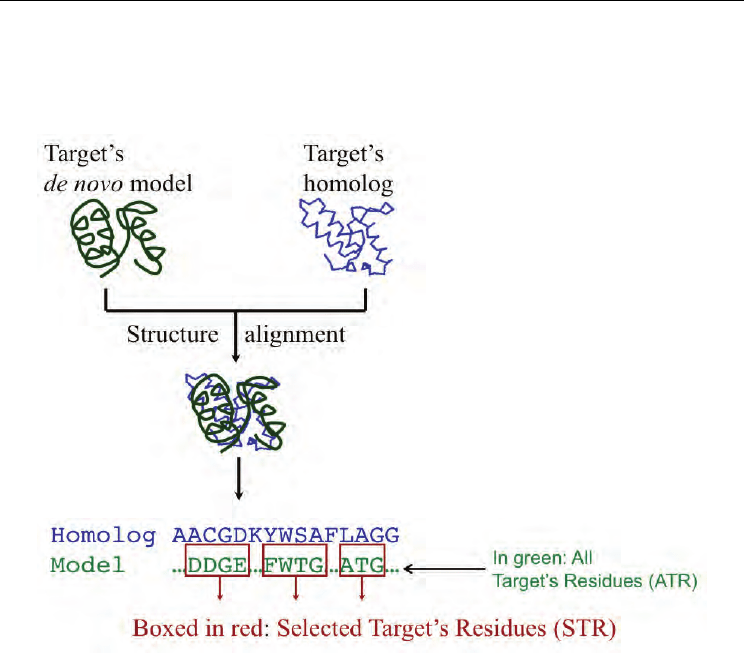
respectively. In this approach (Fig. 1), the user’s model of the target is first structurally
aligned with a target’s homolog. This alignment, which constitutes the core of the
procedure, is then used to separate the target’s residues in two groups: aligned and
Contributions of Structure Comparison Methods to the Protein Structure Prediction Field
331
unaligned. The main assumption of this approach is that aligned residues are of higher
quality than the average. The validity of this assumption is tested in the next section. In
section 3 we discuss the conditions that determine/limit the applicability and usefulness of
the method.
Fig. 1. Use of structure comparison methods for local quality assessment of structure
predictions
2.1 Performance of structure comparison methods in local quality assessment
To show that structurally aligned residues are usually of higher quality we used a set of de
novo predictions with medium/low to very low resolution, obtained with Rosetta(Simons et
al, 1997). Although several de novo prediction programs have shown promising results in the
CASP experiment(Jauch et al, 2007; Vincent et al, 2005), we used Rosetta predictions
because: (i) Rosetta is a well known de novo prediction program that has ranked first in
successive CASP rounds (Jauch et al, 2007; Vincent et al, 2005); (ii) many Rosetta predictions
are available at the server of Baker’s group, thus allowing a consistent test of our approach,
with predictions from the same source; and (iii) the program is available for interested users
(http://www.rosettacommons.org/software/).
We downloaded the protein structure predictions from the server of Baker’s laboratory
(http://depts.washington.edu/bakerpg/drupal/). This set was constituted by 999 de novo
models generated with Rosetta(Simons et al, 1997) for 85 proteins, i.e. a total of 84915
models. Application of the protocol studied here (Fig. 1) requires that the structure of a
homolog of the target is available, and that the predictions used have the fold of the target.

Computational Biology and Applied Bioinformatics
332
The former was enforced by keeping only those proteins with a CATH relative at the T-
level(Pearl et al, 2005) (homologs with the same fold of the target protein, regardless of their
sequence similarity). The second condition was required to focus only on the local quality
assessment problem, and was implemented by excluding those models not having the fold
of their target protein. Technically, this meant that we only kept those models structurally
similar to any member of the target’s structural family: that is, those models giving a score
higher than 5.25 for the model-homolog structure comparison done with MAMMOTH
(Ortiz et al, 2002), for at least one homolog of the target protein. This step was
computationally costly, as it involved 7,493,499 structure comparisons, and could only be
carried using MAMMOTH(Ortiz et al, 2002); the 5.25 score threshold was taken from
MAMMOTH’s article (Ortiz et al, 2002). The final dataset was constituted by 68 target
proteins and a total of 17180 models.
The properties of the selected target’s residues (STR; to avoid meaningless results we only
considered STR sets larger than 20 residues) were characterized with four parameters: two
structure-based, and two sequence-based. The former were used to check if STR really were
of better quality, comparing their parameters’ values with those obtained for the set of all
the target residues (ATR), i.e. the whole model structure. It has to be noted that: (i) STR and
ATR sets are constituted by residues from the target protein, more precisely STR is a subset
of ATR; and (ii) three possible STR sets were produced, because we checked our procedure
using three structure comparison methods (MAMMOTH (Ortiz et al, 2002), SSAP(Orengo &
Taylor, 1990) and LGA(Zemla, 2003)). The sequence-based properties were utilized to
describe how STR spread along the sequence of the target, which helps to assess the
usefulness of the protocol. Below we provide a brief description of each parameter, together
with the results obtained from their use.
2.1.1 Structural quality: rmsd
Rmsd(Kabsch, 1976) is a quality measure widely employed to assess structure models: it
corresponds to the average distance between model atoms and their equivalent in the native
structure. Small rmsd values correspond to higher quality predictions than larger values.
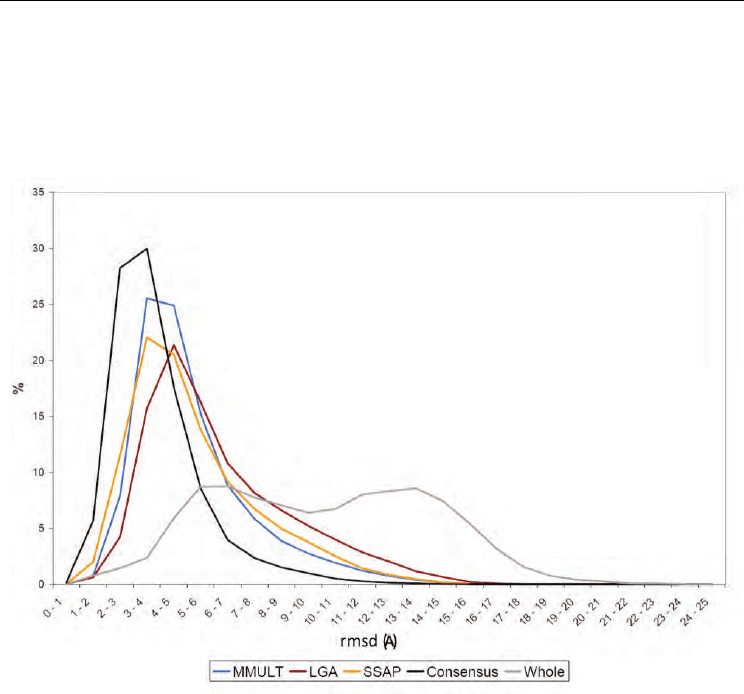
In Fig. 2 we see the STR and ATR rmsd distributions. Regardless of the structure
comparison method used (MAMMOTH (Ortiz et al, 2002), SSAP(Orengo & Taylor, 1990)
and LGA(Zemla, 2003) in blue, yellow and red, respectively), STR distributions are shifted
towards lower rmsd values relative to ATR distributions (in grey). This confirms the starting
assumption: it shows that model residues structurally aligned to the protein’s homolog
usually have a higher structural quality. A consensus alignment (in black), which combined
the results of the three structure comparison methods, gave better results at the price of
including fewer residues; for this reason we excluded the consensus approach from
subsequent analyses.
An interesting feature of STR rmsd distributions was that their maxima were between 3.5 Å
and 6.5 Å, and that a majority of individual values were between 3 Å and 8 Å, and below 10
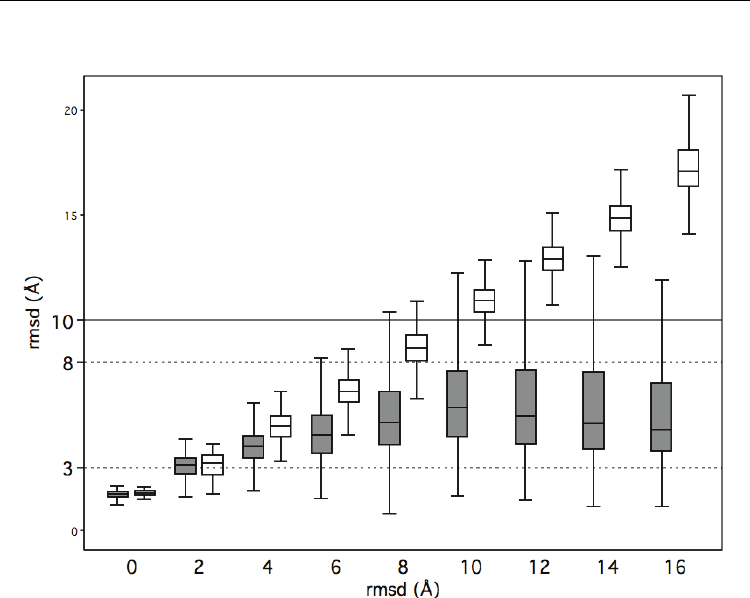
Å. To further explore this issue, we plotted the values of rmsd for STR against ATR (Fig. 3,
grey boxes). In accordance with the histogram results, STR rmsd tended to be smaller than
ATR rmsd. We distinguished two regions in the graph: in the first region (ATR rmsd
between 0 Å and 6-8 Å) there was a roughly linear relationship between ATR and STR
rmsds; however, for ATR rmsd values beyond 8 Å, STR rmsd reached a plateau. This
plateau is at the origin of the thresholds observed in the histograms (Fig. 2), and confirms
Contributions of Structure Comparison Methods to the Protein Structure Prediction Field
333
that structure alignments can be used to identify subsets of model residues with better rmsd
than the rest.
Fig. 2. Quality of structurally aligned regions vs. whole model, rmsd frequency histogram.
As a performance reference we used the PROSA program (Sippl, 1993) (white boxes) which
provides a residue-by-residue, energy-based quality assessment, and is a single model
method, therefore comparable to the approach presented here. PROSA was executed with
default parameters, and we took as high quality residues those having energies below zero.
In Fig. 3 we see that for good models, i.e. those with low ATR values, PROSA results (in
white) were as good as those obtained with structure comparison methods (in grey).
However, as models became poorer, PROSA results became worse, particularly after
structure comparison methods reached their plateau. This indicates that when dealing with
poor predictions use of structure alignments can improve/complement other quality
assessment methods.
Computational Biology and Applied Bioinformatics
334
Fig. 3. Quality of structurally aligned (obtained with MAMMOTH (Ortiz et al, 2002)) regions
vs. whole model, rmsd of selected residues vs. all-residues. Grey: structure comparison-
based protocol (Fig. 1); white: PROSA(Sippl, 1993) results.
2.1.2 Structural quality: GDT_TS
GDT_TS is a quality measure routinely utilised by evaluator teams in the CASP community
experiment (Jauch et al, 2007; Vincent et al, 2005): it is equal to the average of the
percentages of model residues at less than 1 Å, 2 Å, 4 Å and 8 Å from their location in the
correct structure. It was computed following the procedure described by Zemla(Zemla,
2003), using Cα atoms to compute residue-residue distances. GDT_TS varies between 0 and
100, with values approaching 100 as models become better.
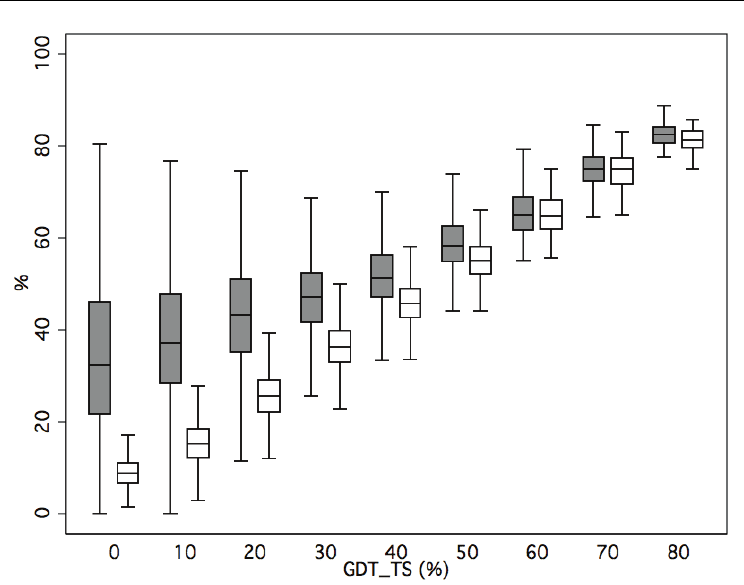
We found that STR GDT_TS was in general better than ATR GDT_TS (Fig. 4); this was
particularly true when the latter was below 40-50. Overall, this shows that STR is enriched
in good quality sub-structures relative to ATR, particularly for poor models.
Consistency with rmsd analysis was observed when comparing the performance of
structure comparison-based quality assessment (in grey) with that of PROSA (in white): for
good models (GDT_TS values above 60-70) both approaches had a similar behavior;
however, as model quality decreased, use of structure alignments showed increasingly
better performance than PROSA at pinpointing correct substructures.
Contributions of Structure Comparison Methods to the Protein Structure Prediction Field
335
Fig. 4. Quality of structurally aligned (obtained with MAMMOTH (Ortiz et al, 2002)) regions
vs. whole model, GDT_TS of the selected residues vs. all-residues GDT_TS. Grey: structure
comparison-based protocol (Fig. 1); white: PROSA(Sippl, 1993) results.
2.1.3 Distribution of high quality residues along the protein sequence
Usually, STR do not form a continuous block, they tend to scatter along the sequence. The
nature of this distribution is of interest for some applications of quality assessment methods
(like model refinement) for which STR sets may be of little value if the involved residues are
either too close in sequence, or contain too many orphan residues.
To characterize the distribution of STR along the sequence we used two measures:
maximum distance (MD) between STR runs and normalized size distribution of STR runs
(SAS). Both are based on the fact that, for a given model, STR sets are constituted by residue
runs of varying size. MD corresponds to the largest sequence distance between STR runs
(i.e. the number of residues between the rightmost and leftmost STR runs), divided by
whole sequence length. MD values near 1 indicate that STR runs are spread over the whole
protein, while smaller values point to a tighter residue clustering. SAS corresponds to the
normalized (again by whole sequence length) size distribution for all runs constituting STR
sets. SAS gives a view of how the sequence coverage is done: either by large sequence
chunks, by small residue clusters, or by a mixture of both. When the alignment is
constituted by small, evenly distributed residue clusters the SAS distribution will approach
zero.
Computational Biology and Applied Bioinformatics
336
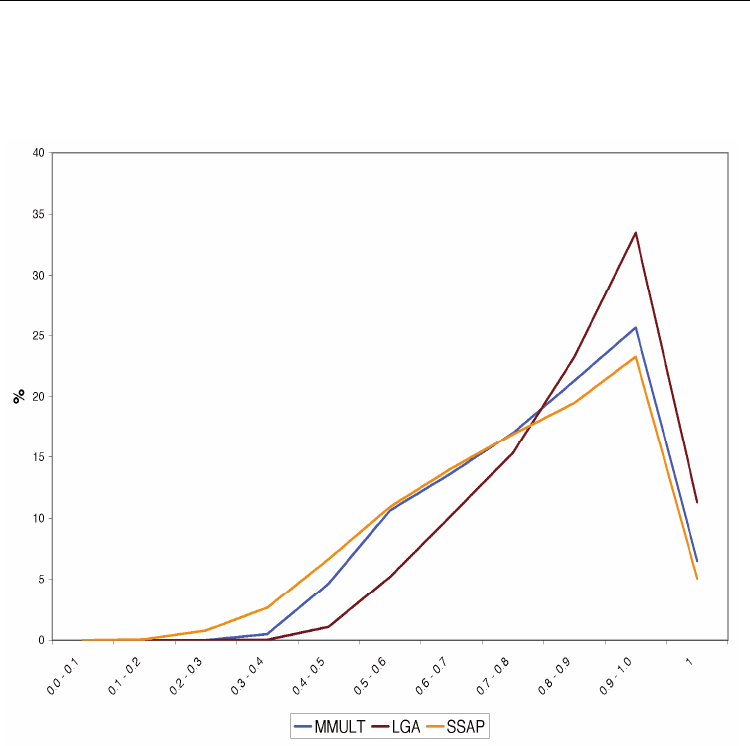
Our results showed that MD values are more frequent above 0.5, and more than 50% of
them were higher than 0.8 (Fig. 5). The three structure comparison methods showed similar
distributions, although LGA was slightly nearer to 1. This indicates that STR spread over a
substantial part of the predicted protein.
Fig. 5. Frequency distribution of the selected residues along the target sequence: normalized
maximum distance between STR runs (unitless parameter).
Results for SAS (Fig. 6) showed that while ~50 % of STR formed clusters of size lower than
10 % of the whole sequence (i.e. SAS values below 0.1), the remaining residues were
grouped in medium to large stretches. This means that for a 100 residue protein, clusters of
more than 10 residues (which is roughly the size of an average α-helix) are frequent. In
addition, for 95 % of the cases, the largest run of adjacent residues was above 30 % of the
target length.
The picture arising from MD and SAS distributions is that STR usually extend over the
protein length. Although STR sets are constituted by somewhat heterogeneous runs they do
not contain too many orphan residues, as they include one large run (the size of a
supersecondary structure motif, or larger) and several, smaller runs (the size of secondary
structure elements).