
Lopes H.S., Cruz L.M. (eds.) Computational Biology and Applied Bioinformatics
Подождите немного. Документ загружается.


Classifying TIM Barrel Protein Domain Structure by an
Alignment Approach Using Best Hit Strategy and PSI-BLAST
297
Method Sequence identity
Secondary structure
identity
RMSD
Q
(%)
Threshold
Q (%)
Threshold
Q
(%)
Threshold
TIM40D
Superfamily 94.2 <16 90.4 <72 57.7 >1.7
Family 90.4 <16 84.6 <74 55.8 >1.7
Class
(ENZYME)
40.4 <17 40.4 <72 25.0 >1.7
TIM95D
Superfamily 91.0 <16 86.6 <72 59.7 >1.8
Family 88.1 <16 80.6 <78 58.2 >1.8
Class
(ENZYME)
47.8 <14 44.8 <72 29.9 >1.7
Table 8. Overall Q values for novel TIM sequences in TIM40D and TIM95D (ASTRAL SCOP
1.73)
3.4 Alignment strategy with the BHPB strategy
The high Q value derived according to sequence identity using the PBH alignment strategy
can decrease the false positives via the homologous finding method. PSI-BLAST is an
established method that detects subtle relationships between proteins that are structurally
distant or functionally homologous owing to a position-specific scoring matrix generated
from multiple alignments of the top-scoring BLAST responses to a given query sequence.
The PSI-BLAST package was integrated into the NCBI standalone BLAST package (Altschul
et al., 1997). All of our tests were implemented using Perl combined with the CPAN bioperl
package (http://www.cpan.org/).
Table 9 presents the overall Q values for TIM sequences in TIM40D and TIM95D from
ASTRAL SCOP 1.71 using PSI-BLAST as a filter. The definition and observation of the
threshold in Table 9 is the same as that in Table 5. For TIM40D (Table 9), the best Q values
acquired according to sequence identity were 76.1% for superfamily, 73.9% for family, and
41.6% for class. For TIM95D, the secondary structure identity was used obtain the best Q
value of 62.2% for class, whereas sequence identity was used to obtain the best Q values for
superfamily (88.8%) and family (88.4%). Based on Tables 5 and 9, the Q values obtained
using the BHPB alignment strategy were slightly lower than those obtained using the PBH
alignment strategy. The lower Q values may be a consequence of proteins for which no
homolog was found using PSI-BLAST method; such proteins were thus false negatives.
Although the overall Q values using the PBH alignment strategy were higher than those
using the BHPB alignment strategy, Precision values obtained using the BHPB alignment
strategy were higher than those using the PBH alignment strategy. Tables 10 (TIM40D from
ASTRAL SCOP 1.71) and 11 (TIM95D) show the overall Q and Precision values for TIM
sequences within various categories. The definitions of the threshold in Tables 10 and 11 are
the same as that in Tables 6 and 7, respectively.
3.4.1 Q analysis
In Table 10, for the superfamily categories, the same categories as those observed in Table 6
obtained Q values above 76.1%; however, all of the categories obtained better or equal Q
values derived according to sequence identity than derived according to secondary

Computational Biology and Applied Bioinformatics
298
Method Sequence identity
Secondary structure
identity
RMSD
Q
(%)
Threshold
Q (%)
Threshold
Q
(%)
Threshold
TIM40D
Superfamily
76.1 <14 73.5 <67 39.0 >1.9
Family
73.9 <14 70.6 <67 37.1 >1.9
Class
(ENZYME)
41.6 <17 40.9 <73 20.1 >1.8
TIM95D
Superfamily
88.8 <14 87.2 <68 67.4 >2.0
Family
88.4 <14 86.3 <68 66.4 >2.0
Class
(ENZYME)
61.3 <18 62.2 <73 47.7 >1.8
Table 9. Overall Q values for the BHPB alignment strategy in TIM40D and TIM95D
(ASTRAL SCOP 1.71)
Method Sequence identity Secondary structure identity
Index
Q (%)
Precision
1
(%)
Precision
2
(%)
Q (%)
Precision
1
(%)
Precision
2
(%)
Superfamily
2 89.5 100.0 100.0(<20) 84.2 80.0 88.9(79)
4 73.3 100.0 100.0(<23) 73.3 100.0 100.0(<77)
8 78.0 100.0 100.0(<14) 74.4 98.4 98.4(<67)
9 44.4 100.0 100.0(<26) 44.4 88.9 100.0(78-79)
10 83.9 96.3 96.3(<17) 83.9 92.9 92.9(<75)
11 83.3 90.9 100.0(17-18) 83.3 100.0 100.0(<80)
12 75.0 90.0 100.0(15) 75.0 100.0 100.0(<77)
Family
2.4 100.0 100.0 100.0(<30) 100.0 90.9 100.0(77-86)
4.1 73.3 100.0 100.0(<23) 73.3 100.0 100.0(<77)
8.1 88.0 100.0 100.0(<14) 92.0 100.0 100.0(<67)
8.3 84.6 100.0 100.0(<17) 76.9 95.2 95.2(<75)
8.5 92.3 100.0 100.0(<18) 84.6 100.0 100.0(< 81)
10.1 83.3 93.8 100.0(18-19) 83.3 88.2 93.8(75-76)
11.2 90.9 90.9 100.0(17-18) 90.9 100.0 100.0(<80)
Class
(ENZYME)
1 66.7 78.3 85.7(21-22) 70.4 73.1 76.0(75-76)
2 38.7 60.0 63.2(17) 32.3 71.4 71.4(<73)
3 42.6 61.7 69.0(18) 44.1 60.0 62.5(72-73)
4 70.7 78.8 85.4(18-19) 69.0 74.1 76.9(75-76)
5 60.9 63.6 63.6(<17) 56.5 56.5 59.1(78-79)
Table 10. Overall Q and Precision values for the BHPB alignment strategy in TIM40D
(ASTRAL SCOP 1.71)
structure identity. For the family categories, only FMN-linked oxidoreductases had a Q
value less than 73.9%. Amylase, catalytic domain was the only category that had a lower Q
value when using sequence identity instead of secondary structure identity. For the class
categories, only Transferases had a Q value less than 41.6%. For Transferases, Lyases and
Isomerases, the Q values derived according to sequence identity were higher than those

Classifying TIM Barrel Protein Domain Structure by an
Alignment Approach Using Best Hit Strategy and PSI-BLAST
299
derived according to secondary structure identity. In Table 11, for the superfamily
categories, (Trans)glycosidases, Metallo-dependent hydrolases and Xylose isomerase-like,
had Q values less than 88.8%. For the family categories, only beta-glycanases had a Q value
less than 88.4%. For all superfamily and family categories, the Q values derived according to
sequence identity were higher than or equal to those derived according to secondary
structure identity. All of the class categories had Q values higher than 62.2%. For
Hydrolases and Isomerases, the Q values derived according to secondary structure identity
were higher than those derived according to sequence identity.
Method Sequence identity Secondary structure identity
Index
Q (%)
Precision
1
(%)
Precision
2
(%)
Q (%)
Precision
1
(%)
Precision
2
(%)
Superfamily
1 100.0 100.0 100.0(<45) 100.0 94.1 94.1(<86)
2 96.7 100.0 100.0(<18) 90.0 93.1 96.4(77-79)
4 90.9 100.0 100.0(<17) 86.4 100.0 100.0(<82)
6 90.0 100.0 100.0(<22) 90.0 100.0 100.0(<88)
7 100.0 100.0 100.0(<24) 100.0 100.0 100.0(<82)
8 86.6 100.0 100.0(<14) 85.1 99.1 99.1(<72)
9 63.6 100.0 100.0(<26) 63.6 93.3 100.0(78-79)
10 93.8 97.8 97.8(<17) 93.8 93.8 95.7(75-77)
11 100.0 100.0 100.0(<22) 100.0 100.0 100.0(<81)
12 100.0 100.0 100.0(<26) 100.0 100.0 100.0(<79)
14 100.0 100.0 100.0(<31) 100.0 100.0 100.0(<86)
15 80.0 100.0 100.0(<18) 80.0 100.0 100.0(<80)
Family
1.1 100.0 100.0 100.0(<45) 100.0 94.1 94.1(<86)
2.4 100.0 100.0 100.0(<30) 100.0 92.9 100.0(77-86)
4.1 90.0 100.0 100.0(<17) 86.4 100.0 100.0(<82)
7.1 100.0 100.0 100.0(<24) 100.0 100.0 100.0(<82)
8.1 95.8 100.0 100.0(<14) 95.8 100.0 100.0(<68)
8.3 87.8 100.0 100.0(<17) 85.4 97.2 97.2(<75)
8.4 100.0 100.0 100.0(<36) 100.0 100.0 100.0(<85)
8.5 94.4 100.0 100.0(<18) 88.9 100.0 100.0(<83)
10.1 93.1 96.4 100.0(18-25) 93.1 93.1 96.4(75-86)
11.2 100.0 100.0 100.0(<22) 100.0 100.0 100.0(<81)
14.1 100.0 100.0 100.0(<31) 100.0 100.0 100.0(<86)
15.3 100.0 100.0 100.0(<68) 100.0 100.0 100.0(<96)
Class
(ENZYME)
1 89.1 87.2 91.1(21-23) 87.0 83.3 85.1(78-79)
2 75.4 81.6 83.3(17) 75.4 88.9 88.9(<73)
3 59.4 72.4 74.1(18) 64.2 73.9 74.7(72-73)
4 89.7 87.9 88.8(17) 88.7 86.9 88.7(77)
5 81.6 93.0 93.0(<19) 83.7 85.4 85.4(<80)
Table 11. Overall Q and Precision values for the BHPB alignment strategy in TIM95D
(ASTRAL SCOP 1.71)
Computational Biology and Applied Bioinformatics
300
3.4.2 Precision analysis
In Tables 10 and 11, Precision values with the threshold were higher or equal to those
without the threshold, thus making it difficult to determine the feasible threshold to obtain
the best Precision value for routine alignment practices. However, the differences between
Precision values with and without the threshold were greatly reduced by using the BHPB
alignment strategy with the exception of Hydrolases of TIM40D. Using the BHPB alignment
strategy in TIM40D, the average Precision values without the threshold were 96.7% for
superfamily, 97.8% for family, and 68.5% for class (Table 10). Using the BHPB alignment
strategy in TIM95D, the average Precision values without the threshold were 99.8% for
superfamily, 99.7% for family, and 84.4% for class (Table 11). The best average Precision
values were derived according to sequence identity. The PSI-BLAST method in the BHPB
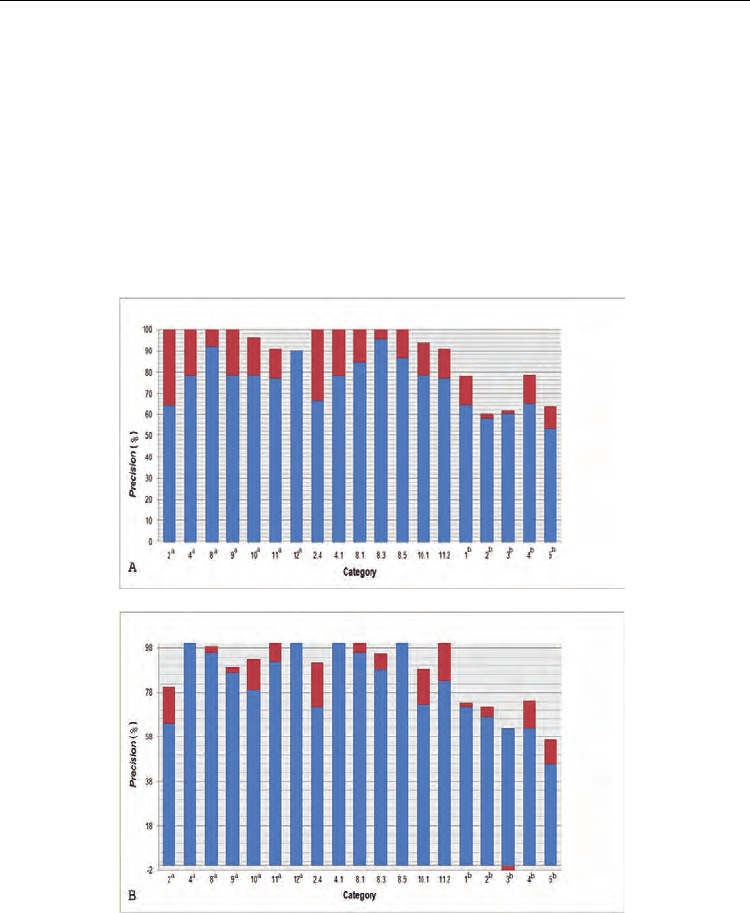
alignment strategy can filter out some of the false positives. Figures 2 and 3 indicate the
Fig. 2. The increase in Precision values for TIM40D (ASTRAL SCOP 1.71) using the BHPB
alignment strategy. (A) Increase in Precision values for TIM40D derived according to
sequence identity. (B) Increase in Precision values for TIM40D derived according to
secondary structure identity. Superscript ‘a’ or ‘b’ indicates the superfamily categories or the
class categories, respecively. Categories without a superscript indicated the family
categories. The blue bar indicates Precision values using the PBH alignment strategy and the
red bar indicates the increase in Precision values using the BHPB alignment strategy.
Classifying TIM Barrel Protein Domain Structure by an
Alignment Approach Using Best Hit Strategy and PSI-BLAST
301
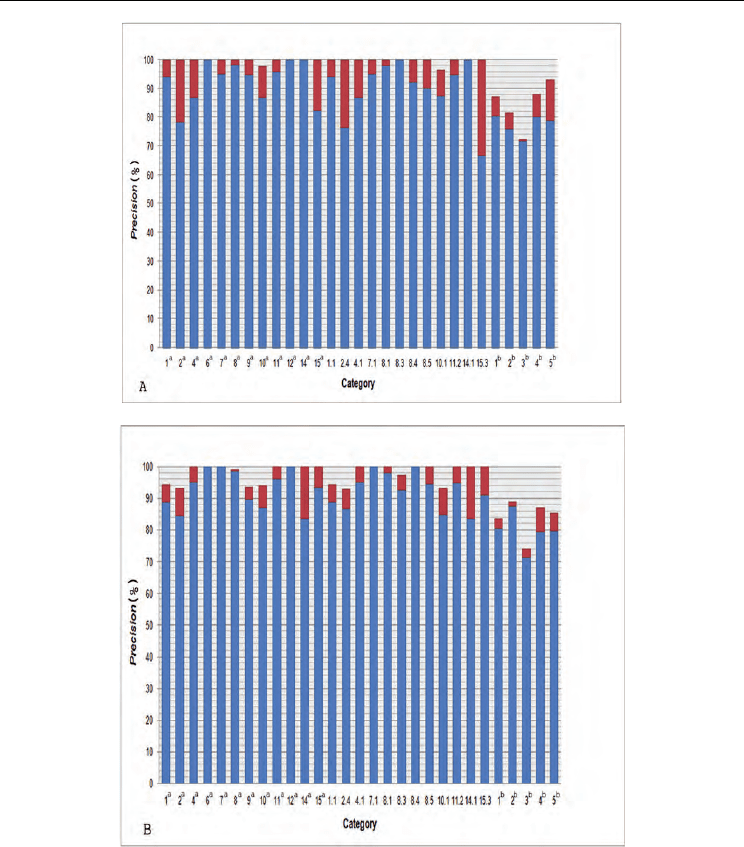
Fig. 3. The increase in Precision values for TIM95D (ASTRAL SCOP 1.71) using the BHPB
alignment strategy. (A) Increase in Precision values for TIM95D derived according to
sequence identity. (B) Increase in Precision values for TIM95D derived according to
secondary structure identity. Superscript ‘a’ or ‘b’ indicates the superfamily categories or the
class categories, respecively. Categories without a superscript indicated the family
categories. The blue bar indicates Precision values using the PBH alignment strategy and the
red bar indicates the increase in Precision values using the BHPB alignment strategy.
increase in Precision values for TIM40D and TIM95D from ASTRAL SCOP 1.71 using the
BHPB alignment strategy as compared to the PBH alignment strategy, respectively. The
Computational Biology and Applied Bioinformatics
302
increase in Precision values was computed by comparing the results shown in Tables 6, 7, 10
and 11 (see supplemental Table S4 (Chu, 2011)). Based on Figures 2 and 3, Precision values for
almost all categories improved when using the BHPB alignment strategy. The average
increases in Precision values for TIM40D using sequence identity were 16.8% for superfamily,
16.7% for family and 8.1% for class. The average increases in Precision values using secondary
structure identity were 7.1% for superfamily, 9.5% for family and 7.0% for class. The average
increases in Precision values derived according to sequence identity were higher than those
derived according to secondary structure identity for TIM40D and TIM95D. Thus, the BHPB
alignment strategy yields higher Precision values than the PBH alignment strategy.
3.4.3 MCC analysis
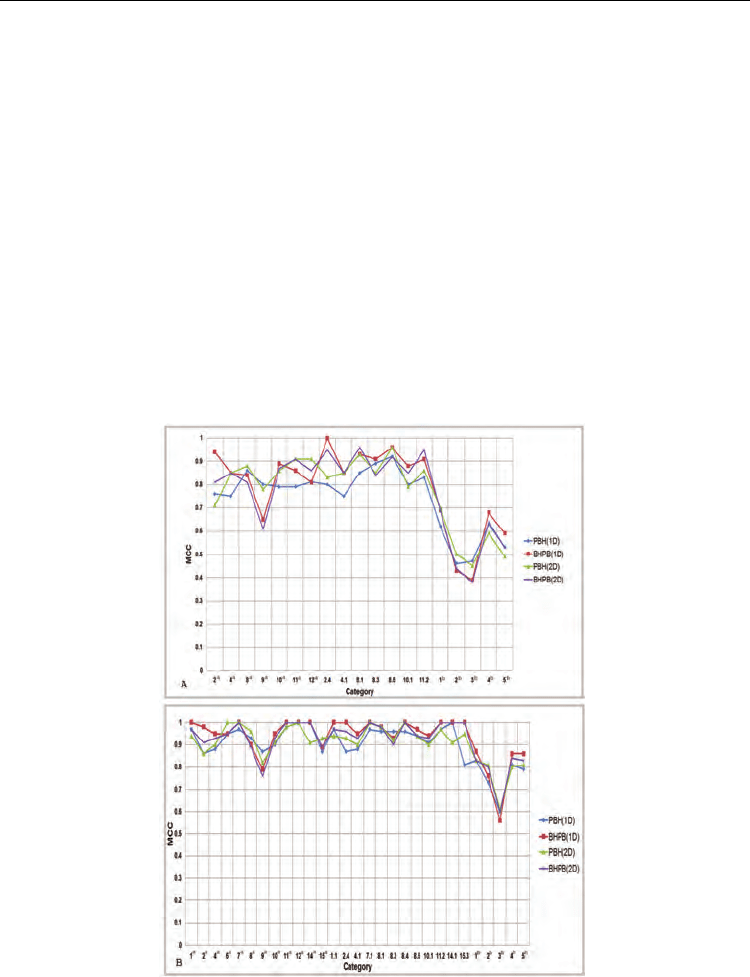
Figure 4 presents the MCC measures of (1) the PBH alignment strategy derived according to
sequence identity (PBH(1D) for short), (2) the PBH alignment strategy derived according to
secondary structure identity (PBH(2D) for short), (3) the BHPB alignment strategy derived
according to sequence identity (BHPB(1D) for short) and (4) the BHPB alignment strategy
derived according to secondary structure identity (BHPB(2D) for short) for TIM40D and
TIM95D from ASTRAL SCOP 1.71, respectively. (see supplemental Table S5 (Chu, 2011))
Fig. 4. MCC scores of PBH(1D), PBH(2D), BHPB(1D) and BHPB(2D) for TIM40D and
TIM95D (ASTRAL SCOP 1.71). (A) MCC scores for TIM40D. (B) MCC scores for TIM95D.
Superscript ‘a’ or ‘b’ indicates the superfamily categories or the class categories. Categories
without a superscript indicate the family categories.

Classifying TIM Barrel Protein Domain Structure by an
Alignment Approach Using Best Hit Strategy and PSI-BLAST
303
Using the PBH and BHPB alignment strategies, all of the superfamily categories had MCC
scores greater than 0.7 except Metallo-dependent hydrolases when using the BHPB
alignment strategy (Figure 4(A)); Ribulose-phosphate binding barrel, Enolase C-terminal
domain-like, and Phosphoenolpyruvate/pyruvate domain had MCC scores greater than 0.9.
All of the family categories had MCC scores greater than 0.7; Tryptophan biosynthesis
enzymes, Amylase, catalytic domain, beta-glycanases, Type II chitinase, and D-glucarate
dehydratase-like had MCC scores greater than 0.9. All of the class categories had MCC
scores between 0.3~0.7, which is not an optimal score. From Figure 4(B), all of the
superfamily and family categories had MCC scores greater than 0.7; 13 categories had the
optimal MCC score (+1), indicating perfect prediction quality. All of the class categories had
MCC scores between 0.5~0.9. The above results demonstrate that the proposed PBH or
BHPB alignment strategy yielded high prediction quality for TIM barrel protein domain
structure classification.
3.5 Discussion
Here we further investigate why the alignment approach with the PBH or BHPB strategy is
not sufficient to classify the class category. For the above experiments, all of the EC
annotations for TIM sequences in TIM40D and TIM95D from ASTRAL SCOP 1.71 and 1.73
were derived from UniProt. There are 24.5% TIM40D (67 of 274) and 20.6% TIM95D (91 of
442) TIM sequences listed as undefined in class from ASTRAL SCOP 1.71; there are 38.5%
TIM40D (20 of 52) and 37.3% TIM95D (25 of 67) novel TIM sequences listed as undefined in
class from ASTRAL SCOP 1.73. These TIM sequences with undefined class categories were
initially assumed to be false negatives before the test. Therefore, the Q values for class
obtained by the PBH or the BHPB alignment strategy derived according to sequence identity
or secondary structure identity is poor. However, the ENZYME functions of some of these
TIM sequences with undefined class categories derived from UniProt have been described
in PDB. Thus, the EC annotations derived from PDB were integrated into TIM40D and
TIM95D from ASTRAL SCOP 1.71 and 1.73 (see supplemental Table S3 (Chu, 2011)), and the
above experiments for the class classification were repeated. After the PDB integrations,
13.6% TIM40D (38 of 279) and 11.1% TIM95D (50 of 450) TIM sequences remained
undefined from ASTRAL SCOP 1.71; further, 11.5% TIM40D (6 of 52) and 9.0% TIM95D (6 of
67) novel TIM sequences remained undefined from ASTRAL SCOP 1.73. These six novel
TIM sequences were identical in TIM40D and TIM95D from ASTRAL SCOP 1.73.
3.5.1 Improvement in Q
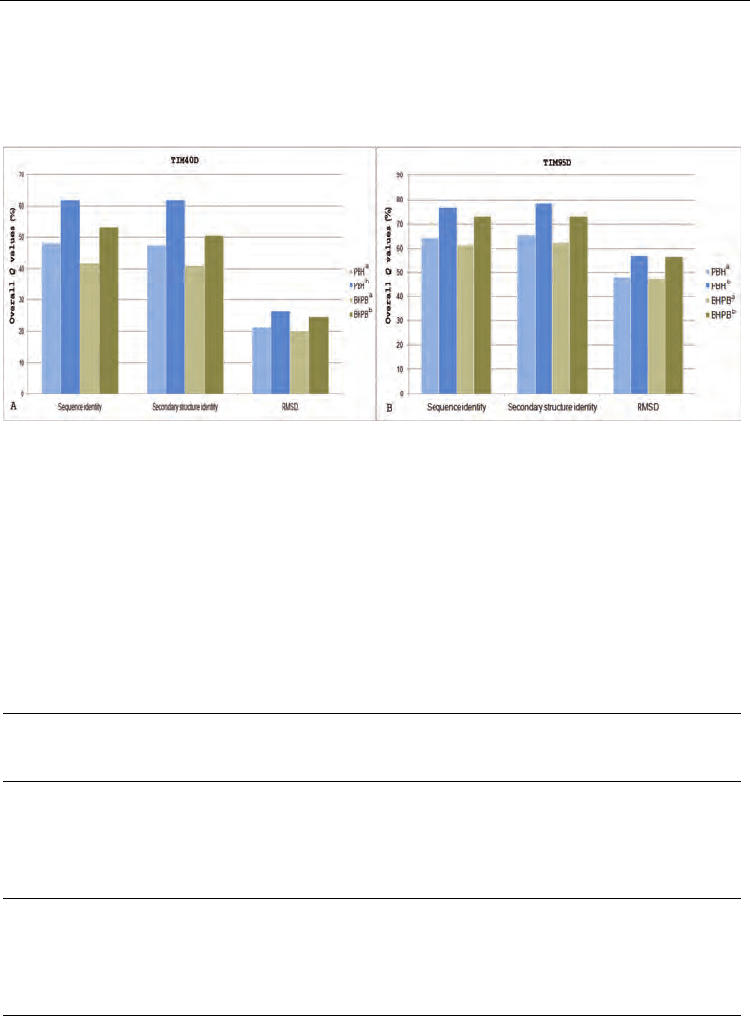
Figure 5 compares the Q values for TIM40D and TIM95D from ASTRAL SCOP 1.71 with
UniProt and PDB EC annotations using the PBH and BHPB alignment strategies. (see
supplemental Table S6 (Chu, 2011)) The Q values for the class classification using the PBH
and BHPB alignment strategies improved after integrating the PDB EC annotations. By
integrating the PDB EC annotations, some of the false negatives from UniProt were
eliminated. The alignment approach using either the PBH or BHPB strategy was useful for
the class classification. For TIM40D, the best Q value of 62.0% (an increase from 48.2%) for
class was derived according to sequence identity or secondary structure identity using the
PBH alignment strategy; the best Q value of 53.4% (an increase from 41.6%) for class was
derived according to sequence identity using the BHPB alignment strategy. For TIM95D, the
best Q value of 78.2% (an increase from 65.2%) for class was derived according to secondary
Computational Biology and Applied Bioinformatics
304
structure identity using the PBH alignment strategy; the best Q value of 72.9% (an increase
from 62.2%) for class was derived according to sequence identity or secondary structure
identity using the BHPB alignment strategy. For the novel TIM sequences in TIM40D and
TIM95D from ASTRAL SCOP 1.73, the best Q values were 73.1% (TIM40D) and 79.1%
(TIM95D) using the PBH alignment strategy (see supplemental Table S6 (Chu, 2011)).
Fig. 5. Comparisons for TIM40D and TIM95D (ASTRAL SCOP 1.71) with UniProt and PDB
EC annotations. (A) The Q values for TIM40D. (B) The Q values for TIM95D. Superscript ‘a’
or ‘b’ indicates TIM sequences available using only UniProt EC annotations or TIM
sequences available using UniProt and PDB EC annotations.
3.5.2 Improvement in MCC
Table 12 presents MCC scores for TIM sequences in TIM40D and TIM95D from ASTRAL
SCOP 1.71 with UniProt and PDB EC annotations using the PBH and BHPB alignment
strategies. All of the class categories had MCC scores between 0.4~0.8 in TIM40D; greater
than 0.7 in TIM95D; Oxidoreductases and Lyases also had MCC scores greater than 0.9 using
the BHPB alignment strategy. Hence, the proposed PBH or BHPB alignment strategy also
yielded high prediction quality for class.
Category Index
Sequence identity Secondary structure identity
M
C
C
M
C
C
PBH BHPB PBH BHPB
TIM40D
Class
(ENZYME)
1 0.72 0.80 0.75 0.76
2 0.49 0.47 0.50 0.42
3 0.68 0.61 0.67 0.57
4 0.67 0.69 0.67 0.65
5 0.50 0.53 0.52 0.49
TIM95D
Class
(ENZYME)
1 0.89 0.93 0.87 0.89
2 0.76 0.78 0.81 0.80
3 0.79 0.74 0.81 0.73
4 0.87 0.91 0.86 0.90
5 0.74 0.78 0.81 0.79
Table 12. MCC scores for TIM40D and TIM95D (ASTRAL SCOP 1.71) with UniProt and PDB
EC annotations

Classifying TIM Barrel Protein Domain Structure by an
Alignment Approach Using Best Hit Strategy and PSI-BLAST
305
3.5.3 Inferring ENZYME function for TIM barrel proteins with undefined class
categories
After integrating the PDB EC annotations into the above tests, there remained 38 (TIM40D)
and 50 (TIM95D) TIM sequences with undefined class categories from ASTRAL SCOP 1.71;
6 novel TIM sequences had undefined class categories from ASTRAL SCOP 1.73. Therefore,
we used the proposed alignment approach to infer the ENZYME functions for TIM barrel
proteins with undefined class.
We first assessed the classification results of the class categories by the PBH alignment
strategy for TIM sequences in TIM40D and TIM95D from ASTRAL SCOP 1.71 with UniProt
and PDB EC annotations. We found that the target protein and its selected protein belong to
the same superfamily category for most of the true positives identified in the alignment.
Table 13 presents statistics for true positives and false negatives for class using the PBH
alignment strategy. For true positives, 94% (162 of 173) and 99% (342 of 344) of the target
and its selected proteins belonged to the same superfamily category derived according to
PBH(1D) in TIM40D and TIM95D, respectively. For false negatives, however, 38% (40 of
106) and 31% (33 of 106) of the target and its selected proteins belonged to the same
superfamily category derived according to PBH(1D) in TIM40D and TIM95D, respectively.
Statistic
TIM40D TIM95D
PBH(1D) PBH(2D) PBH(1D) PBH(2D)
TP
i
FP
i
TP
i
FP
i
TP
i
FP
i
TP
i
FP
i
,sf
154.0 32.0 146.0 37.0 335.0 31.0 332.0 31.0
,s
f
8.0 8.0 13.0 9.0 7.0 2.0 11.0 2.0
s
11.0 28.0 14.0 22.0 2.0 23.0 9.0 15.0
sum 173.0 106.0 173.0 106.0 344.0 106.0 352.0 98.0
s : Target and its selected proteins belong to the same superfamily category
s : Target and its selected proteins belong to the different superfamily categories
f : Target and its selected proteins belong to the same family category
f
: Target and its selected proteins belong to the different family categories
Table 13. Statistical results for true positives and false negatives for class using the PBH
alignment strategy
Overall, 58% (of 279) and 76% (of 450) of the target and its selected proteins belonged to the
same superfamily and class categories derived according to PBH(1D) in TIM40D and
TIM95D, respectively. Similar observations were made based on PBH(2D) in TIM40D and
TIM95D. We observed 19 (PBH(1D)) and 23 (PBH(2D)) TIM sequences with undefined class
categories in TIM40D with the same superfamily
category, respectively. We observed 19
(PBH(1D)) and 26 (PBH(2D)) TIM sequences with undefined class categories in TIM95D
with the same superfamily
category. Therefore, it may be possible to infer the ENZYME
functions for TIM barrel proteins with undefined class categories, especially for TIM95D,
according to the classification results predicted by the proposed alignment approach. Table
13 also shows that 14% of 279 and 7% of 450 target and selected proteins belong to the same

Computational Biology and Applied Bioinformatics
306
superfamily category, but they belong to different class categories derived according to
PBH(1D) in TIM40D and TIM95D, respectively. Hence, all of TIM sequences of undefined
class may not be correctly inferred by the proposed alignment approach with the PBH or the
BHPB strategy. In the future, information regarding the active sites will be used in the
proposed alignment approach to remedy discrepancies in undefined class. In the following
test cases, all of the alignment results were displayed by DS Visualizer (Accelrys). The split
structure superposition was displayed utilizing PyMol Molecular Viewer (DeLano, 2002).
4. Methods
4.1 The alignment approach with the PBH strategy
An alignment approach with the PBH strategy was proposed to perform TIM barrel protein
domain structure classification (Figure 6). TIM40D and TIM95D can be used as the input for
this alignment approach. In the alignment methods block, three alignment tools,
CLUSTALW, SSEA and CE, were adopted to align any two of proteins by the amino acid
sequences, secondary structures and 3D structures, respectively, to obtain the scores of
sequence identity, secondary structure identity and RMSD. CLUSTALW is an established
multiple sequence alignment tool (global alignment) for DNA/RNA or protein sequences
based on a progressive pair-wise alignment method by considering sequence weighting,
variations in amino acid substitution matrices and residue-specific gap penalty scores. It is
widely used by biologists to investigate evolutional relationships among multiple protein
sequences. CLUSTALW may not be the best choice for the sequence alignment because of
recent advancements in programming, but it is still suitable for this alignment approach for
two reasons. First, we simply want to obtain the score of sequence identity for any two
proteins rather than the actual alignment information. Hence, the sequence identity score
obtained by CLUSTALW is not significantly different from that obtained by other tools.
Second, the design of most of other tools is focused on revising the multiple sequence
alignment results, not improving the pair-wise alignment results, even using the pair-wise
alignment results by CLUSTALW. SSEA is a multiple protein secondary structure alignment
tool (either global or local alignment) that aligns entire elements (rather than residue-based
elements [20]) of multiple proteins based on the H, C, and E states of SSEs. CE is a popular
and accurate pair-wise protein 3D structural alignment tool that aligns residues in
sequential order in space. If a protein domain sequence is not continuous, however, each
continuous fragment in the domain will be aligned against the other protein using the CE
alignment tool. Two criteria were adopted to resolve this problem. First, the sequence length
of the continuous fragment must be at least 30 residues, and second the minimal RMSD of
any two aligned fragments must be chosen. The default parameters of CLUSTALW
(accurate, but slow mode in setting your pairwise alignment options) and SSEA (global
alignment version) were used to align any two proteins in TIM40D and TIM95D to obtain
scores for sequence and secondary structure identities with normalized values ranging from
0-100. The default parameters of CE were used to align any two proteins in TIM40D and
TIM95D to obtain RMSD scores. After using CLUSTALW, SSEA and CE, these scores were
used to build an alignment-based protein-protein identity score network.
In the best hit strategy block, each protein in the network was first considered as a target
protein. Each target protein was then used to map the remaining proteins in the network.
Finally, the prediction result of each target protein was determined by selecting the
remaining proteins in the network according to certain parameters, which are critical for