
Lopes H.S., Cruz L.M. (eds.) Computational Biology and Applied Bioinformatics
Подождите немного. Документ загружается.

19
Prediction of Transcriptional Regulatory
Networks for Retinal Development
Ying Li
1
, Haiyan Huang
2
and Li Cai
1
1
Department of Biomedical Engineering, Rutgers University, NJ
2
Department of Statistics, University of California, Berkeley, CA
USA
1. Introduction
The formation of the neatly layered retina during embryonic development is dictated by a
series of complicated transcription factor interactions. Retina-specific expression of these
transcription factors is an essential step in establishing retinal progenitor cells (RPCs) from
embryonic stem cells. The transcriptional control of gene expression is largely mediated by
the combinatorial interactions between cis-regulatory DNA elements and trans-acting
transcription factors, which cooperate/interact with each other to form a transcription
regulatory network during this developmental process. Such regulatory networks are
essential in regulating tissue/cell-specific gene expression, e.g., in cell fate determination
and differentiation during embryonic retinal development (Hu et al., 2010; Kumar, 2009;
Swaroop et al., 2010). Many genes, which involved in transcriptional networks for the
specification of a certain retinal cell lineage, have already been identified and characterized
(Corbo et al., 2010; Kim et al., 2008b; Tang et al., 2010). The transcriptional regulatory
networks for specific retinal cell lineages, e.g., the photoreceptors (Corbo et al., 2010; Hsiau
et al., 2007) and bipolar neurons (Kim et al., 2008b), were established in recent years.
However, the transcriptional regulatory network that governs the entire neural retinal
development is still elusive.
Identifying tissue/cell-specific cis-regulatory elements, trans-acting factor binding sites
(TFBSs), and their binding transcription factors (TFs) represent key steps towards
understanding tissue/cell-specific gene expression and further successful reconstruction of
transcriptional regulatory networks. These steps also present major challenges in both fields
of experimental biology and computational biology.
Currently, the prevailing method of studying TFBSs and transcriptional regulatory
networks is to determine the function of tissue-specific trans-acting factors based on data
from genome-wide gene expression profiling and chromatin immunoprecipitation (ChIP).
ChIP is often used to investigate protein-DNA interactions in a cell. Coupled with massive
parallel sequencing, ChIP-seq is capable of mapping the genome-wide protein-DNA
interaction at a finer resolution (Valouev et al., 2008) to identify candidate enhancer
sequences (Visel et al., 2009). Thus, a regulatory cascade can be recognized via consequential
analysis of the factors involved.
Here, we present a new method for the computational analysis of TFBSs and transcriptional
regulatory networks utilizing genome-wide sequencing, expression, and enhancer data. In

Computational Biology and Applied Bioinformatics
358
contrast to the traditional method, which mainly focuses on factor expression analysis, we
emphasize the sequence elements with tissue-specific enhancer activity. Our hypothesis is
that enhancers, non-coding sequences that direct gene expression in a cell-/tissue-specific
manner, contain common TFBSs that allow the key protein factors (important for the
development of that cell/tissue type) to bind. Experimentally verified tissue-specific
enhancer elements selected from enhancer databases were carefully screened for common
trans-acting factor binding sites to predict potential sequence-factor interacting networks.
DNA-binding protein factors that associate with multiple enhancers can be analyzed using
experimental methods.
As proof-of-principle, simple transcriptional regulatory networks of embryonic retinal
development were assembled based on common/key factors and their interacting genes, as
determined by literature search. These resulting networks provide a general view of
embryonic retinal development and a new hypothesis for further experimentation.
2. Methods and results
In this study, we aimed to develop a method for the identification of regulatory networks
for cell/tissue-specific gene expression. To test our hypothesis of the existence of common
TFBSs on the enhancers of cell/tissue specific genes, we employ the mouse developing
retina as a model system. Enhancers that direct retina-specific gene expression were selected
and their sequences were thoroughly screened for common TFBSs and trans-acting factors
(protein factors) using open-access software such as TESS, JASPA, MatInspector, and
MEME, etc. For common TFBS selection, we developed a Matlab program. These common
protein factors were further studied for their expression profiles. Thereafter, we were able to
construct transcriptional regulatory networks based on the known function of the enhancer-
binding trans-acting factors using a network construction tool, BioTapestry (Longabaugh et
al., 2009).
2.1 Retina-specific enhancers
To determine the transcriptional regulatory networks that govern retinal development, we
identified and selected enhancer elements that direct gene expression in the retina by
searching the VISTA Enhancer Browser. The VISTA Enhancer Browser is a central resource
for experimentally validated human and mouse non-coding DNA fragments with enhancer
activity as assessed in transgenic mice. Most of these non-coding elements were selected for
testing based on their extreme conservation in other vertebrates or epigenomic evidence
(ChIP-Seq) of putative enhancer marks. The results of this in vivo enhancer screen are
provided through this publicly available website (Frazer et al., 2004). Of the 1503 non-
coding DNA elements from human and mouse genomes that were tested for their ability to
direct gene expression on embryonic day 11.5 (E11.5) using a reporter assay in transgenic
mouse, a total of 47 elements were shown to possess enhancer activity in the retina (as of
February 10, 2011). Of the 47 elements, 25 show enhancer activities in both the retina and
other tissues, e.g., heart, limb, brain and spinal cord, etc. These 25 elements were separated
for further analysis as we focused on retina-specific sequence elements. In addition, among
the 22 remaining elements, 17 elements were active enhancers in the retina in at least half of
the tested transgenic embryos (Supporting data 1). To further increase the possibility of
identifying the key enhancer elements that are critical for retinal development, we applied
more stringent selection criteria based on the following two properties: 1) the reporter

Prediction of Transcriptional Regulatory Networks for Retinal Development
359
expression is restricted in the retina and not in any other regions of the CNS; 2) there is
expression of at least one of the flanking genes in the retina at E11.5 (or Theiler Stage 18-21).
The second category was applied because a majority of known enhancers were found in the
immediate up- or downstream region of their target genes, and thus the regulatory activities
of enhancers were considered to be most likely associated with their flanking genes. Any
enhancer elements that did not fit into at least one of the two categories was thus eliminated
(details in Supporting data 5). Based on the above criteria, 8 enhancer elements were
identified (Table 1).
Group
Enhancer
ID
Length
(bp)
Reporter expression
pattern derived
from enhancer
activity
Annotation of
reporter expression
Flanking genes of enhancers and
their endogenous expression in
mouse embryos
Upstream Downstream
1
hs27
1113 eye(4/6), limb(4/6) Retina + non-CNS
Irx5: E11-19
retina
Irx6: E11-19
retina
hs258 1487 eye(3/5), limb, Retina + non-CNS Ccdc39: E14.5
Fxr1: E12-14, E19
retina
hs546 1753 eye(7/7), limb, nose Retina + non-CNS
Nr2f1: E11-19 in
retina
Arrdc3: E14-19
hs1170
1288 eye(8/8) Retina
Nr2f1: E11-19 in
retina
Arrdc3: E14-19
2
hs932
775
eye(6/9), limb, nose,
branchial arch
Retina + non-CNS
AA408296:
unknown
Irf6: not in retina
mm165 926 eye(4/5), heart Retina + non-CNS Lao1: unknown
Slc2a1: not in
retina
3
hs1122 1218 eye(6/7) Retina+ Spinal cord
Ascl1: E11-19 in
retina (MGI)
Pah: not in retina
mm269
760
eye(5/5), heart,
other
Retina+ Spinal cord
Zfand5 (intragenic): E11-13/E13-19
in retina
Table 1. A list of eight retina-specific enhancers. The 8 retina-specific enhancers selected
from the VISTA Enhancer Browser are listed above. They are grouped into 3 sub-groups
according to the reporter expression in mouse embryos derived from these enhancers and
the expression pattern of their flanking genes. The enhancer IDs, their expression pattern
and the flanking gene names were retrieved directly from VISTA Enhancer Browser, with an
expression pattern described as ‘tissue type (positive sample number/total sample
number)’. Flanking genes with expression in the retina are shown in bold.
2.2 Trans-acting factor binding sites on retina-specific enhancers
The binding of trans-acting factors (e.g., transcription factors) to non-coding regulatory
DNA (e.g., promoters, enhancers, etc.) is an essential process in the control of gene
expression. This protein-DNA interaction helps recruit the DNA polymerase complex and
co-activators to form the transcription machinery. The binding of these protein factors can
also act as repressors to prevent transcription. Identification of a TFBS in the enhancer and
promoter for a gene may indicate the possibility that the corresponding factors play a role in
the regulation of that gene. Importantly, the ability of an enhancer to direct cell/tissue-
specific gene expression is achieved via the binding of tissue-specific trans-acting protein

Computational Biology and Applied Bioinformatics
360
factors. To determine what protein factors regulate retina-specific gene expression, it is
important to determine what TFBSs are located on the retina-specific enhancers. We thus
searched DNA sequences of the 8 retina-specific enhancer elements for their known TFBSs
using TESS (Schug, 2002), JASPA (Portales-Casamar et al., 2010; Sandelin et al., 2004) and
MatInspector (Cartharius et al., 2005). For example, TESS (Transcription Element Search
System - http://www.cbil.upenn.edu/cgi-bin/tess) is a web tool for predicting TFBSs in
DNA sequences. It can identify TFBSs using site or consensus strings and positional weight
matrices mainly from the TRANSFAC (Knuppel et al., 1994). TRANSFAC contains data on
transcription factors, their experimentally-proven binding sites, and regulated genes. Its
broad compilation of binding sites allows the derivation of positional weight matrices
(Knuppel et al., 1994). The following search parameters were set when searching TESS: a
minimum string length of 6, a maximum allowable string mismatch of 10%, a minimum log-
likelihood ratio score of 12, and organism selection of Mus musculus (the house mouse). Our
search results show that there are approximately 150 TFBSs for each of the 8 enhancer
sequences (Supporting data 2). Similar results were reported by JASPA and MatInspector.
The corresponding protein factors of these TFBSs were considered to be capable of binding
with the 8 retina-specific enhancers, and thus they are important in activating/suppressing
gene expression in the retina.
2.3 A motif containing Pou3f2 binding sites
Since all 8 enhancers possess the ability to direct retina-specific gene expression, there may
be key TFBSs shared amongst these retina-specific sequence elements. To test this
hypothesis, we sorted and screened the TFBSs of each of the 8 enhancers to identify common
ones using a Matlab program that we developed for this study (Supporting data 6). This
Matlab program for common TFBS selection was designed to compare the TFBSs on each of
the retina-specific enhancer elements predicted by TESS. TFBSs for two or three different
enhancers can be sequentially compared. A “model” character was used as the comparison
category instead of the binding site name in both TESS and our Matlab program. As defined
in TESS, a model is “the site string or weight matrix used to pick this site” (Schug, 2002), and
thus describes the nature of a binding site. One factor may have multiple models, and one
model may be shared by multiple factors. The model character is the only necessary
parameter to characterize the transcription factors depending on their binding site property.
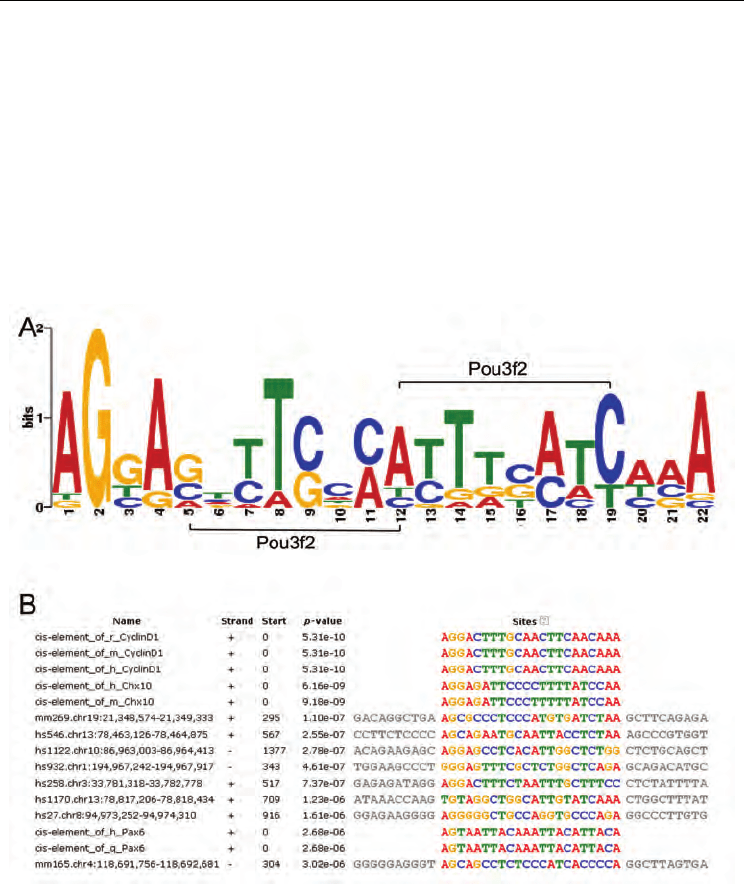
With this sorting/searching program, we identified a TFBS for Pou3f2 (also known as Brn2)
that was present in all 8 retina-specific enhancers (Fig. 1A). Previous studies have
demonstrated that the Pou3f2 transcription factor plays an important role in the
development of neural progenitor cells (Catena et al., 2004; Kim et al., 2008b; McEvilly et al.,
2002; Sugitani et al., 2002). Furthermore, the literature reports that this motif was first
discovered as a cis-element in the Chx10 enhancer, which can drive reporter expression in
intermediate and late RPCs (Rowan and Cepko, 2005). In this study, Pou3f2 was also shown
to affect bipolar interneuron fate determination through interactions with Chx10 and Nestin.
We thus speculate that this Pou3f2 binding site may exist in regulatory sequences among
genes important for the development of neural retinal progenitor cells (RPCs). Therefore,
the cis-elements of Chx10, Cyclin D1, Pax6, Rax, and Six3 were examined because these
genes are known for their role in regulating RPC development and retinal cell
differentiation (Conte et al., 2010; Martinez-de Luna et al., 2010; Oliver et al., 1995; Rowan
and Cepko, 2005; Sicinski et al., 1995). Confirming our prediction, Pou3f2 binding sites were
also present in the cis-elements of Chx10, Cylin D1, and Pax6 genes (sequences can be found
Prediction of Transcriptional Regulatory Networks for Retinal Development
361
in Supporting data 4). Next, sequence alignment analysis was performed to identify a
common motif for Pou3f2 binding sites using MEME (Multiple Em for Motif Elicitation,
http://meme.sdsc.edu/meme4_4_0/cgi-bin/meme.cgi) (Bailey and Elkan, 1994). It is
commonly believed that there are dependencies among different positions in a motif.
MEME may ignore such kind of dependency. Sequence alignment reveals a 22 bp motif
containing two Pou3f2 binding sites among all 8 enhancer elements (with a stringent E-
value of 7.2e-20 and p-value < 3.02e-6) and also in the cis-elements of RPC-specific genes,
e.g., Chx10, CyclinD1, and Pax6, from multiple vertebrate species (Fig. 1B). In addition, a
line of evidence indicates that Pou3f2 binds to the Rax enhancer to regulate the expression of
Rax in RPCs (Martinez-de Luna et al., 2010). Such prevalent existence of repeated Pou3f2
binding sites among retina-specific enhancer elements and cis-elements of RPC-specific
genes suggests that Pou3f2 is a key regulatory factor in the embryonic retinal development.
Fig. 1. A 22 bp motif is present in all 8 retina-specific enhancers and cis-elements of retinal
progenitor gene Chx10, CyclinD1 and Pax6. Sequence alignment was performed using
MEME and the output shows a motif exists among all above 15 sequences (p-value < 3e-6).
A. a SeqLog presentation of the 22bp motif. Dual binding sites of Pou3f2 were located next
to each other forms Pou3f2 binding site repeats. B. sequence alignment reveals the 22bp
motif among the 8 enhancers and cis-elements of RPC-specific genes (e.g., Chx10, CyclinD1
and Pax6) (Rowan and Cepko, 2005). Abbreviation: r, rat; m, mouse; h, human; q, quail.
RPC, retinal progenitor cell.

Computational Biology and Applied Bioinformatics
362
2.4 Key trans-acting factors involved in transcriptional regulatory networks of retinal
development
It is unlikely that only one factor (i.e., Pou3f2) is involved in regulating retina-specific gene
expression. Trans-acting factors often do not function alone but rather in a cooperative
manner. To identify other key protein factors for retina-specific gene expression, we applied
the following assumptions to the enhancer elements and their binding trans-acting factors:
1. Key TFBSs should be common to all or a subset of retina-specific enhancer elements;
2. The flanking genes of these enhancer elements should be expressed in the retina during
early retinal development, because an enhancer often regulates the expression of its
flanking gene(s);
3. The binding factors should have a known function in retinal development, or
4. If the binding factors have an unknown function in retinal development, they should be
at least expressed in the retina during retinal development. In this case, the expression
of the factor provides novel hypothesis for their function in retinal development, which
needs to be tested by functional studies.
Based on the above assumptions, the information on the expression of the flanking genes of
enhancer elements in the developing retina is necessary for the TFBS analysis. Five
databases of gene expression (see Table 2) were searched. The information on the expression
of these flanking genes were retrieved from these databases (Tables 1, 4 and supporting data
3). The factors that do not express in the retina during embryonic retinal development, e.g.,
around E11.5 (when enhancer elements were active), were set aside for further analysis of
retinal transcriptional regulatory networks. We then searched common TFBSs among
subsets of the 8 retina-specific enhancers. The TFBSs common to individual different sub-
groups were combined. In addition to Pou3f2, five other factors (i.e., Crx, Hes1, Meis1, Pbx2,
and Tcf3) were identified (Table 3). Four of the 6 factors have known functions in retinal
development, which is consistent with our hypothesis. The last two factors do not have
known functions in the retina. However, the prediction of their binding with groups of
enhancers suggests they play a role during retinogenesis. As the binding sites of these 6
factors were shared among a subset of retina-specific enhancer elements, these 6 binding
trans-acting factors were predicted as the key factors that participate in regulating retina-
specific gene expression during embryonic development.
Database Source Reference
Gene expression database (emage)
of Edinburg Mouse Atlas Project
(EMAP, v5.0_3.3)
http://www.emouseatlas.org/e
mage/
(Richardson et al.,
2010)
Gene Expression Database in
Mouse Genome Informatics (MGI,
version 4.4)
http://www.informatics.jax.org (Finger et al., 2011)
Eurexpress http://www.eurexpress.org
(Diez-Roux et al.,
2011)
VisiGene Image Browser
http://genome.ucsc.edu/cgi-
bin/hgVisiGene
(Kent et al., 2002)
Genome-scale mouse brain
transcription factor expression
analysis
Supplementary data S4 and S6 (Gray et al., 2004)
Table 2. A list of gene expression databases used in this study.

Prediction of Transcriptional Regulatory Networks for Retinal Development
363
Factor Binding site Known function Expression pattern
Presence in
enhancer
element
Pou3f2 ATTTGCAT Induce Bipolar cells
E10.5-14.5 in retina;
diencephalon, future
midbrain, future SC,
rhombencephalon
All 8 elements
Crx
tgaggGGATCA
Acagact
Induce Photoreceptors E11-adult in retina
hs27, hs258,
hs546, hs1170
Hes1 CTTGTG
Repress Amacrine,
Horizontal, and
Ganglion cells;
Induce Photoreceptors
E11-13 in retina,
thalamus, h
y
pothalamus,
striatum, olfactory
epithelial
hs27, hs258,
hs1170
Meis1
CTGTCActaaga
tgaca
retinal cell fate
determination
E10.5-14.5 in retina, lens
vesicle, diencephalon,
future sc, hindbrain
hs27, hs258,
hs546, hs1170,
hs932, mm165
Pbx-2
cacctgagagTGA
CAGaaggaaggc
agggag
No function known in
retina
E10.5-14.5 in retina,
thalamus, midbrain,
hindbrain, sc, ear
hs27, hs258,
hs546, hs1170,
hs932, mm165
Tcf3
ccaccagCACCT
Gtc
No function known in
retina
E13.5 in retina (MGI)
hs27, hs258,
hs546, hs1170
Table 3. A list of binding factors that show their temporal and spatial co-localization of
expression with each group of enhancers. For each factor, elements shown in the last column
indicate the enhancer elements which share a potential common binding with it. The
‘Expression pattern’ column shows available evidence of the co-localization with enhancers.
Corresponding databases are noted because different databases recorded different
expression pattern for the corresponding factor. The general function of each factor is also
included for future reference. Abbreviation: RPC, retinal progenitor cell; B, bipolar cell; A,
amacrine cell; H, horizontal cell; G, ganglion cell; PR, photoreceptor cell; sc, spinal cord.
Gene Function (related to retina development) and reference
Ascl1
With Mash3, regulate the neuron/glia fate determination (Hatakeyama et al.,
2001); with Mahs3 and Chx10, specify Biopolar cell identity (Satow et al., 2001).
Irx5
Off circuit subsets of bipolar interneuron (Cheng et al., 2005; Cohen et al., 2000;
Kerschensteiner et al., 2008).
Irx6
No known clear function in retina. But It expresses in the in the area lining the
lumen of the otic vesicle including the region giving rise to ganglion complex of
CN VII/VIII at E11.5 through E16.5 and overlaps with Mash1 (Cohen et al.,
2000; Mummenhoff et al., 2001)
Fxr1 Retina pigmentation(de Diego Otero et al., 2000); other function not known.
Nr2f1
Amacrine development, may involve in cone differentiation; express in a
unique gradient in retina along D/V axis (Inoue et al., 2010).
Zfand5 No known function in retina.
Table 4. A list of flanking genes with their function and references
Computational Biology and Applied Bioinformatics
364
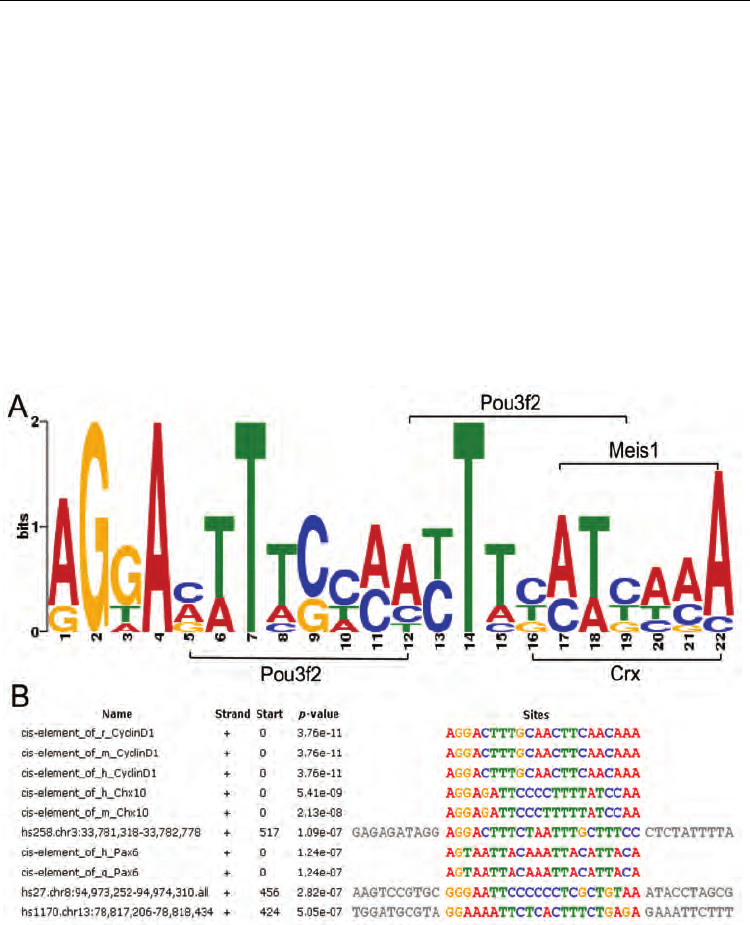
Interestingly, three common TFBSs (i.e., Pou3f2, Crx, and Meis1) were present among
enhancer elements hs27, hs258, and hs1170 (see Tables 1, 3). Sequence alignment of the three
enhancer elements and cis-elements of RPC-specific genes (e.g., Chx10, Cyclin D1, and Pax6)
revealed another 22 bp motif (Fig. 2). Crx binding sites were present on enhancer elements
hs546 and hs1170, while Hes1 binding sites were present on enhancer element hs546. Since
these two enhancer elements (hs1170 and hs546) were both located in the non-coding region
between Nr2f1 and Arrdc3, and since Arrdc3 was not active at E11.5 in the retina, the
binding of Crx and Hes1 may participate in regulating the expression of Nr2f1. This result is
supported by the finding that both Crx (Peng et al., 2005) and Nr2f1 (Inoue et al., 2010; Satoh
et al., 2009) play a role in inducing photoreceptor cell fate, though at different stages. In
addition, Crx has been shown to be expressed in bipolar cells, paired with Otx2 and Pou3f2,
in binding with a 164bp Chx10 enhancer (Kim et al., 2008a). Hes1 has been shown to be
active during early eye formation. By suppressing Math5, Hes1 was shown to be involved in
the development of cone photoreceptors, amacrine, horizontal and ganglion cells from the
RPCs (Le et al., 2006; Lee et al., 2005).
Fig. 2. A 22 bp motif is present in a subset of enhancer elements and cis-elements of RPC-
specific genes, (e.g., Chx10, Cyclin D1, Pax6). Sequence alignment was performed using
MEME among enhance elements (hs258, hs546, and hs1170) and cis-elements of genes
Chx10, Cyclin D1, Pax6. A. a SeqLog presentation of the 22bp motif . This 22 bp motif
contains binding sites for 3 factors: Pou3f2, Meis1 and Crx. B. Sequence alignment between
elements mentioned above. Abbreviation: r, rat; m, mouse; h, human; q, quail.

Prediction of Transcriptional Regulatory Networks for Retinal Development
365
Meis1 together with Meis2, as members of the TALE-homeodomain protein Homothorax
(Hth) related protein family, were known to be expressed in the RPCs of mouse and chick
(Heine et al., 2008). Meis1 was expressed in RPCs throughout the entire neurogenesis
period, and Meis2 was expressed more specifically in RPCs before the initiation of retina
differentiation. Together, they function to maintain the RPCs in a rapid proliferating state
and control the expression of other ocular genes, e.g., Pax6, CyclinD1, Six3 and Chx10 (Bessa
et al., 2008; Heine et al., 2008). Since Meis1 binding sites are present in a subset of retina-
specific enhancers, Meis1 may function as an RPC-specific factor. Since the onset of mouse
retina neurogenesis is approximately at E10.5 when the ganglion cells first appear (Leo M.
Chalupa, 2008). By E11.5, RPCs of all six cell types are highly active. Therefore, binding of
Meis1 with enhancers might influence the cell fate of these RPCs.
The presence of common Pbx2 binding sites may indicate a novel functional role of Pbx2 in
RPCs, since the function of Pbx2 in retinal development has not been documented. Previous
studies have shown that Pbx2 is expressed in the zebrafish retina and tectum (French et al.,
2007) together with Pbx1 and Meis1, and down-regulation in their expression caused by the
deficiency of Prep, the prolyl endopeptidase will lead to eye anomalies (Deflorian et al.,
2004; Ferretti et al., 2006). Pbx and Meis proteins are major DNA-binding partners that form
abundant complexes (Chang et al., 1997). Thus, there is a possibility that Pbx2 may function
in the development of RPCs via the interaction with Meis1 and also regulate other RPC-
specific genes (e.g., Irx5, Nr2f1, etc) through enhancer binding (Table 1).
Tcf3 is not yet known to have a function in embryonic retinal development. However, since
Tcf3 binding sites are present among the retina-specific enhancer elements, and Tcf3 is
expressed in the retina during embryogenesis, its specific function in retinal development
needs to be confirmed.
2.5 Generation of transcriptional regulatory network for early retinal development
Based on the available expression data from VISTA Enhancer Browser and gene expression
databases (Table 2), it is known that these 8 enhancer elements and their common binding
trans-acting factors are active during embryonic development in the retina. Among the 8
retina-specific enhancer elements, we have identified 6 common trans-acting factors. These 6
predicted factors are experimentally verified key protein factors known to be involved in
regulating gene expression and cell differentiation of progenitor cells during embryonic
retinal development (Table 3).
Retina-specific gene expression is most likely determined by two kinds of interactions: (1)
the enhancers with their binding protein factors, and (2) the protein factors with their
interacting partners. The information about these interactions was used to generate the
transcriptional regulatory networks important for retinal development. Therefore,
transcriptional regulatory networks of embryonic retina were predicted based on these 6
common/key trans-acting factors (Table 3) and their known interacting partners (Table 5).
To construct retinal transcriptional regulatory networks, a java-based software program
named BioTapestry (Longabaugh et al., 2009) (http://www.biotapestry.org/, version 5.0.2)
was used to organize the factors and their known interacting partners. BioTapestry is a
network facilitating software program designed for dealing with systems that exhibit
increasingly complex over time, such as genetic regulatory networks. Its unique annotation
system allows the illustration of enhancer-regulated gene expression and connection
between factors. Experimental evidence can also be added to network elements after the
network was built, as a proof of particular interactions. We only used the presenting
Computational Biology and Applied Bioinformatics
366
function of BioTapestry here to show the networks of retinal development during early
neurogenesis. For better illustration, the network was mapped according to the 3-layer
structure of the mouse retina.
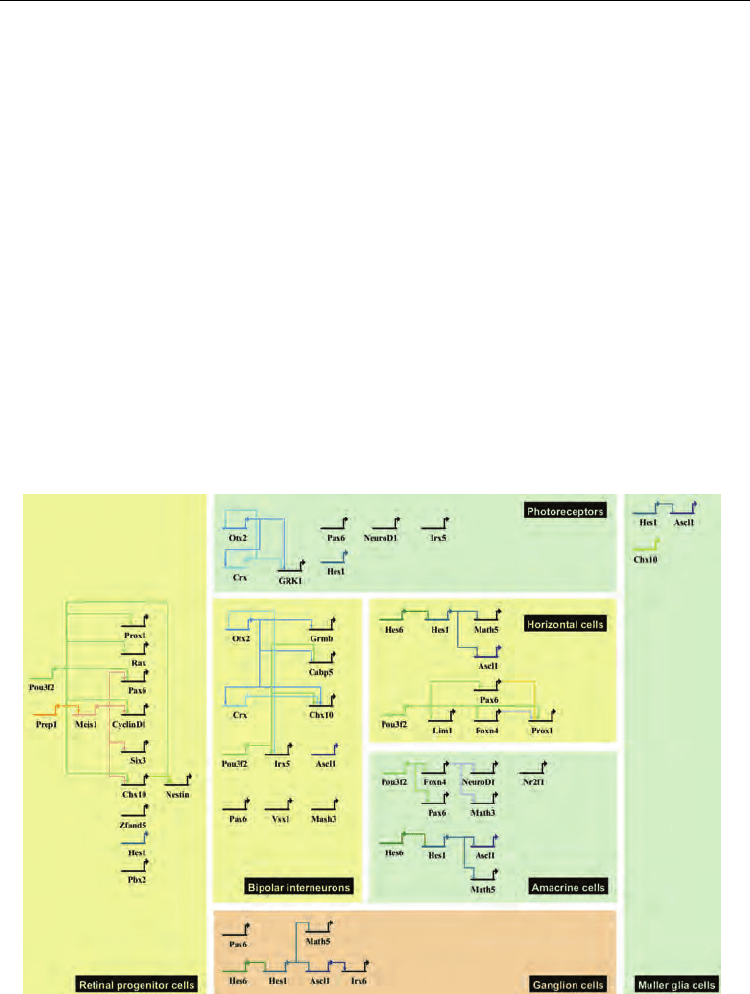
Based on the published information on the interacting factors of these 6 trans-acting factors
and their known functions in retinal cell development, we were able to build transcriptional
regulatory networks for all six major retinal cell types (Fig. 3). In RPCs, Meis1 is regulated
by Prep1 since it has been shown that insufficient Prep1 expression leads to a decrease in
Meis1 expression (Deflorian et al., 2004). Meis1 itself can regulate or interact with 4 other
factors (e.g., Pax6, CyclinD1, Six3 and Chx10) important to retinal cell differentiation (Bessa
et al., 2008; Heine et al., 2008). Crx, interacting with other factors (e.g, Otx2, Nrl and Nr2e3)
plays an important role in both cone and rod photoreceptor cell fate determination (Peng et
al., 2005). Crx can also influence Chx10 and Irx5 expression to affect the bipolar cell
formation (Cheng et al., 2005; Kerschensteiner et al., 2008; Kim et al., 2008a), which is similar
to the function of Pou3f2 (Kim et al., 2008a; Rowan and Cepko, 2005) and Otx2 (Kim et al.,
2008a). Another important factor is Hes1. Hes1 functions in maintaining RPC proliferation
(Wall et al., 2009) and regulating Math5, a critical factor for the generation of amacrine,
horizontal, and ganglion cells (Lee et al., 2005). In addition, Hes1 is regulated by Hes6 (Bae
et al., 2000). The Nr2f1 gene expresses in the retina in a gradient along the dorsal-ventral
axis and has been found to influence the development of amacrine cells. At the same time it
can affect cone and rod photoreceptors differentiation (Inoue et al., 2010). The references of
all genes/factors in the networks are listed in Table 5.
Fig. 3. Examples of transcriptional regulatory networks of embryonic retinal development.
Genes and factors are connected with arrows or bars to indicate the promoting and
suppressing relationship, respectively.