
Lowe D. Networking For Dummies
Подождите немного. Документ загружается.

Book IV
Chapter 1
Introduction to TCP/
IP and the Internet
287
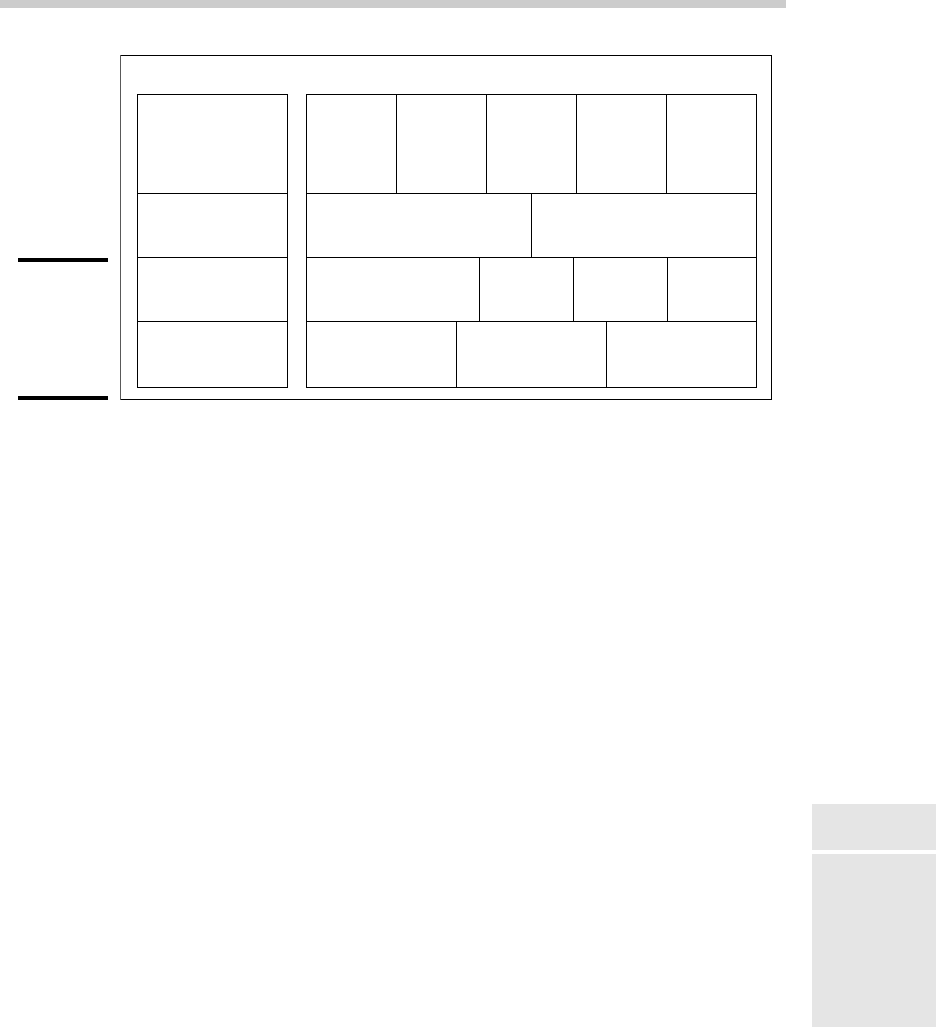
The TCP/IP Protocol Framework
Figure 1-1:
The four
layers of
the TCP/IP
framework.
Application Layer
TCP/IP Layers
Transport Layer
Network Layer
Network Interface
Layer
HTTP
TCP/IP Protocols
FTP Telnet SMTP DNS
TCP UDP
ARPIP ICMP IGMP
Ethernet Token Ring
Other Link-Layer
Protocols
Network layer
The Network layer is where data is addressed, packaged, and routed among
networks. Several important Internet protocols operate at the Network layer:
✦ Internet Protocol (IP): A routable protocol that uses IP addresses to
deliver packets to network devices. IP is an intentionally unreliable
protocol, so it doesn’t guarantee delivery of information.
✦ Address Resolution Protocol (ARP): Resolves IP addresses to hardware
MAC addresses, which uniquely identify hardware devices.
✦ Internet Control Message Protocol (ICMP): Sends and receives diagnostic
messages. ICMP is the basis of the ubiquitous ping command.
✦ Internet Group Management Protocol (IGMP): Used to multicast
messages to multiple IP addresses at once.
Transport layer
The Transport layer is where sessions are established and data packets are
exchanged between hosts. Two core protocols are found at this layer:
✦ Transmission Control Protocol (TCP): Provides reliable connection-
oriented transmission between two hosts. TCP establishes a session
between hosts, and then ensures delivery of packets between the hosts.
✦ User Datagram Protocol (UDP): Provides connectionless, unreliable,
one-to-one or one-to-many delivery.
30_625873-bk04ch01.indd 28730_625873-bk04ch01.indd 287 9/21/10 10:20 PM9/21/10 10:20 PM

288
The TCP/IP Protocol Framework
Application layer
The Application layer of the TCP/IP model corresponds to the Session,
Presentation, and Application layers of the OSI Reference Model. A few of the
most popular Application layer protocols are
✦ HyperText Transfer Protocol (HTTP): The core protocol of the World
Wide Web
✦ File Transfer Protocol (FTP): A protocol that enables a client to send
and receive complete files from a server
✦ Telnet: The protocol that lets you connect to another computer on the
Internet in a terminal emulation mode
✦ Simple Mail Transfer Protocol (SMTP): One of several key protocols
that are used to provide e-mail services
✦ Domain Name System (DNS): The protocol that allows you to refer to
other host computers by using names rather than numbers
30_625873-bk04ch01.indd 28830_625873-bk04ch01.indd 288 9/21/10 10:20 PM9/21/10 10:20 PM

Chapter 2: Understanding
IP Addresses
In This Chapter
✓ Delving into the binary system
✓ Digging into IP addresses
✓ Finding out how subnetting works
✓ Looking at network address translation
O
ne of the most basic components of TCP/IP is IP addressing. Every
device on a TCP/IP network must have a unique IP address. In this
chapter, I describe the ins and outs of these IP addresses. Enjoy!
Understanding Binary
Before you can understand the details of how IP addressing works, you need
to understand how the binary numbering system works because binary is
the basis of IP addressing. If you already understand binary, please skip to
the section, “Introducing IP Addresses.” I don’t want to bore you with stuff
that’s too basic.
Counting by ones
Binary is a counting system that uses only two numerals: 0 and 1. In the
decimal system (with which most people are accustomed), you use 10
numerals: 0–9. In an ordinary decimal number — such as 3,482 — the rightmost
digit represents ones; the next digit to the left, tens; the next, hundreds; the
next, thousands; and so on. These digits represent powers of ten: first 10
0
(which is 1); next, 10
1
(10); then 10
2
(100); then 10
3
(1,000); and so on.
In binary, you have only two numerals rather than ten, which is why binary
numbers look somewhat monotonous, as in 110011, 101111, and 100001.
The positions in a binary number (called bits rather than digits) represent
powers of two rather than powers of ten: 1, 2, 4, 8, 16, 32, and so on. To
figure the decimal value of a binary number, you multiply each bit by its
corresponding power of two and then add the results. The decimal value of
binary 10111, for example, is calculated as follows:
31_625873-bk04ch02.indd 28931_625873-bk04ch02.indd 289 9/21/10 10:20 PM9/21/10 10:20 PM

290
Understanding Binary
1 × 20 = 1 × 1 = 1
+ 1 × 21 = 1 × 2 = 2
+ 1 × 22 = 1 × 4 = 4
+ 0 × 23 = 0 × 8 = 0
+ 1 × 24 = 1 × 16 = _16
23
Fortunately, converting a number between binary and decimal is something
a computer is good at — so good, in fact, that you’re unlikely ever to need
to do any conversions yourself. The point of learning binary is not to be able
to look at a number such as 1110110110110 and say instantly, “Ah! Decimal
7,606!” (If you could do that, Barbara Walters would probably interview you,
and they would even make a movie about you — starring Dustin Hoffman.)
Instead, the point is to have a basic understanding of how computers store
information and — most important — to understand how the binary counting
system works, which I describe in the following section.
Here are some of the more interesting characteristics of binary and how the
system is similar to and differs from the decimal system:
✦ In decimal, the number of decimal places allotted for a number
determines how large the number can be. If you allot six digits, for
example, the largest number possible is 999,999. Because 0 is itself a
number, however, a six-digit number can have any of 1 million different
values.
Similarly, the number of bits allotted for a binary number determines
how large that number can be. If you allot eight bits, the largest value
that number can store is 11111111, which happens to be 255 in decimal.
✦ To quickly figure how many different values you can store in a binary
number of a given length, use the number of bits as an exponent
of two. An eight-bit binary number, for example, can hold 2
8
values.
Because 2
8
is 256, an eight-bit number can have any of 256 different
values. This is why a byte — eight bits — can have 256 different values.
✦ This “powers of two” thing is why computers don’t use nice, even,
round numbers in measuring such values as memory or disk space.
A value of 1K, for example, is not an even 1,000 bytes: It’s actually 1,024
bytes because 1,024 is 2
10
. Similarly, 1MB is not an even 1,000,000 bytes
but instead 1,048,576 bytes, which happens to be 2
20
.
One basic test of computer nerddom is knowing your powers of two
because they play such an important role in binary numbers. Just for
the fun of it, but not because you really need to know, Table 2-1 lists the
powers of two up to 32.
Table 2-1 also shows the common shorthand notation for various
powers of two. The abbreviation K represents 2
10
(1,024). The M in
MB stands for 2
20
, or 1,024K, and the G in GB represents 2
30
, which is
31_625873-bk04ch02.indd 29031_625873-bk04ch02.indd 290 9/21/10 10:20 PM9/21/10 10:20 PM

Book IV
Chapter 2
Understanding IP
Addresses
291
Understanding Binary
1,024MB. These shorthand notations don’t have anything to do with
TCP/IP, but they’re commonly used for measuring computer disk and
memory capacities, so I thought I’d throw them in at no charge because
the table had extra room.
Table 2-1 Powers of Two
Power Bytes Kilobytes Power Bytes K, MB,
or GB
2
1
22
17
131,072 128K
2
2
42
18
262,144 256K
2
3
82
19
524,288 512K
2
4
16 2
20
1,048,576 1MB
2
5
32 2
21
2,097,152 2MB
2
6
64 2
22
4,194,304 4MB
2
7
128 2
23
8,388,608 8MB
2
8
256 2
24
16,777,216 16MB
2
9
512 2
25
33,554,432 32MB
2
10
1,024 1K 2
26
67,108,864 64MB
2
11
2,048 2K 2
27
134,217,728 128MB
2
12
4,096 4K 2
28
268,435,456 256MB
2
13
8,192 8K 2
29
536,870,912 512MB
2
14
16,384 16K 2
30
1,073,741,824 1GB
2
15
32,768 32K 2
31
2,147,483,648 2GB
2
16
65,536 64K 2
32
4,294,967,296 4GB
Doing the logic thing
One of the great things about binary is that it’s very efficient at handling
special operations: namely, logical operations. Four basic logical operations
exist although additional operations are derived from the basic four operations.
Three of the operations — AND, OR, and XOR — compare two binary digits
(bits). The fourth (NOT) works on just a single bit.
The following list summarizes the basic logical operations:
✦ AND: An AND operation compares two binary values. If both values are
1, the result of the AND operation is 1. If one or both of the values are 0,
the result is 0.
31_625873-bk04ch02.indd 29131_625873-bk04ch02.indd 291 9/21/10 10:20 PM9/21/10 10:20 PM
292
Understanding Binary
✦ OR: An OR operation compares two binary values. If at least one of the
values is 1, the result of the OR operation is 1. If both values are 0, the
result is 0.
✦ XOR: An XOR operation compares two binary values. If exactly one of
them is 1, the result is 1. If both values are 0 or if both values are 1, the
result is 0.
✦ NOT: The NOT operation doesn’t compare two values. Instead, it simply
changes the value of a single binary value. If the original value is 1, NOT
returns 0. If the original value is 0, NOT returns 1.
Table 2-2 summarizes how AND, OR, and XOR work.
Table 2-2 Logical Operations for Binary Values
First Value Second Value AND OR XOR
00 000
01 011
10 011
11 110
Logical operations are applied to binary numbers that have more than one
binary digit by applying the operation one bit at a time. The easiest way to
do this manually is to line the two binary numbers on top of one another and
then write the result of the operation beneath each binary digit. The following
example shows how you would calculate 10010100 AND 11011101:
10010100
AND 11011101
10010100
As you can see, the result is 10010100.
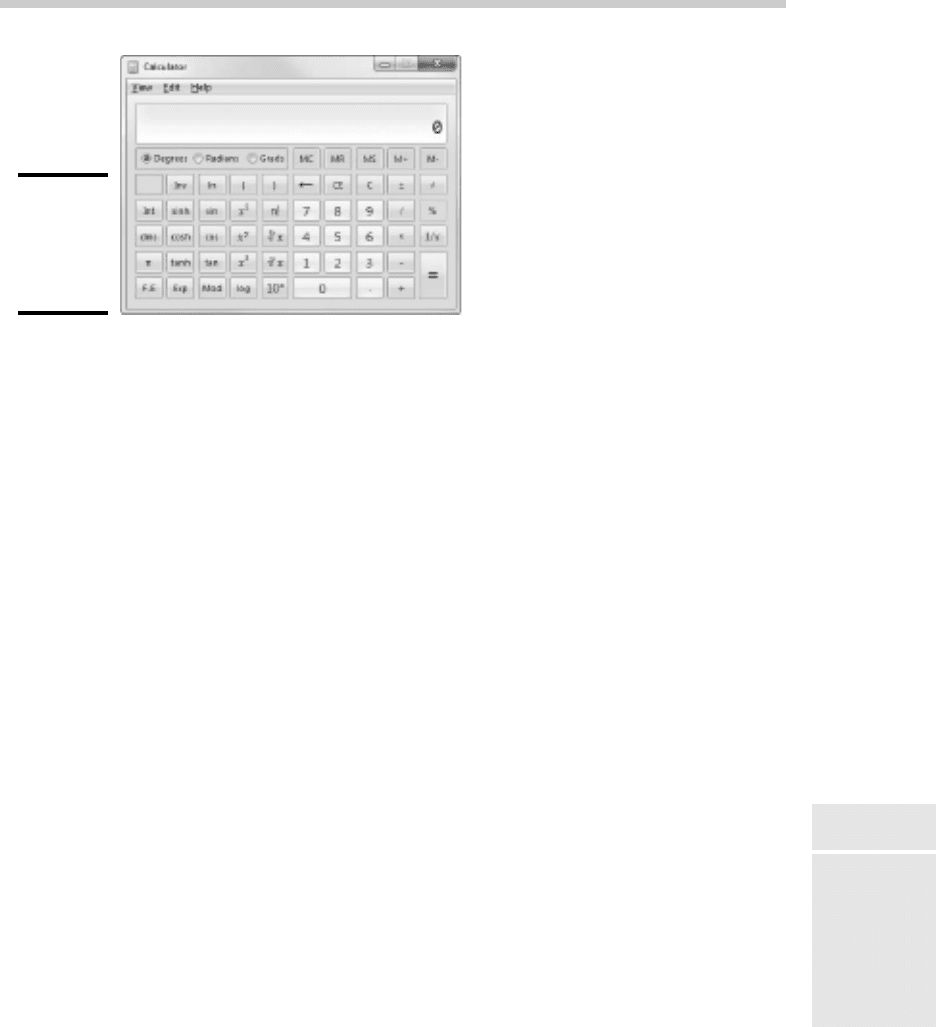
Working with the binary Windows Calculator
The Calculator program that comes with all versions of Windows has a
special Scientific mode that many users don’t know about. When you flip the
Calculator into this mode, you can do instant binary and decimal conversions,
which can occasionally come in handy when you’re working with IP addresses.
To use the Windows Calculator in Scientific mode, launch the Calculator
by choosing Start➪All Programs➪Accessories➪Calculator. Then, choose
the View➪Scientific command from the Calculator menu. The Calculator
changes to a fancy scientific model — the kind I paid $200 for when I was in
college. All kinds of buttons appear, as shown in Figure 2-1.
31_625873-bk04ch02.indd 29231_625873-bk04ch02.indd 292 9/21/10 10:20 PM9/21/10 10:20 PM
Book IV
Chapter 2
Understanding IP
Addresses
293
Introducing IP Addresses
Figure 2-1:
The free
Windows
scientific
Calculator.
You can select the Bin and Dec radio buttons to convert values between
decimal and binary. For example, to find the binary equivalent of decimal
155, enter 155 and then select the Bin radio button. The value in the display
changes to 10011011.
Here are a few other things to note about the Scientific mode of the
Calculator:
✦ Although you can convert decimal values to binary values with the
scientific Calculator, the Calculator can’t handle the dotted-decimal
IP address format that’s described later in this chapter. To convert a
dotted-decimal address to binary, just convert each octet separately.
For example, to convert 172.65.48.120 to binary, first convert 172; then
convert 65; then convert 48; and finally, convert 120.
✦ The scientific Calculator has several features that are designed specifically
for binary calculations, such as AND, XOR, NOT, NOR, and so on.
✦ The scientific Calculator can also handle hexadecimal conversions.
Hexadecimal doesn’t come into play when dealing with IP addresses, but
it is used for other types of binary numbers, so this feature sometimes
proves to be useful.
✦ Windows 7 does the scientific Calculator one step better by providing
a Programmer mode which has even more features for working with
binary numbers.
Introducing IP Addresses
An IP address is a number that uniquely identifies every host on an IP network.
IP addresses operate at the Network layer of the TCP/IP protocol stack, so
they are independent of lower-level Data Link layer MAC addresses, such as
Ethernet MAC addresses.
31_625873-bk04ch02.indd 29331_625873-bk04ch02.indd 293 9/21/10 10:20 PM9/21/10 10:20 PM

294
Introducing IP Addresses
IP addresses are 32-bit binary numbers, which means that theoretically,
a maximum of something in the neighborhood of 4 billion unique host
addresses can exist throughout the Internet. You’d think that would be
enough, but TCP/IP places certain restrictions on how IP addresses are
allocated. These restrictions severely limit the total number of usable IP
addresses. Many experts predict that we will run out of IP addresses as soon
as next year. However, new techniques for working with IP addresses have
helped to alleviate this problem, and a standard for 128-bit IP addresses has
been adopted, though it still is not yet in widespread use.
Networks and hosts
IP stands for Internet protocol, and its primary purpose is to enable
communications between networks. As a result, a 32-bit IP address actually
consists of two parts:
✦ The network ID (or network address): Identifies the network on which a
host computer can be found
✦ The host ID (or host address): Identifies a specific device on the network
indicated by the network ID
Most of the complexity of working with IP addresses has to do with figuring
out which part of the complete 32-bit IP address is the network ID and which
part is the host ID, as described in the following sections.
As I describe the details of how host IDs are assigned, you may notice that
two host addresses seem to be unaccounted for. For example, the Class C
addressing scheme, which uses eight bits for the host ID, allows only 254
hosts — not the 256 hosts you’d expect. That’s because host 0 (the host ID
is all zeros) is always reserved to represent the network itself. The host ID
can’t be 255 (the host ID is all ones) because that host ID is reserved for use
as a broadcast request that’s intended for all hosts on the network.
The dotted-decimal dance
IP addresses are usually represented in a format known as dotted-decimal
notation. In dotted-decimal notation, each group of eight bits — an octet — is
represented by its decimal equivalent. For example, consider the following
binary IP address:
11000000101010001000100000011100
To convert this value to dotted-decimal notation, first divide it into four
octets, as follows:
11000000 10101000 10001000 00011100
31_625873-bk04ch02.indd 29431_625873-bk04ch02.indd 294 9/21/10 10:20 PM9/21/10 10:20 PM
Book IV
Chapter 2
Understanding IP
Addresses
295
Classifying IP Addresses
Then, convert each of the octets to its decimal equivalent:
11000000 10101000 10001000 00011100
192 168 136 28
Then, use periods to separate the four decimal numbers, like this:
192.168.136.28
This is the format in which you’ll usually see IP addresses represented.
Figure 2-2 shows how the 32 bits of an IP address are broken down into four
octets of eight bits each. As you can see, the four octets of an IP address are
often referred to as w, x, y, and z.
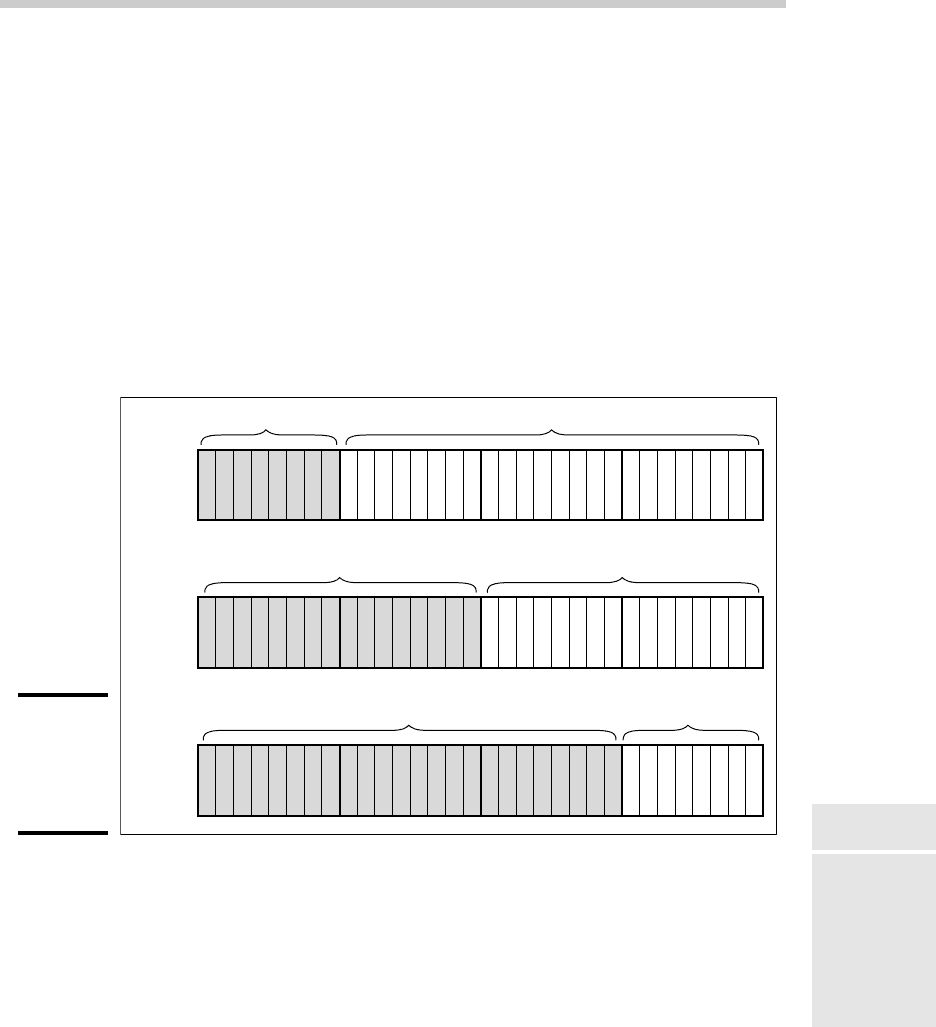
Figure 2-2:
Octets and
dotted-
decimal
notation.
Class A
Network ID
Host ID
0
Class B
Network ID
Host ID
10
Class C
Host ID
Network ID
1 10
Classifying IP Addresses
When the original designers of the IP protocol created the IP addressing
scheme, they could have assigned an arbitrary number of IP address bits
for the network ID. The remaining bits would then be used for the host ID.
For example, suppose that the designers decided that half of the address
(16 bits) would be used for the network, and the remaining 16 bits would be
used for the host ID. The result of that scheme would be that the Internet
could have a total of 65,536 networks, and each of those networks could
have 65,536 hosts.
31_625873-bk04ch02.indd 29531_625873-bk04ch02.indd 295 9/21/10 10:20 PM9/21/10 10:20 PM
296
Classifying IP Addresses
In the early days of the Internet, this scheme probably seemed like several
orders of magnitude more than would ever be needed. However, the IP
designers realized from the start that few networks would actually have tens
of thousands of hosts. Suppose that a network of 1,000 computers joins the
Internet and is assigned one of these hypothetical network IDs. Because that
network will use only 1,000 of its 65,536 host addresses, more than 64,000 IP
addresses would be wasted.
As a solution to this problem, the idea of IP address classes was introduced.
The IP protocol defines five different address classes: A, B, C, D, and E. Each
of the first three classes, A–C, uses a different size for the network ID and
host ID portion of the address. Class D is for a special type of address called
a multicast address. Class E is an experimental address class that isn’t used.
The first four bits of the IP address are used to determine into which class a
particular address fits, as follows:
✦ If the first bit is zero, the address is a Class A address.
Most of the current Internet is based on version
4 of the Internet Protocol, also known as IPv4.
IPv4 has served the Internet well for more than
20 years. However, the growth of the Internet
has put a lot of pressure on IPv4’s limited 32-bit
address space. This chapter describes how
IPv4 has evolved to make the best possible
use of 32-bit addresses. Eventually, though, all
the addresses will be assigned, and the IPv4
address space will be filled to capacity. When
that happens, the Internet will have to migrate
to the next version of IP, known as IPv6.
IPv6 is also called IP next generation, or IPng,
in honor of the favorite television show of most
Internet gurus, Star Trek: The Next Generation.
IPv6 offers several advantages over IPv4,
but the most important is that it uses 128 bits
for Internet addresses instead of 32 bits. The
number of host addresses possible with 128
bits is a number so large that it would have
made Carl Sagan proud. It doesn’t just double
or triple the number of available addresses, or
even a thousand-fold or even a million-fold.
Just for the fun of it, here is the number of
unique Internet addresses provided by IPv6:
340,282,366,920,938,463,463,374,607,431,768,21
1,456
This number is so large it defies understanding.
If the IANA had been around at the creation
of the universe and started handing out IPv6
addresses at a rate of one per millisecond —
that is, 1,000 addresses every second —
it would now, 15 billion years later, have not
yet allocated even 1 percent of the available
addresses.
The transition from IPv4 to IPv6 has been a
slow one. IPv6 is available on all new comput-
ers and has been supported on Windows since
Windows XP Service Pack 1 (released in 2002).
However, most Internet service providers
(ISPs) still base their service on IPv4. Thus, the
Internet will continue to be driven by IPv4 for at
least a few more years.
What about IPv6?
31_625873-bk04ch02.indd 29631_625873-bk04ch02.indd 296 9/21/10 10:20 PM9/21/10 10:20 PM