
Lowe D. Networking For Dummies
Подождите немного. Документ загружается.


Book IV
Chapter 2
Understanding IP
Addresses
297
Classifying IP Addresses
✦ If the first bit is one and if the second bit is zero, the address is a Class
B address.
✦ If the first two bits are both one and if the third bit is zero, the address
is a Class C address.
✦ If the first three bits are all one and if the fourth bit is zero, the
address is a Class D address.
✦ If the first four bits are all one, the address is a Class E address.
Because Class D and E addresses are reserved for special purposes, I focus
the rest of the discussion here on Class A, B, and C addresses. Table 2-3
summarizes the details of each address class.
Table 2-3 IP Address Classes
Class Address Number
Range
Starting
Bits
Length of
Network ID
Number of
Networks
Hosts
A
1–126.x.y.z
0 8 126 16,777,214
B
128–191.x.y.z
10 16 16,384 65,534
C
192–223.x.y.z
110 24 2,097,152 254
Class A addresses
Class A addresses are designed for very large networks. In a Class A address,
the first octet of the address is the network ID, and the remaining three
octets are the host ID. Because only eight bits are allocated to the network
ID and the first of these bits is used to indicate that the address is a Class A
address, only 126 Class A networks can exist in the entire Internet. However,
each Class A network can accommodate more than 16 million hosts.
Only about 40 Class A addresses are actually assigned to companies or
organizations. The rest are either reserved for use by the Internet Assigned
Numbers Authority (IANA) or are assigned to organizations that manage IP
assignments for geographic regions such as Europe, Asia, and Latin America.
Just for fun, Table 2-4 lists some of the better-known Class A networks. You’ll
probably recognize many of them. In case you’re interested, you can find a
complete list of all the Class A address assignments at
www.iana.org/assignments/ipv4-address-space
You may have noticed in Table 2-3 that Class A addresses end with
126.x.y.z, and Class B addresses begin with 128.x.y.z. What happened
to 127.x.y.z? This special range of addresses is reserved for loopback
testing, so these addresses aren’t assigned to public networks.
31_625873-bk04ch02.indd 29731_625873-bk04ch02.indd 297 9/21/10 10:20 PM9/21/10 10:20 PM

298
Classifying IP Addresses
Table 2-4 Some Well-Known Class A Networks
Net Description Net Description
3 General Electric Company 32 Norsk
Informasjonsteknology
4 Bolt Beranek and Newman
Inc.
33 DLA Systems Automation
Center
6 Army Information Systems
Center
35 MERIT Computer Network
8 Bolt Beranek and Newman
Inc.
38 Performance Systems
International
9 IBM 40 Eli Lilly and Company
11 DoD Intel Information
Systems
43 Japan Inet
12 AT&T Bell Laboratories 44 Amateur Radio Digital
Communications
13 Xerox Corporation 45 Interop Show Network
15 Hewlett-Packard Company 46 Bolt Beranek and Newman
Inc.
16 Digital Equipment
Corporation
47 Bell-Northern Research
17 Apple Computer Inc. 48 Prudential Securities Inc.
18 MIT 51 Department of Social
Security of UK
19 Ford Motor Company 52 E.I. duPont de Nemours and
Co., Inc.
20 Computer Sciences
Corporation
53 Cap Debis CCS (Germany)
22 Defense Information
Systems Agency
54 Merck and Co., Inc.
25 Royal Signals and Radar
Establishment
55 Boeing Computer Services
26 Defense Information
Systems Agency
56 U.S. Postal Service
28 Decision Sciences Institute
(North)
57 SITA
29–30 Defense Information
Systems Agency
31_625873-bk04ch02.indd 29831_625873-bk04ch02.indd 298 9/21/10 10:20 PM9/21/10 10:20 PM

Book IV
Chapter 2
Understanding IP
Addresses
299
Subnetting
Class B addresses
In a Class B address, the first two octets of the IP address are used as the
network ID, and the second two octets are used as the host ID. Thus, a Class
B address comes close to my hypothetical scheme of splitting the address
down the middle, using half for the network ID and half for the host ID. It
isn’t identical to this scheme, however, because the first two bits of the first
octet are required to be 10, in order to indicate that the address is a Class
B address. As a result, a total of 16,384 Class B networks can exist. All Class
B addresses fall within the range 128.x.y.z to 191.x.y.z. Each Class B
address can accommodate more than 65,000 hosts.
The problem with Class B networks is that even though they are much
smaller than Class A networks, they still allocate far too many host IDs. Very
few networks have tens of thousands of hosts. Thus, careless assignment
of Class B addresses can lead to a large percentage of the available host
addresses being wasted on organizations that don’t need them.
Class C addresses
In a Class C address, the first three octets are used for the network ID, and
the fourth octet is used for the host ID. With only eight bits for the host ID,
each Class C network can accommodate only 254 hosts. However, with 24
network ID bits, Class C addresses allow for more than 2 million networks.
The problem with Class C networks is that they’re too small. Although few
organizations need the tens of thousands of host addresses provided by a
Class B address, many organizations need more than a few hundred. The
large discrepancy between Class B networks and Class C networks is what
led to the development of subnetting, which I describe in the next section.
Subnetting
Subnetting is a technique that lets network administrators use the 32 bits
available in an IP address more efficiently by creating networks that aren’t
limited to the scales provided by Class A, B, and C IP addresses. With
subnetting, you can create networks with more realistic host limits.
Subnetting provides a more flexible way to designate which portion of an IP
address represents the network ID and which portion represents the host ID.
With standard IP address classes, only three possible network ID sizes exist:
8 bits for Class A, 16 bits for Class B, and 24 bits for Class C. Subnetting lets
you select an arbitrary number of bits to use for the network ID.
31_625873-bk04ch02.indd 29931_625873-bk04ch02.indd 299 9/21/10 10:20 PM9/21/10 10:20 PM

300
Subnetting
Two reasons compel people to use subnetting. The first is to allocate the
limited IP address space more efficiently. If the Internet were limited to Class
A, B, or C addresses, every network would be allocated 254, 64 thousand, or
16 million IP addresses for host devices. Although many networks with more
than 254 devices exist, few (if any) exist with 64 thousand, let alone 16 million.
Unfortunately, any network with more than 254 devices would need a Class
B allocation and probably waste tens of thousands of IP addresses.
The second reason for subnetting is that even if a single organization has
thousands of network devices, operating all those devices with the same
network ID would slow the network to a crawl. The way TCP/IP works
dictates that all the computers with the same network ID must be on the
same physical network. The physical network comprises a single broadcast
domain, which means that a single network medium must carry all the traffic
for the network. For performance reasons, networks are usually segmented
into broadcast domains that are smaller than even Class C addresses provide.
Subnets
A subnet is a network that falls within a Class A, B, or C network. Subnets are
created by using one or more of the Class A, B, or C host bits to extend the
network ID. Thus, instead of the standard 8-, 16-, or 24-bit network ID, subnets
can have network IDs of any length.
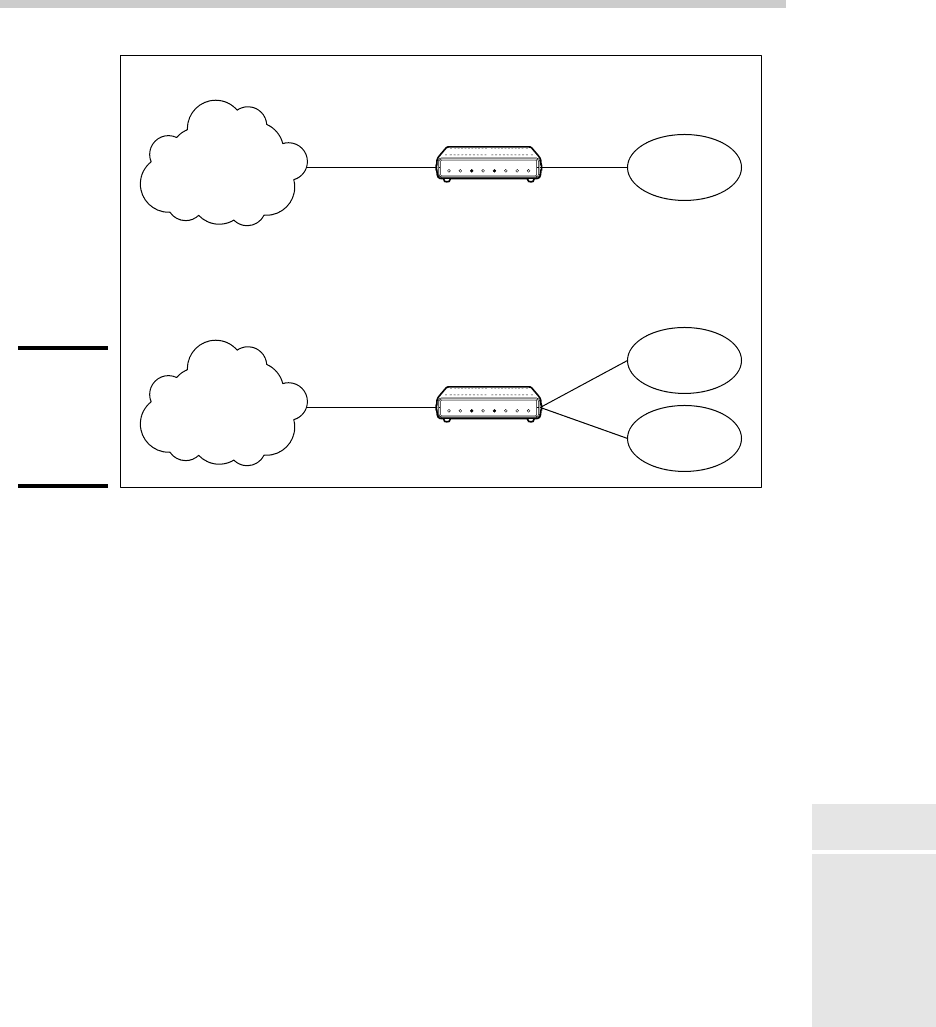
Figure 2-3 shows an example of a network before and after subnetting has
been applied. In the unsubnetted network, the network has been assigned
the Class B address 144.28.0.0. All the devices on this network must
share the same broadcast domain.
In the second network, the first four bits of the host ID are used to divide the
network into two small networks, identified as subnets 16 and 32. To the
outside world (that is, on the other side of the router), these two networks
still appear to be a single network identified as 144.28.0.0. For example,
the outside world considers the device at 144.28.16.22 to belong to the
144.28.0.0 network. As a result, a packet sent to this device will be deliv-
ered to the router at 144.28.0.0. The router then considers the subnet
portion of the host ID to decide whether to route the packet to subnet 16 or
subnet 32.
Subnet masks
For subnetting to work, the router must be told which portion of the host
ID should be used for the subnet network ID. This little sleight of hand is
accomplished by using another 32-bit number, known as a subnet mask.
Those IP address bits that represent the network ID are represented by a 1
in the mask, and those bits that represent the host ID appear as a 0 in the
mask. As a result, a subnet mask always has a consecutive string of ones on
the left, followed by a string of zeros.
31_625873-bk04ch02.indd 30031_625873-bk04ch02.indd 300 9/21/10 10:20 PM9/21/10 10:20 PM
Book IV
Chapter 2
Understanding IP
Addresses
301
Subnetting
Figure 2-3:
A network
before
and after
subnetting.
The Internet
144.28.0.0
Router
144.28.0.0
Before subnetting
The Internet
144.28.32.0
Router
144.28.0.0
144.28.16.0
After subnetting
For example, the subnet mask for the subnet shown in Figure 2-3, where the
network ID consists of the 16-bit network ID plus an additional 4-bit subnet
ID, would look like this:
11111111 11111111 11110000 00000000
In other words, the first 20 bits are ones, and the remaining 12 bits are zeros.
Thus, the complete network ID is 20 bits in length, and the actual host ID
portion of the subnetted address is 12 bits in length.
To determine the network ID of an IP address, the router must have both the
IP address and the subnet mask. The router then performs a bitwise operation
called a logical AND on the IP address in order to extract the network ID. To
perform a logical AND, each bit in the IP address is compared with the
corresponding bit in the subnet mask. If both bits are 1, the resulting bit in
the network ID is set to 1. If either of the bits are 0, the resulting bit is set to 0.
For example, here’s how the network address is extracted from an IP
address using the 20-bit subnet mask from the previous example:
144 . 28 . 16 . 17
IP address: 10010000 00011100 00010000 00010001
Subnet mask: 11111111 11111111 11110000 00000000
Network ID: 10010000 00011100 00010000 00000000
144 . 28 . 16 . 0
Thus, the network ID for this subnet is 144.28.16.0.
31_625873-bk04ch02.indd 30131_625873-bk04ch02.indd 301 9/21/10 10:20 PM9/21/10 10:20 PM
302
Subnetting
The subnet mask itself is usually represented in dotted-decimal notation. As
a result, the 20-bit subnet mask used in the previous example would be
represented as 255.255.240.0:
Subnet mask: 11111111 11111111 11110000 00000000
255 . 255 . 240 . 0
Don’t confuse a subnet mask with an IP address. A subnet mask doesn’t
represent any device or network on the Internet. It’s just a way of indicating
which portion of an IP address should be used to determine the network ID.
(You can spot a subnet mask right away because the first octet is always
255, and 255 is not a valid first octet for any class of IP address.)
Network prefix notation
Because a subnet mask always begins with a consecutive sequence of ones
to indicate which bits to use for the network ID, you can use a shorthand
notation — a network prefix — to indicate how many bits of an IP address
represent the network ID. The network prefix is indicated with a slash
immediately after the IP address, followed by the number of network ID bits
to use. For example, the IP address 144.28.16.17 with the subnet mask
255.255.240.0 can be represented as 144.28.16.17/20 because the
subnet mask 255.255.240.0 has 20 network ID bits.
Network prefix notation is also called classless interdomain routing notation
(CIDR, for short) because it provides a way of indicating which portion of an
address is the network ID and which is the host ID without relying on standard
address classes.
Default subnets
The default subnet masks are three subnet masks that correspond to the
standard Class A, B, and C address assignments. These default masks are
summarized in Table 2-5.
Table 2-5 The Default Subnet Masks
Class Binary Dotted-Decimal Network
Prefix
A
11111111 00000000
00000000 00000000
255.0.0.0 /8
B
11111111 11111111
00000000 00000000
255.255.0.0 /16
C
11111111 11111111
11111111 00000000
255.255.255.0 /24
31_625873-bk04ch02.indd 30231_625873-bk04ch02.indd 302 9/21/10 10:20 PM9/21/10 10:20 PM
Book IV
Chapter 2
Understanding IP
Addresses
303
Subnetting
Keep in mind that a subnet mask is not actually required to use one of these
defaults because the IP address class can be determined by examining the
first three bits of the IP address. If the first bit is 0, the address is Class A,
and the subnet mask 255.0.0 is applied. If the first two bits are 10, the
address is Class B, and 255.255.0.0 is used. If the first three bits are 110,
the Class C default mask 255.255.255.0 is used.
The great subnet roundup
You should know about a few additional restrictions that are placed on
subnets and subnet masks. In particular
✦ The minimum number of network ID bits is eight. As a result, the first
octet of a subnet mask is always 255.
✦ The maximum number of network ID bits is 30. You have to leave at
least two bits for the host ID portion of the address to allow for at least
two hosts. If you use all 32 bits for the network ID, that leaves no bits
for the host ID. Obviously, that won’t work. Leaving just one bit for the
host ID won’t work, either, because a host ID of all ones is reserved for a
broadcast address, and all zeros refers to the network itself. Thus, if you
use 31 bits for the network ID and leave only 1 for the host ID, host ID
1 would be used for the broadcast address, and host ID 0 would be the
network itself, leaving no room for actual hosts. That’s why the maximum
network ID size is 30 bits.
✦ Because the network ID portion of a subnet mask is always composed
of consecutive bits set to 1, only eight values are possible for each
octet of a subnet mask: 0, 128, 192, 224, 248, 252, 254, and 255.
✦ A subnet address can’t be all zeros or all ones. Thus, the number of
unique subnet addresses is two less than two raised to the number of
subnet address bits. For example, with three subnet address bits, six
unique subnet addresses are possible (2
3
– 2 = 6). This implies that you
must have at least two subnet bits. (If a single-bit subnet mask were
allowed, it would violate the “can’t be all zeros or all ones” rule because
the only two allowed values would be 0 or 1.)
IP block parties
A subnet can be thought of as a range or block of IP addresses that have a
common network ID. For example, the CIDR 192.168.1.0/28 represents
the following block of 14 IP addresses:
192.168.1.1 192.168.1.2 192.168.1.3 192.168.1.4
192.168.1.5 192.168.1.6 192.168.1.7 192.168.1.8
192.168.1.9 192.168.1.10 192.168.1.11 192.168.1.12
192.168.1.13 192.168.1.14
31_625873-bk04ch02.indd 30331_625873-bk04ch02.indd 303 9/21/10 10:20 PM9/21/10 10:20 PM

304
Subnetting
Given an IP address in CIDR notation, it’s useful to be able to determine
the range of actual IP addresses that the CIDR represents. This matter is
straightforward when the octet within which the network ID mask ends
happens to be 0, as in the preceding example. You just determine how many
host IDs are allowed based on the size of the network ID and count them off.
However, what if the octet where the network ID mask ends is not 0? For
example, what are the valid IP addresses for 192.168.1.100 when the
subnet mask is 255.255.255.240? In that case, the calculation is a little
harder. The first step is to determine the actual network ID. You can do that
by converting both the IP address and the subnet mask to binary and then
extracting the network ID as in this example:
192 . 168 . 1 . 100
IP address: 11000000 10101000 00000001 01100100
Subnet mask: 11111111 11111111 11111111 11110000
Network ID: 11000000 10101000 00000001 01100000
192 . 168 . 1 . 96
As a result, the network ID is 192.168.1.96.
Next, determine the number of allowable hosts in the subnet based on the
network prefix. You can calculate this by subtracting the last octet of the
subnet mask from 254. In this case, the number of allowable hosts is 14.
To determine the first IP address in the block, add 1 to the network ID.
Thus, the first IP address in my example is 192.168.1.97. To determine
the last IP address in the block, add the number of hosts to the network
ID. In my example, the last IP address is 192.168.1.110. As a result, the
192.168.1.100 with subnet mask 255.255.255.240 designates the
following block of IP addresses:
192.168.1.97 192.168.1.98 192.168.1.99 192.168.1.100
192.168.1.101 192.168.1.102 192.168.1.103 192.168.1.104
192.168.1.105 192.168.1.106 192.168.1.107 192.168.1.108
192.168.1.109 192.168.1.110
Private and public addresses
Any host with a direct connection to the Internet must have a globally
unique IP address. However, not all hosts are connected directly to the
Internet. Some are on networks that aren’t connected to the Internet. Some
hosts are hidden behind firewalls, so their Internet connection is indirect.
Several blocks of IP addresses are set aside just for this purpose, for use
on private networks that are not connected to the Internet or to use on
networks that are hidden behind a firewall. Three such ranges of addresses
exist, summarized in Table 2-6. Whenever you create a private TCP/IP network,
you should use IP addresses from one of these ranges.
31_625873-bk04ch02.indd 30431_625873-bk04ch02.indd 304 9/21/10 10:20 PM9/21/10 10:20 PM
Book IV
Chapter 2
Understanding IP
Addresses
305
Network Address Translation
Table 2-6 Private Address Spaces
CIDR Subnet Mask Address Range
10.0.0.0/8 255.0.0.0 10.0.0.1–10.255.255.254
172.16.0.0/12 255.255.240.0 172.16.1.1–172.31.255.254
192.168.0.0/16 255.255.0.0 192.168.0.1–192.168.255.254
Network Address Translation
Many firewalls use a technique called network address translation (NAT) to
hide the actual IP address of a host from the outside world. When that’s the
case, the NAT device must use a globally unique IP to represent the host to
the Internet. Behind the firewall, though, the host can use any IP address it
wants. When packets cross the firewall, the NAT device translates the private
IP address to the public IP address and vice versa.
One of the benefits of NAT is that it helps to slow down the rate at which the
IP address space is assigned. That’s because a NAT device can use a single
public IP address for more than one host. It does so by keeping track of
outgoing packets so that it can match incoming packets with the correct
host. To understand how this works, consider the following sequence of steps:
1. A host whose private address is 192.168.1.100 sends a request to
216.239.57.99, which happens to be www.google.com. The NAT
device changes the source IP address of the packet to 208.23.110.22,
the IP address of the firewall. That way, Google will send its reply back
to the firewall router. The NAT records that 192.168.1.100 sent a
request to 216.239.57.99.
2. Now another host, at address 192.168.1.107, sends a request to
207.46.134.190, which happens to be www.microsoft.com. The
NAT device changes the source of this request to 208.23.110.22 so
that Microsoft will reply to the firewall router. The NAT records that
192.168.1.107 sent a request to 207.46.134.190.
3. A few seconds later, the firewall receives a reply from 216.239.57.99.
The destination address in the reply is 208.23.110.22, the address
of the firewall. To determine to whom to forward the reply, the firewall
checks its records to see who is waiting for a reply from 216.239.57.99.
It discovers that 192.168.1.100 is waiting for that reply, so it changes
the destination address to 192.168.1.100 and sends the packet on.
Actually, the process is a little more complicated than that, because it’s very
likely that two or more users may have pending requests from the same
public IP. In that case, the NAT device uses other techniques to figure out to
which user each incoming packet should be delivered.
31_625873-bk04ch02.indd 30531_625873-bk04ch02.indd 305 9/21/10 10:20 PM9/21/10 10:20 PM

306
Book IV: TCP/IP and the Internet
31_625873-bk04ch02.indd 30631_625873-bk04ch02.indd 306 9/21/10 10:20 PM9/21/10 10:20 PM