
Mann U. Principles of Chemical Reactor Analysis and Design: New Tools for Industrial Chemical Reactor Operations
Подождите немного. Документ загружается.

consists of chemical reactions with the least number of species, we apply the
reduced matrix to identify independent species composition specifications. To
determine the extents of the independent chemical reactions, we usually specify
either the amount of individual species (moles of molar flow rates) or a quantity
related to all the independent reactions (total number of moles, pressure of the
system, etc.) together with compositions of certain species. Note that specifications
of species mole fractions contain information on the total number of moles or, for
flow reactors, on the molar flow rate.
To identify independent species composition specifications, we adopt the fol-
lowing procedure:
1. Construct a matrix of stoichiometric coefficients for the given reactions, and
then reduce it to the reduced matrix (see Section 2.4) using Gaussian
elimination.
2. Select a species (a nonzero stoichiometric coefficient) to relate to the first
reaction, and then remove the column and the row from the reduced matrix.
3. Repeat step (2) for the remaining reactions until we complete the matrix. The
species that we selected provide independent species compositions.
4. If the given data relates to the total number of moles rather than individual
species (e.g., pressure), we add another column to the reduced matrix, con-
taining the D factors (defined by Eq. 2.2.5) for each reaction in the reduced
matrix. We treat the D column as the measurable quantity that relates to
the sum of species.
For example, for Reactions 2.8.1 and 2.8.2, the reduced matrix is
THBMD
1 1 110
01201
(2:8:4)
The two rows in Matrix 2.8.4 correspond to Reactions 2.8.1 and 2.8.3, respectively.
If we select methane (M) to relate to Reaction 2.8.3, we now remove the fourth
column and the first row. We can now select either H, B, or D to relate to
Reaction 2.8.3. Adding the D factor column to Matrix 2.8.4,
THBMDD
1 1 1100
012010
(2:8:5)
Matrix 2.8.5 indicates that information on the total molar content in not useful in
this case.
70 STOICHIOMETRY

Example 2.13 Consider the chemical reactions of Example 2.12:
Reaction 1: 4NH
3
þ 5O
2
! 4NO þ 6H
2
O
Reaction 2: 4NH
3
þ 3O
2
! 2N
2
þ 6H
2
O
Reaction 3: NO þ O
2
! 2NO
2
Reaction 4: 4NH
3
þ 6NO ! 5N
2
þ 6H
2
O
Identify a set of species compositions that can be specified to determine the
extents when one of the measurable quantities is the pressure.
Solution The reduced matrix for this case was derived in Example 2.12.
Adding to it the column of the D factors,
NH
3
O
2
NO H
2
ON
2
NO
2
D
4 5 46001
0120100
0040121
2
6
4
3
7
5
(a)
We select NH
3
to relate to the first reaction and remove the first row and first
column:
O
2
NO H
2
ON
2
NO
2
D
1 2010 0
0 40121
(b)
We select the total pressure to relate to the last reaction and remove the last row
and last column:
O
2
NO H
2
ON
2
NO
2
[1 2010]
(c)
From Matrix (c), we can select either O
2
, NO, or N
2
to relate to the last reaction.
Hence, we can specify the amount NH
3
and of any one of these species together
with the total pressure to determine the composition of the reactor. The reader is
challenged to check that when the amounts of NH
3
,H
2
O, and the pressure are
specified, we cannot determine the reactor composition.
2.8 INDEPENDENT SPECIES COMPOSITION SPECIFICATIONS 71
2.9 SUMMARY
In this chapter, we described a methodology to express the reactor composition in
terms of the chemical reactions taking place. We covered the following topics:
1. Selection of a chemical reaction as a basis for the calculation and defining its
stoichiometric coefficients
2. Extent of a chemical reaction and how to calculate it
3. Definition of conversion in batch and flow reactors and its relation to the
extent of a chemical reaction
4. A procedure to identify the limiting reactant of a chemical reaction
5. Relation between the composition of a reactor and the extents of independent
reactions
6. A method to determine the number of independent chemical reactions and
how to select a set of independent reactions
7. A method to express dependent chemical reactions in terms of the indepen-
dent reactions
8. The role of independent and dependent reactions in reactor calculations
For convenience, Table A.1 in Appendix A provides a summary of the definitions
and stoichiometric relations derived in this chapter.
PROBLEMS*
2.1
2
Equation 2.2.6 is the mathematical condition for a balanced chemical reac-
tion. Show that the total mass is conserved when this relation is applied.
Show that for a batch reactor M(0) ¼ M(t). Show that for steady-flow reac-
tor, the mass flow rates at the reactor inlet and outlet are identical.
2.2
2
The gas-phase decomposition reaction
C
2
H
6
! C
2
H
2
þ 2H
2
is being investigated in a batch, constant-volume isothermal reactor. The
reactor is charged with 20 mol of ethane, and the initial pressure is 2 atm.
*
Subscript 1 indicates simple problems that require application of equations provided in the text.
Subscript 2 indicates problems whose solutions require some more in-depth analysis and modifi-
cations of given equations. Subscript 3 indicates problems whose solutions require more comprehen-
sive analysis and involve application of several concepts. Subscript 4 indicates problems that require
the use of a mathematical software or the writing of a computer code to obtain numerical solutions.
72
STOICHIOMETRY
When the reaction is stopped, the pressure of the reactor is 5 atm. Assuming
ideal-gas behavior, calculate:
a. The extent of the reaction
b. The conversion of ethane
c. The partial pressure of H
2
and C
2
H
2
at the end of the reaction
2.3
2
Repeat Problem 2.2 where a mixture of 50% ethane and 50% hydrogen is
charged into the reactor. The initial pressure is 2 atm, and the final pressure
is 3 atm.
2.4
2
The gas-phase decomposition reaction
C
2
H
6
! C
2
H
4
þ H
2
is being investigated in an isobaric, batch reactor operated isothermally.
Initially, 10 mol of ethane (pure) are charged into the reactor. If the final
volume of the reactor is 80% larger than the initial volume, calculate:
a. The conversion
b. The reaction extent
c. The mole fraction of H
2
at the end of the operation
Assume ideal-gas behavior.
2.5
2
The gas-phase reaction
A ! 2R þ P
takes place in a constant-volume batch reactor. A thermal conductivity
detector is used to determine the progress of the reaction. The conductivity
reading is proportional to the sum of the concentrations of A and R. At the
beginning of the operation, 2 kmol of A and 1 kmol of P are charged into
the reactor and the conductivity reading is 120 (arbitrary units.) At time t,
the conductivity reading is 180. Calculate:
a. The conversion of reactant A at time t
b. The composition of the reactor at time t
2.6
2
In many organic substitution reactions, the product generated by the
reaction is prone to additional substitution. A semibatch reactor was used
to produce monochlorobenzene by reacting benzene with chlorine. The
reactor was charged with 20 mol of liquid benzene. A stream of gaseous
chlorine bubbled through the liquid, and the chlorine not reacted upon
was recycled. During the operation, monochlorobenzene reacted with the
chlorine to produce dichlorobenzene, and the dichlorobenzene reacted
with the chlorine to produce trichlorobenzene:
C
6
H
6
(l) þ Cl
2
(g) ! C
6
H
5
Cl(l) þ HCl(g)
PROBLEMS 73
C
6
H
5
Cl(l) þ Cl
2
(g) ! C
6
H
4
Cl
2
(l) þ HCl(g)
C
6
H
4
Cl
2
(l) þ Cl
2
(g) ! C
6
H
3
Cl
3
(l) þ HCl(g)
At the end of the operation, the reactor contained 11 mol of benzene and a
product mixture in which the amount of monochlorobenzene was three
times the amount of dichlorobenzene, and the amount of the latter was
twice the amount of trichlorobenzene. The total amount of chlorine fed
during the operation was 40 mol. Find:
a. The conversion of benzene
b. The composition of the reactor (liquid contents)
c. The amount of HCl produced
d. The conversion of chlorine
2.7
2
The dimerization reaction
2A ! R
is taking place in a liquid solution. The progress of the reaction is moni-
tored by an infrared (IR) analyzer whose signal is adjusted such that the
percent of the IR absorbed by the solution is proportional to the sum of
the concentrations of A and R. Initially, the solution contains 5 kmol of
A and no R, and the reading of the analyzer is 85%. At time t, the analyzer
reading is 60%. Calculate:
a. The extent of reaction at time t
b. The conversion at time t
c. The amount of R in the solution at time t
2.8
2
A gaseous fuel consisting of a mixture of methane (CH
4
) and ethane
(C
2
H
6
) is fed into a burner in a proportion of 1 mol of fuel per 20 mol of
air. The following reactions are believed to take place in the reactor:
CH
4
þ 2O
2
! CO
2
þ 2H
2
O
2C
2
H
6
þ 7O
2
! 4CO
2
þ 6H
2
O
An analysis of the flue gas (dry basis) indicates that it consists of 83.7% N
2
,
7.01% CO
2
, 9.15% O
2
, and 0.14% methane (percent mole). Calculate:
a. The composition of the fuel
b. The conversion of oxygen
c. The conversion of methane
d. The conversion of ethane
e. The excess amount of air used
74 STOICHIOMETRY
2.9
1
Ethylene oxide is produced by a catalytic reaction of ethylene and oxygen
at controlled conditions. However, side reactions cannot be completely pre-
vented, and it is believed that the following reactions take place:
2C
2
H
4
þ O
2
! 2C
2
H
4
O
C
2
H
4
þ 3O
2
! 2CO
2
þ 2H
2
O
C
2
H
4
þ 2O
2
! 2CO þ 2H
2
O
2CO þ O
2
! 2CO
2
CO þ H
2
O ! CO
2
þ H
2
a. Determine the number of independent reactions.
b. Choose a set of independent reactions among the given reactions above.
c. Express the dependent reactions in terms of the independent reactions.
2.10
2
Ammonium nitrate is a raw material used in the manufacture of agricultural
chemicals and explosives. The following reactions are believed to take
place in the production of ammonium nitrate:
4NH
3
þ 5O
2
! 4NO þ 6H
2
O
2NO þO
2
! 2NO
2
4NH
3
þ 7O
2
! 4NO
2
þ 6H
2
O
3NO
2
þ H
2
O ! 2HNO
3
þ NO
NH
3
þ HNO
3
! NH
4
NO
3
a. Determine the number of independent reactions.
b. Choose a set of independent reactions among the reactions above.
c. Express the dependent reactions in terms of the independent reactions.
2.11
1
In the reforming of methane, the following chemical reactions may occur:
CH
4
þ 2H
2
O ! CO
2
þ 4H
2
CH
4
þ 2O
2
! CO
2
þ 2H
2
O
2CH
4
þ O
2
! 2CH
3
OH
2CH
4
þ 3O
2
! 2CO þ 4H
2
O
CO
2
þ 3H
2
! CH
3
OH þ H
2
O
PROBLEMS 75
2CH
3
OH þ 3O
2
! 2CO
2
þ 4H
2
O
2CO þ O
2
! 2CO
2
CO þ H
2
O ! CO
2
þ H
2
a. Determine the number of independent reactions.
b. Choose a set of independent reactions from among the reactions above.
c. Express the dependent reactions in terms of the independent reactions.
2.12
1
Consider the classic mechanism of the reaction between hydrogen and
bromine to form hydrogen bromide (the asterisks indicate free radicals):
Br
2
! 2Br
Br
þ H
2
! HBr þ H
H
þ Br
2
! HBr þ Br
H
þ HBr ! H
2
! Br
2Br
! Br
2
a. Determine the number of independent reactions.
b. Identify a set of independent reactions from the reactions above.
c. Express the dependent reactions in terms of the independent reactions.
2.13
3
Methanol is being produced according to the reaction
CO þ 2H
2
! CH
3
OH
A synthesis gas stream consisting of 67.1% H
2
, 32.5% CO, and 0.4% CH
4
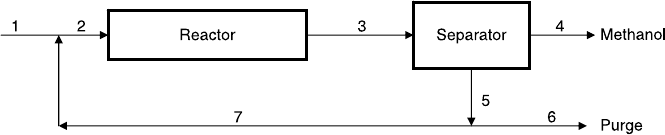
(by mole) is fed into the process described below at a rate of 100 mol/h.
The effluent stream from the reactor is fed into a separator (Fig. P2.13)
where the methanol is completely removed, and the unconverted reactants
are recycled to the reactor. To avoid the buildup of methane, a portion of
the recycled stream is purged. At present operating conditions, the CO
Figure P2.13 Methanol rector with a separator.
76 STOICHIOMETRY
conversion over the entire process is 90%, and the methane mole fraction at
the reactor inlet (stream 2) is 2.87%. Calculate:
a. The production rate of methanol
b. The flow rate of the purge stream (stream 6)
c. The composition of the purge stream
d. The portion of the recycle stream (stream 5) that is purged
e. The CO conversion per pass in the reactor
2.14
3
Solve Problem 2.13 for the following information. The CO conversion per
pass is 15%, and the methane mole fraction at the reactor inlet (stream 2) is
2.5%. Calculate:
a. The production rate of methanol
b. The flow rate of the purge stream (stream 6)
c. The composition of the purge stream
d. The portion of the recycle stream (stream 5) that is purged
e. The CO conversion in the process
2.15
2
The following reactions are believed to take place during the catalytic
oxidation of methane:
2CH
4
þ 3O
2
! 2CO þ 4H
2
O
CH
4
þ 2O
2
! CO
2
þ 2H
2
O
2CH
4
þ O
2
! 2CH
3
OH
CH
4
þ O
2
! HCHO þ H
2
O
CO þ H
2
O ! CO
2
þ H
2
CO þ 2H
2
! CH
3
OH
CO þ H
2
! HCHO
2CH
4
þ O
2
! 2CO þ 4H
2
2CO þ O
2
! 2CO
2
a. Determine the number of independent reactions.
b. Identify a set of independent reactions from the reactions above.
c. Express the dependent reactions in terms of the independent reactions.
2.16
2
Selective oxidation of hydrocarbons is a known method to produce alco-
hols. However, the alcohols react with the oxygen to produce aldehydes,
and the latter react with oxygen to produce organic acids. A 50 mol/s
stream consisting of 90% ethane and 10% nitrogen is mixed with a
PROBLEMS 77
40 mol/s airstream and fed into a catalytic reactor. The following reactions
take place in the reactor:
2C
2
H
6
þ O
2
! 2C
2
H
5
OH
2C
2
H
5
OH þ O
2
! 2CH
3
CHO þ 2H
2
O
2CH
3
CHO þO
2
! 2CH
3
COOH
The oxygen conversion is 80%, and the concentration of the ethanol in the
product stream is three times that of the aldehyde and four times that of the
acetic acid. Calculate:
a. The ethane conversion
b. The production rate of the ethanol
2.17
3
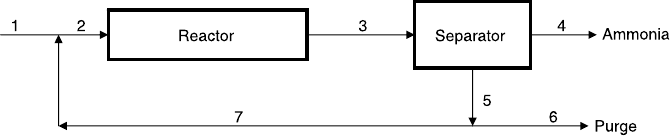
Ammonia is being produced by reacting nitrogen and hydrogen in the
system shown in Figure P2.17. The reaction is
N
2
þ 3H
2
! 2NH
3
The ammonia is removed completely in the separator. A feed stream con-
sisting of 2% argon (by mole) and stoichiometric proportion of the reac-
tants is fed into the system at the rate of 100 mol/min. The mole fraction
of argon in the purge stream (stream 6) is 5%, and the conversion per
pass in the reactor is 10%. Determine:
a. The production rate of ammonia
b. The overall (process) conversions of nitrogen and hydrogen
c. The flow rate of the recycle stream (stream 7)
2.18
3
A gaseous fuel consisting of a mixture of methane (CH
4
) and ethane
(C
2
H
6
) is fed into a burner in a proportion of 1 mol of fuel per 18 mol of
air. The following reactions are believed to take place in the reactor:
CH
4
þ 2O
2
! CO
2
þ 2H
2
O
2CH
4
þ 3O
2
! 2CO þ 4H
2
O
2C
2
H
6
þ 5O
2
! 4CO þ 6H
2
O
Figure P2.17 Ammonia rector with a separator.
78 STOICHIOMETRY
2C
2
H
6
þ 7O
2
! 4CO
2
þ 6H
2
O
2CO þ O
2
! 2CO
2
An analysis of the flue gas (dry basis) indicates that it consists of 7.71%
CO
2
, 0.51% CO, 7.41% O
2
, 84.32% of N
2
, and a trace amount of methane
and ethane (% mole). Calculate:
a. The composition of the fuel
b. The conversion of oxygen
c. The conversion of methane
d. The conversion of ethane
e. The excess amount of air used
2.19
3
Toluene (C
6
H
5
CH
3
) is hydrogenated according to the two simultaneous
chemical reactions
C
6
H
5
CH
3
þ H
2
! C
6
H
6
þ CH
4
(a)
2C
6
H
5
CH
3
þ H
2
! (C
6
H
6
)
2
þ 2CH
4
(b)
Initially, the reactor contains 40% toluene and 60% H
2
(% mole). At
the end of the operation, the reactor contains 10% toluene and 30% CH
4
(% mole). Find:
a. The mole fraction of the diphenyl, (C
6
H
5
)
2
, at the end of the operation
b. The conversion of H
2
c. Solve (a) and (b) when the following final composition is specified: The
reactor contains 10% toluene and 40% H
2
(% mole).
BIBLIOGRAPHY
Other treatments of stoichiometric coefficients, extent of chemical reactions, and
independent reactions can be found in:
R. Aris, Introduction to the Analysis of Chemical Reactors, Prentice-Hall, Englewood
Cliffs, NJ, 1965.
S. I. Sandler, Chemical and Engineering Thermodynamics, 2nd ed. Wiley, New York,
1989.
G. V. Reklaitis, Introduction to Material and Energy Balances, Wiley, New York, 1983.
BIBLIOGRAPHY 79