
Mann U. Principles of Chemical Reactor Analysis and Design: New Tools for Industrial Chemical Reactor Operations
Подождите немного. Документ загружается.


3
CHEMICAL KINETICS
This chapter covers the second fundamental concept used in chemical reaction
engineering—chemical kinetics. The kinetic relationships used in the analysis
and design of chemical reactors are derived and discussed. In Section 3.1, we dis-
cuss the various definitions of the species formation rates. In Section 3.2, we define
the rates of chemical reactions and discuss how they relate to the formation (or
depletion) rates of individual species. In Section 3.3, we discuss the rate expression
that provides the relationship between the reaction rate, the temperature, and species
concentrations. Without going into the theory of chemical kinetics, we review the
common forms of the rate expressions for homogeneous and heterogeneous reac-
tions. In the last section, we introduce and define a measure of the reaction
rate—the characteristic reaction time. In Chapter 4 we use the characteristic reaction
time to reduce the reactor design equations to dimensionless forms.
3.1 SPECIES FORMATION RATES
Consider a batch reactor with volume V where species j is formed (or consumed) by
chemical reactions. We denote the total moles of species j in the reactor by N
j
;
hence, the rate species j being formed in the reactor is dN
j
/dt. The magnitude of
dN
j
/dt depends, of course, on the size of the reactor. To define an intensive quantity
for the formation rate of species j, we consider the nature of the chemical reactions
that are taking place. For homogeneous chemical reactions (reactions that take
Principles of Chemical Reactor Analysis and Design, Second Edition. By Uzi Mann
Copyright # 2009 John Wiley & Sons, Inc.
81

place throughout a given phase), the volume-based species formation rate, (r
j
), is
defined by
(r
j
) ¼ (r
j
)
V
;
1
V
dN
j
dt
(3:1:1a)
Thus, (r
j
) is the formation rate of species j expressed in terms of moles of species j
formed per unit time per unit volume. For heterogeneous chemical reactions (reac-
tions that take place on the surface of a solid catalyst or at the interface of the two
phases), the surface-based formation rate of species j,(r
j
)
S
, is defined by
(r
j
)
S
;
1
S
dN
j
dt
(3:1:1b)
where (r
j
)
S
is expressed in terms of moles of species j formed per unit time per unit
surface area. In some cases, it is convenient to define the mass-based formation rate
of species j (on the basis of the mass of solid catalyst):
(r
j
)
W
;
1
W
dN
j
dt
(3:1:1c)
Here, (r
j
)
W
is the mass-based formation rate of species j expressed in moles of
species j formed per unit time per unit mass of catalyst.
From Eqs. 3.1.1a–3.1.1c, it is easy to show that
(r
j
) ¼
S
V
(r
j
)
S
(3:1:2)
(r
j
) ¼
W
V
(r
j
)
W
(3:1:3)
Hence, when any one of these rates is known, the other two can be determined if the
properties of the reactor (mass of solid catalyst per unit volume or catalyst surface
per unit volume) are provided.
Note that all these definitions do not relate to any specific chemical reaction but
rather to the net formation of species j, which may be formed simultaneously by
some reactions and consumed by others. Also, when species j is consumed, (r
j
)
is negative.
3.2 RATES OF CHEMICAL REACTIONS
Consider a specific chemical reaction and focus on the rate that it progresses. As
discussed in Section 2.2, we first have to select the chemical formula for this reac-
tion (select a basis for the calculation) and then express the progress of the reaction
82 CHEMICAL KINETICS

in terms of the extent of that formula. For a homogeneous chemical reaction, the
volume-based rate of a reaction is defined by
r ;
1
V
dX
dt
(3:2:1a)
where r denotes the reaction rate expressed in terms of moles extent per unit time
per unit volume. For heterogeneous reactions, the surface-based rate of the chemi-
cal reaction is defined by
r
S
;
1
S
dX
dt
(3:2:1b)
where r
S
is expressed in terms of moles extent per unit time per unit surface area.
Similarly, the mass-based rate of the chemical reaction is defined by
r
W
;
1
W
dX
dt
(3:2:1c)
where r
W
is expressed in terms of moles extent per unit time per unit mass. As
before, relationships among these three reaction rate definitions can be easily
obtained:
r ¼
S
V
r
S
(3:2:2)
r ¼
W
V
r
W
(3:2:3)
Next, we consider the relationship between the formation rates of individual
species and the rates of the chemical reactions. When a single chemical reaction
takes place, we can easily relate the rate of the chemical reaction, r, to the formation
rate of a specific species, say species j,(r
j
). Differentiating the definition of the reac-
tion extent (Eq. 2.3.1) with time,
dX
dt
¼
1
s
j
dn
j
dt
(3:2:4)
and by substituting this into Eq. 3.2.1a,
(r
j
) ¼ s
j
r (3:2:5)
Equation 3.2.5 provides a relationship between the reaction rate and the rate of
formation (or depletion) of any species j by that chemical reaction.
3.2 RATES OF CHEMICAL REACTIONS 83

When multiple chemical reactions take place simultaneously, species j may par-
ticipate in several reactions, formed by some and consumed by others. The change
in the molar content of species j in the reactor relates to its formation by all chemi-
cal reactions. Using the definition of the reaction extent (Eq. 2.3.1), the molar con-
tent relates to the reaction extents by
N
j
(t) N
j
(0) ¼
X
n
R
i¼1
(s
j
)
i
X
i
(t)
where n
R
is the number of reactions (reaction pathways). Differentiating this
expression with respect to time and substituting into Eq. 3.1.1a, the formation rate
of species j is
(r
j
) ¼
X
n
R
i¼1
(s
j
)
i
r
i
(3:2:6)
where (s
j
)
i
is the stoichiometric coefficient of species j in the ith chemical reaction,
and r
i
is the rate of the ith reaction. Equation 3.2.6 relates the formation rate of any
species to the rates of the chemical reactions. It is important to note that the sum-
mation in Eq. 3.2.6 is over all the chemical reactions that actually take place in the
reactor (both dependent and independent). Also, note that when a single chemical
reaction takes place, Eq. 3.2.6 reduces to Eq. 3.2.5.
Example 3.1 The heterogeneous catalytic chemical reaction
2C
2
H
4
þ O
2
! 2C
2
H
4
O
is investigated in a packed-bed reactor. The reactor is filled with catalytic pellets
whose surface area is 7 m
2
/g, and the density of the bed is 1.4 kg/L. The
measured consumption rate of ethylene is 0.35 mol/h g catalyst. Determine:
a. The volume-based and surface-based formation rates of ethylene
b. The volume-based rate of the chemical reaction
c. The volume-based formation rate of oxygen
d. The volume-based formation rate of ethylene oxide
Solution The stoichiometric coefficients of the chemical reaction are
s
C
2
H
4
¼2 s
O
2
¼1 s
C
2
H
4
O
¼ 2
The given mass-based formation rate of ethylene is 20.35 mol/h g (the minus
sign indicates that ethylene is consumed).
84 CHEMICAL KINETICS

a. Using Eq. 3.1.3, the volume-based formation rate of ethylene is
(r
C
2
H
4
) ¼
W
V
(r
C
2
H
4
)
W
¼ r
bed
(r
C
2
H
4
)
W
¼ 1:4
kg
L
0:35
mol Et
hg
1000 g
kg
¼490
mol Et
hL
(a)
To determine the surface-based formation rate of ethylene, we first calculate
the specific surface in the reactor:
S
V
¼
W
V
S
W
¼ r
bed
S
W
S
V
¼ (1:4kg=L)(7:0m
2
=kg)(1000 g=kg) ¼ 9800 m
2
=L (b)
Using Eq. 3.1.2, (a), and (b), the surface-based formation rate of ethylene is
(r
C
2
H
4
)
S
¼
490 mol Et =hL
9:80 10
3
m
2
=L
¼5:00 10
2
mol Et=hm
2
(c)
b. The volume-based rate of the reaction is determined by using Eq. 3.2.5
and (a):
r ¼
(r
C
2
H
4
)
s
C
2
H
4
¼
490 mol Et=hL
2 mol Et=mol extent
¼ 245 mol extent=h L (d)
c. The volume-based formation rate of oxygen is determined by using Eq. 3.2.5
and (d):
r
O
2
¼1
mol oxygen
mol extent
245
mol extent
hL
¼245 mol oxygen=h L (e)
The negative sign indicates that oxygen is consumed.
d. The volume-based formation rate of ethylene oxide is determined by using
Eq. 3.2.5 and (d):
r
C
2
H
4
O
¼ 2
mol oxide
mol extent
245
mol extent
hL
¼ 490 mol oxide=hL (f)
3.2 RATES OF CHEMICAL REACTIONS 85

3.3 RATE EXPRESSIONS OF CHEMICAL REACTIONS
The rate of a chemical reaction is a function of the temperature, the composition
of the reacting mixture, and, if present, the catalyst. The relationship between the
reaction rate and these parameters is commonly called the rate expression or,
sometimes, the rate law. Chemical kinetics is the branch of chemistry that deals
with reaction mechanisms and provides a theoretical basis for the rate expression.
When such information is available, we use it to obtain the rate expression. In many
instances, the reaction rate expression is not available and should be determined
experimentally.
For most chemical reactions, the rate expression is a product of two functions,
one of temperature, k(T ), and the second of species concentrations, h(C
j
’s):
r ¼ k(T)h(C
j
,
s) (3:3:1)
The function k(T ) is commonly called the reaction rate constant. However, note
that the reaction rate depends on the temperature. The term rate constant comes
about because k(T ) is independent of the composition and is constant at isothermal
operations.
For most chemical reactions, k(T ) relates to the temperature by the Arrhenius
equation:
k(T) ¼ k
0
e
E
a
=RT
(3:3:2)
where E
a
is a parameter called the activation energy, k
0
is a parameter called the
frequency factor or the preexponential coefficient, and R is the universal gas con-
stant. Both parameters are characteristic of the chemical reaction and the presence
(or absence) of a catalyst. The value of E
a
indicates the sensitivity of the reaction
rate to changes in temperature. When the activation energy is relatively large (200–
400 kJ/mol), the reaction rate is sensitive to temperature. Such values are typical of
combustion and gasification reactions that take place at high temperatures and are
very slow at room temperature. On the other hand, when the value of E
a
is relatively
low (20– 40 kJ/mol), the reaction rate is not insensitive to temperature. These
values are typical of biological and enzymatic reactions that take place at room
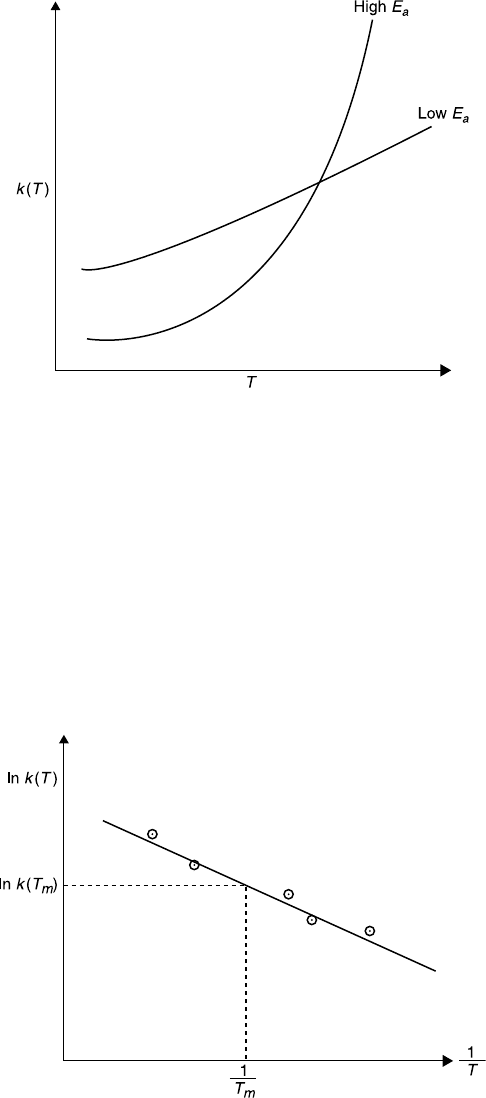
temperature. Figure 3.1 shows the relation between k and T for large and small acti-
vation energies.
The value of the rate constant at a given temperature is readily calculated when
both parameters in the Arrhenius equation, k
0
and E
a
, are known. However, it is
convenient to calculate the value of the rate constant at one temperature on the
basis of its value at a different temperature, using only the activation energy. To
obtain a relationship between the values of the reaction rate constant at two temp-
eratures, T
1
and T
2
, we take the log of Eq. 3.3.2 for each and combine the two
equations to obtain
ln
k(T
2
)
k(T
1
)
¼
E
a
R
1
T
2
1
T
1
(3:3:3)
86 CHEMICAL KINETICS
The values of the parameters in the Arrhenius equation, k
0
and E
a
, are deter-
mined from experimental measurements of the reaction rate constant, k(T ), at
different temperatures. Using Eq. 3.3.3, the plot ln k(T ) versus 1/T gives a straight
line with a slope of 2E
a
/R, as shown schematically in Figure 3.2. The value of k
0
can be determined from the intercept. However, this procedure is not accurate
because it involves an extrapolation far beyond the temperature range of the exper-
imental data. Instead, we first determine the slope and then use Figure 3.2 to obtain
the value of the rate constant at the average temperature, T
m
. We then calculate k
0
from Eq. 3.3.2 using the value of E
a
obtained from the slope (see Fig. 3.2).
Figure 3.1 Reaction rate constant as a function of temperature.
Figure 3.2 Determination of activation energy.
3.3 RATE EXPRESSIONS OF CHEMICAL REACTIONS 87
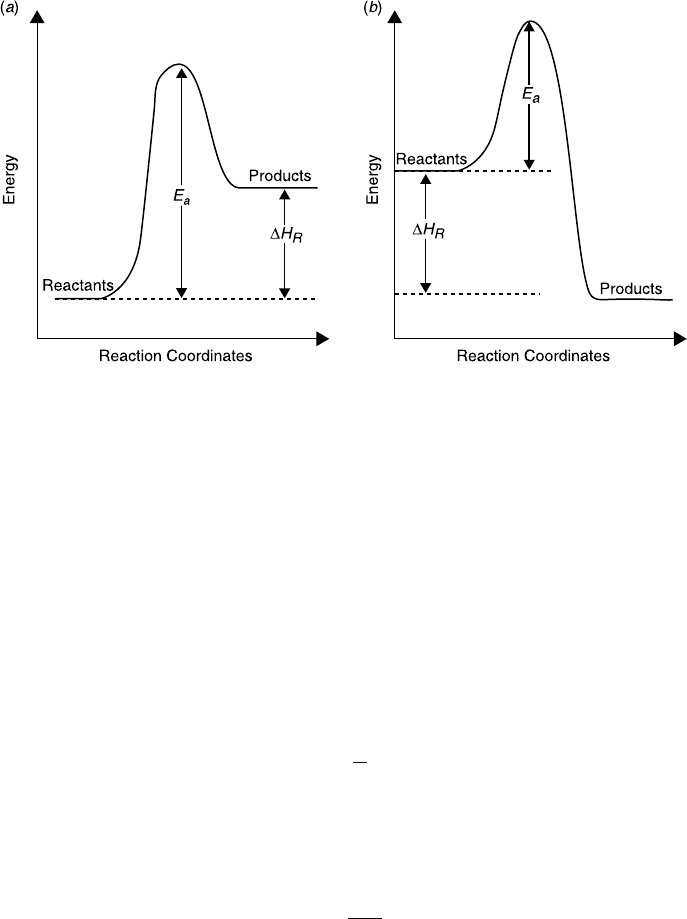
Physically, the activation energy represents an energy barrier that should be
overcome as the reaction proceeds. This barrier and its relationship to the heat of
reaction is shown schematically in Figure 3.3 for exothermic and endothermic reac-
tions. Note that for reversible chemical reactions, the heat of reaction is the differ-
ence between the activation energy of the forward reaction and the activation
energy of the backward reaction, DH
R
¼ (E
a
)
for
( E
a
)
back
.
As will be discussed later, we formulate the design equations of chemical reac-
tors in terms of dimensionless quantities and would like to express the reaction rate
constants in terms of them. We define dimensionless temperature
u ;
T
T
0
(3:3:4)
where T
0
is a conveniently selected reference temperature. We also define a dimen-
sionless activation energy, g,by
g ;
E
a
RT
0
(3:3:5)
which is a characteristic of the chemical reaction and the reference temperature.
Using Eqs. 3.3.4 and 3.3.5, the Arrhenius equation reduces to
k(u) ¼ k(T
0
)e
g(u1)=u
(3:3:6)
where k(T
0
) is the reaction rate constant at the reference temperature T
0
.
Figure 3.3 Activation energy for (a ) endothermic reactions and (b) exothermic reactio ns.
88 CHEMICAL KINETICS

Example 3.2 The rate constant of a chemical reaction is determined exper-
imentally at two temperatures. Based on the data below, determine:
a. The activation energy
b. The dimensionless activation energy if the reference temperature is 308C
c. The preexponential coefficient
Data: T (8C) 30 50
k (min
1
)0:25 1:4
Solution
a. To determine the activation energy, write Eq. 3.3.3 for the two given temp-
eratures, T
1
¼ 30 þ 273.15 ¼ 303.15 K and T
2
¼ 50 þ 273.15 ¼ 323.15 K,
ln
1:4
0:25
¼
E
a
R
1
323:15
1
303:15
(a)
to obtain E
a
/R ¼ 8438 K. Hence,
E
a
¼ (8438 K)(1:987 cal=mol K) ¼ 16:767 kcal=mol (b)
b. The reference temperature is T
0
¼ 303.15 K, and, using Eq. 3.3.5, the dimen-
sionless activation energy is
g ¼
16,767
1:987 303:15
¼ 27:83
c. To determine the preexponential coefficient, we write Eq. 3.3.2 for one of the
given temperatures. For T
1
¼ 303.15 K,
(0:25 min
1
) ¼ k
0
e
8438=303:15
to obtain k
0
¼ 3.06 10
11
min
21
.
Next, we consider the dependence of the rate expression on the species compo-
sition–function h(C
j
’s) in Eq. 3.3.1. For many homogeneous chemical reactions,
h(C
j
’s) is expressed as a power relation of the species concentrations:
h(C
j
,
s) ¼ C
A
a
C
B
b
(3:3:7)
where C
A
, C
B
, ... are the concentrations of the different species. The powers in
Eq. 3.3.7 are called the orders of the reaction: a is the order of the reaction with
respect to species A, b is the order of the reaction with respect to species B, and
so on, and a þ bþ
...
is the overall order of the reaction. The orders can be
3.3 RATE EXPRESSIONS OF CHEMICAL REACTIONS 89