
Manning Ch. D., Raghavan P., Sch?tze H. Introduction to Information Retrieval - Введение в информационный поиск
Подождите немного. Документ загружается.

Online edition (c)2009 Cambridge UP
Online edition (c)2009 Cambridge UP
DRAFT! © April 1, 2009 Cambridge University Press. Feedback welcome. 67
4 Index constructio n
In this chapter, we look at how to construct an inverted index. We call this
process index construction or indexing; the process or machine that performs itINDEXING
the indexer. The design of indexing algorithms is governed by hardware con-INDEXER
straints. We therefore begin this chapter with a review of the basics of com-
puter hardware that are relevant for indexing. We then introduce blocked
sort-based indexing (Section
4.2), an efficient single-machine algorithm de-
signed for static collections that can be viewed as a more scalable version of
the basic sort-based indexing algorithm we introduced in Chapter
1. Sec-
tion 4.3 describes single-pass in-memory indexing, an algorithm that has
even better scaling properties because it does not hold the vocabulary in
memory. For very large collections like the web, indexing has to be dis-
tributed over computer clusters with hundreds or thousands of machines.
We discuss this in Section
4.4. Collections with frequent changes require dy-
namic indexing introduced in Section 4.5 so that changes in the collection are
immediately reflected in the index. Finally, we cover some complicating is-
sues that can arise in indexing – such as security and indexes for ranked
retrieval – in Section
4.6.
Index construction interacts with several topics covered in other chapters.
The indexer needs raw text, but documents are encoded in many ways (see
Chapter
2). Indexers compress and decompress intermediate files and the
final index (see Chapter
5). In web search, documents are not on a local
file system, but have to be spidered or crawled (see Chapter 20). In enter-
prise search, most documents are encapsulated in varied content manage-
ment systems, email applications, and databases. We give some examples
in Section
4.7. Although most of these applications can be accessed via http,
native Application Programming Interfaces (APIs) are usually more efficient.
The reader should be aware that building the subsystem that feeds raw text
to the indexing process can in itself be a challenging problem.

Online edition (c)2009 Cambridge UP
68 4 Index construction
◮
Table 4.1 Typical system parameters in 2007. The seek time is the time needed
to position the disk head in a new position. The transfer time per byte is the rate of
transfer from disk to memory when the head is in the right position.
Symbol Statistic Value
s average seek time 5 ms = 5 ×10
−3
s
b transfer time per byte 0.02 µs = 2 × 10
−8
s
processor’s clock rate 10
9
s
−1
p lowlevel operation
(e.g., compare & swap a word) 0.01 µs = 10
−8
s
size of main memory several GB
size of disk space 1 TB or more
4.1 Hardware basics
When building an information retrieval (IR) system, many decisions are based
on the characteristics of the computer hardware on which the system runs.
We therefore begin this chapter with a brief review of computer hardware.
Performance characteristics typical of systems in 2007 are shown in Table
4.1.
A list of hardware basics that we need in this book to motivate IR system
design follows.
• Access to data in memory is much faster than access to data on disk. It
takes a few clock cycles (perhaps 5 × 10
−9
seconds) to access a byte in
memory, but much longer to transfer it from disk (about 2 × 10
−8
sec-
onds). Consequently, we want to keep as much data as possible in mem-
ory, especially those data that we need to access frequently. We call the
technique of keeping frequently used disk data in main memory caching.CACHING
• When doing a disk read or write, it takes a while for the disk head to
move to the part of the disk where the data are located. This time is called
the seek time and it averages 5 ms for typical disks. No data are beingSEEK TIME
transferred during the seek. To maximize data transfer rates, chunks of
data that will be read together should therefore be stored contiguously on
disk. For example, using the numbers in Table
4.1 it may take as little as
0.2 seconds to transfer 10 megabytes (MB) from disk to memory if it is
stored as one chunk, but up to 0.2 + 100 × (5 × 10
−3
) = 0.7 seconds if it
is stored in 100 noncontiguous chunks because we need to move the disk
head up to 100 times.
• Operating systems generally read and write entire blocks. Thus, reading
a single byte from disk can take as much time as reading the entire block.
Online edition (c)2009 Cambridge UP
4.2 Blocked sort-based indexing 69
Block sizes of 8, 16, 32, and 64 kilobytes (KB) are common. We call the part
of main memory where a block being read or written is stored a buffer.BUFFER
• Data transfers from disk to memory are handled by the system bus, not by
the processor. This means that the processor is available to process data
during disk I/O. We can exploit this fact to speed up data transfers by
storing compressed data on disk. Assuming an efficient decompression
algorithm, the total time of reading and then decompressing compressed
data is usually less than reading uncompressed data.
• Servers used in IR systems typically have several gigabytes (GB) of main
memory, sometimes tens of GB. Available disk space is several orders of
magnitude larger.
4.2 Blocked sort-based indexing
The basic steps in constructing a nonpositional index are depicted in Fig-
ure
1.4 (page 8). We first make a pass through the collection assembling all
term–docID pairs. We then sort the pairs with the term as the dominant key
and docID as the secondary key. Finally, we organize the docIDs for each
term into a postings list and compute statistics like term and document fre-
quency. For small collections, all this can be done in memory. In this chapter,
we describe methods for large collections that require the use of secondary
storage.
To make index construction more efficient, we represent terms as termIDs
(instead of strings as we did in Figure
1.4), where each termID is a uniqueTERMID
serial number. We can build the mapping from terms to termIDs on the fly
while we are processing the collection; or, in a two-pass approach, we com-
pile the vocabulary in the first pass and construct the inverted index in the
second pass. The index construction algorithms described in this chapter all
do a single pass through the data. Section
4.7 gives references to multipass
algorithms that are preferable in certain applications, for example, when disk
space is scarce.
We work with the Reuters-RCV1 collection as our model collection in thisREUTERS-RCV1
chapter, a collection with roughly 1 GB of text. It consists of about 800,000
documents that were sent over the Reuters newswire during a 1-year pe-
riod between August 20, 1996, and August 19, 1997. A typical document is
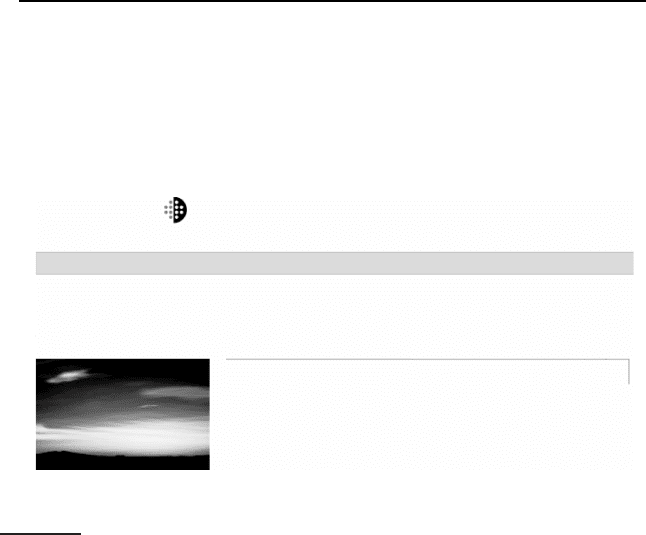
shown in Figure
4.1, but note that we ignore multimedia information like
images in this book and are only concerned with text. Reuters-RCV1 covers
a wide range of international topics, including politics, business, sports, and
(as in this example) science. Some key statistics of the collection are shown
in Table
4.2.
Online edition (c)2009 Cambridge UP
70 4 Index construction
◮
Table 4.2 Collection statistics for Reuters-RCV1. Values are rounded for the com-
putations in this book. The unrounded values are: 806,791 documents, 222 tokens
per document, 391,523 (distinct) terms, 6.04 bytes per token with spaces and punc-
tuation, 4.5 bytes per token without spaces and punctuation, 7.5 bytes per term, and
96,969,056 tokens. The numbers in this table correspond to the third line (“case fold-
ing”) in Table 5.1 (page 87).
Symbol Statistic Value
N documents 800,000
L
ave
avg. # tokens per document 200
M terms 400,000
avg. # bytes per token (incl. spaces/punct.) 6
avg. # bytes per token (without spaces/punct.) 4.5
avg. # bytes per term 7.5
T tokens 100,000,000
REUTERS
Extreme conditions create rare Antarctic clouds
You are here: Home > News > Science > Article
Go to a Section: U.S. International Business Markets Politics Entertainment Technology
Tue Aug 1, 2006 3:20am ET
Email This Article | Print This Article | Reprints
SYDNEY (Reuters) - Rare, mother-of-pearl colored clouds
caused by extreme weather conditions above Antarctica are a
possible indication of global warming, Australian scientists said on
Tuesday.
Known as nacreous clouds, the spectacular formations showing delicate
wisps of colors were photographed in the sky over an Australian
meteorological base at Mawson Station on July 25.
Sports Oddly Enough
[-] Text [+]
◮
Figure 4.1 Document from the Reuters newswire.
Reuters-RCV1 has 100 million tokens. Collecting all termID–docID pairs of
the collection using 4 bytes each for termID and docID therefore requires 0.8
GB of storage. Typical collections today are often one or two orders of mag-
nitude larger than Reuters-RCV1. You can easily see how such collections
overwhelm even large computers if we try to sort their termID–docID pairs
in memory. If the size of the intermediate files during index construction is
within a small factor of available memory, then the compression techniques
introduced in Chapter
5 can help; however, the postings file of many large
collections cannot fit into memory even after compression.
With main memory insufficient, we need to use an external sorting algo-EXTERNAL SORTING
ALGORITHM
rithm, that is, one that uses disk. For acceptable speed, the central require-

Online edition (c)2009 Cambridge UP
4.2 Blocked sort-based indexing 71
BSBINDEXCONSTRUCTION()
1 n ← 0
2 while (all documents have not been processed)
3 do n ← n + 1
4 block ← PARSENEXTBLOCK()
5 BSBI-INVERT(block)
6 WRITEBLOCKTODISK(block, f
n
)
7 MERGEBLOCKS( f
1
, . . . , f
n
; f
merged
)
◮
Figure 4.2 Blocked sort-based indexing. The algorithm stores inverted blocks in
files f
1
, . . . , f
n
and the merged index in f
merged
.
ment of such an algorithm is that it minimize the number of random disk
seeks during sorting – sequential disk reads are far faster than seeks as we
explained in Section 4.1. One solution is the blocked sort-based indexing algo-BLOCKED SORT-BASED
INDEXING ALGORITHM
rithm or BSBI in Figure
4.2. BSBI (i) segments the collection into parts of equal
size, (ii) sorts the termID–docID pairs of each part in memory, (iii) stores in-
termediate sorted results on disk, and (iv) merges all intermediate results
into the final index.
The algorithm parses documents into termID–docID pairs and accumu-
lates the pairs in memory until a block of a fixed size is full (PARSENEXTBLOCK
in Figure
4.2). We choose the block size to fit comfortably into memory to
permit a fast in-memory sort. The block is then inverted and written to disk.
Inversion involves two steps. First, we sort the termID–docID pairs. Next,INVERSION
we collect all termID–docID pairs with the same termID into a postings list,
where a posting is simply a docID. The result, an inverted index for the blockPOSTING
we have just read, is then written to disk. Applying this to Reuters-RCV1 and
assuming we can fit 10 million termID–docID pairs into memory, we end up
with ten blocks, each an inverted index of one part of the collection.
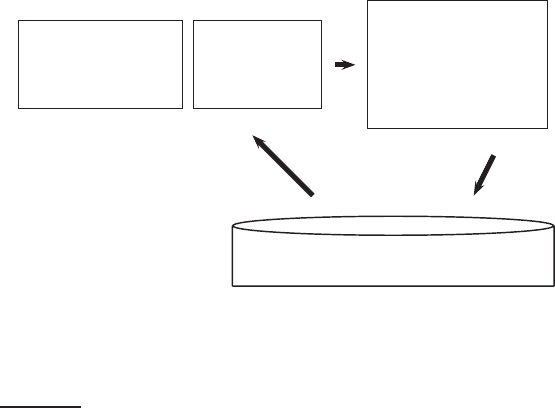
In the final step, the algorithm simultaneously merges the ten blocks into
one large merged index. An example with two blocks is shown in Figure
4.3,
where we use d
i
to denote the i
th
document of the collection. To do the merg-
ing, we open all block files simultaneously, and maintain small read buffers
for the ten blocks we are reading and a write buffer for the final merged in-
dex we are writing. In each iteration, we select the lowest termID that has
not been processed yet using a priority queue or a similar data structure. All
postings lists for this termID are read and merged, and the merged list is
written back to disk. Each read buffer is refilled from its file when necessary.
How expensive is BSBI? Its time complexity is Θ(T log T) because the step
with the highest time complexity is sorting and T is an upper bound for the
number of items we must sort (i.e., the number of termID–docID pairs). But
Online edition (c)2009 Cambridge UP
72 4 Index construction
brutus d1,d3
caesar d1,d2,d4
noble d5
with d1,d2,d3,d5
brutus d6,d7
caesar d8,d9
julius d10
killed d8
postings lists
to be merged
brutus d1,d3,d6,d7
caesar d1,d2,d4,d8,d9
julius d10
killed d8
noble d5
with d1,d2,d3,d5
merged
postings lists
disk
◮
Figure 4.3 Merging in blocked sort-based indexing. Two blocks (“postings lists to
be merged”) are loaded from disk into memory, merged in memory (“merged post-
ings lists”) and written back to disk. We show terms instead of termIDs for better
readability.
the actual indexing time is usually dominated by the time it takes to parse the
documents (PARSENEXTBLOCK) and to do the final merge (MERGEBLOCKS).
Exercise
4.6 asks you to compute the total index construction time for RCV1
that includes these steps as well as inverting the blocks and writing them to
disk.
Notice that Reuters-RCV1 is not particularly large in an age when one or
more GB of memory are standard on personal computers. With appropriate
compression (Chapter
5), we could have created an inverted index for RCV1
in memory on a not overly beefy server. The techniques we have described
are needed, however, for collections that are several orders of magnitude
larger.
?
Exercise 4.1
If we need T log
2
T comparisons (where T is the number of termID–docID pairs) and
two disk seeks for each comparison, how much time would index construction for
Reuters-RCV1 take if we used disk instead of memory for storage and an unopti-
mized sorting algorithm (i.e., not an external sorting algorithm)? Use the system
parameters in Table
4.1.
Exercise 4.2 [⋆]
How would you create the dictionary in blocked sort-based indexing on the fly to
avoid an extra pass through the data?

Online edition (c)2009 Cambridge UP
4.3 Single-pass in-memory indexing 73
SPIMI-INVERT(token_stream)
1 output_f ile = NEWFILE()
2 dictionary = NEWHASH()
3 while (free memory available)
4 do token ← next(token_stream)
5 if term(token) /∈ dictionary
6 then postings_list = ADDTODICTIONARY(dictionary, term(token))
7 else postings_list = GETPOSTINGSLIST(dictionary, term(token))
8 if f ull(postings_list)
9 then postings_list = DOUBLEPOSTINGSLIST(dictionary, term(token ))
10 ADDTOPOSTINGSLIST(postings_list, docID(token))
11 sorted_terms ← SORTTERMS(dict ionary)
12 WRITEBLOCKTODISK(sorted_terms, dictionary, output_f ile)
13 return output_f ile
◮
Figure 4.4 Inversion of a block in single-pass in-memory indexing
4.3 Single-pass in-mem ory inde xing
Blocked sort-based indexing has excellent scaling properties, but it needs
a data structure for mapping terms to termIDs. For very large collections,
this data structure does not fit into memory. A more scalable alternative is
single-pass in-memory indexing or SPI MI. SPIMI uses terms instead of termIDs,SINGLE-PASS
IN-MEMORY INDEXING
writes each block’s dictionary to disk, and then starts a new dictionary for the
next block. SPIMI can index collections of any size as long as there is enough
disk space available.
The SPIMI algorithm is shown in Figure
4.4. The part of the algorithm that
parses documents and turns them into a stream of term–docID pairs, which
we call tokens here, has been omitted. SPIMI-INVERT is called repeatedly on
the token stream until the entire collection has been processed.
Tokens are processed one by one (line 4) during each successive call of
SPIMI-INVERT. When a term occurs for the first time, it is added to the
dictionary (best implemented as a hash), and a new postings list is created
(line 6). The call in line 7 returns this postings list for subsequent occurrences
of the term.
A difference between BSBI and SPIMI is that SPIMI adds a posting di-
rectly to its postings list (line 10). Instead of first collecting all termID–docID
pairs and then sorting them (as we did in BSBI), each postings list is dynamic
(i.e., its size is adjusted as it grows) and it is immediately available to collect
postings. This has two advantages: It is faster because there is no sorting
required, and it saves memory because we keep track of the term a postings

Online edition (c)2009 Cambridge UP
74 4 Index construction
list belongs to, so the termIDs of postings need not be stored. As a result, the
blocks that individual calls of SPIMI-INVERT can process are much larger
and the index construction process as a whole is more efficient.
Because we do not know how large the postings list of a term will be when
we first encounter it, we allocate space for a short postings list initially and
double the space each time it is full (lines 8–9). This means that some mem-
ory is wasted, which counteracts the memory savings from the omission of
termIDs in intermediate data structures. However, the overall memory re-
quirements for the dynamically constructed index of a block in SPIMI are
still lower than in BSBI.
When memory has been exhausted, we write the index of the block (which
consists of the dictionary and the postings lists) to disk (line 12). We have to
sort the terms (line 11) before doing this because we want to write postings
lists in lexicographic order to facilitate the final merging step. If each block’s
postings lists were written in unsorted order, merging blocks could not be
accomplished by a simple linear scan through each block.
Each call of SPIMI-INVERT writes a block to disk, just as in BSBI. The last
step of SPIMI (corresponding to line 7 in Figure
4.2; not shown in Figure 4.4)
is then to merge the blocks into the final inverted index.
In addition to constructing a new dictionary structure for each block and
eliminating the expensive sorting step, SPIMI has a third important compo-
nent: compression. Both the postings and the dictionary terms can be stored
compactly on disk if we employ compression. Compression increases the ef-
ficiency of the algorithm further because we can process even larger blocks,
and because the individual blocks require less space on disk. We refer readers
to the literature for this aspect of the algorithm (Section
4.7).
The time complexity of SPIMI is Θ(T) because no sorting of tokens is re-
quired and all operations are at most linear in the size of the collection.
4.4 Distributed indexing
Collections are often so large that we cannot perform index construction effi-
ciently on a single machine. This is particularly true of the World Wide Web
for which we need large computer clusters
1
to construct any reasonably sized
web index. Web search engines, therefore, use distributed indexing algorithms
for index construction. The result of the construction process is a distributed
index that is partitioned across several machines – either according to term
or according to document. In this section, we describe distributed indexing
for a term-partitioned index. Most large search engines prefer a document-
1. A cluster in this chapter is a group of tightly coupled computers that work together closely.
This sense of the word is different from the use of cluster as a group of documents that are
semantically similar in Chapters 16–18.

Online edition (c)2009 Cambridge UP
4.4 Distributed indexing 75
partitioned index (which can be easily generated from a term-partitioned
index). We discuss this topic further in Section
20.3 (page 454).
The distributed index construction method we describe in this section is an
application of MapReduce, a general architecture for distributed computing.MAPREDUCE
MapReduce is designed for large computer clusters. The point of a cluster is
to solve large computing problems on cheap commodity machines or nodes
that are built from standard parts (processor, memory, disk) as opposed to on
a supercomputer with specialized hardware. Although hundreds or thou-
sands of machines are available in such clusters, individual machines can
fail at any time. One requirement for robust distributed indexing is, there-
fore, that we divide the work up into chunks that we can easily assign and
– in case of failure – reassign. A master node directs the process of assigningMASTER NODE
and reassigning tasks to individual worker nodes.
The map and reduce phases of MapReduce split up the computing job
into chunks that standard machines can process in a short time. The various
steps of MapReduce are shown in Figure
4.5 and an example on a collection
consisting of two documents is shown in Figure 4.6. First, the input data,
in our case a collection of web pages, are split into n splits where the size ofSPLITS
the split is chosen to ensure that the work can be distributed evenly (chunks
should not be too large) and efficiently (the total number of chunks we need
to manage should not be too large); 16 or 64 MB are good sizes in distributed
indexing. Splits are not preassigned to machines, but are instead assigned
by the master node on an ongoing basis: As a machine finishes processing
one split, it is assigned the next one. If a machine dies or becomes a laggard
due to hardware problems, the split it is working on is simply reassigned to
another machine.
In general, MapReduce breaks a large computing problem into smaller
parts by recasting it in terms of manipulation of key-value pairs. For index-KEY-VALUE PAIRS
ing, a key-value pair has the form (termID,docID). In distributed indexing,
the mapping from terms to termIDs is also distributed and therefore more
complex than in single-machine indexing. A simple solution is to maintain
a (perhaps precomputed) mapping for frequent terms that is copied to all
nodes and to use terms directly (instead of termIDs) for infrequent terms.
We do not address this problem here and assume that all nodes share a con-
sistent term → termID mapping.
The map phase of MapReduce consists of mapping splits of the input dataMAP PHASE
to key-value pairs. This is the same parsing task we also encountered in BSBI
and SPIMI, and we therefore call the machines that execute the map phase
parsers. Each parser writes its output to local intermediate files, the segmentPARSER
SEGMENT FILE
files (shown as
a-f g-p q-z in Figure 4.5).
For the reduce phase, we want all values for a given key to be stored closeREDUCE PHASE
together, so that they can be read and processed quickly. This is achieved by