
Manning Ch. D., Raghavan P., Sch?tze H. Introduction to Information Retrieval - Введение в информационный поиск
Подождите немного. Документ загружается.

Online edition (c)2009 Cambridge UP
86 5 Index compression
of compression algorithms is of no concern. But for improved cache uti-
lization and faster disk-to-memory transfer, decompression speeds must be
high. The compression algorithms we discuss in this chapter are highly effi-
cient and can therefore serve all three purposes of index compression.
In this chapter, we define a posting as a docID in a postings list. For exam-POSTING
ple, the postings list (6; 20, 45, 100), where 6 is the termID of the list’s term,
contains three postings. As discussed in Section
2.4.2 (page 41), postings in
most search systems also contain frequency and position information; but we
will only consider simple docID postings here. See Section 5.4 for references
on compressing frequencies and positions.
This chapter first gives a statistical characterization of the distribution of
the entities we want to compress – terms and postings in large collections
(Section
5.1). We then look at compression of the dictionary, using the dictionary-
as-a-string method and blocked storage (Section 5.2). Section 5.3 describes
two techniques for compressing the postings file, variable byte encoding and
γ encoding.
5.1 Statistical properties of terms in information retrieval
As in the last chapter, we use Reuters-RCV1 as our model collection (see Ta-
ble
4.2, page 70). We give some term and postings statistics for the collection
in Table
5.1. “∆%” indicates the reduction in size from the previous line.
“T%” is the cumulative reduction from unfiltered.
The table shows the number of terms for different levels of preprocessing
(column 2). The number of terms is the main factor in determining the size
of the dictionary. The number of nonpositional postings (column 3) is an
indicator of the expected size of the nonpositional index of the collection.
The expected size of a positional index is related to the number of positions
it must encode (column 4).
In general, the statistics in Table
5.1 show that preprocessing affects the size
of the dictionary and the number of nonpositional postings greatly. Stem-
ming and case folding reduce the number of (distinct) terms by 17% each
and the number of nonpositional postings by 4% and 3%, respectively. The
treatment of the most frequent words is also important. The rule of 30 statesRULE OF 30
that the 30 most common words account for 30% of the tokens in written text
(31% in the table). Eliminating the 150 most common words from indexing
(as stop words; cf. Section
2.2.2, page 27) cuts 25% to 30% of the nonpositional
postings. But, although a stop list of 150 words reduces the number of post-
ings by a quarter or more, this size reduction does not carry over to the size
of the compressed index. As we will see later in this chapter, the postings
lists of frequent words require only a few bits per posting after compression.
The deltas in the table are in a range typical of large collections. Note,

Online edition (c)2009 Cambridge UP
5.1 Statistical properties of terms in i nformation retrieval 87
◮
Table 5.1 The effect of preprocessing on the number of terms, nonpositional post-
ings, and tokens for Reuters-RCV1. “∆%” indicates the reduction in size from the pre-
vious line, except that “30 stop words” and “150 stop words” both use “case folding”
as their reference line. “T%” is the cumulative (“total”) reduction from unfiltered. We
performed stemming with the Porter stemmer (Chapter 2, page 33).
tokens (= number of position
(distinct) terms nonpositional postings entries in postings)
number ∆% T% number ∆% T% number ∆% T%
unfiltered 484,494 109,971,179 197,879,290
no numbers 473,723 −2 −2 100,680,242 −8 −8 179,158,204 −9 −9
case folding 391,523 −17 −19 96,969,056 −3 −12 179,158,204 −0 −9
30 stop words 391,493 −0 −19 83,390,443 −14 −24 121,857,825 −31 −38
150 stop words 391,373 −0 −19 67,001,847 −30 −39 94,516,599 −47 −52
stemming 322,383 −17 −33 63,812,300 −4 −42 94,516,599 −0 −52
however, that the percentage reductions can be very different for some text
collections. For example, for a collection of web pages with a high proportion
of French text, a lemmatizer for French reduces vocabulary size much more
than the Porter stemmer does for an English-only collection because French
is a morphologically richer language than English.
The compression techniques we describe in the remainder of this chapter
are lossless, that is, all information is preserved. Better compression ratiosLOSSLESS
can be achieved with lossy compression, which discards some information.LOSSY COMPRESSION
Case folding, stemming, and stop word elimination are forms of lossy com-
pression. Similarly, the vector space model (Chapter 6) and dimensionality
reduction techniques like latent semantic indexing (Chapter 18) create com-
pact representations from which we cannot fully restore the original collec-
tion. Lossy compression makes sense when the “lost” information is unlikely
ever to be used by the search system. For example, web search is character-
ized by a large number of documents, short queries, and users who only look
at the first few pages of results. As a consequence, we can discard postings of
documents that would only be used for hits far down the list. Thus, there are
retrieval scenarios where lossy methods can be used for compression without
any reduction in effectiveness.
Before introducing techniques for compressing the dictionary, we want to
estimate the number of distinct terms M in a collection. It is sometimes said
that languages have a vocabulary of a certain size. The second edition of
the Oxford English Dictionary (OED) defines more than 600,000 words. But
the vocabulary of most large collections is much larger than the OED. The
OED does not include most names of people, locations, products, or scientific
Online edition (c)2009 Cambridge UP
88 5 Index compression
02468
0123456
log10 T
log10 M
◮
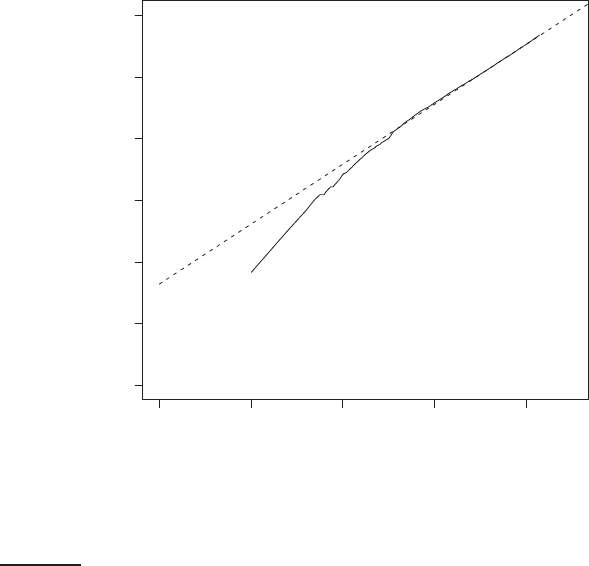
Figure 5.1 Heaps’ law. Vocabulary size M as a function of collection size T
(number of tokens) for Reuters-RCV1. For these data, the dashed line log
10
M =
0.49 ∗log
10
T + 1.64 is the best least-squares fit. Thus, k = 10
1.64
≈ 44 and b = 0.49.
entities like genes. These names need to be included in the inverted index,
so our users can search for them.
5.1.1 Heaps’ law: Estimating the number of terms
A better way of getting a handle on M is Heaps’ law, which estimates vocab-HEAPS’ LAW
ulary size as a function of collection size:
M = kT
b
(5.1)
where T is the number of tokens in the collection. Typical values for the
parameters k and b are: 30 ≤ k ≤ 100 and b ≈ 0.5. The motivation for
Heaps’ law is that the simplest possible relationship between collection size
and vocabulary size is linear in log–log space and the assumption of linearity
is usually born out in practice as shown in Figure
5.1 for Reuters-RCV1. In
this case, the fit is excellent for T > 10
5
= 100,000, for the parameter values
b = 0.49 and k = 44. For example, for the first 1,000,020 tokens Heaps’ law

Online edition (c)2009 Cambridge UP
5.1 Statistical properties of terms in i nformation retrieval 89
predicts 38,323 terms:
44 ×1,000,020
0.49
≈ 38,323.
The actual number is 38,365 terms, very close to the prediction.
The parameter k is quite variable because vocabulary growth depends a
lot on the nature of the collection and how it is processed. Case-folding and
stemming reduce the growth rate of the vocabulary, whereas including num-
bers and spelling errors increase it. Regardless of the values of the param-
eters for a particular collection, Heaps’ law suggests that (i) the dictionary
size continues to increase with more documents in the collection, rather than
a maximum vocabulary size being reached, and (ii) the size of the dictionary
is quite large for large collections. These two hypotheses have been empir-
ically shown to be true of large text collections (Section
5.4). So dictionary
compression is important for an effective information retrieval system.
5.1.2 Zipf’s law: Modeling the distribution of terms
We also want to understand how terms are distributed across documents.
This helps us to characterize the properties of the algorithms for compressing
postings lists in Section
5.3.
A commonly used model of the distribution of terms in a collection is Zipf’sZIPF’S LAW
law. It states that, if t
1
is the most common term in the collection, t
2
is the
next most common, and so on, then the collection frequency cf
i
of the ith
most common term is proportional to 1/i:
cf
i
∝
1
i
.
(5.2)
So if the most frequent term occurs cf
1
times, then the second most frequent
term has half as many occurrences, the third most frequent term a third as
many occurrences, and so on. The intuition is that frequency decreases very
rapidly with rank. Equation (
5.2) is one of the simplest ways of formalizing
such a rapid decrease and it has been found to be a reasonably good model.
Equivalently, we can write Zipf’s law as cf
i
= ci
k
or as log cf
i
= log c +
k log i where k = −1 and c is a constant to be defined in Section
5.3.2. It
is therefore a power law with exponent k = −1. See Chapter
19, page 426,POWER LAW
for another power law, a law characterizing the distribution of links on web
pages.
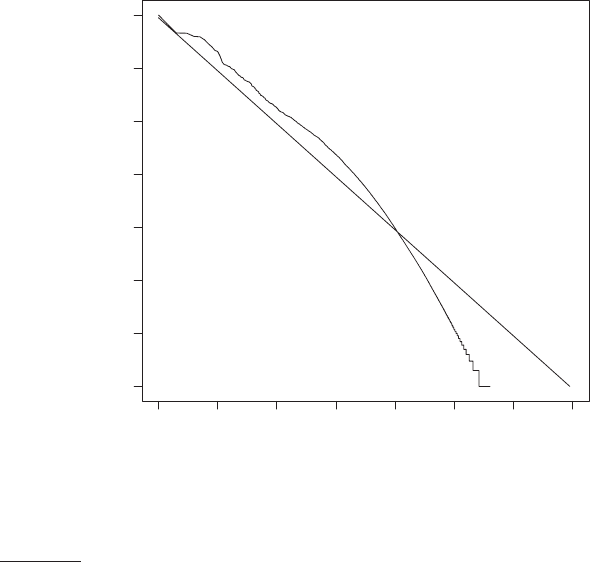
The log–log graph in Figure
5.2 plots the collection frequency of a term as
a function of its rank for Reuters-RCV1. A line with slope –1, corresponding
to the Zipf function log cf
i
= log c −log i, is also shown. The fit of the data
to the law is not particularly good, but good enough to serve as a model for
term distributions in our calculations in Section
5.3.
Online edition (c)2009 Cambridge UP
90 5 Index compression
0123456
01234567
log10 rank
7
log10 cf
◮
Figure 5.2 Zipf’s law for Reuters-RCV1. Frequency is plotted as a function of
frequency rank for the terms in the collection. The line is the distribution predicted
by Zipf’s law (weighted least-squares fit; intercept is 6.95).
?
Exercise 5.1
[⋆]
Assuming one machine word per posting, what is the size of the uncompressed (non-
positional) index for different tokenizations based on Table
5.1? How do these num-
bers compare with Table
5.6?
5.2 Dictionary compression
This section presents a series of dictionary data structures that achieve in-
creasingly higher compression ratios. The dictionary is small compared with
the postings file as suggested by Table 5.1. So why compress it if it is respon-
sible for only a small percentage of the overall space requirements of the IR
system?
One of the primary factors in determining the response time of an IR sys-
tem is the number of disk seeks necessary to process a query. If parts of the
dictionary are on disk, then many more disk seeks are necessary in query
evaluation. Thus, the main goal of compressing the dictionary is to fit it in
main memory, or at least a large portion of it, to support high query through-

Online edition (c)2009 Cambridge UP
5.2 Dictionary compression 91
term document
frequency
pointer to
postings list
a 656,265 −→
aachen 65 −→
.. . . . . .. .
zulu 221 −→
space needed: 20 bytes 4 bytes 4 bytes
◮
Figure 5.3 Storing the dictionary as an array of fixed-width entries.
put. Although dictionaries of very large collections fit into the memory of a
standard desktop machine, this is not true of many other application scenar-
ios. For example, an enterprise search server for a large corporation may
have to index a multiterabyte collection with a comparatively large vocab-
ulary because of the presence of documents in many different languages.
We also want to be able to design search systems for limited hardware such
as mobile phones and onboard computers. Other reasons for wanting to
conserve memory are fast startup time and having to share resources with
other applications. The search system on your PC must get along with the
memory-hogging word processing suite you are using at the same time.
5.2.1 Dictionary as a string
The simplest data structure for the dictionary is to sort the vocabulary lex-
icographically and store it in an array of fixed-width entries as shown in
Figure
5.3. We allocate 20 bytes for the term itself (because few terms have
more than twenty characters in English), 4 bytes for its document frequency,
and 4 bytes for the pointer to its postings list. Four-byte pointers resolve a
4 gigabytes (GB) address space. For large collections like the web, we need
to allocate more bytes per pointer. We look up terms in the array by binary
search. For Reuters-RCV1, we need M × (20 + 4 + 4) = 400,000 ×28 =
11.2megabytes (MB) for storing the dictionary in this scheme.
Using fixed-width entries for terms is clearly wasteful. The average length
of a term in English is about eight characters (Table
4.2, page 70), so on av-
erage we are wasting twelve characters in the fixed-width scheme. Also,
we have no way of storing terms with more than twenty characters like
hydrochlorofluorocarbons and supercalifragilisticexpialidocious. We can overcome
these shortcomings by storing the dictionary terms as one long string of char-
acters, as shown in Figure
5.4. The pointer to the next term is also used to
demarcate the end of the current term. As before, we locate terms in the data
structure by way of binary search in the (now smaller) table. This scheme
saves us 60% compared to fixed-width storage – 12 bytes on average of the

Online edition (c)2009 Cambridge UP
92 5 Index compression
...systilesyzygeticsyzygialsyzygyszaibelyi teszecinszono . . .
freq.
9
92
5
71
12
...
4bytes
postings ptr.
...
4bytes
term ptr.
3bytes
...
→
→
→
→
→
◮
Figure 5.4 Dictionary-as-a-string storage. Pointers mark the end of the preceding
term and the beginning of the next. For example, the first three terms in this example
are systile, syzygetic, and syzygial.
20 bytes we allocated for terms before. However, we now also need to store
term pointers. The term pointers resolve 400,000 × 8 = 3.2 × 10
6
positions,
so they need to be log
2
3.2 ×10
6
≈ 22 bits or 3 bytes long.
In this new scheme, we need 400,000 × (4 + 4 + 3 + 8) = 7.6 MB for the
Reuters-RCV1 dictionary: 4 bytes each for frequency and postings pointer, 3
bytes for the term pointer, and 8 bytes on average for the term. So we have
reduced the space requirements by one third from 11.2 to 7.6 MB.
5.2.2 Blocked storage
We can further compress the dictionary by grouping terms in the string into
blocks of size k and keeping a term pointer only for the first term of each
block (Figure
5.5). We store the length of the term in the string as an ad-
ditional byte at the beginning of the term. We thus eliminate k − 1 term
pointers, but need an additional k bytes for storing the length of each term.
For k = 4, we save (k −1) ×3 = 9 bytes for term pointers, but need an ad-
ditional k = 4 bytes for term lengths. So the total space requirements for the
dictionary of Reuters-RCV1 are reduced by 5 bytes per four-term block, or a
total of 400,000 × 1/4 × 5 = 0.5 MB, bringing us down to 7.1 MB.

Online edition (c)2009 Cambridge UP
5.2 Dictionary compression 93
...7 systile9 syzygetic 8 syzygial6 syz ygy11 szaibe lyite 6 szecin. . .
freq.
9
92
5
71
12
...
postings ptr.
...
term ptr.
...
→
→
→
→
→
◮
Figure 5.5 Blocked storage with four terms per block. The first block consists of
systile, syzygetic, syzygial, and syzygy with lengths of seven, nine, eight, and six charac-
ters, respectively. Each term is preceded by a byte encoding its length that indicates
how many bytes to skip to reach subsequent terms.
By increasing the block size k, we get better compression. However, there
is a tradeoff between compression and the speed of term lookup. For the
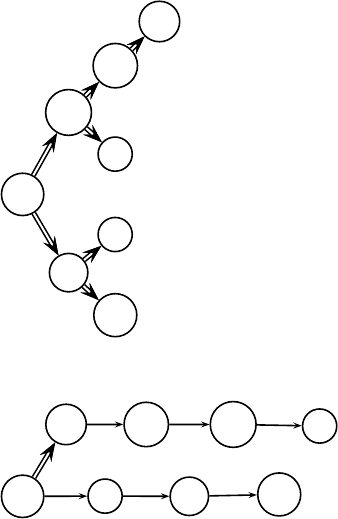
eight-term dictionary in Figure
5.6, steps in binary search are shown as dou-
ble lines and steps in list search as simple lines. We search for terms in the un-
compressed dictionary by binary search (a). In the compressed dictionary, we
first locate the term’s block by binary search and then its position within the
list by linear search through the block (b). Searching the uncompressed dic-
tionary in (a) takes on average (0 + 1 + 2 + 3 + 2 + 1 + 2 + 2)/8 ≈ 1.6 steps,
assuming each term is equally likely to come up in a query. For example,
finding the two terms, aid and box, takes three and two steps, respectively.
With blocks of size k = 4 in (b), we need (0 + 1 + 2 + 3 + 4 + 1 + 2 + 3)/8 = 2
steps on average, ≈ 25% more. For example, finding den takes one binary
search step and two steps through the block. By increasing k, we can get
the size of the compressed dictionary arbitrarily close to the minimum of
400,000 × (4 + 4 + 1 + 8) = 6.8 MB, but term lookup becomes prohibitively
slow for large values of k.
One source of redundancy in the dictionary we have not exploited yet is
the fact that consecutive entries in an alphabetically sorted list share common
prefixes. This observation leads to front coding (Figure
5.7). A common prefixFRONT CODING
Online edition (c)2009 Cambridge UP
94 5 Index compression
(a)
aid
box
den
ex
job
ox
pit
win
(b)
aid box den ex
job ox pit win
◮
Figure 5.6 Search of the uncompressed dictionary (a) and a dictionary com-
pressed by blocking with k = 4 (b).
One block in blocked compression (k = 4) .. .
8automata8automate9automatic10automation
⇓
.. . further compressed with front coding.
8automat∗a1⋄e2 ⋄ ic3⋄ion
◮
Figure 5.7 Front coding. A sequence of terms with identical prefix (“automat”) is
encoded by marking the end of the prefix with ∗ and replacing it with ⋄ in subsequent
terms. As before, the first byte of each entry encodes the number of characters.

Online edition (c)2009 Cambridge UP
5.3 Postings file compression 95
◮
Table 5.2 Dictionary compression for Reuters-RCV1.
data structure size in MB
dictionary, fixed-width 11.2
dictionary, term pointers into string 7.6
∼, with blocking, k = 4 7.1
∼, with blocking & front coding 5.9
is identified for a subsequence of the term list and then referred to with a
special character. In the case of Reuters, front coding saves another 1.2 MB,
as we found in an experiment.
Other schemes with even greater compression rely on minimal perfect
hashing, that is, a hash function that maps M terms onto [1, . . . , M] without
collisions. However, we cannot adapt perfect hashes incrementally because
each new term causes a collision and therefore requires the creation of a new
perfect hash function. Therefore, they cannot be used in a dynamic environ-
ment.
Even with the best compression scheme, it may not be feasible to store
the entire dictionary in main memory for very large text collections and for
hardware with limited memory. If we have to partition the dictionary onto
pages that are stored on disk, then we can index the first term of each page
using a B-tree. For processing most queries, the search system has to go to
disk anyway to fetch the postings. One additional seek for retrieving the
term’s dictionary page from disk is a significant, but tolerable increase in the
time it takes to process a query.
Table
5.2 summarizes the compression achieved by the four dictionary
data structures.
?
Exercise 5.2
Estimate the space usage of the Reuters-RCV1 dictionary with blocks of size k = 8
and k = 16 in blocked dictionary storage.
Exercise 5.3
Estimate the time needed for term lookup in the compressed dictionary of Reuters-
RCV1 with block sizes of k = 4 (Figure
5.6, b), k = 8, and k = 16. What is the
slowdown compared with k = 1 (Figure
5.6, a)?
5.3 Postings file compression
Recall from Table
4.2 (page 70) that Reuters-RCV1 has 800,000 documents,
200 tokens per document, six characters per token, and 100,000,000 post-
ings where we define a posting in this chapter as a docID in a postings
list, that is, excluding frequency and position information. These numbers