
Manning Ch. D., Raghavan P., Sch?tze H. Introduction to Information Retrieval - Введение в информационный поиск
Подождите немного. Документ загружается.

Online edition (c)2009 Cambridge UP
46 2 The term vocabulary and postings lists
et al. 2005). The structure of a character k-gram index over unsegmented text
differs from that in Section
3.2.2 (page 54): there the k-gram dictionary points
to postings lists of entries in the regular dictionary, whereas here it points
directly to document postings lists. For further discussion of Chinese word
segmentation, see Sproat et al. (1996), Sproat and Emerson (2003), Tseng et al.
(2005), and Gao et al. (2005).
Lita et al. (2003) present a method for truecasing. Natural language pro-
cessing work on computational morphology is presented in (Sproat 1992,
Beesley and Karttunen 2003).
Language identification was perhaps first explored in cryptography; for
example, Konheim (1981) presents a character-level k-gram language identi-
fication algorithm. While other methods such as looking for particular dis-
tinctive function words and letter combinations have been used, with the
advent of widespread digital text, many people have explored the charac-
ter n-gram technique, and found it to be highly successful (Beesley 1998,
Dunning 1994, Cavnar and Trenkle 1994). Written language identification
is regarded as a fairly easy problem, while spoken language identification
remains more difficult; see Hughes et al. (2006) for a recent survey.
Experiments on and discussion of the positive and negative impact of
stemming in English can be found in the following works: Salton (1989), Har-
man (1991), Krovetz (1995), Hull (1996). Hollink et al. (2004) provide detailed
results for the effectiveness of language-specific methods on 8 European lan-
guages. In terms of percent change in mean average precision (see page
159)
over a baseline system, diacritic removal gains up to 23% (being especially
helpful for Finnish, French, and Swedish). Stemming helped markedly for
Finnish (30% improvement) and Spanish (10% improvement), but for most
languages, including English, the gain from stemming was in the range 0–
5%, and results from a lemmatizer were poorer still. Compound splitting
gained 25% for Swedish and 15% for German, but only 4% for Dutch. Rather
than language-particular methods, indexing character k-grams (as we sug-
gested for Chinese) could often give as good or better results: using within-
word character 4-grams rather than words gave gains of 37% in Finnish, 27%
in Swedish, and 20% in German, while even being slightly positive for other
languages, such as Dutch, Spanish, and English. Tomlinson (2003) presents
broadly similar results. Bar-Ilan and Gutman (2005) suggest that, at the
time of their study (2003), the major commercial web search engines suffered
from lacking decent language-particular processing; for example, a query on
www.google.fr for l’électricité did not separate off the article l’ but only matched
pages with precisely this string of article+noun.
The classic presentation of skip pointers for IR can be found in Moffat andSKIP LIST
Zobel (1996). Extended techniques are discussed in Boldi and Vigna (2005).
The main paper in the algorithms literature is Pugh (1990), which uses mul-
tilevel skip pointers to give expected O(log P) list access (the same expected
Online edition (c)2009 Cambridge UP
2.5 References and further reading 47
efficiency as using a tree data structure) with less implementational complex-
ity. In practice, the effectiveness of using skip pointers depends on various
system parameters. Moffat and Zobel (1996) report conjunctive queries run-
ning about five times faster with the use of skip pointers, but Bahle et al.
(2002, p. 217) report that, with modern CPUs, using skip lists instead slows
down search because it expands the size of the postings list (i.e., disk I/O
dominates performance). In contrast, Strohman and Croft (2007) again show
good performance gains from skipping, in a system architecture designed to
optimize for the large memory spaces and multiple cores of recent CPUs.
Johnson et al. (2006) report that 11.7% of all queries in two 2002 web query
logs contained phrase queries, though Kammenhuber et al. (2006) report
only 3% phrase queries for a different data set. Silverstein et al. (1999) note
that many queries without explicit phrase operators are actually implicit
phrase searches.
Online edition (c)2009 Cambridge UP
Online edition (c)2009 Cambridge UP
DRAFT! © April 1, 2009 Cambridge University Press. Feedback welcome. 49
3
Dictionaries and to l erant
re t rieval
In Chapters
1 and 2 we developed the ideas underlying inverted indexes
for handling Boolean and proximity queries. Here, we develop techniques
that are robust to typographical errors in the query, as well as alternative
spellings. In Section
3.1 we develop data structures that help the search
for terms in the vocabulary in an inverted index. In Section 3.2 we study
the idea of a wildcard query: a query such as *a*e*i*o*u*, which seeks doc-WILDCARD QUERY
uments containing any term that includes all the five vowels in sequence.
The * symbol indicates any (possibly empty) string of characters. Users pose
such queries to a search engine when they are uncertain about how to spell
a query term, or seek documents containing variants of a query term; for in-
stance, the query automat*would seek documents containing any of the terms
automatic, automation and automated.
We then turn to other forms of imprecisely posed queries, focusing on
spelling errors in Section 3.3. Users make spelling errors either by accident,
or because the term they are searching for (e.g., Herman) has no unambiguous
spelling in the collection. We detail a number of techniques for correcting
spelling errors in queries, one term at a time as well as for an entire string
of query terms. Finally, in Section
3.4 we study a method for seeking vo-
cabulary terms that are phonetically close to the query term(s). This can be
especially useful in cases like the Herman example, where the user may not
know how a proper name is spelled in documents in the collection.
Because we will develop many variants of inverted indexes in this chapter,
we will use sometimes the phrase stand ard inverted index to mean the inverted
index developed in Chapters
1 and 2, in which each vocabulary term has a
postings list with the documents in the collection.
3.1 Search structures for dictionaries
Given an inverted index and a query, our first task is to determine whether
each query term exists in the vocabulary and if so, identify the pointer to the

Online edition (c)2009 Cambridge UP
50 3 Dictionaries and tolerant retrieval
corresponding postings. This vocabulary lookup operation uses a classical
data structure called the dictionary and has two broad classes of solutions:
hashing, and search trees. In the literature of data structures, the entries in
the vocabulary (in our case, terms) are often referred to as keys. The choice
of solution (hashing, or search trees) is governed by a number of questions:
(1) How many keys are we likely to have? (2) Is the number likely to remain
static, or change a lot – and in the case of changes, are we likely to only have
new keys inserted, or to also have some keys in the dictionary be deleted? (3)
What are the relative frequencies with which various keys will be accessed?
Hashing has been used for dictionary lookup in some search engines. Each
vocabulary term (key) is hashed into an integer over a large enough space
that hash collisions are unlikely; collisions if any are resolved by auxiliary
structures that can demand care to maintain.
1
At query time, we hash each
query term separately and following a pointer to the corresponding post-
ings, taking into account any logic for resolving hash collisions. There is no
easy way to find minor variants of a query term (such as the accented and
non-accented versions of a word like resume), since these could be hashed to
very different integers. In particular, we cannot seek (for instance) all terms
beginning with the prefix automat, an operation that we will require below
in Section 3.2. Finally, in a setting (such as the Web) where the size of the
vocabulary keeps growing, a hash function designed for current needs may
not suffice in a few years’ time.
Search trees overcome many of these issues – for instance, they permit us
to enumerate all vocabulary terms beginning with automat. The best-known
search tree is the binary tree, in which each internal node has two children.BINARY TREE
The search for a term begins at the root of the tree. Each internal node (in-
cluding the root) represents a binary test, based on whose outcome the search
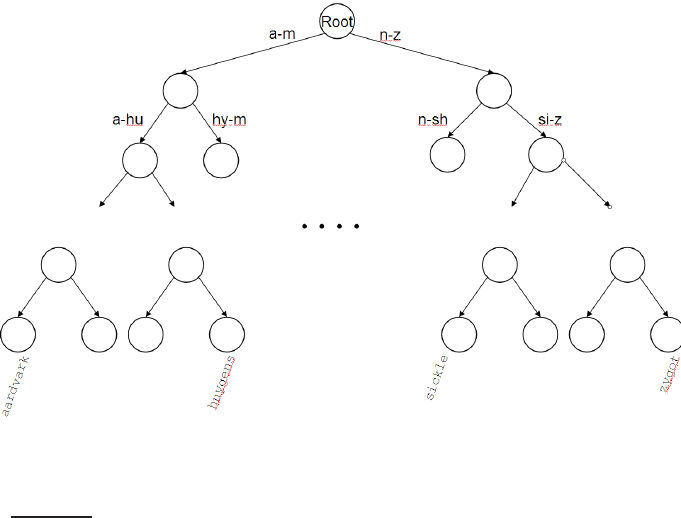
proceeds to one of the two sub-trees below that node. Figure
3.1 gives an ex-
ample of a binary search tree used for a dictionary. Efficient search (with a
number of comparisons that is O(log M)) hinges on the tree being balanced:
the numbers of terms under the two sub-trees of any node are either equal
or differ by one. The principal issue here is that of rebalancing: as terms are
inserted into or deleted from the binary search tree, it needs to be rebalanced
so that the balance property is maintained.
To mitigate rebalancing, one approach is to allow the number of sub-trees
under an internal node to vary in a fixed interval. A search tree commonly
used for a dictionary is the B-tree – a search tree in which every internal nodeB-TREE
has a number of children in the interval [a, b ], where a and b are appropriate
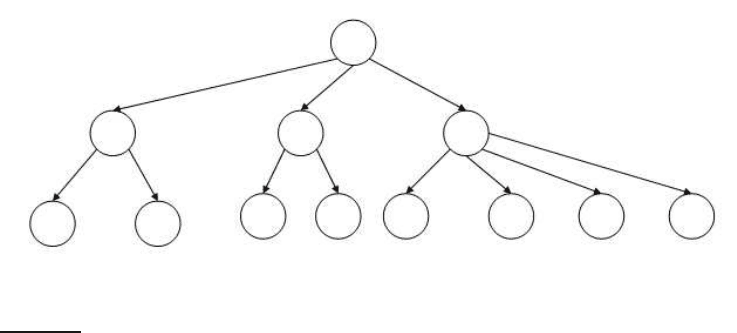
positive integers; Figure
3.2 shows an example with a = 2 and b = 4. Each
branch under an internal node again represents a test for a range of char-
1. So-called perfect hash functions are designed to preclude collisions, but are rather more com-
plicated both to implement and to compute.
Online edition (c)2009 Cambridge UP
3.2 Wildcard queries 51
◮
Figure 3.1 A binary search tree. In this example the branch at the root partitions
vocabulary terms into two subtrees, those whose first letter is between a and m, and
the rest.
acter sequences, as in the binary tree example of Figure 3.1. A B-tree may
be viewed as “collapsing” multiple levels of the binary tree into one; this
is especially advantageous when some of the dictionary is disk-resident, in
which case this collapsing serves the function of pre-fetching imminent bi-
nary tests. In such cases, the integers a and b are determined by the sizes of
disk blocks. Section
3.5 contains pointers to further background on search
trees and B-trees.
It should be noted that unlike hashing, search trees demand that the char-
acters used in the document collection have a prescribed ordering; for in-
stance, the 26 letters of the English alphabet are always listed in the specific
order A through Z. Some Asian languages such as Chinese do not always
have a unique ordering, although by now all languages (including Chinese
and Japanese) have adopted a standard ordering system for their character
sets.
3.2 Wildcard queries
Wildcard queries are used in any of the following situations: (1) the user
is uncertain of the spelling of a query term (e.g., Sydney vs. Sidney, which
Online edition (c)2009 Cambridge UP
52 3 Dictionaries and tolerant retrieval
◮
Figure 3.2 A B-tree. In this example every internal node has between 2 and 4
children.
leads to the wildcard query S*dney); (2) the user is aware of multiple vari-
ants of spelling a term and (consciously) seeks documents containing any of
the variants (e.g., color vs. colour); (3) the user seeks documents containing
variants of a term that would be caught by stemming, but is unsure whether
the search engine performs stemming (e.g., judicial vs. judiciary, leading to the
wildcard query judicia*); (4) the user is uncertain of the correct rendition of a
foreign word or phrase (e.g., the query Universit* Stuttgart).
A query such as mon* is known as a trailing wildcard query, because the *WILDCARD QUERY
symbol occurs only once, at the end of the search string. A search tree on
the dictionary is a convenient way of handling trailing wildcard queries: we
walk down the tree following the symbols m, o and n in turn, at which point
we can enumerate the set W of terms in the dictionary with the prefix mon.
Finally, we use |W| lookups on the standard inverted index to retrieve all
documents containing any term in W.
But what about wildcard queries in which the * symbol is not constrained
to be at the end of the search string? Before handling this general case, we
mention a slight generalization of trailing wildcard queries. First, consider
leading wildcard queries, or queries of the form *mon. Consider a reverse B-tree
on the dictionary – one in which each root-to-leaf path of the B-tree corre-
sponds to a term in the dictionary written backwards: thus, the term lemon
would, in the B-tree, be represented by the path root-n-o-m-e-l. A walk down
the reverse B-tree then enumerates all terms R in the vocabulary with a given
prefix.
In fact, using a regular B-tree together with a reverse B-tree, we can handle
an even more general case: wildcard queries in which there is a single * sym-
bol, such as se*mon. To do this, we use the regular B-tree to enumerate the set
W of dictionary terms beginning with the prefix se, then the reverse B-tree to
Online edition (c)2009 Cambridge UP
3.2 Wildcard queries 53
enumerate the set R of terms ending with the suffix mon. Next, we take the
intersection W ∩ R of these two sets, to arrive at the set of terms that begin
with the prefix se and end with the suffix mon. Finally, we use the standard
inverted index to retrieve all documents containing any terms in this inter-
section. We can thus handle wildcard queries that contain a single * symbol
using two B-trees, the normal B-tree and a reverse B-tree.
3.2.1 General wildcard queries
We now study two techniques for handling general wildcard queries. Both
techniques share a common strategy: express the given wildcard query q
w
as
a Boolean query Q on a specially constructed index, such that the answer to
Q is a superset of the set of vocabulary terms matching q
w
. Then, we check
each term in the answer to Q against q
w
, discarding those vocabulary terms
that do not match q
w
. At this point we have the vocabulary terms matching
q
w
and can resort to the standard inverted index.
Permuterm indexes
Our first special index for general wildcard queries is the permuterm index,PERMUTERM INDEX
a form of inverted index. First, we introduce a special symbol $ into our
character set, to mark the end of a term. Thus, the term hello is shown here as
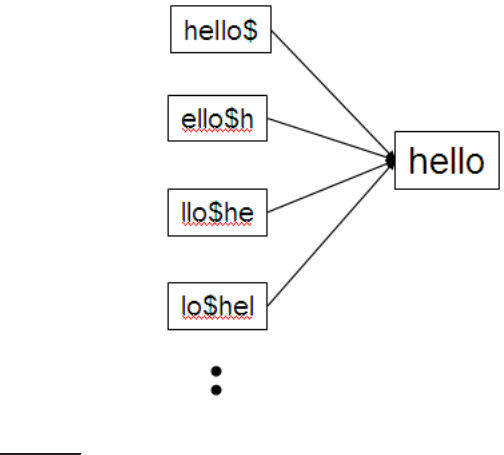
the augmented term hello$. Next, we construct a permuterm index, in which
the various rotations of each term (augmented with $) all link to the original
vocabulary term. Figure
3.3 gives an example of such a permuterm index
entry for the term hello.
We refer to the set of rotated terms in the permuterm index as the per-
muterm vocabulary.
How does this index help us with wildcard queries? Consider the wildcard
query m*n. The key is to rotate such a wildcard query so that the * symbol
appears at the end of the string – thus the rotated wildcard query becomes
n$m*. Next, we look up this string in the permuterm index, where seeking
n$m* (via a search tree) leads to rotations of (among others) the terms man
and moron.
Now that the permuterm index enables us to identify the original vocab-
ulary terms matching a wildcard query, we look up these terms in the stan-
dard inverted index to retrieve matching documents. We can thus handle
any wildcard query with a single * symbol. But what about a query such as
fi*mo*er? In this case we first enumerate the terms in the dictionary that are
in the permuterm index of er$fi*. Not all such dictionary terms will have
the string mo in the middle - we filter these out by exhaustive enumera-
tion, checking each candidate to see if it contains mo. In this example, the
term fishmonger would survive this filtering but filibuster would not. We then
Online edition (c)2009 Cambridge UP
54 3 Dictionaries and tolerant retrieval
◮
Figure 3.3 A portion of a permuterm index.
run the surviving terms through the standard inverted index for document
retrieval. One disadvantage of the permuterm index is that its dictionary
becomes quite large, including as it does all rotations of each term.
Notice the close interplay between the B-tree and the permuterm index
above. Indeed, it suggests that the structure should perhaps be viewed as
a permuterm B-tree. However, we follow traditional terminology here in
describing the permuterm index as distinct from the B-tree that allows us to
select the rotations with a given prefix.
3.2.2 k-gram indexes for wildcard queries
Whereas the permuterm index is simple, it can lead to a considerable blowup
from the number of rotations per term; for a dictionary of English terms, this
can represent an almost ten-fold space increase. We now present a second
technique, known as the k-gram index, for processing wildcard queries. We
will also use k-gram indexes in Section
3.3.4. A k-gram is a sequence of k
characters. Thus cas, ast and stl are all 3-grams occurring in the term castle.
We use a special character $ to denote the beginning or end of a term, so the
full set of 3-grams generated for castle is: $ca, cas, ast, stl, tle, le$.
In a k-gram index, the dictionary contains all k-grams that occur in any termk-GRAM INDEX
in the vocabulary. Each postings list points from a k-gram to all vocabulary
Online edition (c)2009 Cambridge UP
3.2 Wildcard queries 55
etr
beetroot
metric
petrify
retrieval
- - - -
◮
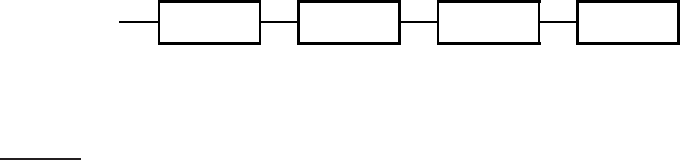
Figure 3.4 Example of a postings list in a 3-gram index. Here the 3-gram etr is
illustrated. Matching vocabulary terms are lexicographically ordered in the postings.
terms containing that k-gram. For instance, the 3-gram etr would point to vo-
cabulary terms such as metric and retrieval. An example is given in Figure
3.4.
How does such an index help us with wildcard queries? Consider the
wildcard query re*ve. We are seeking documents containing any term that
begins with re and ends with ve. Accordingly, we run the Boolean query $re
AND ve$. This is looked up in the 3-gram index and yields a list of matching
terms such as relive, remove and retrieve. Each of these matching terms is then
looked up in the standard inverted index to yield documents matching the
query.
There is however a difficulty with the use of k-gram indexes, that demands
one further step of processing. Consider using the 3-gram index described
above for the query red*. Following the process described above, we first
issue the Boolean query $re AND red to the 3-gram index. This leads to a
match on terms such as retired, which contain the conjunction of the two 3-
grams $re and red, yet do not match the original wildcard query red*.
To cope with this, we introduce a post-filtering step, in which the terms enu-
merated by the Boolean query on the 3-gram index are checked individually
against the original query red*. This is a simple string-matching operation
and weeds out terms such as retired that do not match the original query.
Terms that survive are then searched in the standard inverted index as usual.
We have seen that a wildcard query can result in multiple terms being
enumerated, each of which becomes a single-term query on the standard in-
verted index. Search engines do allow the combination of wildcard queries
using Boolean operators, for example, re*d AND fe*ri. What is the appropriate
semantics for such a query? Since each wildcard query turns into a disjunc-
tion of single-term queries, the appropriate interpretation of this example
is that we have a conjunction of disjunctions: we seek all documents that
contain any term matching re*d and any term matching fe*ri.
Even without Boolean combinations of wildcard queries, the processing of
a wildcard query can be quite expensive, because of the added lookup in the
special index, filtering and finally the standard inverted index. A search en-
gine may support such rich functionality, but most commonly, the capability
is hidden behind an interface (say an “Advanced Query” interface) that most