
Manning Ch. D., Raghavan P., Sch?tze H. Introduction to Information Retrieval - Введение в информационный поиск
Подождите немного. Документ загружается.

Online edition (c)2009 Cambridge UP
186 9 Relevance feedback and query expansion
?
Exercise 9.1
In Rocchio’s algorithm, what weight setting for α/β/γ does a “Find pages like this
one” search correspond to?
Exercise 9.2 [⋆]
Give three reasons why relevance feedback has been little used in web search.
9.1.5 Evaluation of relevance feedback strategies
Interactive relevance feedback can give very substantial gains in retrieval
performance. Empirically, one round of relevance feedback is often very
useful. Two rounds is sometimes marginally more useful. Successful use of
relevance feedback requires enough judged documents, otherwise the pro-
cess is unstable in that it may drift away from the user’s information need.
Accordingly, having at least five judged documents is recommended.
There is some subtlety to evaluating the effectiveness of relevance feed-
back in a sound and enlightening way. The obvious first strategy is to start
with an initial query q
0
and to compute a precision-recall graph. Following
one round of feedback from the user, we compute the modified query q
m
and again compute a precision-recall graph. Here, in both rounds we assess
performance over all documents in the collection, which makes comparisons
straightforward. If we do this, we find spectacular gains from relevance feed-
back: gains on the order of 50% in mean average precision. But unfortunately
it is cheating. The gains are partly due to the fact that known relevant doc-
uments (judged by the user) are now ranked higher. Fairness demands that
we should only evaluate with respect to documents not seen by the user.
A second idea is to use documents in the residual collection (the set of doc-
uments minus those assessed relevant) for the second round of evaluation.
This seems like a more realistic evaluation. Unfortunately, the measured per-
formance can then often be lower than for the original query. This is partic-
ularly the case if there are few relevant documents, and so a fair proportion
of them have been judged by the user in the first round. The relative per-
formance of variant relevance feedback methods can be validly compared,
but it is difficult to validly compare performance with and without relevance
feedback because the collection size and the number of relevant documents
changes from before the feedback to after it.
Thus neither of these methods is fully satisfactory. A third method is to
have two collections, one which is used for the initial query and relevance
judgments, and the second that is then used for comparative evaluation. The
performance of both q
0
and q
m
can be validly compared on the second col-
lection.
Perhaps the best evaluation of the utility of relevance feedback is to do user
studies of its effectiveness, in particular by doing a time-based comparison:

Online edition (c)2009 Cambridge UP
9.1 Relevance feedback and pseudo relevance feedback 187
Precision at k = 50
Term weighting no RF pseudo RF
lnc.ltc 64.2% 72.7%
Lnu.ltu 74.2% 87.0%
◮
Figure 9.5 Results showing pseudo relevance feedback greatly improving perfor-
mance. These results are taken from the Cornell SMART system at TREC 4 (Buckley
et al. 1995), and also contrast the use of two different length normalization schemes
(L vs. l); cf. Figure 6.15 (page 128). Pseudo relevance feedback consisted of adding 20
terms to each query.
how fast does a user find relevant documents with relevance feedback vs.
another strategy (such as query reformulation), or alternatively, how many
relevant documents does a user find in a certain amount of time. Such no-
tions of user utility are fairest and closest to real system usage.
9.1.6 Pseudo relevance feedback
Pseudo relevance feedback, also known as blind relevance feedback, provides aPSEUDO RELEVANCE
FEEDBACK
BLIND RELEVANCE
FEEDBACK
method for automatic local analysis. It automates the manual part of rele-
vance feedback, so that the user gets improved retrieval performance with-
out an extended interaction. The method is to do normal retrieval to find an
initial set of most relevant documents, to then assume that the top k ranked
documents are relevant, and finally to do relevance feedback as before under
this assumption.
This automatic technique mostly works. Evidence suggests that it tends
to work better than global analysis (Section
9.2). It has been found to im-
prove performance in the TREC ad hoc task. See for example the results in
Figure
9.5. But it is not without the dangers of an automatic process. For
example, if the query is about copper mines and the top several documents
are all about mines in Chile, then there may be query drift in the direction of
documents on Chile.
9.1.7 Indirect relevance feedback
We can also use indirect sources of evidence rather than explicit feedback on
relevance as the basis for relevance feedback. This is often called implicit (rel-IMPLICIT RELEVANCE
FEEDBACK
evance) feedback. Implicit feedback is less reliable than explicit feedback, but is
more useful than pseudo relevance feedback, which contains no evidence of
user judgments. Moreover, while users are often reluctant to provide explicit
feedback, it is easy to collect implicit feedback in large quantities for a high
volume system, such as a web search engine.
Online edition (c)2009 Cambridge UP
188 9 Relevance feedback and query expansion
On the web, DirectHit introduced the idea of ranking more highly docu-
ments that users chose to look at more often. In other words, clicks on links
were assumed to indicate that the page was likely relevant to the query. This
approach makes various assumptions, such as that the document summaries
displayed in results lists (on whose basis users choose which documents to
click on) are indicative of the relevance of these documents. In the original
DirectHit search engine, the data about the click rates on pages was gathered
globally, rather than being user or query specific. This is one form of the gen-
eral area of clickstream mining. Today, a closely related approach is used inCLICKSTREAM MINING
ranking the advertisements that match a web search query (Chapter 19).
9.1.8 Summary
Relevance feedback has been shown to be very effective at improving rele-
vance of results. Its successful use requires queries for which the set of rele-
vant documents is medium to large. Full relevance feedback is often onerous
for the user, and its implementation is not very efficient in most IR systems.
In many cases, other types of interactive retrieval may improve relevance by
about as much with less work.
Beyond the core ad hoc retrieval scenario, other uses of relevance feedback
include:
• Following a changing information need (e.g., names of car models of in-
terest change over time)
• Maintaining an information filter (e.g., for a news feed). Such filters are
discussed further in Chapter
13.
• Active learning (deciding which examples it is most useful to know the
class of to reduce annotation costs).
?
Exercise 9.3
Under what conditions would the modified query q
m
in Equation 9.3 be the same as
the original query q
0
? In all other cases, is q
m
closer than q
0
to the centroid of the
relevant documents?
Exercise 9.4
Why is positive feedback likely to be more useful than negative feedback to an IR
system? Why might only using one nonrelevant document be more effective than
using several?
Exercise 9.5
Suppose that a user’s initial query is cheap CDs cheap DVDs extremely cheap CDs. The
user examines two documents, d
1
and d
2
. She judges d
1
, with the content CDs cheap
software cheap CDs relevant and d
2
with content cheap thrills DVDs nonrelevant. As-
sume that we are using direct term frequency (with no scaling and no document
Online edition (c)2009 Cambridge UP
9.2 Global methods for query reformulation 189
frequency). There is no need to length-normalize vectors. Using Rocchio relevance
feedback as in Equation (
9.3) what would the revised query vector be after relevance
feedback? Assume α = 1, β = 0.75, γ = 0.25.
Exercise 9.6 [⋆]
Omar has implemented a relevance feedback web search system, where he is going
to do relevance feedback based only on words in the title text returned for a page (for
efficiency). The user is going to rank 3 results. The first user, Jinxing, queries for:
banana slug
and the top three titles returned are:
banana slug Ariolimax columbianus
Santa Cruz mountains banana slug
Santa Cruz Campus Mascot
Jinxing judges the first two documents relevant, and the third nonrelevant. Assume
that Omar’s search engine uses term frequency but no length normalization nor IDF.
Assume that he is using the Rocchio relevance feedback mechanism, with α = β =
γ = 1. Show the final revised query that would be run. (Please list the vector elements
in alphabetical order.)
9.2 Global me thods f or query reformulation
In this section we more briefly discuss three global methods for expanding a
query: by simply aiding the user in doing so, by using a manual thesaurus,
and through building a thesaurus automatically.
9.2.1 Vocabulary tools for query reformulation
Various user supports in the search process can help the user see how their
searches are or are not working. This includes information about words that
were omitted from the query because they were on stop lists, what words
were stemmed to, the number of hits on each term or phrase, and whether
words were dynamically turned into phrases. The IR system might also sug-
gest search terms by means of a thesaurus or a controlled vocabulary. A user
can also be allowed to browse lists of the terms that are in the inverted index,
and thus find good terms that appear in the collection.
9.2.2 Query expansion
In relevance feedback, users give additional input on documents (by mark-
ing documents in the results set as relevant or not), and this input is used
to reweight the terms in the query for documents. In query expansion on theQUERY EXPANSION
other hand, users give additional input on query words or phrases, possibly
suggesting additional query terms. Some search engines (especially on the
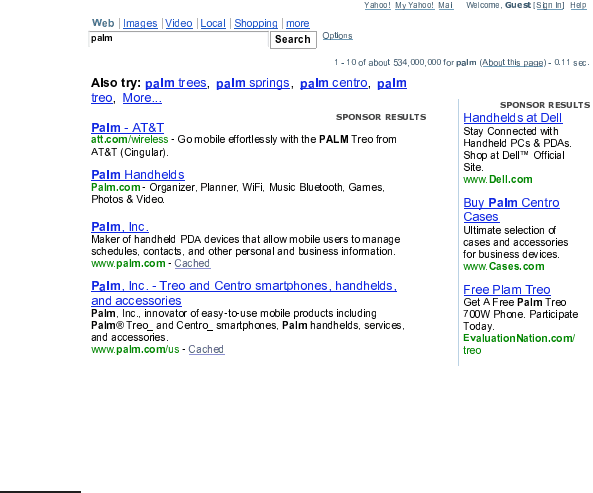
Online edition (c)2009 Cambridge UP
190 9 Relevance feedback and query expansion
◮
Figure 9.6 An example of query expansion in the interface of the Yahoo! web
search engine in 2006. The expanded query suggestions appear just below the “Search
Results” bar.
web) suggest related queries in response to a query; the users then opt to use
one of these alternative query suggestions. Figure
9.6 shows an example of
query suggestion options being presented in the Yahoo! web search engine.
The central question in this form of query expansion is how to generate al-
ternative or expanded queries for the user. The most common form of query
expansion is global analysis, using some form of thesaurus. For each term
t in a query, the query can be automatically expanded with synonyms and
related words of t from the thesaurus. Use of a thesaurus can be combined
with ideas of term weighting: for instance, one might weight added terms
less than original query terms.
Methods for building a thesaurus for query expansion include:
• Use of a controlled vocabulary that is maintained by human editors. Here,
there is a canonical term for each concept. The subject headings of tra-
ditional library subject indexes, such as the Library of Congress Subject
Headings, or the Dewey Decimal system are examples of a controlled
vocabulary. Use of a controlled vocabulary is quite common for well-
resourced domains. A well-known example is the Unified Medical Lan-
guage System (UMLS) used with MedLine for querying the biomedical
research literature. For example, in Figure
9.7, neoplasms was added to a

Online edition (c)2009 Cambridge UP
9.2 Global methods for query reformulation 191
• User query: cancer
• PubMed query: (“neoplasms”[TIAB] NOT Medline[SB]) OR “neoplasms”[MeSH
Terms] OR cancer[Text Word]
• User query: skin itch
• PubMed query: (“skin”[MeSH Terms] OR (“integumentary system”[TIAB] NOT
Medline[SB]) OR “integumentary system”[MeSH Terms] OR skin[Text Word]) AND
((“pruritus”[TIAB] NOT Medline[SB]) OR “pruritus”[MeSH Terms] OR itch[Text
Word])
◮
Figure 9.7 Examples of query expansion via the PubMed thesaurus. When a user
issues a query on the PubMed interface to Medline at http://www.ncbi.nlm.nih.gov/entrez/,
their query is mapped on to the Medline vocabulary as shown.
search for cancer. This Medline query expansion also contrasts with the
Yahoo! example. The Yahoo! interface is a case of interactive query expan-
sion, whereas PubMed does automatic query expansion. Unless the user
chooses to examine the submitted query, they may not even realize that
query expansion has occurred.
• A manual thesaurus. Here, human editors have built up sets of synony-
mous names for concepts, without designating a canonical term. The
UMLS metathesaurus is one example of a thesaurus. Statistics Canada
maintains a thesaurus of preferred terms, synonyms, broader terms, and
narrower terms for matters on which the government collects statistics,
such as goods and services. This thesaurus is also bilingual English and
French.
• An automatically derived thesaurus. Here, word co-occurrence statistics
over a collection of documents in a domain are used to automatically in-
duce a thesaurus; see Section
9.2.3.
• Query reformulations based on query log mining. Here, we exploit the
manual query reformulations of other users to make suggestions to a new
user. This requires a huge query volume, and is thus particularly appro-
priate to web search.
Thesaurus-based query expansion has the advantage of not requiring any
user input. Use of query expansion generally increases recall and is widely
used in many science and engineering fields. As well as such global analysis
techniques, it is also possible to do query expansion by local analysis, for
instance, by analyzing the documents in the result set. User input is now

Online edition (c)2009 Cambridge UP
192 9 Relevance feedback and query expansion
Word Nearest neighbors
absolutely absurd, whatsoever, totally, exactly, nothing
bottomed dip, copper, drops, topped, slide, trimmed
captivating shimmer, stunningly, superbly, plucky, witty
doghouse dog, porch, crawling, beside, downstairs
makeup repellent, lotion, glossy, sunscreen, skin, gel
mediating reconciliation, negotiate, case, conciliation
keeping hoping, bring, wiping, could, some, would
lithographs drawings, Picasso, Dali, sculptures, Gauguin
pathogens toxins, bacteria, organisms, bacterial, parasite
senses grasp, psyche, truly, clumsy, naive, innate
◮
Figure 9.8 An example of an automatically generated thesaurus. This example
is based on the work in Schütze (1998), which employs latent semantic indexing (see
Chapter 18).
usually required, but a distinction remains as to whether the user is giving
feedback on documents or on query terms.
9.2.3 Automatic thesaurus generation
As an alternative to the cost of a manual thesaurus, we could attempt to
generate a thesaurus automatically by analyzing a collection of documents.
There are two main approaches. One is simply to exploit word cooccurrence.
We say that words co-occurring in a document or paragraph are likely to be
in some sense similar or related in meaning, and simply count text statistics
to find the most similar words. The other approach is to use a shallow gram-
matical analysis of the text and to exploit grammatical relations or grammat-
ical dependencies. For example, we say that entities that are grown, cooked,
eaten, and digested, are more likely to be food items. Simply using word
cooccurrence is more robust (it cannot be misled by parser errors), but using
grammatical relations is more accurate.
The simplest way to compute a co-occurrence thesaurus is based on term-
term similarities. We begin with a term-document matrix A, where each cell
A
t,d
is a weighted count w
t,d
for term t and document d, with weighting so
A has length-normalized rows. If we then calculate C = AA
T
, then C
u,v
is
a similarity score between terms u and v, with a larger number being better.
Figure
9.8 shows an example of a thesaurus derived in basically this manner,
but with an extra step of dimensionality reduction via Latent Semantic In-
dexing, which we discuss in Chapter 18. While some of the thesaurus terms
are good or at least suggestive, others are marginal or bad. The quality of the
associations is typically a problem. Term ambiguity easily introduces irrel-
Online edition (c)2009 Cambridge UP
9.3 References and further reading 193
evant statistically correlated terms. For example, a query for Apple computer
may expand to Apple red fruit computer. In general these thesauri suffer from
both false positives and false negatives. Moreover, since the terms in the au-
tomatic thesaurus are highly correlated in documents anyway (and often the
collection used to derive the thesaurus is the same as the one being indexed),
this form of query expansion may not retrieve many additional documents.
Query expansion is often effective in increasing recall. However, there is
a high cost to manually producing a thesaurus and then updating it for sci-
entific and terminological developments within a field. In general a domain-
specific thesaurus is required: general thesauri and dictionaries give far too
little coverage of the rich domain-particular vocabularies of most scientific
fields. However, query expansion may also significantly decrease precision,
particularly when the query contains ambiguous terms. For example, if the
user searches for interest rate, expanding the query to interest rate fascinateeval-
uate is unlikely to be useful. Overall, query expansion is less successful than
relevance feedback, though it may be as good as pseudo relevance feedback.
It does, however, have the advantage of being much more understandable to
the system user.
?
Exercise 9.7
If A is simply a Boolean cooccurrence matrix, then what do you get as the entries in
C?
9.3 Refe rences and further reading
Work in information retrieval quickly confronted the problem of variant ex-
pression which meant that the words in a query might not appear in a doc-
ument, despite it being relevant to the query. An early experiment about
1960 cited by Swanson (1988) found that only 11 out of 23 documents prop-
erly indexed under the subject toxicity had any use of a word containing the
stem toxi. There is also the issue of translation, of users knowing what terms
a document will use. Blair and Maron (1985) conclude that “it is impossibly
difficult for users to predict the exact words, word combinations, and phrases
that are used by all (or most) relevant documents and only (or primarily) by
those documents”.
The main initial papers on relevance feedback using vector space models
all appear in Salton (1971b), including the presentation of the Rocchio al-
gorithm (Rocchio 1971) and the Ide dec-hi variant along with evaluation of
several variants (Ide 1971). Another variant is to regard all documents in
the collection apart from those judged relevant as nonrelevant, rather than
only ones that are explicitly judged nonrelevant. However, Schütze et al.
(1995) and Singhal et al. (1997) show that better results are obtained for rout-
ing by using only documents close to the query of interest rather than all
Online edition (c)2009 Cambridge UP
194 9 Relevance feedback and query expansion
documents. Other later work includes Salton and Buckley (1990), Riezler
et al. (2007) (a statistical NLP approach to RF) and the recent survey paper
Ruthven and Lalmas (2003).
The effectiveness of interactive relevance feedback systems is discussed in
(Salton 1989, Harman 1992, Buckley et al. 1994b). Koenemann and Belkin
(1996) do user studies of the effectiveness of relevance feedback.
Traditionally Roget’s thesaurus has been the best known English language
thesaurus (Roget 1946). In recent computational work, people almost always
use WordNet (Fellbaum 1998), not only because it is free, but also because of
its rich link structure. It is available at: http://wordnet.princeton.edu.
Qiu and Frei (1993) and Schütze (1998) discuss automatic thesaurus gener-
ation. Xu and Croft (1996) explore using both local and global query expan-
sion.

Online edition (c)2009 Cambridge UP
DRAFT! © April 1, 2009 Cambridge University Press. Feedback welcome. 195
10 XML ret r ieval
Information retrieval systems are often contrasted with relational databases.
Traditionally, IR systems have retrieved information from unstructured text
– by which we mean “raw” text without markup. Databases are designed
for querying relational data: sets of records that have values for predefined
attributes such as employee number, title and salary. There are fundamental
differences between information retrieval and database systems in terms of
retrieval model, data structures and query language as shown in Table
10.1.
1
Some highly structured text search problems are most efficiently handled
by a relational database, for example, if the employee table contains an at-
tribute for short textual job descriptions and you want to find all employees
who are involved with invoicing. In this case, the SQL query:
select lastname from employees where job_desc like ’invoic%’;
may be sufficient to satisfy your information need with high precision and
recall.
However, many structured data sources containing text are best modeled
as structured documents rather than relational data. We call the search over
such structured documents st ruct ured retrieval. Queries in structured retrievalSTRUCTURED
RETRIEVAL
can be either structured or unstructured, but we will assume in this chap-
ter that the collection consists only of structured documents. Applications
of structured retrieval include digital libraries, patent databases, blogs, text
in which entities like persons and locations have been tagged (in a process
called named entity tagging) and output from office suites like OpenOffice
that save documents as marked up text. In all of these applications, we want
to be able to run queries that combine textual criteria with structural criteria.
Examples of such queries are give me a full-length article on fast fourier transforms
(digital libraries), give me patents whose claims mention RSA public key encryption
1. In most modern database systems, one can enable full-text search for text columns. This
usually means that an inverted index is created and Boolean or vector space search enabled,
effectively combining core database with information retrieval technologies.