
Manning Ch. D., Raghavan P., Sch?tze H. Introduction to Information Retrieval - Введение в информационный поиск
Подождите немного. Документ загружается.


Online edition (c)2009 Cambridge UP
156 8 Evaluation in information retrieval
assumed to have a certain tolerance for seeing some false positives provid-
ing that they get some useful information. The measures of precision and
recall concentrate the evaluation on the return of true positives, asking what
percentage of the relevant documents have been found and how many false
positives have also been returned.
The advantage of having the two numbers for precision and recall is that
one is more important than the other in many circumstances. Typical web
surfers would like every result on the first page to be relevant (high preci-
sion) but have not the slightest interest in knowing let alone looking at every
document that is relevant. In contrast, various professional searchers such as
paralegals and intelligence analysts are very concerned with trying to get as
high recall as possible, and will tolerate fairly low precision results in order to
get it. Individuals searching their hard disks are also often interested in high
recall searches. Nevertheless, the two quantities clearly trade off against one
another: you can always get a recall of 1 (but very low precision) by retriev-
ing all documents for all queries! Recall is a non-decreasing function of the
number of documents retrieved. On the other hand, in a good system, preci-
sion usually decreases as the number of documents retrieved is increased. In
general we want to get some amount of recall while tolerating only a certain
percentage of false positives.
A single measure that trades off precision versus recall is the F measure,F MEASURE
which is the weighted harmonic mean of precision and recall:
F =
1
α
1
P
+ (1 − α)
1
R
=
(β
2
+ 1)PR
β
2
P + R
where β
2
=
1 − α
α
(8.5)
where α ∈ [0, 1] and thus β
2
∈ [0, ∞]. The default balanced F measure equally
weights precision and recall, which means making α = 1/2 or β = 1. It is
commonly written as F
1
, which is short for F
β=1
, even though the formula-
tion in terms of α more transparently exhibits the F measure as a weighted
harmonic mean. When using β = 1, the formula on the right simplifies to:
F
β=1
=
2PR
P + R
(8.6)
However, using an even weighting is not the only choice. Values of β < 1
emphasize precision, while values of β > 1 emphasize recall. For example, a
value of β = 3 or β = 5 might be used if recall is to be emphasized. Recall,
precision, and the F measure are inherently measures between 0 and 1, but
they are also very commonly written as percentages, on a scale between 0
and 100.
Why do we use a harmonic mean rather than the simpler average (arith-
metic mean)? Recall that we can always get 100% recall by just returning all
documents, and therefore we can always get a 50% arithmetic mean by the
Online edition (c)2009 Cambridge UP
8.3 Evaluation of unranked retrieval sets 157
◮
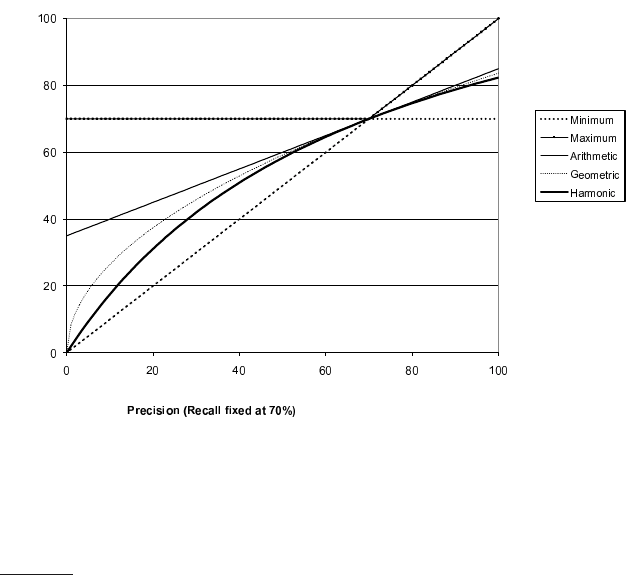
Figure 8.1 Graph comparing the harmonic mean to other means. The graph
shows a slice through the calculation of various means of precision and recall for
the fixed recall value of 70%. The harmonic mean is always less than either the arith-
metic or geometric mean, and often quite close to the minimum of the two numbers.
When the precision is also 70%, all the measures coincide.
same process. This strongly suggests that the arithmetic mean is an unsuit-
able measure to use. In contrast, if we assume that 1 document in 10,000 is
relevant to the query, the harmonic mean score of this strategy is 0.02%. The
harmonic mean is always less than or equal to the arithmetic mean and the
geometric mean. When the values of two numbers differ greatly, the har-
monic mean is closer to their minimum than to their arithmetic mean; see
Figure
8.1.
?
Exercise 8.1
[⋆]
An IR system returns 8 relevant documents, and 10 nonrelevant documents. There
are a total of 20 relevant documents in the collection. What is the precision of the
system on this search, and what is its recall?
Exercise 8.2 [⋆]
The balanced F measure (a.k.a. F
1
) is defined as the harmonic mean of precision and
recall. What is the advantage of using the harmonic mean rather than “averaging”
(using the arithmetic mean)?
Online edition (c)2009 Cambridge UP
158 8 Evaluation in information retrieval
0.0
0.2
0.4
0.6
0.8
1.0
0.0 0.2 0.4 0.6 0.8 1.0
Recall
Precision
◮
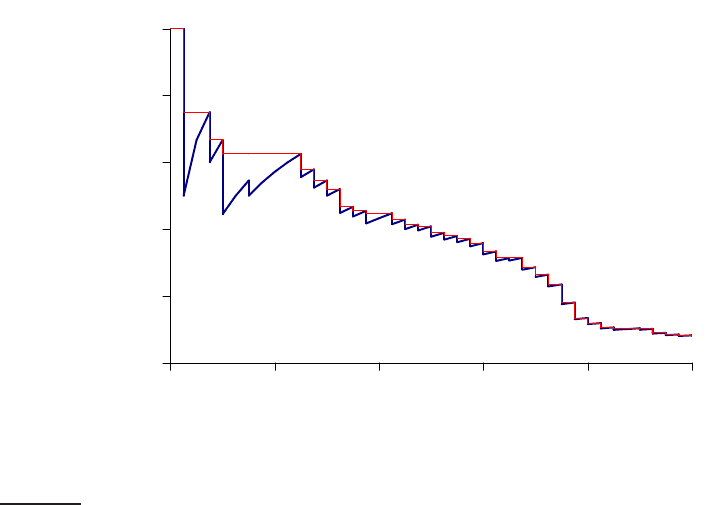
Figure 8.2 Precision/recall graph.
Exercise 8.3 [⋆⋆]
Derive the equivalence between the two formulas for F measure shown in Equa-
tion (8.5), given that α = 1/(β
2
+ 1).
8.4 Evaluation of ranked retrieval results
Precision, recall, and the F measure are set-based measures. They are com-
puted using unordered sets of documents. We need to extend these measures
(or to define new measures) if we are to evaluate the ranked retrieval results
that are now standard with search engines. In a ranked retrieval context,
appropriate sets of retrieved documents are naturally given by the top k re-
trieved documents. For each such set, precision and recall values can be
plotted to give a precision-recall curve, such as the one shown in Figure 8.2.PRECISION-RECALL
CURVE
Precision-recall curves have a distinctive saw-tooth shape: if the (k + 1)
th
document retrieved is nonrelevant then recall is the same as for the top k
documents, but precision has dropped. If it is relevant, then both precision
and recall increase, and the curve jags up and to the right. It is often useful to
remove these jiggles and the standard way to do this is with an interpolated
precision: the interpolated precision p
in terp
at a certain recall level r is definedINTERPOLATED
PRECISION

Online edition (c)2009 Cambridge UP
8.4 Evaluation of ranked retrieval results 159
Recall Interp.
Precision
0.0 1.00
0.1 0.67
0.2 0.63
0.3 0.55
0.4 0.45
0.5 0.41
0.6 0.36
0.7 0.29
0.8 0.13
0.9 0.10
1.0 0.08
◮
Table 8.1 Calculation of 11-point Interpolated Average Precision. This is for the
precision-recall curve shown in Figure 8.2.
as the highest precision found for any recall level r
′
≥ r:
p
in terp
(r) = max
r
′
≥r
p(r
′
)(8.7)
The justification is that almost anyone would be prepared to look at a few
more documents if it would increase the percentage of the viewed set that
were relevant (that is, if the precision of the larger set is higher). Interpolated
precision is shown by a thinner line in Figure
8.2. With this definition, the
interpolated precision at a recall of 0 is well-defined (Exercise 8.4).
Examining the entire precision-recall curve is very informative, but there
is often a desire to boil this information down to a few numbers, or perhaps
even a single number. The traditional way of doing this (used for instance
in the first 8 TREC Ad Hoc evaluations) is the 11-po int interpolated average11-POINT
INTERPOLATED
AVERAGE PRECISION
precision. For each information need, the interpolated precision is measured
at the 11 recall levels of 0.0, 0.1, 0.2, . . ., 1.0. For the precision-recall curve in
Figure
8.2, these 11 values are shown in Table 8.1. For each recall level, we
then calculate the arithmetic mean of the interpolated precision at that recall
level for each information need in the test collection. A composite precision-
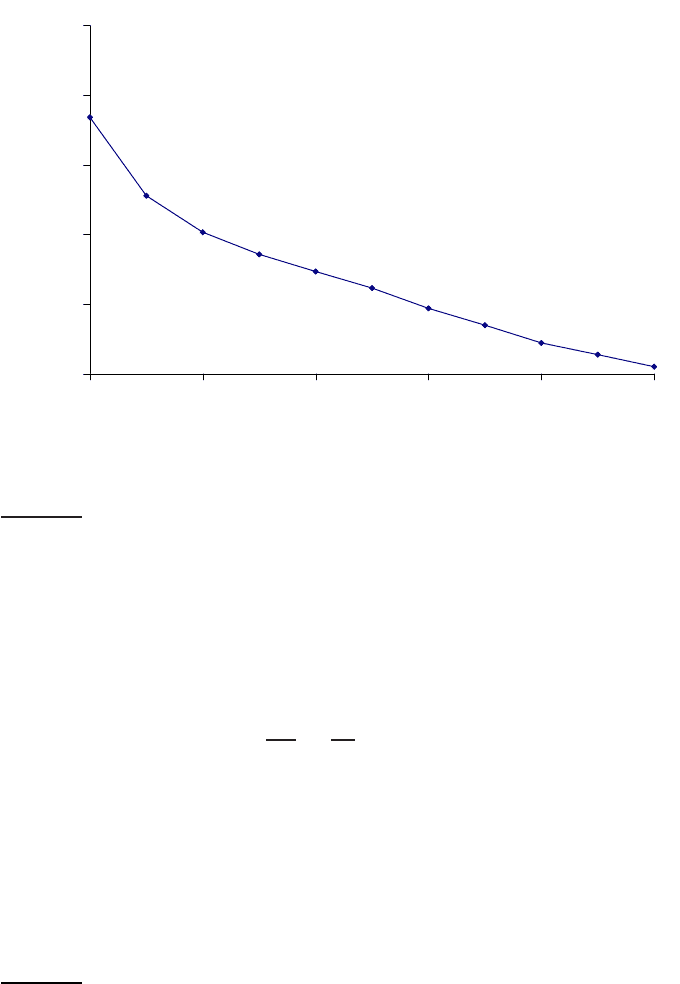
recall curve showing 11 points can then be graphed. Figure
8.3 shows an
example graph of such results from a representative good system at TREC 8.
In recent years, other measures have become more common. Most stan-
dard among the TREC community is Mean Average Precision (MAP), whichMEAN AVERAGE
PRECISION
provides a single-figure measure of quality across recall levels. Among eval-
uation measures, MAP has been shown to have especially good discrimina-
tion and stability. For a single information need, Average Precision is the
Online edition (c)2009 Cambridge UP
160 8 Evaluation in information retrieval
0
0.2
0.4
0.6
0.8
1
0 0.2 0.4 0.6 0.8 1
Recall
Precision
◮
Figure 8.3 Averaged 11-point precision/recall graph across 50 queries for a rep-
resentative TREC system. The Mean Average Precision for this system is 0.2553.
average of the precision value obtained for the set of top k documents exist-
ing after each relevant document is retrieved, and this value is then averaged
over information needs. That is, if the set of relevant documents for an in-
formation need q
j
∈ Q is {d
1
, . . . d
m
j
} and R
jk
is the set of ranked retrieval
results from the top result until you get to document d
k
, then
MAP(Q) =
1
|Q|
|Q|
∑
j=1
1
m
j
m
j
∑
k=1
Precision(R
jk
)
(8.8)
When a relevant document is not retrieved at all,
1
the precision value in the
above equation is taken to be 0. For a single information need, the average
precision approximates the area under the uninterpolated precision-recall
curve, and so the MAP is roughly the average area under the precision-recall
curve for a set of queries.
Using MAP, fixed recall levels are not chosen, and there is no interpola-
tion. The MAP value for a test collection is the arithmetic mean of average
1. A system may not fully order all documents in the collection in response to a query or at
any rate an evaluation exercise may be based on submitting only the top k results for each
information need.
Online edition (c)2009 Cambridge UP
8.4 Evaluation of ranked retrieval results 161
precision values for individual information needs. (This has the effect of
weighting each information need equally in the final reported number, even
if many documents are relevant to some queries whereas very few are rele-
vant to other queries.) Calculated MAP scores normally vary widely across
information needs when measured within a single system, for instance, be-
tween 0.1 and 0.7. Indeed, there is normally more agreement in MAP for
an individual information need across systems than for MAP scores for dif-
ferent information needs for the same system. This means that a set of test
information needs must be large and diverse enough to be representative of
system effectiveness across different queries.
The above measures factor in precision at all recall levels. For many promi-PRECISION AT k
nent applications, particularly web search, this may not be germane to users.
What matters is rather how many good results there are on the first page or
the first three pages. This leads to measuring precision at fixed low levels of
retrieved results, such as 10 or 30 documents. This is referred to as “Precision
at k”, for example “Precision at 10”. It has the advantage of not requiring any
estimate of the size of the set of relevant documents but the disadvantages
that it is the least stable of the commonly used evaluation measures and that
it does not average well, since the total number of relevant documents for a
query has a strong influence on precision at k.
An alternative, which alleviates this problem, is R-p recision. It requiresR-PRECISION
having a set of known relevant documents Rel, from which we calculate the
precision of the top Rel documents returned. (The set Rel may be incomplete,
such as when Rel is formed by creating relevance judgments for the pooled
top k results of particular systems in a set of experiments.) R-precision ad-
justs for the size of the set of relevant documents: A perfect system could
score 1 on this metric for each query, whereas, even a perfect system could
only achieve a precision at 20 of 0.4 if there were only 8 documents in the
collection relevant to an information need. Averaging this measure across
queries thus makes more sense. This measure is harder to explain to naive
users than Precision at k but easier to explain than MAP. If there are |Re l|
relevant documents for a query, we examine the top |Rel| results of a sys-
tem, and find that r are relevant, then by definition, not only is the precision
(and hence R-precision) r/|Rel|, but the recall of this result set is also r/|Rel|.
Thus, R-precision turns out to be identical to the break-even point, anotherBREAK-EVEN POINT
measure which is sometimes used, defined in terms of this equality relation-
ship holding. Like Precision at k, R-precision describes only one point on
the precision-recall curve, rather than attempting to summarize effectiveness
across the curve, and it is somewhat unclear why you should be interested
in the break-even point rather than either the best point on the curve (the
point with maximal F-measure) or a retrieval level of interest to a particular
application (Precision at k). Nevertheless, R-precision turns out to be highly
correlated with MAP empirically, despite measuring only a single point on
Online edition (c)2009 Cambridge UP
162 8 Evaluation in information retrieval
0.0
0.2
0.4
0.6
0.8
1.0
0 0.2 0.4 0.6 0.8 1
1 − specificity
sensitivity ( = recall)
◮
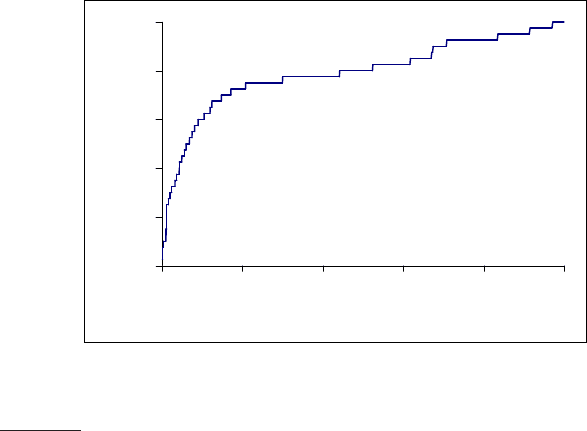
Figure 8.4 The ROC curve corresponding to the precision-recall curve in Fig-
ure 8.2.
.
the curve.
Another concept sometimes used in evaluation is an ROC curve. (“ROC”ROC CURVE
stands for “Receiver Operating Characteristics”, but knowing that doesn’t
help most people.) An ROC curve plots the true positive rate or sensitiv-
ity against the false positive rate or (1 − specificity). Here, sensitivity is justSENSITIVITY
another term for recall. The false positive rate is given by f p/( f p + tn). Fig-
ure
8.4 shows the ROC curve corresponding to the precision-recall curve in
Figure
8.2. An ROC curve always goes from the bottom left to the top right of
the graph. For a good system, the graph climbs steeply on the left side. For
unranked result sets, specificity, given by tn/( f p + tn), was not seen as a verySPECIFICITY
useful notion. Because the set of true negatives is always so large, its value
would be almost 1 for all information needs (and, correspondingly, the value
of the false positive rate would be almost 0). That is, the “interesting” part of
Figure
8.2 is 0 < recall < 0.4, a part which is compressed to a small corner
of Figure 8.4. But an ROC curve could make sense when looking over the
full retrieval spectrum, and it provides another way of looking at the data.
In many fields, a common aggregate measure is to report the area under the
ROC curve, which is the ROC analog of MAP. Precision-recall curves are
sometimes loosely referred to as ROC curves. This is understandable, but
not accurate.
A final approach that has seen increasing adoption, especially when em-
ployed with machine learning approaches to ranking (see Section
15.4, page 341)
is measures of cumulative gain, and in particular normalized d iscounted cum u-CUMULATIVE GAIN
NORMALIZED
DISCOUNTED
CUMULATIVE GAIN

Online edition (c)2009 Cambridge UP
8.4 Evaluation of ranked retrieval results 163
lative gain (NDCG). NDCG is designed for situations of non-binary notionsNDCG
of relevance (cf. Section
8.5.1). Like precision at k, it is evaluated over some
number k of top search results. For a set of queries Q, let R(j, d) be the rele-
vance score assessors gave to document d for query j. Then,
NDCG(Q, k) =
1
|Q|
|Q|
∑
j=1
Z
kj
k
∑
m=1
2
R(j,m)
−1
log
2
(1 + m)
,
(8.9)
where Z
kj
is a normalization factor calculated to make it so that a perfect
ranking’s NDCG at k for query j is 1. For queries for which k
′
< k documents
are retrieved, the last summation is done up to k
′
.
?
Exercise 8.4
[⋆]
What are the possible values for interpolated precision at a recall level of 0?
Exercise 8.5 [⋆⋆]
Must there always be a break-even point between precision and recall? Either show
there must be or give a counter-example.
Exercise 8.6 [⋆⋆]
What is the relationship between the value of F
1
and the break-even point?
Exercise 8.7 [⋆⋆]
The Dice coefficient of two sets is a measure of their intersection scaled by their sizeDICE COEFFICIENT
(giving a value in the range 0 to 1):
Dice(X, Y) =
2|X ∩Y|
|X| + |Y|
Show that the balanced F-measure (F
1
) is equal to the Dice coefficient of the retrieved
and relevant document sets.
Exercise 8.8 [⋆]
Consider an information need for which there are 4 relevant documents in the collec-
tion. Contrast two systems run on this collection. Their top 10 results are judged for
relevance as follows (the leftmost item is the top ranked search result):
System 1 R N R N N N N N R R
System 2 N R N N R R R N N N
a. What is the MAP of each system? Which has a higher MAP?
b. Does this result intuitively make sense? What does it say about what is important
in getting a good MAP score?
c. What is the R-precision of each system? (Does it rank the systems the same as
MAP?)
Online edition (c)2009 Cambridge UP
164 8 Evaluation in information retrieval
Exercise 8.9
[⋆⋆]
The following list of Rs and Ns represents relevant (R) and nonrelevant (N) returned
documents in a ranked list of 20 documents retrieved in response to a query from a
collection of 10,000 documents. The top of the ranked list (the document the system
thinks is most likely to be relevant) is on the left of the list. This list shows 6 relevant
documents. Assume that there are 8 relevant documents in total in the collection.
R R N N N N N N R N R N N N R N N N N R
a. What is the precision of the system on the top 20?
b. What is the F
1
on the top 20?
c. What is the uninterpolated precision of the system at 25% recall?
d. What is the interpolated precision at 33% recall?
e. Assume that these 20 documents are the complete result set of the system. What
is the MAP for the query?
Assume, now, instead, that the system returned the entire 10,000 documents in a
ranked list, and these are the first 20 results returned.
f. What is the largest possible MAP that this system could have?
g. What is the smallest possible MAP that this system could have?
h. In a set of experiments, only the top 20 results are evaluated by hand. The result
in (e) is used to approximate the range (f)–(g). For this example, how large (in
absolute terms) can the error for the MAP be by calculating (e) instead of (f) and
(g) for this query?
8.5 Assessing relevance
To properly evaluate a system, your test information needs must be germane
to the documents in the test document collection, and appropriate for pre-
dicted usage of the system. These information needs are best designed by
domain experts. Using random combinations of query terms as an informa-
tion need is generally not a good idea because typically they will not resem-
ble the actual distribution of information needs.
Given information needs and documents, you need to collect relevance
assessments. This is a time-consuming and expensive process involving hu-
man beings. For tiny collections like Cranfield, exhaustive judgments of rel-
evance for each query and document pair were obtained. For large modern
collections, it is usual for relevance to be assessed only for a subset of the
documents for each query. The most standard approach is pooling, where rel-POOLING
evance is assessed over a subset of the collection that is formed from the top
k documents returned by a number of different IR systems (usually the ones
to be evaluated), and perhaps other sources such as the results of Boolean
keyword searches or documents found by expert searchers in an interactive
process.

Online edition (c)2009 Cambridge UP
8.5 Assessing relevance 165
Judge 2 Relevance
Yes No Total
Judge 1 Yes 300 20 320
Relevance No 10 70 80
Total 310 90 400
Observed proportion of the times the judges agreed
P(A) = (300 + 70)/400 = 370/400 = 0.925
Pooled marginals
P(nonrelevant) = (80 + 90)/(400 + 400) = 170/800 = 0.2125
P(relevant) = (320 + 310)/(400 + 400) = 630/800 = 0.7878
Probability that the two judges agreed by chance
P(E) = P(nonrelevant)
2
+ P(relevant)
2
= 0.2125
2
+ 0.7878
2
= 0.665
Kappa statistic
κ = (P(A) − P(E))/(1 − P(E)) = (0.925 −0.665)/(1 − 0.665) = 0.776
◮
Table 8.2 Calculating the kappa statistic.
A human is not a device that reliably reports a gold standard judgment
of relevance of a document to a query. Rather, humans and their relevance
judgments are quite idiosyncratic and variable. But this is not a problem
to be solved: in the final analysis, the success of an IR system depends on
how good it is at satisfying the needs of these idiosyncratic humans, one
information need at a time.
Nevertheless, it is interesting to consider and measure how much agree-
ment between judges there is on relevance judgments. In the social sciences,
a common measure for agreement between judges is the kappa statistic. It isKAPPA STATISTIC
designed for categorical judgments and corrects a simple agreement rate for
the rate of chance agreement.
kappa =
P(A) − P(E)
1 − P(E)
(8.10)
where P(A) is the proportion of the times the judges agreed, and P(E) is the
proportion of the times they would be expected to agree by chance. There
are choices in how the latter is estimated: if we simply say we are making
a two-class decision and assume nothing more, then the expected chance
agreement rate is 0.5. However, normally the class distribution assigned is
skewed, and it is usual to use marginal statistics to calculate expected agree-MARGINAL
ment.
2
There are still two ways to do it depending on whether one pools
2. For a contingency table, as in Table 8.2, a marginal statistic is formed by summing a row or
column. The marginal a
i.k
=
∑
j
a
ijk
.