
Manning Ch. D., Raghavan P., Sch?tze H. Introduction to Information Retrieval - Введение в информационный поиск
Подождите немного. Документ загружается.

Online edition (c)2009 Cambridge UP
Online edition (c)2009 Cambridge UP
DRAFT! © April 1, 2009 Cambridge University Press. Feedback welcome. 177
9
Relevance feedback an d query
expansion
In most collections, the same concept may be referred to using different
words. This issue, known as synonymy, has an impact on the recall of mostSYNONYMY
information retrieval systems. For example, you would want a search for
aircraft to match plane (but only for references to an a irp la ne, not a woodwork-
ing plane), and for a search on thermodynamics to match references to heat in
appropriate discussions. Users often attempt to address this problem them-
selves by manually refining a query, as was discussed in Section 1.4; in this
chapter we discuss ways in which a system can help with query refinement,
either fully automatically or with the user in the loop.
The methods for tackling this problem split into two major classes: global
methods and local methods. Global methods are techniques for expanding
or reformulating query terms independent of the query and results returned
from it, so that changes in the query wording will cause the new query to
match other semantically similar terms. Global methods include:
• Query expansion/reformulation with a thesaurus or WordNet (Section 9.2.2)
• Query expansion via automatic thesaurus generation (Section 9.2.3)
• Techniques like spelling correction (discussed in Chapter 3)
Local methods adjust a query relative to the documents that initially appear
to match the query. The basic methods here are:
• Relevance feedback (Section 9.1)
• Pseudo relevance feedback, also known as Blind relevance feedback (Sec-
tion
9.1.6)
• (Global) indirect relevance feedback (Section 9.1.7)
In this chapter, we will mention all of these approaches, but we will concen-
trate on relevance feedback, which is one of the most used and most success-
ful approaches.
Online edition (c)2009 Cambridge UP
178 9 Relevance feedback and query expansion
9.1 Relevance feedback and pseudo relevance feedback
The idea of relevance feedback (RF) is to involve the user in the retrieval processRELEVANCE FEEDBACK
so as to improve the final result set. In particular, the user gives feedback on
the relevance of documents in an initial set of results. The basic procedure is:
• The user issues a (short, simple) query.
• The system returns an initial set of retrieval results.
• The user marks some returned documents as relevant or nonrelevant.
• The system computes a better representation of the information need based
on the user feedback.
• The system displays a revised set of retrieval results.
Relevance feedback can go through one or more iterations of this sort. The
process exploits the idea that it may be difficult to formulate a good query
when you don’t know the collection well, but it is easy to judge particular
documents, and so it makes sense to engage in iterative query refinement
of this sort. In such a scenario, relevance feedback can also be effective in
tracking a user’s evolving information need: seeing some documents may
lead users to refine their understanding of the information they are seeking.
Image search provides a good example of relevance feedback. Not only is
it easy to see the results at work, but this is a domain where a user can easily
have difficulty formulating what they want in words, but can easily indicate
relevant or nonrelevant images. After the user enters an initial query for bike
on the demonstration system at:
http://nayana.ece.ucsb.edu/imsearch/imsearch.html
the initial results (in this case, images) are returned. In Figure 9.1 (a), the
user has selected some of them as relevant. These will be used to refine the
query, while other displayed results have no effect on the reformulation. Fig-
ure
9.1 (b) then shows the new top-ranked results calculated after this round
of relevance feedback.
Figure
9.2 shows a textual IR example where the user wishes to find out
about new applications of space satellites.
9.1.1 The Rocchio algorithm for relevance feedback
The Rocchio Algorithm is the classic algorithm for implementing relevance
feedback. It models a way of incorporating relevance feedback information
into the vector space model of Section
6.3.

Online edition (c)2009 Cambridge UP
9.1 Relevance feedback and pseudo relevance feedback 179
(a)
(b)
◮
Figure 9.1 Relevance feedback searching over images. (a) The user views the
initial query results for a query of bike, selects the first, third and fourth result in
the top row and the fourth result in the bottom row as relevant, and submits this
feedback. (b) The users sees the revised result set. Precision is greatly improved.
From http://nayana.ece.ucsb.edu/imsearch/imsearch.html (Newsam et al. 2001).
Online edition (c)2009 Cambridge UP
180 9 Relevance feedback and query expansion
(a) Query: New space satellite applications
(b) + 1. 0.539, 08/13/91, NASA Hasn’t Scrapped Imaging Spectrometer
+ 2. 0.533, 07/09/91, NASA Scratches Environment Gear From Satel-
lite Plan
3. 0.528, 04/04/90, Science Panel Backs NASA Satellite Plan, But
Urges Launches of Smaller Probes
4. 0.526, 09/09/91, A NASA Satellite Project Accomplishes Incredi-
ble Feat: Staying Within Budget
5. 0.525, 07/24/90, Scientist Who Exposed Global Warming Pro-
poses Satellites for Climate Research
6. 0.524, 08/22/90, Report Provides Support for the Critics Of Using
Big Satellites to Study Climate
7. 0.516, 04/13/87, Arianespace Receives Satellite Launch Pact
From Telesat Canada
+ 8. 0.509, 12/02/87, Telecommunications Tale of Two Companies
(c) 2.074 new 15.106 space
30.816 satellite 5.660 application
5.991 nasa 5.196 eos
4.196 launch 3.972 aster
3.516 instrument 3.446 arianespace
3.004 bundespost 2.806 ss
2.790 rocket 2.053 scientist
2.003 broadcast 1.172 earth
0.836 oil 0.646 measure
(d) * 1. 0.513, 07/09/91, NASA Scratches Environment Gear From Satel-
lite Plan
* 2. 0.500, 08/13/91, NASA Hasn’t Scrapped Imaging Spectrometer
3. 0.493, 08/07/89, When the Pentagon Launches a Secret Satellite,
Space Sleuths Do Some Spy Work of Their Own
4. 0.493, 07/31/89, NASA Uses ‘Warm’ Superconductors For Fast
Circuit
* 5. 0.492, 12/02/87, Telecommunications Tale of Two Companies
6. 0.491, 07/09/91, Soviets May Adapt Parts of SS-20 Missile For
Commercial Use
7. 0.490, 07/12/88, Gaping Gap: Pentagon Lags in Race To Match
the Soviets In Rocket Launchers
8. 0.490, 06/14/90, Rescue of Satellite By Space Agency To Cost $90
Million
◮
Figure 9.2 Example of relevance feedback on a text collection. (a) The initial query
(a). (b) The user marks some relevant documents (shown with a plus sign). (c) The
query is then expanded by 18 terms with weights as shown. (d) The revised top
results are then shown. A * marks the documents which were judged relevant in the
relevance feedback phase.
Online edition (c)2009 Cambridge UP
9.1 Relevance feedback and pseudo relevance feedback 181
◮
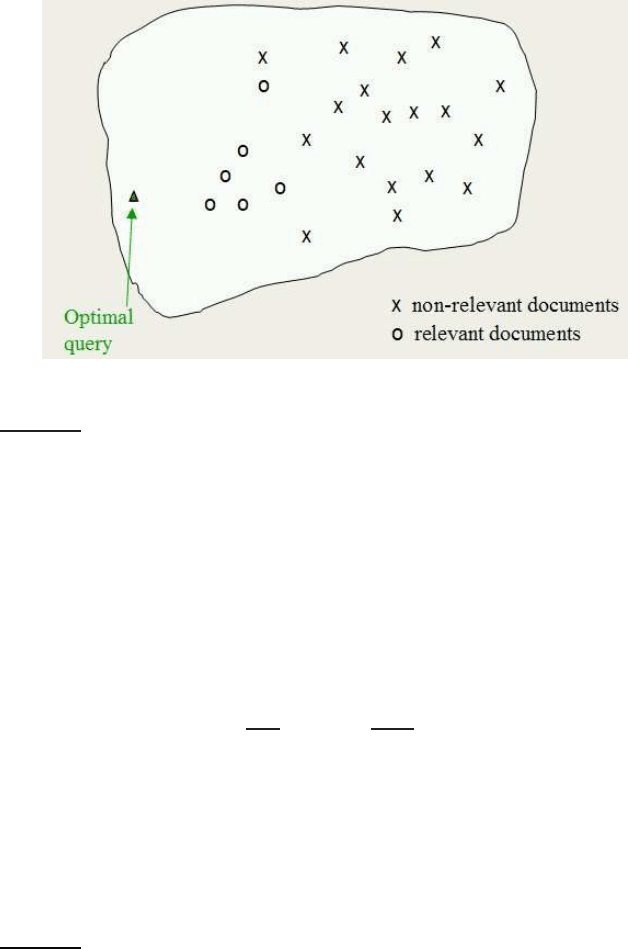
Figure 9.3 The Rocchio optimal query for separating relevant and nonrelevant
documents.
The underlying theory. We want to find a query vector, denoted as ~q , that
maximizes similarity with relevant documents while minimizing similarity
with nonrelevant documents. If C
r
is the set of relevant documents and C
nr
is the set of nonrelevant documents, then we wish to find:
1
~q
opt
= arg max
~q
[sim(~q, C
r
) − sim(~q, C
nr
)],
(9.1)
where sim is defined as in Equation 6.10. Under cosine similarity, the optimal
query vector~q
opt
for separating the relevant and nonrelevant documents is:
~q
opt
=
1
|C
r
|
∑
~
d
j
∈C
r
~
d
j
−
1
|C
nr
|
∑
~
d
j
∈C
nr
~
d
j
(9.2)
That is, the optimal query is the vector difference between the centroids of the
relevant and nonrelevant documents; see Figure 9.3. However, this observa-
tion is not terribly useful, precisely because the full set of relevant documents
is not known: it is what we want to find.
The Rocchio (1971) algorithm. This was the relevance feedback mecha-ROCCHIO ALGORITHM
1. In the equation, arg max
x
f (x) returns a value of x which maximizes the value of the function
f (x). Similarly, argmin
x
f (x) returns a value of x which minimizes the value of the function
f (x).
Online edition (c)2009 Cambridge UP
182 9 Relevance feedback and query expansion
◮
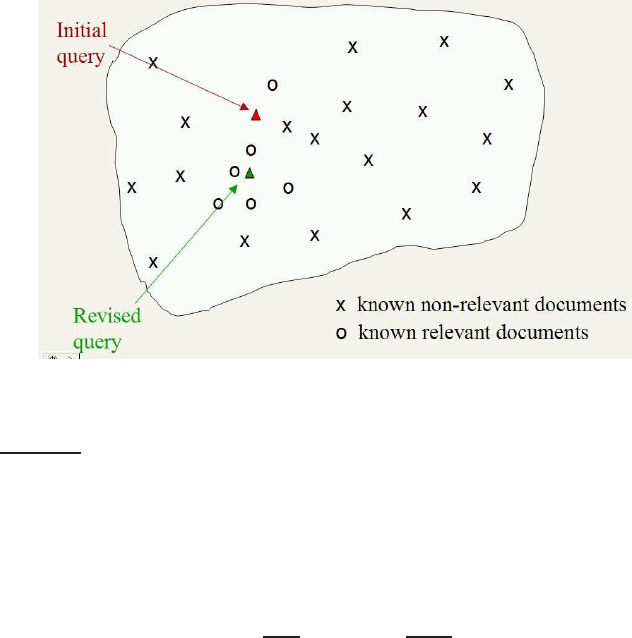
Figure 9.4 An application of Rocchio’s algorithm. Some documents have been
labeled as relevant and nonrelevant and the initial query vector is moved in response
to this feedback.
nism introduced in and popularized by Salton’s SMART system around 1970.
In a real IR query context, we have a user query and partial knowledge of
known relevant and nonrelevant documents. The algorithm proposes using
the modified query ~q
m
:
~q
m
= α~q
0
+ β
1
|D
r
|
∑
~
d
j
∈D
r
~
d
j
− γ
1
|D
nr
|
∑
~
d
j
∈D
nr
~
d
j
(9.3)
where q
0
is the original query vector, D
r
and D
nr
are the set of known rel-
evant and nonrelevant documents respectively, and α, β, and γ are weights
attached to each term. These control the balance between trusting the judged
document set versus the query: if we have a lot of judged documents, we
would like a higher β and γ. Starting from q
0
, the new query moves you
some distance toward the centroid of the relevant documents and some dis-
tance away from the centroid of the nonrelevant documents. This new query
can be used for retrieval in the standard vector space model (see Section
6.3).
We can easily leave the positive quadrant of the vector space by subtracting
off a nonrelevant document’s vector. In the Rocchio algorithm, negative term
weights are ignored. That is, the term weight is set to 0. Figure
9.4 shows the
effect of applying relevance feedback.
Relevance feedback can improve both recall and precision. But, in prac-
tice, it has been shown to be most useful for increasing recall in situations
Online edition (c)2009 Cambridge UP
9.1 Relevance feedback and pseudo relevance feedback 183
where recall is important. This is partly because the technique expands the
query, but it is also partly an effect of the use case: when they want high
recall, users can be expected to take time to review results and to iterate on
the search. Positive feedback also turns out to be much more valuable than
negative feedback, and so most IR systems set γ < β. Reasonable values
might be α = 1, β = 0.75, and γ = 0.15. In fact, many systems, such as
the image search system in Figure
9.1, allow only positive feedback, which
is equivalent to setting γ = 0. Another alternative is to use only the marked
nonrelevant document which received the highest ranking from the IR sys-
tem as negative feedback (here, |D
nr
| = 1 in Equation (
9.3)). While many of
the experimental results comparing various relevance feedback variants are
rather inconclusive, some studies have suggested that this variant, called IdeIDE DEC-HI
dec-hi is the most effective or at least the most consistent performer.
✄
9.1.2 Probabilistic relevance feedback
Rather than reweighting the query in a vector space, if a user has told us
some relevant and nonrelevant documents, then we can proceed to build a
classifier. One way of doing this is with a Naive Bayes probabilistic model.
If R is a Boolean indicator variable expressing the relevance of a document,
then we can estimate P(x
t
= 1|R), the probability of a term t appearing in a
document, depending on whether it is relevant or not, as:
ˆ
P(x
t
= 1|R = 1) = |VR
t
|/|VR|
(9.4)
ˆ
P(x
t
= 1|R = 0) = (d f
t
−|VR
t
|)/(N − |VR|)
where N is the total number of documents, d f
t
is the number that contain
t, VR is the set of known relevant documents, and VR
t
is the subset of this
set containing t. Even though the set of known relevant documents is a per-
haps small subset of the true set of relevant documents, if we assume that
the set of relevant documents is a small subset of the set of all documents
then the estimates given above will be reasonable. This gives a basis for
another way of changing the query term weights. We will discuss such prob-
abilistic approaches more in Chapters
11 and 13, and in particular outline
the application to relevance feedback in Section
11.3.4 (page 228). For the
moment, observe that using just Equation (9.4) as a basis for term-weighting
is likely insufficient. The equations use only collection statistics and infor-
mation about the term distribution within the documents judged relevant.
They preserve no memory of the original query.
9.1.3 When does relevance feedback work?
The success of relevance feedback depends on certain assumptions. Firstly,
the user has to have sufficient knowledge to be able to make an initial query
Online edition (c)2009 Cambridge UP
184 9 Relevance feedback and query expansion
which is at least somewhere close to the documents they desire. This is
needed anyhow for successful information retrieval in the basic case, but
it is important to see the kinds of problems that relevance feedback cannot
solve alone. Cases where relevance feedback alone is not sufficient include:
• Misspellings. If the user spells a term in a different way to the way it
is spelled in any document in the collection, then relevance feedback is
unlikely to be effective. This can be addressed by the spelling correction
techniques of Chapter
3.
• Cross-language information retrieval. Documents in another language
are not nearby in a vector space based on term distribution. Rather, docu-
ments in the same language cluster more closely together.
• Mismatch of searcher’s vocabulary versus collection vocabulary. If the
user searches for laptop but all the documents use the term notebook com-
puter, then the query will fail, and relevance feedback is again most likely
ineffective.
Secondly, the relevance feedback approach requires relevant documents to
be similar to each other. That is, they should cluster. Ideally, the term dis-
tribution in all relevant documents will be similar to that in the documents
marked by the users, while the term distribution in all nonrelevant docu-
ments will be different from those in relevant documents. Things will work
well if all relevant documents are tightly clustered around a single proto-
type, or, at least, if there are different prototypes, if the relevant documents
have significant vocabulary overlap, while similarities between relevant and
nonrelevant documents are small. Implicitly, the Rocchio relevance feedback
model treats relevant documents as a single cluster, which it models via the
centroid of the cluster. This approach does not work as well if the relevant
documents are a multimodal class, that is, they consist of several clusters of
documents within the vector space. This can happen with:
• Subsets of the documents using different vocabulary, such as Burma vs.
Myanmar
• A query for which the answer set is inherently disjunctive, such as Pop
stars who once worked at Burger King.
• Instances of a general concept, which often appear as a disjunction of
more specific concepts, for example, felines.
Good editorial content in the collection can often provide a solution to this
problem. For example, an article on the attitudes of different groups to the
situation in Burma could introduce the terminology used by different parties,
thus linking the document clusters.
Online edition (c)2009 Cambridge UP
9.1 Relevance feedback and pseudo relevance feedback 185
Relevance feedback is not necessarily popular with users. Users are often
reluctant to provide explicit feedback, or in general do not wish to prolong
the search interaction. Furthermore, it is often harder to understand why a
particular document was retrieved after relevance feedback is applied.
Relevance feedback can also have practical problems. The long queries
that are generated by straightforward application of relevance feedback tech-
niques are inefficient for a typical IR system. This results in a high computing
cost for the retrieval and potentially long response times for the user. A par-
tial solution to this is to only reweight certain prominent terms in the relevant
documents, such as perhaps the top 20 terms by term frequency. Some ex-
perimental results have also suggested that using a limited number of terms
like this may give better results (Harman 1992) though other work has sug-
gested that using more terms is better in terms of retrieved document quality
(Buckley et al. 1994b).
9.1.4 Relevance feedback on the web
Some web search engines offer a similar/related pages feature: the user in-
dicates a document in the results set as exemplary from the standpoint of
meeting his information need and requests more documents like it. This can
be viewed as a particular simple form of relevance feedback. However, in
general relevance feedback has been little used in web search. One exception
was the Excite web search engine, which initially provided full relevance
feedback. However, the feature was in time dropped, due to lack of use. On
the web, few people use advanced search interfaces and most would like to
complete their search in a single interaction. But the lack of uptake also prob-
ably reflects two other factors: relevance feedback is hard to explain to the
average user, and relevance feedback is mainly a recall enhancing strategy,
and web search users are only rarely concerned with getting sufficient recall.
Spink et al. (2000) present results from the use of relevance feedback in
the Excite search engine. Only about 4% of user query sessions used the
relevance feedback option, and these were usually exploiting the “More like
this” link next to each result. About 70% of users only looked at the first
page of results and did not pursue things any further. For people who used
relevance feedback, results were improved about two thirds of the time.
An important more recent thread of work is the use of clickstream data
(what links a user clicks on) to provide indirect relevance feedback. Use
of this data is studied in detail in (Joachims 2002b, Joachims et al. 2005).
The very successful use of web link structure (see Chapter
21) can also be
viewed as implicit feedback, but provided by page authors rather than read-
ers (though in practice most authors are also readers).