
Manning Ch. D., Raghavan P., Sch?tze H. Introduction to Information Retrieval - Введение в информационный поиск
Подождите немного. Документ загружается.

Online edition (c)2009 Cambridge UP
206 10 XML retrieval
FFT
title
chapter
FFT
title
chapter
FFT
title
encryption
title
referenceschapter
book
q
5
q
6
d
4
◮
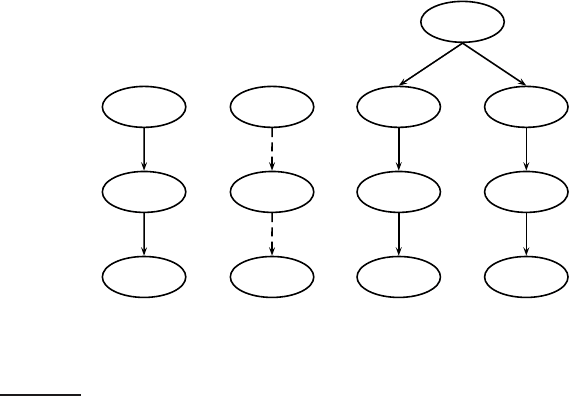
Figure 10.7 A structural mismatch between two queries and a document.
10.3 A vector space model for XML retrieval
In this section, we present a simple vector space model for XML retrieval.
It is not intended to be a complete description of a state-of-the-art system.
Instead, we want to give the reader a flavor of how documents can be repre-
sented and retrieved in XML retrieval.
To take account of structure in retrieval in Figure 10.4, we want a book
entitled Julius Caesar to be a match for q
1
and no match (or a lower weighted
match) for q
2
. In unstructured retrieval, there would be a single dimension
of the vector space for Caesar. In XML retrieval, we must separate the title
word Caesar from the author name Caesar. One way of doing this is to have
each dimension of the vector space encode a word together with its position
within the XML tree.
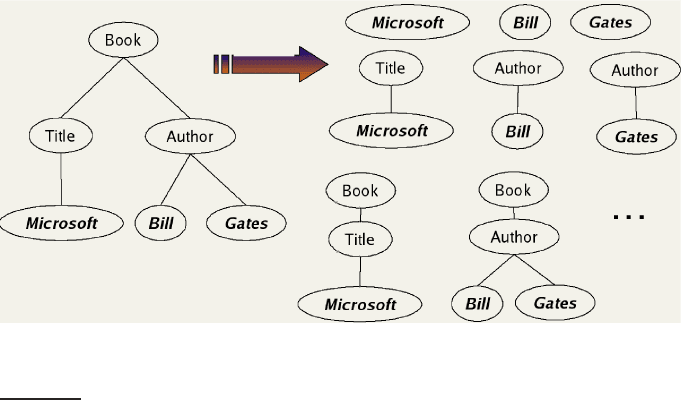
Figure
10.8 illustrates this representation. We first take each text node
(which in our setup is always a leaf) and break it into multiple nodes, one for
each word. So the leaf node Bill Gates is split into two leaves Bill and Gates.
Next we define the dimensions of the vector space to be lexicalized subtrees
of documents – subtrees that contain at least one vocabulary term. A sub-
set of these possible lexicalized subtrees is shown in the figure, but there are
others – e.g., the subtree corresponding to the whole document with the leaf
node Gates removed. We can now represent queries and documents as vec-
tors in this space of lexicalized subtrees and compute matches between them.
This means that we can use the vector space formalism from Chapter 6 for
XML retrieval. The main difference is that the dimensions of vector space
Online edition (c)2009 Cambridge UP
10.3 A vector space model for XML retrieval 207
◮
Figure 10.8 A mapping of an XML document (left) to a set of lexicalized subtrees
(right).
in unstructured retrieval are vocabulary terms whereas they are lexicalized
subtrees in XML retrieval.
There is a tradeoff between the dimensionality of the space and accuracy
of query results. If we trivially restrict dimensions to vocabulary terms, then
we have a standard vector space retrieval system that will retrieve many
documents that do not match the structure of the query (e.g., Gates in the
title as opposed to the author element). If we create a separate dimension
for each lexicalized subtree occurring in the collection, the dimensionality of
the space becomes too large. A compromise is to index all paths that end
in a single vocabulary term, in other words, all XML-context/term pairs.
We call such an XML-context/term pair a structural term and denote it bySTRUCTURAL TERM
hc, ti: a pair of XML-context c and vocabulary term t. The document in
Figure 10.8 has nine structural terms. Seven are shown (e.g., "Bill" and
Author#"Bill") and two are not shown: /Book/Author#"Bill" and
/Book/Author#"Gates". The tree with the leaves Bill and Gates is a lexical-
ized subtree that is not a structural term. We use the previously introduced
pseudo-XPath notation for structural terms.
As we discussed in the last section users are bad at remembering details
about the schema and at constructing queries that comply with the schema.
We will therefore interpret all queries as extended queries – that is, there can
be an arbitrary number of intervening nodes in the document for any parent-
child node pair in the query. For example, we interpret q
5
in Figure
10.7 as
q
6
.
But we still prefer documents that match the query structure closely by

Online edition (c)2009 Cambridge UP
208 10 XML retrieval
inserting fewer additional nodes. We ensure that retrieval results respect this
preference by computing a weight for each match. A simple measure of the
similarity of a path c
q
in a query and a path c
d
in a document is the following
context resemblance function CR:CONTEXT
RESEMBLANCE
CR(c
q
, c
d
) =
(
1+|c
q
|
1+|c
d
|
if c
q
matches c
d
0 if c
q
does not match c
d
(10.1)
where |c
q
| and |c
d
| are the number of nodes in the query path and document
path, respectively, and c
q
matches c
d
iff we can transform c
q
into c
d
by in-
serting additional nodes. Two examples from Figure
10.6 are CR(c
q
4
, c
d
2
) =
3/4 = 0.75 and CR(c
q
4
, c
d
3
) = 3/5 = 0.6 where c
q
4
, c
d
2
and c
d
3
are the rele-
vant paths from top to leaf node in q
4
, d
2
and d
3
, respectively. The value of
CR(c
q
, c
d
) is 1.0 if q and d are identical.
The final score for a document is computed as a variant of the cosine mea-
sure (Equation (
6.10), page 121), which we call SIMNOMERGE for reasons
that will become clear shortly. SIMNOMERGE is defined as follows:
SIMNOMERGE(q, d) =
∑
c
k
∈B
∑
c
l
∈B
CR(c
k
, c
l
)
∑
t∈V
weight(q, t, c
k
)
weight(d, t, c
l
)
q
∑
c∈B,t∈V
weight
2
(d, t, c)
(10.2)
where V is the vocabulary of non-structural terms; B is the set of all XML con-
texts; and weight(q, t, c) and weight(d , t, c) are the weights of term t in XML
context c in query q and document d, respectively. We compute the weights
using one of the weightings from Chapter
6, such as idf
t
·wf
t,d
. The inverse
document frequency idf
t
depends on which elements we use to compute
df
t
as discussed in Section
10.2. The similarity measure SIMNOMERGE(q, d)
is not a true cosine measure since its value can be larger than 1.0 (Exer-
cise
10.11). We divide by
q
∑
c∈B,t∈V
weight
2
(d, t, c) to normalize for doc-
ument length (Section
6.3.1, page 121). We have omitted query length nor-
malization to simplify the formula. It has no effect on ranking since, for
a given query, the normalizer
q
∑
c∈B,t∈V
weight
2
(q, t, c) is the same for all
documents.
The algorithm for computing SIMNOMERGE for all documents in the col-
lection is shown in Figure
10.9. The array normalizer in Figure 10.9 contains
q
∑
c∈B,t∈V
weight
2
(d, t, c) from Equation (
10.2) for each document.
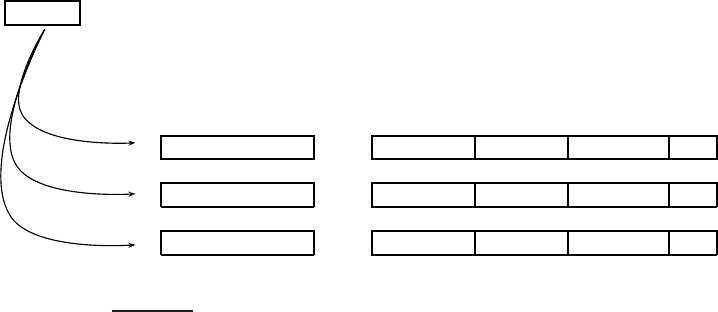
We give an example of how SIMNOMERGE computes query-document
similarities in Figure
10.10. hc
1
, ti is one of the structural terms in the query.
We successively retrieve all postings lists for structural terms hc
′
, ti with the
same vocabulary term t. Three example postings lists are shown. For the
first one, we have CR(c
1
, c
1
) = 1.0 since the two contexts are identical. The
Online edition (c)2009 Cambridge UP
10.3 A vector space model for XML retrieval 209
SCOREDOCUMENTSWITHSIMNOMERGE(q, B, V, N, normalizer)
1 for n ← 1 to N
2 do score[n] ← 0
3 for each hc
q
, ti ∈ q
4 do w
q
← WEIGHT(q, t, c
q
)
5 for each c ∈ B
6 do if CR(c
q
, c) > 0
7 then postings ← GETPOSTINGS(hc, ti)
8 for each posting ∈ postings
9 do x ← CR(c
q
, c) ∗ w
q
∗ weight(posting)
10 score[docID(posting)] += x
11 for n ← 1 to N
12 do score[n] ← score[n]/normalizer[n]
13 return score
◮
Figure 10.9 The algorithm for scoring documents with SIMNOMERGE.
query
hc
1
, ti
CR(c
1
, c
1
) = 1.0
CR(c
1
, c
2
) = 0
CR(c
1
, c
3
) = 0.63
inverted index
hc
1
, ti −→ hd
1
, 0.5i hd
4
, 0.1i hd
9
, 0.2i . . .
hc
2
, ti −→ hd
2
, 0.25i hd
3
, 0.1i hd
12
, 0.9i . . .
hc
3
, ti −→ hd
3
, 0.7i hd
6
, 0.8i hd
9
, 0.6i . . .
◮
Figure 10.10 Scoring of a query with one structural term in SIMNOMERGE.
next context has no context resemblance with c
1
: CR(c
1
, c
2
) = 0 and the cor-
responding postings list is ignored. The context match of c
1
with c
3
is 0.63>0
and it will be processed. In this example, the highest ranking document is d
9
with a similarity of 1.0 ×0.2 + 0.63 ×0.6 = 0.578. To simplify the figure, the
query weight of hc
1
, ti is assumed to be 1.0.
The query-document similarity function in Figure
10.9 is called SIMNOMERGE
because different XML contexts are kept separate for the purpose of weight-
ing. An alternative similarity function is SIMMERGE which relaxes the match-
ing conditions of query and document further in the following three ways.
Online edition (c)2009 Cambridge UP
210 10 XML retrieval
•
We collect the statistics used for computing weight(q, t, c) and weight(d, t, c)
from all contexts that have a non-zero resemblance to c (as opposed to just
from c as in SIMNOMERGE). For instance, for computing the document
frequency of the structural term atl#"recognition", we also count
occurrences of recognition in XML contexts fm/atl, article//atl etc.
• We modify Equation (10.2) by merging all structural terms in the docu-
ment that have a non-zero context resemblance to a given query struc-
tural term. For example, the contexts /play/act/scene/title and
/play/title in the document will be merged when matching against
the query term /play/title#"Macbeth".
• The context resemblance function is further relaxed: Contexts have a non-
zero resemblance in many cases where the definition of CR in Equation (
10.1)
returns 0.
See the references in Section
10.6 for details.
These three changes alleviate the problem of sparse term statistics dis-
cussed in Section
10.2 and increase the robustness of the matching function
against poorly posed structural queries. The evaluation of SIMNOMERGE
and SIMMERGE in the next section shows that the relaxed matching condi-
tions of SIMMERGE increase the effectiveness of XML retrieval.
?
Exercise 10.1
Consider computing df for a structural term as the number of times that the structural
term occurs under a particular parent node. Assume the following: the structural
term hc, ti = author#"Herbert" occurs once as the child of the node squib; there are
10 squib nodes in the collection; hc, ti occurs 1000 times as the child of article; there are
1,000,000 article nodes in the collection. The idf weight of hc, ti then is log
2
10/1 ≈ 3.3
when occurring as the child of squib and log
2
1,000,000/1000 ≈ 10.0 when occurring
as the child of article. (i) Explain why this is not an appropriate weighting for hc , ti.
Why should hc, ti not receive a weight that is three times higher in articles than in
squibs? (ii) Suggest a better way of computing idf.
Exercise 10.2
Write down all the structural terms occurring in the XML document in Figure 10.8.
Exercise 10.3
How many structural terms does the document in Figure 10.1 yield?
10.4 Evaluation of XML retrieval
The premier venue for research on XML retrieval is the INEX (INitiative forINEX
the Evaluat io n of XML retrieval) program, a collaborative effort that has pro-
duced reference collections, sets of queries, and relevance judgments. A
yearly INEX meeting is held to present and discuss research results. The
Online edition (c)2009 Cambridge UP
10.4 Evaluation of XML retrieval 211
12,107
number of documents
494 MB size
1995–2002 time of publication of articles
1,532
average number of XML nodes per document
6.9 average depth of a node
30
number of CAS topics
30 number of CO topics
◮
Table 10.2 INEX 2002 collection statistics.
IEEE Transac-
tion on Pat-
tern Analysis
journal tit le
Activity
recognition
article title
This work fo-
cuses on . . .
paragraph
Introduction
title
front matter
section
body
article
◮
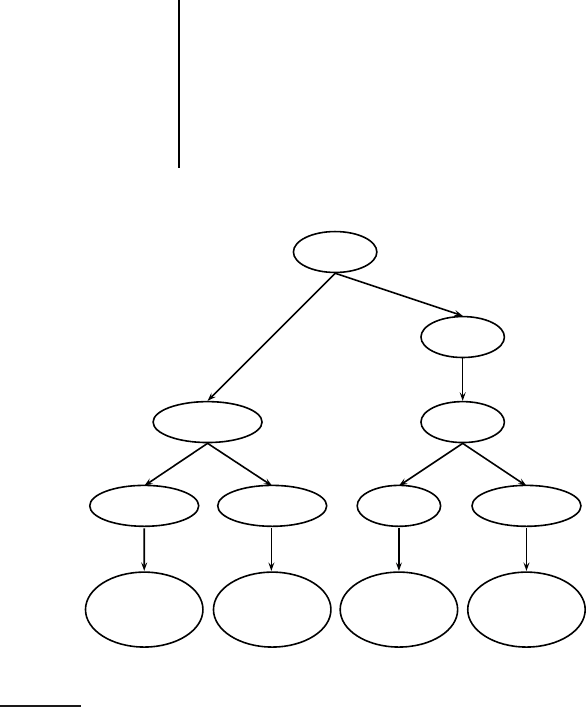
Figure 10.11 Simplified schema of the documents in the INEX collection.
INEX 2002 collection consisted of about 12,000 articles from IEEE journals.
We give collection statistics in Table
10.2 and show part of the schema of
the collection in Figure 10.11. The IEEE journal collection was expanded in
2005. Since 2006 INEX uses the much larger English Wikipedia as a test col-
lection. The relevance of documents is judged by human assessors using the
methodology introduced in Section
8.1 (page 152), appropriately modified
for structured documents as we will discuss shortly.
Two types of information needs or topics in INEX are content-only or CO
topics and content-and-structure (CAS) topics. CO topics are regular key-CO TOPICS
word queries as in unstructured information retrieval. CAS topics have struc-CAS TOPICS
tural constraints in addition to keywords. We already encountered an exam-
Online edition (c)2009 Cambridge UP
212 10 XML retrieval
ple of a CAS topic in Figure 10.3. The keywords in this case are summer and
holidays and the structural constraints specify that the keywords occur in a
section that in turn is part of an article and that this article has an embedded
year attribute with value 2001 or 2002.
Since CAS queries have both structural and content criteria, relevance as-
sessments are more complicated than in unstructured retrieval. INEX 2002
defined component coverage and topical relevance as orthogonal dimen-
sions of relevance. The component coverage dimension evaluates whether theCOMPONENT
COVERAGE
element retrieved is “structurally” correct, i.e., neither too low nor too high
in the tree. We distinguish four cases:
• Exact coverage (E). The information sought is the main topic of the com-
ponent and the component is a meaningful unit of information.
• Too small (S). The information sought is the main topic of the component,
but the component is not a meaningful (self-contained) unit of informa-
tion.
• Too large (L). The information sought is present in the component, but is
not the main topic.
• No coverage (N). The information sought is not a topic of the component.
The topical relevance dimension also has four levels: highly relevant (3),TOPICAL RELEVANCE
fairly relevant (2), marginally relevant (1) and nonrelevant (0). Components
are judged on both dimensions and the judgments are then combined into
a digit-letter code. 2S is a fairly relevant component that is too small and
3E is a highly relevant component that has exact coverage. In theory, there
are 16 combinations of coverage and relevance, but many cannot occur. For
example, a nonrelevant component cannot have exact coverage, so the com-
bination 3N is not possible.
The relevance-coverage combinations are quantized as follows:
Q(rel, cov) =
1.00 if (rel, cov) = 3E
0.75 if (rel, cov) ∈ {2E, 3L}
0.50 if (rel, cov) ∈ {1E, 2L, 2S}
0.25 if (rel, cov) ∈ {1S, 1L}
0.00 if (rel, cov) = 0N
This evaluation scheme takes account of the fact that binary relevance judg-
ments, which are standard in unstructured information retrieval (Section
8.5.1,
page
166), are not appropriate for XML retrieval. A 2S component provides
incomplete information and may be difficult to interpret without more con-
text, but it does answer the query partially. The quantization function Q
does not impose a binary choice relevant/nonrelevant and instead allows us
to grade the component as partially relevant.

Online edition (c)2009 Cambridge UP
10.4 Evaluation of XML retrieval 213
algorithm average precision
SIMNOMERGE 0.242
SIMMERGE 0.271
◮
Table 10.3 INEX 2002 results of the vector space model in Section 10.3 for content-
and-structure (CAS) queries and the quantization function Q.
The number of relevant components in a retrieved set A of components
can then be computed as:
#(relevant items retrieved) =
∑
c∈A
Q(rel(c), cov(c))
As an approximation, the standard definitions of precision, recall and F from
Chapter
8 can be applied to this modified definition of relevant items re-
trieved, with some subtleties because we sum graded as opposed to binary
relevance assessments. See the references on focused retrieval in Section 10.6
for further discussion.
One flaw of measuring relevance this way is that overlap is not accounted
for. We discussed the concept of marginal relevance in the context of un-
structured retrieval in Section
8.5.1 (page 166). This problem is worse in
XML retrieval because of the problem of multiple nested elements occur-
ring in a search result as we discussed on page
203. Much of the recent focus
at INEX has been on developing algorithms and evaluation measures that
return non-redundant results lists and evaluate them properly. See the refer-
ences in Section
10.6.
Table 10.3 shows two INEX 2002 runs of the vector space system we de-
scribed in Section
10.3. The better run is the SIMMERGE run, which incor-
porates few structural constraints and mostly relies on keyword matching.
SIMMERGE’s median average precision (where the median is with respect to
average precision numbers over topics) is only 0.147. Effectiveness in XML
retrieval is often lower than in unstructured retrieval since XML retrieval is
harder. Instead of just finding a document, we have to find the subpart of a
document that is most relevant to the query. Also, XML retrieval effective-
ness – when evaluated as described here – can be lower than unstructured
retrieval effectiveness on a standard evaluation because graded judgments
lower measured performance. Consider a system that returns a document
with graded relevance 0.6 and binary relevance 1 at the top of the retrieved
list. Then, interpolated precision at 0.00 recall (cf. page
158) is 1.0 on a binary
evaluation, but can be as low as 0.6 on a graded evaluation.
Table 10.3 gives us a sense of the typical performance of XML retrieval,
but it does not compare structured with unstructured retrieval. Table
10.4
directly shows the effect of using structure in retrieval. The results are for a

Online edition (c)2009 Cambridge UP
214 10 XML retrieval
content only full structure improvement
precision at 5 0.2000 0.3265 63.3%
precision at 10 0.1820 0.2531 39.1%
precision at 20 0.1700 0.1796 5.6%
precision at 30 0.1527 0.1531 0.3%
◮
Table 10.4 A comparison of content-only and full-structure search in INEX
2003/2004.
language-model-based system (cf. Chapter 12) that is evaluated on a subset
of CAS topics from INEX 2003 and 2004. The evaluation metric is precision
at k as defined in Chapter
8 (page 161). The discretization function used for
the evaluation maps highly relevant elements (roughly corresponding to the
3E elements defined for Q) to 1 and all other elements to 0. The content-
only system treats queries and documents as unstructured bags of words.
The full-structure model ranks elements that satisfy structural constraints
higher than elements that do not. For instance, for the query in Figure
10.3
an element that contains the phrase summer holidays in a section will be rated
higher than one that contains it in an abstract.
The table shows that structure helps increase precision at the top of the
results list. There is a large increase of precision at k = 5 and at k = 10. There
is almost no improvement at k = 30. These results demonstrate the benefits
of structured retrieval. Structured retrieval imposes additional constraints on
what to return and documents that pass the structural filter are more likely
to be relevant. Recall may suffer because some relevant documents will be
filtered out, but for precision-oriented tasks structured retrieval is superior.
10.5 Text-centric vs. data-centric XML retrieval
In the type of structured retrieval we cover in this chapter, XML structure
serves as a framework within which we match the text of the query with the
text of the XML documents. This exemplifies a system that is optimized for
text-centric XML. While both text and structure are important, we give higherTEXT-CENTRIC XML
priority to text. We do this by adapting unstructured retrieval methods to
handling additional structural constraints. The premise of our approach is
that XML document retrieval is characterized by (i) long text fields (e.g., sec-
tions of a document), (ii) inexact matching, and (iii) relevance-ranked results.
Relational databases do not deal well with this use case.
In contrast, data-centric XML mainly encodes numerical and non-text attribute-DATA-CENTRIC XML
value data. When querying data-centric XML, we want to impose exact
match conditions in most cases. This puts the emphasis on the structural
aspects of XML documents and queries. An example is:
Online edition (c)2009 Cambridge UP
10.5 Text-centric vs. data-centric XML retrieval 215
Find employees whose salary is the same this month as it was 12 months
ago.
This query requires no ranking. It is purely structural and an exact matching
of the salaries in the two time periods is probably sufficient to meet the user’s
information need.
Text-centric approaches are appropriate for data that are essentially text
documents, marked up as XML to capture document structure. This is be-
coming a de facto standard for publishing text databases since most text
documents have some form of interesting structure – paragraphs, sections,
footnotes etc. Examples include assembly manuals, issues of journals, Shake-
speare’s collected works and newswire articles.
Data-centric approaches are commonly used for data collections with com-
plex structures that mainly contain non-text data. A text-centric retrieval
engine will have a hard time with proteomic data in bioinformatics or with
the representation of a city map that (together with street names and other
textual descriptions) forms a navigational database.
Two other types of queries that are difficult to handle in a text-centric struc-
tured retrieval model are joins and ordering constraints. The query for em-
ployees with unchanged salary requires a join. The following query imposes
an ordering constraint:
Retrieve the chapter of the book I ntroduction to algorithms that follows
the chapter Binomial heaps.
This query relies on the ordering of elements in XML – in this case the order-
ing of chapter elements underneath the book node. There are powerful query
languages for XML that can handle numerical attributes, joins and ordering
constraints. The best known of these is XQuery, a language proposed for
standardization by the W3C. It is designed to be broadly applicable in all ar-
eas where XML is used. Due to its complexity, it is challenging to implement
an XQuery-based ranked retrieval system with the performance characteris-
tics that users have come to expect in information retrieval. This is currently
one of the most active areas of research in XML retrieval.
Relational databases are better equipped to handle many structural con-
straints, particularly joins (but ordering is also difficult in a database frame-
work – the tuples of a relation in the relational calculus are not ordered). For
this reason, most data-centric XML retrieval systems are extensions of rela-
tional databases (see the references in Section
10.6). If text fields are short,
exact matching meets user needs and retrieval results in form of unordered
sets are acceptable, then using a relational database for XML retrieval is ap-
propriate.