
Manning Ch. D., Raghavan P., Sch?tze H. Introduction to Information Retrieval - Введение в информационный поиск
Подождите немного. Документ загружается.

Online edition (c)2009 Cambridge UP
246 12 Language models for information retrieval
of the models. The reason for this is explored in Exercise 12.8. The extent
of smoothing in these two models is controlled by the λ and α parameters: a
small value of λ or a large value of α means more smoothing. This parameter
can be tuned to optimize performance using a line search (or, for the linear
interpolation model, by other methods, such as the expectation maximimiza-
tion algorithm; see Section
16.5, page 368). The value need not be a constant.
One approach is to make the value a function of the query size. This is useful
because a small amount of smoothing (a “conjunctive-like” search) is more
suitable for short queries, while a lot of smoothing is more suitable for long
queries.
To summarize, the retrieval ranking for a query q under the basic LM for
IR we have been considering is given by:
P(d|q) ∝ P(d)
∏
t∈q
((1 −λ)P(t|M
c
) + λP(t|M
d
))
(12.12)
This equation captures the probability that the document that the user had
in mind was in fact d.
✎
Example 12.3: Suppose the document collection contains two documents:
• d
1
: Xyzzy reports a profit but revenue is down
• d
2
: Quorus narrows quarter loss but revenue decreases further
The model will be MLE unigram models from the documents and collection, mixed
with λ = 1/2.
Suppose the query is revenue down. Then:
P(q|d
1
) = [(1/8 + 2/16)/2] × [(1/8 + 1/16)/2]
(12.13)
= 1/8 ×3/32 = 3/256
P(q|d
2
) = [(1/8 + 2/16)/2] × [(0/8 + 1/16)/2]
= 1/8 ×1/32 = 1/256
So, the ranking is d
1
> d
2
.
12.2.3 Ponte and Croft’s Experiments
Ponte and Croft (1998) present the first experiments on the language model-
ing approach to information retrieval. Their basic approach is the model that
we have presented until now. However, we have presented an approach
where the language model is a mixture of two multinomials, much as in
(Miller et al. 1999, Hiemstra 2000) rather than Ponte and Croft’s multivari-
ate Bernoulli model. The use of multinomials has been standard in most
subsequent work in the LM approach and experimental results in IR, as
well as evidence from text classification which we consider in Section
13.3

Online edition (c)2009 Cambridge UP
12.2 The query likelihood model 247
Precision
Rec. tf-idf LM %chg
0.0 0.7439 0.7590 +2.0
0.1 0.4521 0.4910 +8.6
0.2 0.3514 0.4045 +15.1 *
0.3 0.2761 0.3342 +21.0 *
0.4 0.2093 0.2572 +22.9 *
0.5 0.1558 0.2061 +32.3 *
0.6 0.1024 0.1405 +37.1 *
0.7 0.0451 0.0760 +68.7 *
0.8 0.0160 0.0432 +169.6 *
0.9 0.0033 0.0063 +89.3
1.0 0.0028 0.0050 +76.9
Ave 0.1868 0.2233 +19.55 *
◮
Figure 12.4 Results of a comparison of tf-idf with language modeling (LM) term
weighting by Ponte and Croft (1998). The version of tf-idf from the INQUERY IR sys-
tem includes length normalization of tf. The table gives an evaluation according to
11-point average precision with significance marked with a * according to a Wilcoxon
signed rank test. The language modeling approach always does better in these exper-
iments, but note that where the approach shows significant gains is at higher levels
of recall.
(page 263), suggests that it is superior. Ponte and Croft argued strongly for
the effectiveness of the term weights that come from the language modeling
approach over traditional tf-idf weights. We present a subset of their results
in Figure
12.4 where they compare tf-idf to language modeling by evaluating
TREC topics 202–250 over TREC disks 2 and 3. The queries are sentence-
length natural language queries. The language modeling approach yields
significantly better results than their baseline tf-idf based term weighting ap-
proach. And indeed the gains shown here have been extended in subsequent
work.
?
Exercise 12.6
[⋆]
Consider making a language model from the following training text:
the martian has landed on the latin pop sensation ricky martin
a. Under a MLE-estimated unigram probability model, what are P(the) and P(martian)?
b. Under a MLE-estimated bigram model, what are P(sensation|pop) and P(pop|the)?

Online edition (c)2009 Cambridge UP
248 12 Language models for information retrieval
Exercise 12.7
[⋆⋆]
Suppose we have a collection that consists of the 4 documents given in the below
table.
docID Document text
1 click go the shears boys click click click
2 click click
3 metal here
4 metal shears click here
Build a query likelihood language model for this document collection. Assume a
mixture model between the documents and the collection, with both weighted at 0.5.
Maximum likelihood estimation (mle) is used to estimate both as unigram models.
Work out the model probabilities of the queries click, shears, and hence click shears for
each document, and use those probabilities to rank the documents returned by each
query. Fill in these probabilities in the below table:
Query Doc 1 Doc 2 Doc 3 Doc 4
click
shears
click shears
What is the final ranking of the documents for the query click shears?
Exercise 12.8 [⋆⋆]
Using the calculations in Exercise
12.7 as inspiration or as examples where appro-
priate, write one sentence each describing the treatment that the model in Equa-
tion (
12.10) gives to each of the following quantities. Include whether it is present
in the model or not and whether the effect is raw or scaled.
a. Term frequency in a document
b. Collection frequency of a term
c. Document frequency of a term
d. Length normalization of a term
Exercise 12.9 [⋆⋆]
In the mixture model approach to the query likelihood model (Equation (
12.12)), the
probability estimate of a term is based on the term frequency of a word in a document,
and the collection frequency of the word. Doing this certainly guarantees that each
term of a query (in the vocabulary) has a non-zero chance of being generated by each
document. But it has a more subtle but important effect of implementing a form of
term weighting, related to what we saw in Chapter
6. Explain how this works. In
particular, include in your answer a concrete numeric example showing this term
weighting at work.
12.3 Lan guage modeling versus other approaches in IR
The language modeling approach provides a novel way of looking at the
problem of text retrieval, which links it with a lot of recent work in speech
Online edition (c)2009 Cambridge UP
12.3 Language modeling versus other approaches in IR 249
and language processing. As Ponte and Croft (1998) emphasize, the language
modeling approach to IR provides a different approach to scoring matches
between queries and documents, and the hope is that the probabilistic lan-
guage modeling foundation improves the weights that are used, and hence
the performance of the model. The major issue is estimation of the docu-
ment model, such as choices of how to smooth it effectively. The model
has achieved very good retrieval results. Compared to other probabilistic
approaches, such as the BIM from Chapter
11, the main difference initially
appears to be that the LM approach does away with explicitly modeling rel-
evance (whereas this is the central variable evaluated in the BIM approach).
But this may not be the correct way to think about things, as some of the
papers in Section
12.5 further discuss. The LM approach assumes that docu-
ments and expressions of information needs are objects of the same type, and
assesses their match by importing the tools and methods of language mod-
eling from speech and natural language processing. The resulting model is
mathematically precise, conceptually simple, computationally tractable, and
intuitively appealing. This seems similar to the situation with XML retrieval
(Chapter
10): there the approaches that assume queries and documents are
objects of the same type are also among the most successful.
On the other hand, like all IR models, you can also raise objections to the
model. The assumption of equivalence between document and information
need representation is unrealistic. Current LM approaches use very simple
models of language, usually unigram models. Without an explicit notion of
relevance, relevance feedback is difficult to integrate into the model, as are
user preferences. It also seems necessary to move beyond a unigram model
to accommodate notions of phrase or passage matching or Boolean retrieval
operators. Subsequent work in the LM approach has looked at addressing
some of these concerns, including putting relevance back into the model and
allowing a language mismatch between the query language and the docu-
ment language.
The model has significant relations to traditional tf-idf models. Term fre-
quency is directly represented in tf-idf models, and much recent work has
recognized the importance of document length normalization. The effect of
doing a mixture of document generation probability with collection gener-
ation probability is a little like idf: terms rare in the general collection but
common in some documents will have a greater influence on the ranking of
documents. In most concrete realizations, the models share treating terms as
if they were independent. On the other hand, the intuitions are probabilistic
rather than geometric, the mathematical models are more principled rather
than heuristic, and the details of how statistics like term frequency and doc-
ument length are used differ. If you are concerned mainly with performance
numbers, recent work has shown the LM approach to be very effective in re-
trieval experiments, beating tf-idf and BM25 weights. Nevertheless, there is
Online edition (c)2009 Cambridge UP
250 12 Language models for information retrieval
Query
Query model
P(t|Query)
Document
Doc. model
P(t|Docum ent)
(a)
(b)
(c)
◮
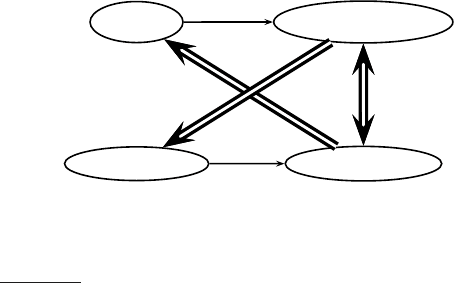
Figure 12.5 Three ways of developing the language modeling approach: (a) query
likelihood, (b) document likelihood, and (c) model comparison.
perhaps still insufficient evidence that its performance so greatly exceeds that
of a well-tuned traditional vector space retrieval system as to justify chang-
ing an existing implementation.
12.4 Exten d ed language modeling approaches
In this section we briefly mention some of the work that extends the basic
language modeling approach.
There are other ways to think of using the language modeling idea in IR
settings, and many of them have been tried in subsequent work. Rather than
looking at the probability of a document language model M
d
generating the
query, you can look at the probability of a query language model M
q
gener-
ating the document. The main reason that doing things in this direction and
creating a document likelihood model is less appealing is that there is much lessDOCUMENT
LIKELIHOOD MODEL
text available to estimate a language model based on the query text, and so
the model will be worse estimated, and will have to depend more on being
smoothed with some other language model. On the other hand, it is easy to
see how to incorporate relevance feedback into such a model: you can ex-
pand the query with terms taken from relevant documents in the usual way
and hence update the language model M
q
(Zhai and Lafferty 2001a). Indeed,
with appropriate modeling choices, this approach leads to the BIM model of
Chapter
11. The relevance model of Lavrenko and Croft (2001) is an instance
of a document likelihood model, which incorporates pseudo-relevance feed-
back into a language modeling approach. It achieves very strong empirical
results.
Rather than directly generating in either direction, we can make a lan-
guage model from both the document and query, and then ask how different
these two language models are from each other. Lafferty and Zhai (2001) lay

Online edition (c)2009 Cambridge UP
12.4 Extended language modeling approaches 251
out these three ways of thinking about the problem, which we show in Fig-
ure
12.5, and develop a general risk minimization approach for document
retrieval. For instance, one way to model the risk of returning a document d
as relevant to a query q is to use the Kullback-Leibler (KL) divergence betweenKULLBACK-LEIBLER
DIVERGENCE
their respective language models:
R(d; q) = KL(M
d
kM
q
) =
∑
t∈V
P(t|M
q
) log
P(t|M
q
)
P(t|M
d
)
(12.14)
KL divergence is an asymmetric divergence measure originating in informa-
tion theory, which measures how bad the probability distribution M
q
is at
modeling M
d
(Cover and Thomas 1991, Manning and Schütze 1999). Laf-
ferty and Zhai (2001) present results suggesting that a model comparison
approach outperforms both query-likelihood and document-likelihood ap-
proaches. One disadvantage of using KL divergence as a ranking function
is that scores are not comparable across queries. This does not matter for ad
hoc retrieval, but is important in other applications such as topic tracking.
Kraaij and Spitters (2003) suggest an alternative proposal which models sim-
ilarity as a normalized log-likelihood ratio (or, equivalently, as a difference
between cross-entropies).
Basic LMs do not address issues of alternate expression, that is, synonymy,
or any deviation in use of language between queries and documents. Berger
and Lafferty (1999) introduce translation models to bridge this query-document
gap. A translation model lets you generate query words not in a document byTRANSLATION MODEL
translation to alternate terms with similar meaning. This also provides a ba-
sis for performing cross-language IR. We assume that the translation model
can be represented by a conditional probability distribution T(·|·) between
vocabulary terms. The form of the translation query generation model is
then:
P(q|M
d
) =
∏
t∈q
∑
v∈V
P(v|M
d
)T(t|v)
(12.15)
The term P(v|M
d
) is the basic document language model, and the term T(t|v)
performs translation. This model is clearly more computationally intensive
and we need to build a translation model. The translation model is usually
built using separate resources (such as a traditional thesaurus or bilingual
dictionary or a statistical machine translation system’s translation diction-
ary), but can be built using the document collection if there are pieces of
text that naturally paraphrase or summarize other pieces of text. Candi-
date examples are documents and their titles or abstracts, or documents and
anchor-text pointing to them in a hypertext environment.
Building extended LM approaches remains an active area of research. In
general, translation models, relevance feedback models, and model compar-
Online edition (c)2009 Cambridge UP
252 12 Language models for information retrieval
ison approaches have all been demonstrated to improve performance over
the basic query likelihood LM.
12.5 Ref erences and further reading
For more details on the basic concepts of probabilistic language models and
techniques for smoothing, see either Manning and Schütze (1999, Chapter 6)
or Jurafsky and Martin (2008, Chapter 4).
The important initial papers that originated the language modeling ap-
proach to IR are: (Ponte and Croft 1998, Hiemstra 1998, Berger and Lafferty
1999, Miller et al. 1999). Other relevant papers can be found in the next sev-
eral years of SIGIR proceedings. (Croft and Lafferty 2003) contains a col-
lection of papers from a workshop on language modeling approaches and
Hiemstra and Kraaij (2005) review one prominent thread of work on using
language modeling approaches for TREC tasks. Zhai and Lafferty (2001b)
clarify the role of smoothing in LMs for IR and present detailed empirical
comparisons of different smoothing methods. Zaragoza et al. (2003) advo-
cate using full Bayesian predictive distributions rather than MAP point es-
timates, but while they outperform Bayesian smoothing, they fail to outper-
form a linear interpolation. Zhai and Lafferty (2002) argue that a two-stage
smoothing model with first Bayesian smoothing followed by linear interpo-
lation gives a good model of the task, and performs better and more stably
than a single form of smoothing. A nice feature of the LM approach is that it
provides a convenient and principled way to put various kinds of prior infor-
mation into the model; Kraaij et al. (2002) demonstrate this by showing the
value of link information as a prior in improving web entry page retrieval
performance. As briefly discussed in Chapter 16 (page 353), Liu and Croft
(2004) show some gains by smoothing a document LM with estimates from
a cluster of similar documents; Tao et al. (2006) report larger gains by doing
document-similarity based smoothing.
Hiemstra and Kraaij (2005) present TREC results showing a LM approach
beating use of BM25 weights. Recent work has achieved some gains by
going beyond the unigram model, providing the higher order models are
smoothed with lower order models (Gao et al. 2004, Cao et al. 2005), though
the gains to date remain modest. Spärck Jones (2004) presents a critical view-
point on the rationale for the language modeling approach, but Lafferty and
Zhai (2003) argue that a unified account can be given of the probabilistic
semantics underlying both the language modeling approach presented in
this chapter and the classical probabilistic information retrieval approach of
Chapter
11. The Lemur Toolkit (http://www.lemurproject.org/) provides a flexi-
ble open source framework for investigating language modeling approaches
to IR.
Online edition (c)2009 Cambridge UP
DRAFT! © April 1, 2009 Cambridge University Press. Feedback welcome. 253
13
Text classi fication and Nai ve
Bayes
Thus far, this book has mainly discussed the process of ad h oc retrieval, where
users have transient information needs that they try to address by posing
one or more queries to a search engine. However, many users have ongoing
information needs. For example, you might need to track developments in
multicore computer chips. One way of doing this is to issue the query multi-
core AND computer AND chip against an index of recent newswire articles each
morning. In this and the following two chapters we examine the question:
How can this repetitive task be automated? To this end, many systems sup-
port standing queries. A standing query is like any other query except that itSTANDING QUERY
is periodically executed on a collection to which new documents are incre-
mentally added over time.
If your standing query is just multicore AND computer AND chip, you will tend
to miss many relevant new articles which use other terms such as multicore
processors. To achieve good recall, standing queries thus have to be refined
over time and can gradually become quite complex. In this example, using a
Boolean search engine with stemming, you might end up with a query like
(multicore OR multi-core) AND (chip OR processor OR microprocessor).
To capture the generality and scope of the problem space to which stand-
ing queries belong, we now introduce the general notion of a classificationCLASSIFICATION
problem. Given a set of classes, we seek to determine which class(es) a given
object belongs to. In the example, the standing query serves to divide new
newswire articles into the two classes: documents about multicore computer chips
and documents not about multicore computer chips. We refer to this as two-class
classification. Classification using standing queries is also called routing orROUTING
filteringand will be discussed further in Section
15.3.1 (page 335).FILTERING
A class need not be as narrowly focused as the standing query multicore
computer chips. Often, a class is a more general subject area like China or coffee.
Such more general classes are usually referred to as top ics, and the classifica-
tion task is then called text classification, text categorization, topic classificat ion,TEXT CLASSIFICATION
or topic spotting. An example for China appears in Figure
13.1. Standing
queries and topics differ in their degree of specificity, but the methods for
Online edition (c)2009 Cambridge UP
254 13 Text classification and Naive Bayes
solving routing, filtering, and text classification are essentially the same. We
therefore include routing and filtering under the rubric of text classification
in this and the following chapters.
The notion of classification is very general and has many applications within
and beyond information retrieval (IR). For instance, in computer vision, a
classifier may be used to divide images into classes such as landscape, por-
trait, and neither. We focus here on examples from information retrieval such
as:
• Several of the preprocessing steps necessary for indexing as discussed in
Chapter 2: detecting a document’s encoding (ASCII, Unicode UTF-8 etc;
page 20); word segmentation (Is the white space between two letters a
word boundary or not? page 24 ) ; truecasing (page
30); and identifying
the language of a document (page 46).
• The automatic detection of spam pages (which then are not included in
the search engine index).
• The automatic detection of sexually explicit content (which is included in
search results only if the user turns an option such as SafeSearch off).
• Sentiment detection or the automatic classification of a movie or productSENTIMENT DETECTION
review as positive or negative. An example application is a user search-
ing for negative reviews before buying a camera to make sure it has no
undesirable features or quality problems.
• Personal email sorting. A user may have folders like talk announcements,EMAIL SORTING
electronic bills, email from family and friends, and so on, and may want a
classifier to classify each incoming email and automatically move it to the
appropriate folder. It is easier to find messages in sorted folders than in
a very large inbox. The most common case of this application is a spam
folder that holds all suspected spam messages.
• Topic-specific or vertical search. Vertical search engines restrict searches toVERTICAL SEARCH
ENGINE
a particular topic. For example, the query computer science on a vertical
search engine for the topic China will return a list of Chinese computer
science departments with higher precision and recall than the query com-
puter science China on a general purpose search engine. This is because the
vertical search engine does not include web pages in its index that contain
the term china in a different sense (e.g., referring to a hard white ceramic),
but does include relevant pages even if they do not explicitly mention the
term China.
• Finally, the ranking function in ad hoc information retrieval can also be
based on a document classifier as we will explain in Section 15.4 (page 341).
Online edition (c)2009 Cambridge UP
255
This list shows the general importance of classification in IR. Most retrieval
systems today contain multiple components that use some form of classifier.
The classification task we will use as an example in this book is text classifi-
cation.
A computer is not essential for classification. Many classification tasks
have traditionally been solved manually. Books in a library are assigned
Library of Congress categories by a librarian. But manual classification is
expensive to scale. The multicore computer chips example illustrates one al-
ternative approach: classification by the use of standing queries – which can
be thought of as rules – most commonly written by hand. As in our exam-RULES IN TEXT
CLASSIFICATION
ple (multicore OR multi-core) AND (chip OR processor OR microprocessor), rules are
sometimes equivalent to Boolean expressions.
A rule captures a certain combination of keywords that indicates a class.
Hand-coded rules have good scaling properties, but creating and maintain-
ing them over time is labor intensive. A technically skilled person (e.g., a
domain expert who is good at writing regular expressions) can create rule
sets that will rival or exceed the accuracy of the automatically generated clas-
sifiers we will discuss shortly; however, it can be hard to find someone with
this specialized skill.
Apart from manual classification and hand-crafted rules, there is a third
approach to text classification, namely, machine learning-based text classifi-
cation. It is the approach that we focus on in the next several chapters. In
machine learning, the set of rules or, more generally, the decision criterion of
the text classifier, is learned automatically from training data. This approach
is also called statistical text classification if the learning method is statistical.STATISTICAL TEXT
CLASSIFICATION
In statistical text classification, we require a number of good example docu-
ments (or training documents) for each class. The need for manual classifi-
cation is not eliminated because the training documents come from a person
who has labeled them – where labeling refers to the process of annotatingLABELING
each document with its class. But labeling is arguably an easier task than
writing rules. Almost anybody can look at a document and decide whether
or not it is related to China. Sometimes such labeling is already implicitly
part of an existing workflow. For instance, you may go through the news
articles returned by a standing query each morning and give relevance feed-
back (cf. Chapter
9) by moving the relevant articles to a special folder like
multicore-processors.
We begin this chapter with a general introduction to the text classification
problem including a formal definition (Section
13.1); we then cover Naive
Bayes, a particularly simple and effective classification method (Sections
13.2–
13.4). All of the classification algorithms we study represent documents in
high-dimensional spaces. To improve the efficiency of these algorithms, it
is generally desirable to reduce the dimensionality of these spaces; to this
end, a technique known as feature selection is commonly applied in text clas-