
Manning Ch. D., Raghavan P., Sch?tze H. Introduction to Information Retrieval - Введение в информационный поиск
Подождите немного. Документ загружается.


Online edition (c)2009 Cambridge UP
226 11 Probabilistic information retrieval
11.3.2 Probability estimates in theory
For each term t, what would these c
t
numbers look like for the whole collec-
tion? (
11.19) gives a contingency table of counts of documents in the collec-
tion, where df
t
is the number of documents that contain term t:
(11.19)
documents relevant nonrelevant Total
Term present x
t
= 1 s df
t
− s df
t
Term absent x
t
= 0 S − s (N −df
t
) − (S − s) N −df
t
Total S N − S N
Using this, p
t
= s/S and u
t
= (df
t
−s )/(N − S) and
c
t
= K(N, df
t
, S, s) = log
s/(S − s)
(df
t
−s )/((N − df
t
) − (S − s))
(11.20)
To avoid the possibility of zeroes (such as if every or no relevant document
has a particular term) it is fairly standard to add
1
2
to each of the quantities
in the center 4 terms of (
11.19), and then to adjust the marginal counts (the
totals) accordingly (so, the bottom right cell totals N + 2). Then we have:
ˆ
c
t
= K(N, df
t
, S, s) = log
(s +
1
2
)/(S −s +
1
2
)
(df
t
− s +
1
2
)/(N −df
t
−S + s +
1
2
)
(11.21)
Adding
1
2
in this way is a simple form of smoothing. For trials with cat-
egorical outcomes (such as noting the presence or absence of a term), one
way to estimate the probability of an event from data is simply to count the
number of times an event occurred divided by the total number of trials.
This is referred to as the relative frequency of the event. Estimating the prob-RELATIVE FREQUENCY
ability as the relative frequency is the maximum likelihood estimate (or MLE),MAXIMUM LIKELIHOOD
ESTIMATE
MLE
because this value makes the observed data maximally likely. However, if
we simply use the MLE, then the probability given to events we happened to
see is usually too high, whereas other events may be completely unseen and
giving them as a probability estimate their relative frequency of 0 is both an
underestimate, and normally breaks our models, since anything multiplied
by 0 is 0. Simultaneously decreasing the estimated probability of seen events
and increasing the probability of unseen events is referred to as smoothing.SMOOTHING
One simple way of smoothing is to add a number α to each of the observed
counts. These pseudocounts correspond to the use of a uniform distributionPSEUDOCOUNTS
over the vocabulary as a Bayesian prior, following Equation (
11.4). We ini-BAYESIAN PRIOR
tially assume a uniform distribution over events, where the size of α denotes
the strength of our belief in uniformity, and we then update the probability
based on observed events. Since our belief in uniformity is weak, we use

Online edition (c)2009 Cambridge UP
11.3 The Binary Independence Model 227
α =
1
2
. This is a form of maximum a posteriori (MAP) estimation, where weMAXIMUM A
POSTERIORI
MAP
choose the most likely point value for probabilities based on the prior and
the observed evidence, following Equation (
11.4). We will further discuss
methods of smoothing estimated counts to give probability models in Sec-
tion
12.2.2 (page 243); the simple method of adding
1
2
to each observed count
will do for now.
11.3.3 Probability estimates in practice
Under the assumption that relevant documents are a very small percentage
of the collection, it is plausible to approximate statistics for nonrelevant doc-
uments by statistics from the whole collection. Under this assumption, u
t
(the probability of term occurrence in nonrelevant documents for a query) is
df
t
/N and
log[(1 − u
t
)/u
t
] = log[(N −df
t
)/df
t
] ≈ log N/df
t
(11.22)
In other words, we can provide a theoretical justification for the most fre-
quently used form of idf weighting, which we saw in Section
6.2.1.
The approximation technique in Equation (11.22) cannot easily be extended
to relevant documents. The quantity p
t
can be estimated in various ways:
1. We can use the frequency of term occurrence in known relevant docu-
ments (if we know some). This is the basis of probabilistic approaches to
relevance feedback weighting in a feedback loop, discussed in the next
subsection.
2. Croft and Harper (1979) proposed using a constant in their combination
match model. For instance, we might assume that p
t
is constant over all
terms x
t
in the query and that p
t
= 0.5. This means that each term has
even odds of appearing in a relevant document, and so the p
t
and (1 − p
t
)
factors cancel out in the expression for RSV. Such an estimate is weak, but
doesn’t disagree violently with our hopes for the search terms appearing
in many but not all relevant documents. Combining this method with our
earlier approximation for u
t
, the document ranking is determined simply
by which query terms occur in documents scaled by their idf weighting.
For short documents (titles or abstracts) in situations in which iterative
searching is undesirable, using this weighting term alone can be quite
satisfactory, although in many other circumstances we would like to do
better.
3. Greiff (1998) argues that the constant estimate of p
t
in the Croft and Harper
(1979) model is theoretically problematic and not observed empirically: as
might be expected, p
t
is shown to rise with df
t
. Based on his data analysis,
a plausible proposal would be to use the estimate p
t
=
1
3
+
2
3
df
t
/N.

Online edition (c)2009 Cambridge UP
228 11 Probabilistic information retrieval
Iterative methods of estimation, which combine some of the above ideas,
are discussed in the next subsection.
11.3.4 Probabilistic approaches to relevance feedback
We can use (pseudo-)relevance feedback, perhaps in an iterative process of
estimation, to get a more accurate estimate of p
t
. The probabilistic approach
to relevance feedback works as follows:
1. Guess initial estimates of p
t
and u
t
. This can be done using the probability
estimates of the previous section. For instance, we can assume that p
t
is
constant over all x
t
in the query, in particular, perhaps taking p
t
=
1
2
.
2. Use the current estimates of p
t
and u
t
to determine a best guess at the set
of relevant documents R = {d : R
d,q
= 1}. Use this model to retrieve a set
of candidate relevant documents, which we present to the user.
3. We interact with the user to refine the model of R. We do this by learn-
ing from the user relevance judgments for some subset of documents V.
Based on relevance judgments, V is partitioned into two subsets: VR =
{d ∈ V, R
d,q
= 1} ⊂ R and VNR = {d ∈ V, R
d,q
= 0}, which is disjoint
from R.
4. We reestimate p
t
and u
t
on the basis of known relevant and nonrelevant
documents. If the sets VR and VNR are large enough, we may be able
to estimate these quantities directly from these documents as maximum
likelihood estimates:
p
t
= |VR
t
|/|VR|
(11.23)
(where VR
t
is the set of documents in VR containing x
t
). In practice,
we usually need to smooth these estimates. We can do this by adding
1
2
to both the count |VR
t
| and to the number of relevant documents not
containing the term, giving:
p
t
=
|VR
t
|+
1
2
|VR| + 1
(11.24)
However, the set of documents judged by the user (V) is usually very
small, and so the resulting statistical estimate is quite unreliable (noisy),
even if the estimate is smoothed. So it is often better to combine the new
information with the original guess in a process of Bayesian updating. In
this case we have:
p
(k +1)
t
=
|VR
t
|+ κp
(k )
t
|VR| + κ
(11.25)

Online edition (c)2009 Cambridge UP
11.3 The Binary Independence Model 229
Here p
(k )
t
is the k
th
estimate for p
t
in an iterative updating process and
is used as a Bayesian prior in the next iteration with a weighting of κ.
Relating this equation back to Equation (
11.4) requires a bit more proba-
bility theory than we have presented here (we need to use a beta distribu-
tion prior, conjugate to the Bernoulli random variable X
t
). But the form
of the resulting equation is quite straightforward: rather than uniformly
distributing pseudocounts, we now distribute a total of κ pseudocounts
according to the previous estimate, which acts as the prior distribution.
In the absence of other evidence (and assuming that the user is perhaps
indicating roughly 5 relevant or nonrelevant documents) then a value
of around κ = 5 is perhaps appropriate. That is, the prior is strongly
weighted so that the estimate does not change too much from the evi-
dence provided by a very small number of documents.
5. Repeat the above process from step 2, generating a succession of approxi-
mations to R and hence p
t
, until the user is satisfied.
It is also straightforward to derive a pseudo-relevance feedback version of
this algorithm, where we simply pretend that VR = V. More briefly:
1. Assume initial estimates for p
t
and u
t
as above.
2. Determine a guess for the size of the relevant document set. If unsure, a
conservative (too small) guess is likely to be best. This motivates use of a
fixed size set V of highest ranked documents.
3. Improve our guesses for p
t
and u
t
. We choose from the methods of Equa-
tions (11.23) and (11.25) for re-estimating p
t
, except now based on the set
V instead of VR. If we let V
t
be the subset of documents in V containing
x
t
and use add
1
2
smoothing, we get:
p
t
=
|V
t
|+
1
2
|V| + 1
(11.26)
and if we assume that documents that are not retrieved are nonrelevant
then we can update our u
t
estimates as:
u
t
=
df
t
−|V
t
|+
1
2
N −|V| + 1
(11.27)
4.
Go to step 2 until the ranking of the returned results converges.
Once we have a real estimate for p
t
then the c
t
weights used in the RSV
value look almost like a tf-idf value. For instance, using Equation (
11.18),

Online edition (c)2009 Cambridge UP
230 11 Probabilistic information retrieval
Equation (11.22), and Equation (11.26), we have:
c
t
= log
p
t
1 − p
t
·
1 − u
t
u
t
≈ log
"
|V
t
|+
1
2
|V| −|V
t
|+ 1
·
N
df
t
#
(11.28)
But things aren’t quite the same: p
t
/(1 − p
t
) measures the (estimated) pro-
portion of relevant documents that the term t occurs in, not term frequency.
Moreover, if we apply log identities:
c
t
= log
|V
t
|+
1
2
|V| −|V
t
|+ 1
+ log
N
df
t
(11.29)
we see that we are now adding the two log scaled components rather than
multiplying them.
?
Exercise 11.1
Work through the derivation of Equation (11.20) from Equations (11.18) and (11.19).
Exercise 11.2
What are the differences between standard vector space tf-idf weighting and the BIM
probabilistic retrieval model (in the case where no document relevance information
is available)?
Exercise 11.3 [⋆⋆]
Let X
t
be a random variable indicating whether the term t appears in a document.
Suppose we have |R| relevant documents in the document collection and that X
t
= 1
in s of the documents. Take the observed data to be just these observations of X
t
for
each document in R. Show that the MLE for the parameter p
t
= P(X
t
= 1|R = 1,~q),
that is, the value for p
t
which maximizes the probability of the observed data, is
p
t
= s/|R|.
Exercise 11.4
Describe the differences between vector space relevance feedback and probabilistic
relevance feedback.
11.4 A n appraisal and some extensions
11.4.1 An appraisal of probabilistic models
Probabilistic methods are one of the oldest formal models in IR. Already
in the 1970s they were held out as an opportunity to place IR on a firmer
theoretical footing, and with the resurgence of probabilistic methods in com-
putational linguistics in the 1990s, that hope has returned, and probabilis-
tic methods are again one of the currently hottest topics in IR. Traditionally,
probabilistic IR has had neat ideas but the methods have never won on per-
formance. Getting reasonable approximations of the needed probabilities for
Online edition (c)2009 Cambridge UP
11.4 An appraisal and some extension s 231
a probabilistic IR model is possible, but it requires some major assumptions.
In the BIM these are:
• a Boolean representation of documents/queries/relevance
• term independence
• terms not in the query don’t affect the outcome
• document relevance values are independent
It is perhaps the severity of the modeling assumptions that makes achieving
good performance difficult. A general problem seems to be that probabilistic
models either require partial relevance information or else only allow for
deriving apparently inferior term weighting models.
Things started to change in the 1990s when the BM25 weighting scheme,
which we discuss in the next section, showed very good performance, and
started to be adopted as a term weighting scheme by many groups. The
difference between “vector space” and “probabilistic” IR systems is not that
great: in either case, you build an information retrieval scheme in the exact
same way that we discussed in Chapter 7. For a probabilistic IR system, it’s
just that, at the end, you score queries not by cosine similarity and tf-idf in
a vector space, but by a slightly different formula motivated by probability
theory. Indeed, sometimes people have changed an existing vector-space
IR system into an effectively probabilistic system simply by adopted term
weighting formulas from probabilistic models. In this section, we briefly
present three extensions of the traditional probabilistic model, and in the next
chapter, we look at the somewhat different probabilistic language modeling
approach to IR.
11.4.2 Tree-structured dependencies between terms
Some of the assumptions of the BIM can be removed. For example, we can
remove the assumption that terms are independent. This assumption is very
far from true in practice. A case that particularly violates this assumption is
term pairs like Hong and Kong, which are strongly dependent. But dependen-
cies can occur in various complex configurations, such as between the set of
terms New, York, England, City, Stock, Exchange, and University. van Rijsbergen
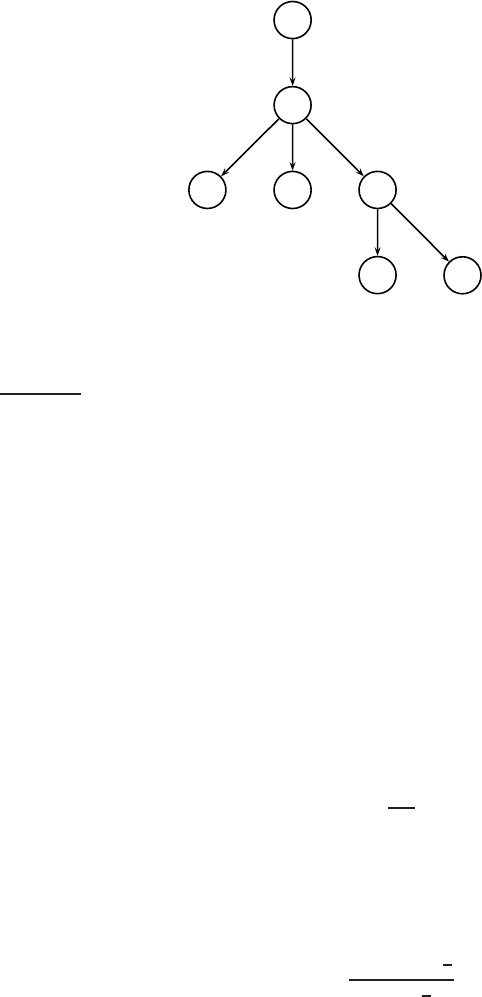
(1979) proposed a simple, plausible model which allowed a tree structure of
term dependencies, as in Figure
11.1. In this model each term can be directly
dependent on only one other term, giving a tree structure of dependencies.
When it was invented in the 1970s, estimation problems held back the practi-
cal success of this model, but the idea was reinvented as the Tree Augmented
Naive Bayes model by Friedman and Goldszmidt (1996), who used it with
some success on various machine learning data sets.
Online edition (c)2009 Cambridge UP
232 11 Probabilistic information retrieval
x
1
x
2
x
3
x
4
x
5
x
6
x
7
◮
Figure 11.1 A tree of dependencies between terms. In this graphical model rep-
resentation, a term x
i
is directly dependent on a term x
k
if there is an arrow x
k
→ x
i
.
11.4.3 Okapi BM25: a non-binary model
The BIM was originally designed for short catalog records and abstracts of
fairly consistent length, and it works reasonably in these contexts, but for
modern full-text search collections, it seems clear that a model should pay
attention to term frequency and document length, as in Chapter
6. The BM25BM25 WEIGHTS
weighting scheme, often called Okapi weighting, after the system in which it wasOKAPI WEIGHTING
first implemented, was developed as a way of building a probabilistic model
sensitive to these quantities while not introducing too many additional pa-
rameters into the model (Spärck Jones et al. 2000). We will not develop the
full theory behind the model here, but just present a series of forms that
build up to the standard form now used for document scoring. The simplest
score for document d is just idf weighting of the query terms present, as in
Equation (
11.22):
RSV
d
=
∑
t∈q
log
N
df
t
(11.30)
Sometimes, an alternative version of idf is used. If we start with the formula
in Equation (
11.21) but in the absence of relevance feedback information we
estimate that S = s = 0, then we get an alternative idf formulation as follows:
RSV
d
=
∑
t∈q
log
N −df
t
+
1
2
df
t
+
1
2
(11.31)

Online edition (c)2009 Cambridge UP
11.4 An appraisal and some extension s 233
This variant behaves slightly strangely: if a term occurs in over half the doc-
uments in the collection then this model gives a negative term weight, which
is presumably undesirable. But, assuming the use of a stop list, this normally
doesn’t happen, and the value for each summand can be given a floor of 0.
We can improve on Equation (
11.30) by factoring in the frequency of each
term and document length:
RSV
d
=
∑
t∈q
log
N
df
t
·
(k
1
+ 1)tf
td
k
1
((1 −b) + b × (L
d
/L
ave
)) + tf
td
(11.32)
Here, tf
td
is the frequency of term t in document d, and L
d
and L
ave
are the
length of document d and the average document length for the whole col-
lection. The variable k
1
is a positive tuning parameter that calibrates the
document term frequency scaling. A k
1
value of 0 corresponds to a binary
model (no term frequency), and a large value corresponds to using raw term
frequency. b is another tuning parameter (0 ≤ b ≤ 1) which determines
the scaling by document length: b = 1 corresponds to fully scaling the term
weight by the document length, while b = 0 corresponds to no length nor-
malization.
If the query is long, then we might also use similar weighting for query
terms. This is appropriate if the queries are paragraph long information
needs, but unnecessary for short queries.
RSV
d
=
∑
t∈q
log
N
df
t
·
(k
1
+ 1)tf
td
k
1
((1 − b) + b ×(L
d
/L
ave
)) + tf
td
·
(k
3
+ 1)tf
tq
k
3
+ tf
tq
(11.33)
with tf
tq
being the frequency of term t in the query q, and k
3
being another
positive tuning parameter that this time calibrates term frequency scaling
of the query. In the equation presented, there is no length normalization of
queries (it is as if b = 0 here). Length normalization of the query is unnec-
essary because retrieval is being done with respect to a single fixed query.
The tuning parameters of these formulas should ideally be set to optimize
performance on a development test collection (see page
153). That is, we
can search for values of these parameters that maximize performance on a
separate development test collection (either manually or with optimization
methods such as grid search or something more advanced), and then use
these parameters on the actual test collection. In the absence of such opti-
mization, experiments have shown reasonable values are to set k
1
and k
3
to
a value between 1.2 and 2 and b = 0.75.
If we have relevance judgments available, then we can use the full form of
(
11.21) in place of the approximation log(N/df
t
) introduced in (11.22):
RSV
d
=
∑
t∈q
log
""
(|VR
t
|+
1
2
)/(|VNR
t
|+
1
2
)
(df
t
−|VR
t
|+
1
2
)/(N −df
t
−|VR| + |VR
t
| +
1
2
)
#
(11.34)

Online edition (c)2009 Cambridge UP
234 11 Probabilistic information retrieval
×
(k
1
+ 1)tf
td
k
1
((1 − b) + b(L
d
/L
ave
)) + tf
td
×
(k
3
+ 1)tf
tq
k
3
+ tf
tq
Here, VR
t
, NVR
t
, and VR are used as in Section
11.3.4. The first part of the
expression reflects relevance feedback (or just idf weighting if no relevance
information is available), the second implements document term frequency
and document length scaling, and the third considers term frequency in the
query.
Rather than just providing a term weighting method for terms in a user’s
query, relevance feedback can also involve augmenting the query (automat-
ically or with manual review) with some (say, 10–20) of the top terms in the
known-relevant documents as ordered by the relevance factor
ˆ
c
t
from Equa-
tion (
11.21), and the above formula can then be used with such an augmented
query vector~q.
The BM25 term weighting formulas have been used quite widely and quite
successfully across a range of collections and search tasks. Especially in the
TREC evaluations, they performed well and were widely adopted by many
groups. See Spärck Jones et al. (2000) for extensive motivation and discussion
of experimental results.
11.4.4 B ayesian network approaches to IR
Turtle and Croft (1989; 1991) introduced into information retrieval the use
of B ayesian networks (Jensen and Jensen 2001), a form of probabilistic graph-BAYESIAN NETWORKS
ical model. We skip the details because fully introducing the formalism of
Bayesian networks would require much too much space, but conceptually,
Bayesian networks use directed graphs to show probabilistic dependencies
between variables, as in Figure
11.1, and have led to the development of so-
phisticated algorithms for propagating influence so as to allow learning and
inference with arbitrary knowledge within arbitrary directed acyclic graphs.
Turtle and Croft used a sophisticated network to better model the complex
dependencies between a document and a user’s information need.
The model decomposes into two parts: a document collection network and
a query network. The document collection network is large, but can be pre-
computed: it maps from documents to terms to concepts. The concepts are
a thesaurus-based expansion of the terms appearing in the document. The
query network is relatively small but a new network needs to be built each
time a query comes in, and then attached to the document network. The
query network maps from query terms, to query subexpressions (built us-
ing probabilistic or “noisy” versions of AND and OR operators), to the user’s
information need.
The result is a flexible probabilistic network which can generalize vari-
ous simpler Boolean and probabilistic models. Indeed, this is the primary
Online edition (c)2009 Cambridge UP
11.5 References and further reading 235
case of a statistical ranked retrieval model that naturally supports structured
query operators. The system allowed efficient large-scale retrieval, and was
the basis of the InQuery text retrieval system, built at the University of Mas-
sachusetts. This system performed very well in TREC evaluations and for a
time was sold commercially. On the other hand, the model still used various
approximations and independence assumptions to make parameter estima-
tion and computation possible. There has not been much follow-on work
along these lines, but we would note that this model was actually built very
early on in the modern era of using Bayesian networks, and there have been
many subsequent developments in the theory, and the time is perhaps right
for a new generation of Bayesian network-based information retrieval sys-
tems.
11.5 Ref erences and further reading
Longer introductions to probability theory can be found in most introduc-
tory probability and statistics books, such as (Grinstead and Snell 1997, Rice
2006, Ross 2006). An introduction to Bayesian utility theory can be found in
(Ripley 1996).
The probabilistic approach to IR originated in the UK in the 1950s. The
first major presentation of a probabilistic model is Maron and Kuhns (1960).
Robertson and Jones (1976) introduce the main foundations of the BIM and
van Rijsbergen (1979) presents in detail the classic BIM probabilistic model.
The idea of the PRP is variously attributed to S. E. Robertson, M. E. Maron
and W. S. Cooper (the term “Probabilistic Ordering Principle” is used in
Robertson and Jones (1976), but PRP dominates in later work). Fuhr (1992)
is a more recent presentation of probabilistic IR, which includes coverage of
other approaches such as probabilistic logics and Bayesian networks. Crestani
et al. (1998) is another survey.Spärck Jones et al. (2000) is the definitive pre-
sentation of probabilistic IR experiments by the “London school”, and Robert-
son (2005) presents a retrospective on the group’s participation in TREC eval-
uations, including detailed discussion of the Okapi BM25 scoring function
and its development. Robertson et al. (2004) extend BM25 to the case of mul-
tiple weighted fields.
The open-source Indri search engine, which is distributed with the Lemur
toolkit (http://www.lemurproject.org/) merges ideas from Bayesian inference net-
works and statistical language modeling approaches (see Chapter 12), in par-
ticular preserving the former’s support for structured query operators.