
Manning Ch. D., Raghavan P., Sch?tze H. Introduction to Information Retrieval - Введение в информационный поиск
Подождите немного. Документ загружается.

Online edition (c)2009 Cambridge UP
256 13 Text classification and Naive Bayes
sification as discussed in Section 13.5. Section 13.6 covers evaluation of text
classification. In the following chapters, Chapters
14 and 15, we look at two
other families of classification methods, vector space classifiers and support
vector machines.
13.1 The tex t classification problem
In text classification, we are given a description d ∈ X of a document, where
X is the docum ent space; and a fixed set of classes C = {c
1
, c
2
, . . . , c
J
}. ClassesDOCUMENT SPACE
CLASS
are also called ca tegories or labels. Typically, the document space X is some
type of high-dimensional space, and the classes are human defined for the
needs of an application, as in the examples China and documents that talk
about multicore computer chips above. We are given a training set D of labeledTRAINING SET
documents hd, ci,where hd, ci ∈ X × C. For example:
hd, ci = hBeijing joins the World Trade Organization, Chinai
for the one-sentence document B eijing joins the World Trade Organization and
the class (or label) China.
Using a learning meth o d or learning algorithm, we then wish to learn a clas-LEARNING METHOD
sifier or classification function γ that maps documents to classes:CLASSIFIER
γ : X → C
(13.1)
This type of learning is called supervised learning because a supervisor (theSUPERVISED LEARNING
human who defines the classes and labels training documents) serves as a
teacher directing the learning process. We denote the supervised learning
method by Γ and write Γ(D) = γ. The learning method Γ takes the training
set D as input and returns the learned classification function γ.
Most names for learning methods Γ are also used for classifiers γ. We
talk about the Naive Bayes (NB) learning method Γ when we say that “Naive
Bayes is robust,” meaning that it can be applied to many different learning
problems and is unlikely to produce classifiers that fail catastrophically. But
when we say that “Naive Bayes had an error rate of 20%,” we are describing
an experiment in which a particular NB classifier γ (which was produced by
the NB learning method) had a 20% error rate in an application.
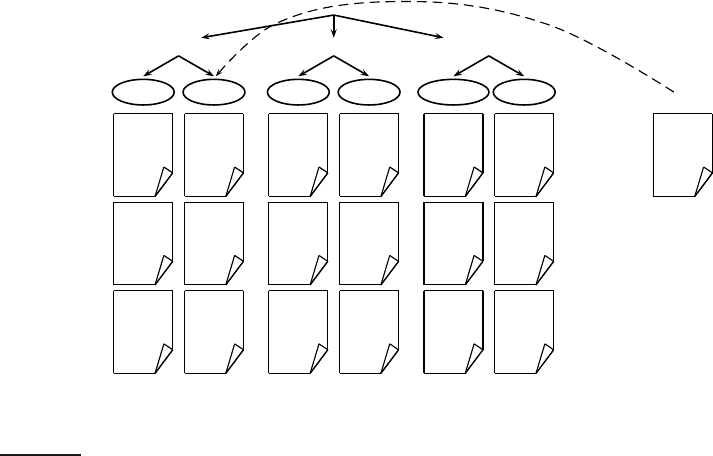
Figure
13.1 shows an example of text classification from the Reuters-RCV1
collection, introduced in Section 4.2, page 69. There are six classes (UK, Ch ina,
.. . , sports), each with three training documents. We show a few mnemonic
words for each document’s content. The training set provides some typical
examples for each class, so that we can learn the classification function γ.
Once we have learned γ, we can apply it to the test set (or test data), for ex-TEST SET
ample, the new document first privat e Chinese airline whose class is unknown.
Online edition (c)2009 Cambridge UP
13.1 The text classification probl em 257
classes:
training
set:
test
set:
regions
industries
subject areas
γ(d
′
) =China
first
private
Chinese
airline
UK
China
poultry coffee
elections
sports
London
congestion
Big Ben
Parliament
the Queen
Windsor
Beijing
Olympics
Great Wall
tourism
communist
Mao
chicken
feed
ducks
pate
turkey
bird flu
beans
roasting
robusta
arabica
harvest
Kenya
votes
recount
run-off
seat
campaign
TV ads
baseball
diamond
soccer
forward
captain
team
d
′
◮
Figure 13.1 Classes, training set, and test set in text classification .
In Figure 13.1, the classification function assigns the new document to class
γ(d) = China, which is the correct assignment.
The classes in text classification often have some interesting structure such
as the hierarchy in Figure
13.1. There are two instances each of region cate-
gories, industry categories, and subject area categories. A hierarchy can be
an important aid in solving a classification problem; see Section
15.3.2 for
further discussion. Until then, we will make the assumption in the text clas-
sification chapters that the classes form a set with no subset relationships
between them.
Definition (
13.1) stipulates that a document is a member of exactly one
class. This is not the most appropriate model for the hierarchy in Figure 13.1.
For instance, a document about the 2008 Olympics should be a member of
two classes: the China class and the sports class. This type of classification
problem is referred to as an any-of problem and we will return to it in Sec-
tion
14.5 (page 306). For the time being, we only consider one-of problems
where a document is a member of exactly one class.
Our goal in text classification is high accuracy on test data or new data – for
example, the newswire articles that we will encounter tomorrow morning
in the multicore chip example. It is easy to achieve high accuracy on the
training set (e.g., we can simply memorize the labels). But high accuracy on
the training set in general does not mean that the classifier will work well on

Online edition (c)2009 Cambridge UP
258 13 Text classification and Naive Bayes
new data in an application. When we use the training set to learn a classifier
for test data, we make the assumption that training data and test data are
similar or from the same distribution. We defer a precise definition of this
notion to Section
14.6 (page 308).
13.2 Naive Bayes text classification
The first supervised learning method we introduce is the multinomial NaiveMULTINOMIAL NAIVE
BAYES
Bayes or multinomial NB model, a probabilistic learning method. The proba-
bility of a document d being in class c is computed as
P(c|d) ∝ P(c)
∏
1≤k≤n
d
P(t
k
|c)
(13.2)
where P(t
k
|c) is the conditional probability of term t
k
occurring in a docu-
ment of class c.
1
We interpret P(t
k
|c) as a measure of how much evidence
t
k
contributes that c is the correct class. P(c) is the prior probability of a
document occurring in class c. If a document’s terms do not provide clear
evidence for one class versus another, we choose the one that has a higher
prior probability. ht
1
, t
2
, . . . , t
n
d
i are the tokens in d that are part of the vocab-
ulary we use for classification and n
d
is the number of such tokens in d. For
example, ht
1
, t
2
, . . . , t
n
d
i for the one-sentence document Beijing and Taipei join
the WTO might be hBeijing, Taipei, join, WTOi, with n
d
= 4, if we treat the terms
and and the as stop words.
In text classification, our goal is to find the best class for the document. The
best class in NB classification is the most likely or maximum a posteriori (MAP)MAXIMUM A
POSTERIORI CLASS
class c
map
:
c
map
= arg max
c∈C
ˆ
P(c|d) = arg max
c∈C
ˆ
P(c)
∏
1≤k≤n
d
ˆ
P(t
k
|c).
(13.3)
We write
ˆ
P for P because we do not know the true values of the parameters
P(c) and P(t
k
|c), but estimate them from the training set as we will see in a
moment.
In Equation (
13.3), many conditional probabilities are multiplied, one for
each position 1 ≤ k ≤ n
d
. This can result in a floating point underflow.
It is therefore better to perform the computation by adding logarithms of
probabilities instead of multiplying probabilities. The class with the highest
log probability score is still the most probable; log(xy) = log(x) + log(y)
and the logarithm function is monotonic. Hence, the maximization that is
1. We will explain in the next section why P(c|d) is proportional to (∝), not equal to the quantity
on the right.

Online edition (c)2009 Cambridge UP
13.2 Naive Bayes text classification 259
actually done in most implementations of NB is:
c
map
= arg max
c∈C
[log
ˆ
P(c) +
∑
1≤k≤n
d
log
ˆ
P(t
k
|c)].
(13.4)
Equation (13.4) has a simple interpretation. Each conditional parameter
log
ˆ
P(t
k
|c) is a weight that indicates how good an indicator t
k
is for c. Sim-
ilarly, the prior log
ˆ
P(c) is a weight that indicates the relative frequency of
c. More frequent classes are more likely to be the correct class than infre-
quent classes. The sum of log prior and term weights is then a measure of
how much evidence there is for the document being in the class, and Equa-
tion (
13.4) selects the class for which we have the most evidence.
We will initially work with this intuitive interpretation of the multinomial
NB model and defer a formal derivation to Section
13.4.
How do we estimate the parameters
ˆ
P(c) and
ˆ
P(t
k
|c)? We first try the
maximum likelihood estimate (MLE; Section 11.3.2, page 226), which is sim-
ply the relative frequency and corresponds to the most likely value of each
parameter given the training data. For the priors this estimate is:
ˆ
P(c) =
N
c
N
,
(13.5)
where N
c
is the number of documents in class c and N is the total number of
documents.
We estimate the conditional probability
ˆ
P(t|c) as the relative frequency of
term t in documents belonging to class c:
ˆ
P(t|c) =
T
ct
∑
t
′
∈V
T
ct
′
,
(13.6)
where T
ct
is the number of occurrences of t in training documents from class
c, including multiple occurrences of a term in a document. We have made the
positional independence assumption here, which we will discuss in more detail
in the next section: T
ct
is a count of occurrences in all positions k in the doc-
uments in the training set. Thus, we do not compute different estimates for
different positions and, for example, if a word occurs twice in a document,
in positions k
1
and k
2
, then
ˆ
P(t
k
1
|c) =
ˆ
P(t
k
2
|c).
The problem with the MLE estimate is that it is zero for a term–class combi-
nation that did not occur in the training data. If the term WTO in the training
data only occurred in China documents, then the MLE estimates for the other
classes, for example UK, will be zero:
ˆ
P(WTO|UK) = 0.
Now, the one-sentence document Britain is a member of the WTO will get a
conditional probability of zero for UK because we are multiplying the condi-
tional probabilities for all terms in Equation (
13.2). Clearly, the model should

Online edition (c)2009 Cambridge UP
260 13 Text classification and Naive Bayes
TRAINMULTINOMIALNB(C, D)
1 V ← EXTRACTVOCABULARY(D)
2 N ← COUNTDOCS(D)
3 for each c ∈ C
4 do N
c
← COUNTDOCSINCLASS(D, c)
5 prior[c] ← N
c
/N
6 text
c
← CONCATENATETEXTOFALLDOCSINCLASS(D, c)
7 for each t ∈ V
8 do T
ct
← COUNTTOKENSOFTERM(text
c
, t)
9 for each t ∈ V
10 do condprob[t][c] ←
T
ct
+1
∑
t
′
(T
ct
′
+1)
11 return V, prior, condprob
APPLYMULTINOMIALNB(C, V, prior, condprob, d)
1 W ← EXTRACTTOKENSFROMDOC(V, d)
2 for each c ∈ C
3 do score[c] ← log prior[c]
4 for each t ∈ W
5 do score[c] += log condprob[t][c]
6 return arg max
c∈C
score[c]
◮
Figure 13.2 Naive Bayes algorithm (multinomial model): Training and testing.
assign a high probability to the UK class because the term Britain occurs. The
problem is that the zero probability for WTO cannot be “conditioned away,”
no matter how strong the evidence for the class UK from other features. The
estimate is 0 because of sparseness: The training data are never large enoughSPARSENESS
to represent the frequency of rare events adequately, for example, the fre-
quency of WTO occurring in UK documents.
To eliminate zeros, we use add-one or Laplace smoothing, which simply addsADD-ONE SMOOTHING
one to each count (cf. Section
11.3.2):
ˆ
P(t|c) =
T
ct
+ 1
∑
t
′
∈V
(T
ct
′ + 1)
=
T
ct
+ 1
(
∑
t
′
∈V
T
ct
′) + B
,
(13.7)
where B = |V| is the number of terms in the vocabulary. Add-one smoothing
can be interpreted as a uniform prior (each term occurs once for each class)
that is then updated as evidence from the training data comes in. Note that
this is a prior probability for the occurrence of a term as opposed to the prior
probability of a class which we estimate in Equation (
13.5) on the document
level.

Online edition (c)2009 Cambridge UP
13.2 Naive Bayes text classification 261
◮
Table 13.1 Data for parameter estimation examples.
docID words in document in c = China?
training set 1 Chinese Beijing Chinese yes
2 Chinese Chinese Shanghai yes
3 Chinese Macao yes
4 Tokyo Japan Chinese no
test set 5 Chinese Chinese Chinese Tokyo Japan ?
◮
Table 13.2 Training and test times for NB.
mode time complexity
training Θ(|D|L
ave
+ |C||V|)
testing Θ(L
a
+ |C|M
a
) = Θ(|C|M
a
)
We have now introduced all the elements we need for training and apply-
ing an NB classifier. The complete algorithm is described in Figure
13.2.
✎
Example 13.1: For the example in Table
13.1, the multinomial parameters we
need to classify the test document are the priors
ˆ
P(c) = 3/4 and
ˆ
P(
c) = 1/4 and the
following conditional probabilities:
ˆ
P(Chinese|c) = (5 + 1)/(8 + 6) = 6/14 = 3/7
ˆ
P(Tokyo|c) =
ˆ
P(Japan|c) = (0 + 1)/(8 + 6) = 1/14
ˆ
P(Chinese|
c) = (1 + 1)/(3 + 6) = 2/9
ˆ
P(Tokyo|
c) =
ˆ
P(Japan|c) = (1 + 1)/(3 + 6) = 2/9
The denominators are (8 + 6) and (3 + 6) because the lengths of text
c
and text
c
are 8
and 3, respectively, and because the constant B in Equation (
13.7) is 6 as the vocabu-
lary consists of six terms.
We then get:
ˆ
P(c|d
5
) ∝ 3/4 ·(3/7)
3
·1/14 ·1/14 ≈ 0.0003.
ˆ
P(c|d
5
) ∝ 1/4 ·(2/9)
3
·2/9 ·2/9 ≈ 0.0001.
Thus, the classifier assigns the test document to c = China. The reason for this clas-
sification decision is that the three occurrences of the positive indicator Chinese in d
5
outweigh the occurrences of the two negative indicators Japan and Tokyo.
What is the time complexity of NB? The complexity of computing the pa-
rameters is Θ(|C||V|) because the set of parameters consists of |C||V| con-
ditional probabilities and |C| priors. The preprocessing necessary for com-
puting the parameters (extracting the vocabulary, counting terms, etc.) can
be done in one pass through the training data. The time complexity of this

Online edition (c)2009 Cambridge UP
262 13 Text classification and Naive Bayes
component is therefore Θ(|D|L
ave
), where |D| is the number of documents
and L
ave
is the average length of a document.
We use Θ(|D|L
ave
) as a notation for Θ(T) here, where T is the length of the
training collection. This is nonstandard; Θ(.) is not defined for an average.
We prefer expressing the time complexity in terms of D and L
ave
because
these are the primary statistics used to characterize training collections.
The time complexity of APPLYMULTINOMIALNB in Figure
13.2 is Θ(|C|L
a
).
L
a
and M
a
are the numbers of tokens and types, respectively, in the test doc-
ument. APPLYMULTINOMIALNB can be modified to be Θ(L
a
+ |C|M
a
) (Ex-
ercise
13.8). Finally, assuming that the length of test documents is bounded,
Θ(L
a
+ |C|M
a
) = Θ(|C|M
a
) because L
a
< b|C|M
a
for a fixed constant b.
2
Table
13.2 summarizes the time complexities. In general, we have |C||V| <
|D|L
ave
, so both training and testing complexity are linear in the time it takes
to scan the data. Because we have to look at the data at least once, NB can be
said to have optimal time complexity. Its efficiency is one reason why NB is
a popular text classification method.
13.2.1 R elation to multinomial unigram language model
The multinomial NB model is formally identical to the multinomial unigram
language model (Section
12.2.1, page 242). In particular, Equation (13.2) is
a special case of Equation (
12.12) from page 243, which we repeat here for
λ = 1:
P(d|q) ∝ P(d)
∏
t∈q
P(t|M
d
).
(13.8)
The document d in text classification (Equation (13.2)) takes the role of the
query in language modeling (Equation (13.8)) and the classes c in text clas-
sification take the role of the documents d in language modeling. We used
Equation (
13.8) to rank documents according to the probability that they are
relevant to the query q . In NB classification, we are usually only interested
in the top-ranked class.
We also used MLE estimates in Section
12.2.2 (page 243) and encountered
the problem of zero estimates owing to sparse data (page 244); but instead
of add-one smoothing, we used a mixture of two distributions to address the
problem there. Add-one smoothing is closely related to add-
1
2
smoothing in
Section
11.3.4 (page 228).
?
Exercise 13.1
Why is |C||V| < |D|L
ave
in Table 13.2 expected to hold for most text collections?
2. Our assumption here is that the length of test documents is bounded. L
a
would exceed
b|C|M
a
for extremely long test documents.

Online edition (c)2009 Cambridge UP
13.3 The Bernoulli model 263
TRAINBERNOULLINB(C, D)
1 V ← EXTRACTVOCABULARY(D)
2 N ← COUNTDOCS(D)
3 for each c ∈ C
4 do N
c
← COUNTDOCSINCLASS(D, c)
5 pr io r[c] ← N
c
/N
6 for each t ∈ V
7 do N
ct
← COUNTDOCSINCLASSCONTAININGTERM(D, c, t)
8 condprob[t][c] ← (N
ct
+ 1)/(N
c
+ 2)
9 return V, prior, condp rob
APPLYBERNOULLINB(C, V, prior, condprob, d)
1 V
d
← EXTRACTTERMSFROMDOC(V, d)
2 for each c ∈ C
3 do score[c] ← log prior[c]
4 for each t ∈ V
5 do if t ∈ V
d
6 then score[c] += log condprob[t][c]
7 else score[c] += log(1 − condprob[t][c])
8 return arg max
c∈C
score[c]
◮
Figure 13.3 NB algorithm (Bernoulli model): Training and testing. The add-one
smoothing in Line 8 (top) is in analogy to Equation (13.7) with B = 2.
13.3 The Bernoulli m odel
There are two different ways we can set up an NB classifier. The model we in-
troduced in the previous section is the multinomial model. It generates one
term from the vocabulary in each position of the document, where we as-
sume a generative model that will be discussed in more detail in Section
13.4
(see also page 237).
An alternative to the multinomial model is the multivariate Bernoulli model
or Bernoulli model. It is equivalent to the binary independence model of Sec-BERNOULLI MODEL
tion
11.3 (page 222), which generates an indicator for each term of the vo-
cabulary, either 1 indicating presence of the term in the document or 0 indi-
cating absence. Figure 13.3 presents training and testing algorithms for the
Bernoulli model. The Bernoulli model has the same time complexity as the
multinomial model.
The different generation models imply different estimation strategies and
different classification rules. The Bernoulli model estimates
ˆ
P(t|c) as the frac-
tion of d o cuments of class c that contain term t (Figure
13.3, TRAINBERNOULLI-

Online edition (c)2009 Cambridge UP
264 13 Text classification and Naive Bayes
NB, line 8). In contrast, the multinomial model estimates
ˆ
P(t|c) as the frac-
tion of tokens or fraction of positions in documents of class c that contain term
t (Equation (
13.7)). When classifying a test document, the Bernoulli model
uses binary occurrence information, ignoring the number of occurrences,
whereas the multinomial model keeps track of multiple occurrences. As a
result, the Bernoulli model typically makes many mistakes when classifying
long documents. For example, it may assign an entire book to the class China
because of a single occurrence of the term China.
The models also differ in how nonoccurring terms are used in classifica-
tion. They do not affect the classification decision in the multinomial model;
but in the Bernoulli model the probability of nonoccurrence is factored in
when computing P(c|d) (Figure
13.3, APPLYBERNOULLINB, Line 7). This is
because only the Bernoulli NB model models absence of terms explicitly.
✎
Example 13.2: Applying the Bernoulli model to the example in Table
13.1, we
have the same estimates for the priors as before:
ˆ
P(c) = 3/4,
ˆ
P(
c) = 1/4. The
conditional probabilities are:
ˆ
P(Chinese|c) = (3 + 1)/(3 + 2) = 4/5
ˆ
P(Japan|c) =
ˆ
P(Tokyo|c) = (0 + 1)/(3 + 2) = 1/5
ˆ
P(Beijing|c) =
ˆ
P(Macao|c) =
ˆ
P(Shanghai|c) = (1 + 1)/(3 + 2) = 2/5
ˆ
P(Chinese|
c) = (1 + 1)/(1 + 2) = 2/3
ˆ
P(Japan|
c) =
ˆ
P(Tokyo|c) = (1 + 1)/(1 + 2) = 2/3
ˆ
P(Beijing|
c) =
ˆ
P(Macao|c) =
ˆ
P(Shanghai|c) = (0 + 1)/(1 + 2) = 1/3
The denominators are (3 + 2) and (1 + 2) because there are three documents in c
and one document in
c and because the constant B in Equation (13.7) is 2 – there are
two cases to consider for each term, occurrence and nonoccurrence.
The scores of the test document for the two classes are
ˆ
P(c|d
5
) ∝
ˆ
P(c) ·
ˆ
P(Chinese|c) ·
ˆ
P(Japan|c) ·
ˆ
P(Tokyo|c)
·(1 −
ˆ
P(Beijing|c)) · (1 −
ˆ
P(Shanghai|c)) · (1 −
ˆ
P(Macao|c))
= 3/4 ·4/5 ·1/5 ·1/5 · (1−2/5) ·(1−2/5) · (1−2/5)
≈ 0.005
and, analogously,
ˆ
P(
c|d
5
) ∝ 1/4 ·2/3 ·2/3 ·2/3 ·(1−1/3) · (1−1/3) · (1−1/3)
≈ 0.022
Thus, the classifier assigns the test document to c = not-China. When looking only
at binary occurrence and not at term frequency, Japan and Tokyo are indicators for
c
(2/3 > 1/5) and the conditional probabilities of Chinese for c and
c are not different
enough (4/5 vs. 2/3) to affect the classification decision.

Online edition (c)2009 Cambridge UP
13.4 Properties of Naive Bayes 265
13.4 Properties of Naive Bayes
To gain a better understanding of the two models and the assumptions they
make, let us go back and examine how we derived their classification rules in
Chapters
11 and 12. We decide class membership of a document by assigning
it to the class with the maximum a posteriori probability (cf. Section
11.3.2,
page 226), which we compute as follows:
c
map
= arg max
c∈C
P(c|d)
= arg max
c∈C
P(d|c)P(c)
P(d)
(13.9)
= arg max
c∈C
P(d|c)P(c),(13.10)
where Bayes’ rule (Equation (11.4), page 220) is applied in (13.9) and we drop
the denominator in the last step because P(d) is the same for all classes and
does not affect the argmax.
We can interpret Equation (
13.10) as a description of the generative process
we assume in Bayesian text classification. To generate a document, we first
choose class c with probability P(c) (top nodes in Figures
13.4 and 13.5). The
two models differ in the formalization of the second step, the generation of
the document given the class, corresponding to the conditional distribution
P(d|c):
Multinomial P(d|c) = P(ht
1
, . . . , t
k
, . . . , t
n
d
i|c)(13.11)
Bernoulli P(d|c) = P(he
1
, . . . , e
i
, . . . , e
M
i|c),(13.12)
where ht
1
, . . . , t
n
d
i is the sequence of terms as it occurs in d (minus terms
that were excluded from the vocabulary) and he
1
, . . . , e
i
, . . . , e
M
i is a binary
vector of dimensionality M that indicates for each term whether it occurs in
d or not.
It should now be clearer why we introduced the document space X in
Equation (
13.1) when we defined the classification problem. A critical step
in solving a text classification problem is to choose the document represen-
tation. ht
1
, . . . , t
n
d
i and he
1
, . . . , e
M
i are two different document representa-
tions. In the first case, X is the set of all term sequences (or, more precisely,
sequences of term tokens). In the second case, X is {0, 1}
M
.
We cannot use Equations (
13.11) and (13.12) for text classification directly.
For the Bernoulli model, we would have to estimate 2
M
|C| different param-
eters, one for each possible combination of M values e
i
and a class. The
number of parameters in the multinomial case has the same order of magni-