
Manning Ch. D., Raghavan P., Sch?tze H. Introduction to Information Retrieval - Введение в информационный поиск
Подождите немного. Документ загружается.

Online edition (c)2009 Cambridge UP
Online edition (c)2009 Cambridge UP
DRAFT! © April 1, 2009 Cambridge University Press. Feedback welcome. 237
12
Language models for information
re t rieval
A common suggestion to users for coming up with good queries is to think
of words that would likely appear in a relevant document, and to use those
words as the query. The language modeling approach to IR directly models
that idea: a document is a good match to a query if the document model
is likely to generate the query, which will in turn happen if the document
contains the query words often. This approach thus provides a different real-
ization of some of the basic ideas for document ranking which we saw in Sec-
tion
6.2 (page 117). Instead of overtly modeling the probability P(R = 1|q, d)
of relevance of a document d to a query q, as in the traditional probabilis-
tic approach to IR (Chapter
11), the basic language modeling approach in-
stead builds a probabilistic language model M
d
from each document d, and
ranks documents based on the probability of the model generating the query:
P(q|M
d
).
In this chapter, we first introduce the concept of language models (Sec-
tion
12.1) and then describe the basic and most commonly used language
modeling approach to IR, the Query Likelihood Model (Section 12.2). Af-
ter some comparisons between the language modeling approach and other
approaches to IR (Section
12.3), we finish by briefly describing various ex-
tensions to the language modeling approach (Section
12.4).
12.1 Lan guage models
12.1.1 Finite automata and language models
What do we mean by a document model generating a query? A traditional
generative model of a language, of the kind familiar from formal languageGENERATIVE MODEL
theory, can be used either to recognize or to generate strings. For example,
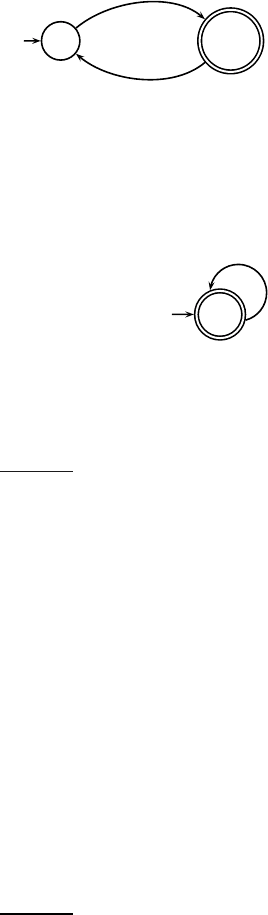
the finite automaton shown in Figure
12.1 can generate strings that include
the examples shown. The full set of strings that can be generated is called
the language of the automaton.
1
LANGUAGE
Online edition (c)2009 Cambridge UP
238 12 Language models for information retrieval
I
wish
I wish
I wish I wish
I wish I wish I wish
I wish I wish I wish I wish I wish I wish
.. .
CANNOT GENERATE: wish I wish
◮
Figure 12.1 A simple finite automaton and some of the strings in the language it
generates. → shows the start state of the automaton and a double circle indicates a
(possible) finishing state.
q
1
P(STOP|q
1
) = 0.2
the 0.2
a 0.1
frog 0.01
toad 0.01
said 0.03
likes 0.02
that 0.04
.. . . . .
◮
Figure 12.2 A one-state finite automaton that acts as a unigram language model.
We show a partial specification of the state emission probabilities.
If instead each node has a probability distribution over generating differ-
ent terms, we have a language model. The notion of a language model is
inherently probabilistic. A language model is a function that puts a probabilityLANGUAGE MODEL
measure over strings drawn from some vocabulary. That is, for a language
model M over an alphabet Σ:
∑
s∈Σ
∗
P(s) = 1
(12.1)
One simple kind of language model is equivalent to a probabilistic finite
automaton consisting of just a single node with a single probability distri-
bution over producing different terms, so that
∑
t∈V
P(t) = 1, as shown
in Figure
12.2. After generating each word, we decide whether to stop or
to loop around and then produce another word, and so the model also re-
quires a probability of stopping in the finishing state. Such a model places a
probability distribution over any sequence of words. By construction, it also
provides a model for generating text according to its distribution.
1. Finite automata can have outputs attached to either their states or their arcs; we use states
here, because that maps directly on to the way probabilistic automata are usually formalized.

Online edition (c)2009 Cambridge UP
12.1 Language models 239
Model M
1
Model M
2
the 0.2 the 0.15
a 0.1 a 0.12
frog 0.01 frog 0.0002
toad 0.01 toad 0.0001
said 0.03 said 0.03
likes 0.02 likes 0.04
that 0.04 that 0.04
dog 0.005 dog 0.01
cat 0.003 cat 0.015
monkey 0.001 monkey 0.002
.. . . . . .. . . . .
◮
Figure 12.3 Partial specification of two unigram language models.
✎
Example 12.1: To find the probability of a word sequence, we just multiply the
probabilities which the model gives to each word in the sequence, together with the
probability of continuing or stopping after producing each word. For example,
P(frog said that toad likes frog) = (0.01 ×0.03 ×0.04 ×0.01 ×0.02 × 0.01)
(12.2)
×(0.8 ×0.8 ×0.8 × 0.8 ×0.8 ×0.8 × 0.2)
≈ 0.000000000001573
As you can see, the probability of a particular string/document, is usually a very
small number! Here we stopped after generating frog the second time. The first line of
numbers are the term emission probabilities, and the second line gives the probabil-
ity of continuing or stopping after generating each word. An explicit stop probability
is needed for a finite automaton to be a well-formed language model according to
Equation (
12.1). Nevertheless, most of the time, we will omit to include STOP and
(1 − STOP) probabilities (as do most other authors). To compare two models for a
data set, we can calculate their likelihood ratio, which results from simply dividing theLIKELIHOOD RATIO
probability of the data according to one model by the probability of the data accord-
ing to the other model. Providing that the stop probability is fixed, its inclusion will
not alter the likelihood ratio that results from comparing the likelihood of two lan-
guage models generating a string. Hence, it will not alter the ranking of documents.
2
Nevertheless, formally, the numbers will no longer truly be probabilities, but only
proportional to probabilities. See Exercise
12.4.
✎
Example 12.2: Suppose, now, that we have two language models M
1
and M
2
,
shown partially in Figure
12.3. Each gives a probability estimate to a sequence of
2. In the IR context that we are leading up to, taking the stop probability to be fixed across
models seems reasonable. This is because we are generating queries, and the length distribution
of queries is fixed and independent of the document from which we are generating the language
model.
Online edition (c)2009 Cambridge UP
240 12 Language models for information retrieval
terms, as already illustrated in Example 12.1. The language model that gives the
higher probability to the sequence of terms is more likely to have generated the term
sequence. This time, we will omit STOP probabilities from our calculations. For the
sequence shown, we get:
(12.3) s frog said that toad likes that dog
M
1
0.01 0.03 0.04 0.01 0.02 0.04 0.005
M
2
0.0002 0.03 0.04 0.0001 0.04 0.04 0.01
P(s|M
1
) = 0.00000000000048
P(s|M
2
) = 0.000000000000000384
and we see that P(s|M
1
) > P(s|M
2
). We present the formulas here in terms of prod-
ucts of probabilities, but, as is common in probabilistic applications, in practice it is
usually best to work with sums of log probabilities (cf. page
258).
12.1.2 Types of language models
How do we build probabilities over sequences of terms? We can always
use the chain rule from Equation (
11.1) to decompose the probability of a
sequence of events into the probability of each successive event conditioned
on earlier events:
P(t
1
t
2
t
3
t
4
) = P(t
1
)P(t
2
|t
1
)P(t
3
|t
1
t
2
)P(t
4
|t
1
t
2
t
3
)
(12.4)
The simplest form of language model simply throws away all conditioning
context, and estimates each term independently. Such a model is called a
unigram language model:UNIGRAM LANGUAGE
MODEL
P
uni
(t
1
t
2
t
3
t
4
) = P(t
1
)P(t
2
)P(t
3
)P(t
4
)
(12.5)
There are many more complex kinds of language models, such as bigramBIGRAM LANGUAGE
MODEL
language models, which condition on the previous term,
P
bi
(t
1
t
2
t
3
t
4
) = P(t
1
)P(t
2
|t
1
)P(t
3
|t
2
)P(t
4
|t
3
)
(12.6)
and even more complex grammar-based language models such as proba-
bilistic context-free grammars. Such models are vital for tasks like speech
recognition, spelling correction, and machine translation, where you need
the probability of a term conditioned on surrounding context. However,
most language-modeling work in IR has used unigram language models.
IR is not the place where you most immediately need complex language
models, since IR does not directly depend on the structure of sentences to
the extent that other tasks like speech recognition do. Unigram models are
often sufficient to judge the topic of a text. Moreover, as we shall see, IR lan-
guage models are frequently estimated from a single document and so it is

Online edition (c)2009 Cambridge UP
12.1 Language models 241
questionable whether there is enough training data to do more. Losses from
data sparseness (see the discussion on page
260) tend to outweigh any gains
from richer models. This is an example of the bias-variance tradeoff (cf. Sec-
tion
14.6, page 308): With limited training data, a more constrained model
tends to perform better. In addition, unigram models are more efficient to
estimate and apply than higher-order models. Nevertheless, the importance
of phrase and proximity queries in IR in general suggests that future work
should make use of more sophisticated language models, and some has be-
gun to (see Section
12.5, page 252). Indeed, making this move parallels the
model of van Rijsbergen in Chapter
11 (page 231).
12.1.3 Multinomial distributions over words
Under the unigram language model the order of words is irrelevant, and so
such models are often called “bag of words” models, as discussed in Chap-
ter
6 (page 117). Even though there is no conditioning on preceding context,
this model nevertheless still gives the probability of a particular ordering of
terms. However, any other ordering of this bag of terms will have the same
probability. So, really, we have a multinomial distribution over words. So longMULTINOMIAL
DISTRIBUTION
as we stick to unigram models, the language model name and motivation
could be viewed as historical rather than necessary. We could instead just
refer to the model as a multinomial model. From this perspective, the equa-
tions presented above do not present the multinomial probability of a bag of
words, since they do not sum over all possible orderings of those words, as
is done by the multinomial coefficient (the first term on the right-hand side)
in the standard presentation of a multinomial model:
P(d) =
L
d
!
tf
t
1
,d
!tf
t
2
,d
! ···tf
t
M
,d
!
P(t
1
)
tf
t
1
,d
P(t
2
)
tf
t
2
,d
···P(t
M
)
tf
t
M
,d
(12.7)
Here, L
d
=
∑
1≤i≤M
tf
t
i
,d
is the length of document d, M is the size of the term
vocabulary, and the products are now over the terms in the vocabulary, not
the positions in the document. However, just as with STOP probabilities, in
practice we can also leave out the multinomial coefficient in our calculations,
since, for a particular bag of words, it will be a constant, and so it has no effect
on the likelihood ratio of two different models generating a particular bag of
words. Multinomial distributions also appear in Section
13.2 (page 258).
The fundamental problem in designing language models is that we do not
know what exactly we should use as the model M
d
. However, we do gener-
ally have a sample of text that is representative of that model. This problem
makes a lot of sense in the original, primary uses of language models. For ex-
ample, in speech recognition, we have a training sample of (spoken) text. But
we have to expect that, in the future, users will use different words and in
Online edition (c)2009 Cambridge UP
242 12 Language models for information retrieval
different sequences, which we have never observed before, and so the model
has to generalize beyond the observed data to allow unknown words and se-
quences. This interpretation is not so clear in the IR case, where a document
is finite and usually fixed. The strategy we adopt in IR is as follows. We
pretend that the document d is only a representative sample of text drawn
from a model distribution, treating it like a fine-grained topic. We then esti-
mate a language model from this sample, and use that model to calculate the
probability of observing any word sequence, and, finally, we rank documents
according to their probability of generating the query.
?
Exercise 12.1
[⋆]
Including stop probabilities in the calculation, what will the sum of the probability
estimates of all strings in the language of length 1 be? Assume that you generate a
word and then decide whether to stop or not (i.e., the null string is not part of the
language).
Exercise 12.2 [⋆]
If the stop probability is omitted from calculations, what will the sum of the scores
assigned to strings in the language of length 1 be?
Exercise 12.3 [⋆]
What is the likelihood ratio of the document according to M
1
and M
2
in Exam-
ple
12.2?
Exercise 12.4 [⋆]
No explicit STOP probability appeared in Example 12.2. Assuming that the STOP
probability of each model is 0.1, does this change the likelihood ratio of a document
according to the two models?
Exercise 12.5 [⋆⋆]
How might a language model be used in a spelling correction system? In particular,
consider the case of context-sensitive spelling correction, and correcting incorrect us-
ages of words, such as their in Are you their? (See Section
3.5 (page 65) for pointers to
some literature on this topic.)
12.2 The query likelihood model
12.2.1 Using query likelihood language models in IR
Language modeling is a quite general formal approach to IR, with many vari-
ant realizations. The original and basic method for using language models
in IR is the query likelihood model. In it, we construct from each document dQUERY LIKELIHOOD
MODEL
in the collection a language model M
d
. Our goal is to rank documents by
P(d|q), where the probability of a document is interpreted as the likelihood
that it is relevant to the query. Using Bayes rule (as introduced in Section
11.1,
page
220), we have:
P(d|q) = P(q|d)P(d)/P(q)

Online edition (c)2009 Cambridge UP
12.2 The query likelihood model 243
P(q) is the same for all documents, and so can be ignored. The prior prob-
ability of a document P(d) is often treated as uniform across all d and so it
can also be ignored, but we could implement a genuine prior which could in-
clude criteria like authority, length, genre, newness, and number of previous
people who have read the document. But, given these simplifications, we
return results ranked by simply P(q|d), the probability of the query q under
the language model derived from d. The Language Modeling approach thus
attempts to model the query generation process: Documents are ranked by
the probability that a query would be observed as a random sample from the
respective document model.
The most common way to do this is using the multinomial unigram lan-
guage model, which is equivalent to a multinomial Naive Bayes model (page
263),
where the documents are the classes, each treated in the estimation as a sep-
arate “language”. Under this model, we have that:
P(q|M
d
) = K
q
∏
t∈V
P(t|M
d
)
tf
t,d
(12.8)
where, again K
q
= L
d
!/(tf
t
1
,d
!tf
t
2
,d
! ···tf
t
M
,d
!) is the multinomial coefficient
for the query q, which we will henceforth ignore, since it is a constant for a
particular query.
For retrieval based on a language model (henceforth LM), we treat the
generation of queries as a random process. The approach is to
1. Infer a LM for each document.
2. Estimate P(q|M
d
i
), the probability of generating the query according to
each of these document models.
3. Rank the documents according to these probabilities.
The intuition of the basic model is that the user has a prototype document in
mind, and generates a query based on words that appear in this document.
Often, users have a reasonable idea of terms that are likely to occur in doc-
uments of interest and they will choose query terms that distinguish these
documents from others in the collection.
3
Collection statistics are an integral
part of the language model, rather than being used heuristically as in many
other approaches.
12.2.2 Estimating the query generation probability
In this section we describe how to estimate P(q|M
d
). The probability of pro-
ducing the query given the LM M
d
of document d using maximum likelihood
3. Of course, in other cases, they do not. The answer to this within the language modeling
approach is translation language models, as briefly discussed in Section 12.4.

Online edition (c)2009 Cambridge UP
244 12 Language models for information retrieval
estimation (MLE) and the unigram assumption is:
ˆ
P(q|M
d
) =
∏
t∈q
ˆ
P
mle
(t|M
d
) =
∏
t∈q
tf
t,d
L
d
(12.9)
where M
d
is the language model of document d, tf
t,d
is the (raw) term fre-
quency of term t in document d, and L
d
is the number of tokens in docu-
ment d. That is, we just count up how often each word occurred, and divide
through by the total number of words in the document d. This is the same
method of calculating an MLE as we saw in Section
11.3.2 (page 226), but
now using a multinomial over word counts.
The classic problem with using language models is one of estimation (the
ˆ
symbol on the P’s is used above to stress that the model is estimated):
terms appear very sparsely in documents. In particular, some words will
not have appeared in the document at all, but are possible words for the in-
formation need, which the user may have used in the query. If we estimate
ˆ
P(t|M
d
) = 0 for a term missing from a document d, then we get a strict
conjunctive semantics: documents will only give a query non-zero probabil-
ity if all of the query terms appear in the document. Zero probabilities are
clearly a problem in other uses of language models, such as when predicting
the next word in a speech recognition application, because many words will
be sparsely represented in the training data. It may seem rather less clear
whether this is problematic in an IR application. This could be thought of
as a human-computer interface issue: vector space systems have generally
preferred more lenient matching, though recent web search developments
have tended more in the direction of doing searches with such conjunctive
semantics. Regardless of the approach here, there is a more general prob-
lem of estimation: occurring words are also badly estimated; in particular,
the probability of words occurring once in the document is normally over-
estimated, since their one occurrence was partly by chance. The answer to
this (as we saw in Section
11.3.2, page 226) is smoothing. But as people have
come to understand the LM approach better, it has become apparent that the
role of smoothing in this model is not only to avoid zero probabilities. The
smoothing of terms actually implements major parts of the term weighting
component (Exercise
12.8). It is not just that an unsmoothed model has con-
junctive semantics; an unsmoothed model works badly because it lacks parts
of the term weighting component.
Thus, we need to smooth probabilities in our document language mod-
els: to discount non-zero probabilities and to give some probability mass to
unseen words. There’s a wide space of approaches to smoothing probabil-
ity distributions to deal with this problem. In Section
11.3.2 (page 226), we
already discussed adding a number (1, 1/2, or a small α) to the observed

Online edition (c)2009 Cambridge UP
12.2 The query likelihood model 245
counts and renormalizing to give a probability distribution.
4
In this sec-
tion we will mention a couple of other smoothing methods, which involve
combining observed counts with a more general reference probability distri-
bution. The general approach is that a non-occurring term should be possi-
ble in a query, but its probability should be somewhat close to but no more
likely than would be expected by chance from the whole collection. That is,
if tf
t,d
= 0 then
ˆ
P(t|M
d
) ≤ cf
t
/T
where cf
t
is the raw count of the term in the collection, and T is the raw size
(number of tokens) of the entire collection. A simple idea that works well in
practice is to use a mixture between a document-specific multinomial distri-
bution and a multinomial distribution estimated from the entire collection:
ˆ
P(t|d) = λ
ˆ
P
mle
(t|M
d
) + (1 −λ)
ˆ
P
mle
(t|M
c
)
(12.10)
where 0 < λ < 1 and M
c
is a language model built from the entire doc-
ument collection. This mixes the probability from the document with the
general collection frequency of the word. Such a model is referred to as a
linear interpolation language model.
5
Correctly setting λ is important to theLINEAR
INTERPOLATION
good performance of this model.
An alternative is to use a language model built from the whole collection
as a prior distribution in a Bayesian updating process (rather than a uniformBAYESIAN SMOOTHING
distribution, as we saw in Section
11.3.2). We then get the following equation:
ˆ
P(t|d) =
tf
t,d
+ α
ˆ
P(t|M
c
)
L
d
+ α
(12.11)
Both of these smoothing methods have been shown to perform well in IR
experiments; we will stick with the linear interpolation smoothing method
for the rest of this section. While different in detail, they are both conceptu-
ally similar: in both cases the probability estimate for a word present in the
document combines a discounted MLE and a fraction of the estimate of its
prevalence in the whole collection, while for words not present in a docu-
ment, the estimate is just a fraction of the estimate of the prevalence of the
word in the whole collection.
The role of smoothing in LMs for IR is not simply or principally to avoid es-
timation problems. This was not clear when the models were first proposed,
but it is now understood that smoothing is essential to the good properties
4. In the context of probability theory, (re)normalization refers to summing numbers that cover
an event space and dividing them through by their sum, so that the result is a probability distri-
bution which sums to 1. This is distinct from both the concept of term normalization in Chapter 2
and the concept of length normalization in Chapter 6, which is done with a L
2
norm.
5. It is also referred to as Jelinek-Mercer smoothing.