
Manning Ch. D., Raghavan P., Sch?tze H. Introduction to Information Retrieval - Введение в информационный поиск
Подождите немного. Документ загружается.

Online edition (c)2009 Cambridge UP
266 13 Text classification and Naive Bayes
C=China
X
1
=Beijing X
2
=and X
3
=Taipei X
4
=join X
5
=WTO
◮
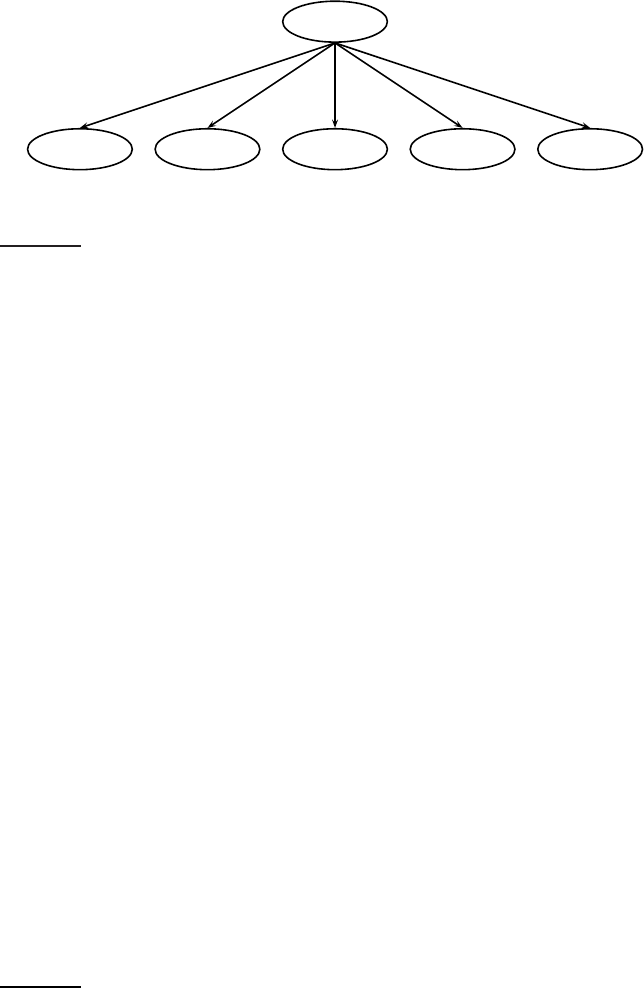
Figure 13.4 The multinomial NB model.
tude.
3
This being a very large quantity, estimating these parameters reliably
is infeasible.
To reduce the number of parameters, we make the Naive Bayes conditionalCONDITIONAL
INDEPENDENCE
ASSUMPTION
independence assumption. We assume that attribute values are independent of
each other given the class:
Multinomial P(d|c) = P(ht
1
, . . . , t
n
d
i|c) =
∏
1≤k≤n
d
P(X
k
= t
k
|c)
(13.13)
Bernoulli P(d|c) = P(he
1
, . . . , e
M
i|c) =
∏
1≤i≤M
P(U
i
= e
i
|c).(13.14)
We have introduced two random variables here to make the two different
generative models explicit. X
k
is the random variable for position k in theRANDOM VARIABLE X
document and takes as values terms from the vocabulary. P(X
k
= t|c) is the
probability that in a document of class c the term t will occur in position k. U
i
RANDOM VARIABLE U
is the random variable for vocabulary term i and takes as values 0 (absence)
and 1 (presence).
ˆ
P(U
i
= 1|c) is the probability that in a document of class c
the term t
i
will occur – in any position and possibly multiple times.
We illustrate the conditional independence assumption in Figures
13.4 and 13.5.
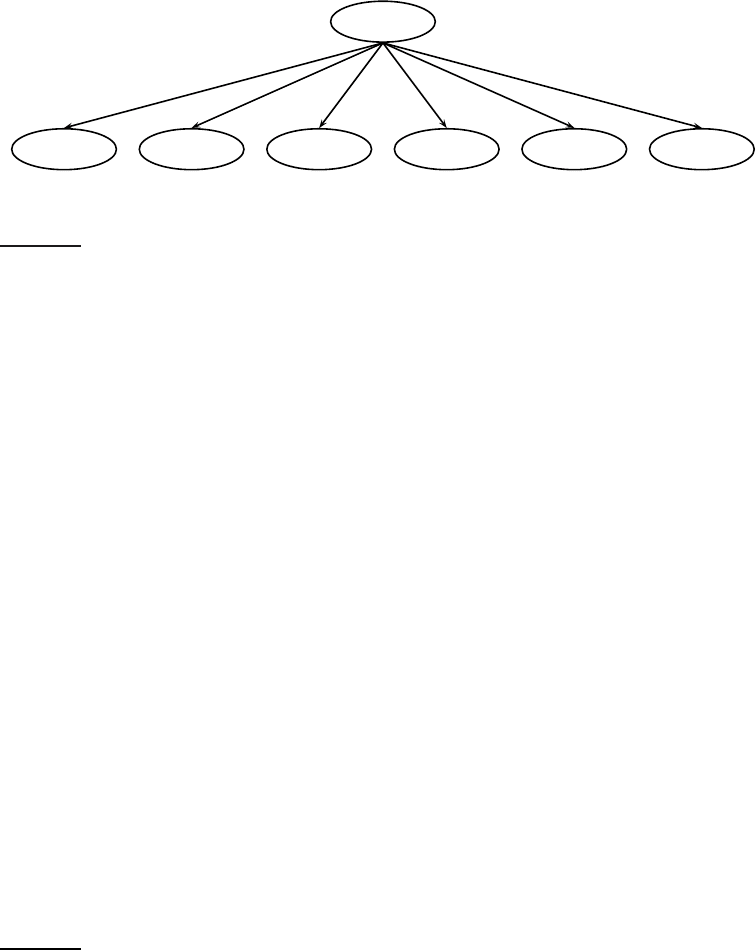
The class China generates values for each of the five term attributes (multi-
nomial) or six binary attributes (Bernoulli) with a certain probability, inde-
pendent of the values of the other attributes. The fact that a document in the
class China contains the term Taipei does not make it more likely or less likely
that it also contains Beijing.
In reality, the conditional independence assumption does not hold for text
data. Terms are conditionally dependent on each other. But as we will dis-
cuss shortly, NB models perform well despite the conditional independence
assumption.
3. In fact, if the length of documents is not bounded, the number of parameters in the multino-
mial case is infinite.
Online edition (c)2009 Cambridge UP
13.4 Properties of Naive Bayes 267
U
Alaska
=0
U
Beijing
=1
U
India
=0
U
join
=1 U
Taipei
=1
U
WTO
=1
C=China
◮
Figure 13.5 The Bernoulli NB model.
Even when assuming conditional independence, we still have too many
parameters for the multinomial model if we assume a different probability
distribution for each position k in the document. The position of a term in a
document by itself does not carry information about the class. Although
there is a difference between China sues France and France sues China, the
occurrence of China in position 1 versus position 3 of the document is not
useful in NB classification because we look at each term separately. The con-
ditional independence assumption commits us to this way of processing the
evidence.
Also, if we assumed different term distributions for each position k, we
would have to estimate a different set of parameters for each k. The probabil-
ity of bean appearing as the first term of a coffee document could be different
from it appearing as the second term, and so on. This again causes problems
in estimation owing to data sparseness.
For these reasons, we make a second independence assumption for the
multinomial model, positional independence: The conditional probabilities forPOSITIONAL
INDEPENDENCE
a term are the same independent of position in the document.
P(X
k
1
= t|c) = P(X
k
2
= t|c)
for all positions k
1
, k
2
, terms t and classes c. Thus, we have a single dis-
tribution of terms that is valid for all positions k
i
and we can use X as its
symbol.
4
Positional independence is equivalent to adopting the bag of words
model, which we introduced in the context of ad hoc retrieval in Chapter
6
(page 117).
With conditional and positional independence assumptions, we only need
to estimate Θ(M|C|) parameters P(t
k
|c) (multinomial model) or P(e
i
|c) (Bernoulli
4. Our terminology is nonstandard. The random variable X is a categorical variable, not a multi-
nomial variable, and the corresponding NB model should perhaps be called a seq u ence model. We
have chosen to present this sequence model and the multinomial model in Section 13.4.1 as the
same model because they are computationally identical.

Online edition (c)2009 Cambridge UP
268 13 Text classification and Naive Bayes
◮
Table 13.3 Multinomial versus Bernoulli model.
multinomial model Bernoulli model
event model generation of token generation of document
random variable(s) X = t iff t occurs at given pos U
t
= 1 iff t occurs in doc
document representation d = ht
1
, . . . , t
k
, . . . , t
n
d
i, t
k
∈ V d = he
1
, . . . , e
i
, . . . , e
M
i,
e
i
∈ {0, 1}
parameter estimation
ˆ
P(X = t|c)
ˆ
P(U
i
= e|c)
decision rule: maximize
ˆ
P(c)
∏
1≤k≤n
d
ˆ
P(X = t
k
|c)
ˆ
P(c)
∏
t
i
∈V
ˆ
P(U
i
= e
i
|c)
multiple occurrences taken into account ignored
length of docs can handle longer docs works best for short docs
# features can handle more works best with fewer
estimate for term the
ˆ
P(X = the|c) ≈ 0.05
ˆ
P(U
the
= 1|c) ≈ 1.0
model), one for each term–class combination, rather than a number that is
at least exponential in M , the size of the vocabulary. The independence
assumptions reduce the number of parameters to be estimated by several
orders of magnitude.
To summarize, we generate a document in the multinomial model (Fig-
ure
13.4) by first picking a class C = c with P(c) where C is a random variableRANDOM VARIABLE C
taking values from C as values. Next we generate term t
k
in position k with
P(X
k
= t
k
|c) for each of the n
d
positions of the document. The X
k
all have
the same distribution over terms for a given c. In the example in Figure
13.4,
we show the generation of ht
1
, t
2
, t
3
, t
4
, t
5
i = hBeijing, and, Taipei, join, WTOi,
corresponding to the one-sentence document Beijing and Taipei join WTO.
For a completely specified document generation model, we would also
have to define a distribution P(n
d
|c) over lengths. Without it, the multino-
mial model is a token generation model rather than a document generation
model.
We generate a document in the Bernoulli model (Figure
13.5) by first pick-
ing a class C = c with P(c) and then generating a binary indicator e
i
for each
term t
i
of the vocabulary (1 ≤ i ≤ M). In the example in Figure 13.5, we
show the generation of he
1
, e
2
, e
3
, e
4
, e
5
, e
6
i = h0, 1, 0, 1, 1, 1i, corresponding,
again, to the one-sentence document Beijing and Taipei join WTO where we
have assumed that and is a stop word.
We compare the two models in Table
13.3, including estimation equations
and decision rules.
Naive Bayes is so called because the independence assumptions we have
just made are indeed very naive for a model of natural language. The condi-
tional independence assumption states that features are independent of each
other given the class. This is hardly ever true for terms in documents. In
many cases, the opposite is true. The pairs hong and kong or london and en-

Online edition (c)2009 Cambridge UP
13.4 Properties of Naive Bayes 269
◮
Table 13.4 Correct estimation implies accurate prediction, but accurate predic-
tion does not imply correct estimation.
c
1
c
2
class selected
true probability P(c|d) 0.6 0.4 c
1
ˆ
P(c)
∏
1≤k≤n
d
ˆ
P(t
k
|c) (Equation (13.13)) 0.00099 0.00001
NB estimate
ˆ
P(c|d) 0.99 0.01 c
1
glish in Figure 13.7 are examples of highly dependent terms. In addition, the
multinomial model makes an assumption of positional independence. The
Bernoulli model ignores positions in documents altogether because it only
cares about absence or presence. This bag-of-words model discards all in-
formation that is communicated by the order of words in natural language
sentences. How can NB be a good text classifier when its model of natural
language is so oversimplified?
The answer is that even though the probability estimates of NB are of low
quality, its classification decisions are surprisingly good. Consider a document
d with true probabilities P(c
1
|d) = 0.6 and P(c
2
|d) = 0.4 as shown in Ta-
ble 13.4. Assume that d contains many terms that are positive indicators for
c
1
and many terms that are negative indicators for c
2
. Thus, when using the
multinomial model in Equation (
13.13),
ˆ
P(c
1
)
∏
1≤k≤n
d
ˆ
P(t
k
|c
1
) will be much
larger than
ˆ
P(c
2
)
∏
1≤k≤n
d
ˆ
P(t
k
|c
2
) (0.00099 vs. 0.00001 in the table). After di-
vision by 0.001 to get well-formed probabilities for P(c|d), we end up with
one estimate that is close to 1.0 and one that is close to 0.0. This is common:
The winning class in NB classification usually has a much larger probabil-
ity than the other classes and the estimates diverge very significantly from
the true probabilities. But the classification decision is based on which class
gets the highest score. It does not matter how accurate the estimates are. De-
spite the bad estimates, NB estimates a higher probability for c
1
and therefore
assigns d to the correct class in Table
13.4. Correct estimatio n imp lies accurate
prediction, but accurate prediction does not imply correct estimation. NB classifiers
estimate badly, but often classify well.
Even if it is not the method with the highest accuracy for text, NB has many
virtues that make it a strong contender for text classification. It excels if there
are many equally important features that jointly contribute to the classifi-
cation decision. It is also somewhat robust to noise features (as defined in
the next section) and concept drift – the gradual change over time of the con-CONCEPT DRIFT
cept underlying a class like US president from Bill Clinton to George W. Bush
(see Section
13.7). Classifiers like kNN (Section 14.3, page 297) can be care-
fully tuned to idiosyncratic properties of a particular time period. This will
then hurt them when documents in the following time period have slightly

Online edition (c)2009 Cambridge UP
270 13 Text classification and Naive Bayes
◮
Table 13.5 A set of documents for which the NB independence assumptions are
problematic.
(1) He moved from London, Ontario, to London, England.
(2) He moved from London, England, to London, Ontario.
(3) He moved from England to London, Ontario.
different properties.
The Bernoulli model is particularly robust with respect to concept drift.
We will see in Figure 13.8 that it can have decent performance when using
fewer than a dozen terms. The most important indicators for a class are less
likely to change. Thus, a model that only relies on these features is more
likely to maintain a certain level of accuracy in concept drift.
NB’s main strength is its efficiency: Training and classification can be ac-
complished with one pass over the data. Because it combines efficiency with
good accuracy it is often used as a baseline in text classification research.
It is often the method of choice if (i) squeezing out a few extra percentage
points of accuracy is not worth the trouble in a text classification application,
(ii) a very large amount of training data is available and there is more to be
gained from training on a lot of data than using a better classifier on a smaller
training set, or (iii) if its robustness to concept drift can be exploited.
In this book, we discuss NB as a classifier for text. The independence as-
sumptions do not hold for text. However, it can be shown that NB is an
optimal classifier (in the sense of minimal error rate on new data) for dataOPTIMAL CLASSIFIER
where the independence assumptions do hold.
13.4.1 A variant of the multinomial model
An alternative formalization of the multinomial model represents each doc-
ument d as an M-dimensional vector of counts htf
t
1
,d
, . . . , tf
t
M
,d
i where tf
t
i
,d
is the term frequency of t
i
in d. P(d|c) is then computed as follows (cf. Equa-
tion (
12.8), page 243);
P(d|c) = P(htf
t
1
,d
, . . . , tf
t
M
,d
i|c) ∝
∏
1≤i≤M
P(X = t
i
|c)
tf
t
i
,d
(13.15)
Note that we have omitted the multinomial factor. See Equation (12.8) (page 243).
Equation (13.15) is equivalent to the sequence model in Equation (13.2) as
P(X = t
i
|c)
tf
t
i
,d
= 1 for terms that do not occur in d (tf
t
i
,d
= 0) and a term
that occurs tf
t
i
,d
≥ 1 times will contribute tf
t
i
,d
factors both in Equation (
13.2)
and in Equation (13.15).

Online edition (c)2009 Cambridge UP
13.5 Feature selection 271
SELECTFEATURES(D, c, k)
1 V ← EXTRACTVOCABULARY(D)
2 L ← []
3 for each t ∈ V
4 do A(t, c) ← COMPUTEFEATUREUTILITY(D, t, c)
5 APPEND(L, hA(t, c), ti)
6 return FEATURESWITHLARGESTVALUES(L, k)
◮
Figure 13.6 Basic feature selection algorithm for selecting the k best features.
?
Exercise 13.2
[⋆]
Which of the documents in Table
13.5 have identical and different bag of words rep-
resentations for (i) the Bernoulli model (ii) the multinomial model? If there are differ-
ences, describe them.
Exercise 13.3
The rationale for the positional independence assumption is that there is no useful
information in the fact that a term occurs in position k of a document. Find exceptions.
Consider formulaic documents with a fixed document structure.
Exercise 13.4
Table 13.3 gives Bernoulli and multinomial estimates for the word the. Explain the
difference.
13.5 Feature selection
Feature selection is the process of selecting a subset of the terms occurringFEATURE SELECTION
in the training set and using only this subset as features in text classifica-
tion. Feature selection serves two main purposes. First, it makes training
and applying a classifier more efficient by decreasing the size of the effective
vocabulary. This is of particular importance for classifiers that, unlike NB,
are expensive to train. Second, feature selection often increases classifica-
tion accuracy by eliminating noise features. A noise feature is one that, whenNOISE FEATURE
added to the document representation, increases the classification error on
new data. Suppose a rare term, say arachnocentric, has no information about
a class, say China, but all instances of arachnocentric happen to occur in China
documents in our training set. Then the learning method might produce a
classifier that misassigns test documents containing arachnocentric to China.
Such an incorrect generalization from an accidental property of the training
set is called overfitting.OVERFITTING
We can view feature selection as a method for replacing a complex clas-
sifier (using all features) with a simpler one (using a subset of the features).
Online edition (c)2009 Cambridge UP
272 13 Text classification and Naive Bayes
It may appear counterintuitive at first that a seemingly weaker classifier is
advantageous in statistical text classification, but when discussing the bias-
variance tradeoff in Section
14.6 (page 308), we will see that weaker models
are often preferable when limited training data are available.
The basic feature selection algorithm is shown in Figure
13.6. For a given
class c, we compute a utility measure A(t, c) for each term of the vocabulary
and select the k terms that have the highest values of A(t, c). All other terms
are discarded and not used in classification. We will introduce three different
utility measures in this section: mutual information, A(t, c) = I(U
t
; C
c
); the
χ
2
test, A(t, c) = X
2
(t, c); and frequency, A(t, c) = N(t, c).
Of the two NB models, the Bernoulli model is particularly sensitive to
noise features. A Bernoulli NB classifier requires some form of feature se-
lection or else its accuracy will be low.
This section mainly addresses feature selection for two-class classification
tasks like China versus not-China. Section 13.5.5 briefly discusses optimiza-
tions for systems with more than two classes.
13.5.1 Mutual information
A common feature selection method is to compute A(t, c) as the expected
mutual information (MI) of term t and class c.
5
MI measures how much in-MUTUAL INFORMATION
formation the presence/absence of a term contributes to making the correct
classification decision on c. Formally:
I(U; C) =
∑
e
t
∈{1,0}
∑
e
c
∈{1,0}
P(U = e
t
, C = e
c
) log
2
P(U = e
t
, C = e
c
)
P(U = e
t
)P(C = e
c
)
,
(13.16)
where U is a random variable that takes values e
t
= 1 (the document contains
term t) and e
t
= 0 (the document does not contain t), as defined on page 266,
and C is a random variable that takes values e
c
= 1 (the document is in class
c) and e
c
= 0 (the document is not in class c). We write U
t
and C
c
if it is not
clear from context which term t and class c we are referring to.
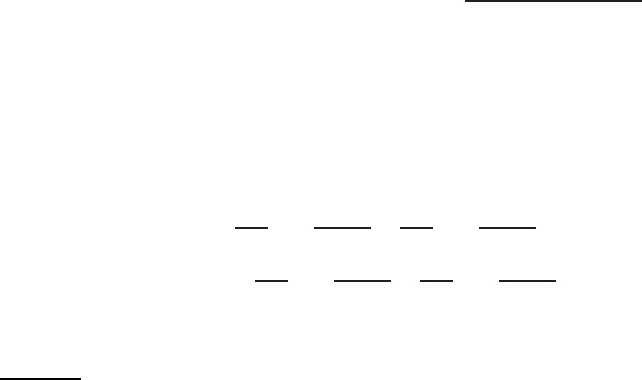
ForMLEs of the probabilities, Equation (
13.16) is equivalent to Equation (13.17):
I(U; C) =
N
11
N
log
2
NN
11
N
1.
N
.1
+
N
01
N
log
2
NN
01
N
0.
N
.1
(13.17)
+
N
10
N
log
2
NN
10
N
1.
N
.0
+
N
00
N
log
2
NN
00
N
0.
N
.0
where the Ns are counts of documents that have the values of e
t
and e
c
that
are indicated by the two subscripts. For example, N
10
is the number of doc-
5. Take care not to confuse expected mutual information with pointwise mutual information,
which is defined as log N
11
/E
11
where N
11
and E
11
are defined as in Equation (13.18). The
two measures have different properties. See Section 13.7.

Online edition (c)2009 Cambridge UP
13.5 Feature selection 273
uments that contain t (e
t
= 1) and are not in c (e
c
= 0). N
1.
= N
10
+ N
11
is
the number of documents that contain t (e
t
= 1) and we count documents
independent of class membership (e
c
∈ {0, 1}). N = N
00
+ N
01
+ N
10
+ N
11
is the total number of documents. An example of one of the MLE estimates
that transform Equation (
13.16) into Equation (13.17) is P(U = 1, C = 1) =
N
11
/N.
✎
Example 13. 3: Consider the class poultry and the term export in Reuters-RCV1.
The counts of the number of documents with the four possible combinations of indi-
cator values are as follows:
e
c
= e
poultry
= 1 e
c
= e
poultry
= 0
e
t
= e
export
= 1 N
11
= 49 N
10
= 27,652
e
t
= e
export
= 0 N
01
= 141 N
00
= 774,106
After plugging these values into Equation (13.17) we get:
I(U; C) =
49
801,948
log
2
801,948 ·49
(49+27,652)(49+141)
+
141
801,948
log
2
801,948 ·141
(141+774,106)(49+141)
+
27,652
801,948
log
2
801,948 ·27,652
(49+27,652)(27,652+774,106)
+
774,106
801,948
log
2
801,948 · 774,106
(141+774,106)(27,652+774,106)
≈ 0.0001105
To select k terms t
1
, . . . , t
k
for a given class, we use the feature selection al-
gorithm in Figure
13.6: We compute the utility measure as A(t, c) = I(U
t
, C
c
)
and select the k terms with the largest values.
Mutual information measures how much information – in the information-
theoretic sense – a term contains about the class. If a term’s distribution is
the same in the class as it is in the collection as a whole, then I(U; C) =
0. MI reaches its maximum value if the term is a perfect indicator for class
membership, that is, if the term is present in a document if and only if the
document is in the class.
Figure
13.7 shows terms with high mutual information scores for the six
classes in Figure 13.1.
6
The selected terms (e.g., london, uk, british for the class
UK) are of obvious utility for making classification decisions for their respec-
tive classes. At the bottom of the list for UK we find terms like peripherals
and tonight (not shown in the figure) that are clearly not helpful in deciding
6. Feature scores were computed on the first 100,000 documents, except for poultry, a rare class,
for which 800,000 documents were used. We have omitted numbers and other special words
from the top ten lists.

Online edition (c)2009 Cambridge UP
274 13 Text classification and Naive Bayes
UK
london 0.1925
uk 0.0755
british 0.0596
stg 0.0555
britain 0.0469
plc 0.0357
england 0.0238
pence 0.0212
pounds 0.0149
english 0.0126
China
china 0.0997
chinese 0.0523
beijing 0.0444
yuan 0.0344
shanghai 0.0292
hong 0.0198
kong 0.0195
xinhua 0.0155
province 0.0117
taiwan 0.0108
poultry
poultry 0.0013
meat 0.0008
chicken 0.0006
agriculture 0.0005
avian 0.0004
broiler 0.0003
veterinary 0.0003
birds 0.0003
inspection 0.0003
pathogenic 0.0003
coffee
coffee 0.0111
bags 0.0042
growers 0.0025
kg 0.0019
colombia 0.0018
brazil 0.0016
export 0.0014
exporters 0.0013
exports 0.0013
crop 0.0012
elections
election 0.0519
elections 0.0342
polls 0.0339
voters 0.0315
party 0.0303
vote 0.0299
poll 0.0225
candidate 0.0202
campaign 0.0202
democratic 0.0198
sports
soccer 0.0681
cup 0.0515
match 0.0441
matches 0.0408
played 0.0388
league 0.0386
beat 0.0301
game 0.0299
games 0.0284
team 0.0264
◮
Figure 13.7 Features with high mutual information scores for six Reuters-RCV1
classes.
whether the document is in the class. As you might expect, keeping the in-
formative terms and eliminating the non-informative ones tends to reduce
noise and improve the classifier’s accuracy.
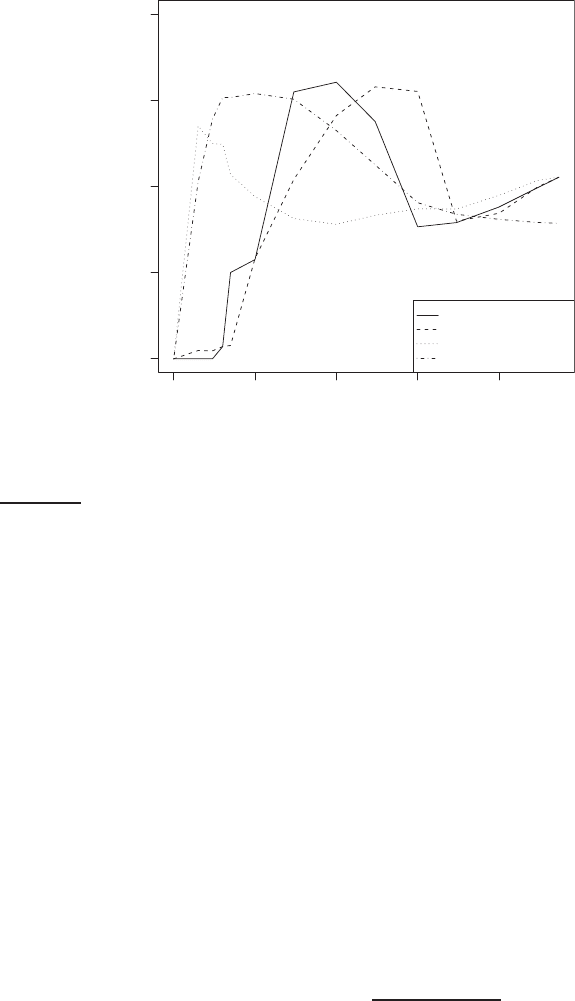
Such an accuracy increase can be observed in Figure
13.8, which shows
F
1
as a function of vocabulary size after feature selection for Reuters-RCV1.
7
Comparing F
1
at 132,776 features (corresponding to selection of all features)
and at 10–100 features, we see that MI feature selection increases F
1
by about
0.1 for the multinomial model and by more than 0.2 for the Bernoulli model.
For the Bernoulli model, F
1
peaks early, at ten features selected. At that point,
the Bernoulli model is better than the multinomial model. When basing a
classification decision on only a few features, it is more robust to consider bi-
nary occurrence only. For the multinomial model (MI feature selection), the
peak occurs later, at 100 features, and its effectiveness recovers somewhat at
7. We trained the classifiers on the first 100,000 documents and computed F
1
on the next 100,000.
The graphs are averages over five classes.
Online edition (c)2009 Cambridge UP
13.5 Feature selection 275
###
#
#
#
#
#
#
#
#
#
#
##
110 100 1000 10000
0.0 0.2 0.4 0.6 0.8
number of features selected
F1 measure
o
o
o
o
o
o
o
o
o
o
o
o
o
oo
x
x
x
x
x
x
x
x
x
x
x
x
x
xx
b
b
b
bb
b
b
b
b
b
b
b
b
bb
#
o
x
b
multinomial, MI
multinomial, chisquare
multinomial, frequency
binomial, MI
◮
Figure 13.8 Effect of feature set size on accuracy for multinomial and Bernoulli
models.
the end when we use all features. The reason is that the multinomial takes
the number of occurrences into account in parameter estimation and clas-
sification and therefore better exploits a larger number of features than the
Bernoulli model. Regardless of the differences between the two methods,
using a carefully selected subset of the features results in better effectiveness
than using all features.
13.5.2 χ
2
Feature selection
Another popular feature selection method is χ
2
. In statistics, the χ
2
test isχ
2
FEATURE SELECTION
applied to test the independence of two events, where two events A and B are
defined to be indep endent if P (AB) = P(A)P(B) or, equivalently, P(A|B) =INDEPENDENCE
P(A) and P(B|A) = P(B). In feature selection, the two events are occurrence
of the term and occurrence of the class. We then rank terms with respect to
the following quantity:
X
2
(D, t, c) =
∑
e
t
∈{0,1}
∑
e
c
∈{0,1}
(N
e
t
e
c
− E
e
t
e
c
)
2
E
e
t
e
c
(13.18)