
Manning Ch. D., Raghavan P., Sch?tze H. Introduction to Information Retrieval - Введение в информационный поиск
Подождите немного. Документ загружается.

Online edition (c)2009 Cambridge UP
426 19 Web search basics
◮
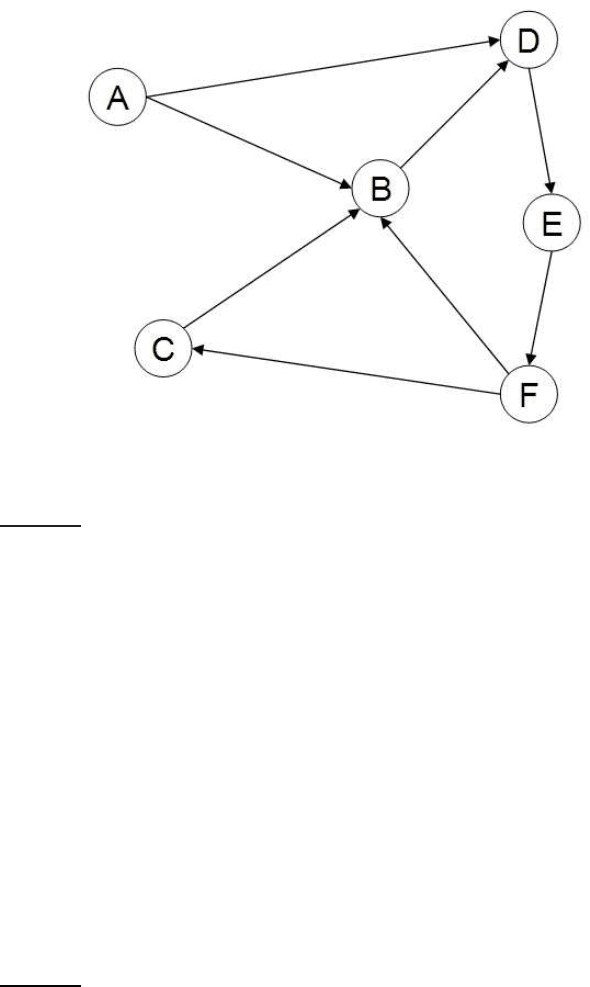
Figure 19.3 A sample small web graph. In this example we have six pages labeled
A-F. Page B has in-degree 3 and out-degree 1. This example graph is not strongly
connected: there is no path from any of pages B-F to page A.
of it. These notions are represented in Figure 19.3.
There is ample evidence that these links are not randomly distributed; for
one thing, the distribution of the number of links into a web page does not
follow the Poisson distribution one would expect if every web page were
to pick the destinations of its links uniformly at random. Rather, this dis-
tribution is widely reported to be a power law, in which the total number ofPOWER LAW
web pages with in-degree i is proportional to 1/i
α
; the value of α typically
reported by studies is 2.1.
1
Furthermore, several studies have suggested that
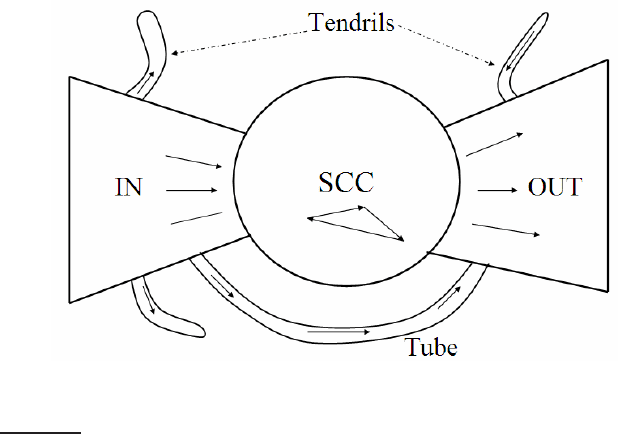
the directed graph connecting web pages has a bowtie shape: there are threeBOWTIE
major categories of web pages that are sometimes referred to as IN, OUT
and SCC. A web surfer can pass from any page in IN to any page in SCC, by
following hyperlinks. Likewise, a surfer can pass from page in SCC to any
page in OUT. Finally, the surfer can surf from any page in SCC to any other
page in SCC. However, it is not possible to pass from a page in SCC to any
page in IN, or from a page in OUT to a page in SCC (or, consequently, IN).
Notably, in several studies IN and OUT are roughly equal in size, whereas
1. Cf. Zipf’s law of the distribution of words in text in Chapter 5 (page 90), which is a power
law with α = 1.
Online edition (c)2009 Cambridge UP
19.2 Web characteristics 427
◮
Figure 19.4 The bowtie structure of the Web. Here we show one tube and three
tendrils.
SCC is somewhat larger; most web pages fall into one of these three sets. The
remaining pages form into tubes that are small sets of pages outside SCC that
lead directly from IN to OUT, and tendrils that either lead nowhere from IN,
or from nowhere to OUT. Figure
19.4 illustrates this structure of the Web.
19.2.2 Spam
Early in the history of web search, it became clear that web search engines
were an important means for connecting advertisers to prospective buyers.
A user searching for maui golf real estate is not merely seeking news or en-
tertainment on the subject of housing on golf courses on the island of Maui,
but instead likely to be seeking to purchase such a property. Sellers of such
property and their agents, therefore, have a strong incentive to create web
pages that rank highly on this query. In a search engine whose scoring was
based on term frequencies, a web page with numerous repetitions of maui golf
real estate would rank highly. This led to the first generation of spam, whichSPAM
(in the context of web search) is the manipulation of web page content for
the purpose of appearing high up in search results for selected keywords.
To avoid irritating users with these repetitions, sophisticated spammers re-
sorted to such tricks as rendering these repeated terms in the same color as
the background. Despite these words being consequently invisible to the hu-
man user, a search engine indexer would parse the invisible words out of
Online edition (c)2009 Cambridge UP
428 19 Web search basics
◮
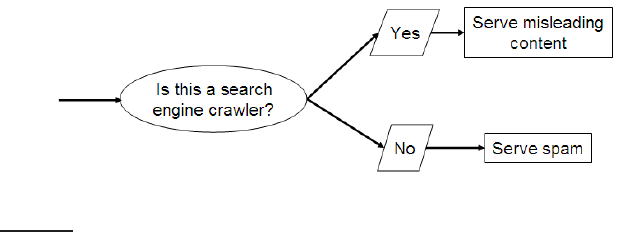
Figure 19.5 Cloaking as used by spammers.
the HTML representation of the web page and index these words as being
present in the page.
At its root, spam stems from the heterogeneity of motives in content cre-
ation on the Web. In particular, many web content creators have commercial
motives and therefore stand to gain from manipulating search engine results.
You might argue that this is no different from a company that uses large fonts
to list its phone numbers in the yellow pages; but this generally costs the
company more and is thus a fairer mechanism. A more apt analogy, perhaps,
is the use of company names beginning with a long string of A’s to be listed
early in a yellow pages category. In fact, the yellow pages’ model of com-
panies paying for larger/darker fonts has been replicated in web search: in
many search engines, it is possible to pay to have one’s web page included
in the search engine’s index – a model known as paid inclusion. DifferentPAID INCLUSION
search engines have different policies on whether to allow paid inclusion,
and whether such a payment has any effect on ranking in search results.
Search engines soon became sophisticated enough in their spam detection
to screen out a large number of repetitions of particular keywords. Spam-
mers responded with a richer set of spam techniques, the best known of
which we now describe. The first of these techniques is cloaking, shown in
Figure
19.5. Here, the spammer’s web server returns different pages depend-
ing on whether the http request comes from a web search engine’s crawler
(the part of the search engine that gathers web pages, to be described in
Chapter
20), or from a human user’s browser. The former causes the web
page to be indexed by the search engine under misleading keywords. When
the user searches for these keywords and elects to view the page, he receives
a web page that has altogether different content than that indexed by the
search engine. Such deception of search indexers is unknown in the tra-
ditional world of information retrieval; it stems from the fact that the rela-
tionship between page publishers and web search engines is not completely
collaborative.
A doorway page contains text and metadata carefully chosen to rank highly
Online edition (c)2009 Cambridge UP
19.3 Advertising as the economic model 429
on selected search keywords. When a browser requests the doorway page, it
is redirected to a page containing content of a more commercial nature. More
complex spamming techniques involve manipulation of the metadata related
to a page including (for reasons we will see in Chapter
21) the links into a
web page. Given that spamming is inherently an economically motivated
activity, there has sprung around it an industry of Search Engine Optimizers,SEARCH ENGINE
OPTIMIZERS
or SEOs to provide consultancy services for clients who seek to have their
web pages rank highly on selected keywords. Web search engines frown on
this business of attempting to decipher and adapt to their proprietary rank-
ing techniques and indeed announce policies on forms of SEO behavior they
do not tolerate (and have been known to shut down search requests from cer-
tain SEOs for violation of these). Inevitably, the parrying between such SEOs
(who gradually infer features of each web search engine’s ranking methods)
and the web search engines (who adapt in response) is an unending struggle;
indeed, the research sub-area of adversarial information retrieval has sprung upADVERSARIAL
INFORMATION
RETRIEVAL
around this battle. To combat spammers who manipulate the text of their
web pages is the exploitation of the link structure of the Web – a technique
known as link analysis. The first web search engine known to apply link anal-
ysis on a large scale (to be detailed in Chapter
21) was Google, although all
web search engines currently make use of it (and correspondingly, spam-
mers now invest considerable effort in subverting it – this is known as linkLINK SPAM
spam).
?
Exercise 19.1
If the number of pages with in-degree i is proportional to 1/i
2.1
, what is the probabil-
ity that a randomly chosen web page has in-degree 1?
Exercise 19.2
If the number of pages with in-degree i is proportional to 1/i
2.1
, what is the average
in-degree of a web page?
Exercise 19.3
If the number of pages with in-degree i is proportional to 1/i
2.1
, then as the largest
in-degree goes to infinity, does the fraction of pages with in-degree i grow, stay the
same, or diminish? How would your answer change for values of the exponent other
than 2.1?
Exercise 19.4
The average in-degree of all nodes in a snapshot of the web graph is 9. What can we
say about the average out-degree of all nodes in this snapshot?
19.3 A d ver tising as the economic model
Early in the history of the Web, companies used graphical banner advertise-
ments on web pages at popular websites (news and entertainment sites such
as MSN, America Online, Yahoo! and CNN). The primary purpose of these
advertisements was branding: to convey to the viewer a positive feeling about
Online edition (c)2009 Cambridge UP
430 19 Web search basics
the brand of the company placing the advertisement. Typically these adver-
tisements are priced on a cost per mil (CPM) basis: the cost to the company ofCPM
having its banner advertisement displayed 1000 times. Some websites struck
contracts with their advertisers in which an advertisement was priced not by
the number of times it is displayed (also known as impressions), but rather
by the number of times it was clicked on by the user. This pricing model is
known as the cost p er click (CPC) model. In such cases, clicking on the adver-CPC
tisement leads the user to a web page set up by the advertiser, where the user
is induced to make a purchase. Here the goal of the advertisement is not so
much brand promotion as to induce a transaction. This distinction between
brand and transaction-oriented advertising was already widely recognized
in the context of conventional media such as broadcast and print. The inter-
activity of the web allowed the CPC billing model – clicks could be metered
and monitored by the website and billed to the advertiser.
The pioneer in this direction was a company named Goto, which changed
its name to Overture prior to eventual acquisition by Yahoo! Goto was not,
in the traditional sense, a search engine; rather, for every query term q it ac-
cepted bids from companies who wanted their web page shown on the query
q. In response to the query q, Goto would return the pages of all advertisers
who bid for q, ordered by their bids. Furthermore, when the user clicked
on one of the returned results, the corresponding advertiser would make a
payment to Goto (in the initial implementation, this payment equaled the
advertiser’s bid for q).
Several aspects of Goto’s model are worth highlighting. First, a user typing
the query q into Goto’s search interface was actively expressing an interest
and intent related to the query q. For instance, a user typing golf clubs is more
likely to be imminently purchasing a set than one who is simply browsing
news on golf. Second, Goto only got compensated when a user actually ex-
pressed interest in an advertisement – as evinced by the user clicking the ad-
vertisement. Taken together, these created a powerful mechanism by which
to connect advertisers to consumers, quickly raising the annual revenues of
Goto/Overture into hundreds of millions of dollars. This style of search en-
gine came to be known variously as sponsored search or search advertising.SPONSORED SEARCH
SEARCH ADVERTISING
Given these two kinds of search engines – the “pure” search engines such
as Google and Altavista, versus the sponsored search engines – the logi-
cal next step was to combine them into a single user experience. Current
search engines follow precisely this model: they provide pure search results
(generally known as algorithmic search results) as the primary response to aALGORITHMIC SEARCH
user’s search, together with sponsored search results displayed separately
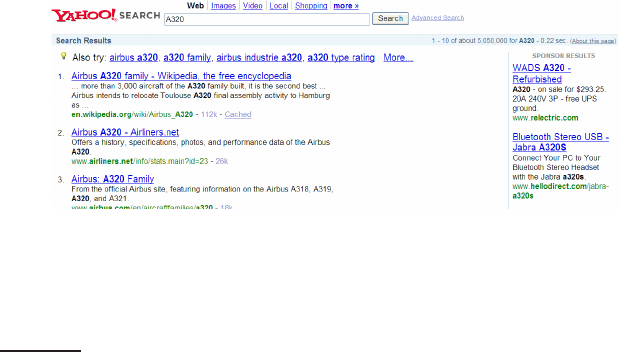
and distinctively to the right of the algorithmic results. This is shown in Fig-
ure
19.6. Retrieving sponsored search results and ranking them in response
to a query has now become considerably more sophisticated than the sim-
ple Goto scheme; the process entails a blending of ideas from information
Online edition (c)2009 Cambridge UP
19.3 Advertising as the economic model 431
◮
Figure 19.6 Search advertising triggered by query keywords. Here the query A320
returns algorithmic search results about the Airbus aircraft, together with advertise-
ments for various non-aircraft goods numbered A320, that advertisers seek to market
to those querying on this query. The lack of advertisements for the aircraft reflects the
fact that few marketers attempt to sell A320 aircraft on the web.
retrieval and microeconomics, and is beyond the scope of this book. For
advertisers, understanding how search engines do this ranking and how to
allocate marketing campaign budgets to different keywords and to different
sponsored search engines has become a profession known as search engineSEARCH ENGINE
MARKETING
marketing (SEM).
The inherently economic motives underlying sponsored search give rise
to attempts by some participants to subvert the system to their advantage.
This can take many forms, one of which is known as click spam. There isCLICK SPAM
currently no universally accepted definition of click spam. It refers (as the
name suggests) to clicks on sponsored search results that are not from bona
fide search users. For instance, a devious advertiser may attempt to exhaust
the advertising budget of a competitor by clicking repeatedly (through the
use of a robotic click generator) on that competitor’s sponsored search ad-
vertisements. Search engines face the challenge of discerning which of the
clicks they observe are part of a pattern of click spam, to avoid charging their
advertiser clients for such clicks.
?
Exercise 19.5
The Goto method ranked advertisements matching a query by b id: the highest-bidding
advertiser got the top position, the second-highest the next, and so on. What can go
wrong with this when the highest-bidding advertiser places an advertisement that is
irrelevant to the query? Why might an advertiser with an irrelevant advertisement
bid high in this manner?
Exercise 19.6
Suppose that, in addition to bids, we had for each advertiser their click-through rate:
the ratio of the historical number of times users click on their advertisement to the
number of times the advertisement was shown. Suggest a modification of the Goto
scheme that exploits this data to avoid the problem in Exercise
19.5 above.
Online edition (c)2009 Cambridge UP
432 19 Web search basics
19.4 The sea rch user experience
It is crucial that we understand the users of web search as well. This is
again a significant change from traditional information retrieval, where users
were typically professionals with at least some training in the art of phrasing
queries over a well-authored collection whose style and structure they un-
derstood well. In contrast, web search users tend to not know (or care) about
the heterogeneity of web content, the syntax of query languages and the art
of phrasing queries; indeed, a mainstream tool (as web search has come to
become) should not place such onerous demands on billions of people. A
range of studies has concluded that the average number of keywords in a
web search is somewhere between 2 and 3. Syntax operators (Boolean con-
nectives, wildcards, etc.) are seldom used, again a result of the composition
of the audience – “normal” people, not information scientists.
It is clear that the more user traffic a web search engine can attract, the
more revenue it stands to earn from sponsored search. How do search en-
gines differentiate themselves and grow their traffic? Here Google identified
two principles that helped it grow at the expense of its competitors: (1) a
focus on relevance, specifically precision rather than recall in the first few re-
sults; (2) a user experience that is lightweight, meaning that both the search
query page and the search results page are uncluttered and almost entirely
textual, with very few graphical elements. The effect of the first was simply
to save users time in locating the information they sought. The effect of the
second is to provide a user experience that is extremely responsive, or at any
rate not bottlenecked by the time to load the search query or results page.
19.4.1 User query needs
There appear to be three broad categories into which common web search
queries can be grouped: (i) informational, (ii) navigational and (iii) transac-
tional. We now explain these categories; it should be clear that some queries
will fall in more than one of these categories, while others will fall outside
them.
Informational queries seek general information on a broad topic, such asINFORMATIONAL
QUERIES
leukemia or Provence. There is typically not a single web page that con-
tains all the information sought; indeed, users with informational queries
typically try to assimilate information from multiple web pages.
Navigational queries seek the website or home page of a single entity that theNAVIGATIONAL
QUERIES
user has in mind, say Lufthansa airlines. In such cases, the user’s expectation
is that the very first search result should be the home page of Lufthansa.
The user is not interested in a plethora of documents containing the term
Lufthansa; for such a user, the best measure of user satisfaction is precision at
1.
Online edition (c)2009 Cambridge UP
19.5 Index size and estimation 433
A transactional query is one that is a prelude to the user performing a trans-TRANSACTIONAL
QUERY
action on the Web – such as purchasing a product, downloading a file or
making a reservation. In such cases, the search engine should return results
listing services that provide form interfaces for such transactions.
Discerning which of these categories a query falls into can be challeng-
ing. The category not only governs the algorithmic search results, but the
suitability of the query for sponsored search results (since the query may re-
veal an intent to purchase). For navigational queries, some have argued that
the search engine should return only a single result or even the target web
page directly. Nevertheless, web search engines have historically engaged in
a battle of bragging rights over which one indexes more web pages. Does
the user really care? Perhaps not, but the media does highlight estimates
(often statistically indefensible) of the sizes of various search engines. Users
are influenced by these reports and thus, search engines do have to pay at-
tention to how their index sizes compare to competitors’. For informational
(and to a lesser extent, transactional) queries, the user does care about the
comprehensiveness of the search engine.
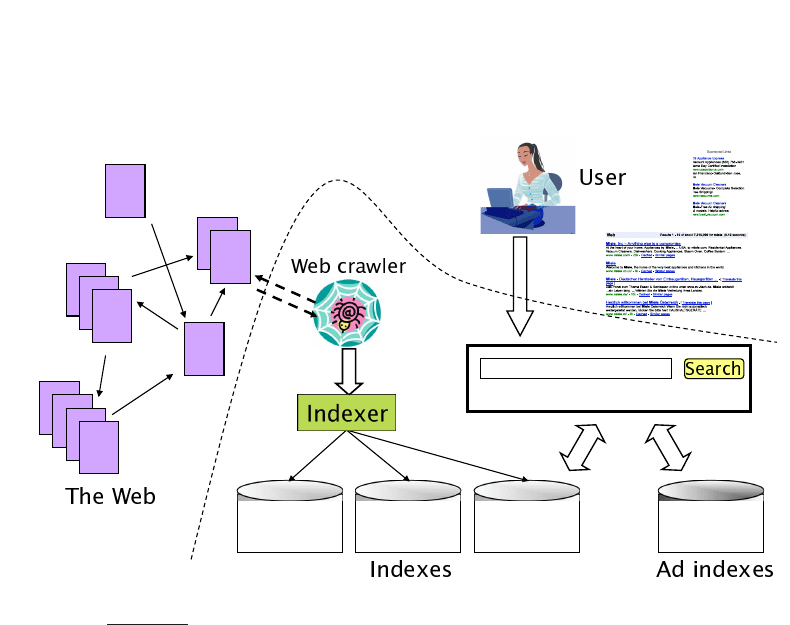
Figure
19.7 shows a composite picture of a web search engine including
the crawler, as well as both the web page and advertisement indexes. The
portion of the figure under the curved dashed line is internal to the search
engine.
19.5 Ind ex size and estimation
To a first approximation, comprehensiveness grows with index size, although
it does matter which specific pages a search engine indexes – some pages are
more informative than others. It is also difficult to reason about the fraction
of the Web indexed by a search engine, because there is an infinite number of
dynamic web pages; for instance, http://www.yahoo.com/any_string
returns a valid HTML page rather than an error, politely informing the user
that there is no such page at Yahoo! Such a "soft 404 error" is only one exam-
ple of many ways in which web servers can generate an infinite number of
valid web pages. Indeed, some of these are malicious spider traps devised
to cause a search engine’s crawler (the component that systematically gath-
ers web pages for the search engine’s index, described in Chapter
20) to stay
within a spammer’s website and index many pages from that site.
We could ask the following better-defined question: given two search en-
gines, what are the relative sizes of their indexes? Even this question turns
out to be imprecise, because:
1. In response to queries a search engine can return web pages whose con-
tents it has not (fully or even partially) indexed. For one thing, search
engines generally index only the first few thousand words in a web page.
Online edition (c)2009 Cambridge UP
434 19 Web search basics
◮
Figure 19.7 The various components of a web search engine.
In some cases, a search engine is aware of a page p that is linked to by pages
it has indexed, but has not indexed p itself. As we will see in Chapter
21,
it is still possible to meaningfully return p in search results.
2. Search engines generally organize their indexes in various tiers and parti-
tions, not all of which are examined on every search (recall tiered indexes
from Section
7.2.1). For instance, a web page deep inside a website may be
indexed but not retrieved on general web searches; it is however retrieved
as a result on a search that a user has explicitly restricted to that website
(such site-specific search is offered by most web search engines).
Thus, search engine indexes include multiple classes of indexed pages, so
that there is no single measure of index size. These issues notwithstanding,
a number of techniques have been devised for crude estimates of the ratio of
the index sizes of two search engines, E
1
and E
2
. The basic hypothesis under-
lying these techniques is that each search engine indexes a fraction of the Web
chosen independently and uniformly at random. This involves some ques-
tionable assumptions: first, that there is a finite size for the Web from which
each search engine chooses a subset, and second, that each engine chooses
an independent, uniformly chosen subset. As will be clear from the discus-
sion of crawling in Chapter 20, this is far from true. However, if we begin

Online edition (c)2009 Cambridge UP
19.5 Index size and estimation 435
with these assumptions, then we can invoke a classical estimation technique
known as the capture-recapture method.CAPTURE-RECAPTURE
METHOD
Suppose that we could pick a random page from the index of E
1
and test
whether it is in E
2
’s index and symmetrically, test whether a random page
from E
2
is in E
1
. These experiments give us fractions x and y such that our
estimate is that a fraction x of the pages in E
1
are in E
2
, while a fraction y of
the pages in E
2
are in E
1
. Then, letting |E
i
| denote the size of the index of
search engine E
i
, we have
x|E
1
| ≈ y|E
2
|,
from which we have the form we will use
|E
1
|
|E
2
|
≈
y
x
.
(19.1)
If our assumption about E
1
and E
2
being independent and uniform random
subsets of the Web were true, and our sampling process unbiased, then Equa-
tion (
19.1) should give us an unbiased estimator for |E
1
|/|E
2
|. We distinguish
between two scenarios here. Either the measurement is performed by some-
one with access to the index of one of the search engines (say an employee of
E
1
), or the measurement is performed by an independent party with no ac-
cess to the innards of either search engine. In the former case, we can simply
pick a random document from one index. The latter case is more challeng-
ing; by picking a random page from one search engine from outside the search
engine, then verify whether the random page is present in the other search
engine.
To implement the sampling phase, we might generate a random page from
the entire (idealized, finite) Web and test it for presence in each search engine.
Unfortunately, picking a web page uniformly at random is a difficult prob-
lem. We briefly outline several attempts to achieve such a sample, pointing
out the biases inherent to each; following this we describe in some detail one
technique that much research has built on.
1. Random searches: Begin with a search log of web searches; send a random
search from this log to E
1
and a random page from the results. Since such
logs are not widely available outside a search engine, one implementation
is to trap all search queries going out of a work group (say scientists in a
research center) that agrees to have all its searches logged. This approach
has a number of issues, including the bias from the types of searches made
by the work group. Further, a random document from the results of such
a random search to E
1
is not the same as a random document from E
1
.
2. Random IP addresses: A second approach is to generate random IP ad-
dresses and send a request to a web server residing at the random ad-
dress, collecting all pages at that server. The biases here include the fact