
Manning Ch. D., Raghavan P., Sch?tze H. Introduction to Information Retrieval - Введение в информационный поиск
Подождите немного. Документ загружается.

Online edition (c)2009 Cambridge UP
416 18 Matrix decompositions and latent semanti c indexing
−0.5−1.0−1.5
0.5
1.0
−0.5
−1.0
dim 2
dim 1
×
d
1
×
d
2
×
d
3
×
d
4
×
d
5
×
d
6
◮
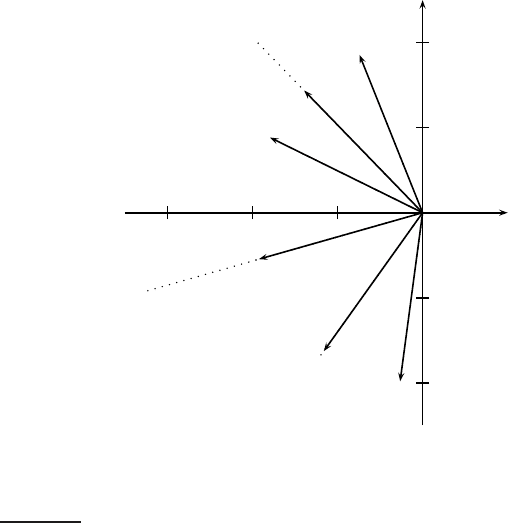
Figure 18.3 The documents of Example 18.4 reduced to two dimensions in (V
′
)
T
.
Dumais (1993) and Dumais (1995) conducted experiments with LSI on
TREC documents and tasks, using the commonly-used Lanczos algorithm
to compute the SVD. At the time of their work in the early 1990’s, the LSI
computation on tens of thousands of documents took approximately a day
on one machine. On these experiments, they achieved precision at or above
that of the median TREC participant. On about 20% of TREC topics their
system was the top scorer, and reportedly slightly better on average than
standard vector spaces for LSI at about 350 dimensions. Here are some con-
clusions on LSI first suggested by their work, and subsequently verified by
many other experiments.
• The computational cost of the SVD is significant; at the time of this writ-
ing, we know of no successful experiment with over one million docu-
ments. This has been the biggest obstacle to the widespread adoption to
LSI. One approach to this obstacle is to build the LSI representation on a
randomly sampled subset of the documents in the collection, following
which the remaining documents are “folded in” as detailed with Equa-
tion (
18.21).
Online edition (c)2009 Cambridge UP
18.5 References and further reading 417
•
As we reduce k, recall tends to increase, as expected.
• Most surprisingly, a value of k in the low hundreds can actually increase
precision on some query benchmarks. This appears to suggest that for a
suitable value of k, LSI addresses some of the challenges of synonymy.
• LSI works best in applications where there is little overlap between queries
and documents.
The experiments also documented some modes where LSI failed to match
the effectiveness of more traditional indexes and score computations. Most
notably (and perhaps obviously), LSI shares two basic drawbacks of vector
space retrieval: there is no good way of expressing negations (find docu-
ments that contain germanbut not shepherd), and no way of enforcing Boolean
conditions.
LSI can be viewed as soft clustering by interpreting each dimension of theSOFT CLUSTERING
reduced space as a cluster and the value that a document has on that dimen-
sion as its fractional membership in that cluster.
18.5 Ref erences and further reading
Strang (1986) provides an excellent introductory overview of matrix decom-
positions including the singular value decomposition. Theorem 18.4 is due
to Eckart and Young (1936). The connection between information retrieval
and low-rank approximations of the term-document matrix was introduced
in Deerwester et al. (1990), with a subsequent survey of results in Berry
et al. (1995). Dumais (1993) and Dumais (1995) describe experiments on
TREC benchmarks giving evidence that at least on some benchmarks, LSI
can produce better precision and recall than standard vector-space retrieval.
http://www.cs.utk.edu/˜berry/lsi++/and http://lsi.argreenhouse.com/lsi/LSIpapers.html
offer comprehensive pointers to the literature and software of LSI. Schütze
and Silverstein (1997) evaluate LSI and truncated representations of cen-
troids for efficient K-means clustering (Section
16.4). Bast and Majumdar
(2005) detail the role of the reduced dimension k in LSI and how different
pairs of terms get coalesced together at differing values of k. Applications of
LSI to cross-language information retrieval (where documents in two or moreCROSS-LANGUAGE
INFORMATION
RETRIEVAL
different languages are indexed, and a query posed in one language is ex-
pected to retrieve documents in other languages) are developed in Berry and
Young (1995) and Littman et al. (1998). LSI (referred to as LSA in more gen-
eral settings) has been applied to host of other problems in computer science
ranging from memory modeling to computer vision.
Hofmann (1999a;b) provides an initial probabilistic extension of the basic
latent semantic indexing technique. A more satisfactory formal basis for a

Online edition (c)2009 Cambridge UP
418 18 Matrix decompositions and latent semanti c indexing
DocID Document text
1 hello
2 open house
3 mi casa
4 hola Profesor
5 hola y bienvenido
6 hello and welcome
◮
Figure 18.4 Documents for Exercise 18.11.
Spanish English
mi my
casa house
hola hello
profesor professor
y and
bienvenido welcome
◮
Figure 18.5 Glossary for Exercise 18.11.
probabilistic latent variable model for dimensionality reduction is the Latent
Dirichlet Allocation (LDA) model (Blei et al. 2003), which is generative and
assigns probabilities to documents outside of the training set. This model is
extended to a hierarchical clustering by Rosen-Zvi et al. (2004). Wei and Croft
(2006) present the first large scale evaluation of LDA, finding it to signifi-
cantly outperform the query likelihood model of Section
12.2 (page 242), but
to not perform quite as well as the relevance model mentioned in Section
12.4
(page 250) – but the latter does additional per-query processing unlike LDA.
Teh et al. (2006) generalize further by presenting Hierarchical Dirichlet Pro-
cesses, a probabilistic model which allows a group (for us, a document) to
be drawn from an infinite mixture of latent topics, while still allowing these
topics to be shared across documents.
?
Exercise 18.11
Assume you have a set of documents each of which is in either English or in Spanish.
The collection is given in Figure
18.4.
Figure
18.5 gives a glossary relating the Spanish and English words above for your
own information. This glossary is NOT available to the retrieval system:
1. Construct the appropriate term-document matrix C to use for a collection con-
sisting of these documents. For simplicity, use raw term frequencies rather than
normalized tf-idf weights. Make sure to clearly label the dimensions of your ma-
trix.
Online edition (c)2009 Cambridge UP
18.5 References and further reading 419
2.
Write down the matrices U
2
, Σ
′
2
and V
2
and from these derive the rank 2 approxi-
mation C
2
.
3. State succinctly what the (i, j) entry in the matrix C
T
C represents.
4. State succinctly what the (i, j) entry in the matrix C
T
2
C
2
represents, and why it
differs from that in C
T
C.
Online edition (c)2009 Cambridge UP
Online edition (c)2009 Cambridge UP
DRAFT! © April 1, 2009 Cambridge University Press. Feedback welcome. 421
19 Web search bas ics
In this and the following two chapters, we consider web search engines. Sec-
tions
19.1–19.4 provide some background and history to help the reader ap-
preciate the forces that conspire to make the Web chaotic, fast-changing and
(from the standpoint of information retrieval) very different from the “tradi-
tional” collections studied thus far in this book. Sections
19.5–19.6 deal with
estimating the number of documents indexed by web search engines, and the
elimination of duplicate documents in web indexes, respectively. These two
latter sections serve as background material for the following two chapters.
19.1 Background and history
The Web is unprecedented in many ways: unprecedented in scale, unprece-
dented in the almost-complete lack of coordination in its creation, and un-
precedented in the diversity of backgrounds and motives of its participants.
Each of these contributes to making web search different – and generally far
harder – than searching “traditional” documents.
The invention of hypertext, envisioned by Vannevar Bush in the 1940’s and
first realized in working systems in the 1970’s, significantly precedes the for-
mation of the World Wide Web (which we will simply refer to as the Web), in
the 1990’s. Web usage has shown tremendous growth to the point where it
now claims a good fraction of humanity as participants, by relying on a sim-
ple, open client-server design: (1) the server communicates with the client
via a protocol (the http or hypertext transfer protocol) that is lightweight andHTTP
simple, asynchronously carrying a variety of payloads (text, images and –
over time – richer media such as audio and video files) encoded in a sim-
ple markup language called HTML (for hypertext markup language); (2) theHTML
client – generally a browser, an application within a graphical user environ-
ment – can ignore what it does not understand. Each of these seemingly
innocuous features has contributed enormously to the growth of the Web, so
it is worthwhile to examine them further.
Online edition (c)2009 Cambridge UP
422 19 Web search basics
The basic operation is as follows: a client (such as a browser) sends an http
request to a web server. The browser specifies a URL (for Universal Resource Lo-URL
cator) such as http://www.stanford.edu/home/atoz/contact.html.
In this example URL, the string http refers to the protocol to be used for
transmitting the data. The string www.stanford.edu is known as the d o -
main and specifies the root of a hierarchy of web pages (typically mirroring a
filesystem hierarchy underlying the web server). In this example, /home/atoz/contact.html
is a path in this hierarchy with a file contact.html that contains the infor-
mation to be returned by the web server at www.stanford.edu in response
to this request. The HTML-encoded file contact.html holds the hyper-
links and the content (in this instance, contact information for Stanford Uni-
versity), as well as formatting rules for rendering this content in a browser.
Such an http request thus allows us to fetch the content of a page, some-
thing that will prove to be useful to us for crawling and indexing documents
(Chapter
20).
The designers of the first browsers made it easy to view the HTML markup
tags on the content of a URL. This simple convenience allowed new users to
create their own HTML content without extensive training or experience;
rather, they learned from example content that they liked. As they did so, a
second feature of browsers supported the rapid proliferation of web content
creation and usage: browsers ignored what they did not understand. This
did not, as one might fear, lead to the creation of numerous incompatible
dialects of HTML. What it did promote was amateur content creators who
could freely experiment with and learn from their newly created web pages
without fear that a simple syntax error would “bring the system down.” Pub-
lishing on the Web became a mass activity that was not limited to a few
trained programmers, but rather open to tens and eventually hundreds of
millions of individuals. For most users and for most information needs, the
Web quickly became the best way to supply and consume information on
everything from rare ailments to subway schedules.
The mass publishing of information on the Web is essentially useless un-
less this wealth of information can be discovered and consumed by other
users. Early attempts at making web information “discoverable” fell into two
broad categories: (1) full-text index search engines such as Altavista, Excite
and Infoseek and (2) taxonomies populated with web pages in categories,
such as Yahoo! The former presented the user with a keyword search in-
terface supported by inverted indexes and ranking mechanisms building on
those introduced in earlier chapters. The latter allowed the user to browse
through a hierarchical tree of category labels. While this is at first blush a
convenient and intuitive metaphor for finding web pages, it has a number of
drawbacks: first, accurately classifying web pages into taxonomy tree nodes
is for the most part a manual editorial process, which is difficult to scale
with the size of the Web. Arguably, we only need to have “high-quality”
Online edition (c)2009 Cambridge UP
19.2 Web characteristics 423
web pages in the taxonomy, with only the best web pages for each category.
However, just discovering these and classifying them accurately and consis-
tently into the taxonomy entails significant human effort. Furthermore, in
order for a user to effectively discover web pages classified into the nodes of
the taxonomy tree, the user’s idea of what sub-tree(s) to seek for a particu-
lar topic should match that of the editors performing the classification. This
quickly becomes challenging as the size of the taxonomy grows; the Yahoo!
taxonomy tree surpassed 1000 distinct nodes fairly early on. Given these
challenges, the popularity of taxonomies declined over time, even though
variants (such as About.com and the Open Directory Project) sprang up with
subject-matter experts collecting and annotating web pages for each cate-
gory.
The first generation of web search engines transported classical search
techniques such as those in the preceding chapters to the web domain, focus-
ing on the challenge of scale. The earliest web search engines had to contend
with indexes containing tens of millions of documents, which was a few or-
ders of magnitude larger than any prior information retrieval system in the
public domain. Indexing, query serving and ranking at this scale required
the harnessing together of tens of machines to create highly available sys-
tems, again at scales not witnessed hitherto in a consumer-facing search ap-
plication. The first generation of web search engines was largely successful
at solving these challenges while continually indexing a significant fraction
of the Web, all the while serving queries with sub-second response times.
However, the quality and relevance of web search results left much to be
desired owing to the idiosyncrasies of content creation on the Web that we
discuss in Section
19.2. This necessitated the invention of new ranking and
spam-fighting techniques in order to ensure the quality of the search results.
While classical information retrieval techniques (such as those covered ear-
lier in this book) continue to be necessary for web search, they are not by
any means sufficient. A key aspect (developed further in Chapter
21) is that
whereas classical techniques measure the relevance of a document to a query,
there remains a need to gauge the aut horitativeness of a document based on
cues such as which website hosts it.
19.2 Web characteristics
The essential feature that led to the explosive growth of the web – decentral-
ized content publishing with essentially no central control of authorship –
turned out to be the biggest challenge for web search engines in their quest to
index and retrieve this content. Web page authors created content in dozens
of (natural) languages and thousands of dialects, thus demanding many dif-
ferent forms of stemming and other linguistic operations. Because publish-
Online edition (c)2009 Cambridge UP
424 19 Web search basics
ing was now open to tens of millions, web pages exhibited heterogeneity at a
daunting scale, in many crucial aspects. First, content-creation was no longer
the privy of editorially-trained writers; while this represented a tremendous
democratization of content creation, it also resulted in a tremendous varia-
tion in grammar and style (and in many cases, no recognizable grammar or
style). Indeed, web publishing in a sense unleashed the best and worst of
desktop publishing on a planetary scale, so that pages quickly became rid-
dled with wild variations in colors, fonts and structure. Some web pages,
including the professionally created home pages of some large corporations,
consisted entirely of images (which, when clicked, led to richer textual con-
tent) – and therefore, no indexable text.
What about the substance of the text in web pages? The democratization
of content creation on the web meant a new level of granularity in opinion on
virtually any subject. This meant that the web contained truth, lies, contra-
dictions and suppositions on a grand scale. This gives rise to the question:
which web pages does one trust? In a simplistic approach, one might argue
that some publishers are trustworthy and others not – begging the question
of how a search engine is to assign such a measure of trust to each website
or web page. In Chapter
21 we will examine approaches to understanding
this question. More subtly, there may be no universal, user-independent no-
tion of trust; a web page whose contents are trustworthy to one user may
not be so to another. In traditional (non-web) publishing this is not an issue:
users self-select sources they find trustworthy. Thus one reader may find
the reporting of The New York Times to be reliable, while another may prefer
The Wall Street Journal. But when a search engine is the only viable means
for a user to become aware of (let alone select) most content, this challenge
becomes significant.
While the question “how big is the Web?” has no easy answer (see Sec-
tion 19.5), the question “how many web pages are in a search engine’s index”
is more precise, although, even this question has issues. By the end of 1995,
Altavista reported that it had crawled and indexed approximately 30 million
static web pages. Static web pages are those whose content does not vary fromSTATIC WEB PAGES
one request for that page to the next. For this purpose, a professor who man-
ually updates his home page every week is considered to have a static web
page, but an airport’s flight status page is considered to be dynamic. Dy-
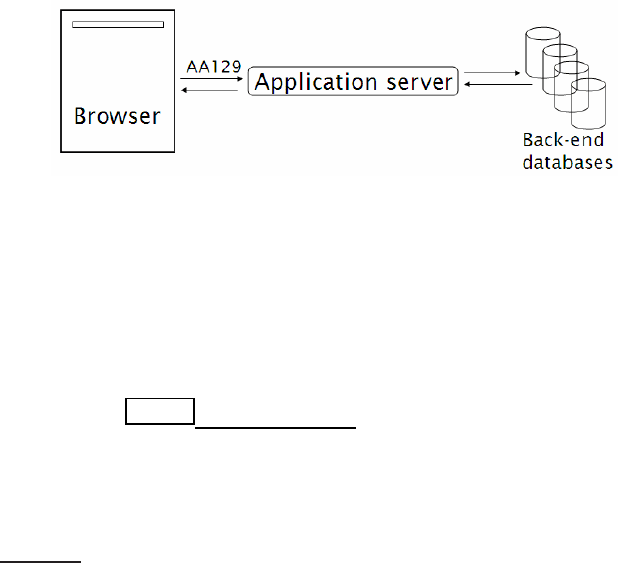
namic pages are typically mechanically generated by an application server
in response to a query to a database, as show in Figure
19.1. One sign of
such a page is that the URL has the character "?" in it. Since the number
of static web pages was believed to be doubling every few months in 1995,
early web search engines such as Altavista had to constantly add hardware
and bandwidth for crawling and indexing web pages.
Online edition (c)2009 Cambridge UP
19.2 Web characteristics 425
◮
Figure 19.1 A dynamically generated web page. The browser sends a request for
flight information on flight AA129 to the web application, that fetches the informa-
tion from back-end databases then creates a dynamic web page that it returns to the
browser.
&%
'$
&%
'$
-
anchor
◮
Figure 19.2 Two nodes of the web graph joined by a link.
19.2.1 T he web graph
We can view the static Web consisting of static HTML pages together with
the hyperlinks between them as a directed graph in which each web page is
a node and each hyperlink a directed edge.
Figure
19.2 shows two nodes A and B from the web graph, each corre-
sponding to a web page, with a hyperlink from A to B. We refer to the set of
all such nodes and directed edges as the web graph. Figure 19.2 also shows
that (as is the case with most links on web pages) there is some text surround-
ing the origin of the hyperlink on page A. This text is generally encapsulated
in the href attribute of the <a> (for anchor) tag that encodes the hyperlink
in the HTML code of page A, and is referred to as a nchor text. As one mightANCHOR TEXT
suspect, this directed graph is not strongly connected: there are pairs of pages
such that one cannot proceed from one page of the pair to the other by follow-
ing hyperlinks. We refer to the hyperlinks into a page as in-links and thoseIN-LINKS
out of a page as out-links. The number of in-links to a page (also known asOUT-LINKS
its in-degree) has averaged from roughly 8 to 15, in a range of studies. We
similarly define the out-degree of a web page to be the number of links out