
Marder M.P. Condensed Matter Physics
Подождите немного. Документ загружается.

xi
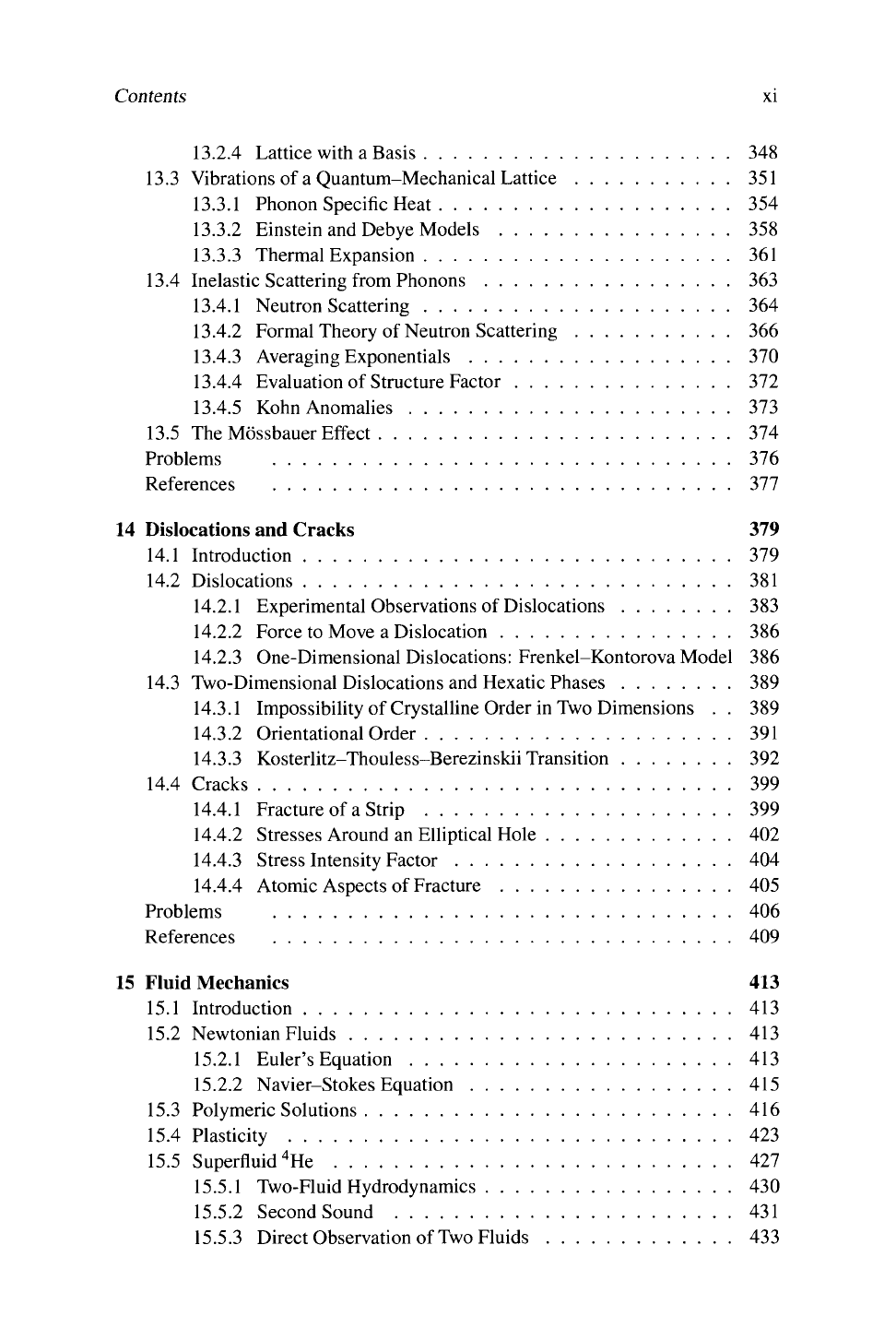
13.2.4 Lattice with a Basis 348
13.3 Vibrations of a Quantum-Mechanical Lattice 351
13.3.1 Phonon Specific Heat 354
13.3.2 Einstein and Debye Models 358
13.3.3 Thermal Expansion 361
13.4 Inelastic Scattering from Phonons 363
13.4.1 Neutron Scattering 364
13.4.2 Formal Theory of Neutron Scattering 366
13.4.3 Averaging Exponentials 370
13.4.4 Evaluation of Structure Factor 372
13.4.5 Kohn Anomalies 373
13.5 The Mössbauer Effect 374
Problems 376
References 377
14 Dislocations and Cracks 379
14.1 Introduction 379
14.2 Dislocations 381
14.2.1 Experimental Observations of Dislocations 383
14.2.2 Force to Move a Dislocation 386
14.2.3 One-Dimensional Dislocations: Frenkel-Kontorova Model 386
14.3 Two-Dimensional Dislocations and Hexatic Phases 389
14.3.1 Impossibility of Crystalline Order in Two Dimensions . . 389
14.3.2 Orientational Order 391
14.3.3 Kosterlitz-Thouless-Berezinskii Transition 392
14.4 Cracks 399
14.4.1 Fracture of a Strip 399
14.4.2 Stresses Around an Elliptical Hole 402
14.4.3 Stress Intensity Factor 404
14.4.4 Atomic Aspects of Fracture 405
Problems 406
References 409
15 Fluid Mechanics 413
15.1 Introduction 413
15.2 Newtonian Fluids 413
15.2.1 Euler's Equation 413
15.2.2 Navier-Stokes Equation 415
15.3 Polymeric Solutions 416
15.4 Plasticity 423
15.5 Superfluida 427
15.5.1 Two-Fluid Hydrodynamics 430
15.5.2 Second Sound 431
15.5.3 Direct Observation of Two Fluids 433
Xll
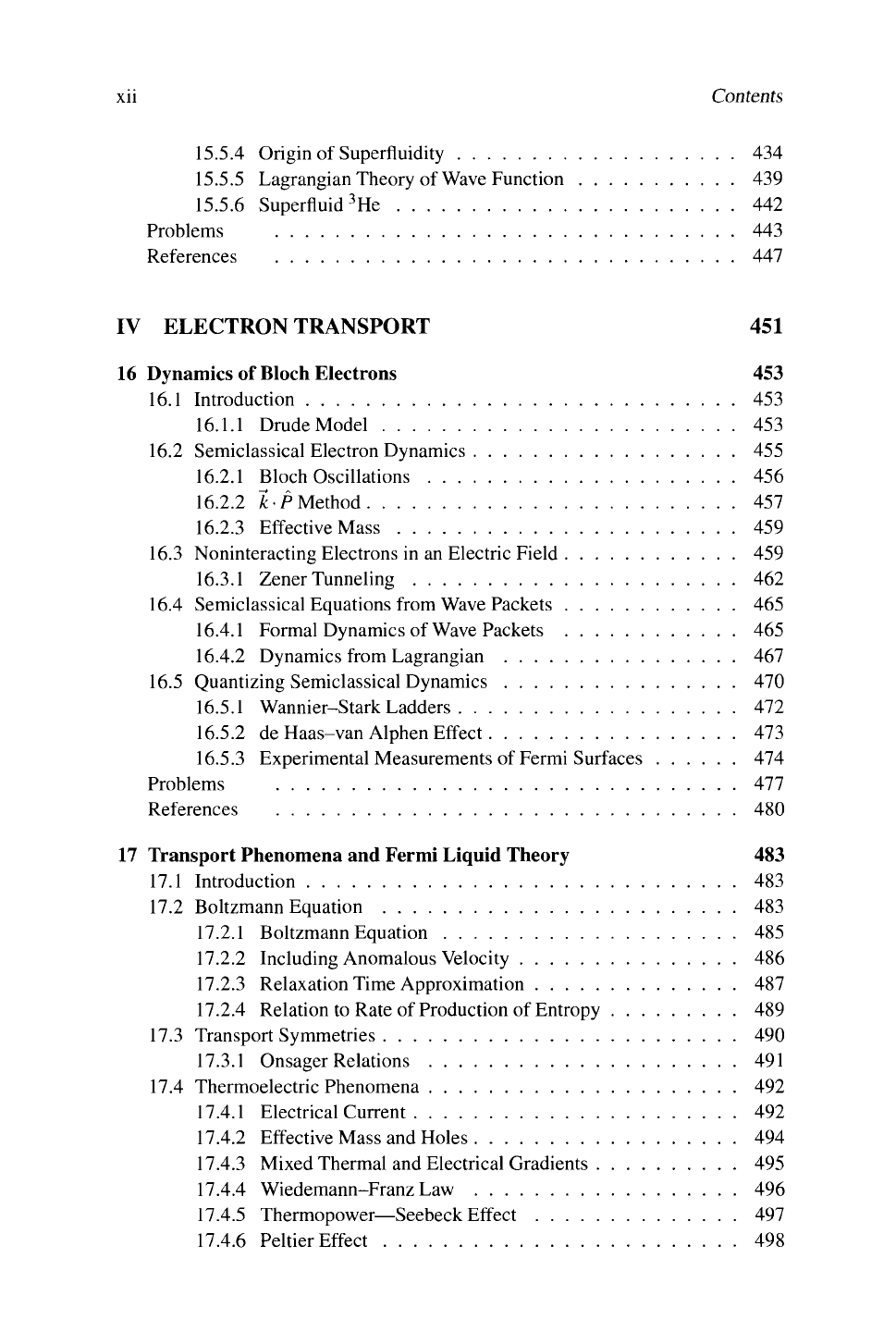
Contents
15.5.4 Origin of Superfluidity 434
15.5.5 Lagrangian Theory of Wave Function 439
15.5.6 Superfluid
3
He 442
Problems 443
References 447
IV ELECTRON TRANSPORT 451
16 Dynamics of Bloch Electrons 453
16.1 Introduction 453
16.1.1 Drude Model 453
16.2 Semiclassical Electron Dynamics 455
16.2.1 Bloch Oscillations 456
16.2.2 k-P Method 457
16.2.3 Effective Mass 459
16.3 Noninteracting Electrons in an Electric Field 459
16.3.1 Zener Tunneling 462
16.4 Semiclassical Equations from Wave Packets 465
16.4.1 Formal Dynamics of Wave Packets 465
16.4.2 Dynamics from Lagrangian 467
16.5 Quantizing Semiclassical Dynamics 470
16.5.1 Wannier-Stark Ladders 472
16.5.2 de Haas-van Alphen Effect 473
16.5.3 Experimental Measurements of Fermi Surfaces 474
Problems 477
References 480
17 Transport Phenomena and Fermi Liquid Theory 483
17.1 Introduction 483
17.2 Boltzmann Equation 483
17.2.1 Boltzmann Equation 485
17.2.2 Including Anomalous Velocity 486
17.2.3 Relaxation Time Approximation 487
17.2.4 Relation to Rate of Production of Entropy 489
17.3 Transport Symmetries 490
17.3.1 Onsager Relations 491
17.4 Thermoelectric Phenomena 492
17.4.1 Electrical Current 492
17.4.2 Effective Mass and Holes 494
17.4.3 Mixed Thermal and Electrical Gradients 495
17.4.4 Wiedemann-Franz Law 496
17.4.5 Thermopower—Seebeck Effect 497
17.4.6 Peltier Effect 498
Contents xiii
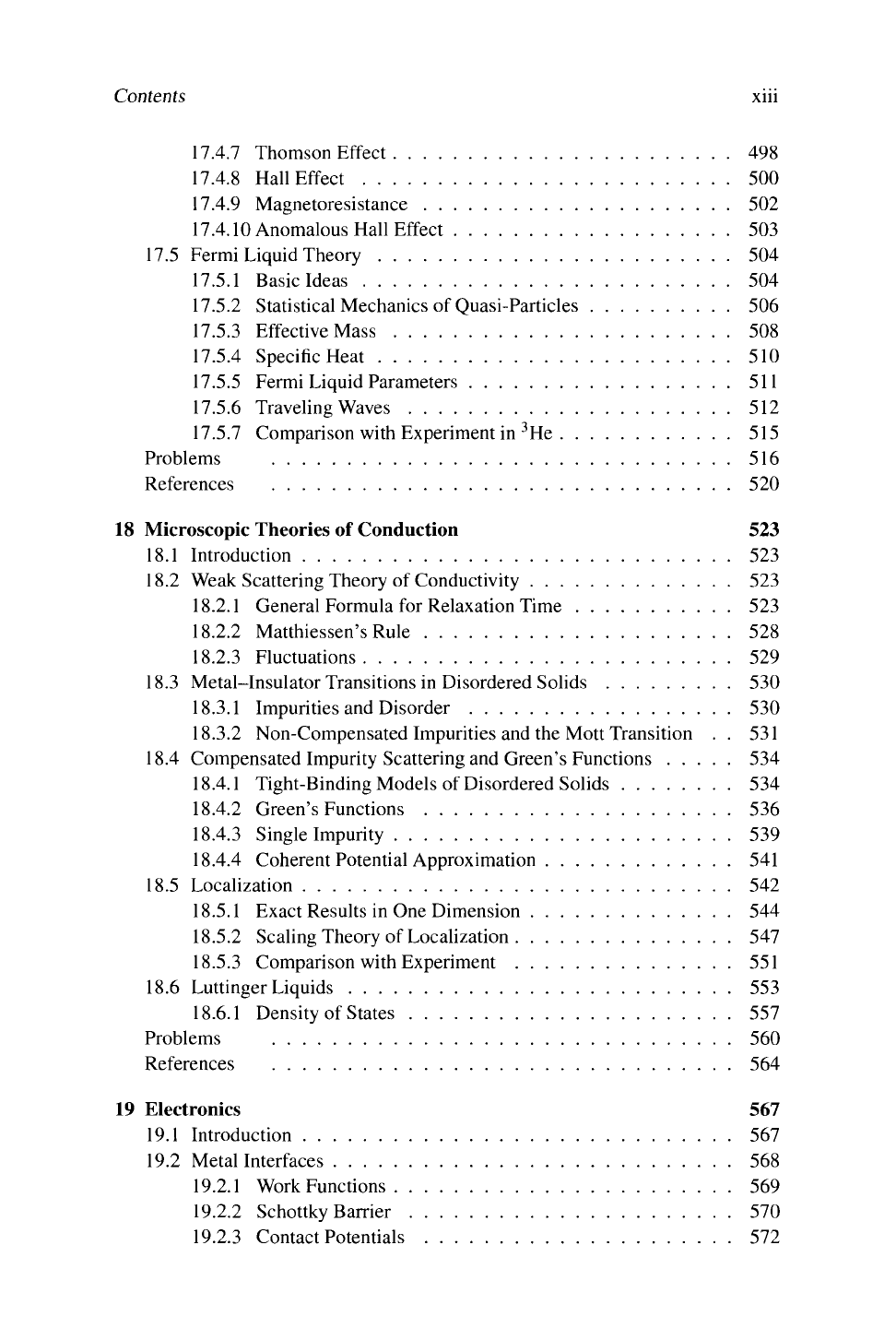
17.4.7 Thomson Effect 498
17.4.8 Hall Effect 500
17.4.9 Magnetoresistance 502
17.4.10 Anomalous Hall Effect 503
17.5 Fermi Liquid Theory 504
17.5.1 Basic Ideas 504
17.5.2 Statistical Mechanics of Quasi-Particles 506
17.5.3 Effective Mass 508
17.5.4 Specific Heat 510
17.5.5 Fermi Liquid Parameters 511
17.5.6 Traveling Waves 512
17.5.7 Comparison with Experiment in
3
He 515
Problems 516
References 520
18 Microscopic Theories of Conduction 523
18.1 Introduction 523
18.2 Weak Scattering Theory of Conductivity 523
18.2.1 Genera] Formula for Relaxation Time 523
18.2.2 Matthiessen's Rule 528
18.2.3 Fluctuations 529
18.3 Metal-Insulator Transitions in Disordered Solids 530
18.3.1 Impurities and Disorder 530
18.3.2 Non-Compensated Impurities and the Mott Transition . . 531
18.4 Compensated Impurity Scattering and Green's Functions 534
18.4.1 Tight-Binding Models of Disordered Solids 534
18.4.2 Green's Functions 536
18.4.3 Single Impurity 539
18.4.4 Coherent Potential Approximation 541
18.5 Localization 542
18.5.1 Exact Results in One Dimension 544
18.5.2 Scaling Theory of Localization 547
18.5.3 Comparison with Experiment 551
18.6 Luttinger Liquids 553
18.6.1 Density of States 557
Problems 560
References 564
19 Electronics 567
19.1 Introduction 567
19.2 Metal Interfaces 568
19.2.1 Work Functions 569
19.2.2 Schottky Barrier 570
19.2.3 Contact Potentials 572
xiv Contents
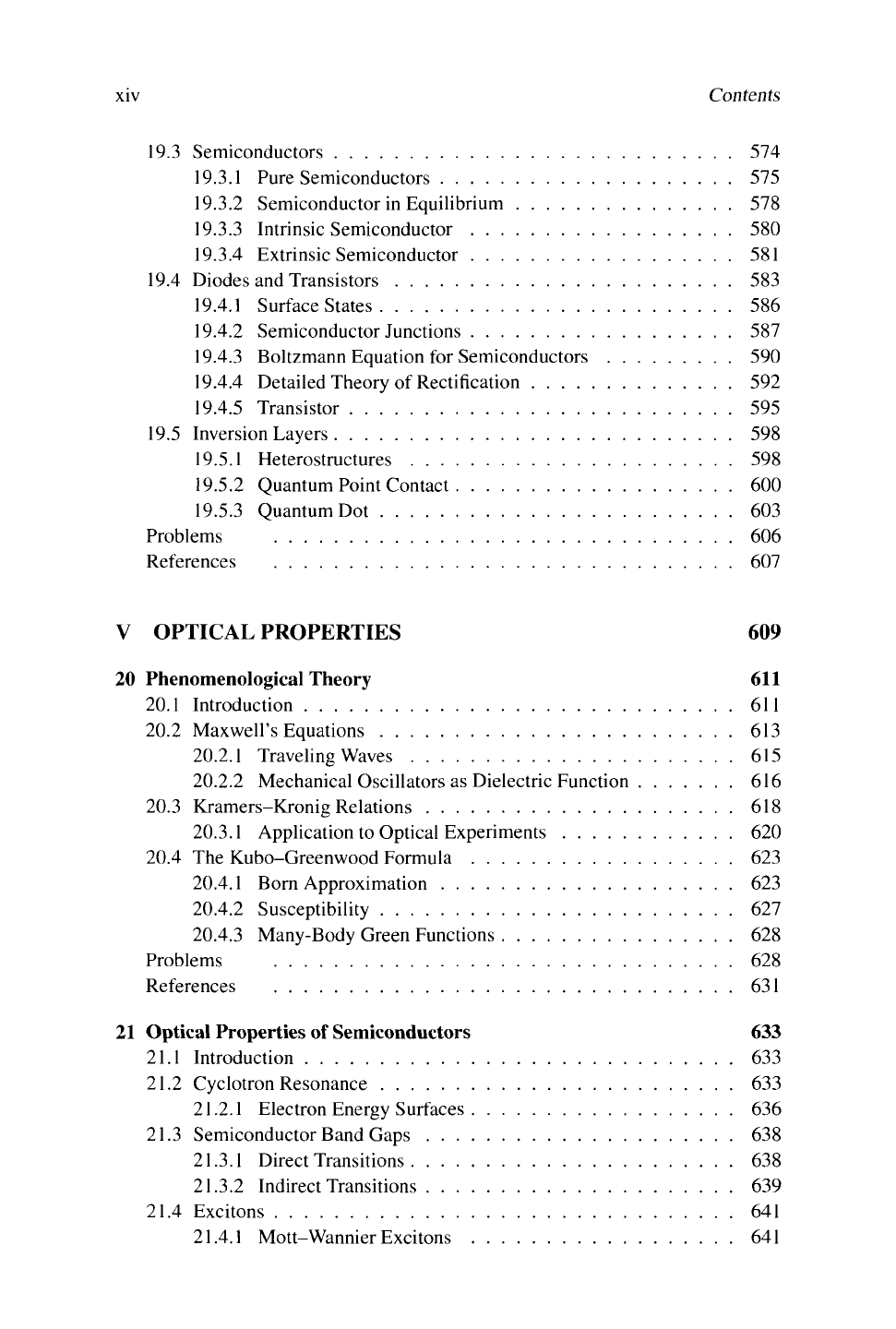
19.3 Semiconductors 574
19.3.1 Pure Semiconductors 575
19.3.2 Semiconductor in Equilibrium 578
19.3.3 Intrinsic Semiconductor 580
19.3.4 Extrinsic Semiconductor 581
19.4 Diodes and Transistors 583
19.4.1 Surface States 586
19.4.2 Semiconductor Junctions 587
19.4.3 Boltzmann Equation for Semiconductors 590
19.4.4 Detailed Theory of Rectification 592
19.4.5 Transistor 595
19.5 Inversion Layers 598
19.5.1 Heterostructures 598
19.5.2 Quantum Point Contact 600
19.5.3 Quantum Dot 603
Problems 606
References 607
V OPTICAL PROPERTIES 609
20 Phenomenological Theory 611
20.1 Introduction 611
20.2 Maxwell's Equations 613
20.2.1 Traveling Waves 615
20.2.2 Mechanical Oscillators as Dielectric Function 616
20.3 Kramers-Kronig Relations 618
20.3.1 Application to Optical Experiments 620
20.4 The Kubo-Greenwood Formula 623
20.4.1 Born Approximation 623
20.4.2 Susceptibility 627
20.4.3 Many-Body Green Functions 628
Problems 628
References 631
21 Optical Properties of Semiconductors 633
21.1 Introduction 633
21.2 Cyclotron Resonance 633
21.2.1 Electron Energy Surfaces 636
21.3 Semiconductor Band Gaps 638
21.3.1 Direct Transitions 638
21.3.2 Indirect Transitions 639
21.4 Excitons 641
21.4.1 Mott-Wannier Excitons 641
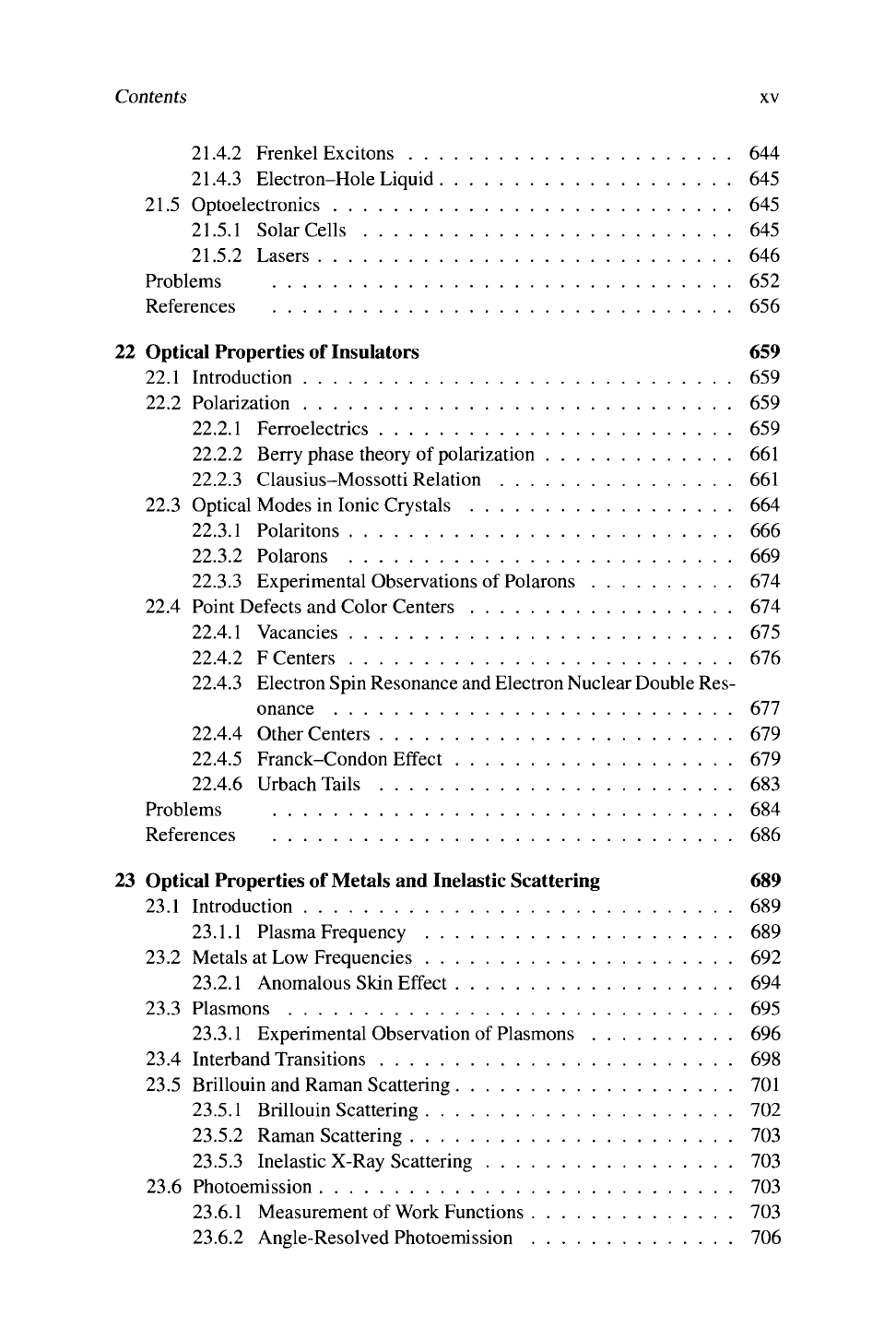
Contents
xv
21.4.2 Frenkel Excitons 644
21.4.3 Electron-Hole Liquid 645
21.5 Optoelectronics 645
21.5.1 Solar Cells 645
21.5.2 Lasers 646
Problems 652
References 656
22 Optical Properties of Insulators 659
22.1 Introduction 659
22.2 Polarization 659
22.2.1 Ferroelectrics 659
22.2.2 Berry phase theory of polarization 661
22.2.3 Clausius-Mossotti Relation 661
22.3 Optical Modes in Ionic Crystals 664
22.3.1 Polaritons 666
22.3.2 Polarons 669
22.3.3 Experimental Observations of Polarons 674
22.4 Point Defects and Color Centers 674
22.4.1 Vacancies 675
22.4.2 F Centers 676
22.4.3 Electron Spin Resonance and Electron Nuclear Double Res-
onance 677
22.4.4 Other Centers 679
22.4.5 Franck-Condon Effect 679
22.4.6 Urbach Tails 683
Problems 684
References 686
23 Optical Properties of Metals and Inelastic Scattering 689
23.1 Introduction 689
23.1.1 Plasma Frequency 689
23.2 Metals at Low Frequencies 692
23.2.1 Anomalous Skin Effect 694
23.3 Plasmons 695
23.3.1 Experimental Observation of Plasmons 696
23.4 Interband Transitions 698
23.5 Brillouin and Raman Scattering 701
23.5.1 Brillouin Scattering 702
23.5.2 Raman Scattering 703
23.5.3 Inelastic X-Ray Scattering 703
23.6 Photoemission 703
23.6.1 Measurement of Work Functions 703
23.6.2 Angle-Resolved Photoemission 706
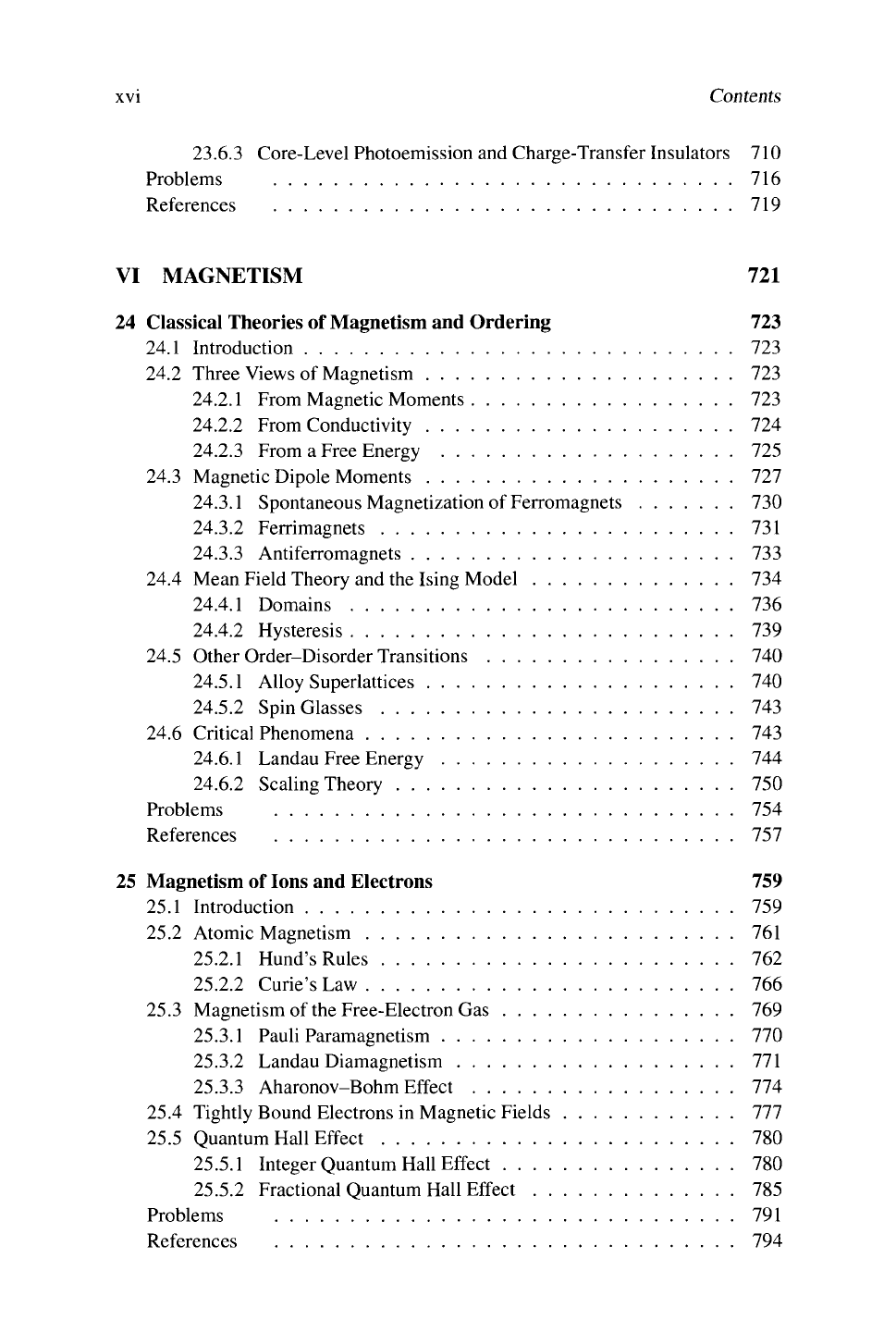
XVI
Contents
23.6.3 Core-Level Photoemission and Charge-Transfer Insulators 710
Problems 716
References 719
VI MAGNETISM 721
24 Classical Theories of Magnetism and Ordering 723
24.1 Introduction 723
24.2 Three Views of Magnetism 723
24.2.1 From Magnetic Moments 723
24.2.2 From Conductivity 724
24.2.3 From a Free Energy 725
24.3 Magnetic Dipole Moments 727
24.3.1 Spontaneous Magnetization of Ferromagnets 730
24.3.2 Ferrimagnets 731
24.3.3 Antiferromagnets 733
24.4 Mean Field Theory and the Ising Model 734
24.4.1 Domains 736
24.4.2 Hysteresis 739
24.5 Other Order-Disorder Transitions 740
24.5.1 Alloy Superlattices 740
24.5.2 Spin Glasses 743
24.6 Critical Phenomena 743
24.6.1 Landau Free Energy 744
24.6.2 Scaling Theory 750
Problems 754
References 757
25 Magnetism of Ions and Electrons 759
25.1 Introduction 759
25.2 Atomic Magnetism 761
25.2.1 Hund's Rules 762
25.2.2 Curie's Law 766
25.3 Magnetism of the Free-Electron Gas 769
25.3.1 Pauli Paramagnetism 770
25.3.2 Landau Diamagnetism 771
25.3.3 Aharonov-Bohm Effect 774
25.4 Tightly Bound Electrons in Magnetic Fields 777
25.5 Quantum Hall Effect 780
25.5.1 Integer Quantum Hall Effect 780
25.5.2 Fractional Quantum Hall Effect 785
Problems 791
References 794
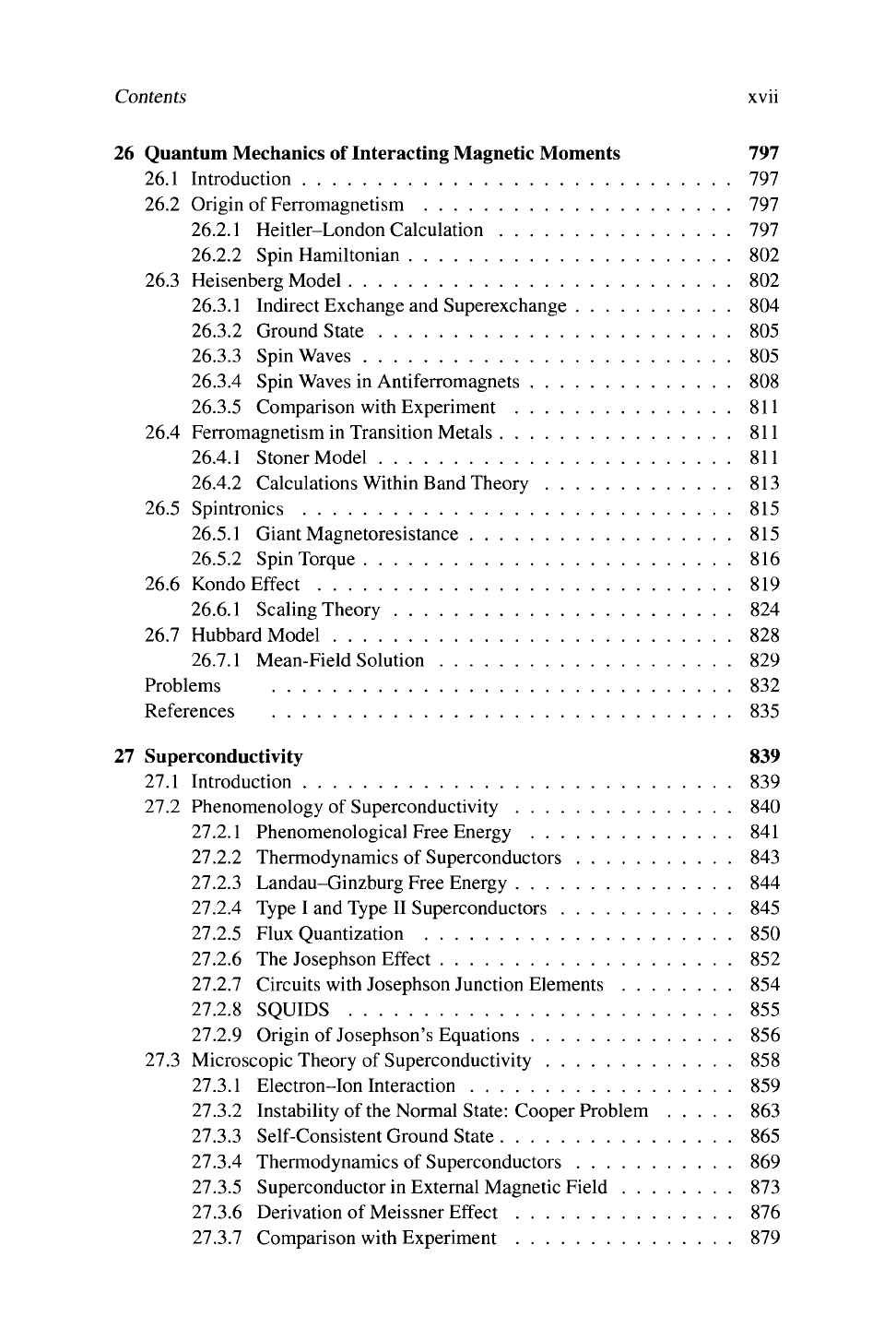
Contents xvii
26 Quantum Mechanics of Interacting Magnetic Moments 797
26.1 Introduction 797
26.2 Origin of Ferromagnetism 797
26.2.1 Heitler-London Calculation 797
26.2.2 Spin Hamiltonian 802
26.3 Heisenberg Model 802
26.3.1 Indirect Exchange and Superexchange 804
26.3.2 Ground State 805
26.3.3 Spin Waves 805
26.3.4 Spin Waves in Antiferromagnets 808
26.3.5 Comparison with Experiment 811
26.4 Ferromagnetism in Transition Metals 811
26.4.1 Stoner Model 811
26.4.2 Calculations Within Band Theory 813
26.5 Spintronics 815
26.5.1 Giant Magnetoresistance 815
26.5.2 Spin Torque 816
26.6 Kondo Effect 819
26.6.1 Scaling Theory 824
26.7 Hubbard Model 828
26.7.1 Mean-Field Solution 829
Problems 832
References 835
27 Superconductivity 839
27.1 Introduction 839
27.2 Phenomenology of Superconductivity 840
27.2.1 Phenomenological Free Energy 841
27.2.2 Thermodynamics of Superconductors 843
27.2.3 Landau-Ginzburg Free Energy 844
27.2.4 Type I and Type II Superconductors 845
27.2.5 Flux Quantization 850
27.2.6 The Josephson Effect 852
27.2.7 Circuits with Josephson Junction Elements 854
27.2.8 SQUIDS 855
27.2.9 Origin of Josephson's Equations 856
27.3 Microscopic Theory of Superconductivity 858
27.3.1 Electron-Ion Interaction 859
27.3.2 Instability of the Normal State: Cooper Problem 863
27.3.3 Self-Consistent Ground State 865
27.3.4 Thermodynamics of Superconductors 869
27.3.5 Superconductor in External Magnetic Field 873
27.3.6 Derivation of Meissner Effect 876
27.3.7 Comparison with Experiment 879
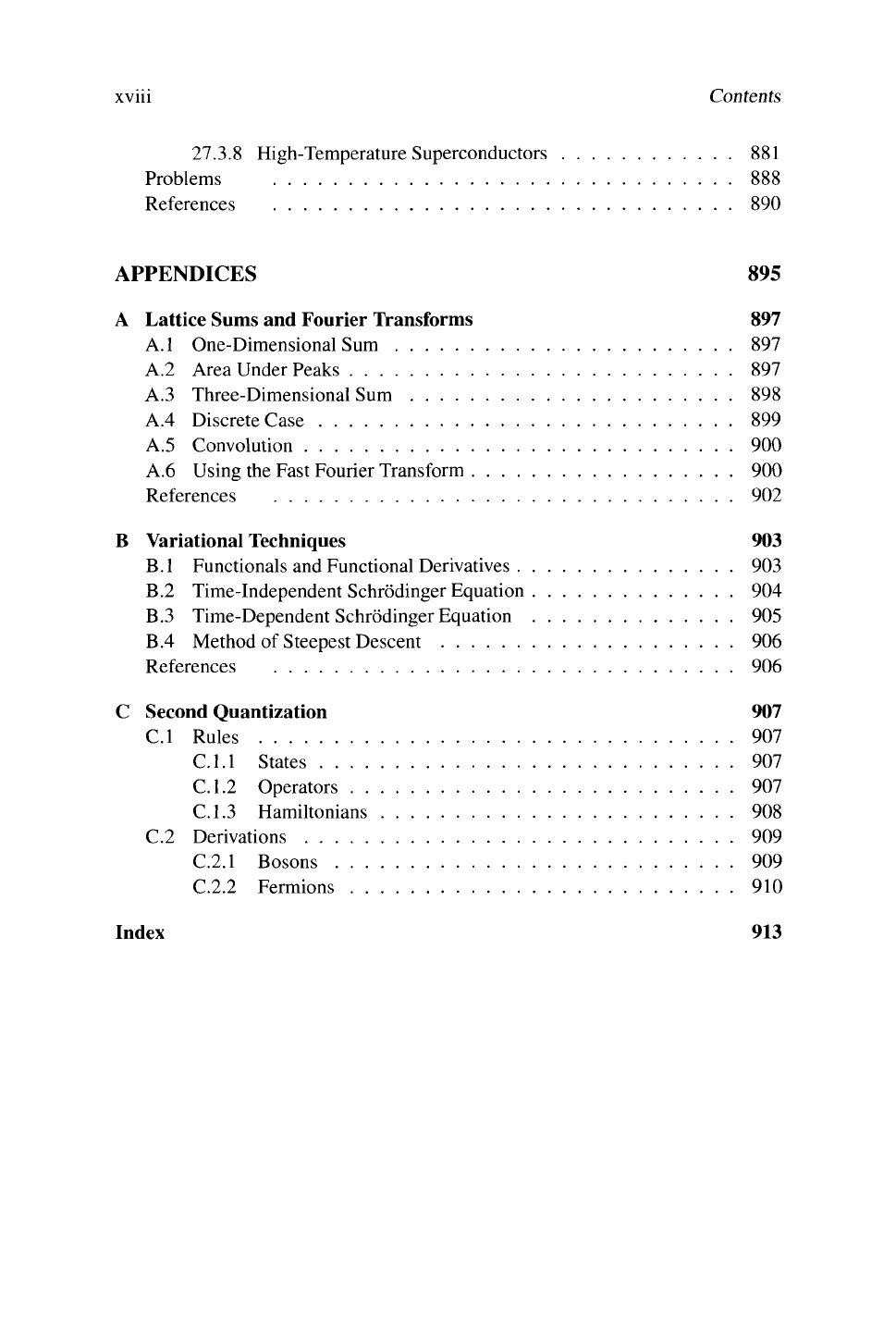
xviii Contents
27.3.8 High-Temperature Superconductors 881
Problems 888
References 890
APPENDICES 895
A Lattice Sums and Fourier Transforms 897
A.l One-Dimensional Sum 897
A.2 Area Under Peaks 897
A.3 Three-Dimensional Sum 898
A.4 Discrete Case 899
A.5 Convolution 900
A.6 Using the Fast Fourier Transform 900
References 902
B Variational Techniques 903
B.l Functionals and Functional Derivatives 903
B.2 Time-Independent Schrödinger Equation 904
B.3 Time-Dependent Schrödinger Equation 905
B.4 Method of Steepest Descent 906
References 906
C Second Quantization 907
C.l Rules 907
C.l.l States 907
C.1.2 Operators 907
C.1.3 Hamiltonians 908
C.2 Derivations 909
C.2.1 Bosons 909
C.2.2 Fermions 910
Index 913
Preface
Preface to first edition
Using this book.
This textbook provides material for a one-year graduate course on condensed
matter physics. It contains introductions to classic subjects, and it also presents
topics I believe will continue to occupy the field in the future. The book teaches
not only about the effective masses of electrons in semiconductor crystals and band
theory, but also about quasicrystals, dynamics of phase separation, why rubber is
more floppy than steel, electron interference in nanometer-sized channels, and the
quantum Hall effect.
It is arranged in six parts, convenient for dividing into two semesters or three
quarters. However, there is more material than can reasonably be covered in one
year. My experience suggests that an instructor should aim to cover roughly two-
thirds of the material in each part. The remainder is available for reference. Ev-
ery instructor will find that some of the topics are very elementary and others are
quite advanced. However, instructors with different backgrounds will disagree to
a surprising extent on which are which. The web site associated with the book,
http
:
//chaos .ph. utexas . edu/~cmp, contains sample syllabi, as well as
corrections, and other information.
Each chapter is followed by a collection of problems. Some are brief deriva-
tions,
but many introduce new topics and are fairly lengthy. An instructor's manual
is available to aid in decisions on what to assign. Whether in academic or industrial
posts,
experimentalists and theorists must all become fluent in manipulating data
and symbols with the computer. Therefore, many of the problems involve numeri-
cal work, ranging from no more than plotting graphs to a series of linked exercises
that produces a simple band structure code.
The book presumes a working knowledge of quantum mechanics, statistical
mechanics, and electricity and magnetism. I decided to exclude many-body Green
functions, which become such an absorbing formal world of their own that they too
easily drive physical reasoning out of
an
introductory course. However, as the book
proceeds I do begin to employ second quantization, and it becomes quite common
by the time of the section on magnetism.
If simple arguments explain a phenomenon, I present them, but I also have paid
some attention to the actual historical process by which ideas were accepted, and I
try to explain in detail some of the calculations and experimental data that actually
convinced the specialists. Not all the subjects discussed in this book are closed;
even simple questions do not always have answers; and theory and experiment do
not always completely agree. The topics that can today be presented only within a
distressing cloud of uncertainty are precisely the ones most likely to remain central
to the development of condensed matter physics.
References to original literature. There are two attitudes toward references to
original literature. One is that it is ridiculous to "cite the original work of Maxwell,
for example, which nobody bothers to look up anyway" [Aharoni (1996), p. vii].
xix
XX
Preface
Maxwell himself
disagreed.
He believed that it "is of great advantage to the student
of any subject to read the original memoirs on that subject, for science is always
most completely assimilated when it is found in its nascent state" [Maxwell (1904),
p.
xi]. While it would be impossible to cite all papers responsible for the develop-
ment of condensed matter physics without having reference lists longer than the
remainder of the book, I have cited some of the most influential papers for two
reasons. First, anyone who is part of research today knows how strongly all au-
thors feel about having contributions recognized, and it hardly seems fair to have
older generations drift entirely out of consciousness simply because they are no
longer around to defend themselves. Second, original papers on difficult topics
sometimes provide clearer explanations than anything that ever follows. Review
articles quickly race over elementary points so as to provide comprehensive cover-
age of current developments, while textbooks easily make assertions, ignoring the
complex web of evidence that eventually produced a consensus.
To try to ensure that major portions of the field were not left unrepresented, I
somewhat arbitrarily chose three series of review articles and included a reference
to almost every article with a bearing on condensed matter physics in the last 30
years.
These are: Solid State Physics: Advances in Research and Applications,
Reviews of Modern Physics, and Physics
Today.
Some of these articles have a very
narrow focus, but the degree of difficulty can happily be estimated with little effort
by using Ziman's "coefficient of non-specifìcity, calculated as follows: transform
the title into a succession of A adjectives qualifying S substantives, omitting re-
dundant words like 'physics', 'effects', 'properties', 'materials', etc. Then take
the ratio A/S. Inspection ... shows quite clearly that if the coefficient is greater
than 3 the article is too specialized The optimum seems to be in the range
1 < A/5 < 2" [Ziman (1961)].
Origin of the
field.
The discovery of quantum mechanics raised the hope of ex-
plaining the familiar world from equations at the atomic scale. In early stages this
enterprise was largely restricted to metals in crystalline form. The field began as
"metals physics," but the term excluded widely studied solids such as ionic crystals.
"Solid state physics" was adopted instead, with creation of the Division of Solid
State Physics by the American Physical Society in 1947. A decade later even "solid
state"
was becoming too restrictive for a field tackling liquid metals, liquid helium,
liquid crystals, and polymer melts. In 1963, Busch began editing ajournai called
Physik der Kondensierten Materie/Physique de la matière condensée/Physics of
condensed matter. The daring term gained usage slowly. The American Physical
Society Division of Solid State Physics voted in April 1978 to change its name to
the Division of Condensed Matter Physics.
Having set itself the modest goal of explaining the whole material world, in-
cluding structural and electronic properties of solids and liquids, the field of con-
densed matter physics has become enormous. It overlaps statistical physics, ma-
terials physics, and fluid and solid mechanics. The diversity in topics obscures a
unity of approach.
Experiments play a crucial role. The systems studied by condensed matter