
Marder M.P. Condensed Matter Physics
Подождите немного. Документ загружается.

Monatomic Lattices
23
2.2.4 The Hexagonal Lattice
A hexagonal lattice is pictured in Figure 2.4. This structure does not occur among
the elements, except as the starting point for the hexagonal close-packed structure.
Its primitive vectors are
ai = (αλ/3/2 a/2 0), a
2
= (aVÌ/2 -a/2 0), a
3
= (0 0 c), (2.5)
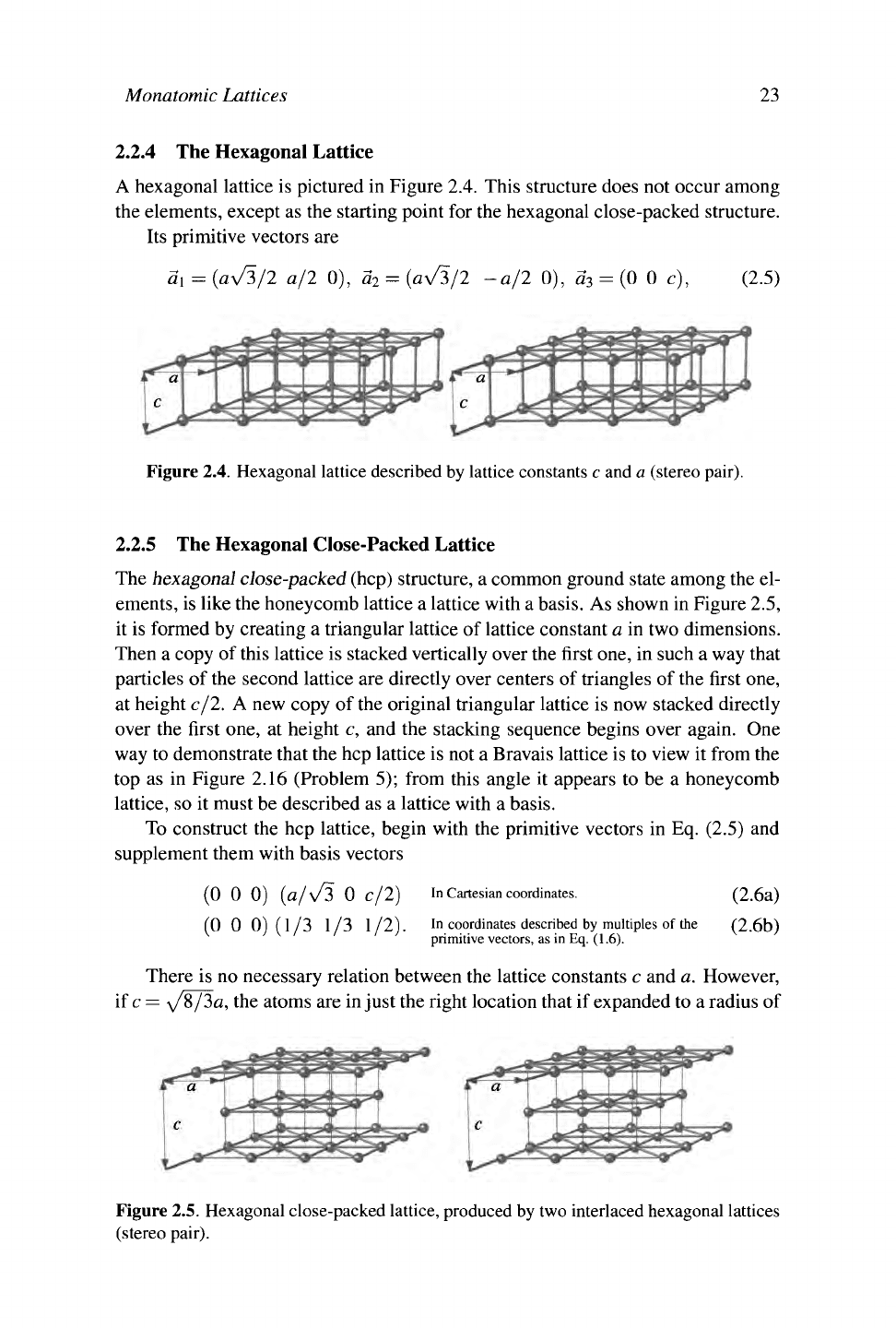
Figure 2.4. Hexagonal lattice described by lattice constants c and a (stereo pair).
2.2.5 The Hexagonal Close-Packed Lattice
The hexagonal close-packed (hep) structure, a common ground state among the el-
ements, is like the honeycomb lattice a lattice with a
basis.
As shown in Figure 2.5,
it is formed by creating a triangular lattice of lattice constant a in two dimensions.
Then a copy of this lattice is stacked vertically over the first one, in such a way that
particles of the second lattice are directly over centers of triangles of the first one,
at height c/2. A new copy of the original triangular lattice is now stacked directly
over the first one, at height c, and the stacking sequence begins over again. One
way to demonstrate that the hep lattice is not a Bravais lattice is to view it from the
top as in Figure 2.16 (Problem 5); from this angle it appears to be a honeycomb
lattice, so it must be described as a lattice with a basis.
To construct the hep lattice, begin with the primitive vectors in Eq. (2.5) and
supplement them with basis vectors
(0 0 0) (a/y/3 0 c/2) In Cartesian coordinates. (2.6a)
(0 0 0) (1/3 1/3 1/2). In coordinates described by multiples of the (2.6b)
primitive vectors, as in Eq. (1.6).
There is no necessary relation between the lattice constants c and a. However,
if c = ^/8/3a, the atoms are
in
just the right location that if expanded to a radius of
Figure 2.5. Hexagonal close-packed lattice, produced by two interlaced hexagonal lattices
(stereo pair).
24 Chapter 2. Three-Dimensional Lattices
a/2, they form a perfect close-packed structure. The difference between this close-
packed structure and the one formed by the face-centered cubic lattice lies in the
way that successive triangular layers are stacked upon one another. In Figure 2.5,
notice that one has two choices as to where to put the topmost layer of atoms. In
the hep lattice, the layers are stacked so that the structure repeats, after two layers,
while to produce the fee lattice, one stacks them so that they repeat after three, as
in Figure 2.2(D). More than 25 elements adopt the hep lattice, including zinc and
titanium.
2.2.6 The Diamond Lattice
The diamond lattice is constructed by taking the fee lattice described by Eq. (2.3)
and making a copy of it, displaced relative to the original by (a/4 a/4 a/4).
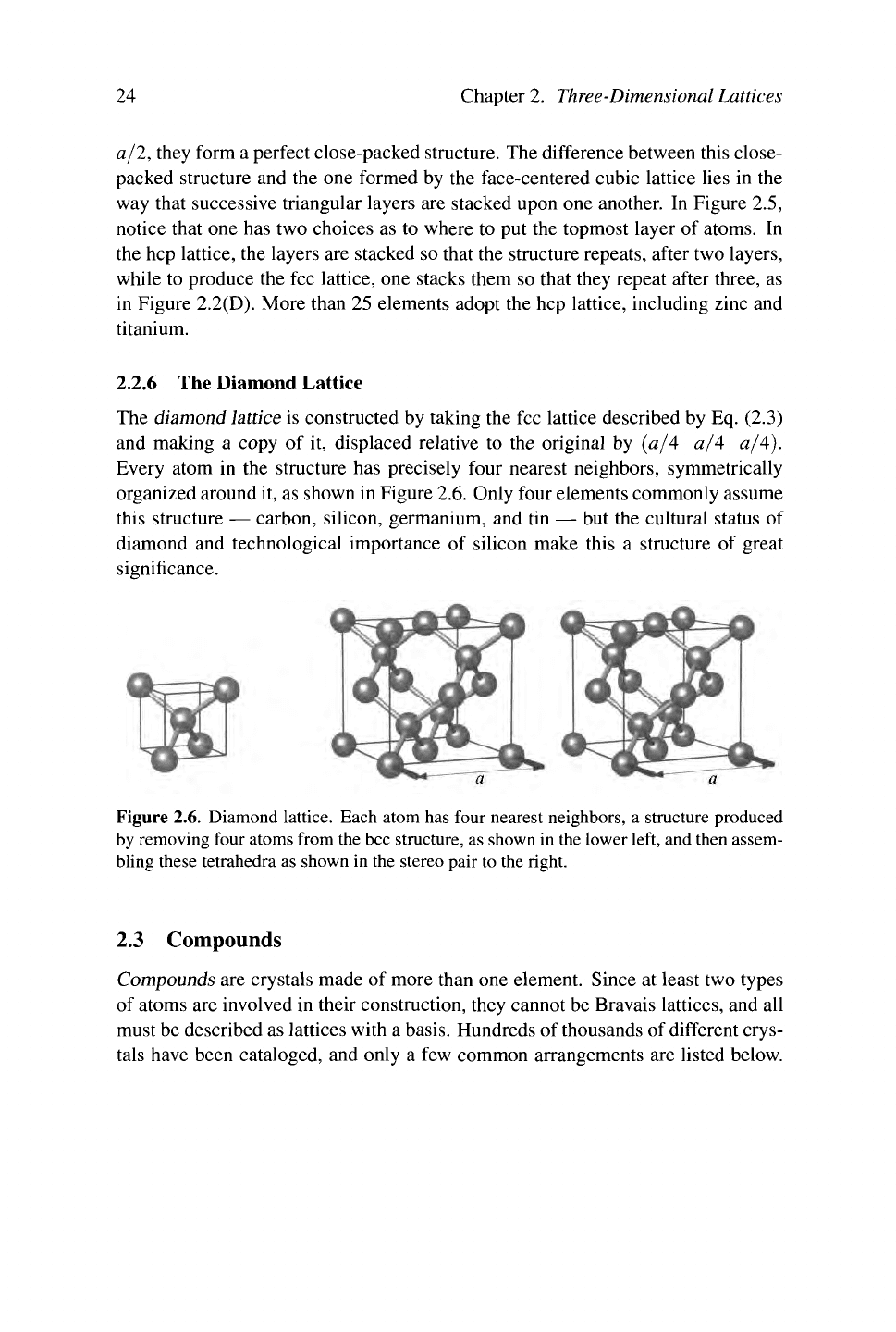
Every atom in the structure has precisely four nearest neighbors, symmetrically
organized around it, as shown in Figure 2.6. Only four elements commonly assume
this structure — carbon, silicon, germanium, and tin — but the cultural status of
diamond and technological importance of silicon make this a structure of great
significance.
Figure 2.6. Diamond lattice. Each atom has four nearest neighbors, a structure produced
by removing four atoms from the bec structure, as shown in the lower left, and then assem-
bling these tetrahedra as shown in the stereo pair to the right.
2.3 Compounds
Compounds are crystals made of more than one element. Since at least two types
of atoms are involved in their construction, they cannot be Bravais lattices, and all
must be described as lattices with a basis. Hundreds of thousands of different crys-
tals have been cataloged, and only a few common arrangements are listed below.
Compounds
25
2.3.1 Rocksalt—Sodium Chloride
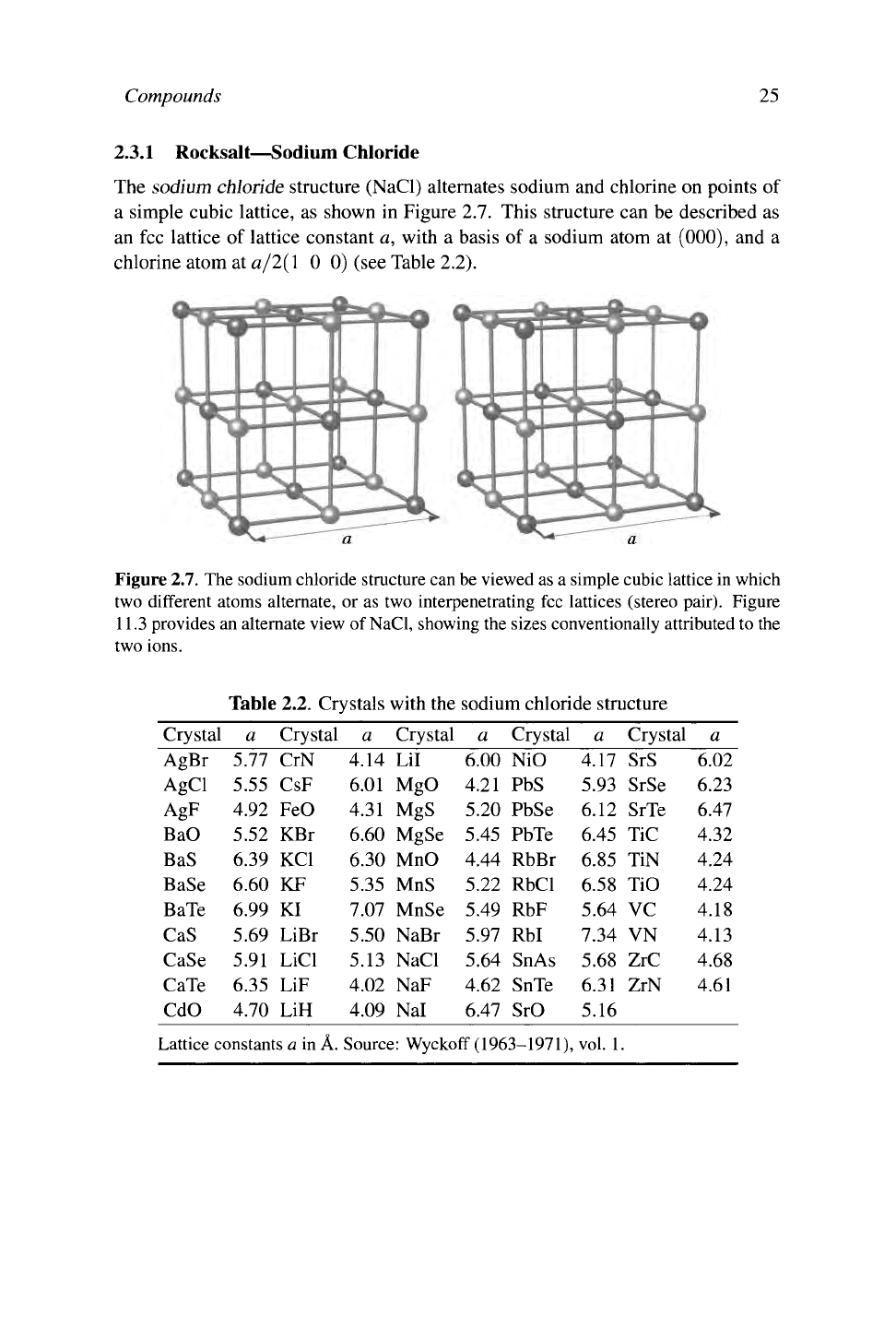
The sodium chloride structure (NaCl) alternates sodium
and
chlorine
on
points
of
a simple cubic lattice,
as
shown
in
Figure
2.7.
This structure
can be
described
as
an
fee
lattice
of
lattice constant
a,
with
a
basis
of a
sodium atom
at
(000),
and a
chlorine atom
at a/2(\ 0 0)
(see Table
2.2).
Figure 2.7. The sodium chloride structure can be viewed
as a
simple cubic lattice
in
which
two different atoms alternate,
or as two
interpenetrating
fee
lattices (stereo pair). Figure
11.3 provides
an
alternate view
of
NaCl, showing the sizes conventionally attributed to
the
two ions.
Table 2.2. Crystals with
the
sodium chloride structure
Crystal
AgBr
AgCl
AgF
BaO
BaS
BaSe
BaTe
CaS
CaSe
CaTe
CdO
a
5.77
5.55
4.92
5.52
6.39
6.60
6.99
5.69
5.91
6.35
4.70
Crystal
CrN
CsF
FeO
KBr
KC1
KF
KI
LiBr
LiCl
LiF
LiH
a
4.14
6.01
4.31
6.60
6.30
5.35
7.07
5.50
5.13
4.02
4.09
Crystal
Lil
MgO
MgS
MgSe
MnO
MnS
MnSe
NaBr
NaCl
NaF
Nal
a
6.00
4.21
5.20
5.45
4.44
5.22
5.49
5.97
5.64
4.62
6.47
Crystal
NiO
PbS
PbSe
PbTe
RbBr
RbCl
RbF
Rbl
SnAs
SnTe
SrO
a
4.17
5.93
6.12
6.45
6.85
6.58
5.64
7.34
5.68
6.31
5.16
Crystal
SrS
SrSe
SrTe
TiC
TiN
TiO
VC
VN
ZrC
ZrN
a
6.02
6.23
6.47
4.32
4.24
4.24
4.18
4.13
4.68
4.61
Lattice constants
a in
Â. Source: Wyckoff (1963-1971), vol.
1.
26
Chapter 2. Three-Dimensional Lattices
2.3.2 Cesium Chloride
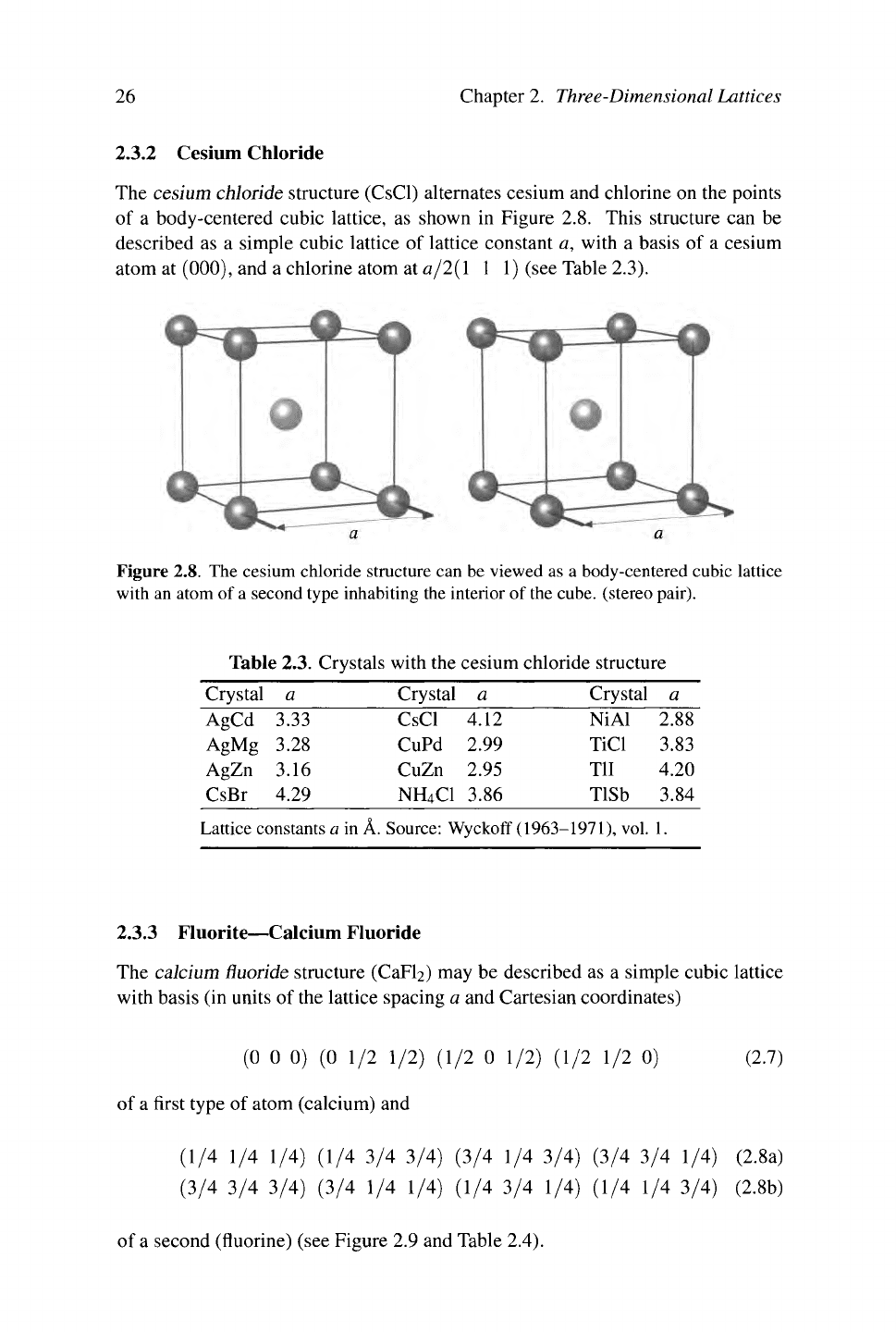
The cesium chlonde structure (CsCI) alternates cesium and chlorine on the points
of a body-centered cubic lattice, as shown in Figure 2.8. This structure can be
described as a simple cubic lattice of lattice constant a, with a basis of a cesium
atom at (000), and a chlorine atom at a/2(l 1 1) (see Table 2.3).
Figure 2.8. The cesium chloride structure can be viewed as a body-centered cubic lattice
with an atom of
a
second type inhabiting the interior of
the
cube, (stereo pair).
Table 2.3. Crystals with the cesium chloride structure
Crystal a Crystal a Crystal a
AgCd 3.33 CsCÎ 4TÏ2 NÎÂÎ ÏM
AgMg 3.28 CuPd 2.99 TiCl 3.83
AgZn 3.16 CuZn 2.95 Til 4.20
CsBr 4.29 NH
4
C1 3.86 TISb 3.84
Lattice constants a in Â. Source: Wyckoff
(1963-1971),
vol. 1.
2.3.3 Fluorite—Calcium Fluoride
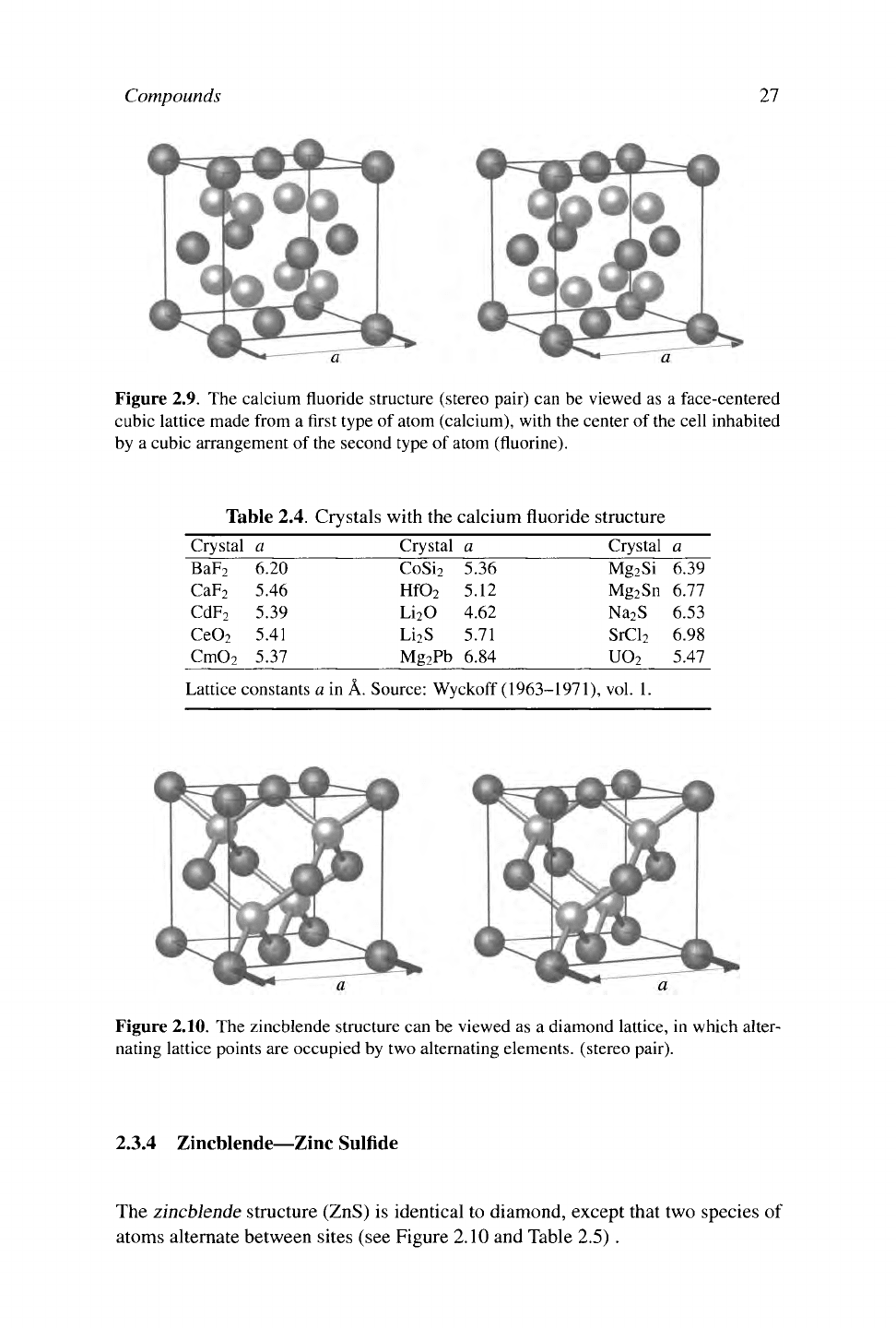
The calcium fluoride structure (CaFl2) may be described as a simple cubic lattice
with basis (in units of the lattice spacing a and Cartesian coordinates)
(0 0 0) (0 1/2 1/2) (1/2 0 1/2) (1/2 1/2 0) (2.7)
of a first type of atom (calcium) and
(1/4 1/4 1/4) (1/4 3/4 3/4) (3/4 1/4 3/4) (3/4 3/4 1/4) (2.8a)
(3/4 3/4 3/4) (3/4 1/4 1/4) (1/4 3/4 1/4) (1/4 1/4 3/4) (2.8b)
of a second (fluorine) (see Figure 2.9 and Table 2.4).
Compounds
27
Figure 2.9. The calcium fluoride structure (stereo pair) can be viewed as a face-centered
cubic lattice made from a first type of atom (calcium), with the center of the cell inhabited
by a cubic arrangement of the second type of atom (fluorine).
Table 2.4. Crystals with the calcium fluoride structure
Crystal a Crystal a Crystal a
BaF?
CaF
2
CdF
2
Ce0
2
Cm0
2
6.20
5.46
5.39
5.41
5.37
CoSi
2
5.36
Hf0
2
5.12
Li
2
0 4.62
Li
2
S 5.71
Mg
2
Pb 6.84
Mg
2
Si
Mg
2
Sn
Na
2
S
SrCl
2
uo
2
6.39
6.77
6.53
6.98
5.47
Lattice constants a in Â. Source: Wyckoff (1963-1971), vol. 1.
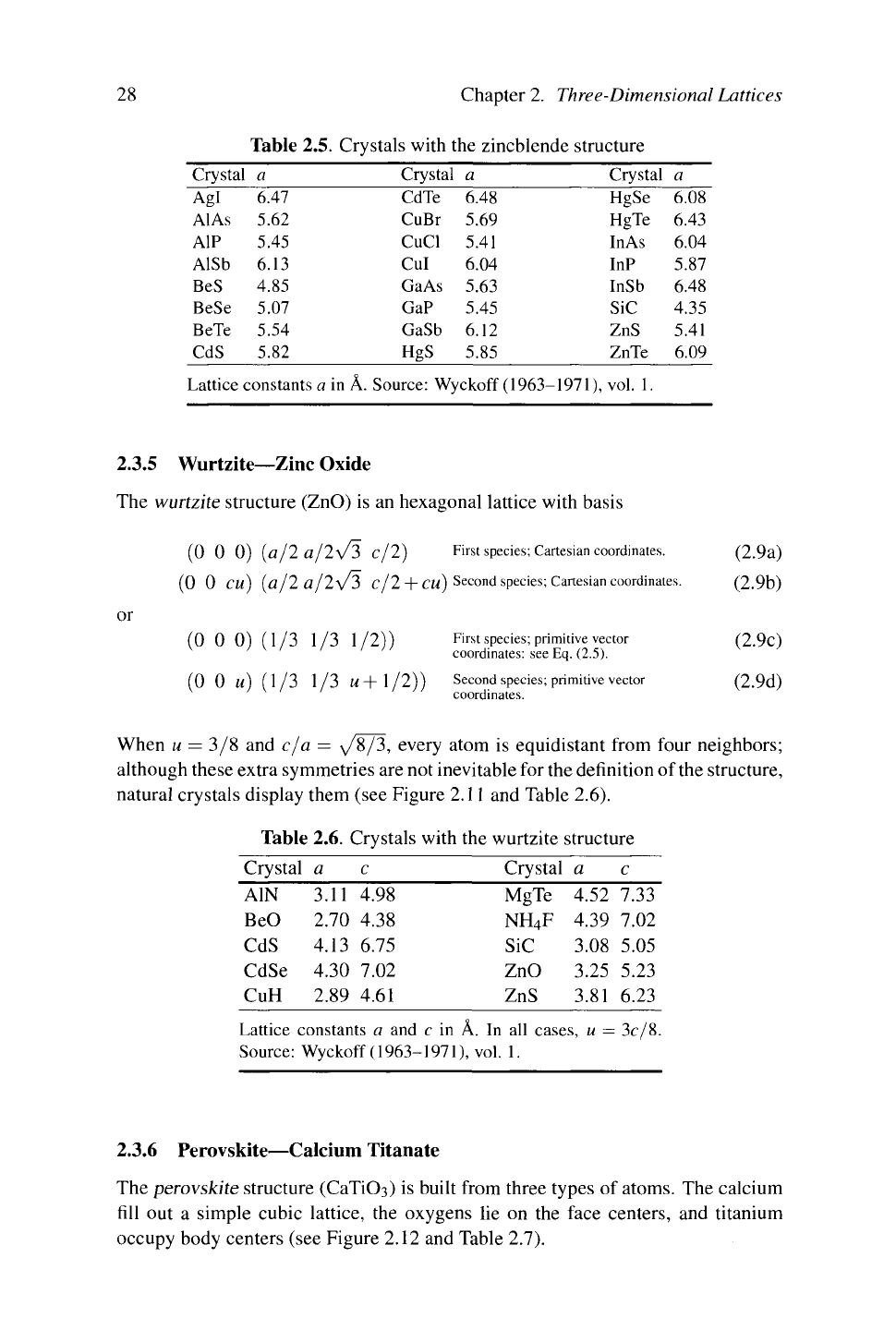
Figure 2.10. The zincblende structure can be viewed as a diamond lattice, in which alter-
nating lattice points are occupied by two alternating elements, (stereo pair).
2.3.4 Zincblende—Zinc Sulfide
The zincblende structure (ZnS) is identical to diamond, except that two species of
atoms alternate between sites (see Figure 2.10 and Table 2.5).
28 Chapter 2. Three-Dimensional Lattices
Table 2.5. Crystals with the zincblende structure
Crystal
Agi
AlAs
AIP
AlSb
BeS
BeSe
BeTe
CdS
a
6.47
5.62
5.45
6.13
4.85
5.07
5.54
5.82
Lattice constants a in Â.
Crystal
CdTe
CuBr
CuCl
Cui
GaAs
GaP
GaSb
HgS
a
6.48
5.69
5.41
6.04
5.63
5.45
6.12
5.85
Source: Wyckoff
(
1963-
-1971)
Crystal
HgSe
HgTe
InAs
InP
InSb
SiC
ZnS
ZnTe
, vol. 1.
a
6.08
6.43
6.04
5.87
6.48
4.35
5.41
6.09
2.3.5 Wurtzite—Zinc Oxide
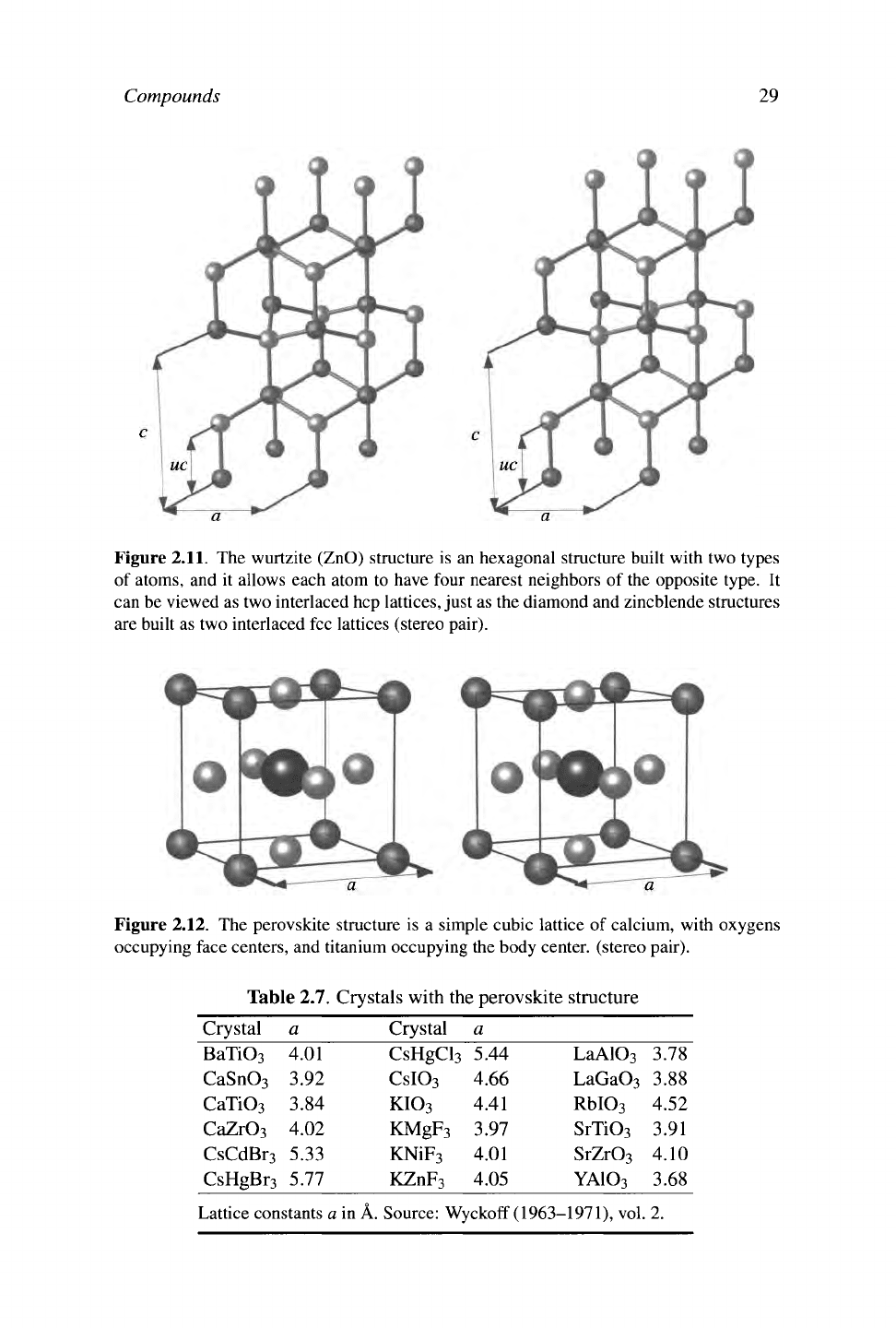
The wurtzite structure (ZnO) is an hexagonal lattice with basis
(0 0 0) (α/2α/2ν
/
3 c/2) First species; Cartesian coordinates. (2.9a)
(0 0 Cu) (a/2 a/2V3 c/2 + eu) Second species; Cartesian coordinates. (2.9b)
or
(0 0 0) (1/3 1/3 1/2)) First species; primitive vector (2.9c)
v
'
v
' ' ' " coordinates: see Eq. (2.5).
(0 0 u) (1/3 1/3 U+l/2)) Second species; primitive vector (2.9d)
v
'
v
' ' ' " coordinates.
When u = 3/8 and c/a =
^/8/3,
every atom is equidistant from four neighbors;
although these extra symmetries are not inevitable for the definition of the structure,
natural crystals display them (see Figure 2.11 and Table 2.6).
Table 2.6. Crystals with the wurtzite structure
Crystal a c Crystal a
A1N
BeO
CdS
CdSe
CuH
3.11 4.98
2.70 4.38
4.13 6.75
4.30 7.02
2.89 4.61
MgTe
NH
4
F
SiC
ZnO
ZnS
4.52
4.39
3.08
3.25
3.81
7.33
7.02
5.05
5.23
6.23
Lattice constants a and c in Â. In all cases, u = 3c/c
Source: Wyckoff (1963-1971), vol. 1.
2.3.6 Perovskite—Calcium Titanate
The perovskite structure (CaTiC>3) is built from three types of atoms. The calcium
fill out a simple cubic lattice, the oxygens lie on the face centers, and titanium
occupy body centers (see Figure 2.12 and Table 2.7).
Compounds 29
Figure 2.11.
The
wurtzite (ZnO) structure
is an
hexagonal structure built with
two
types
of atoms,
and it
allows each atom
to
have four nearest neighbors
of
the opposite type.
It
can
be
viewed
as
two interlaced hep lattices, just as
the
diamond
and
zincblende structures
are built
as two
interlaced
fee
lattices (stereo pair).
Figure
2.12. The
perovskite structure
is a
simple cubic lattice
of
calcium, with oxygens
occupying face centers,
and
titanium occupying
the
body center, (stereo pair).
Table
2.7.
Crystals with
the
perovskite structure
Crystal
BaTi0
3
CaSn0
3
CaTi0
3
CaZr0
3
CsCdBr
3
CsHgBr
3
a
4.01
3.92
3.84
4.02
5.33
5.77
Crystal
CsHgCl
3
CsI0
3
κιο
3
KMgF
3
KNiF
3
KZnF
3
a
5.44
4.66
4.41
3.97
4.01
4.05
LaA10
3
LaGa0
3
RbI0
3
SrTi0
3
SrZr0
3
YA10
3
3.78
3.88
4.52
3.91
4.10
3.68
Lattice constants
a in Â.
Source: Wyckoff (1963-1971), vol.
2.
30 Chapter 2. Three-Dimensional Lattices
2.4 Classification of Lattices by Symmetry
There is a complete classification of lattices by symmetry, which includes no less
than 230 distinct types and which will be discussed only briefly.
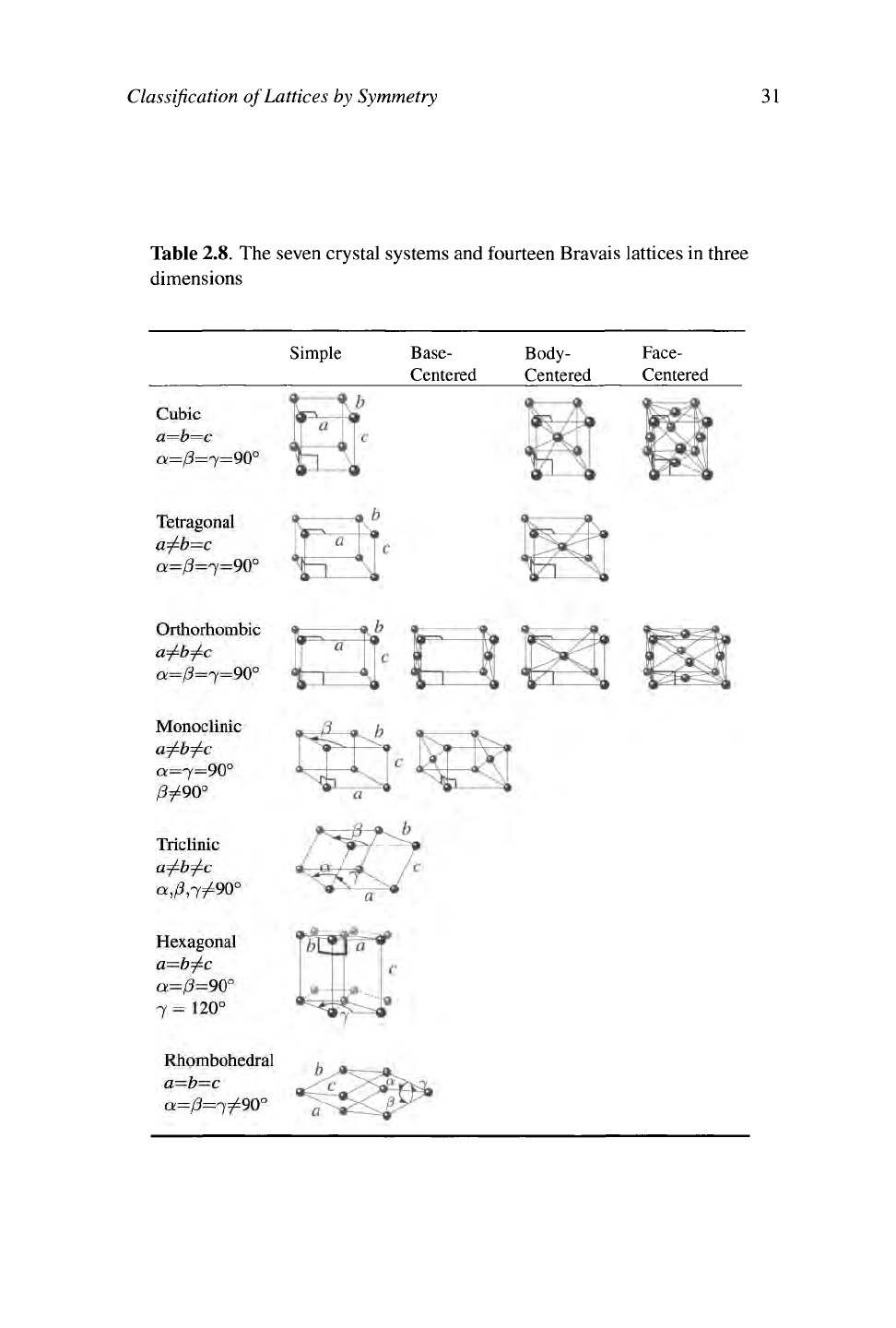
2.4.1 Fourteen Bravais Lattices and Seven Crystal Systems
There are precisely seven distinct point symmetry groups that arise when one con-
structs Bravais lattices out of identical point particles. They are called the seven
crystal systems and are shown in Table 2.8. A related but separate question is how
many distinct three-dimensional Bravais lattices can be built out of identical point
particles. The answer is 14, and all are listed in Table 2.8.
Cubic system: The first symmetry to strike the eye after inspecting the cube has to
do with the square sides. However, the cubic symmetry class derives its name
from three threefold axes about lines [1,1,1] between opposite corners of the
cube.
The cube is also invariant under rotations of 90° about any of three
perpendicular axes, and under reflections about the three planes perpendicular
to these axes. It has twofold rotation and mirror symmetries about the axis
[1,1,0].
The three Bravais lattices possessing this set of symmetries are the
simple cubic, face-centered cubic, and body-centered cubic lattices.
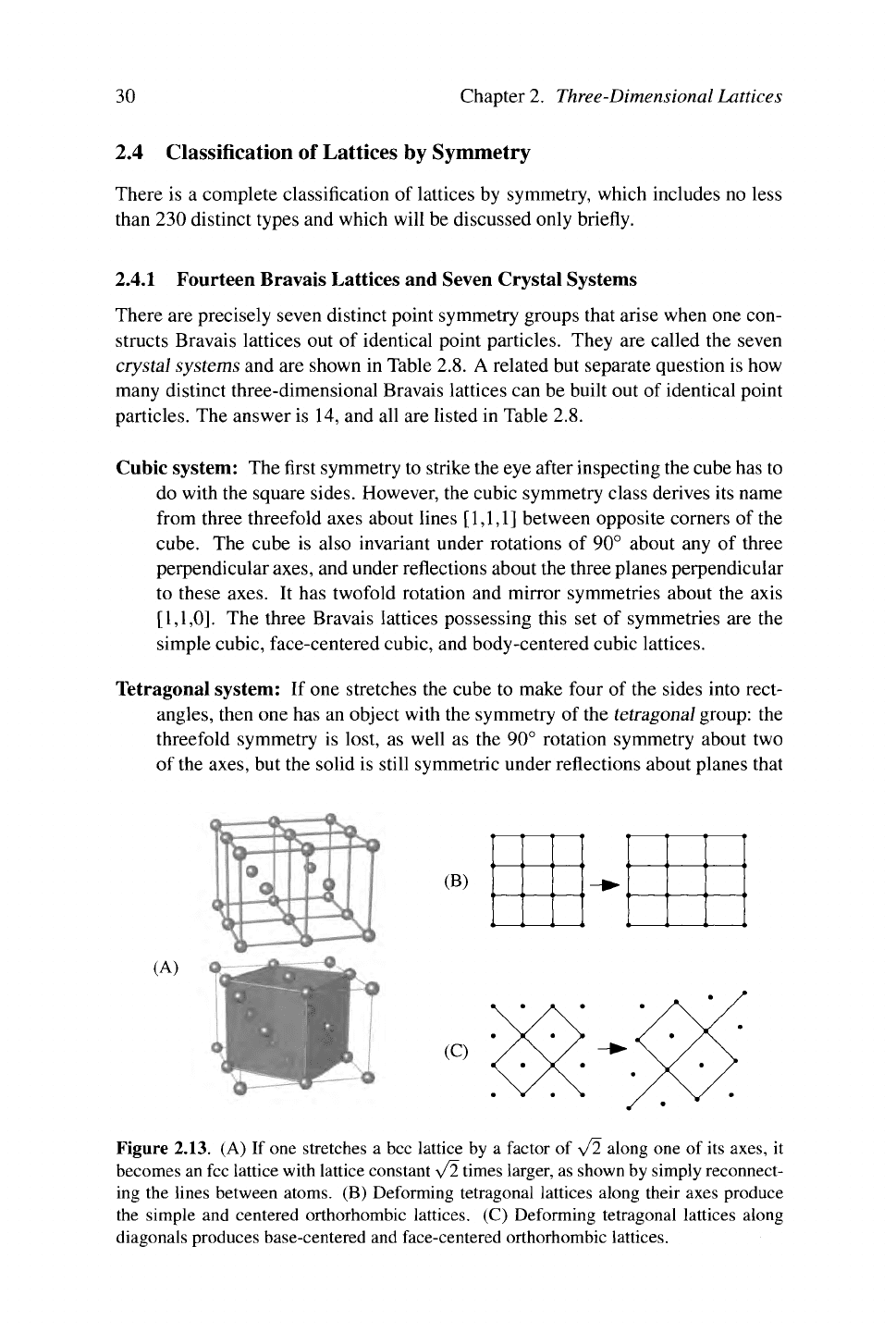
Tetragonal system: If one stretches the cube to make four of the sides into rect-
angles, then one has an object with the symmetry of the
tetragonal
group:
the
threefold symmetry is lost, as well as the 90° rotation symmetry about two
of the axes, but the solid is still symmetric under reflections about planes that
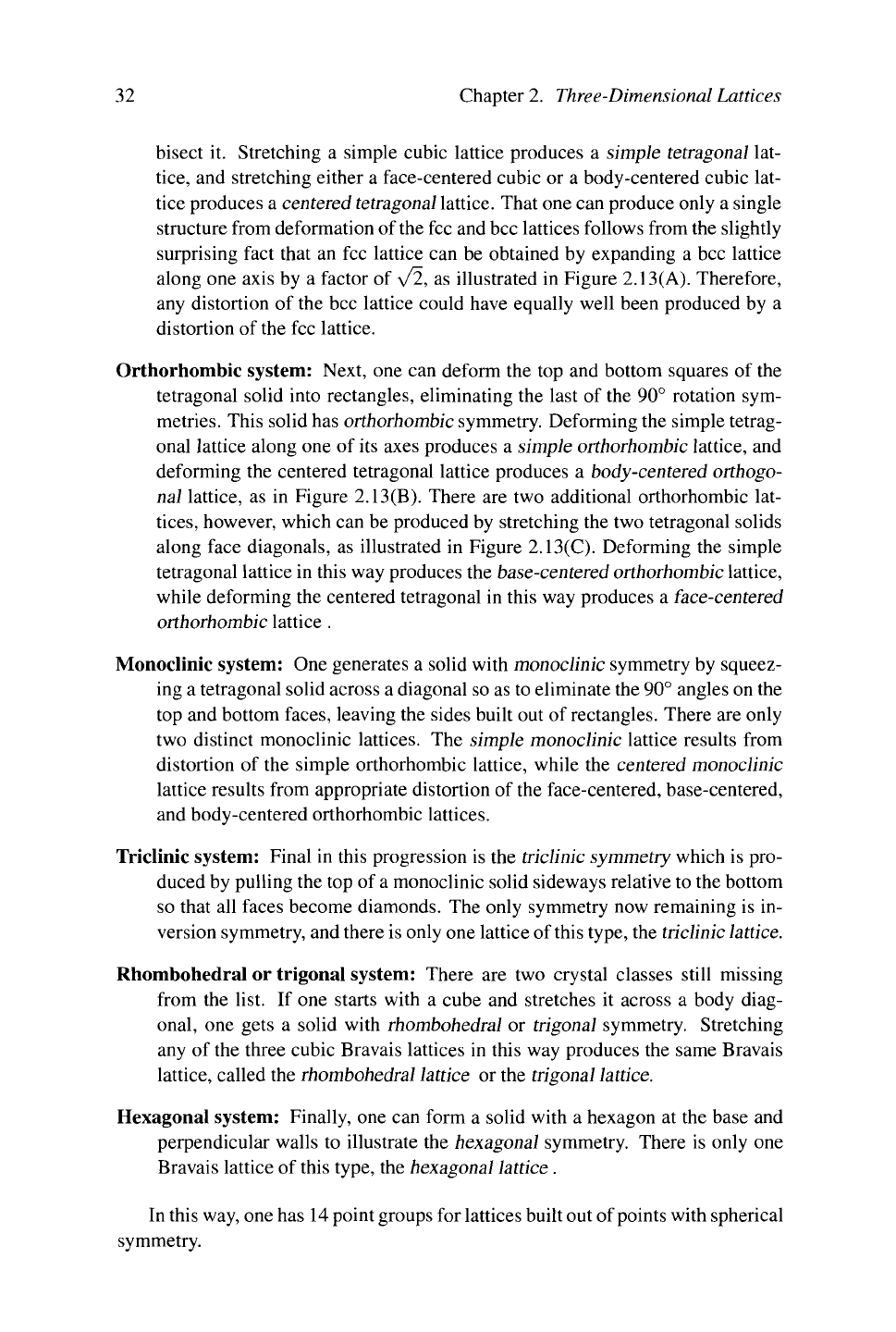
Figure 2.13. (A) If one stretches a bcc lattice by a factor of y/2 along one of its axes, it
becomes an fee lattice with lattice constant \[2 times larger, as shown by simply reconnect-
ing the lines between atoms. (B) Deforming tetragonal lattices along their axes produce
the simple and centered orthorhombic lattices. (C) Deforming tetragonal lattices along
diagonals produces base-centered and face-centered orthorhombic lattices.
Classification of Lattices by Symmetry
31
Table 2.8. The seven crystal systems and fourteen Bravais lattices in three
dimensions
Simple Base- Body- Face-
Centered Centered Centered
32
Chapter 2. Three-Dimensional Lattices
bisect it. Stretching a simple cubic lattice produces a simple
tetragonal
lat-
tice,
and stretching either a face-centered cubic or a body-centered cubic lat-
tice produces a centered
tetragonal
lattice. That one can produce only a single
structure from deformation of
the
fee and bec lattices follows from the slightly
surprising fact that an fee lattice can be obtained by expanding a bec lattice
along one axis by a factor of \/2, as illustrated in Figure 2.13(A). Therefore,
any distortion of the bec lattice could have equally well been produced by a
distortion of the fee lattice.
Orthorhombic system: Next, one can deform the top and bottom squares of the
tetragonal solid into rectangles, eliminating the last of the 90° rotation sym-
metries. This solid has orthorhombic symmetry. Deforming the simple tetrag-
onal lattice along one of its axes produces a simple orthorhombic lattice, and
deforming the centered tetragonal lattice produces a body-centered orthogo-
nal lattice, as in Figure 2.13(B). There are two additional orthorhombic lat-
tices,
however, which can be produced by stretching the two tetragonal solids
along face diagonals, as illustrated in Figure 2.13(C). Deforming the simple
tetragonal lattice in this way produces the base-centered orthorhombic lattice,
while deforming the centered tetragonal in this way produces a face-centered
orthorhombic lattice.
Monoclinic system: One generates a solid with monoclinic symmetry by squeez-
ing a tetragonal solid across a diagonal so as to eliminate the 90° angles on the
top and bottom faces, leaving the sides built out of rectangles. There are only
two distinct monoclinic lattices. The simple monoclinic lattice results from
distortion of the simple orthorhombic lattice, while the centered monoclinic
lattice results from appropriate distortion of the face-centered, base-centered,
and body-centered orthorhombic lattices.
Triclinic system: Final in this progression is the triclinic symmetry which is pro-
duced by pulling the top of a monoclinic solid sideways relative to the bottom
so that all faces become diamonds. The only symmetry now remaining is in-
version symmetry, and there is only one lattice of
this
type, the
triclinic
lattice.
Rhombohedral or trigonal system: There are two crystal classes still missing
from the list. If one starts with a cube and stretches it across a body diag-
onal, one gets a solid with rhombohedral or trigonal symmetry. Stretching
any of the three cubic Bravais lattices in this way produces the same Bravais
lattice, called the rhombohedral lattice or the
trigonal
lattice.
Hexagonal system: Finally, one can form a solid with a hexagon at the base and
perpendicular walls to illustrate the hexagonal symmetry. There is only one
Bravais lattice of this type, the hexagonal lattice.
In this way, one has
14
point groups for lattices built out of points with spherical
symmetry.