
Marder M.P. Condensed Matter Physics
Подождите немного. Документ загружается.

1.
The Idea of Crystals
1.1 Introduction
From the point of view of the physicist, a theory of matter is a policy
rather than a
creed;
its object is to connect or co-ordinate apparently
diverse
phenomena, and above all to suggest, stimulate and direct exper-
iment. —Thomson (1907), p. 1
The goal of condensed matter physics is to understand how underlying laws
unfold themselves in objects of the natural world. Because the complexity of con-
densed matter systems is so enormous, the number of atoms they involve so great,
and the possibility of solving all underlying equations in full detail so remote, the
laws of greatest importance are principles of symmetry.
A first step is to describe how atoms are arranged. As a mental image of ar-
rangement, the idea of the crystal has emerged out of an obscure class of minerals
to dominate thought about all solids. Here is symmetry with a vengeance. A small
group of atoms repeats a simple pattern endlessly through the stretches of a macro-
scopic body. The most precise experiments and the most detailed theories of solids
are all carried out in perfect crystals. Yet the world is neither a collection of crys-
tals,
nor a collection of solids wishing to be crystals but falling short of perfection.
Principles of symmetry more general than crystalline order still function in struc-
tures bearing no resemblance to the perfect lattice, while a rigid insistence upon
considering only solids in crystalline form would force one to abandon most natu-
rally occurring substances and technologically important materials. Nevertheless,
the science of condensed matter physics begins with the crystal, its single most
important structural idea.
In Greek, the word κρύσταλλος originally referred to ice. In the middle ages,
the word "crystal" first referred to quartz, and later to any solid whose external
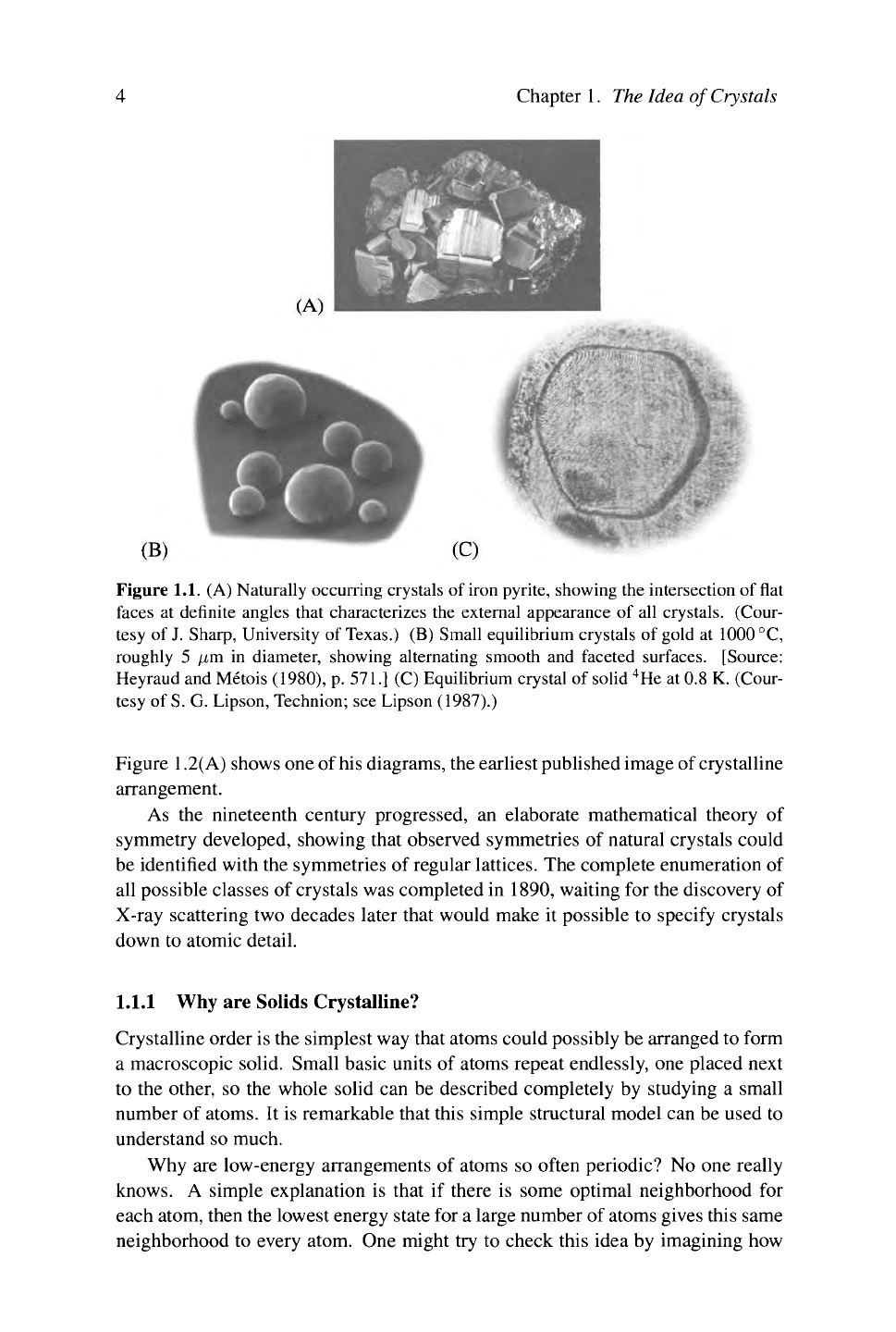
form consisted of flat faces intersecting at sharp angles (Figure 1.1). The first law
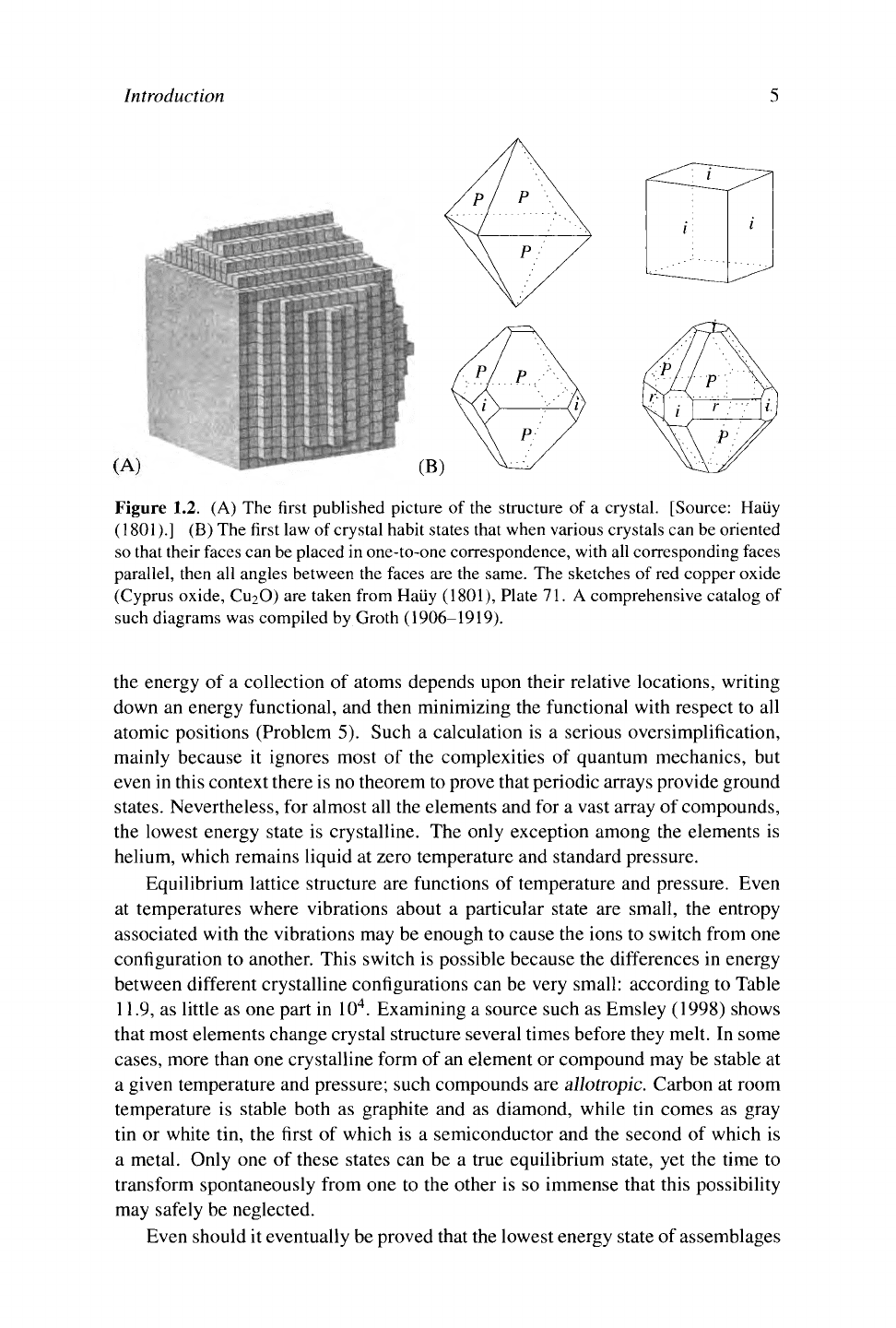
of crystal habit, discovered by Steno (1671), and illustrated in Figure 1.2, states
that corresponding faces of quartz always meet at the same angle. The second law
of crystal habit (see Problem 9 in Chapter 2), discovered by Haiiy (1801), states
that if one takes three edges of a crystal as coordinate axes and then asks where the
planes of other faces intersect these axes, the three intersection points are always
rational multiples of one another. Haiiy explained this law by assuming, as many
other scientists had done since around 1750, that crystals were built of vast numbers
of identical units, perhaps small polyhedra, stacked together in a regular fashion.
3
Condensed Matter
Physics,
Second Edition
by Michael P. Marder
Copyright © 2010 John Wiley & Sons, Inc.
4
Chapter 1. The Idea of Crystals
Figure 1.1. (A) Naturally occurring crystals of iron pyrite, showing the intersection of flat
faces at definite angles that characterizes the external appearance of all crystals. (Cour-
tesy of J. Sharp, University of Texas.) (B) Small equilibrium crystals of gold at 1000 °C,
roughly 5 μιη in diameter, showing alternating smooth and faceted surfaces. [Source:
Heyraud and Métois (1980), p. 571.] (C) Equilibrium crystal of solid
4
He at 0.8 K. (Cour-
tesy of S. G. Lipson, Technion; see Lipson (1987).)
Figure
1.2(A)
shows one of his diagrams, the earliest published image of crystalline
arrangement.
As the nineteenth century progressed, an elaborate mathematical theory of
symmetry developed, showing that observed symmetries of natural crystals could
be identified with the symmetries of regular lattices. The complete enumeration of
all possible classes of crystals was completed in 1890, waiting for the discovery of
X-ray scattering two decades later that would make it possible to specify crystals
down to atomic detail.
1.1.1 Why are Solids Crystalline?
Crystalline order is the simplest way that atoms could possibly be arranged to form
a macroscopic solid. Small basic units of atoms repeat endlessly, one placed next
to the other, so the whole solid can be described completely by studying a small
number of atoms. It is remarkable that this simple structural model can be used to
understand so much.
Why are low-energy arrangements of atoms so often periodic? No one really
knows. A simple explanation is that if there is some optimal neighborhood for
each atom, then the lowest energy state for a large number of atoms gives this same
neighborhood to every atom. One might try to check this idea by imagining how
Introduction
5
Figure 1.2. (A) The first published picture of the structure of a crystal. [Source: Haiiy
(1801).] (B) The first law of crystal habit states that when various crystals can be oriented
so that their faces can be placed in one-to-one correspondence, with all corresponding faces
parallel, then all angles between the faces are the same. The sketches of red copper oxide
(Cyprus oxide, CU2O) are taken from Haiiy (1801), Plate 71. A comprehensive catalog of
such diagrams was compiled by Groth (1906-1919).
the energy of a collection of atoms depends upon their relative locations, writing
down an energy functional, and then minimizing the functional with respect to all
atomic positions (Problem 5). Such a calculation is a serious oversimplification,
mainly because it ignores most of the complexities of quantum mechanics, but
even in this context there is no theorem to prove that periodic arrays provide ground
states.
Nevertheless, for almost all the elements and for a vast array of compounds,
the lowest energy state is crystalline. The only exception among the elements is
helium, which remains liquid at zero temperature and standard pressure.
Equilibrium lattice structure are functions of temperature and pressure. Even
at temperatures where vibrations about a particular state are small, the entropy
associated with the vibrations may be enough to cause the ions to switch from one
configuration to another. This switch is possible because the differences in energy
between different crystalline configurations can be very small: according to Table
11.9,
as little as one part in 10
4
. Examining a source such as Emsley (1998) shows
that most elements change crystal structure several times before they melt. In some
cases,
more than one crystalline form of an element or compound may be stable at
a given temperature and pressure; such compounds are allotropie. Carbon at room
temperature is stable both as graphite and as diamond, while tin comes as gray
tin or white tin, the first of which is a semiconductor and the second of which is
a metal. Only one of these states can be a true equilibrium state, yet the time to
transform spontaneously from one to the other is so immense that this possibility
may safely be neglected.
Even should it eventually be proved that the lowest energy state of assemblages
6
Chapter 1. The Idea of Crystals
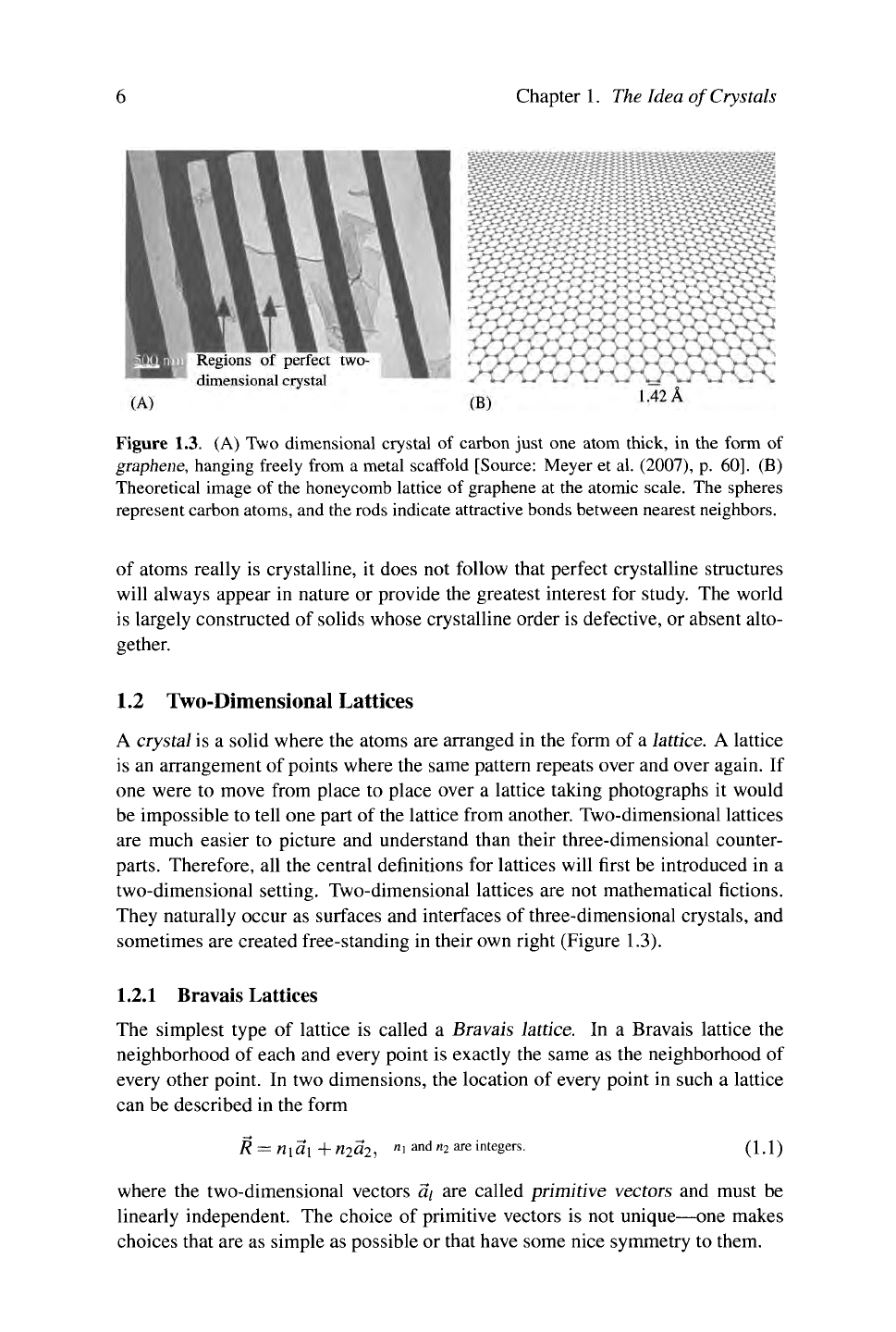
Figure 1.3. (A) Two dimensional crystal of carbon just one atom thick, in the form of
graphene,
hanging freely from a metal scaffold [Source: Meyer et al. (2007), p. 60]. (B)
Theoretical image of the honeycomb lattice of graphene at the atomic scale. The spheres
represent carbon atoms, and the rods indicate attractive bonds between nearest neighbors.
of atoms really is crystalline, it does not follow that perfect crystalline structures
will always appear in nature or provide the greatest interest for study. The world
is largely constructed of solids whose crystalline order is defective, or absent alto-
gether.
1.2 Two-Dimensional Lattices
A crystal is a solid where the atoms are arranged in the form of a lattice. A lattice
is an arrangement of points where the same pattern repeats over and over again. If
one were to move from place to place over a lattice taking photographs it would
be impossible to tell one part of the lattice from another. Two-dimensional lattices
are much easier to picture and understand than their three-dimensional counter-
parts.
Therefore, all the central definitions for lattices will first be introduced in a
two-dimensional setting. Two-dimensional lattices are not mathematical fictions.
They naturally occur as surfaces and interfaces of three-dimensional crystals, and
sometimes are created free-standing in their own right (Figure 1.3).
1.2.1 Bravais Lattices
The simplest type of lattice is called a Bravais lattice. In a Bravais lattice the
neighborhood of each and every point is exactly the same as the neighborhood of
every other point. In two dimensions, the location of every point in such a lattice
can be described in the form
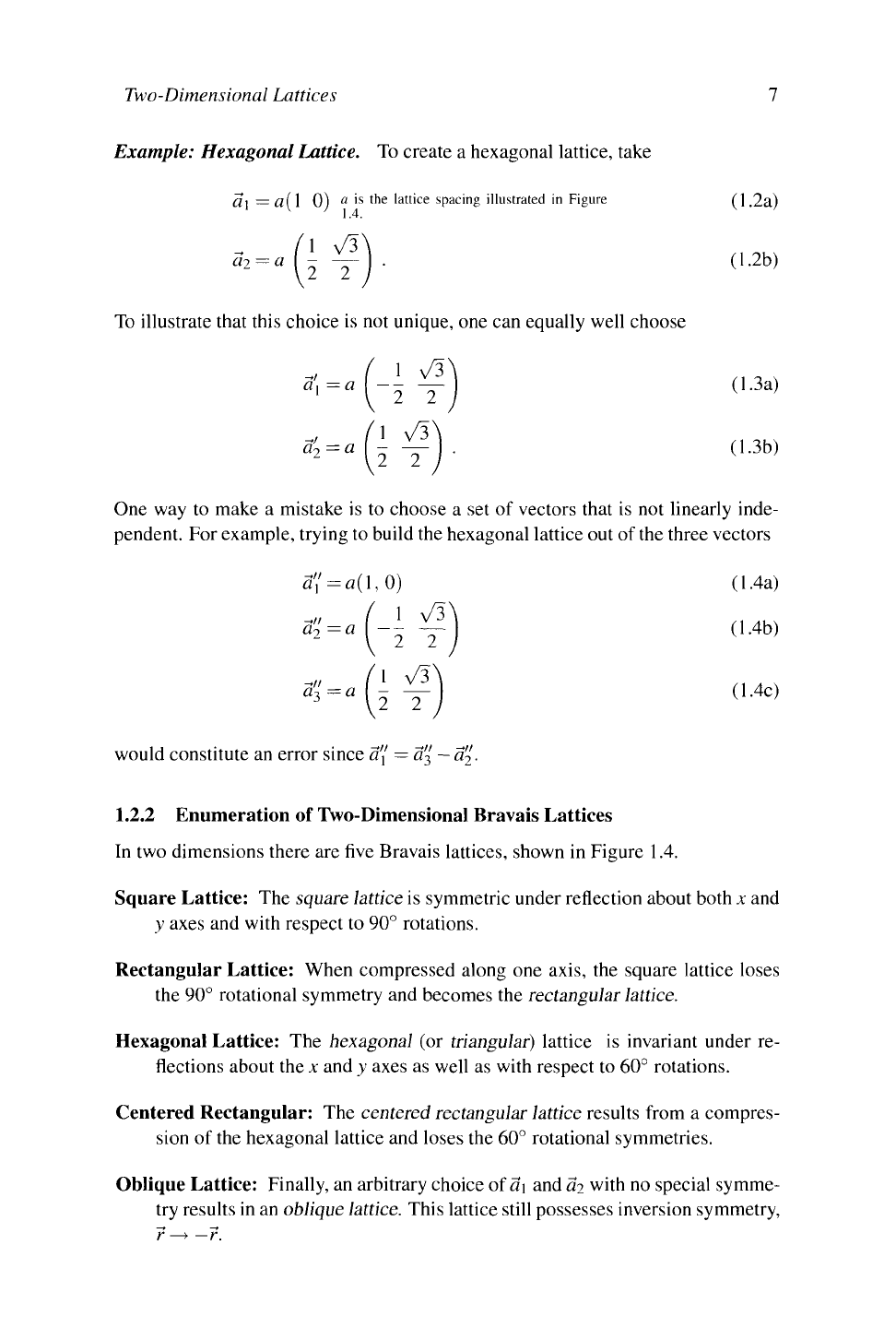
R = n\d\ + «2«2, "l and «2 are integers. (1.1)
where the two-dimensional vectors 5/ are called primitive vectors and must be
linearly independent. The choice of primitive vectors is not unique—one makes
choices that are as simple as possible or that have some nice symmetry to them.
Two-Dimensional Lattices 7
Example: Hexagonal Lattice. To create a hexagonal lattice, take
(X\ = a{\ 0)
a
'
s tne
lattice spacing illustrated in Figure (1.2a)
*2 = *(^)- 0-2b)
To illustrate that this choice is not unique, one can equally well choose
^ = *(^)· d-3b)
One way to make a mistake is to choose a set of vectors that is not linearly inde-
pendent. For example, trying to build the hexagonal lattice out of the three vectors
α" = α(1,0) (1.4a)
<=·(ΊΤ)
(K4b)
%
= <■({
ψ)
(1.4c)
would constitute an error since
a'[
= a" ~ a'j.
1.2.2 Enumeration of Two-Dimensional Bravais Lattices
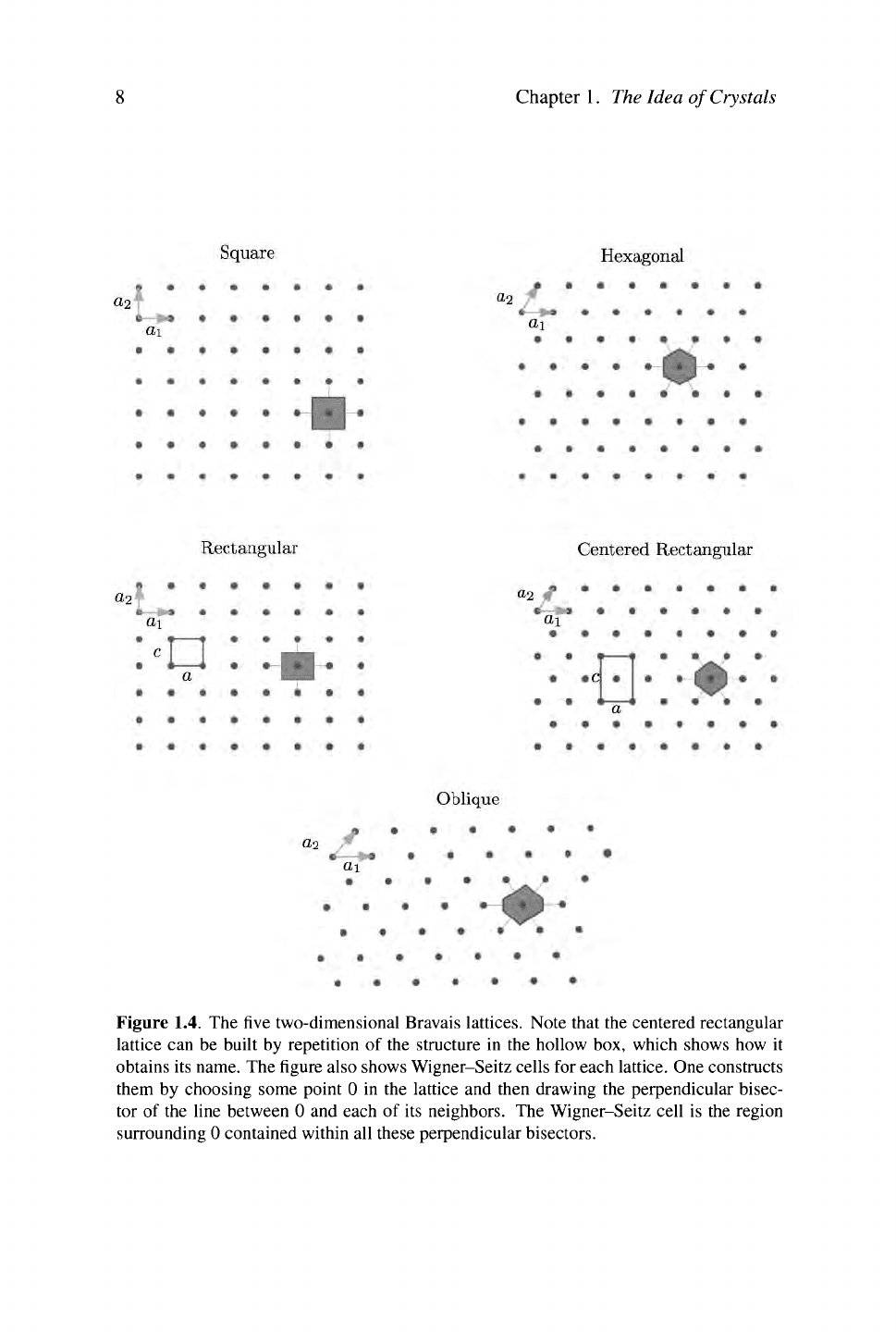
In two dimensions there are five Bravais lattices, shown in Figure 1.4.
Square Lattice: The
square
lattice is symmetric under reflection about both x and
y axes and with respect to 90° rotations.
Rectangular Lattice: When compressed along one axis, the square lattice loses
the 90° rotational symmetry and becomes the
rectangular
lattice.
Hexagonal Lattice: The hexagonal (or
triangular)
lattice is invariant under re-
flections about the x and y axes as well as with respect to 60° rotations.
Centered Rectangular: The centered
rectangular
lattice results from a compres-
sion of the hexagonal lattice and loses the 60° rotational symmetries.
Oblique Lattice: Finally, an arbitrary choice of
a\
and
a2
with no special symme-
try results in an oblique
lattice.
This lattice still possesses inversion symmetry,
8 Chapter 1. The Idea of Crystals
Figure 1.4. The five two-dimensional Bravais lattices. Note that the centered rectangular
lattice can be built by repetition of the structure in the hollow box, which shows how it
obtains its name. The figure also shows Wigner-Seitz cells for each lattice. One constructs
them by choosing some point 0 in the lattice and then drawing the perpendicular bisec-
tor of the line between 0 and each of its neighbors. The Wigner-Seitz cell is the region
surrounding 0 contained within all these perpendicular bisectors.
Two-Dimensional Lattices
9
1.2.3 Lattices with Bases
It
is
important
to
emphasize that the neighborhoods
of
all particles must
be
iden-
tical under translation
in
order
for a
structure
to
qualify
to be a
Bravais lattice.
Most lattices occurring
in
nature
are not
Bravais lattices,
but are
lattices with
a
basis. Lattices
of
this type are constructed by beginning with
a
Bravais lattice, but
putting
at
each lattice site
an
identical assembly
of
particles, rather than
a
single
rotationally invariant particle.
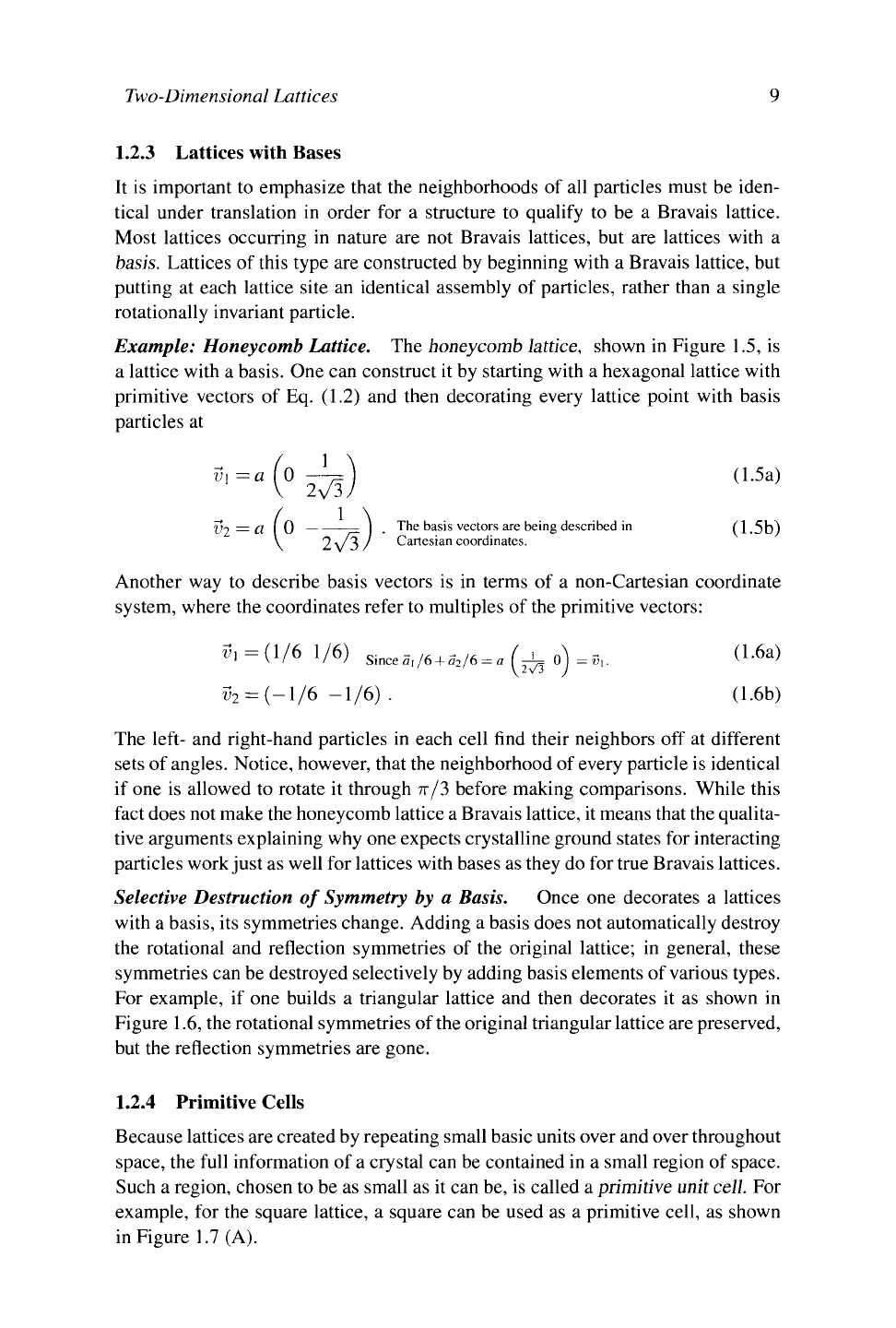
Example: Honeycomb Lattice. The honeycomb lattice, shown
in
Figure
1.5, is
a lattice with
a
basis. One can construct
it
by starting with
a
hexagonal lattice with
primitive vectors
of
Eq.
(1.2) and
then decorating every lattice point with basis
particles
at
%)2
= ü (0 1 .
The basis vectors are being described
in
(1.5b)
y
2v/3/
Cartesian coordinates.
Another
way to
describe basis vectors
is in
terms
of a
non-Cartesian coordinate
system, where the coordinates refer to multiples
of
the primitive vectors:
U, =(1/6 1/6) since2
I
/6 + %/6 =
e
(^0)=ii
1
. ^ ^
u
2
= (-l/6 -1/6) .
(1.6b)
The left-
and
right-hand particles
in
each cell find their neighbors
off at
different
sets
of
angles.
Notice, however, that the neighborhood
of
every particle is identical
if one
is
allowed
to
rotate
it
through
π/3
before making comparisons. While this
fact does not make the honeycomb lattice a Bravais lattice, it means that the qualita-
tive arguments explaining why one expects crystalline ground states for interacting
particles work just as well
for
lattices with bases as they do for true Bravais lattices.
Selective Destruction
of
Symmetry
by a
Basis. Once
one
decorates
a
lattices
with a basis,
its
symmetries change. Adding a basis does not automatically destroy
the rotational
and
reflection symmetries
of
the original lattice;
in
general, these
symmetries can be destroyed selectively by adding basis elements
of
various types.
For example,
if
one builds
a
triangular lattice
and
then decorates
it as
shown
in
Figure 1.6, the rotational symmetries of
the
original triangular lattice are preserved,
but the reflection symmetries are gone.
1.2.4 Primitive Cells
Because lattices are created by repeating small basic units over and over throughout
space, the full information
of
a crystal can be contained
in a
small region
of
space.
Such
a
region, chosen to be as small
as it
can be,
is
called a primitive unit
cell.
For
example,
for
the square lattice,
a
square can
be
used
as a
primitive cell,
as
shown
in Figure
1.7
(A).
10 Chapter 1. The Idea of Crystals
(C)
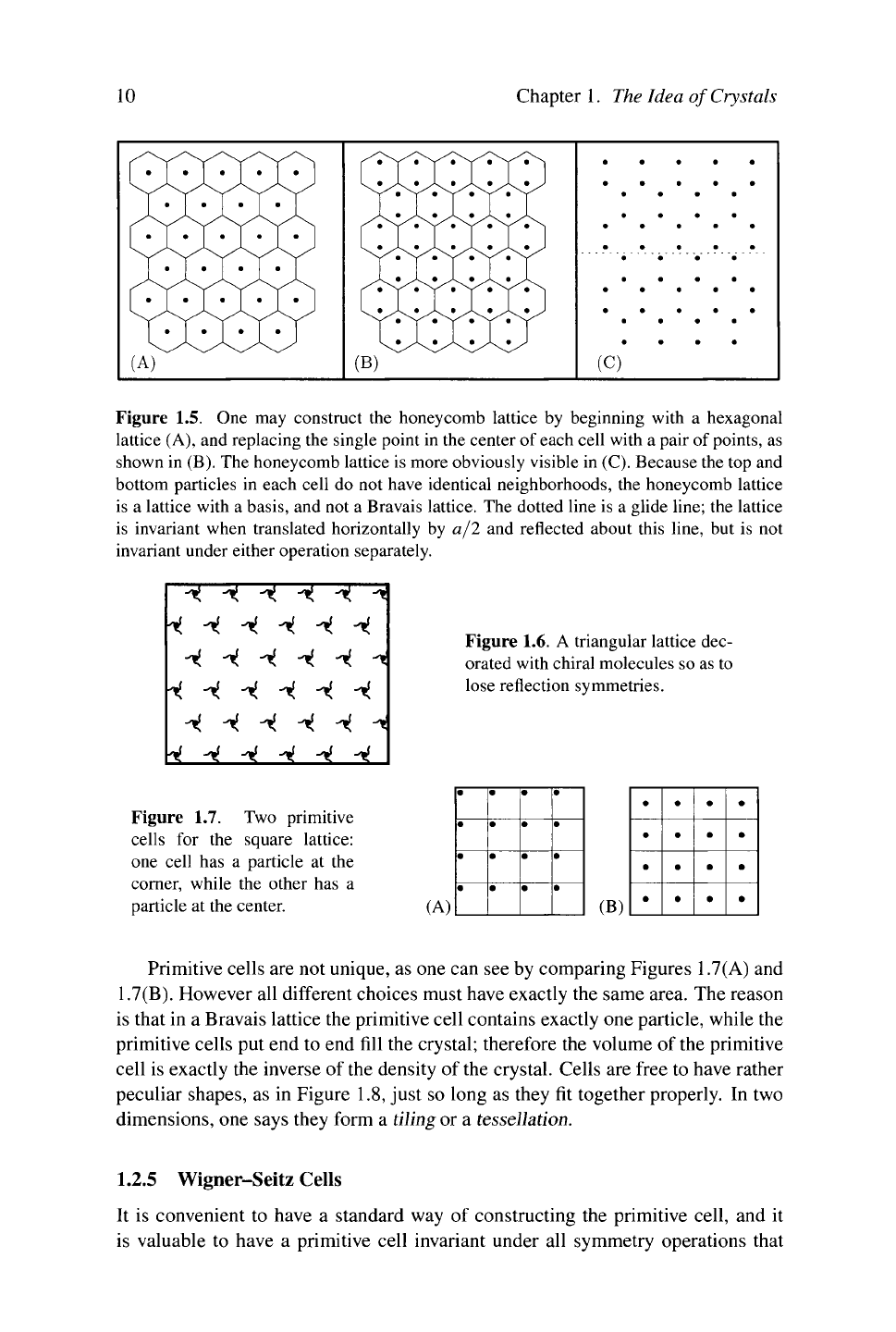
Figure 1.5. One may construct the honeycomb lattice by beginning with a hexagonal
lattice (A), and replacing the single point in the center of each cell with a pair of points, as
shown in (B). The honeycomb lattice is more obviously visible in (C). Because the top and
bottom particles in each cell do not have identical neighborhoods, the honeycomb lattice
is a lattice with a basis, and not a Bravais lattice. The dotted line is a glide line; the lattice
is invariant when translated horizontally by a/2 and reflected about this line, but is not
invariant under either operation separately.
< 4 4 4 ^
^
H
* < * < *
^ Λ( * -i * t
H < < -i < *
-y * ^ -y Λ( ^
k
H
*
Λ?
^ -y
Figure 1.7. Two primitive
cells for the square lattice:
one cell has a particle at the
corner, while the other has a
particle at the center.
Figure 1.6. A triangular lattice dec-
orated with chiral molecules so as to
lose reflection symmetries.
(A)
•
•
•
•
•
•
•
•
•
•
•
•
•
•
•
(B)
•
•
•
•
•
•
•
•
•
•
•
•
•
•
•
•
Primitive cells are not unique, as one can see by comparing Figures
1.7(A)
and
1.7(B).
However all different choices must have exactly the same area. The reason
is that in a Bravais lattice the primitive cell contains exactly one particle, while the
primitive cells put end to end fill the crystal; therefore the volume of the primitive
cell is exactly the inverse of the density of the crystal. Cells are free to have rather
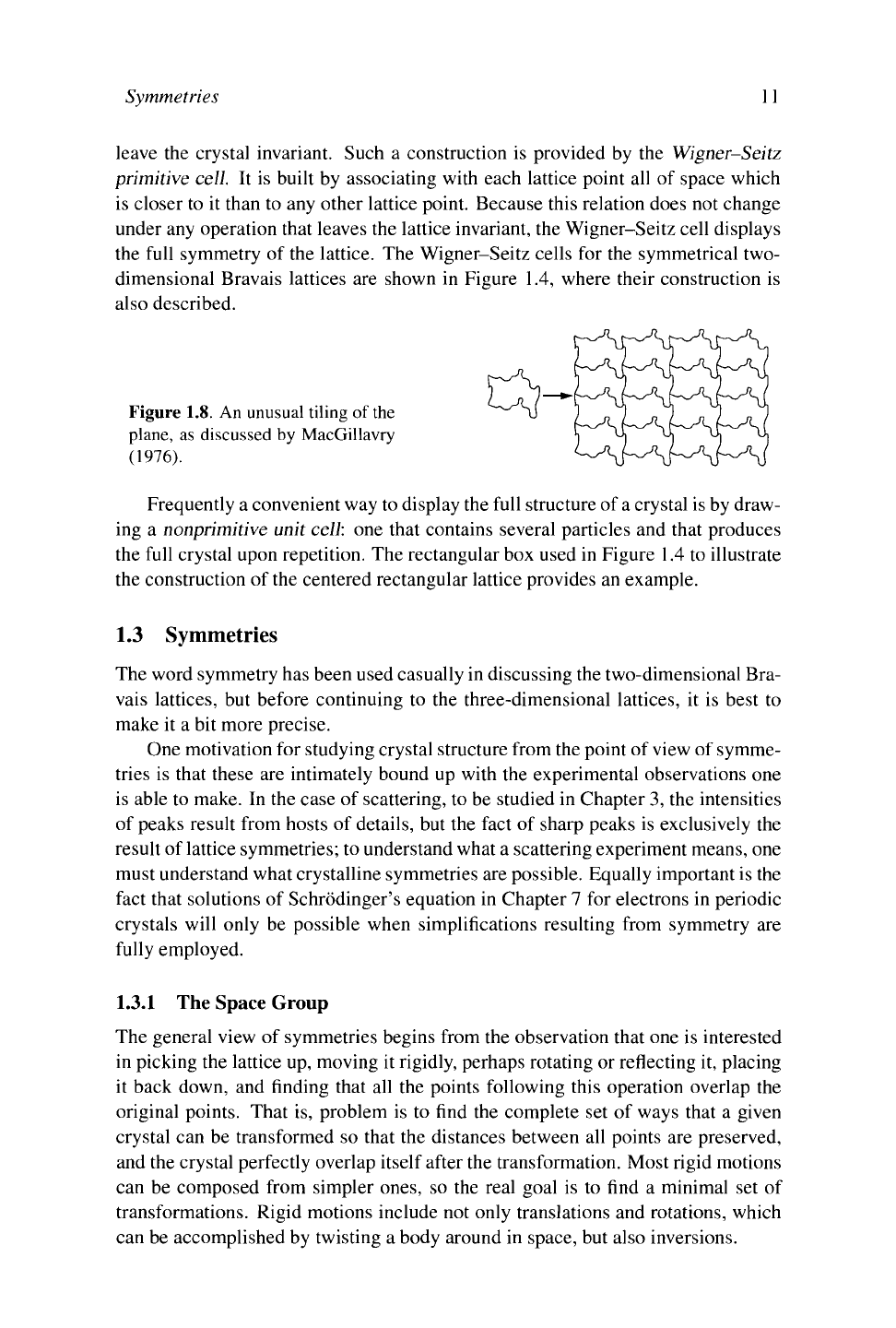
peculiar shapes, as in Figure 1.8, just so long as they fit together properly. In two
dimensions, one says they form a tiling or a tessellation.
1.2.5 Wigner-Seitz Cells
It is convenient to have a standard way of constructing the primitive cell, and it
is valuable to have a primitive cell invariant under all symmetry operations that
Symmetries 11
leave the crystal invariant. Such a construction is provided by the Wigner-Seitz
primitive cell. It is built by associating with each lattice point all of space which
is closer to it than to any other lattice point. Because this relation does not change
under any operation that leaves the lattice invariant, the Wigner-Seitz cell displays
the full symmetry of the lattice. The Wigner-Seitz cells for the symmetrical two-
dimensional Bravais lattices are shown in Figure 1.4, where their construction is
also described.
Figure 1.8. An unusual tiling of the
plane, as discussed by MacGillavry
(1976).
Frequently a convenient way to display the full structure of
a
crystal is by draw-
ing a nonprimitive unit
cell:
one that contains several particles and that produces
the full crystal upon repetition. The rectangular box used in Figure 1.4 to illustrate
the construction of the centered rectangular lattice provides an example.
1.3 Symmetries
The word symmetry has been used casually in discussing the two-dimensional Bra-
vais lattices, but before continuing to the three-dimensional lattices, it is best to
make it a bit more precise.
One motivation for studying crystal structure from the point of view of symme-
tries is that these are intimately bound up with the experimental observations one
is able to make. In the case of scattering, to be studied in Chapter 3, the intensities
of peaks result from hosts of details, but the fact of sharp peaks is exclusively the
result of lattice symmetries; to understand what a scattering experiment means, one
must understand what crystalline symmetries are possible. Equally important is the
fact that solutions of Schrödinger's equation in Chapter 7 for electrons in periodic
crystals will only be possible when simplifications resulting from symmetry are
fully employed.
1.3.1 The Space Group
The general view of symmetries begins from the observation that one is interested
in picking the lattice up, moving it rigidly, perhaps rotating or reflecting it, placing
it back down, and finding that all the points following this operation overlap the
original points. That is, problem is to find the complete set of ways that a given
crystal can be transformed so that the distances between all points are preserved,
and the crystal perfectly overlap itself after the transformation. Most rigid motions
can be composed from simpler ones, so the real goal is to find a minimal set of
transformations. Rigid motions include not only translations and rotations, which
can be accomplished by twisting a body around in space, but also inversions.
12
Chapter 1. The Idea of Crystals
Rigid motions can be described as a translation a plus a rotation Jl:
Explicit expressions for
31
in terms of angles and rota-
/~> _ jt
_i_
<T>
(-p
f. n\ tion axes appear in books on classical mechanics such as (i n\
yy u^i-J\\r,n,u).
Marion and
Thornton
( 1988)
or Goldstein
( 1980)
under
V ;
the heading of Euler angles.
3?(r, n,
Θ)
produces a rotation through
Θ
around axis h passing through point r.
Operators
3?
that invert or reflect the crystal are also allowed.
The complete set of rigid motions that take a crystal into itself is called the
space group. It is a group (formally defined in Section 7.3) because it consists
of a set of operations (rigid motions) with a natural product (perform a first rigid
motion, then another—the combined result is still a rigid motion). The unit element
consists of doing nothing.
1.3.2 Translation and Point Groups
Two subgroups of the space group deserve special mention. The
translation
group
consists of translations through all lattice vectors of the form n\a\ +«2^2 · . ·, and
by definition it leaves the crystal invariant. The point group consists of those op-
erations that leave the crystal invariant and which in addition map some particular
Bravais lattice point onto
itself.
It might seem that the space group is simply a prod-
uct of the point group and the translation group. This is true for Br-avail lattices,
but not for crystals in general, since there can exist combinations of translation
and reflection or rotation that leave a crystal invariant when used together but not
separately. The honeycomb lattice (Figure 1.5C) is invariant when translated hori-
zontally by a/2 and then reflected about a glide line. Screw
axes,
where a lattice is
invariant under a combination of translation and proper rotation neither of which is
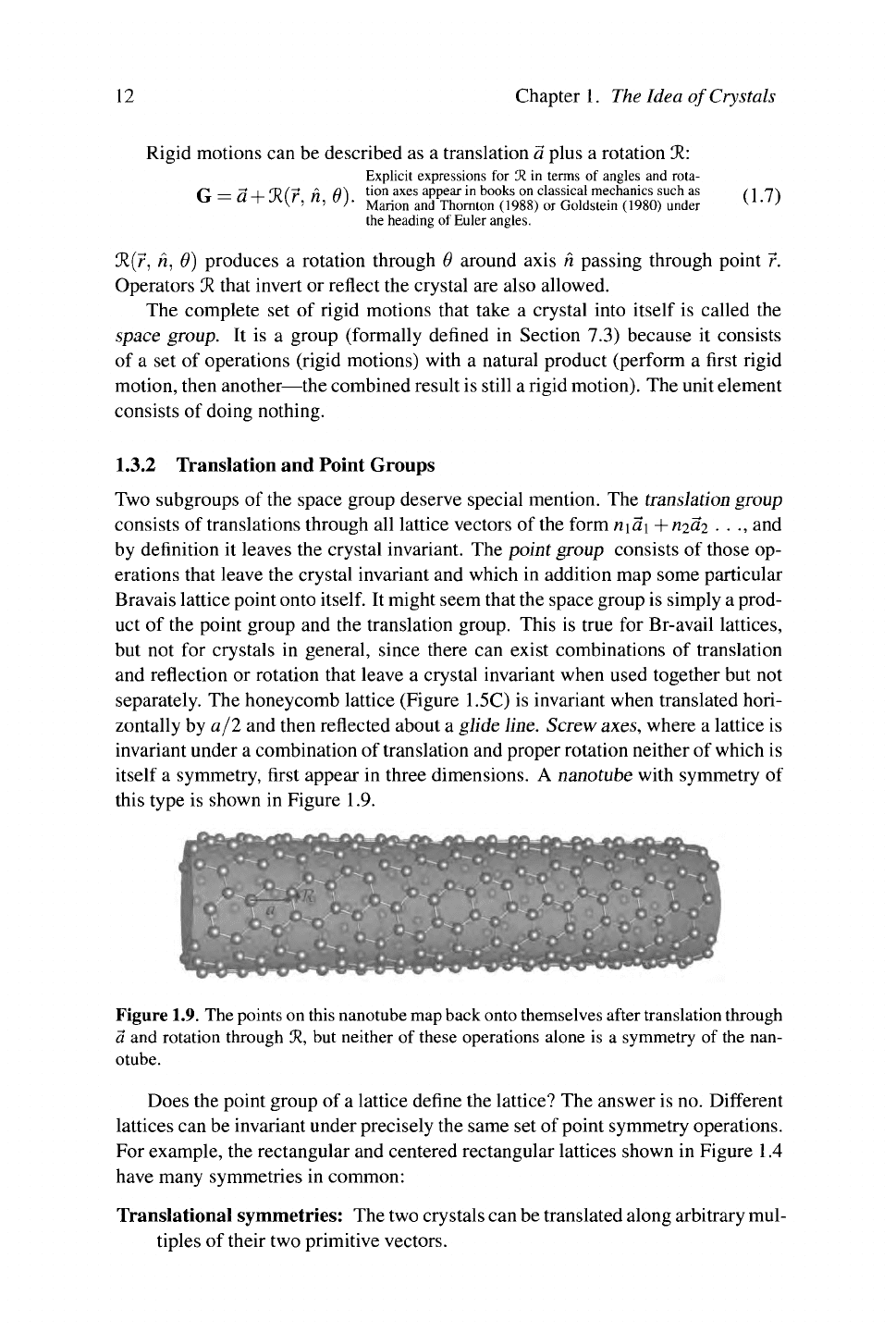
itself a symmetry, first appear in three dimensions. A nanotube with symmetry of
this type is shown in Figure 1.9.
Figure 1.9. The points
on
this nanotube
map
back
onto
themselves after translation through
a and rotation through % but neither of these operations alone is a symmetry of the nan-
otube.
Does the point group of a lattice define the lattice? The answer is no. Different
lattices can be invariant under precisely the same set of point symmetry operations.
For example, the rectangular and centered rectangular lattices shown in Figure 1.4
have many symmetries in common:
Translational symmetries: The two crystals can be translated along arbitrary mul-
tiples of their two primitive vectors.