
Marder M.P. Condensed Matter Physics
Подождите немного. Документ загружается.

B.
Variational Techniques
B.l Functionals and Functional Derivatives
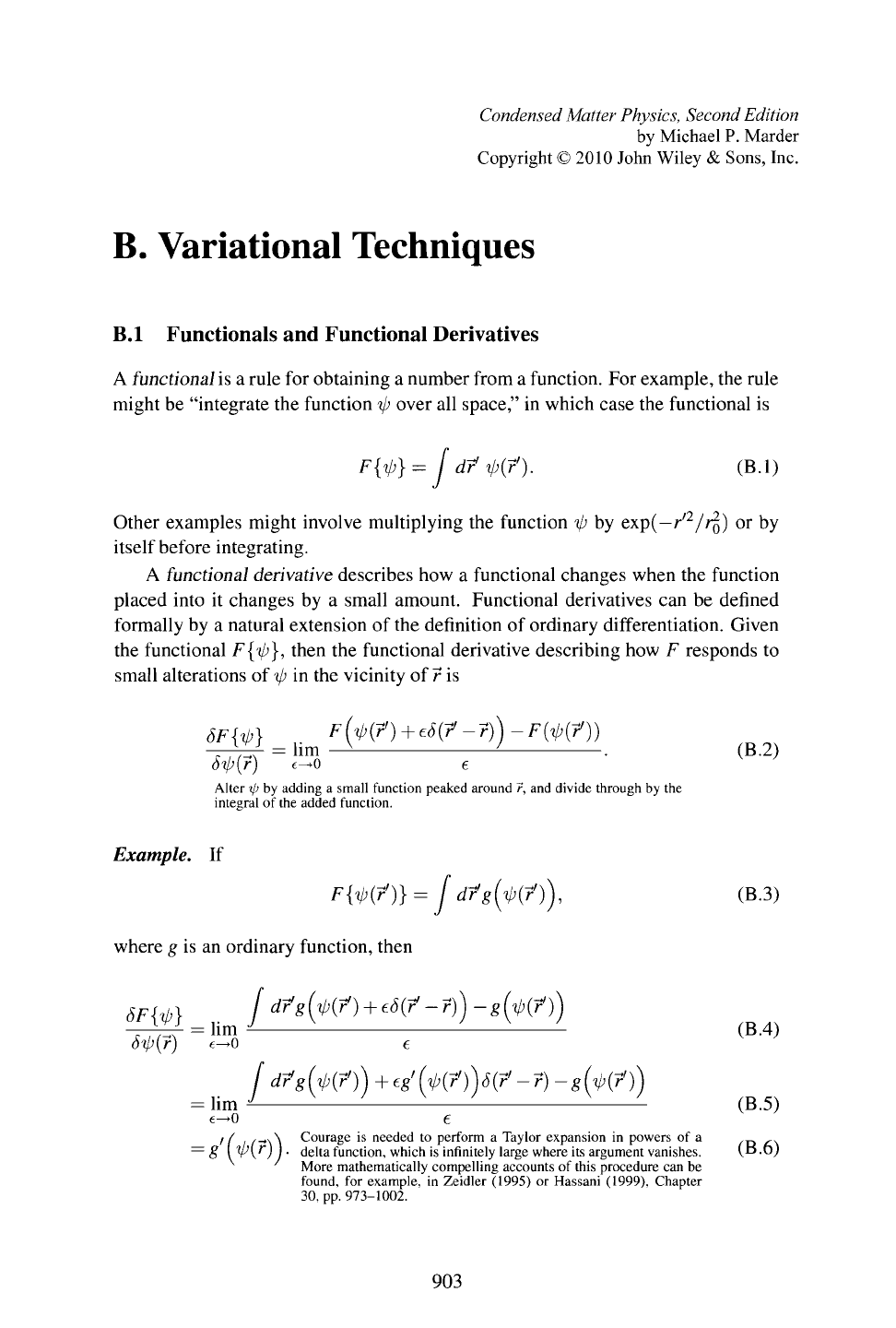
A functional is a rule for obtaining a number from a function. For example, the rule
might be "integrate the function
i\)
over all space," in which case the functional is
F{ip} = f df
ip(r
f
).
(B.l)
Other examples might involve multiplying the function ip by exp(—r
/2
/rg) or by
itself before integrating.
A functional derivative describes how a functional changes when the function
placed into it changes by a small amount. Functional derivatives can be defined
formally by a natural extension of the definition of ordinary differentiation. Given
the functional F {'(/>}, then the functional derivative describing how F responds to
small alterations of
xj)
in the vicinity of r is
SF{M FU(r')+e6(r'-r))-F^(r>))
T7PT =
lim
n — " •
(B
-
2)
Alter
ip
by adding a small function peaked around r, and divide through by the
integral of the added function.
Example. If
F{^(r')} = Jdr'g(^(r')), (B.3)
where g is an ordinary function, then
6FM I dr'gU(r') + eS(r'-r))-gN>(T>
„ \Z! = lim
l
(B.4)
6il>(r) e^o e
dr
,
gU(7'))+e
8
'U(r'))ö(r'
lim
J
- (B.5)
_> \ Courage is needed to perform a Taylor expansion in powers of a ,
f) j
■
delta function, which is infinitely large where its argument vanishes. (B.Ô)
More mathematically compelling accounts of this procedure can be
found, for example, in Zeidler (1995) or Hassani (1999), Chapter
30,
pp. 973-1002.
903
Condensed Matter
Physics,
Second Edition
by Michael P. Marder
Copyright © 2010 John Wiley & Sons, Inc.
904
Appendix B. Variational Techniques
B.2 Time-Independent Schrödinger Equation
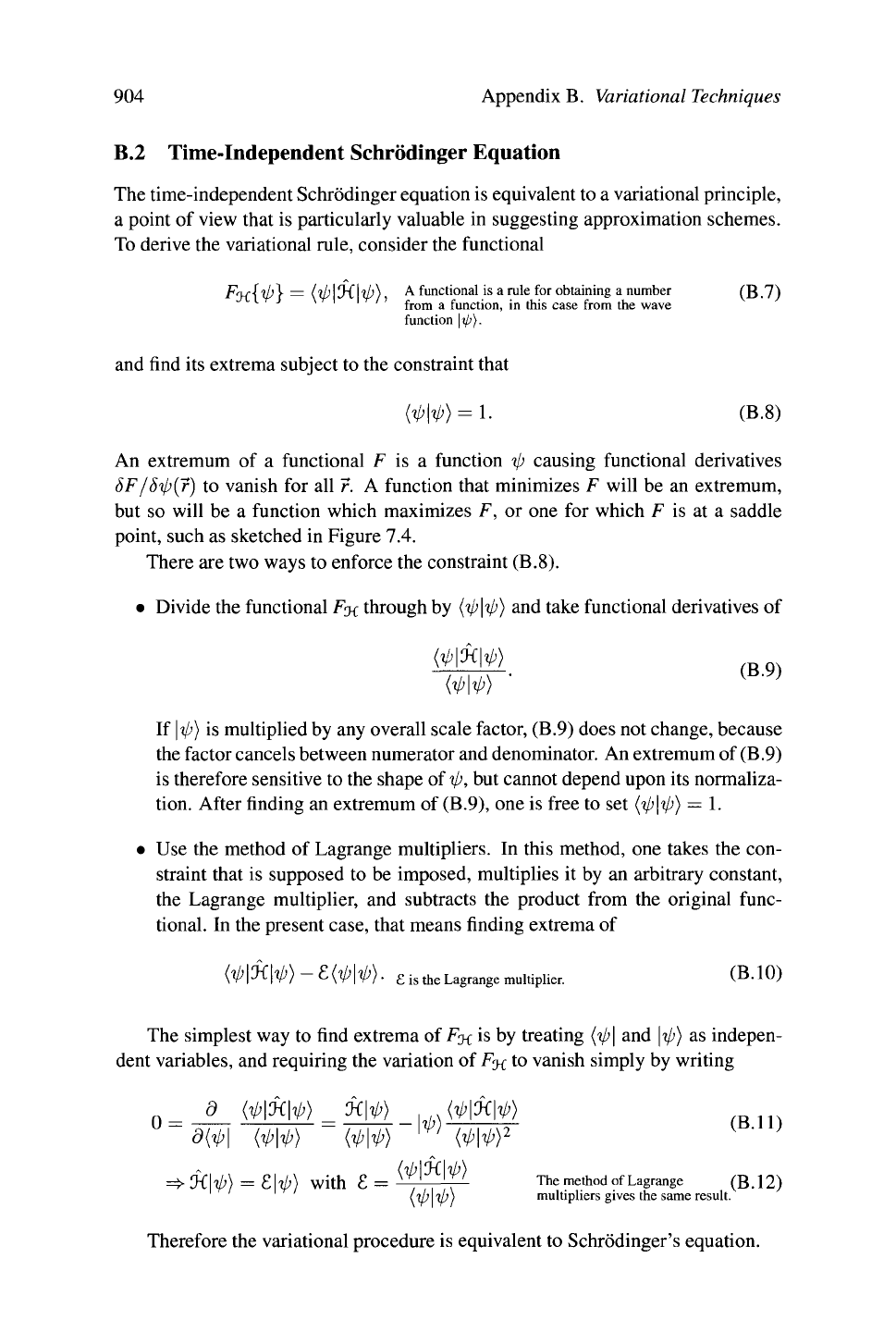
The time-independent Schrödinger equation is equivalent to a variational principle,
a point of view that is particularly valuable in suggesting approximation schemes.
To derive the variational rule, consider the functional
F'u{lb\
^
(ibl^Kllb) A functional is a rule for obtaining a number
(B.7)
from
a
function, in this case from the wave
function \ip).
and find its extrema subject to the constraint that
<V#>
=
i-
(B.8)
An extremum
of a
functional
F is a
function ip causing functional derivatives
6F/ôip(r) to vanish for all r.
A
function that minimizes
F
will be an extremum,
but so will be a function which maximizes F, or one for which
F
is at
a
saddle
point, such as sketched in Figure 7.4.
There are two ways to enforce the constraint (B.8).
• Divide the functional Fx through by
(ip\ip)
and take functional derivatives of
<^|Ä|V>
<</#>
(B.9)
•
If
\I/J)
is multiplied by any overall scale factor, (B.9) does not change, because
the factor cancels between numerator and denominator. An extremum of (B.9)
is therefore sensitive to the shape of
ip,
but cannot depend upon its normaliza-
tion. After finding an extremum of (B.9), one is free to set
(ip\ip)
— 1.
Use the method of Lagrange multipliers. In this method, one takes the con-
straint that is supposed to be imposed, multiplies it by an arbitrary constant,
the Lagrange multiplier, and subtracts the product from the original func-
tional. In the present case, that means finding extrema of
£ is the Lagrange multiplier.
(B.10)
The simplest way to find extrema of
FH;
is by treating
(ip\
and
\tp)
as indepen-
dent variables, and requiring the variation of
F<x
to vanish simply by writing
n
_
a
wKh/>>_w>
^,jmw
(B11)
d(ip\
(V#)
<V#>
' '
<V#>
2
■Mlp) =
S.\lp)
With £= V,, r
The method of Lagrange
(ß.12)
(lp\w)
multipliers gives the same result.
Therefore the variational procedure is equivalent to Schrödinger's equation.
Time-Dependent Schrödinger Equation 905
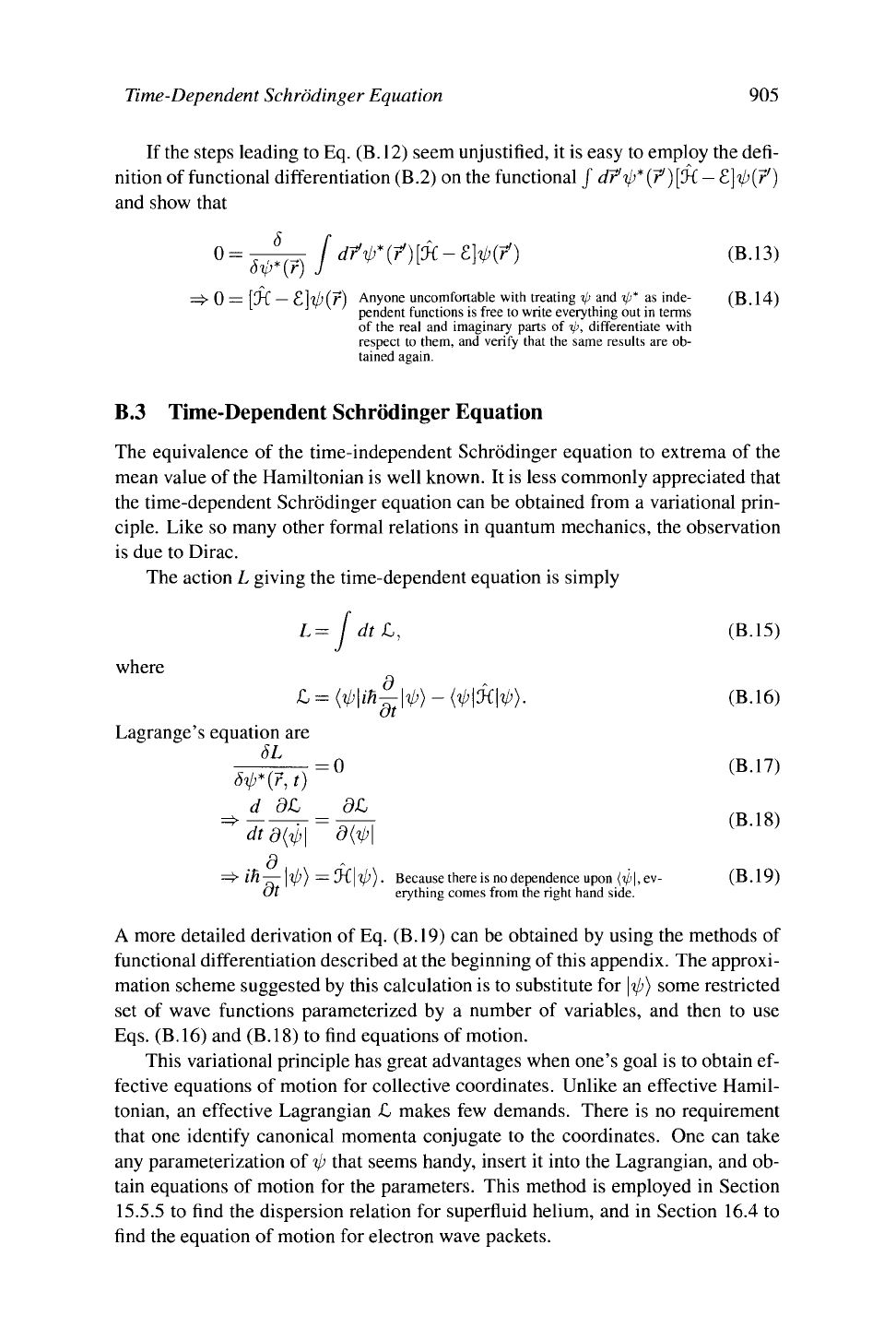
If the steps leading to Eq. (B.12) seem unjustified, it is easy to employ the defi-
nition of functional differentiation (B.2) on the functional /
dr'ip*
(?') \K
—
E^ipif)
and show that
0 =
WÏ7)
I^V)^-
£
]^)
<
B
-
13
)
=> 0 =
\0~C
— £.\lb(~r) Anyone uncomfortable with treating ip and ip" as inde- (B.14)
pendent functions is free to write everything out in terms
of the real and imaginary parts of ip, differentiate with
respect to them, and verify that the same results are ob-
tained again.
B.3 Time-Dependent Schrödinger Equation
The equivalence of the time-independent Schrödinger equation to extrema of the
mean value of the Hamiltonian is well known. It is less commonly appreciated that
the time-dependent Schrödinger equation can be obtained from a variational prin-
ciple. Like so many other formal relations in quantum mechanics, the observation
is due to Dirac.
The action L giving the time-dependent equation is simply
L= f dt £, (B.15)
where
£ = (#-ftj^)-M%>). (B.16)
Lagrange's equation are
5L
d dL dL
0 (B.17)
(B.18)
dtd(ip\ d(ip\
d
=r- 'Ä— \ip) —
J~C\lp).
Because there is no dependence upon (ip|, ev- (B.19)
Ot erything comes from the right hand side.
A more detailed derivation of Eq. (B.19) can be obtained by using the methods of
functional differentiation described at the beginning of this appendix. The approxi-
mation scheme suggested by this calculation is to substitute for
\ip)
some restricted
set of wave functions parameterized by a number of variables, and then to use
Eqs.
(B.16) and (B.18) to find equations of motion.
This variational principle has great advantages when one's goal is to obtain ef-
fective equations of motion for collective coordinates. Unlike an effective Hamil-
tonian, an effective Lagrangian
XL
makes few demands. There is no requirement
that one identify canonical momenta conjugate to the coordinates. One can take
any parameterization of
ip
that seems handy, insert it into the Lagrangian, and ob-
tain equations of motion for the parameters. This method is employed in Section
15.5.5 to find the dispersion relation for superfluid helium, and in Section 16.4 to
find the equation of motion for electron wave packets.
906 Appendix B.
Variational
Techniques
B.4 Method of Steepest Descent
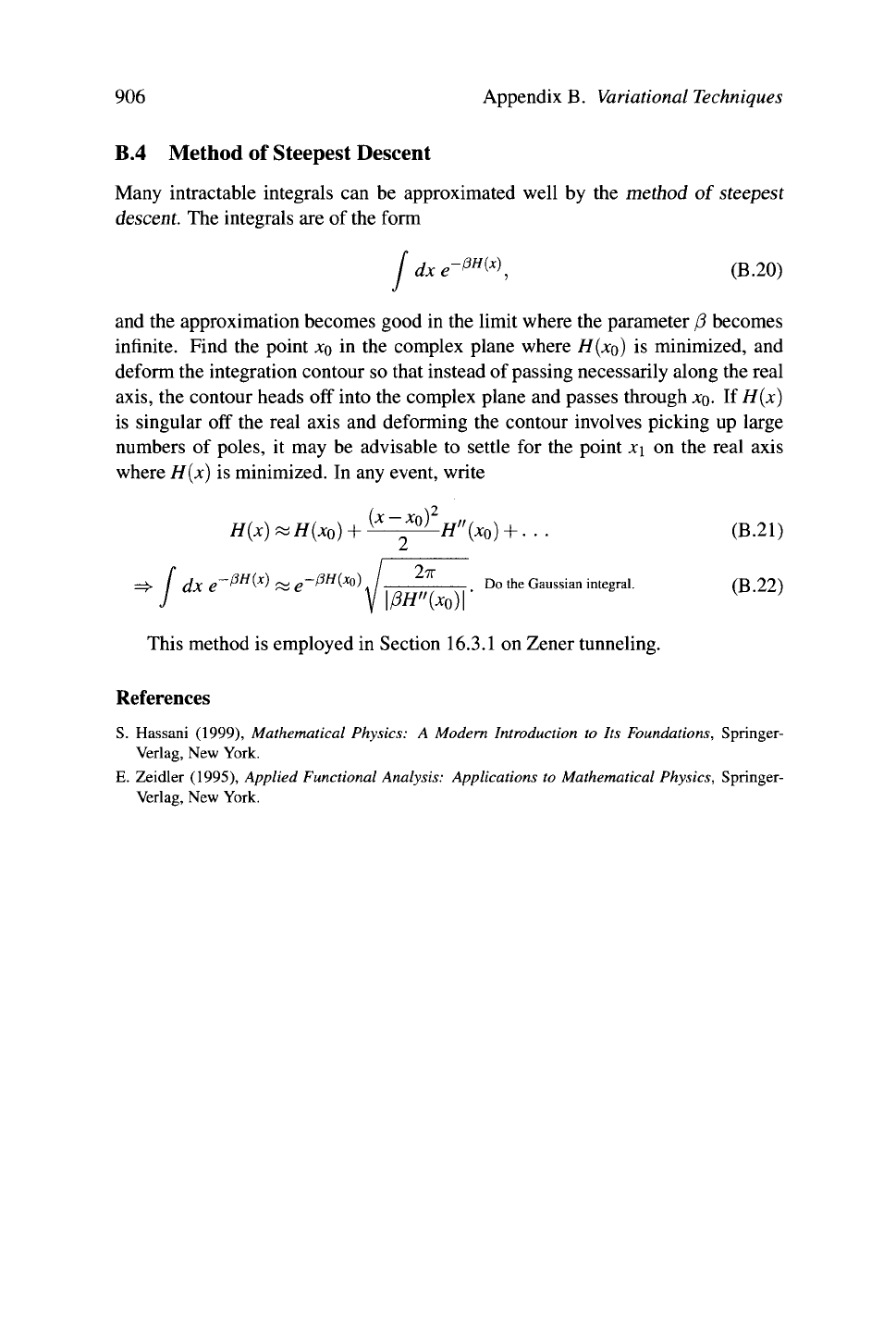
Many intractable integrals can be approximated well by the method of steepest
descent. The integrals are of the form
I dxe~
m(
-
x
\ (B.20)
and the approximation becomes good in the limit where the parameter ß becomes
infinite. Find the point xo in the complex plane where
H(XQ)
is minimized, and
deform the integration contour so that instead of passing necessarily along the real
axis,
the contour heads off into the complex plane and passes through
XQ.
If H(x)
is singular off the real axis and deforming the contour involves picking up large
numbers of poles, it may be advisable to settle for the point x\ on the real axis
where H(x) is minimized. In any event, write
/
H(x) « H(xo) +
{X
2
X0)
H"(x
0
) +. . . (B.21)
dx
e"^
Hi
^
« e~^
H
^ . \ Do the Gaussian integral. (B 22Ï
y\ßH"(x
0
)\'
^
}
This method is employed in Section 16.3.1 on Zener tunneling.
References
S. Hassani (1999), Mathematical Physics: A Modern Introduction to Its Foundations, Springer-
Verlag, New York.
E. Zeidler (1995), Applied Functional Analysis: Applications to Mathematical Physics, Springer-
Verlag, New York.
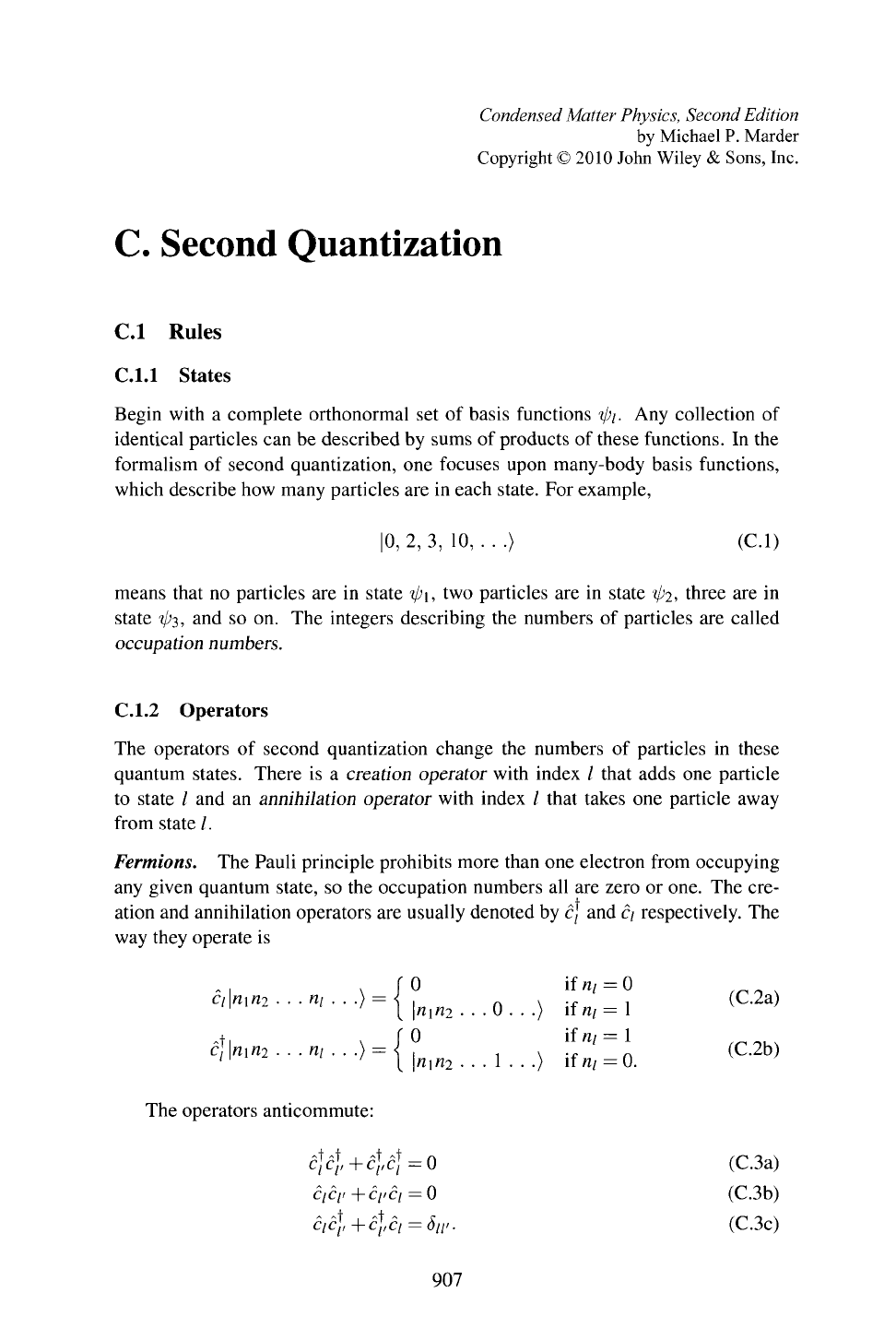
C.
Second Quantization
C.l Rules
C.1.1 States
Begin with a complete orthonormal set of basis functions ipi. Any collection of
identical particles can be described by sums of products of these functions. In the
formalism of second quantization, one focuses upon many-body basis functions,
which describe how many particles are in each state. For example,
|0,2,3,10,...) (C.l)
means that no particles are in state ip\, two particles are in state
V>2,
three are in
state fa, and so on. The integers describing the numbers of particles are called
occupation numbers.
C.1.2 Operators
The operators of second quantization change the numbers of particles in these
quantum states. There is a creation operator with index / that adds one particle
to state / and an annihilation operator with index / that takes one particle away
from state /.
Fermions. The Pauli principle prohibits more than one electron from occupying
any given quantum state, so the occupation numbers all are zero or one. The cre-
ation and annihilation operators are usually denoted by cj and c/ respectively. The
way they operate is
ci\n\ri2 ... ni ...) =
<
. „ , .
r
, (L.za)
1
' \ |m«2 • • . 0 . . .) if«/ = 1
ti \_/° ifn/ = l
c\\n\ni ... ni ...) =
<
. , > .
c
„ (C.2b)
" ' \ \n\n
2
. . . 1 . . .) if
ni
= 0.
The operators anticommute:
c]c},+c],c] = 0 (C.3a)
C[Ci>
+ CfCi = 0
(C.3b)
cic],
+
c],ci
=
Su'
■
(C.3c)
907
Condensed Matter
Physics,
Second Edition
by Michael P. Marder
Copyright © 2010 John Wiley & Sons, Inc.
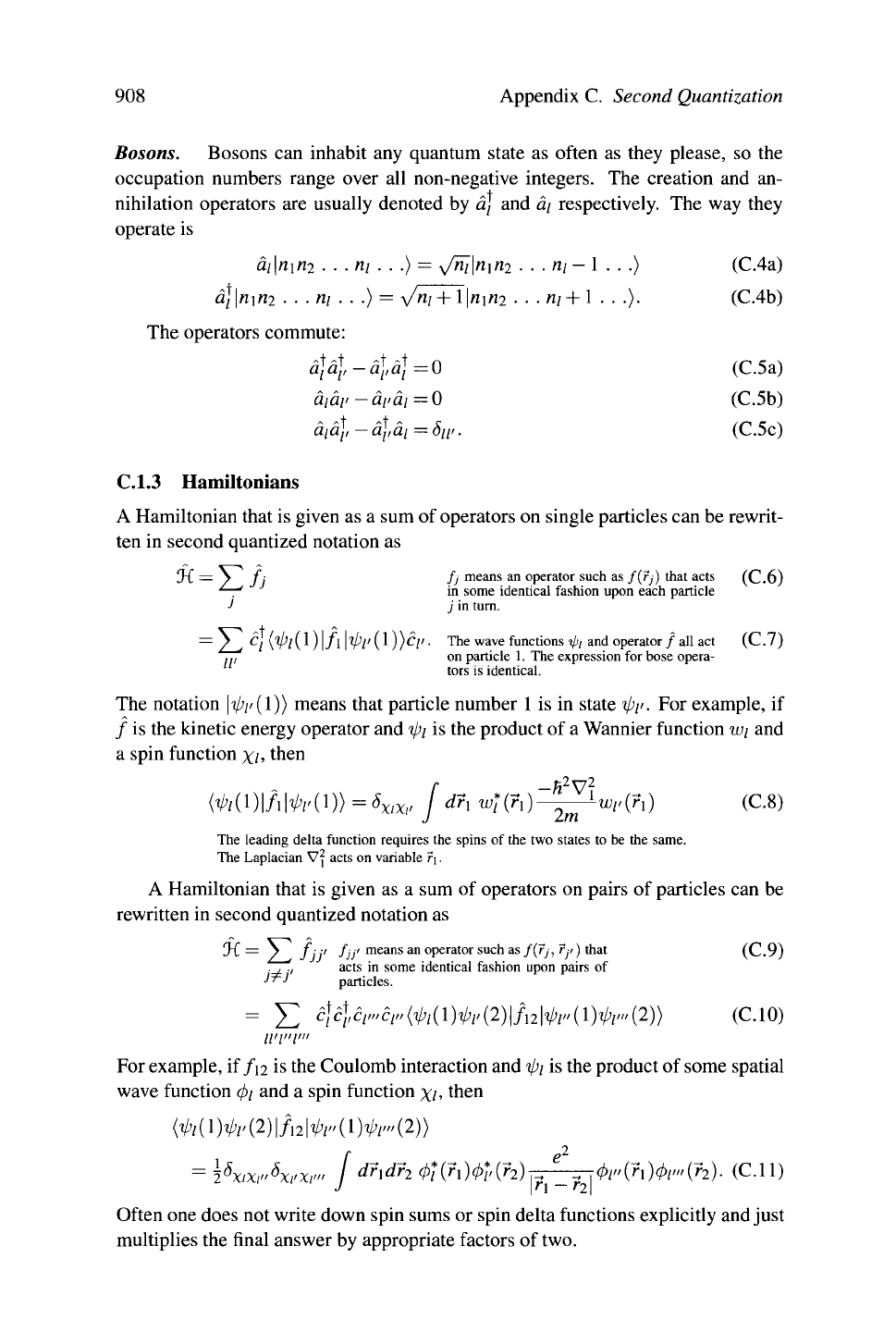
908
Appendix C. Second Quantization
Bosons. Bosons can inhabit any quantum state as often as they please, so the
occupation numbers range over all non-negative integers. The creation and an-
nihilation operators are usually denoted by a[ and
<3/
respectively. The way they
operate is
âi\n\H2 . . . ni . . .} =
y/h~i\nin
2
...«/-
1
.. .) (C.4a)
âj|ni«2 ...«/...) = \A*/ + l|«i«2 • •
•
ni + l . . .). (C.4b)
The operators commute:
â\â], -
â],â]
= 0 (C.5a)
âiâi'
—
âi'âi = 0 (C.5b)
âiâj,
—
aj,âi =
Ou'
•
(C.5c)
C.1.3 Hamiltonians
A Hamiltonian that is given as a sum of operators on single particles can be rewrit-
ten in second quantized notation as
J-C
:= \ f: fj means an operator such as f(7j) that acts (C.6)
^—? in some identical fashion upon each particle
J j in turn.
= y^ c] {ipi^lfillpi'
(\))ci/.
The wave functions tpi and operator / all act (C.7)
,,, on particle 1. The expression for bose opera-
tors is identical.
The notation
\ipi>(l))
means that particle number
1
is in state ipy. For example, if
/ is the kinetic energy operator and
tpi
is the product of a Wannier function wi and
a spin function Xh then
<V>/(i)l/ihMi)> = <W /^i ™;(n)
z
U
i
Mn) (C.8)
The leading delta function requires the spins of the two states to be the same.
The Laplacian V^ acts on variable T\.
A Hamiltonian that is given as a sum of operators on pairs of particles can be
rewritten in second quantized notation as
3"C = y fj:/ fjji means an operator such as /(?/, 7y) that (C.9)
M/'
acts in some identical fashion upon pairs of
particles.
= Y, eJ4e/'"e/"(^/(l)#(2)|/i2|#'(l)#"(2)) (C.10)
For example, if fu is the Coulomb interaction and
ipi
is the product of some spatial
wave function
</>/
and a spin function xi, then
(V/(l)#(2)|/i2|#'(l)#"(2)>
f e
2
= l
ô
xtXi"
0
x,'Xi'" / àridr
2
4>*(ri)4>Hr
2
)7z
—><t>i"(?\)<l>i>"(?i)■
(Cll)
J \
r
\ —>"2\
Often one does not write down spin sums or spin delta functions explicitly and just
multiplies the final answer by appropriate factors of two.
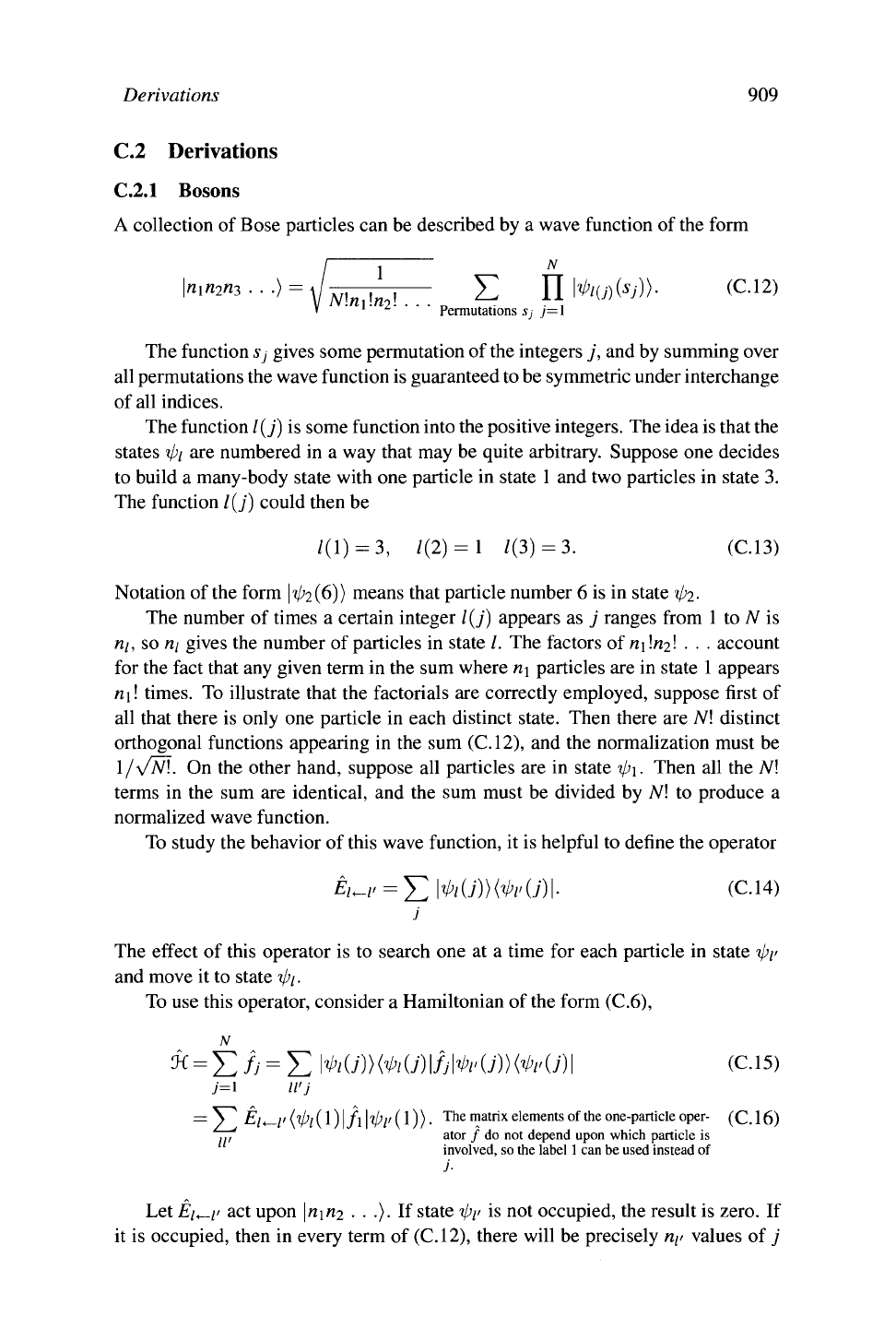
Derivations
909
C.2 Derivations
C.2.1 Bosons
A collection of Bose particles can be described by a wave function of the form
i"i"2*3...)=J
W
L, £ ni^M- (ci«
V Permutations Sj y'=l
The function
Sj
gives some permutation of the integers
j,
and by summing over
all permutations the wave function is guaranteed to be symmetric under interchange
of all indices.
The function /(_/) is some function into the positive
integers.
The idea is that the
states
ipi
are numbered in a way that may be quite arbitrary. Suppose one decides
to build a many-body state with one particle in state
1
and two particles in state 3.
The function l(j) could then be
/(1) = 3, /(2) =
1
/(3) = 3. (C.13)
Notation of the form |?/>2(6)) means that particle number 6 is in state
ip2-
The number of times a certain integer l(j) appears as j ranges from 1 to N is
ni, so m gives the number of particles in state /. The factors of
n\\ri2\
■ ■ ■
account
for the fact that any given term in the sum where n\ particles are in state
1
appears
n\\
times. To illustrate that the factorials are correctly employed, suppose first of
all that there is only one particle in each distinct state. Then there are N\ distinct
orthogonal functions appearing in the sum (C.12), and the normalization must be
\/y/N\.
On the other hand, suppose all particles are in state ip\. Then all the N\
terms in the sum are identical, and the sum must be divided by
AH
to produce a
normalized wave function.
To study the behavior of this wave function, it is helpful to define the operator
iz-/'
El^(i))(#(;)l- (c.14)
The effect of this operator is to search one at a time for each particle in state
ipi>
and move it to state ipi.
To use this operator, consider a Hamiltonian of the form (C.6),
^
=
E fj
=
E \MJ))(W)\fj\MJ)){MJ)\
(c.15)
= \ £/<_/' (lbi(\)
I
f\ |l/>;/(l)). The matrix elements of the one-particle oper- (C.16)
.,, ator / do not depend upon which particle is
involved, so the label
1
can be used instead of
j-
Let £/<_// act upon |«i«2 • • •)• If state
ipi>
is not occupied, the result is zero. If
it is occupied, then in every term of (C.12), there will be precisely
ni>
values of j
910
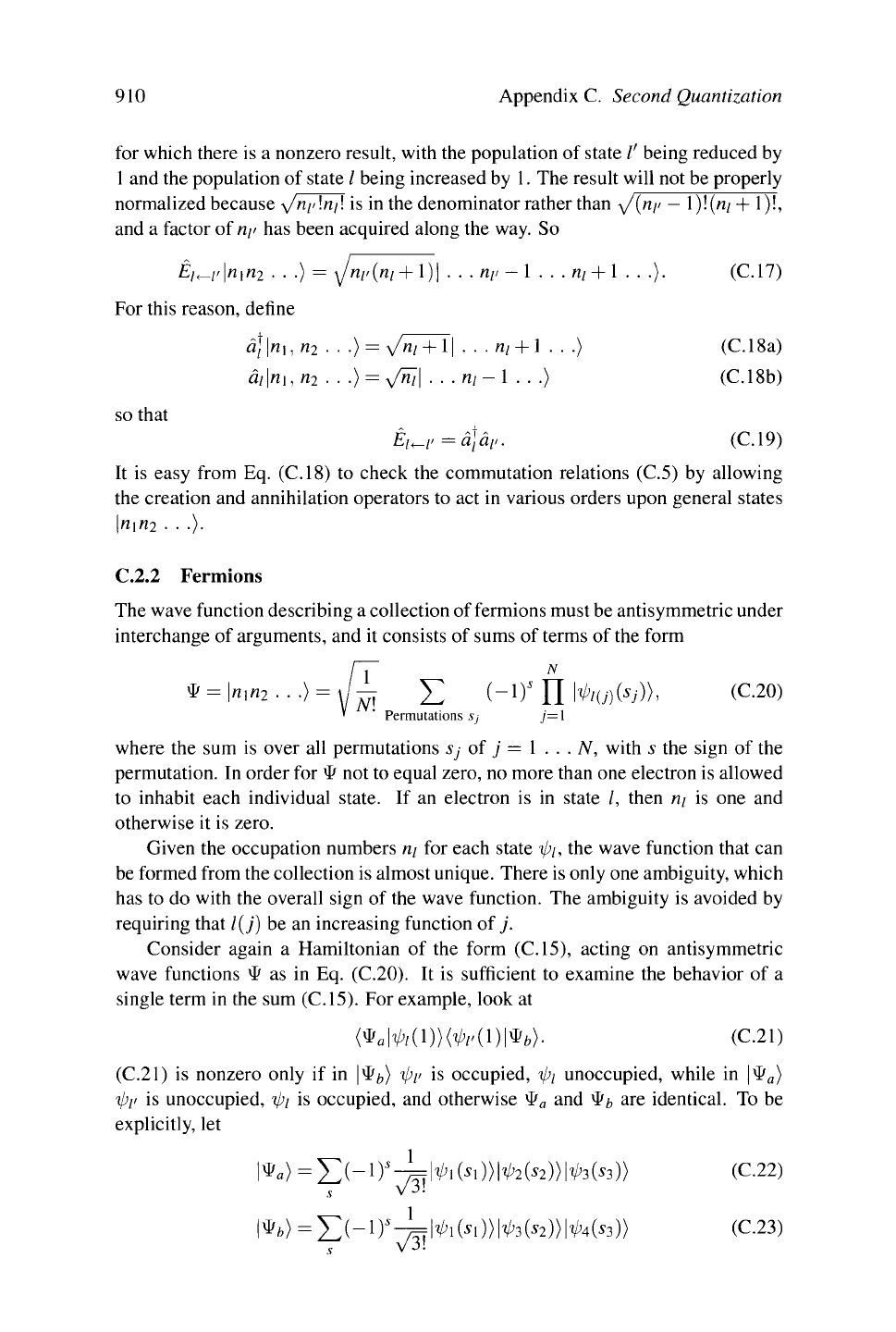
Appendix C. Second Quantization
for which there is a nonzero result, with the population of state /' being reduced by
1 and the population of state / being increased by 1. The result will not be properly
normalized because \fn[i\n\\ is in the denominator rather than
y/(ni>
—
l)!(n/
+
1)!,
and a factor of n^ has been acquired along the way. So
£/<-/'l
w
i«2 • • •)
=
y «/'(«/
+
1)|
. . .
«//
-
1
. .
. n/
+
1
. .
.). (C.17)
For this reason, define
a]\n\
â[\n\
,
n
2
■
,
n
2
■
■
■)
=
A/«Z
+
1|
. . .
n/
+ l
■
.
.) =
y/h~i\
. . . ni -
1
. . .)
£■
4-
£S/^/'
=
a, a/i.
(Cl 8a)
(C.18b)
so that
(C.19)
It is easy from Eq. (C.18) to check the commutation relations (C.5) by allowing
the creation and annihilation operators to act in various orders upon general states
\n\n
2
. .
.).
C.2.2 Fermions
The wave function describing a collection of fermions must be antisymmetric under
interchange of arguments, and it consists of sums of terms of the form
fT
N
* = h«2
• - •)
= v^ï
£
(-
1
)" II Mœto)>. (c.20)
'
'
Permutations Sj
j=\
where the sum is over all permutations Sj of
j
= 1
. .
. N, with 5 the sign of the
permutation. In order for
^
not to equal zero, no more than one electron is allowed
to inhabit each individual state.
If
an electron
is in
state
/,
then «/
is
one and
otherwise it is zero.
Given the occupation numbers «/ for each state
ipi,
the wave function that can
be formed from the collection is almost
unique.
There is only one ambiguity, which
has to do with the overall sign of the wave function. The ambiguity is avoided by
requiring that /(_/) be an increasing function of
j.
Consider again
a
Hamiltonian
of
the form (C.15), acting on antisymmetric
wave functions
^
as in Eq. (C.20). It is sufficient to examine the behavior of a
single term in the sum (C.15). For example, look at
(*a\Ml))(Ml)\*b).
(C21)
(C.21) is nonzero only
if
in \^b) ipi'
is
occupied, ipi unoccupied, while in |^>
a
)
ijj[i
is unoccupied, ipi is occupied, and otherwise
ty
a
and
^>b
are identical. To be
explicitly, let
l^>=£(-l)'
S
^lVM(si)>hMs2))|V>3(s3)) (C.22)
|^>
=
E(-
i
r-Ll^(*i)>l^(^2))|V'4(^)>
(C23)
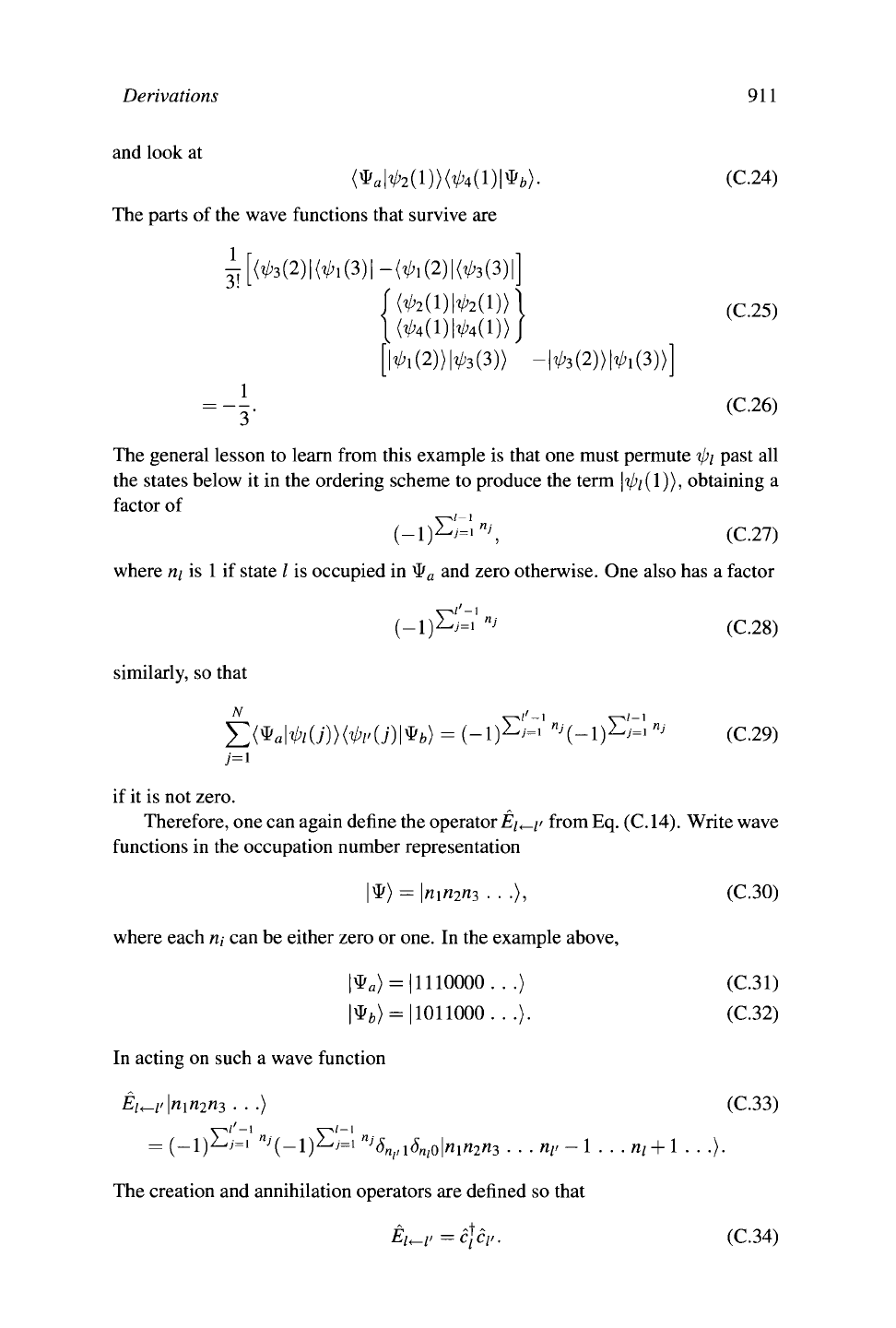
Derivations 911
and look at
(*
fl
|^(l))(V
4
(l)|**).
The parts of the wave functions that survive are
1 r
(C.24)
3!
(^(2)|(Vi(3)|-(Vi(2)|(^(3)|
'<V>2(l)hMl)>
|^(2))|^(3)) -|^3(2))|Vi(3))
(C.25)
(C.26)
The general lesson to learn from this example is that one must permute
ipi
past all
the states below it in the ordering scheme to produce the term |Vv(l)), obtaining a
factor of
(_!)£;=! »^ (C.27)
where «/ is
1
if state / is occupied in ty
a
and zero otherwise. One also has a factor
(-1)
v-V-l
(C.28)
similarly, so that
N
,/'-!
e^lVvOm'U)!**) =
(-1)^=«
^(-1)^=. "' (C.29)
7=1
if it is not zero.
Therefore, one can again define the operator
£/«_/>
from
Eq.
(C.
14).
Write wave
functions in the occupation number representation
|*> = |«1«2«3
>, (C30)
where each
n,-
can be either zero or one. In the example above,
|*
a
) = |1110000. . .)
|#
fc
) =
|
1011000. . .).
In acting on such a wave function
£/<_//|«in
2
n3 • • •}
=
(-i)EU' ">(-l)^=i
nj
S
nill
ö
ni
o\n
in2
m . . . n
v
-
1
. . . ni +
1
. . .).
The creation and annihilation operators are defined so that
(C.31)
(C.32)
(C.33)
£/<_/>
=0%,.
(C.34)
912 AppendixC. Second Quantization
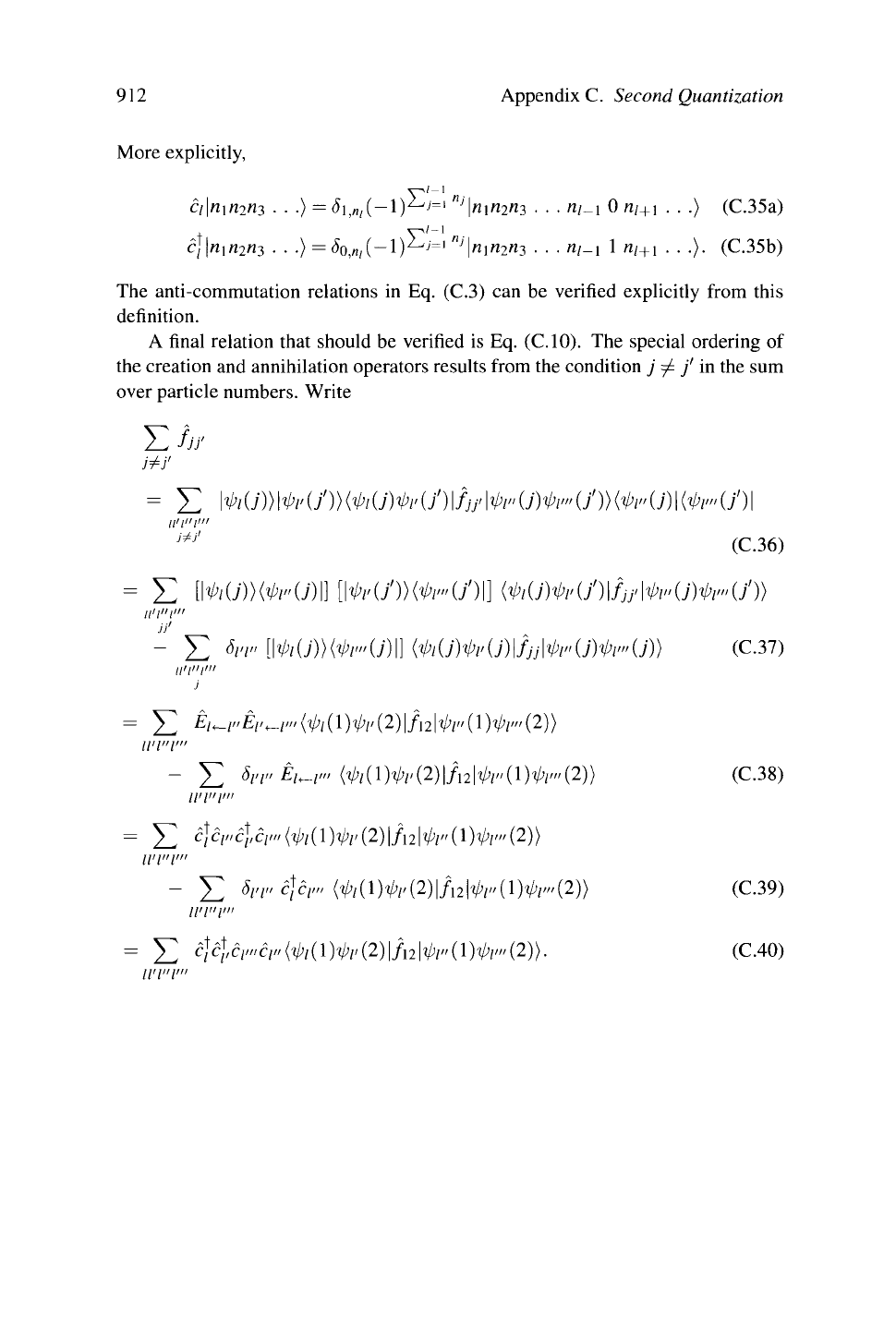
More explicitly,
Q|«in2«3 • •
■)
= 5i,n,(-l)
j=1 n
'\n\n
2
m . . . rc
;
_i 0 «
/+]
. . .) (C.35a)
cj|«in
2
«3 • • ^^o.nX-
1
)
i=l y
|"i"2"3 • •
•
"/-i 1 "/+1 • • •)• (C.35b)
The anti-commutation relations in Eq. (C.3) can be verified explicitly from this
definition.
A final relation that should be verified is Eq. (C.IO). The special ordering of
the creation and annihilation operators results from the condition j ^ / in the sum
over particle numbers. Write
E fjr
= E IV'/O0)I^K/))(V'/a)#(/)l/i/l#K;>/-(/))(V'/»(i)K#»(/)l
;//
(C.36)
= E
[\MJ)){^i"U)\]
[l^'(/)><#»(/)l]
{MJ)MJ')\fjjWi>iJ)rPi>»(j'))
E <W' [\Mj)H^i'"U)\] (MJ)MJ)\fjjWi»UWi>"U))
(C.37)
ll>l"t"'
j/
,,1,11,111
j
'{"V"
- Y. 5/'/"^/"'^/(l)#(2)|/i2|#'(l)#»(2)> (C38)
E c]"c
/
//c
/
t
,c/»'(^/(l)#(2)|/i
2
|V'/"(l)#''(2))
E <*/'/» £/V (^(1)#(2)|/
12
|^/»(1)^»(2)> (C.39)
E c
/
t
4c
/
///c
/
//(V/(l)V/'(2)|/,
2
|#'(l)#»(2)>. (C40)
//'/"/
//'/"/"
//'/"/'•