
Marder M.P. Condensed Matter Physics
Подождите немного. Документ загружается.

Microscopic Theory of Superconductivity 883
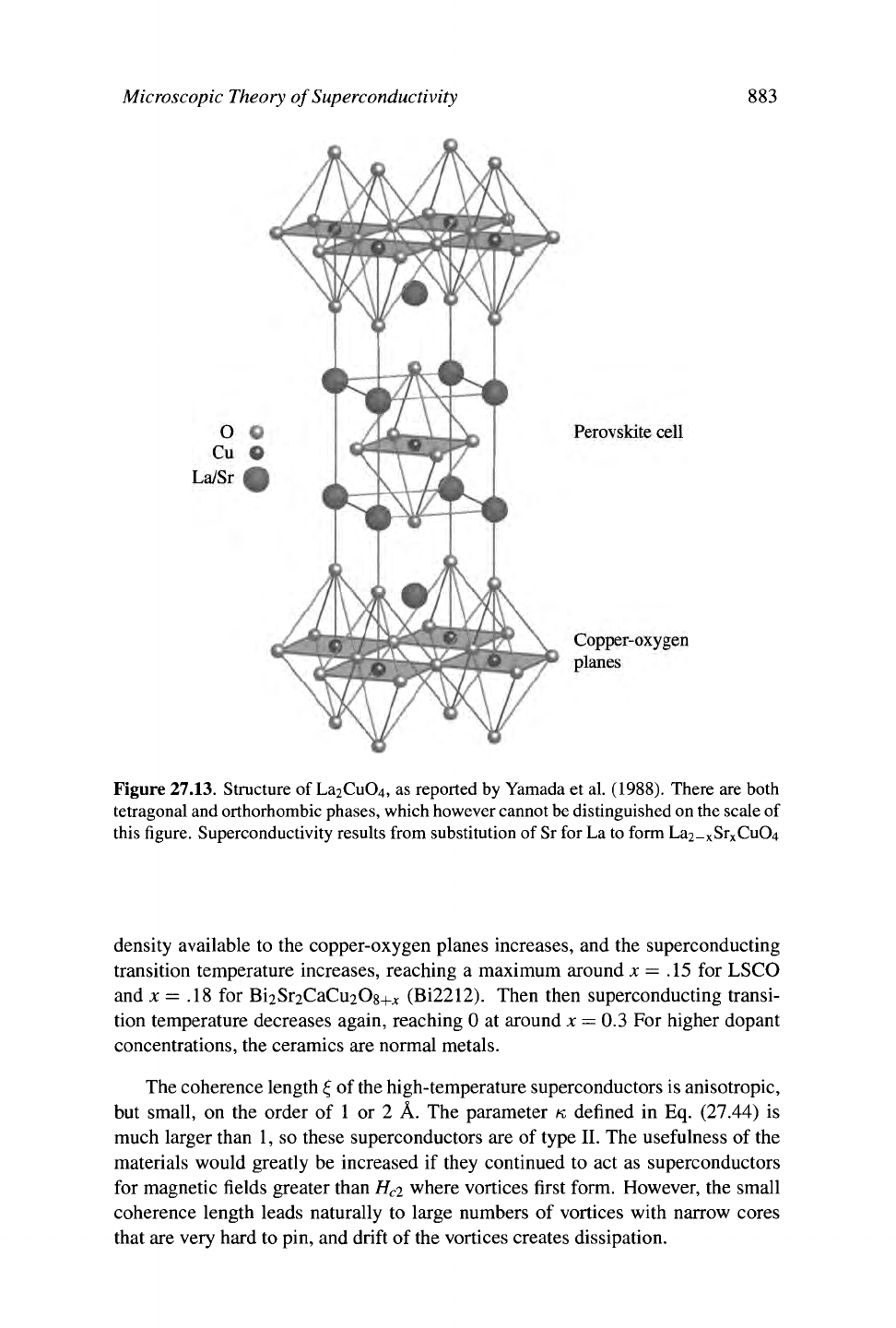
Figure
27.13.
Structure of
La2Cu04,
as reported by Yamada et al. (1988). There are both
tetragonal and orthorhombic
phases,
which however cannot
be
distinguished
on the
scale
of
this figure. Superconductivity results from substitution of
Sr
for La to form La2-*Sr
x
Cu04
density available to the copper-oxygen planes increases, and the superconducting
transition temperature increases, reaching a maximum around x = .15 for LSCO
and x = .18 for BiaS^CaCuaOs+j (Bi2212). Then then superconducting transi-
tion temperature decreases again, reaching 0 at around x
—
0.3 For higher dopant
concentrations, the ceramics are normal metals.
The coherence length £ of
the
high-temperature superconductors is anisotropic,
but small, on the order of 1 or 2 Â. The parameter K defined in Eq. (27.44) is
much larger than 1, so these superconductors are of type II. The usefulness of the
materials would greatly be increased if they continued to act as superconductors
for magnetic fields greater than
H
C
2
where vortices first form. However, the small
coherence length leads naturally to large numbers of vortices with narrow cores
that are very hard to pin, and drift of the vortices creates dissipation.
884
Chapter 27. Superconductivity
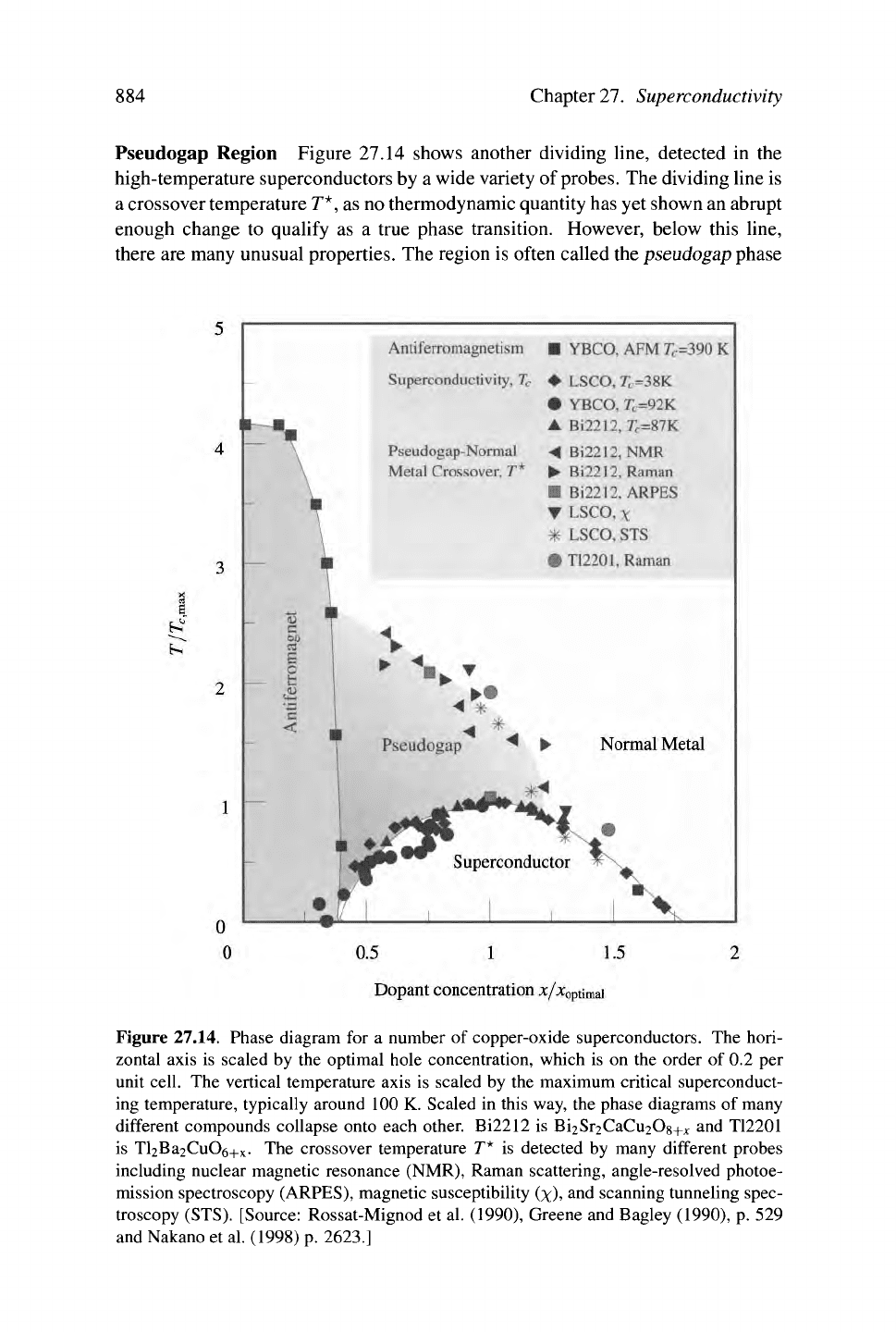
Pseudogap Region Figure 27.14 shows another dividing line, detected in the
high-temperature superconductors by a wide variety of probes. The dividing line is
a crossover temperature T*, as no thermodynamic quantity has yet shown an abrupt
enough change to qualify as a true phase transition. However, below this line,
there are many unusual properties. The region is often called the pseudogap phase
Figure 27.14. Phase diagram for a number of copper-oxide superconductors. The hori-
zontal axis is scaled by the optimal hole concentration, which is on the order of 0.2 per
unit cell. The vertical temperature axis is scaled by the maximum critical superconduct-
ing temperature, typically around 100 K. Scaled in this way, the phase diagrams of many
different compounds collapse onto each other. Bi2212 is I^S^CaC^Os+jc and T12201
is Tl2Ba2CuOö+
x
. The crossover temperature T* is detected by many different probes
including nuclear magnetic resonance (NMR), Raman scattering, angle-resolved photoe-
mission spectroscopy (ARPES), magnetic susceptibility (x), and scanning tunneling spec-
troscopy (STS). [Source: Rossat-Mignod et al. (1990), Greene and Bagley (1990), p. 529
and Nakano et al. (1998) p. 2623.]
Microscopic Theory of Superconductivity 885
because as discussed by Damascelli et al. (2003), angle-resolved photoemission
detects a superconducting gap, by techniques like that shown in Figure 27.12, along
some but not all directions perpendicular to the Fermi surface. Investigations with
scanning tunneling probes, reviewed by Fischer et al. (2007), tell a similar story.
Almost any probe one chooses shows some sort of cross-over between two limiting
behaviors at round T*, and thus one can map out the line with Raman spectroscopy,
nuclear magnetic resonance, or magnetic susceptibility as well.
Even the normal metal phase may be unusual. Electrical resistivity is surpris-
ingly linear in temperature; in the case of YBCO, the linear behavior persists up
to around 1000 K. The various competing contributions to resistivity, as for exam-
ple in Figure 18.1, are mysteriously absent. A phenomenological account of this
behavior is provided by Varma et al. (1989).
Theories While experimentalists have been busy mapping out the phase diagram,
theorists have been busy trying to calculate it. No definitive answer has yet been
reached. A very appealing theory is that the essence of the high-temperature su-
perconductors is to be found in the Hubbard model of Section 26.7. The high-
temperature superconductors are no more and no less than doped Mott-Hubbard
insulators. The challenge faced by this point of view is that it has so far not proved
possible to solve the Hubbard model exactly, nor has any method of approximation
been found completely convincing. Thus, if some approximate solution is found
that reproduces some feature of the experiments, it is hard to tell whether this fea-
ture really resulted from the Hubbard model
itself,
or from the choice of approx-
imations. Lee et al. (2006) provide a confident case that Mott-Hubbard physics
does indeed explain the main features of the copper-oxide ceramic superconduc-
tors.
Chen et al. (2005) provide a careful presentation of some alternatives. If one
theory does eventually emerge dominant, it will happen because the great majority
of experimentalists finds it useful in interpreting their experiments. This has not
yet happened with a single microscopic theory.
Symmetry of the Order Parameter.
The majority of experimental evidence supports the claim that the supercon-
ducting order parameter of the high T
c
materials has d-wave character, while for
most previous superconductors it had 5-wave character. Before displaying the ex-
perimental evidence, it is necessary to establish what this claim means, which re-
quires in turn asking about the relationship between the Landau-Ginzburg equation
and the underlying microscopic theory of Bardeen, Cooper, and Schrieffer.
The theory of Landau and Ginzburg is built upon the order parameter *. The
most important properties of this order parameter are, first, that it becomes nonzero
only in the presence of superconductivity and, second, that it alters under gauge
transformations
A
-►
A + Vx as * -> m
e
-
2iex/hc
. (27.229)
The phase of * then naturally satisfied the conditions outlined in Section 27.2.9
that lead to the Josephson effect.
886 Chapter
27.
Superconductivity
The Bogoliubov equations feature a quantity that shares these two properties—
the pair potential A?. To see why, turn to Eqs. (27.198), and ask how u, v, and A
transform after gauge transformations. To keep the form of the equations intact,
they transform as
u
%
(r) — nj(7)<?
_fe
*
/,ic
)
vffl -+ vfflj**!**, and A
7
->
A^-
2
^^.
(27.230)
Very near the transition temperature T
c
, Gor'kov (1959) showed that A? is in
fact proportional to \I/. At lower temperatures the correspondence is less certain,
but the precise form of the Landau-Ginzburg equations is not necessarily correct
in any event.
In searching for the form that a theory of high-temperature superconductivity
might take, it is natural to ask how A^ might generalize when the simplifying
assumptions leading to Eq. (27.196) no longer apply. If the effective potential U is
not isotropic, then
i'
Fourier transforming according to prescriptions as in Eq. (27.189) gives
&7T>
= Yl
~~%T
(c-ricr'-ri)
■
(27.232)
7"
The implication of this calculation is that in a general theory of superconductivity,
the analog of
\&
should depend upon two arguments, becoming \P(r, ?). The calcu-
lations worked out so far assumed that the effective potential U was isotropic, and
consequently that ^ depended only upon the center-of-mass coordinate (r + 7
y
)/2.
In a more general theory, \&(r, 7
1
) might be expected to do the following:
Vary slowly as a function of (r + r')/2. (27.233a)
Decay rapidly as a function R— |r
—
r^|. (27.233b)
Depend upon the direction of R = r
—
f. (27.233c)
A superconductor where
*&
is independent of the direction of R is called s-wave.
One where * has the symmetry of x- R oc cos 6 is p-wave. Superfluid
3
He has an
order parameter of this type. One with the symmetry of (x
■
R)
2
—
{y-R)
2
oc cos 29
is called d-wave. Problem 8 shows that under some simplifying assumptions, one
should expect to measure
|A-j|
OC | COS
2<f)\
Where 0 is the angle of the vector (k
x
, k
y
). . (27.234)
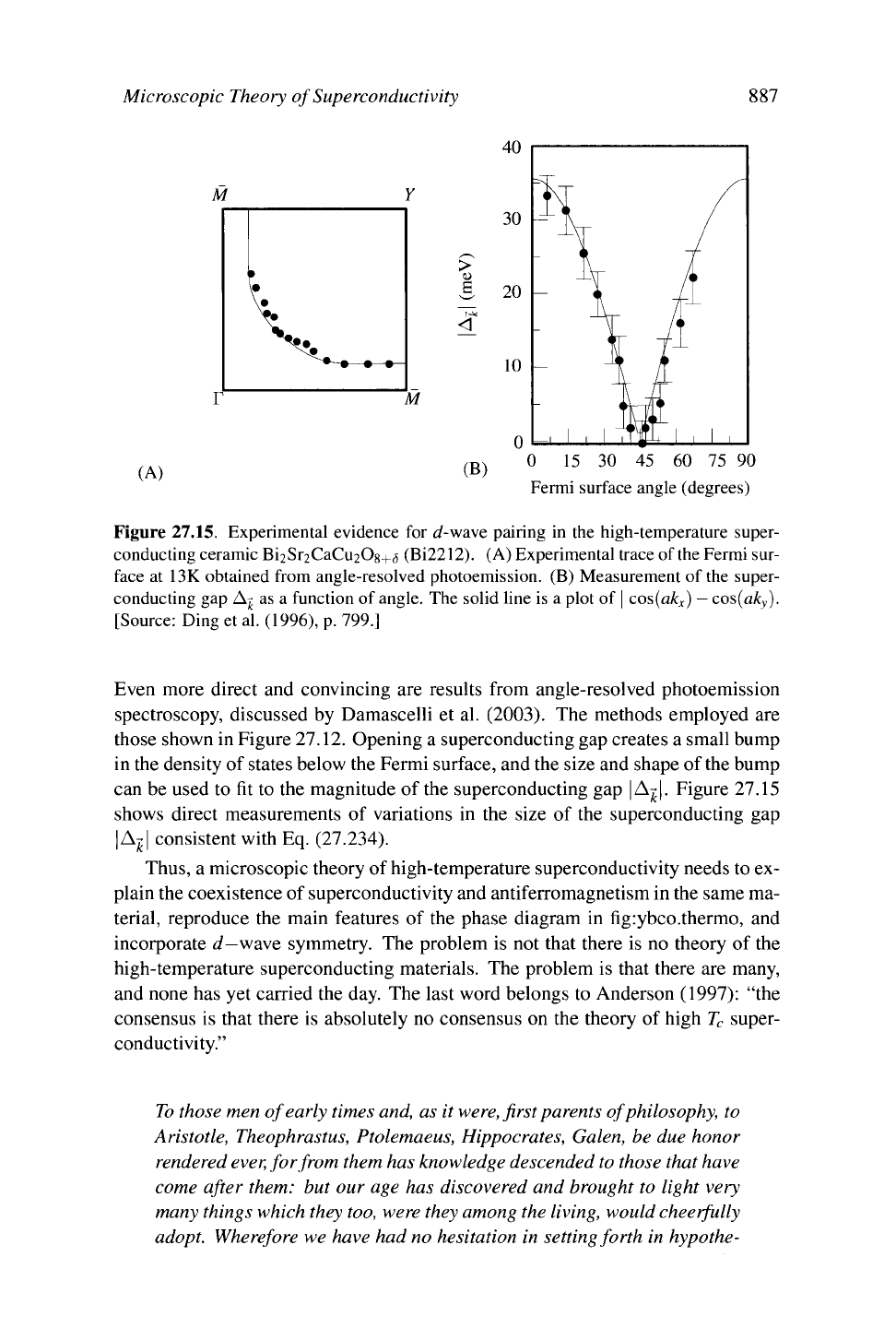
Experimental investigations of the symmetry of the order parameter can be
carried out without commitment to any particular microscopic theory of the inter-
action U, as discussed by Annett et al. (1996). Two particularly direct experiments
provide evidence for d-wave pairing. The first is Josephson tunneling into super-
conducting samples from different angles, as performed by Wollman et al. (1995).
Microscopic Theory of Superconductivity
887
>
(A)
(B)
0 15 30 45 60 75 90
Fermi surface angle (degrees)
Figure 27.15. Experimental evidence for af-wave pairing in the high-temperature super-
conducting ceramic E^S^CaC^Og+ä (Bi2212). (A) Experimental trace of the Fermi sur-
face at 13K obtained from angle-resolved photoemission. (B) Measurement of the super-
conducting gap Aj as a function of angle. The solid line is a plot of
|
cos(a£
x
)
—
cos(ak
y
).
[Source: Ding et al. (1996), p. 799.]
Even more direct and convincing are results from angle-resolved photoemission
spectroscopy, discussed by Damascelli et al. (2003). The methods employed are
those shown in Figure 27.12. Opening a superconducting gap creates a small bump
in the density of states below the Fermi surface, and the size and shape of the bump
can be used to fit to the magnitude of the superconducting gap
|
A^|. Figure 27.15
shows direct measurements of variations in the size of the superconducting gap
|Aj|
consistent with Eq. (27.234).
Thus,
a microscopic theory of high-temperature superconductivity needs to ex-
plain the coexistence of superconductivity and antiferromagnetism in the same ma-
terial, reproduce the main features of the phase diagram in flg:ybco.thermo, and
incorporate d—wave symmetry. The problem is not that there is no theory of the
high-temperature superconducting materials. The problem is that there are many,
and none has yet carried the day. The last word belongs to Anderson (1997): "the
consensus is that there is absolutely no consensus on the theory of high T
c
super-
conductivity."
To those men of early times and, as it were, first parents of philosophy, to
Aristotle, Theophrastus, Ptolemaeus, Hippocrates, Galen, be due honor
rendered
ever,
for from them has knowledge descended to those that have
come after them: but our age has discovered and brought to light very
many things which they too, were they among the living, would cheerfully
adopt. Wherefore we have had no hesitation in setting forth in hypothe-
Chapter
27.
Superconductivity
ses that are provable, the things that we have through long experience
discovered. Farewell. — Gilbert (1600), p. li
Problems
1.
Superconducting sphere: Consider a sphere of superconducting material of
type I, whose critical field is H
c
, in a uniform external magnetic field H.
(a) Using the fact that normal magnetic fields must vanish at the surface of a
superconductor, show that when the external field H reaches a value of \H
C
,
some portion of the sphere must make the transition to normal metal. Do not
try to find the shape of the region that does so.
(b) At what external field will the entire sphere become normal?
2.
Energy of normal-superconducting interfaces: Consider a half-space, x <
0, of normal metal in equilibrium with a superconductor filling x > 0. To
allow the normal and superconducting metals to remain in equilibrium, the
normal metal is permeated almost everywhere by a magnetic induction B
c
.
(a) First consider the limit
K
—>
0, where the penetration depth
XL
is small. Be-
cause superconductivity vanishes in the normal metal, it is reasonable to guess
that one needs to look for a solution in the superconductor such that \P van-
ishes at x = 0, such as Eq. (27.41). Find the difference in free energy S be-
tween a superconductor where ^ vanishes at x = 0, and one where the wave
function \P fills the space x > 0 uniformly. Show that the interface energy is
positive, and given by Eq. (27.52).
(b) Next consider the opposite limit, in which the coherence length £ is small
compared to the penetration depth A^.. Now the gradients of ty can be ne-
glected, and instead one has to consider the contributions of the magnetic
field. First compute the free energy per area
7= /
dx^l—^A
2
+ —. (27.235)
Jo 2mc
z
8-7T
Simplify J with the use of Eq. (27.9). Then compute S as defined in
Eq.
(24.27),
and verify Eq. (27.53).
3.
Diffraction effects in Josephson junctions: Referring to Figure 27.5, and
employing Eq. (27.68a), show that the maximum zero-voltage current J
c
able
to flow through a rectangular Josephson junction in the presence of
a
magnetic
field is given by
sin(27r$/$o)
y
c
oc
(27T#/$o)
(27.236)
(a) Write down a vector potential A that produces the desired field B
Problems 889
(b) Assuming some phases
(p\
and <fo on the two sides of the junction, find the
total current J by integrating (27.68a) across the area of the junction.
(c) Choose the phases
4>\
and 02 to maximize the zero-voltage current flow.
4.
Josephson Lagrangian: Verify Eqs. (27.84).
5.
Properties of BCS coherent state: Verify Eqs. (27.130) through (27.133).
6. London gauge:
(a) Show that if V
•
A = 0, then first-order changes in the energies
E-
k
do not
appear in Eqs. (27.200).
(b) Verify that A? responds to a change in gauge \ as reported in Eq. (27.230).
(c) Physical properties of superconductors are functionals of
the
vector potential
A.
For small vector potentials, the functional is linear, and in a homogeneous
superconductor one must have
A- = A
(0)
+ Ai° = A
(0)
+ j dr
1
7{r-r') -Â(r'), (27.237)
X is
for some function
CP.
Consider the particular case where A = V%, and
A ia
very small. Linearizing Eq. (27.230) and comparing it with Eq. (27.237),
show that
™ - w
v
(;)
►
(27
-
238)
(d) Show as a consequence that in the London gauge, where V
•
A = 0, and if
A
■
n vanishes at the outer reaches of the system, with « is a unit normal, then
Al° = 0, and A? = A. In other words, gauge invariance is used to choose a
convenient gauge in which the problem simplifies.
7.
Meissner effect integral: Evaluate
W(R) = JdÇ dÇ'L(Ç, C') cos [(C - Ç')R/hv
F
] . (27.239)
(a) Use Eq. (27.214) for
L(Ç,
CO
and Eq. (27.202) for £
?
. Make the substitutions
C
= A sinh x and C' = A sinh x'.
(b) Define y = (x
—
x')/2 and/ = (x
+
xf)/2. Express the integral in terms of y
and y.
(c) Retain the variable y', but make the substitution p = sinh y. The integral over
p can be performed to give
c-/ N * f , expf-2A cosh
y'R/hv
F
1 ,,„..„
W(R) = 7rhv
F
S(R)-TrA / dy' —^ , ,
;
—-
1
. (27.240)
J cosh /
890
Chapter 27. Superconductivity
8.
d—wave
Superconductivity: Suppose that the gap function A^/ of Eq. (27.232)
obeys the conditions
of
Eqs. (27.233);
in
fact, there
is
no dependence upon
(r + r
1
). Suppose that the dependence on the direction of R is of the d-wave
form
(x-R)
2
-(y-R)
2
(xcos29.
(27.241)
Show that
Ajgj,
takes the form for some function
f(k)
**
=
'*{**-%)
m
<27
'
242)
resulting in
a
symmetry for the gap function given by Eq. (27.234).
References
A. A. Abrikosov (1957), On the magnetic properties
of
superconductors of the second group, Soviet
Physics JETP, 6, 489^92.
P.
B. Allen and B. Mitrovic (1982), Theory of superconducting T
c
, Solid State Physics: Advances in
Research and Applications, 37, 1-92.
P.
W. Anderson (1997), The Theory of Superconductivity in the
High-T
c
Cuprates, Princeton Univer-
sity Press, Princeton, NJ.
P.
W. Anderson and
J.
M. Rowell (1963), Probable observation
of
the Josephson superconducting
tunneling effect, Physical Review Letters, 10, 230-232.
J. F. Annett, N. Goldenfeld, and A. J. Leggett (1996), Experimental constraints on the pairing state of
the cuprate superconductors: An emerging consensus, in Physical Properties of High
Temperature
Superconductors, D. M. Ginsberg, ed., vol. V, pp.
375^61.
J. Bardeen (1963), Development
of
concepts in superconductivity, in Proceedings of
the
Eighth In-
ternational Conference on Low Temperature Physics, R. O. Davies, ed., pp. 3-8, Butterworths,
London.
J. Bardeen (1990), Superconductivity and other macroscopic quantum phenomena, Physics Today,
43(12),
25-31.
J. Bardeen, L. N. Cooper, and J. R. Schrieffer (1957), Theory of superconductivity, Physical Review,
108,
1175-1204.
B.
Batlogg (1991), Physical properties of high-r
c
superconductors, Physics
Today,
44(6), 44—50.
G. Bednorz and K. A. Müller (1986), Possible high T
c
superconductivity in the Ba-Ca-Cu-O system,
Zeitschrift für
Physik,
B64, 189-193.
J. G. Bednorz and K. A. Muller (1988), Perovskite-type oxides—the new approach to high-T,; super-
conductivity, Reviews of Modern Physics, 60, 585-600.
R. Beyers and T. M. Shaw (1989), The structure of yttrium barium copper oxide (YiBa2Cu307_^),
Solid State Physics: Advances in Research and Applications, 42, 135-212.
G. Blatter, M. V. Feigel'man, V. B. Geshkenbein, A.
I.
Larkin, and V. M. Vinokur (1994), Vortices
in high-temperature superconductors, Reviews of Modern Physics, 66, 1125-1388.
N.
N. Bogoliubov (1958), A new method in the theory of superconductivity, Soviet Physics JETP, 7,
41-46.
Reprinted in Pines (1961), pp. 399^104.
H.
A.
Boorse (1959), Superconducting electronic specific heats,
the
"exponential law,"
and the
Bardeen, Cooper, Schrieffer theory, Physical Review Letters, 2, 391-393.
J. P. Carbotte (1990), Properties
of
boson-exchange superconductors, Reviews of Modern Physics,
62,
1027-1157.
References
891
P.
M. Chaikin and R. L. Greene (1986), Superconductivity and magnetism in organic metals, Physics
Today, 39(5), 24-32.
Q. Chen, J. Stajic, S. Tan, and K. Levin (2005), Bcs-bec crossover: From high temperature super-
conductors to ultracold superfluids, Physics Reports, 412(1),
1
- 88.
L. N. Cooper (1956), Bound electron pairs in a degenerate Fermi gas, Physical Review, 104, 1189-
1190.
D.
L. Cox and M. B. Maple (1995), Electronic pairing in exotic superconductors, Physics Today,
48(2),
32-M).
G. W. Crabtree and D. R. Nelson (1997), Vortex physics in high-temperature superconductors,
Physics
Today,
50(4), 38-45.
E. Dagotto (1994), Correlated electrons in high-temperature superconductors, Reviews of Modern
Physics, 66, 763-840.
A. Damascelli, Z. Hussain, and Z.-X. Shen (2003), Angle-resolved photoemission studies of the
cuprate superconductors, Reviews of Modern Physics, 75(2),
473-541.
P.-G. de Gennes (1992), Superconductivity of Metals and Alloys, Addison-Wesley, Reading, MA.
B.
S. Deaver and W. M. Fairbank (1961), Experimental evidence for quantized flux in superconduct-
ing cylinders, Physical Review Letters, 1, 43^4-6.
H. Ding, M. R. Norman, J. C. Campuzano, et al. (1996), Angle-resolved photoemission spectroscopy
study of the superconducting gap anisotropy in Bi2Sr2CaCu20s
+x
, Physical Review B, 54(14),
R9678-R9681.
R. Doll and M. Näbauer (1961), Experimental proof of magnetic flux quantization in a supercon-
ducting ring, Physical Review Letters, 1, 51-52.
R. C. Dynes, V. Narayanamurt, and J. P. Garno (1978), Direct measurement of quasiparticle-lifetime
broadening in a strong-coupled superconductor, Physical Review Letters, 41, 1509-1512.
G. M. Eliashberg (1960), Interactions between electrons and lattice vibrations in a superconductor,
Soviet Physics JETP,
11,
696-702.
L. Esaki (1974), Long journey into tunnelling, Reviews of Modern Physics, 46, 237-244.
0. Fischer, M. Kugler, I. Maggio-Aprile, C. Berthod, and C. Renner (2007), Scanning tunneling
spectroscopy of high-temperature superconductors, Reviews of Modern Physics, 79, 353^419.
H. Fröhlich (1950), Isotope effect in superconductivity, Proceedings of the Physical Society (Lon-
don),
A63,
778.
T. H. Geballe (1993), Superconductivity: from physics to technology, Physics
Today,
46(10), 52-56.
1.
Giaever (1974), Electron tunnelling and superconductivity, Reviews of Modern Physics, 46, 245-
250.
W. Gilbert
(
1600),
On the Loadstone and Magnetic
Bodies,
and
on
the Great Magnet the Earth, John
Wiley and Sons, New York. Translated by P. F. Mottelay, 1893
H. Goldstein (1980), Classical Mechanics, 2nd ed., Addison-Wesley, Reading, MA.
L. P. Gor'kov (1959), Microscopic derivation of the Ginzburg-Landau equations in the theory of
superconductivity, Soviet Physics JETP, 9, 1364-1367.
L. H. Greene and
B.
G. Bagley
(
1990),
Oxygen stoichiometric effects and related atomic substitutions
in the high T
c
cuprates, in Physical Properties of High Temperature Superconductors, D. M.
Ginsberg, ed., vol. 2, pp. 509-569, World Scientific, Singapore.
I. S. Grigoriev and E. Z. Meilkhov, eds. (1997), Handbook of Physical Quantities, CRC Press, Boca
Raton, FL.
O. Gunnarsson (1997), Superconductivity in füllendes, Reviews of Modern Physics, 69, 575-606.
A. V. Gurevich and R. G. Mints (1987), Self-heating in normal metals and superconductors, Reviews
of Modern Physics, 59, 941-999.
J. Hansen and P. E. Lindelof (1984), Static and dynamic interactions between Josephson junctions,
Reviews of Modern Physics, 56, 431-459.
892
Chapter
27.
Superconductivity
K. C. Hass (1989), Electronic structure of copper-oxide superconductors, Solid State Physics: Ad-
vances in Research and Applications, 42, 213-270.
H. Hayakawa (1986), Josephson computer technology, Physics
Today,
39(3), 46-52.
A. F. Hebard (1992), Superconductivity in doped fullerenes, Physics
Today,
45(11), 26-32.
J. D. Jorgensen (1991), Defects and superconductivity in the copper oxides, Physics Today, 44(6),
34-^0.
B.
D. Josephson (1962), Possible new effects in superconductive tunneling, Physics Letters, 1, 251-
253.
B.
D. Josephson (1974), The discovery of tunnelling supercurrents, Reviews of Modern Physics, 46,
251-254.
H. Kamerlingh Onnes (1911), The resistance of platinum at helium temperature, Communications
from the Physical Laboratory at the University of Leiden, 119b, 19-26.
L. D. Landau (1965), Collected Papers of L D Landau, D. ter Haar, ed., Gordon and Breach, New
York.
L. D. Landau and
V.
L. Ginzburg (1950), On the theory of superconductivity, Journal of Experimental
and Theoretical Physics (U.S.S.R.), 20, 1064-1084. In Russian. Translated in Landau (1965), pp.
546-568
D.
Larbalestier (1991), Critical currents and magnet applications of high-r
c
superconductors, Physics
Today,
44(6), 74-82.
P.
A. Lee, N. Nagaosa, and X.-G. Wen (2006), Doping a mott insulator: Physics of high-temperature
superconductivity, Reviews of Modern Physics, 78(1), 17.
C. M. Lieber and Z. Zhe (1994), Physical properties of metal-doped fullerene superconductors, Solid
State Physics: Advances in Research and Applications, 48, 349-384.
K. K. Likharev (1979), Superconducting weak links, Reviews of Modern Physics, 51, 101-159.
F.
London (1961), Superfluids, 2nd ed., Dover, New York.
D.
E. MacLaughlin (1976), Magnetic resonance in the superconducting state, Solid State Physics:
Advances in Research and Applications,
31,
1-69.
M. B. Maple (1986), Novel types of superconductivity in /-electron systems, Physics Today, 39(3),
72-80.
Y Masuda and A. G. Redfield (1962), Nuclear spin relaxation in superconducting aluminum, Physi-
cal Review, 125, 159-163.
E. Maxwell (1950), Isotope effect in the superconductivity of mercury, Physical Review, 78, 477.
W. McMillan (1968), Transition temperature of strong-coupled superconductors, Physical Review,
167,331-344.
W. Meissner and R. Ochsenfeld (1933), A new effect in penetration of superconductors, Die Natur-
wissenschaften, 21, 787-788. In German.
J. E. Mercereau (1969), Macroscopic quantum phenomena, in Superconductivity, R. D. Parks, ed.,
vol.
I, pp.
393-421,
Marcel Dekker, New York.
R. Meservey and
B.
B. Schwartz (1969), Equilibrium
properties:
Comparison of experimental results
with predictions of the BCS theory, in Superconductivity, R. D. Parks, ed., vol. I, pp.
117-191,
Marcel Dekker, New York.
R. Micnas, J. Ranninger, and S. Robaszkiewicz (1990), Superconductivity in narrow-band systems
with local nonretarded attractive interactions, Reviews of Modern Physics, 62, 113-234.
R. G. Mints and A. L. Rakhmanov (1981), Critical state stability in type-II superconductors and
superconducting-normal-metal composites, Reviews of Modern Physics, 53, 551-592.
T. Nakano, N. Mömono, M. Oda, and M. Ido (1998), Correlation between the doping dependences of
superconducting gap magnitude 2A and pseudogap temperature T* in high-r
c
cuprates, Journal
of the Physical Society of Japan, 67, 2622-2625.
J. Nobel and
P.
Lindenfeld (1996), The discovery of superconductivity, Physics
Today,
49(9), 40^2.