
Masujima M. Applied Mathematical Methods in Theoretical Physics
Подождите немного. Документ загружается.

7.2 Homogeneous Wiener–Hopf Integral Equation of the Second Kind 247
Recalling the definition of the beta function B(n, m),
B(n, m) =
1
0
dρρ
n−1
(1 −ρ)
m−1
= (n)(m)/(n + m),
we have
ˆ
K(k) = 2
ik +
1
2
−ik +
1
2
/
ik +
1
2
−ik +
1
2
= 2
ik +
1
2
−ik +
1
2
.
Recalling the property of the gamma function,
(z)(1 −z) = π/ sin π z, (7.2.39)
we thus obtain the Fourier transform of K(x)as
ˆ
K(k) = 2π/ cosh π k. (7.2.40)
Defining ψ(x)by
ψ(x) = λ
+∞
0
1
cosh
1
2
(x − y)
φ(y)dy, x < 0, (7.2.41)
we obtain the following equation as usual:
(1 −λ
ˆ
K(k))
ˆ
φ
−
(k) =−
ˆ
ψ
+
(k), (7.2.42)
where
1 −λ
ˆ
K(k) = 1 −
2πλ
cosh π k
= Y
−
(k)/Y
+
(k), (7.2.43)
and the regions of the analyticity of
ˆ
φ
−
(k)and
ˆ
ψ
+
(k)aresuchthat
(i)
ˆ
φ
−
(k) is analytic in the lower half plane ( Im k ≤−1/2),
(ii)
ˆ
ψ
+
(k)isanalyticintheupperhalfplane(Imk > −1/2).
(7.2.44)
Rewriting Eq. (7.2.42) in terms of Y
±
(k)’s, we have
Y
−
(k)
ˆ
φ
−
(k) =−Y
+
(k)
ˆ
ψ
+
(k) ≡ G(k), (7.2.45)
where G(k)isentireink.

248 7 Wiener–Hopf Method and Wiener–Hopf Integral Equation
Factorization of 1 − λ
ˆ
K(k):
Y
−
(k)/Y
+
(k) = 1 −
2πλ
cosh π k
=
cosh π k − 2πλ
cosh π k
. (7.2.46)
Case 1. 0 < 2πλ ≤ 1.
Setting
cos πα ≡ 2πλ,0≤ α<1/2, (7.2.47)
we have
Y
−
(k)/Y
+
(k) = [cos(iπ k) − cos πα]/ sin π
ik +
1
2
= 2sin[
π
2
(α + ik)] sin
π
2
(α − ik)
/ sin π
ik +
1
2
. (7.2.48)
Replacing all sine functions in Eq. (7.2.48) with the appropriate product of the
gamma functions through the use of the formula
sin π z = π/(z)(1 −z), (7.2.49)
we obtain
Y
−
(k)/Y
+
(k)
= 2π
1
2
+ ik
1
2
− ik
/
α + ik
2
α − ik
2
1 −
α + ik
2
1 −
α − ik
2
. (7.2.50)
We note that
(z) has simple pole at z = 0, −1, −2, ...,
(1 −z) has simple pole at z = 1, 2, 3, ....
(7.2.51)
(1)
1
2
+ ik
has simple poles at k = i
1
2
, i
3
2
, i
5
2
, i
7
2
, ..., all of which are assigned
to Y
−
(k).
(2)
1
2
− ik
has simple poles at k =−i
1
2
, −i
3
2
, −i
5
2
, −i
7
2
, ...,allofwhichare
assigned to Y
+
(k).
(3)
α+ik
2
has simple poles at k = iα, i(2 +α), i(4 +α), ...,allofwhichare
assigned to Y
−
(k).
(4)
α−ik
2
has simple poles at k =−iα, −i(2 +α), −i(4 +α), ....Since
0 <α<1/2, the first pole at k =−iα is assigned to Y
−
(k), while the
remaining poles are assigned to Y
+
(k). Using the property of the gamma
function, (z) = (z + 1)/z,werewrite

7.2 Homogeneous Wiener–Hopf Integral Equation of the Second Kind 249
α − ik
2
=
2
α − ik
1 +
α − ik
2
,
(5) where (α − ik)/2 is assigned to Y
−
(k)while(1 +
α−ik
2
) is assigned to Y
+
(k).
(6)
1 −
α+ik
2
has simple poles at k =−i(2 − α), −i(4 − α), −i(6 − α), ...,all
of which are assigned to Y
+
(k).
(7)
1 −
α−ik
2
has simple poles at k = i(2 −α), i(4 −α), i(6 −α), ...,allof
which are assigned to Y
−
(k).
Then we obtain Y
±
(k) as follows:
Y
−
(k) =−2π
1
2
+ ik
α + ik
2
−
α − ik
2
, (7.2.52a)
Y
+
(k) =
1 +
α − ik
2
1 −
α + ik
2
1
2
− ik
. (7.2.52b)
Now G(k) is determined by the asymptotic behavior of Y
±
(k)ask →∞.Making
use of the Duplication formula and the Stirling formula,
(2z) = 2
2z−1
(z)
z +
1
2
/
√
π, (7.2.53)
lim
|
z
|
→∞
(z + β)/(z) ∼ z
β
, (7.2.54)
we find the asymptotic behavior of Y
−
(k)tobegivenby
Y
−
(k) ∼−i
π
2
2
ik
· k. (7.2.55)
Defining
Z
±
(k) ≡ 2
−ik
· Y
±
(k), (7.2.56)
we find
Z
±
(k) ∼−i
π
2
k, (7.2.57)
since
Z
−
(k)/Z
+
(k) = Y
−
(k)/Y
+
(k) = 1 −λ
ˆ
K(k) → 1ask →∞.
Then Eq. (7.2.45) becomes
Z
−
(k)
ˆ
φ
−
(k) =−Z
+
(k)
ˆ
ψ
+
(k) = 2
−ik
G(k) ≡ g(k), (7.2.58)
250 7 Wiener–Hopf Method and Wiener–Hopf Integral Equation
where g(k)isnowentire.Since
ˆ
φ
−
(k),
ˆ
ψ
+
(k) → 0ask →∞,
and Eq. (7.2.57) for Z
±
(k), g(k) cannot grow as fast as k. By Liouville’s theorem, we
then have
g(k) = C
,constant.
Thus we obtain
ˆ
φ
−
(k) = C
/Z
−
(k) = C
2
ik
α + ik
2
−
α − ik
2
/
1
2
+ik
. (7.2.59)
We now invert
ˆ
φ
−
(k)toobtainφ(x),
φ(x) = C
+∞
−∞
dk
2π
e
ikx
2
ik
α + ik
2
−
α − ik
2
/
1
2
+ik
, x ≥ 0,
(7.2.60)
φ(x) = 0, x < 0.
For x > 0, we close the contour in the upper half plane, picking up the pole
contributions from
α+ik
2
and
−
α−ik
2
. Poles of
α+ik
2
are located at
k = i(2n + α), n = 0, 1, 2, .... Poles of
−
α−ik
2
are located at k = i(2n − α), n =
0, 1, 2, ....Since
Res.(z)
|
z=−n
= (−1)
n
1
n!
, (7.2.61)
we have
φ(x) = C
∞
n=0
e
−(2n+α)x
2
−(2n+α)
(−1)
n
n!
(−n − α)
1
2
− 2n − α
+ (α →−α)
.
(7.2.62)
Since
(z) =
π
sin π z
1
(1 −z)
,
we have
(−n − α) =
(−1)
n+1
π
sin απ
1
(n + 1 +α)
,
and with the use of the duplication formula,
1
2
− 2n − α
=
π
cos απ
·
√
2π2
−(2n+α)
·
1
(
1
4
+
α
2
+ n)
3
4
+
α
2
+ n
,

7.2 Homogeneous Wiener–Hopf Integral Equation of the Second Kind 251
we have
(−n − α)
1
2
−2n − α
=
(−1)
n+1
√
2π
· 2
(2n+α)
·
cos απ
sin απ
·
1
4
+
α
2
+n
3
4
+
α
2
+ n
(1 +α + n)
.
Our solution φ(x)isgivenby
φ(x)
= C
cos απ
sin απ
·
∞
n=0
e
−αx
(e
−2x
)
n
n!
(
1
4
+
α
2
+ n)
3
4
+
α
2
+ n
× (1 + α +n)
− (α →−α)
.
(7.2.63)
Recall that the hypergeometric function F(a, b, c;z)isgivenby
F(a, b, c;z) =
∞
n=0
(α + n)
(a)
·
(b + n)
(b)
·
(c)
(c + n)
·
z
n
n!
. (7.2.64)
Setting
a =
1
4
+
α
2
, b =
3
4
+
α
2
, c = 1 +α,
we have
φ(x) = C
cos απ
sin απ
e
−αx
(
1
4
+
α
2
)(
3
4
+
α
2
)
(1 +α)
× F
1
4
+
α
2
,
3
4
+
α
2
,1+ α;e
−2x
−(α →−α)
. (7.2.65)
Recall that the Legendre function of the second kind, Q
α−
1
2
(z)isgivenby
Q
α−
1
2
(z) =
√
π
2
α+
1
2
·
(
1
2
+ α)
(1 +α)
· z
−(
1
2
+α)
· F
1
4
+
α
2
,
3
4
+ α,1+α;z
−2
=
1
2
·
(
1
4
+
α
2
)(
3
4
+
α
2
)
(1 +α)
·z
−(
1
2
+α)
·F
1
4
+
α
2
,
3
4
+
α
2
,1+ α;z
−2
,
(7.2.66)
so our solution given above can be simplified as
φ(x) = C
cos απ
sin απ
e
x
2
Q
α−
1
2
(e
x
) −Q
−α−
1
2
(e
x
)
. (7.2.67)

252 7 Wiener–Hopf Method and Wiener–Hopf Integral Equation
Recall that the Legendre function of the first kind, P
β
(z), is given by
P
β
(z) =
1
π
sin βπ
cos βπ
Q
β
(z) −Q
−β−1
(z)
, (7.2.68)
so
P
α−
1
2
(z) =−
1
π
cos απ
sin απ
Q
α−
1
2
(z) − Q
−α−
1
2
(z)
. (7.2.69)
So, the final expression for φ(x )isgivenby
φ(x) = C ·
exp
x
2
·P
α−
1
2
e
x
, x ≥ 0, 0 ≤ α<1/2, 2πλ = cos απ.
(7.2.70)
Similar analysis can be carried out for the cases 2πλ > 1andλ<0. We only list
the final answers for all cases.
Summary of Example 7.4:
Case 1:0< 2πλ ≤ 1, 2πλ = cos απ,0≤ α<1/2.
φ(x) = C
1
· (exp
x
2
) ·P
α−
1
2
(e
x
), x ≥ 0.
Case 2:2πλ > 1, 2πλ = cosh απ, α>0.
φ(x) = C
2
· (exp
x
2
) · P
iα−
1
2
(e
x
), x ≥ 0.
Case 3:2πλ ≤ 0.
φ(x) = 0, x ≥ 0.
7.3
General Decomposition Problem
In the original Wiener–Hopf problem we examined in Section 7.1,
φ
−
(k) = ψ
+
(k) + F(k), (7.3.1)
we need to make the decomposition
F(k) = F
+
(k) + F
−
(k). (7.3.2)
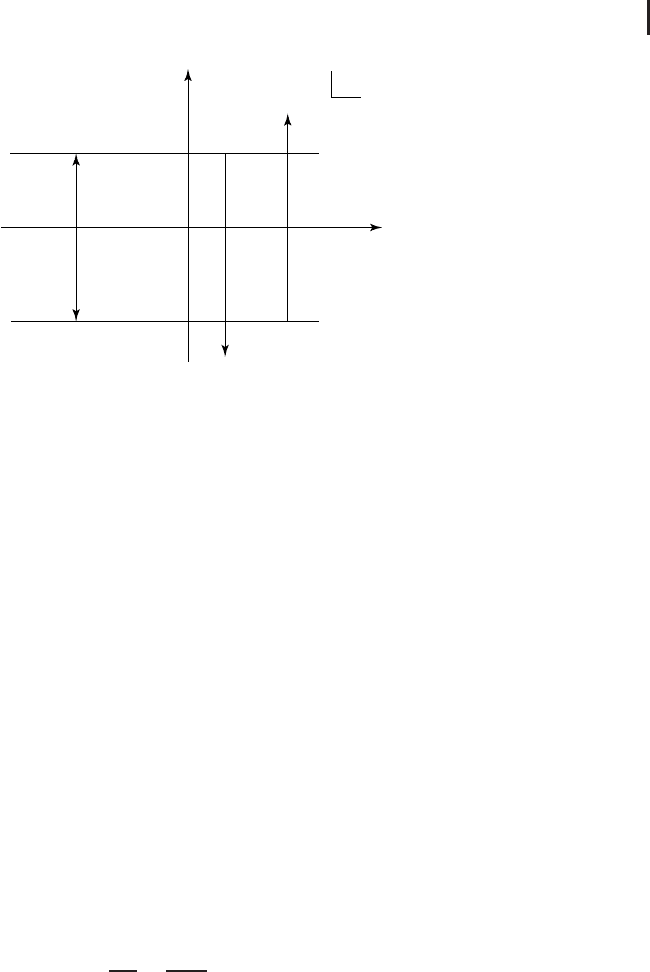
7.3 General Decomposition Problem 253
k
k
2
k
1
t
+
t
−
Fig. 7.12 Sum splitting of F(k). φ
−
(k)isanalyticinthe
lower half plane, Im k <τ
−
. ψ
+
(k) is analytic in the upper
half plane, Im k >τ
+
. F(k) is analytic inside the strip, τ
+
<
Im k <τ
−
.
In the problems we just examined in Section 7.2, i.e., the homogeneous
Wiener–Hopf integral equation of the second kind, we need to make the
decomposition,
1 −λ
ˆ
K(k) = Y
−
(k)/Y
+
(k). (7.3.3)
Here we discuss how this can be done in general, as opposed to by inspection.
Consider the first problem (sum splitting) first (Figure 7.12):
φ
−
(k) = ψ
+
(k) +F(k).
Assume that
φ
−
(k), ψ
+
(k), F(k) → 0ask →∞. (7.3.4)
Examine the decomposition of F(k). Since F(k) is analytic inside the strip,
τ
+
< Im k = k
2
<τ
−
, (7.3.5)
bytheCauchyintegralformula,wehave
F(k) =
1
2πi
C
F(ζ )
ζ − k
dζ (7.3.6)
where the complex integration contour C consists of the following path as in
Figure 7.13:
C = C
1
+ C
2
+ C
↑
+C
↓
. (7.3.7)
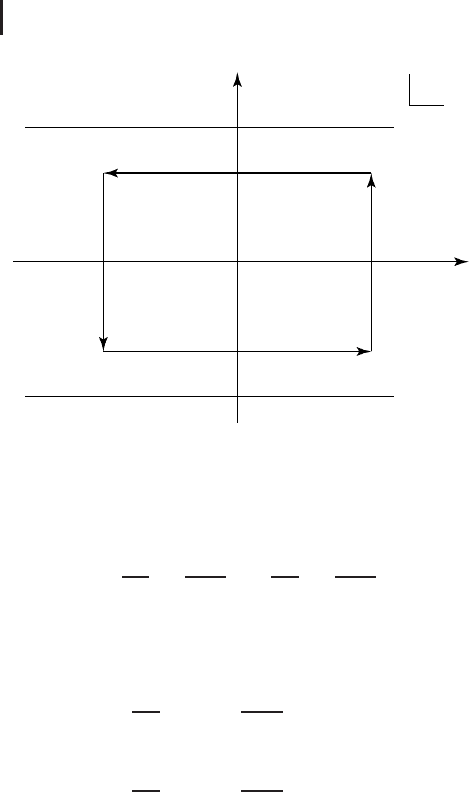
254 7 Wiener–Hopf Method and Wiener–Hopf Integral Equation
k
k
2
k
1
k
2
= t
−
k
2
= t
+
C
2
C
1
C
↑
C
↓
Fig. 7.13 Sum splitting contour C of Eq. (7.3.6) for F(k)insidethestrip,τ
+
< Im k <τ
−
.
The contributions from C
↑
and C
↓
vanish as these contours tend to infinity, since
F(ζ )
is bounded (actually→0), and
1/(ζ − k)
→ 0asζ →∞.
Thus we have
F(k) =
1
2πi
C
1
F(ζ )
ζ − k
dζ +
1
2πi
C
2
F(ζ )
ζ − k
dζ , (7.3.8)
where the contribution from C
1
is a + function, analytic for Im k = k
2
>τ
+
,while
the contribution from C
2
is a − function, analytic for Im k = k
2
<τ
−
, i.e.,
F
+
(k) =
1
2πi
+∞+iτ
+
−∞+iτ
+
F(ζ )
ζ − k
dζ , (7.3.9a)
F
−
(k) =
1
2πi
+∞+iτ
−
−∞+iτ
−
F(ζ )
ζ − k
dζ. (7.3.9b)
Consider now the factorization of 1 −λ
ˆ
K(k) into a ratio ofthe − functiontothe +
function. The function 1 − λ
ˆ
K(k) is analytic inside the strip,
−a < Im k = k
2
< b, (7.3.10)
and the inversion contour is somewhere inside the strip,
−a < Im k = k
2
< −a + ε. (7.3.11)
The analytic function 1 −λ
ˆ
K(k) may have some zeros inside the strip, −a < Im k =
k
2
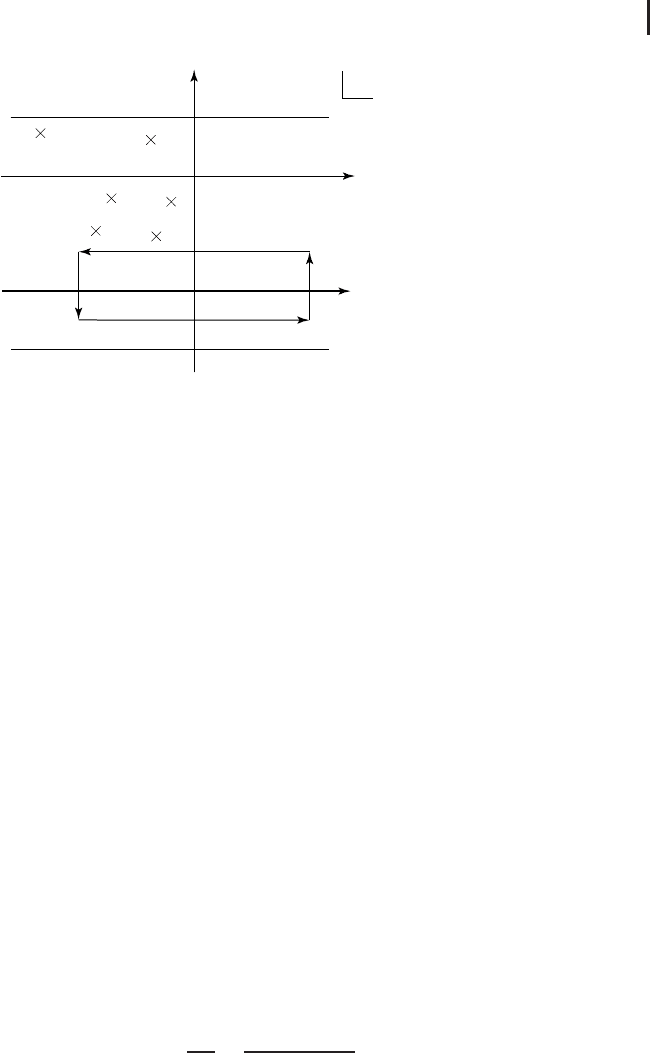
< b. Choose a rectangular contour, as indicated in Figure 7.14, below all zeros
of 1 − λ
ˆ
K(k) inside the strip, −a < Im k = k
2
< b.
7.3 General Decomposition Problem 255
k
k
2
k
1
C
1
C
2
C
↑
C
↓
k
2
=
A
k
2
=
b
k
2
=−
a
Fig. 7.14 Rectangularcontourforthefactorizationof
1 −λ
ˆ
K(k). This contour is chosen below all the zeros of
1 −λ
ˆ
K(k)insidethestrip,−a < Im k < b.
Note if 1 −λ
ˆ
K(k)hasazeroonk
2
=−a, it is all right, since it just remains in the
lower half plane. The inversion contour k
2
= A will be chosen inside this rectangle.
Now, 1 −λ
ˆ
K(k) is analytic inside the rectangle
C
1
+ C
↑
+ C
2
+C
↓
and has no zeros inside this rectangle. Also since
ˆ
K(k) → 0ask →∞,
we know
1 −λ
ˆ
K(k) → 1ask →∞.
In order to express 1 −λ
ˆ
K(k)astheratioY
−
(k)/Y
+
(k), we shall take the logarithm
of (7.3.3) to find
ln
1 −λ
ˆ
K(k)
= ln
Y
−
(k)/Y
+
(k)
= ln Y
−
(k) − ln Y
+
(k). (7.3.12)
Now, ln[1 − λ
ˆ
K(k)] is itself analytic in the rectangle (because it has no branch points
since 1 −λ
ˆ
K(k) has no zeros there), so we can apply the Cauchy integral formula
ln
1 −λ
ˆ
K(k)
=
1
2πi
C
ln
1 −λ
ˆ
K(ζ )
ζ − k
dζ ,
with k inside the rectangle and C consisting of C
1
+ C
2
+ C
↑
+ C
↓
.Thuswewrite

256 7 Wiener–Hopf Method and Wiener–Hopf Integral Equation
ln
1 − λ
ˆ
K(k)
=
1
2πi
C
1
ln
1 −λ
ˆ
K(ζ )
ζ − k
dζ −
1
2πi
−C
2
ln
1 −λ
ˆ
K(ζ )
ζ − k
dζ
+
1
2πi
C↑+C↓
ln
1 −λ
ˆ
K(ζ )
ζ − k
dζ. (7.3.13)
In Eq. (7.3.13), it is tempting to drop the contributions from C
↑
and C
↓
altogether.
It is, however, not always possible to do so. Because of the multivaluedness of the
logarithm, we may have, in the limit
|
ζ
|
→∞,
ln
1 − λ
ˆ
K(ζ )
→ ln e
2πin
= 2πin (n = 0, ±1, ±2, ...) (7.3.14)
and we have no guarantee that the contributions from C
↑
and C
↓
cancel each other.
In other words, 1 −λ
ˆ
K(ζ ) may develop a phase angle as ζ ranges from −∞ + iA
to +∞+ iA.
Let us define index ν of 1 −λ
ˆ
K(ζ )by
ν ≡
1
2πi
ln
1 −λ
ˆ
K(ζ )
ζ =+∞+iA
ζ =−∞+iA
. (7.3.15)
Graphically what we do is the following: plot z = [1 − λ
ˆ
K(ζ )] as ζ ranges from
−∞ + iA to +∞ + iA in the complex z plane, and count the number of counter-
clockwise revolutions z makesabouttheorigin.Theindexν is equal to the number
of these revolutions.
We now examine the properties of index ν;inparticular,arelationship between
index ν and the zeros and the poles of 1 −λ
ˆ
K(k) in the complex k plane. Suppose
1 − λ
ˆ
K(k) has a zero in the upper half plane, say, 1 −λ
ˆ
K(k) = k − z
u
,Imz
u
> −a.
Then the contribution from this z
u
to the index ν is ν(z
u
) =
1
2πi
0 − (−iπ)
=
1
2
.
Similar analysis yields the following results:
zero in the upper half plane ⇒ ν(z
u
) =+
1
2
,
pole in the upper half plane ⇒ ν(p
u
) =−
1
2
,
zero in the lower half plane ⇒ ν(z
l
) =−
1
2
,
pole in the lower half plane ⇒ ν(p
l
) =+
1
2
.
(7.3.16)
In many cases, the translation kernel K(x − y)isoftheform
K(x − y) = K(
x − y
). (7.3.17)
Then
ˆ
K(k)isevenink,
ˆ
K(k) =
ˆ
K(−k). (7.3.18)
Then 1 −λ
ˆ
K(k) (which is even) has an equal number of zeros (poles) in the upper
half plane and in the lower half plane,