
Masujima M. Applied Mathematical Methods in Theoretical Physics
Подождите немного. Документ загружается.


7.3 General Decomposition Problem 257
number of z
u
= number of z
l
, number of p
u
= number of p
l
.
Thus the index of 1 −λ
ˆ
K(k) onthereallineisequaltozero(ν ≡ 0) for
ˆ
K(k) even.
Suppose we now lift the path above the real line (Im k = 0) into the upper half
plane. As the path C (Im k = A) passes by a zero of 1 −λ
ˆ
K(k)inImk > 0, index ν
of 1 −λ
ˆ
K(k) with respect to the path C (Im k = A) decreases by 1. This is because
the point k = z
0
is the zero in the upper half plane with respect to the path C
<
(Im k = A
−
) while it is the zero in the lower half plane with respect to the path C
>
(Im k = A
+
), and hence
ν = ν(z
l
) − ν(z
u
) =−
1
2
−
1
2
=−1. (7.3.19z)
Likewise, for a pole of 1 − λ
ˆ
K(k)inImk > 0, we find
ν = ν(p
l
) − ν(p
u
) =+
1
2
+
1
2
=+1. (7.3.19p)
Consider first the case when index ν is equal to zero,
ν = 0. (7.3.20)
We choose a branch so that ln[1 −λ
ˆ
K(ζ )] vanishes on C
↑
and C
↓
.Wehave
ln Y
−
(k) − ln Y
+
(k) =
1
2πi
C
1
ln
1 −λ
ˆ
K(ζ )
ζ − k
dζ −
1
2πi
−C
2
ln
1 −λ
ˆ
K(ζ )
ζ − k
dζ.
(7.3.21)
In the first integral on the right-hand side of Eq. (7.3.21), we let k be anywhere
above C
1
where C
1
is arbitrarily close to Im k = k
2
=−a from above. Then
ln Y
+
(k) =−
1
2πi
C
1
ln
1 −λ
ˆ
K(ζ )
ζ − k
dζ ,Imk = k
2
> −a, (7.3.22)
is analytic in the upper half plane, and hence is identified to be a + function. It
also vanishes as
k
→∞in the upper half plane (Im k > −a).
In the second integral on the right-hand side of Eq. (7.3.21), we let k be anywhere
below −C
2
where −C
2
is arbitrarily close to Im k = k
2
=−a from above. Then
ln Y
−
(k) =−
1
2πi
−C
2
ln
1 −λ
ˆ
K(ζ )
ζ − k
dζ ,Imk = k
2
≤−a, (7.3.23)
is analytic in the lower half plane, and hence is identified to be a − function. It also
vanishes as
k
→∞inthelowerhalfplane(Imk ≤−a).

258 7 Wiener–Hopf Method and Wiener–Hopf Integral Equation
Thus
Y
+
(k) = exp[−
1
2πi
C
1
ln
1 −λ
ˆ
K(ζ )
ζ − k
dζ ], (7.3.24)
Y
−
(k) = exp
−
1
2πi
−C
2
ln
1 −λ
ˆ
K(ζ )
ζ − k
dζ
. (7.3.25)
We also note that
Y
±
(k) → 1as
k
→∞ in
Im k > −a,
Im k ≤−a.
(7.3.26)
ThentheentirefunctionG(k) in the following equation:
Y
−
(k)
ˆ
φ
−
(k) =−Y
+
(k)
ˆ
ψ
+
(k) = G(k),
must vanish identically by Liouville’s theorem . Hence
ˆ
φ
−
(k) = 0orφ(x) = 0whenν = 0. (7.3.27)
Consider next the case when index ν is positive,
ν>0. (7.3.28)
Instead of dealing with C
↑
and C
↓
of the integral (7.3.13), we construct the object
whose index is equal to zero,
ν
%
i=1
k − z
l
(i)
k − p
u
(i)
1 −λ
ˆ
K(k)
= Z
−
(k)/Z
+
(k). (7.3.29)
Here z
l
(i) is a point in the lower half plane (Im k ≤ A) which contributes −ν/2in
its totality (i = 1,..., ν) to the index and p
u
(i) is a point in the upper half plane
(Im k > A) which contributes −ν/2 in its totality (i = 1,..., ν)totheindex.Then
expression (7.3.29) has the index equal to zero with respect to Im k = A,
−
ν
2
(from z
l
(i)
s) −
ν
2
(from p
u
(i)
s) +ν(from 1 −λ
ˆ
K(k)) = 0. (7.3.30)
By factoring of Eq. (7.3.29), using Eqs. (7.3.24) and (7.3.25), we obtain
Z
−
(k) = exp
−
1
2πi
−C
2
ln
(1 −λ
ˆ
K(ζ ))
ν
%
i=1
ζ −z
l
(i)
ζ −p
u
(i)
ζ − k
dζ
, (7.3.31)

7.3 General Decomposition Problem 259
Z
+
(k) = exp
−
1
2πi
C
1
ln
(1 −λ
ˆ
K(ζ ))
ν
%
i=1
ζ −z
l
(i)
ζ −p
u
(i)
ζ − k
dζ
, (7.3.32)
with the following properties:
(1) Z
±
(k) → 1as
k
→∞,
(2) Z
−
(k)(Z
+
(k)) is analytic in the lower (upper) half plane,
(3) Z
−
(k)(Z
+
(k)) has no zero in the lower (upper) half plane.
We write Eq. (7.3.29) as
1 −λ
ˆ
K(k) =
Y
−
(k)
Y
+
(k)
=
Z
−
(k)
Z
+
(k)
·
,
ν
i=1
(k − p
u
(i))
,
ν
i=1
(k − z
l
(i))
. (7.3.33)
By the prescription stated in Eq. (7.2.17), we obtain
Y
−
(k) = Z
−
(k) ·
ν
%
i=1
(k − p
u
(i)), (7.3.34)
Y
+
(k) = Z
+
(k) ·
ν
%
i=1
(k − z
l
(i)). (7.3.35)
We observe that
Y
±
(k) → k
ν
as
k
→∞. (7.3.36)
Thus the entire function G(k) in the following equation:
Y
−
(k)
ˆ
φ
−
(k) =−Y
+
(k)
ˆ
ψ
+
(k) = G(k),
cannot grow as fast as k
ν
as k →∞. By Liouville’s theorem , we have
G(k) =
ν−1
j=0
C
j
k
j
,0≤ j ≤ ν − 1, (7.3.37)
where C
j
’s are arbitrary ν constants. Then we obtain
ˆ
φ
−
(k) = G(k)/Y
−
(k) =
ν−1
j=0
C
j
k
j
/Y
−
(k), Im k ≤ A. (7.3.38)
Inverting this expression along Im k = A,weobtain
φ(x) =
1
2πi
+∞+iA
−∞+iA
dke
ikx
ˆ
φ
−
(k) =
ν−1
j=0
C
j
φ
(j)
(x), when ν>0, (7.3.39)

260 7 Wiener–Hopf Method and Wiener–Hopf Integral Equation
where
φ
(j)
(x) =
1
2πi
+∞+iA
−∞+iA
dke
ikx
k
j
/Y
−
(k), j = 0, ..., ν − 1. (7.3.40)
We have ν independent homogeneous solutions, φ
(j)
(x), j = 0,..., ν −1, which are
related to each other by differentiation,
−i
d
dx
φ
(j)
(x) = φ
(j+1)
(x), 0 ≤ j ≤ ν −2.
Thus it is sufficient to compute φ
(0)
(x),
φ
(j)
(x) =
−i
d
dx
j
φ
(0)
(x), j = 0, 1, ..., ν − 1. (7.3.41)
Differentiation under the integral, Eq. (7.3.40), is justified by
k
j+1
Y
−
(k)
→
k
j+1
k
ν
→ 0ask →∞, j ≤ ν − 2.
Consider thirdly the case when index ν is negative,
ν<0. (7.3.42)
As before, we construct the object whose index is equal to zero:
|
ν
|
%
i=1
(k − z
u
(i))
(k − p
l
(i))
·
1 −λ
ˆ
K(k)
= Z
−
(k)/Z
+
(k), (7.3.43)
which has indeed index zero as shown below.
+
|
ν
|
2
(fromz
u
(i)
s) +
|
ν
|
2
(fromp
l
(i)
s) + ν(from1 − λ
ˆ
K(k)) = 0. (7.3.44)
We apply the factorization to the left-hand side of Eq. (7.3.43). Then we write
1 −λ
ˆ
K(k) =
Y
−
(k)
Y
+
(k)
=
Z
−
(k)
Z
+
(k)
·
,
|
ν
|
i=1
(k − p
l
(i))
,
|
ν
|
i=1
(k − z
u
(i))
. (7.3.45)
By the prescription stated in Eq. (7.2.17), we obtain
Y
−
(k) = Z
−
(k)/
|
ν
|
%
i=1
(k − z
u
(i)), (7.3.46)
Y
+
(k) = Z
+
(k)/
|
ν
|
%
i=1
(k − p
l
(i)). (7.3.47)

7.4 Inhomogeneous Wiener–Hopf Integral Equation of the Second Kind 261
Then we have
Z
±
(k) → 1andY
±
(k) → 1/k
|
ν
|
,ask →∞. (7.3.48)
Thus the entire function G(k) in the following equation:
Y
−
(k)
ˆ
φ
−
(k) =−Y
+
(k)
ˆ
ψ
+
(k) = G(k),
must vanish identically by Liouville’s theorem. Hence we obtain
φ(x) = 0, when ν<0. (7.3.49)
7.4
Inhomogeneous Wiener–Hopf Integral Equation of the Second Kind
Let us consider the inhomogeneous Wiener–Hopf integral equation of the second kind,
φ(x) = f (x) + λ
+∞
0
K(x − y)φ(y)dy, x ≥ 0, (7.4.1)
where we assume as in Section 7.3 that the asymptotic behavior of the kernel K(x)
is given by
K(x) ∼
O(e
ax
)asx →−∞,
O(e
−bx
)asx →+∞,
a, b > 0, (7.4.2)
and the asymptotic behavior of the inhomogeneous term f (x)isgivenby
f (x) → O(e
cx
)asx →+∞. (7.4.3)
We define ψ(x)forx < 0asbefore
ψ(x) = λ
+∞
0
K(x − y)φ(y)dy, x < 0. (7.4.4)
We take the Fourier transform of φ(x)andψ(x)forx ≥ 0andx < 0 and add the
results together,
ˆ
φ
−
(k) +
ˆ
ψ
+
(k) =
ˆ
f
−
(k) + λ
ˆ
K(k)
ˆ
φ
−
(k), (7.4.5)
where
ˆ
K(k) is analytic inside the strip,
−a < Im k = k
2
< b. (7.4.6)

262 7 Wiener–Hopf Method and Wiener–Hopf Integral Equation
Difficulty may arise when the inhomogeneous term f (x)growstoofastasx →∞
so there may not exist a common region of analyticity for Eq. (7.4.5) to hold. The
Fourier transform
ˆ
f
−
(k)isdefinedby
ˆ
f
−
(k) =
+∞
0
dxe
−ikx
f (x), (7.4.7)
where
e
−ikx
f (x)
∼ e
(k
2
+c)x
as x →∞ with k = k
1
+ ik
2
.
That is,
ˆ
f
−
(k) is analytic in the lower half plane,
Im k = k
2
< −c. (7.4.8)
We require that a and c satisfy
a > c. (7.4.9)
In other words, f (x) grows at most as fast as
f (x) ∼ e
(a−ε)x
, ε>0, as x →∞.
We try to solve Eq. (7.4.5) in the narrower strip,
−a < Im k = k
2
< min(−c, b). (7.4.10)
Writing Eq. (7.4.5) as
(1 −λ
ˆ
K(k))
ˆ
φ
−
(k) =
ˆ
f
−
(k) −
ˆ
ψ
+
(k), (7.4.11)
we are content to obtain one particular solution of Eq. (7.4.1). We factor 1 −λ
ˆ
K(k)
as before,
1 −λ
ˆ
K(k) = Y
−
(k)/Y
+
(k). (7.4.12)
Thus we have from Eqs. (7.4.11) and (7.4.12)
Y
−
(k)
ˆ
φ
−
(k) = Y
+
(k)
ˆ
f
−
(k) − Y
+
(k)
ˆ
ψ
+
(k), (7.4.13)
where Y
−
(k)
ˆ
φ
−
(k) is analytic in the lower half plane and Y
+
(k)
ˆ
ψ
+
(k)isanalyticin
the upper half plane. We split Y
+
(k)
ˆ
f
−
(k) into a sum of two functions, one analytic
in the upper half plane and the other analytic in the lower half plane,
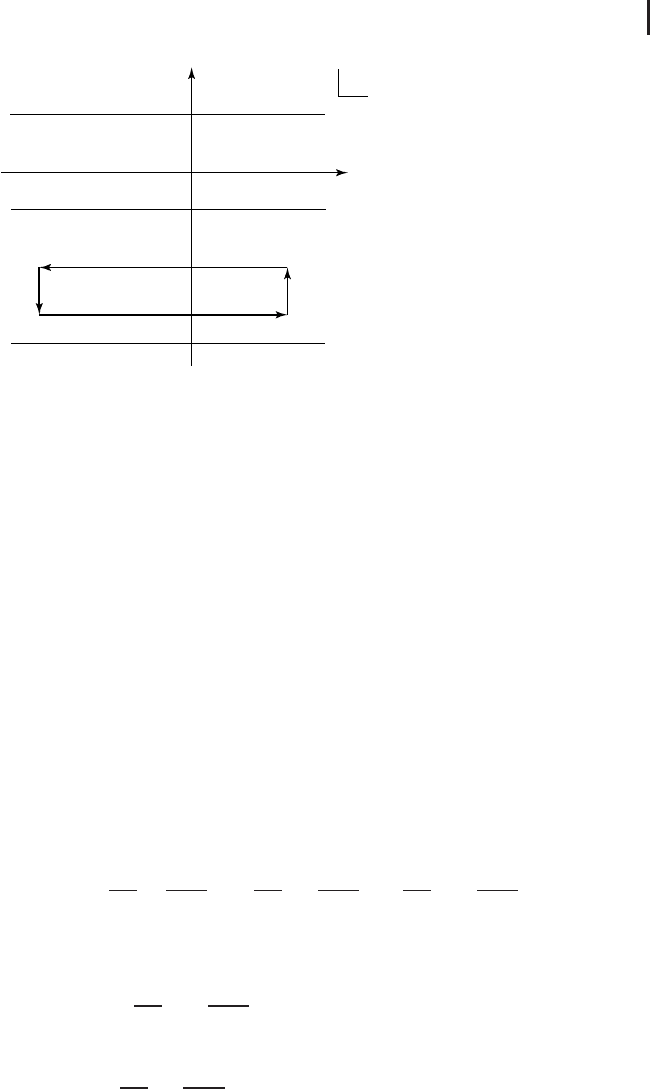
7.4 Inhomogeneous Wiener–Hopf Integral Equation of the Second Kind 263
k
2
=−
a
k
2
=
b
k
2
=−
c
k
k
2
k
1
C
1
C
2
C
↑
C
↓
Fig. 7.15 Region of analyticity and the integration contour
C for
ˆ
F(k)insidethestrip,−a < Im k < min(−c, b).
Y
+
(k)
ˆ
f
−
(k) = (Y
+
(k)
ˆ
f
−
(k))
+
+ (Y
+
(k)
ˆ
f
−
(k))
−
.
Inordertodothis,wemustconstructY
+
(k)suchthat
Y
+
(k)
ˆ
f
−
(k) → 0ask →∞,
or
Y
+
(k) → constant as k →∞. (7.4.14)
Suppose
ˆ
F (k) is analytic inside the strip,
−a < Im k = k
2
< min(−c, b). (7.4.15)
By choosing the contour C inside the strip as in Figure 7.15, we apply the Cauchy
integral formula.
ˆ
F(k) =
1
2πi
C
ˆ
F(ζ )
ζ − k
dζ =
1
2πi
C
1
ˆ
F(ζ )
ζ − k
dζ −
1
2πi
−C
2
ˆ
F(ζ )
ζ − k
dζ. (7.4.16)
By the same argument as in the previous section, we identify
ˆ
F
−
(k) =−
1
2πi
−C
2
ˆ
F(ζ )
ζ − k
dζ , (7.4.17)
ˆ
F
+
(k) =
1
2πi
C
1
ˆ
F(ζ )
ζ − k
dζ. (7.4.18)

264 7 Wiener–Hopf Method and Wiener–Hopf Integral Equation
Thus, under the assumption that Y
+
(k) satisfy the above-stipulated condition
(7.4.14), we obtain
(Y
+
(k)
ˆ
f
−
(k))
−
=−
1
2πi
−C
2
[Y
+
(ζ )
ˆ
f
−
(ζ )/(ζ − k)]dζ , (7.4.19)
(Y
+
(k)
ˆ
f
−
(k))
+
=
1
2πi
C
1
[Y
+
(ζ )
ˆ
f
−
(ζ )/(ζ − k)]dζ. (7.4.20)
Then we write
Y
−
(k)
ˆ
φ
−
(k) −(Y
+
(k)
ˆ
f
−
(k))
−
= (Y
+
(k)
ˆ
f
−
(k))
+
− Y
+
(k)
ˆ
ψ
+
(k) ≡ G(k), (7.4.21)
where G(k)isentireink. If we are looking for the most general homogeneous
solutions, we set
ˆ
f
−
(k) ≡ 0 and determine the most general form of the entire
function G(k). Now we are just looking for one particular solution to the inhomogeneous
equation,sothatwesetG(k) = 0. Then we have
ˆ
φ
−
(k) = (Y
+
(k)
ˆ
f
−
(k))
−
/Y
−
(k), (7.4.22)
ˆ
ψ
+
(k) = (Y
+
(k)
ˆ
f
−
(k))
+
/Y
+
(k). (7.4.23)
Choices of Y
±
(k) for an inhomogeneous solution are different from those for a
homogeneous solution. In view of Eqs. (7.4.22) and (7.4.23), we require that
(1) 1/Y
−
(k) is analytic in the lower half plane,
Im k < c
, −a < c
< b, (7.4.24)
and 1/Y
+
(k) is analytic in the upper half plane,
Im k > c
, −a < c
< b. (7.4.25)
(2)
ˆ
φ
−
(k) → 0,
ˆ
ψ
+
(k) → 0ask →∞. (7.4.26)
According to this requirement, Y
−
(k) for an inhomogeneous solution can have a
pole in the lower half plane. This is all right because then 1/Y
−
(k)hasazeroin
the lower half plane. Once requirements (1) and (2) are satisfied,
ˆ
φ
−
(k)and
ˆ
ψ
+
(k)
given by Eqs. (7.4.22) and (7.4.23) are analytic in the respective half plane. Then we
construct the following expression from Eqs. (7.4.22) and (7.4.23):
[1 −λ
ˆ
K(k)]
ˆ
φ
−
(k) =
ˆ
f
−
(k) −
ˆ
ψ
+
(k). (7.4.27)

7.4 Inhomogeneous Wiener–Hopf Integral Equation of the Second Kind 265
Inverting for x ≥ 0, we obtain
φ(x) −λ
+∞
0
K(x − y)φ(y)dy = f (x), x ≥ 0.
Thus
ˆ
φ
−
(k)and
ˆ
ψ
+
(k) derived in Eqs. (7.4.22) and (7.4.23) under the requirements
(1) and (2) do provide a particular solution to Eq. (7.4.1).
Case 1:Indexν = 0.
When index ν of 1 − λ
ˆ
K(k) with respect to the line Im k = A is equal to zero,no
nontrivial homogeneous solution exists. From Eqs. (7.3.22) and (7.3.23), we have
1 −λ
ˆ
K(k) = Y
−
(k)/Y
+
(k), (7.4.28)
where
Y
−
(k) = exp
−
1
2πi
−C
2
dζ
ln
1 −λ
ˆ
K(ζ )
ζ − k
,Imk ≤ A, (7.4.29)
Y
+
(k) = exp
−
1
2πi
C
1
dζ
ln
1 −λ
ˆ
K(ζ )
ζ − k
,Imk > A, (7.4.30)
and
Y
±
(k) → 1as
k
→∞. (7.4.31)
Since Y
+
(k)(Y
−
(k)) has no zeros in the upper half plane (the lower half plane),
1/Y
+
(k)(1/Y
−
(k)) is analytic in the upper half plane (the lower half plane). Then
we have
Y
+
(k)
ˆ
f
−
(k) → 0ask →∞,
so that Y
+
(k)
ˆ
f
−
(k) can be split into the + part and the − part as in Eqs. (7.4.19) and
(7.4.20).
Using Y
±
(k)givenfortheν ≡ 0 case, Eqs. (7.4.29) and (7.4.30), we construct a
resolvent kernel H(x , y). Since 1/Y
−
(k) is analytic in the lower plane and approaches
to 1 as k →∞,wedefiney
−
(x)by
1
Y
−
(k)
− 1 ≡
+∞
0
dxe
−ikx
y
−
(x), (7.4.32)
266 7 Wiener–Hopf Method and Wiener–Hopf Integral Equation
where the left-hand side is analytic in the lower half plane and vanishes as k →∞.
Inverting Eq. (7.4.32) for y
−
(x), we have
y
−
(x) =
+∞+iA
−∞+iA
dk
2π
e
ikx
1
Y
−
(k)
− 1
for x ≥ 0, (7.4.33)
y
−
(x) = 0forx < 0. (7.4.34)
Similarly, we define y
+
(x)by
Y
+
(k) −1 ≡
0
−∞
dxe
−ikx
y
+
(x), (7.4.35)
where the left-hand side is analytic in the upper half plane and vanishes as k →∞.
Inverting Eq. (7.4.35) for y
+
(x), we have
y
+
(x) =
+∞+iA
−∞+iA
dk
2π
e
ikx
[Y
+
(k) − 1] for x < 0, (7.4.36)
y
+
(x) = 0forx ≥ 0. (7.4.37)
We define
ˆ
y
±
(k)by
1
Y
−
(k)
≡ 1 +
+∞
0
dxe
−ikx
y
−
(x) ≡ 1 +
ˆ
y
−
(k), (7.4.38)
Y
+
(k) ≡ 1 +
0
−∞
dxe
−ikx
y
+
(x) ≡ 1 +
ˆ
y
+
(k). (7.4.39)
Then
ˆ
φ
−
(k) given by Eq. (7.4.23) becomes
ˆ
φ
−
(k) =
1
Y
−
(k)
(Y
+
(k)
ˆ
f
−
(k))
−
= (1 +
ˆ
y
−
(k))(
ˆ
f
−
(k) +
ˆ
y
+
(k)
ˆ
f
−
(k))
−
=
ˆ
f
−
(k) +
ˆ
y
−
(k)
ˆ
f
−
(k) + (
ˆ
y
+
(k)
ˆ
f
−
(k))
−
+
ˆ
y
−
(k)(
ˆ
y
+
(k)
ˆ
f
−
(k))
−
. (7.4.40)
Inverting Eq. (7.4.40) for x > 0,
φ(x) = f (x) +
+∞
0
y
−
(x − y)f (y)dy +
+∞
0
y
+
(x − y)f (y)dy
+
+∞
0
y
−
(x − z)dz
+∞
0
y
+
(z − y)f (y)dy
= f (x) +
+∞
0
H (x, y)f (y)dy, x ≥ 0, (7.4.41)