
Masujima M. Applied Mathematical Methods in Theoretical Physics
Подождите немного. Документ загружается.

7.5 Toeplitz Matrix and Wiener–Hopf Sum Equation 277
x′
x
2
′
x
1
′
C
1
C
2
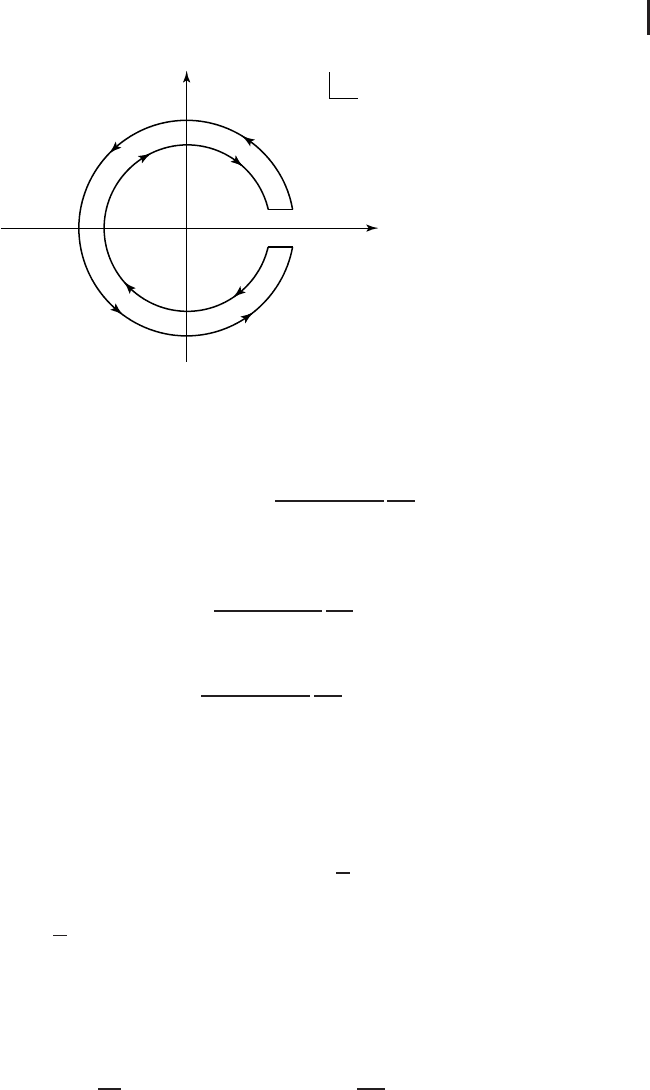
Fig. 7.16 Integration contour of ln[M(ξ
)], when the index ν = 0.
Case 2:theindex ν>0(positive integer).
We construct the object with the index zero, M(ξ )/ξ
ν
and obtain
M(ξ) = ξ
ν
exp
-
C
1
−
-
C
2
ln[M(ξ
)/(ξ
)
ν
]
ξ
− ξ
dξ
2πi
, (7.5.38)
from which, we obtain
N
in
(ξ) = ξ
ν
exp
-
C
1
ln[M(ξ
)/(ξ
)
ν
]
ξ
− ξ
dξ
2πi
→ ξ
ν
as
|
ξ
|
→∞, (7.5.39a)
N
out
(ξ) = exp
-
C
2
ln[M(ξ
)/(ξ
)
ν
]
ξ
− ξ
dξ
2πi
→ 1as
|
ξ
|
→∞. (7.5.39b)
By Liouville’s theorem, G(ξ) cannot grow as fast as ξ
ν
.Hencewehave
G(ξ) =
ν−1
m=0
G
m
ξ
m
, (7.5.40)
where G
m
’s are ν arbitrary constants. Thus X(ξ)isgivenby
X(ξ ) =
ν−1
m=0
G
m
ξ
m
/N
in
(ξ), (7.5.41a)
from which, we obtain ν independent homogeneous solutions X
n
’s by the Fourier series
inversion formula on the unit circle,
X
n
=
1
2π
2π
0
dθ exp[−inθ ]X(exp[iθ ]) =
1
2πi
-
|
ξ
|
=1
dξξ
−n−1
X(ξ ). (7.5.41b)

278 7 Wiener–Hopf Method and Wiener–Hopf Integral Equation
Case 3:theindex ν<0(negative integer).
We construct the object with the index zero , M(ξ)ξ
|
ν
|
,andobtain
M(ξ) =
1
ξ
|
ν
|
exp
-
C
1
−
-
C
2
ln[M(ξ
)(ξ
)
|
ν
|
]
ξ
− ξ
dξ
2πi
, (7.5.42)
from which, we obtain
N
in
(ξ) =
1
ξ
|
ν
|
exp
-
C
1
ln[M(ξ
)(ξ
)
|
ν
|
]
ξ
− ξ
dξ
2πi
→
1
ξ
|
ν
|
as
|
ξ
|
→∞, (7.5.43a)
N
out
(ξ) = exp
-
C
2
ln[M(ξ
)(ξ
)
|
ν
|
]
ξ
− ξ
dξ
2πi
→ 1as
|
ξ
|
→∞. (7.5.43b)
By Liouville’s theorem, we have
G(ξ) = 0, (7.5.44)
and hence we have no nontrivial solution.
Inhomogeneous problem : We restate the inhomogeneous problem below,
M(ξ)X(ξ ) = f (ξ ) + Y(ξ ), (7.5.45)
where we assume that f (ξ )isanalyticfor
|
ξ
|
< 1 +ε.FactoringM(ξ ) as before,
M(ξ) = N
in
(ξ)/N
out
(ξ), (7.5.46)
and multiplying by N
out
(ξ) on both sides of Eq. (7.5.45), we have
X(ξ )N
in
(ξ) = f (ξ )N
out
(ξ) + Y(ξ )N
out
(ξ), (7.5.47a)
or, splitting f (ξ )N
out
(ξ) into a sum of the in function and the out function,
X(ξ )N
in
(ξ) − [f (ξ )N
out
(ξ)]
in
= [f (ξ )N
out
(ξ)]
out
+ Y(ξ )N
out
(ξ) ≡ F(ξ ), (7.5.47b)
where F(ξ ) is entire in the complex ξ plane. Since we are intent to obtain one
particular solution to Eq. (7.5.45), we set in Eq. (7.5.47b)
F(ξ) = 0, (7.5.48)
resulting in the particular solution,
X
part
(ξ) = [f (ξ )N
out
(ξ)]
in
/N
in
(ξ), (7.5.49a)

7.5 Toeplitz Matrix and Wiener–Hopf Sum Equation 279
Y(ξ) =−[f (ξ )N
out
(ξ)]
out
/N
out
(ξ). (7.5.49b)
The fact that Eqs. (7.5.49a) and (7.5.49b) satisfy Eq. (7.5.47a) can be easily demon-
strated. From Eq. (7.5.49a), the particular solution, X
n,part
’s can be obtained by the
Fourier series inversion formula on the unit circle.
We note that in writing Eq. (7.5.47b), the following property of N
out
(ξ) is essential:
N
out
(ξ) → 1as
|
ξ
|
→∞. (7.5.50)
Case 1:theindex ν = 0.
Since the homogeneous problem has no nontrivial solution, the unique particular
solution, X
n,part
’s, is obtained for the inhomogeneous problem.
Case 2:theindex ν>0(positive integer).
In this case, since the homogeneous problem has ν independent solutions, the
solution to the inhomogeneous problem is not unique.
Case 3:theindex ν<0(negative integer).
In this case, consider the homogeneous adjoint problem,
∞
m=0
M
m−n
X
adj
m
= 0. (7.5.51)
Its M function, M
adj
(ξ), is defined by
M
adj
(ξ) ≡
+∞
n=−∞
M
−n
ξ
n
=
+∞
n=−∞
M
n
ξ
−n
= M(1/ξ ). (7.5.52)
The index ν
adj
of M
adj
(ξ)isdefinedby
ν
adj
≡
1
2πi
ln[M
adj
(exp[iθ])]
θ=2π
θ=0
=
1
2πi
ln[M(exp[−iθ ])]
θ=2π
θ=0
=
1
2πi
ln[{M(exp[iθ])}
∗
]
θ=2π
θ=0
=−
1
2πi
ln[M(exp[iθ ])]
θ=2π
θ=0
=−ν. (7.5.53)
The factorization of M
adj
(ξ)iscarriedoutasinthecaseofM(ξ ), with the result
M
adj
(ξ) = N
adj
in
(ξ)/N
adj
out
(ξ) = M(1/ξ ) = N
in
(1/ξ )/N
out
(1/ξ ). (7.5.54)
From this, we recognize that
N
adj
in
(ξ) = N
−1
out
(1/ξ )analyticin
|
ξ
|
< 1, and continuous for
|
ξ
|
≤ 1,
N
adj
out
(ξ) = N
−1
in
(1/ξ )analyticin
|
ξ
|
> 1, and continuous for
|
ξ
|
≥ 1.
(7.5.55)

280 7 Wiener–Hopf Method and Wiener–Hopf Integral Equation
Then, in this case, the homogeneous adjoint problem has
|
ν
|
independent solutions,
X
adj(j)
m
j = 1, ...,
|
ν
|
, m ≥ 0. (7.5.56)
By the argument similar to the derivation of the solvability condition for the inhomo-
geneous Wiener–Hopf integral equation of the second kind discussed in Section
7.4, noting Eq. (7.5.50), we obtain the solvability condition for the inhomogeneous
Wiener–Hopf sum equation as follows:
∞
m=0
f
m
X
adj(j)
m
= 0, j = 1, ...,
|
ν
|
. (7.5.57)
Thus, if and only if the solvability condition (7.5.57) is satisfied, i.e., the inhomogeneous
term f
m
is orthogonal to all the
|
ν
|
independent solutions X
adj(j)
m
to the homogeneous
adjoint problem (7.5.51), the inhomogeneous Wiener–Hopf sum equation has the
unique solution, X
n,part
.
From this analysis of the inhomogeneous Wiener–Hopf sum equation,wefindthat
the problem at hand is the discrete analog of the inhomogeneous Wiener–Hopf integral
equation of the second kind, not of the first kind, despite its formal appearance.
For an interesting application of the Wiener–Hopf sum equation to the phase
transition of the two-dimensional Ising model, the reader is referred to the article
by T.T. Wu, cited in the bibliography.
For another interesting application of the Wiener–Hopf sum equation to the
Yagi–Uda semi-infinite arrays, the reader is referred to the articles by W. Wasylki-
wskyj and A.L. VanKoughnett, cited in the bibliography.
The Cauchy integral formula used in this section should actually be Pollard’s
theorem which is the generalization of the Cauchy integral formula. We avoided
the mathematical technicalities in the presentation of the Wiener–Hopf sum
equation.
As for the mathematical details related to the Wiener–Hopf sum equation,
Liouville’s theorem, the Wiener–L
´
evy theorem, and Pollard’s theorem, we refer
the reader to Chapter IX of the book by B. McCoy and T.T. Wu, cited in the
bibliography.
Summary of the Wiener–Hopf sum equation:
∞
m=0
M
n−m
X
m
= f
n
, n ≥ 0,
∞
m=0
M
m−n
X
adj
m
= 0, n ≥ 0.

7.6 Wiener–Hopf Integral Equation of the First Kind and Dual Integral Equations 281
(1) Index ν = 0.
Homogeneous problem has no nontrivial solution.
Homogeneous adjoint problem has no nontrivial solution.
Inhomogeneous problem has a unique solution.
(2) Index ν>0.
Homogeneous problem has ν independent nontrivial solutions.
Homogeneous adjoint problem has no nontrivial solution.
Inhomogeneous problem has nonunique solutions.
(3) Index ν<0.
Homogeneous problem has no nontrivial solution.
Homogeneous adjoint problem has
|
ν
|
independent nontrivial solutions.
Inhomogeneous problem has a unique solution, if and only if the
inhomogeneous term is orthogonal to all
|
ν
|
independent solutions to the
homogeneous adjoint problem.
7.6
Wiener–Hopf Integral Equation of the First Kind and Dual Integral Equations
In this section, we shall reexamine the mixed boundary value problem considered
in Section 7.1 with some generality and show its equivalence to the Wiener–Hopf
integral equation of the first kind and to the dual integral equations.Thisequivalence
does not constitute a solution to the original problem; rather it provides a hint for
solving the Wiener–Hopf integral equation of the first kind and the dual integral
equations .
Example 7.5. Solve the mixed boundary value problem of two-dimensional
Laplace equation in half plane:
∂
2
∂x
2
+
∂
2
∂y
2
φ(x, y) = 0, y ≥ 0, (7.6.1)
with the boundary conditions specified on the x-axis,
φ(x,0)= f (x), x ≥ 0;φ
y
(x,0) = g(x), x < 0;φ(x, y) → 0asx
2
+ y
2
→∞.
(7.6.2)
Solution. We write
φ(x, y) = lim
ε→0
+
+∞
−∞
dk
2π
e
ikx−
√
k
2
+ε
2
y
ˆ
φ(k), y ≥ 0. (7.6.3)
Setting y = 0 in Eq. (7.6.3),
+∞
−∞
dk
2π
e
ikx
ˆ
φ(k) =
f (x), x ≥ 0,
φ(x,0), x < 0.
(7.6.4)

282 7 Wiener–Hopf Method and Wiener–Hopf Integral Equation
Thus we have
ˆ
φ(k) =
+
−∞
∞dxe
−ikx
φ(x,0)=
ˆ
φ
+
(k) +
ˆ
f
−
(k), (7.6.5)
where
ˆ
φ
+
(k) =
0
−∞
dxe
−ikx
φ(x, 0), (7.6.6)
ˆ
f
−
(k) =
+∞
0
dxe
−ikx
f (x). (7.6.7)
We know that
ˆ
φ
+
(k)(
ˆ
f
−
(k)) is analytic in the upper half plane (the lower half plane).
Differentiating Eq. (7.6.3) with respect to y, and setting y = 0, we have
+∞
−∞
dk
2π
e
ikx
−
k
2
+ ε
2
ˆ
φ(k) =
φ
y
(x,0), x ≥ 0,
g(x), x < 0.
(7.6.8)
Then, by inversion, we obtain
−
k
2
+ ε
2
ˆ
φ(k) =
ˆ
g
+
(k) +
ˆ
ψ
−
(k), (7.6.9)
where
ˆ
g
+
(k) =
0
−∞
dxe
−ikx
g(x), (7.6.10)
ˆ
ψ
−
(k) =
+∞
0
dxe
−ikx
φ
y
(x,0). (7.6.11)
As before, we know that
ˆ
g
+
(k)(
ˆ
ψ
−
(k)) is analytic in the upper half plane (the lower
half plane).
Eliminating
ˆ
φ(k) from Eqs. (7.6.5) and (7.6.9), we obtain
ˆ
φ
+
(k) +
ˆ
f
−
(k) =
−
1
√
k
2
+ ε
2
ˆ
g
+
(k) +
−
1
√
k
2
+ ε
2
ˆ
ψ
−
(k). (7.6.12)
Inverting Eq. (7.6.12) for x > 0, we obtain
+∞
−∞
dk
2π
e
ikx
(
ˆ
φ
+
(k) +
ˆ
f
−
(k) +
1
√
k
2
+ ε
2
ˆ
g
+
(k))
=
+∞
−∞
dk
2π
e
ikx
−
1
√
k
2
+ ε
2
ˆ
ψ
−
(k), x > 0, (7.6.13)

7.6 Wiener–Hopf Integral Equation of the First Kind and Dual Integral Equations 283
where
+∞
−∞
dk
2π
e
ikx
ˆ
φ
+
(k) = 0, for x > 0, (7.6.14)
because
ˆ
φ
+
(k) is analytic in the upper half plane and the contour of the integration
is closed in the upper half plane for x > 0.
The remaining terms on the left-hand side of Eq. (7.6.13) are identified as
+∞
−∞
dk
2π
e
ikx
ˆ
f
−
(k) = f (x), x > 0, (7.6.15)
+∞
−∞
dk
2π
e
ikx
1
√
k
2
+ ε
2
ˆ
g
+
(k) ≡ G(x), x > 0. (7.6.16)
The right-hand side of Eq. (7.6.13) is identified as
+∞
−∞
dk
2π
e
ikx
−
1
√
k
2
+ ε
2
ˆ
ψ
−
(k) =
+∞
0
ψ(y)K(x − y)dy , x > 0, (7.6.17)
where ψ(x)andK(x)aredefinedby
ψ(x) ≡ φ
y
(x,0), x > 0, (7.6.18)
K(x) ≡
+∞
−∞
dk
2π
e
ikx
−
1
√
k
2
+ε
2
. (7.6.19)
Thus we obtain the integral equation for ψ(x) from Eq. (7.6.13),
+∞
0
K(x − y)ψ(y)dy = f (x ) + G(x), x > 0. (7.6.20)
This is the integral equation with a translational kernel of semi-infinite range
andiscalledtheWiener–Hopf integral equation of the first kind. As noted earlier,
this reduction of the mixed boundary value problem, Eqs. (7.6.1)–(7.6.2c), to the
Wiener–Hopf integral equation of the first kind by no means constitutes a solution
to the original mixed boundary value problem.
In order to solve the Wiener–Hopf integral equation of the first kind
+∞
0
K(x − y)ψ(y)dy = F(x), x ≥ 0, (7.6.21)
we rather argue backward. Equation (7.6.21) is reduced to the form of Eq. (7.6.12).
We define the left-hand side of Eq. (7.6.21) for x < 0by
+∞
0
K(x − y)ψ(y)dy = H(x), x < 0. (7.6.22)

284 7 Wiener–Hopf Method and Wiener–Hopf Integral Equation
We consider the Fourier transforms of Eqs. (7.6.21) and (7.6.22),
+∞
0
dxe
−ikx
+∞
0
dyK(x − y)ψ(y) =
+∞
0
dxe
−ikx
F(x) ≡
ˆ
F
−
(k), (7.6.23a)
0
−∞
dxe
−ikx
+∞
0
dyK(x − y)ψ(y) =
0
−∞
dxe
−ikx
H (x) ≡
ˆ
H
+
(k), (7.6.23b)
where
ˆ
F
−
(k)(
ˆ
H
+
(k)) is analytic in the lower half plane (the upper half plane).
Adding Eqs. (7.6.23a) and (7.6.23b) together, we obtain
+∞
0
dye
−iky
ψ(y)
+∞
−∞
dxe
−ik(x−y)
K(x − y) =
ˆ
F
−
(k) +
ˆ
H
+
(k).
Hencewehave
ˆ
ψ
−
(k)
ˆ
K(k) =
ˆ
F
−
(k) +
ˆ
H
+
(k), (7.6.24)
where
ˆ
ψ
−
(k)and
ˆ
K(k), respectively, are defined by
ˆ
ψ
−
(k) ≡
+∞
0
e
−ikx
ψ(x)dx, (7.6.25)
ˆ
K(k) ≡
+∞
−∞
e
−ikx
K(x)dx. (7.6.26)
From Eq. (7.6.24), we have
ˆ
ψ
−
(k) = (1/
ˆ
K(k))(
ˆ
F
−
(k) +
ˆ
H
+
(k)). (7.6.27)
Carrying out the sum splitting on the right-hand side of Eq. (7.6.27) either by
inspection or by the general method discussed in Section 7.3, we can obtain
ˆ
ψ
−
(k)
as in Section 7.1.
Returning to Example 7.5, we note that the mixed boundary value problem we
examined belongs to the general class of the equation,
ˆ
φ
+
(k) +
ˆ
f
−
(k) =
ˆ
K(k)(
ˆ
g
+
(k) +
ˆ
ψ
−
(k)). (7.6.28)
If we directly invert for
ˆ
ψ
−
(k)forx > 0 in Eq. (7.6.28), we obtain the Wiener–Hopf
integral equation of the first kind (7.6.20). Instead, we may write Eq. (7.6.28) as a
pair of equations,
(k) =
ˆ
g
+
(k) +
ˆ
ψ
−
(k), (7.6.29a)

7.7 Problems for Chapter 7 285
ˆ
K(k)(k) =
ˆ
φ
+
(k) +
ˆ
f
−
(k). (7.6.29b)
Inverting Eqs. (7.6.29a) and (7.6.29b) for x < 0andx ≥ 0, respectively, we find a
pair of integral equations for (k) of the following form:
+∞
−∞
dk
2π
e
ikx
(k) = g(x), x < 0, (7.6.30a)
+∞
−∞
dk
2π
e
ikx
ˆ
K(k)(k) = f (x), x ≥ 0. (7.6.30b)
A pair of integral equations, one holding in some range of the independent
variable and the other holding in the complementary range, are called the dual
integral equations. This pair is equivalent to the mixed boundary value problem,
Eqs. (7.6.1)–(7.6.2c). A solution to the dual integral equations is again provided by
the methods we developed in Sections 7.1 and 7.3.
7.7
Problems for Chapter 7
7.1. (due to H. C.). Solve the Sommerfeld diffraction problem in two spatial
dimensions with the boundary condition
φ
x
(x,0)= 0forx < 0.
7.2. (due to H. C.). Solve the half-line problem
∂
2
∂x
2
+
∂
2
∂y
2
− p
2
φ(x, y) = 0withφ(x,0) = e
x
for x ≤ 0,
and
φ(x, y) → 0asx
2
+ y
2
→∞.
It is assumed that φ(x, y)andφ
y
(x, y) are continuous except on the half-line
y = 0withx ≤ 0.
7.3. (Due to D. M.) Solve the boundary value problem,
∂
2
∂x
2
+
∂
2
∂y
2
+ p
2
φ(x, y) = 0withφ
y
(x,0) = e
iαx
for x ≥ 0,
and
x
2
+y
2
(φ
y
(x, y) +ipφ(x, y)) → 0as
x
2
+ y
2
→∞,
286 7 Wiener–Hopf Method and Wiener–Hopf Integral Equation
by using the Wiener–Hopf method. In the above, the point (x, y)liesinthe
entire (x, y)-plane with the exception of the half-line,
{(x, y):y = 0, x ≥ 0},
p is real and positive, and
0 <α<p.
We note that the given condition for
x
2
+ y
2
→∞is called the
Sommerfeld radiation condition.
7.4. (Due to D. M.) Solve the boundary value problem,
∂
2
∂x
2
+
∂
2
∂y
2
− p
2
φ(x, y) = 0withφ
y
(x,0)= e
iαx
for x ≥ 0,
and
φ(x, y) → 0as
x
2
+ y
2
→∞,
by using the Wiener–Hopf method. In this problem, the point (x, y)liesin
the region stated in the previous problem. Note that the Sommerfeld
radiation condition is now replaced by the usual condition of zero limit.
Compare your answer with the previous one.
7.5. (due to H. C.). Solve
∇
2
φ(x, y) = 0,
with a cut on the positive x-axis, subject to the boundary conditions
φ(x,0)= e
−ax
for x ≥ 0,
φ(x, y) → 0asx
2
+ y
2
→∞.
7.6. (due to H. C.). Solve
∇
2
φ(x, y) = 0, 0 < y < 1,
subject to the boundary conditions
φ(x,0)= 0forx ≥ 0,