
Menon E.S. Liquid Pipeline Hydraulics
Подождите немного. Документ загружается.

Pipeline Economics 223
costs for each pipe size. As indicated in the previous paragraph, the
optimum pipe size and pump station configuration will be the alternative
that minimizes total investment, after taking into account the time value of
money over the life of the project. We will illustrate this using an example.
Example Problem 12.2
A city is proposing to build a 24 mile long pipeline to transport water at a
flow rate of 14.4 million gal/day. There is static elevation head of 250 ft
from the originating pump station to the delivery terminus. A minimum
delivery pressure of 50 psi is required at the pipeline terminus.
The pipeline operating pressure must be limited to 1000 psi using steel
pipe with a yield strength of 52,000 psi. Determine the optimum pipe
diameter and the HP required for pumping this volume on a continuous
basis, assuming 350 days operation, 24 hr a day. Electricity costs for
driving the pumps will be based on 8 cents/kWh. The interest rate on
borrowed money is 8% per year. Use the Hazen-Williams equation for
pressure drop with a C-factor of 100.
Assume $700/ton for pipe material cost and $20,000/inch-diametermile
for pipeline construction cost. For pump stations, assume a total installed
cost of $1500 per HP. To account for items other than pipe and pump
stations in the total cost use a 25% factor.
Solution
First we have to bracket the pipe diameter range. If we consider 20 in.
diameter pipe, 0.250 in. wall thickness, the average water velocity using
Equation (3.11) will be
V=0.4085×10,000/19.5
2
=10.7 ft/s
where 10,000 gal/min is the flow rate based on 14.4 million gal/day. This is
not a very high velocity. Therefore, 20 in. pipe can be considered as one of
the options. We will compare this with two other pipe sizes: 22 in. and 24
in. nominal diameter.
Initially, we will assume 0.500 in. pipe wall thickness for the 22 in. and
24 in. pipes. Later we will calculate the actual required wall thickness for
the given MAOP. Using ratios, the velocity in the 22 in. pipe will be
approximately
10.7×(19.5/21)
2
or 9.2 ft/s
and the velocity in the 24 in. pipe will be
10.7×(19.5/23)
2
or 7.7 ft/s
Copyright © 2004 by Marcel Dekker, Inc.
Chapter 12224
Thus, the selected pipe sizes of 20 in., 22 in., and 24 in. will result in a
water velocity between 7.7 ft/s and 10.7 ft/s, which is an acceptable range
of velocities in a pipe.
Next we need to choose a suitable wall thickness for each pipe size to
limit the operating pressure to 1000 psi. Using the internal design
pressure Equation (4.3), we calculate the pipe wall thickness required as
follows:
For 20 in. pipe, the wall thickness is
T=1000×20/(2×52,000×0.72)=0.267 in.
Similarly for the other two pipe sizes we calculate:
For 22 inch pipe, the wall thickness is
T=1000×22/(2×52,000×0.72)=0.294 in.
For 24 in. pipe, the wall thickness is
T=1000×24/(2×52,000×0.72)=0.321 in.
Using the closest commercially available pipe wall thicknesses, we choose
the following three sizes:
20 in., 0.281 in. wall thickness (MAOP=1052 psi)
22 in., 0.312 in. wall thickness (MAOP=1061 psi)
24 in., 0.344 in. wall thickness (MAOP=1072 psi)
The revised MAOP values for each pipe size, with the slightly higher than
required minimum wall thickness, were calculated as shown within
parentheses above. With the revised pipe wall thickness, the velocity
calculated earlier will be corrected to
V
20
=10.81 ft/s
V
22
=8.94 ft/s
V
24
=7.52 ft/s
Next, we calculate the pressure drop due to friction in each pipe size at the
given flow rate of 10,000 gal/min, using the Hazen-Williams equation with
a C-factor of 100. From Equation (3.36) for the 20 in. pipeline
10,000×60×24/42=0.1482×100(20-2×0.281)
2.63
(Pm/1.0)
0.54
Rearranging and solving for the pressure drop P
m
we get
P
m
=63.94 psi/mile for the 20 in. pipe
Copyright © 2004 by Marcel Dekker, Inc.
Pipeline Economics 225
Similarly, we get the following for the pressure drop in the 22 in. and 24 in.
pipelines:
P
m
=40.25 psi/mile for the 22 in. pipe
P
m
=26.39 psi/mile for the 24 in. pipe
We can now calculate the total pressure required for each pipe size, taking
into account the friction drop in the 24 mile pipeline and the elevation head
of 250 ft along with a minimum delivery pressure of 50 psi at the pipeline
terminus.
Total pressure required at the origin pump station is:
(63.94×24)+250×1.0/2.31+50=1692.79 psi for the 20 in. pipe
(40.25×24)+250×1.0/2.31+50=1124.23 psi for the 22 in. pipe
(26.39×24)+250×1.0/2.31+50=791.59 psi for the 24 in. pipe
Since the MAOP of the pipeline is limited to 1000 psi, it is clear that we
would need two pump stations for the 20 in. and 22 in. pipeline cases while
one pump station would suffice for the 24 in. pipeline case.
The total BHP required for each case will be calculated from the above
total pressure and the flow rate of 10,000 gal/min using Equation (5.18)
assuming a pump efficiency of 80%. We will also assume that the pumps
require a minimum suction pressure of 50 psi.
BHP=10,000×(1693-50)/(0.8×1714)=11,983 for 20 in.
BHP=10,000×(1124-50)/(0.8×1714)=7833 for 22 in.
BHP=10,000×(792-50)/(0.8×1714)=5412 for 24 in.
Increasing the BHP values above by 10% for installed HP and choosing the
nearest motor size, we will use 14,000 HP for the 20 in. pipeline system,
9000 HP for the 22 in. system, and 6000 HP for the 24 in. pipeline system. If
we had factored in a 95% efficiency for the electric motor and picked the next
nearest size motor we would have arrived at the same HP motors as above.
To calculate the capital cost of facilities, we will use $700 per ton for
steel pipe, delivered to the construction site. The labor cost for installing
the pipe will be based on $20,000 per inch-diameter-mile.
The installed cost for pump stations will be assumed to be $1500/HP. To
account for other cost items discussed earlier in this chapter, we will add
25% to the subtotal of pipeline and pump station cost.
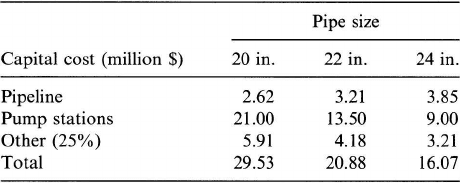
The estimated capital costs for the three pipe sizes are summarized in
Table 12.1. Based on total capital costs alone, it can be seen that the 24 in.
system is the best. However, we will have to look at the operating costs as
well, before making a decision on the optimum pipe size.
Next, we calculate the operating cost for each scenario, using electrical
energy costs for pumping. As discussed in an earlier section of this chapter,
Copyright © 2004 by Marcel Dekker, Inc.
Chapter 12226
many other items enter into the calculation of annual operating costs, such as
O&M, G&A costs, etc. For simplicity, we will increase the electrical cost of
the pump stations by a factor to account for all other operating costs.
Using the BHP calculated at each pump station for the three cases and 8
cents/kWh for electricity cost, we find that the annual operating cost for 24
hr operation per day, 350 days per year the annual costs are:
11,983×0.746×24×350×0.08=$6.0 million/yr for 20 in.
7833×0.746×24×350×0.08=$3.93 million/yr for 22 in.
5412×0.746×24×350×0.08=$2.71 million/yr for 24 in.
Strictly speaking, the above costs will have to be increased to account for
the demand charge for starting and stopping electric motors. The utility
company may charge based on the kW rating of the motor. This will range
from $4 to $6 per kW/month. Using an average demand charge of $5/kW/
month, we get the following demand charges for the pump station in a 12
month period:
14,000×5×12=$840,000 for 20 in.
9000×5×12=$540,000 for 22. in.
6000×5×12=$360,000 for 24 in.
Adding the demand charges to the previously calculated electric power
cost, we get the total annual electricity costs as
$6.84 million/yr for 20 in.
$4.47 million/yr for 22 in.
$3.07 million/yr for 24 in.
Increasing above numbers by a 50% factor to account for other operating
costs such as O&M, G&A, etc., we get the following for total annual costs
for each scenario:
$10.26 million/yr for 20 in.
$6.7 million/yr for 22 in.
Table 12.1 Capital Costs for Varying Pipe Sizes
Copyright © 2004 by Marcel Dekker, Inc.
Pipeline Economics 227
$4.6 million/yr for 24 in.
Next, we use a project life of 20 years and interest rate of 8% to perform a
discounted cash flow (DCF) analysis, to obtain the present value of these
annual operating costs. Then the total capital cost calculated earlier and
listed in Table 12.1 will be added to the present values of the annual
operating costs. The present value (PV) will then be obtained for each of
the three scenarios.
PV of 20 in. system=$29.53+present value of $10.26 million/yr at
8% for 20 years
or
PV
20
=29.53+100.74=$130.27 million
Similarly, for the 22 in. and 24 in. systems, we get
PV
22
=20.88+65.78=$86.66 million
PV
24
=16.07+45.16=$61.23 million
Thus, based on the net present value of investment, we can conclude that
the 24 in. pipeline system with one 6000 HP pump station is the preferred
choice.
In the preceding calculations we made several assumptions for the sake
of simplicity. We considered major cost components, such as pipeline and
pump station costs, and added a percentage of the subtotal to account for
other costs. Also, in calculating the PV of the annual costs we used
constant numbers for each year. A more rigorous approach would require
the annual costs be inflated by some percentage every year to account for
inflation and cost of living adjustments. The Consumer Price Index (CPI)
could be used in this regard. As far as capital costs go, we can get more
accurate results if we perform a more detailed analysis of the cost of
valves, meters, and tanks instead of using a flat percentage of the pipeline
and pump station costs. The objective in this chapter was to introduce the
reader to the importance of economic analysis and to outline a simple
approach to selecting the economical pipe size.
In addition, the earlier section on cost of services and tariff calculations
provided an insight into how transportation companies finance a project
and collect revenues for their services.
12.5 Summary
We have reviewed the major cost components of a pipeline system
consisting of pipe, pump station, etc., and illustrated methods of estimating
the capital costs of these items. The annual costs such as electrical energy,
Copyright © 2004 by Marcel Dekker, Inc.
Chapter 12228
O&M, etc., were also identified and calculated for a typical pipeline. Using
the capital cost and operating cost, the annual cost of service was
calculated based on specified project life, interest cost, etc. We thus
determined the transportation tariff that could be charged for shipments
through the pipelines. Also a methodology for determining the optimal
pipe size for a particular application using present value (PV) was
explained. Considering three different pipe sizes, we determined the best
option based on a comparison of PV of the three different cases.
12.6 Problems
12.6.1 Calculate the annual cost of service and transportation tariff
to be charged for shipments through a refined products
pipeline as follows. The pipeline is 90 km long, 400 mm
diameter and 8 mm wall thickness and constructed of steel
with a yield strength of 448 MPa. The terrain is essentially
flat. It is used to transport gasoline (specific gravity=0.74 and
viscosity=0.65 cSt at 60°F) at a flow rate of 2000 m
3
/ hr. The
annual operating costs such as O&M, G&A, etc., are
estimated to be $2 million and do not include power costs.
Assume a power cost of $0.10 per kWh for the electric motor-
driven pumps. The project will be financed at a debt/equity
ratio 70/30. The interest rate on debt is 7% and the rate of
return allowed by regulators is 14%. Assume a project life of
25 years and overall tax rate of 35%.
12.6.2 Compare pipeline sizes of 12 in., 14 in., and 16 in. for an
application that requires shipments of crude oil from a tank
farm to a refinery 30 miles away at 5000 bbl/hr. The tank farm
is at an elevation of 350 ft while the refinery is at 675 ft
elevation. The pipe MAOP is limited to 1400 psi. Consider
5LX-65 pipe and a 72% design factor. The suction pressure at
the tank farm may be assumed at 50 psi and the delivery
pressure at the refinery is 30 psi. The pipeline will be operated
355 days a year, 24 hr per day. Electricity cost is 6 cents/kWh.
12.6.3 In Problem 12.6.2, assuming the steady-state flow rate of 5000
bbl/hr remains constant for the first 10 years, what is the
estimated tariff? Determine the reduction in tariff if the flow
rate is increased by 20% for the next 10 years.
Copyright © 2004 by Marcel Dekker, Inc.
229
Appendix A
Tables and Charts
A.1 Units and Conversions
A.2 Common Properties of Petroleum Fluids
A.3 Specific Gravity and API Gravity
A.4 Viscosity Conversions
A.5 Thermal Conductivities
A.6 Absolute Roughness of Pipe
A.7 Moody Diagram
A.8 Typical Hazen-Williams C-factors
A.9 Friction Loss in Valves: Resistance Coefficient K
A.10 Equivalent Lengths of Valves and Fittings
A.11 Seam Joint Factors for Pipes
A.12 ANSI Pressure Ratings
A.13 Centrifugal Pump Performance Viscosity Correction
A.14 Approximate Pipeline Construction Cost
A.15 Thermal Hydraulics Summary
A.16 Thermal Hydraulics Pressure Gradient
A.17 Thermal Hydraulics Temperature Gradient
Copyright © 2004 by Marcel Dekker, Inc.
Appendix A230
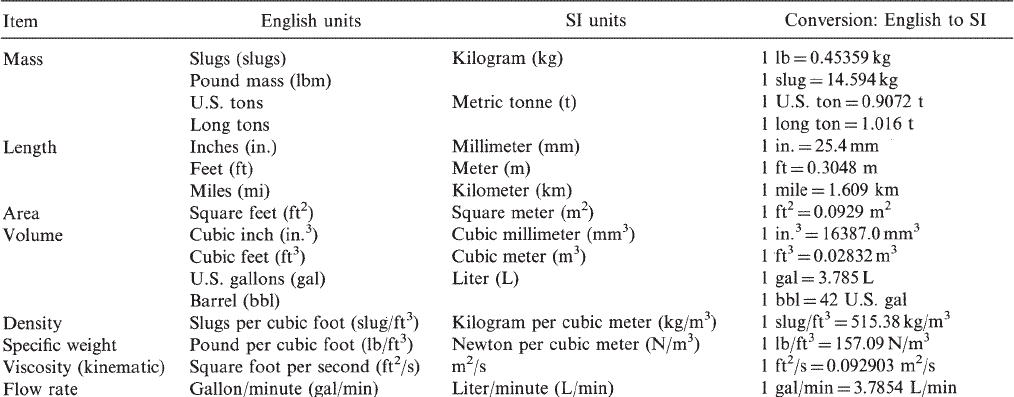
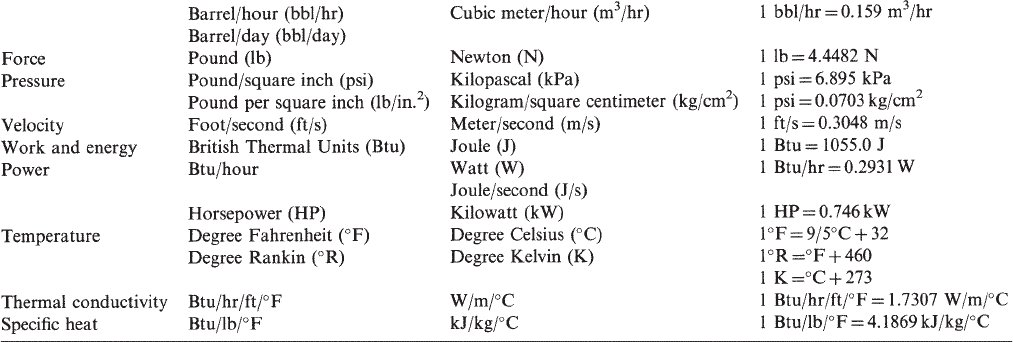
Table A.1 Units and Conversions
Copyright © 2004 by Marcel Dekker, Inc.
Appendix A 231
Copyright © 2004 by Marcel Dekker, Inc.
Appendix A232
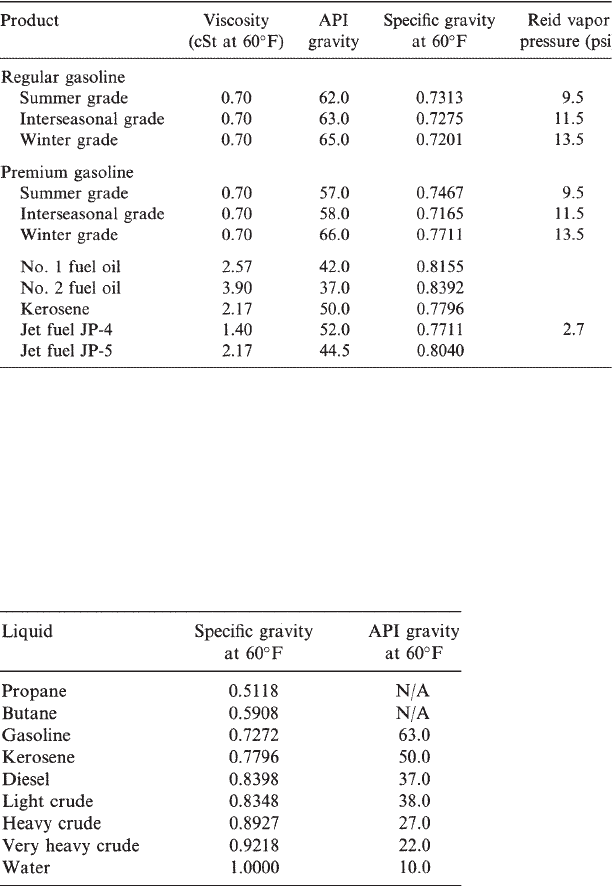
Table A.2 Common Properties of Petroleum Fluids
Table A.3 Specific Gravity and API Gravity
Copyright © 2004 by Marcel Dekker, Inc.