
Menon E.S. Liquid Pipeline Hydraulics
Подождите немного. Документ загружается.

Thermal Hydraulics 183
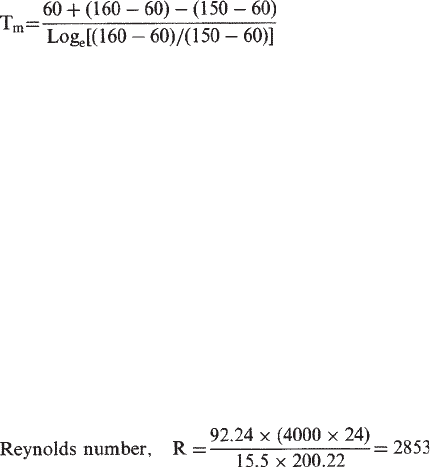
(9.34)
or
T
m
=154.91°F
Therefore, H
b
from Equation (9.33) above becomes
H
b
=2479.76(154.91-60)=235,354 Btu/hr
The frictional heating component H
w
will be calculated using Equations
(9.24) and (9.25). The frictional head drop h
f
depends on the specific
gravity and viscosity at the calculated mean temperature T
m
. Using the
viscosity-temperature relationship from Chapter 2, we calculate the
specific gravity and viscosity at 154.91°F to be 0.9478 and 200.22 cSt,
respectively.
Using the Colebrook-White equation, the friction factor is
f=0.034
Frictional head drop h
f
will be calculated from the Darcy-Weisbach
equation (3.26) as follows:
h
f
=0.034(5280×12/15.5)(V
2
/64.4)
The velocity V is calculated using Equation (3.12) as follows
V=0.2859(4000)/(15.5)
2
=
4.76 ft/s
Therefore, the frictional pressure drop is
h
f
=0.034(5280×12/15.5)(4.76×4.76/64.4)=48.89 ft
From Equation (9.25) the frictional horsepower (HP) is
HHP=(1.7664×10
-4
)×4000×0.9478×48.89×1.0=32.74
Therefore frictional heating from Equation (9.24) is
H
w
=2545×32.74=83,323 Btu/hr
Copyright © 2004 by Marcel Dekker, Inc.
Chapter 9184
The mass flow rate is
w=4000×5.6146×0.9478×62.4=1.328×10
6
lb/hr
From Equation (9.30) the liquid temperature at the outlet of the 1 mile
segment is
T
2
=(1/(1.328×10
6
×0.45))[83,323–235,354+1.328
×10
6
×0.45×160]
=[-0.255+160]=159.75°F
This value of T
2
is used as a second approximation in Equation (9.34) to
calculate a new value of T
m
and subsequently the next approximation for
T
2
. Calculations are repeated until successive values of T
2
are within close
agreement. This is left as an exercise for the reader.
It can be seen from the foregoing that manual calculation of
temperatures and pressures along a heated oil pipeline is definitely a
laborious process, but that can be eased using programmable calculators
and personal computers.
Thermal hydraulics is very complex and calculations require utilization
of some type of computer program to generate quick results. Such a
program can subdivide the pipeline into short segments and calculate the
temperatures, liquid properties, and pressure drops as we have seen in the
examples in this chapter. Several software packages are commercially
available to perform thermal hydraulics. One such package is LIQTHERM
developed by SYSTEK Technologies, Inc. (www.systek.us). For a sample
output report from a liquid pipeline thermal hydraulics analysis using
LIQTHERM software, refer to Table A.15 in Appendix A.
9.3 Summary
We have explored the thermal effects of pipeline hydraulics in this chapter.
To transport viscous liquids, they have to be heated to a temperature
sometimes much higher than the ambient conditions. This temperature
differential between the pumped liquid and the surrounding soil (buried
pipeline) or ambient air (above-ground pipeline) causes heat transfer to
occur, resulting in temperature variation of the liquid along the pipeline.
Unlike isothermal flow, where the liquid temperature is uniform
throughout the pipeline, heated pipeline hydraulics requires subdividing
the pipeline into short segments and calculating pressure drops based on
liquid properties at the average temperature of each segment. We
illustrated this using an example that showed how the temperature varies
along the pipeline. The concept of LMTD was introduced for determining
a more accurate average segment temperature. Also, a method to compute
Copyright © 2004 by Marcel Dekker, Inc.

Thermal Hydraulics 185
the heat transfer between the liquid and the surrounding medium was
shown taking into account thermal conductivities of pipe, soil, and
insulation, if present. The heating of liquid due to friction was also
quantified, as was the liquid heating associated with pump inefficiency.
It was pointed out that unlike isothermal hydraulics, thermal hydraulics
is a complex phenomenon that requires computer methods to correctly
solve equations for temperature variation and pressure drop calculations.
9.4 Problems
9.4.1 An 8 in. nominal diameter pipe is used to move heavy crude
oil from a heated storage tank to a refinery 12 miles away.
The inlet temperature is 180°F and the crude oil has the
following characteristics:
If the outlet temperature cannot drop below 150°F, what
minimum flow rate needs to be maintained in the pipeline?
Use the MIT equation and 0.002 in. pipe roughness, 70°F
soil temperature, 36 in. burial depth, and 0.25 in. insulation,
with K=0.02 Btu/hr/ft/°F. The K value for soil=0.6 Btu/hr/ft/
°F. Pipeline pressures are limited to ANSI 600 rating (1440
psi).
9.4.2 In Problem 9.4.1, if insulation were absent what minimum
flow rate could be tolerated? Compare the HP requirements
in both cases. Assume 15 psi pump suction pressure.
9.4.3 From Problem 9.4.1 develop a set of data points for flow rate
versus pressure required for plotting a system head curve.
Assume 50 psi delivery pressure.
Temperature (°F): 100 180
Specific gravity: 0.985 0.912
Viscosity (cSt): 4000 25
Copyright © 2004 by Marcel Dekker, Inc.
186
10
Flow Measurement
In this chapter we discuss the various methods and instruments used in the
measurement of liquid that flows through a pipeline. The formulas used for
calculating the liquid velocities, flow rates, etc., from the pressure readings,
their limitations, and the degree of accuracy attainable will be covered for
some of the more commonly used instruments. Considerable work is
currently being done in this field of flow measurement to improve the
accuracy of instruments, particularly when custody transfer of products is
involved. For more detailed analysis of the various flow measurement
devices, the reader is referred to the publications listed in the References
section.
10.1 History
Measurement of flow of liquids has been going on for centuries. The
Romans used some form of flow measurement to allocate water from the
aqueducts to the houses in their cities. This was necessary to control the
quantity of water used by the citizens and prevent waste. Similarly, it is
reported that the Chinese used to measure salt water to the brine pots that
were used for salt production. In later years, a commodity had to be
Copyright © 2004 by Marcel Dekker, Inc.
187Flow Measurement
measured so that it could be properly allocated and the ultimate user
charged for it appropriately. Today, gasoline is dispensed from meters at gas
stations and the recipient is billed according to the volume of gasoline so
measured. Water companies measure water consumed by a household using
water meters, while natural gas for residential and industrial consumers is
measured by gas meters. In all these instances, the objective is to ensure that
the supplier gets paid for the commodity and the user of the commodity is
billed for the product at the agreed price. In addition, in industrial processes
that involve the use of liquids and gases to perform a specific function,
accurate quantities need to be dispensed so that the desired effect of the
processes may be realized. In most cases involving consumers, certain
regulatory or public agencies (for example, the department of weights and
measures) periodically check flow measurement devices to ensure that they
are performing accurately and if necessary calibrate them against a very
accurate master device.
10.2 Flow Meters
Several types of instruments are available to measure the flow rate of a
liquid in a pipeline. Some measure the velocity of flow, while others
directly measure the volume flow rate or the mass flow rate.
The following flow meters are used in the pipeline industry:
Venturi meter
Flow nozzle
Orifice meter
Flow tube
Rotameter
Turbine meter
Vortex flow meter
Magnetic flow meter
Ultrasonic flow meter
Positive displacement meter
Mass flow meter
Pitot tube
The first four items listed above are called variable-head meters since the
flow rate measured is based on the pressure drop due to a restriction in the
meter, which varies with the flow rate. The last item, the Pitot tube, is also
called a velocity probe, since it actually measures the velocity of the liquid.
Copyright © 2004 by Marcel Dekker, Inc.
188 Chapter 10
From the measured velocity, we can calculate the flow rate using the
conservation of mass equation, discussed in an earlier chapter.
Mass flow=(Flow rate)×(density)
=(Area)×(Velocity)×(density)
or
M=Q
ρ
=AV
ρ
Since the liquid density is practically constant, we can state that:
Q =A V (10.2)
where
A=Cross-sectional area of flow
V=Velocity of flow
ρ=Liquid density
We will discuss the principle of operation and the formulas used for some of
the more common meters described above. For a more detailed discussion
on flow meters and flow measurement, the reader is referred to one of the
fine texts listed in the References section.
10.3 Venturi Meter
The Venturi meter, also known as a Venturi tube, belongs to the category of
variable-head flow meters. The principle of a Venturi meter is depicted in
Figure 10.1. This type of a Venturi meter is also known as the Herschel type
and consists of a smooth gradual contraction from the main pipe size to the
throat section, followed by a smooth, gradual enlargement from the throat
section to the original pipe diameter.
The included angle from the main pipe to the throat section in the
gradual contraction is generally in the range of 21°±2°. Similarly, the
gradual expansion from the throat to the main pipe section is limited to a
range of 5° to 15° in this design of Venturi meter. This construction results in
minimum energy loss, causing the discharge coefficient (discussed later) to
approach the value of 1.0. This type of a Venturi meter is generally rough
cast with a pipe diameter range of 4.0 in. to 48.0 in. The throat diameter may
vary considerably, but the ratio of the throat diameter to the main pipe
diameter (d/D), also known as the beta ratio, represented by the symbol ß,
should range between 0.30 and 0.75.
The Venturi meter consists of a main piece of pipe which decreases in
size to a section called the throat, followed by a gradually increasing size
back to the original pipe size. The liquid pressure at the main pipe section
Copyright © 2004 by Marcel Dekker, Inc.
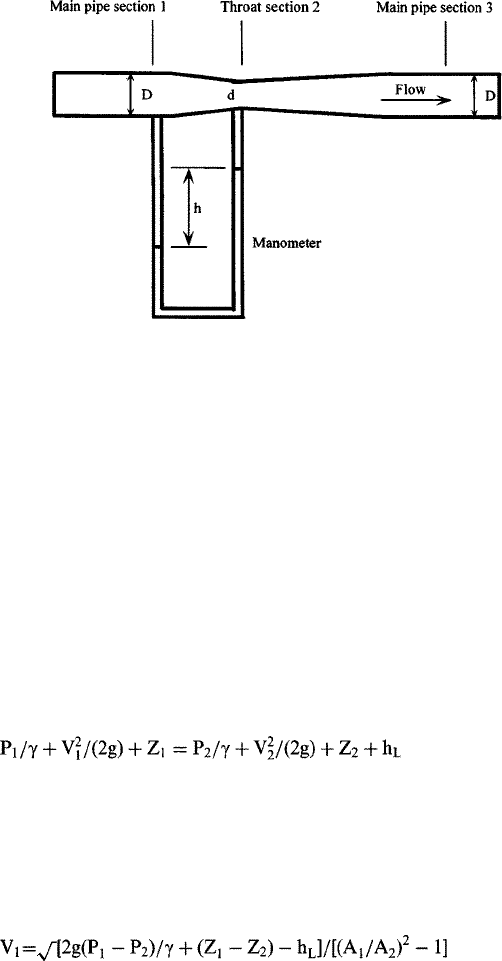
189Flow Measurement
1 is denoted by P
1
and that at the throat section 2 is represented by P
2
. As the
liquid flows through the narrow throat section, it accelerates to compensate
for the reduction in area, since the volume flow rate is constant (Q=AV from
Equation 10.2). As the velocity increases in the throat section, the pressure
decreases (Bernoulli’s equation). As the flow continues past the throat, the
gradual increase in the flow area results in a reduction in flow velocity back
to the level at section 1; correspondingly the liquid pressure will increase to
some value higher than at the throat section.
We can calculate the flow rate using Bernoulli’s equation, introduced in
Chapter 2, along with the continuity equation, based on the conservation of
mass as shown in Equation (10.1). If we consider the main pipe section 1
and the throat section 2 as reference, and apply Bernoulli’s equation for
these two sections, we get
(10.3)
And from the continuity equation
Q=A
1
V
1
=A
2
V
2
(10.4)
where γ is the specific weight of liquid and h
L
represents the pressure drop
due to friction between sections 1 and 2.
Simplifying the above equations yields the following:
(10.5)
Figure 10.1 Venturi meter.
Copyright © 2004 by Marcel Dekker, Inc.
190 Chapter 10
The elevation difference Z
1
-Z
2
is negligible even if the Venturi meter is
positioned vertically. We will also drop the friction loss term h
L
and include
it in a coefficient C, called the discharge coefficient, and rewrite Equation
(10.5) as follows:
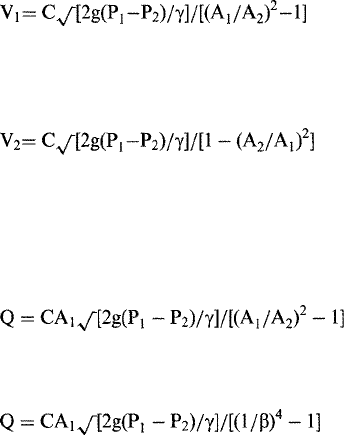
(10.6)
The above equation gives us the velocity of the liquid in the main pipe
section 1. Similarly, the velocity in the throat section, V
2
, can be calculated
using Equation (10.4) as follows:
(10.7)
The volume flow rate Q can now be calculated using Equation (10.4) as
follows:
Q=A
1
V
1
Therefore,
(10.8)
Since the beta ratio β=d/D and A
1
/A
2
=(D/d)
2
we can write the above
equations in terms of the beta ratio as follows:
(10.9)
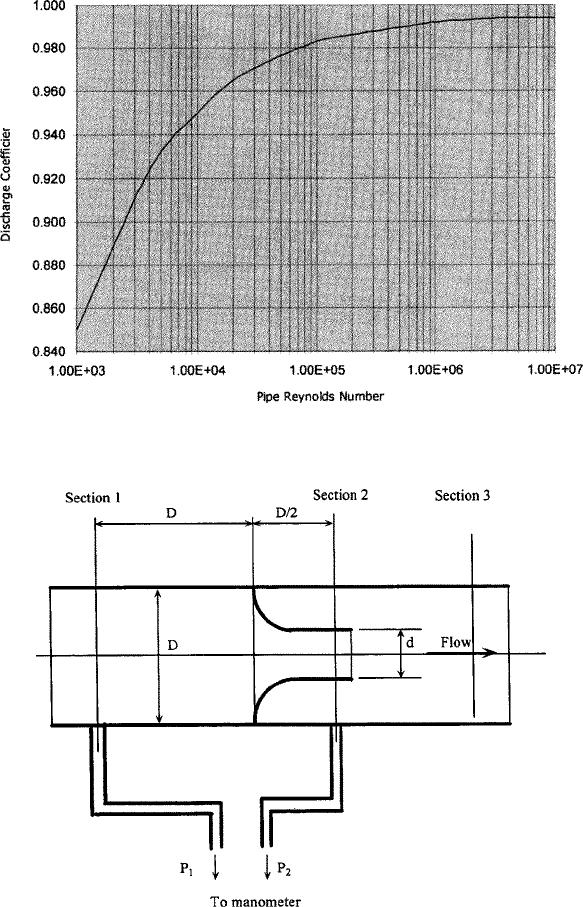
It can be seen by examining Equations (10.5), (10.6) and (10.7) that the
discharge coefficient C actually represents the ratio of the velocity of liquid
through the Venturi meter to the ideal velocity when the energy loss (h
L
) is
zero. C must therefore be a number less than 1.0. The value of C depends on
the Reynolds number in the main pipe section 1 and is shown graphically in
Figure 10.2. For a Reynolds number greater than 2×10
5
the value of C
remains constant at 0.984.
For smaller piping (2 to 10 in.), Venturi meters are machined and hence
have a better surface finish than the larger, rough cast meters. These smaller
Venturi meters have a C value of 0.995 for Reynolds number greater than
2×10
5
.
10.4 Flow Nozzle
A typical flow nozzle is illustrated in Figure 10.3. It consists of the main
pipe section 1, followed by a gradual reduction in flow area and a
subsequent short cylindrical section, and finally an expansion to the main
pipe section 3.
Copyright © 2004 by Marcel Dekker, Inc.
191Flow Measurement
Figure 10.2 Venturi meter discharge coefficient.
Figure 10.3 Flow nozzle. (From Mott, Robert L., Applied Fluid Mechanics, 5th ed.,
Copyright 2000. Reprinted by permission of Pearson Education, Inc., Upper Saddle
River, NJ.)
Copyright © 2004 by Marcel Dekker, Inc.

192 Chapter 10
The American Society of Mechanical Engineers (ASME) and the
International Standards Organization (ISO) have defined the geometries of
these flow nozzles and published equations to be used with them. Due to
the smooth gradual contraction from the main pipe diameter D to the nozzle
diameter d, the energy loss between sections 1 and 2 is very small. We can
apply the same Equations (10.6) through (10.8) for the Venturi meter to the
flow nozzle also. The discharge coefficient C for the flow nozzle is found to
be 0.99 or better for Reynolds numbers above 10
6
. At lower Reynolds
numbers there is greater energy loss immediately following the nozzle
throat, due to sudden expansion, and hence C values are lower.
Depending on the beta ratio and the Reynolds number, the discharge
coefficient C can be calculated from the equation
(10.10)
where
β=d/D
and R is the Reynolds number based on the pipe diameter D.
Compared with the Venturi meter, the flow nozzle is more compact, since
it does not require the length for a gradual decrease in diameter at the throat,
or the additional length for the smooth, gradual expansion from the throat
to the main pipe size. However, there is more energy loss (and, therefore,
pressure head loss) in the flow nozzle, due to the sudden expansion from the
nozzle diameter to the main pipe diameter. The latter causes greater
turbulence and eddies compared with the gradual expansion in the Venturi
meter.
10.5 Orifice Meter
An orifice meter consists of a flat plate that has a sharp-edged hole
accurately machined in it and placed concentrically in a pipe, as shown in
Figure 10.4. As liquid flows through the pipe, the flow suddenly contracts
as it approaches the orifice and then suddenly expands after the orifice back
to the full pipe diameter. This forms a vena contracta or a throat
immediately past the orifice. This reduction in flow pattern at the vena
contracta causes increased velocity and hence lower pressure at the throat,
similar to the Venturi meter discussed earlier.
The pressure difference between section 1, with the full flow, and section
2 at the throat can then be used to measure the liquid flow rate, using
equations developed earlier for the Venturi meter and the flow nozzle. Due
to the sudden contraction at the orifice and the subsequent sudden
Copyright © 2004 by Marcel Dekker, Inc.