
Menon E.S. Liquid Pipeline Hydraulics
Подождите немного. Документ загружается.

193Flow Measurement
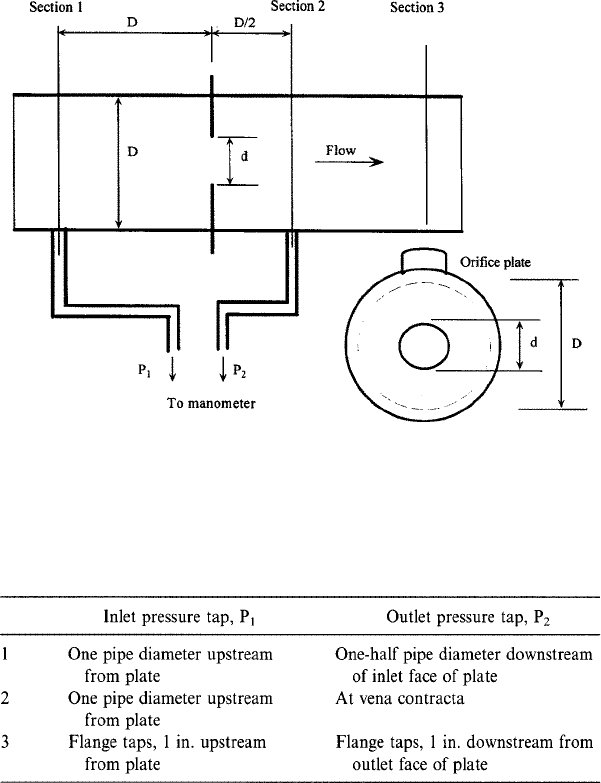
expansion after the orifice, the coefficient of discharge C for the orifice
meter is much lower than that of a Venturi meter or a flow nozzle. In
addition, depending on the pressure tap locations in section 1 and section
2, the value of C is different for orifice meters.
There are three possible pressure tap locations for an orifice meter, as
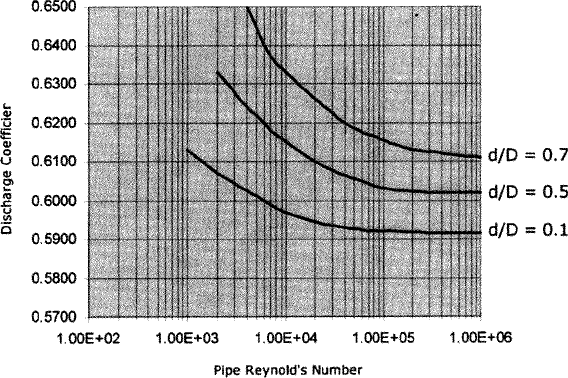
listed in Table 10.1. Figure 10.5 shows the variation of C with the beta ratio
d/D for various values of pipe Reynolds number.
Figure 10.4 Orifice meter. (From Mott, Robert L., Applied Fluid Mechanics, 5th ed.,
Copyright 2000. Reprinted by permission of Pearson Education, Inc., Upper Saddle
River, NJ.)
Table 10.1 Pressure Taps for Orifice Meter
Copyright © 2004 by Marcel Dekker, Inc.
194 Chapter 10
Comparing the three types of flow meter discussed above, we can
conclude that the orifice meter has the highest energy loss due to the
sudden contraction followed by the sudden expansion. On the other hand,
the Venturi meter has a lower energy loss compared with the flow nozzle due
to the smooth, gradual reduction at the throat followed by the smooth
gradual expansion after the throat.
Flow tubes are proprietary, variable-head flow meters that are
streamlined in design to cause the least amount of energy loss. They are
manufactured by different companies with their own proprietary designs.
10.6 Turbine Meters
Turbine meters are used in a wide variety of applications. The food industry
uses turbine meters for measurement of milk, cheese, cream, syrups,
vegetable oils, etc. Turbine meters are also used in the oil industry.
Basically the turbine meter is a velocity-measuring instrument. Liquid
flows through a free-turning rotor that is mounted co-axially inside the
meter. Upstream and downstream of the meter, certain lengths of straight
piping are required to ensure smooth velocities through the meter. The
liquid striking the rotor causes it to rotate, the velocity of rotation being
Figure 10.5 Orifice meter discharge coefficient. (From Mott, Robert L., Applied Fluid
Mechanics, 5th ed., Copyright 2000. Reprinted by permission of Pearson Education,
Inc., Upper Saddle River, NJ.)
Copyright © 2004 by Marcel Dekker, Inc.
195Flow Measurement
proportional to the flow rate. From the rotor speed measured and the flow
area, we can compute the flow rate through the meter. The turbine meter
must be calibrated since flow depends on the friction, turbulence, and the
manufacturing tolerance of the rotor parts.
For liquids with viscosity close to that of water the range of flow rates is
10:1. With higher- and lower-viscosity liquids it drops to 3:1. Density effect
is similar to viscosity.
A turbine meter requires a straight length of pipe before and after the
meter. The straightening vanes located in the straight lengths of pipe helps
eliminate swirl in flow. The upstream length of straight pipe has to be 10D
in length, where D is the pipe diameter. After the meter, the straight length of
pipe is 5D long. Turbine meters may be of a two-section type or three-
section type, depending upon the number of pieces the meter assembly is
composed of. For liquid flow measurement, the API Manual of Petroleum
Measurement standard must be followed. In addition, bypass piping must
also be installed to isolate the meter for maintenance and repair. To
maintain flow measurements on a continuous basis for custody transfer, an
entire spare meter unit will be required on the bypass piping, to be used
when the main meter is taken out of service for testing and maintenance.
From the turbine meter reading at flowing temperature, the flow rate at
some base temperature (such as 60°F) is calculated using the following
equation:
Q
b
=Q
f
×M
f
×F
t
×F
p
(10.11)
where
Q
b
=Flow rate at base conditions, such as 60°F and 14.7 psi
Q
f
=Measured flow rate at operating conditions, such as 80°F and 350 psi
M
f
=Meter factor for correcting meter reading, based on meter calibration
data
F
t
=Temperature correction factor for correcting from flowing
temperature to the base temperature
F
p
=Pressure correction factor for correcting from flowing pressure to the
base pressure
10.7 Positive Displacement Meter
The positive displacement (PD) meter is most commonly used in residential
applications for measuring water and natural gas consumption. PD meters
can measure small flows with good accuracy. These meters are used when
consistently high accuracy is required under steady flow through a
Copyright © 2004 by Marcel Dekker, Inc.
196 Chapter 10
pipeline. PD meters are accurate within ±1% over a flow range of 20:1. They
are suitable for batch operations, for mixing and blending of liquids that are
clean without deposits, and for use with noncorrosive liquids.
PD meters basically operate by measuring fixed quantities of the liquid
in containers that are alternately filled and emptied. The individual
volumes are then totaled and displayed. As the liquid flows through the
meter, the force from the flowing stream causes a pressure drop in the meter,
which is a function of the internal geometry. The PD meter does not require
the straightening vanes as with a turbine meter and hence is a more compact
design. However PD meters can be large and heavy compared with an
equivalent turbine meter. Also, jamming can occur when the meter is
stopped and restarted. This necessitates some form of bypass piping with
valves to prevent a pressure rise and damage to meter. The accuracy of a PD
meter depends on clearance between the moving and stationary
components. Hence precision machined parts are required to maintain
accuracy. PD meters are not suitable for slurries or liquids with suspended
particles that could jam the components and cause damage to the meter.
There are several types of PD meter, including the reciprocating piston type,
rotating disk, rotary piston, sliding vane, and rotary vane type.
Many modern petroleum installations employ PD meters for crude oil
and refined products. These have to be calibrated periodically, to ensure
accurate flow measurement. Most PD meters used in the oil industry are
tested at regular intervals, such as daily or weekly, using a master meter
called a meter prover system that is installed as a fixed unit along with the
PD meter.
Example Problem 10.1
A Venturi meter is used for measuring the flow rate of water at 70° F. The
flow enters a 6.625 in. pipe, 0.250 in. wall thickness; the throat diameter is
2.4 in. The Venturi meter is of the Herschel type and is rough cast with a
mercury manometer. The manometer reading shows a pressure difference of
12.2 in. of mercury. Calculate the flow velocity in the pipe and the volume
flow rate. Use a specific gravity of 13.54 for mercury.
Solution
At 70°F the specific weight and viscosity are:
γ=62.3 lb/ft
3
Copyright © 2004 by Marcel Dekker, Inc.

197Flow Measurement
and
v=1.05×10
-5
ft
2
/s
Assume first that the Reynolds number is greater than 2×10
5
. Therefore, the
discharge coefficient C will be 0.984 from Figure 10.2. The beta ratio
β=2.4/(6.625-0.5)=0.3918 and therefore β is between 0.3 and 0.75.
A
1
/A
2
=(1/0.3918)
2
=6.5144
The manometer reading will give us the pressure difference, by equating
the pressures at the two points in the manometer:
P
1
+γ
w
(y+h)=P
2
+γ
w
y+γ
m
h
where y is depth of the higher mercury level below the centerline of the
Venturi meter and γ
w
and γ
m
are the specific weights of water and mercury
respectively.
Simplifying the above, we get:
(P
1
-P
2
)/γw=(γ
m
/γ
w
-1)h
=(13.54×62.4/62.3–1)×12.2/12=12.77 ft
And using Equation (10.6), we get
Now we check the value of the Reynolds number:
R =4.38×(6.125/12)/1.05×10
-
5
=2.13×10
5
Since R is greater than 2×10
5
our assumption for C is correct. The volume
flow rate is
Q=A
1
V
1
Flow rate=0.7854(6.125/12)
2
×4.38=0.8962 ft
3
/s
or
Flow rate=0.8962×(1728/231)×60=402.25 gal/min
Copyright © 2004 by Marcel Dekker, Inc.
198 Chapter 10
Example Problem 10.2
An orifice meter is used to measure the flow rate of kerosene in a 2 in.
schedule 40 pipe at 70°F. The orifice is 1.0 in. diameter. Calculate the
volume flow rate if the pressure difference across the orifice is 0.54 psi.
Specific gravity of kerosene=0.815 and viscosity=2.14×10
-5
ft
2
/s.
Solution
Since the flow rate depends on the discharge coefficient C, which in turn
depends on the beta ratio and the Reynolds number, we will have to solve
this problem by trial and error.
The 2 in. schedule 40 pipe is 2.375 in. outside diameter and 0.154 in.
wall thickness. The beta ratio
β=1.0/(2.375–2×0.154)=0.4838
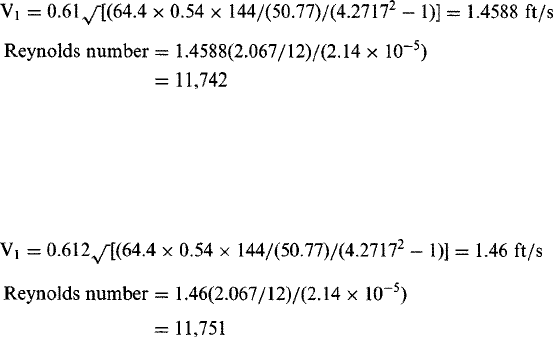
First, we assume a value for the discharge coefficient C (say 0.61) and
calculate the flow rate from Equation (10.6). We then calculate the
Reynolds number and obtain a more correct value of C from Figure 10.5.
Repeating the method a couple of times will yield a more accurate value of
C and finally the flow rate.
The density of kerosene=0.815×62.3=50.77 lb/ft
3
Ratio of areas
A
1
/A
2
=(1/0.4838)
2
=4.2717
Using Equation (10.6), we get
Using this value of the Reynolds number, we obtain from Figure 10.5 the
discharge coefficient C=0.612. Since we earlier assumed C=0.61 we were
not too far off.
Recalculating based on the new value of C:
Copyright © 2004 by Marcel Dekker, Inc.
199Flow Measurement
This is quite close to the previous value of the Reynolds number. Therefore
we will use the last calculated value for velocity. The volume flow rate is
Q=A
1
V
1
Flow rate=0.7854(2.067/12)
2
×1.46=0.034 ft
3
/s
or
Flow rate=0.034×(1728/231)×60=15.27 gal/min
10.8 Summary
In this chapter we discussed the more commonly used devices for the
measurement of liquid pipeline flow rates. Variable-head flow meters, such
as the Venturi meter, flow nozzle and orifice meter, and the equations for
calculating the velocities and flow rate from the pressure drop were
explained. The importance of the discharge coefficient and how it varies
with the Reynolds number and the beta ratio were also discussed. A trial-
and-error method for calculating the flow rate through an orifice meter was
illustrated using an example. For a more detailed description and analysis
of flow meters, the reader should refer to any of the standard texts used in the
industry. Some of these are listed in the References section.
10.9 Problems
10.9.1 Water flow through a 4 in. internal diameter pipeline is measured
using a Venturi tube. The flow rate expected is 300 gal/min. Specific
weight of water is 62.4 lb/ft
3
and viscosity is 1.2× 10
-5
ft2/s.
(a) Calculate the upstream Reynolds number.
(b) If the pressure differential across the meter is 10 psi, determine
the dimensions of the meter.
(c) Calculate the throat Reynolds number.
10.9.2 A 12 in. Venturi meter with a 7 in. throat is used for measuring
flow of diesel at 60°F. The differential pressure reads 70 in. of
water. Calculate the volume and mass flow rates. Specific gravity
of diesel is 0.85 and viscosity is 5 cSt.
10.9.3 An orifice meter with a beta ratio of 0.70 is used for measuring
crude oil (0.895 specific gravity and 15 cSt viscosity). The pipeline
is 10.75 in. diameter, 0.250 in. wall thickness and the line pressure
Copyright © 2004 by Marcel Dekker, Inc.
200 Chapter 10
is 250 psig. With pipe taps the differential pressure is 200 in. of
water. Calculate the flow rate of crude oil.
10.9.4 Water flows through a Venturi tube of 300 mm main pipe diameter
and 150 mm throat diameter at 150 m
3
/hr. The differential
manometer deflection is 106 cm. The specific gravity of the
manometer liquid is 1.3. Calculate the discharge coefficient of the
meter.
Copyright © 2004 by Marcel Dekker, Inc.
201
11
Unsteady Flow in Pipelines
Throughout the last 10 chapters we have addressed steady flow of liquids
in pipelines. This means that the pipeline flow rates, velocities, and
pressures at any point along the pipeline do not change with time. In other
words, flow is not time-dependent. In reality this may not be true. Many
factors affect pipeline operation. Even though volumes may be taken out
of storage tanks at a constant rate and pump stations pump the liquid at a
uniform rate there will always be some environmental or mechanical
factors that could result in changes to the steady-state flow in the pipeline.
In this chapter we briefly discuss unsteady flow and pipeline transients. A
detailed analysis of unsteady flow and pipeline transient pressures is
beyond the scope of this book. The reader is advised to refer to more
specialized texts on unsteady flow, listed in the References section.
11.1 Steady Versus Unsteady Flow
In steady-state flow we assume the hydraulic gradient, representing the
variation in pipeline pressures along the pipeline, to be fixed as long as the
same liquid is being pumped at the same flow rate. Also, in steady-state
flow we assume that liquids are incompressible. In reality, liquids are
compressible, to some extent. The compressibility effect can cause
Copyright © 2004 by Marcel Dekker, Inc.
Chapter 11202
transients or surges in otherwise steady-state flow. If, during the course of
operation, different liquids enter the pipeline at different times, such as in
a batched pipeline, the pressures, velocities, and flow rates will vary with
time, resulting in changes to the hydraulic pressure gradient.
Unsteady flow occurs when the flow rate, velocity, and pressure at a
point in a pipeline change with time. Examples of such pressure transients
include the effect of opening and closing valves, starting and stopping a
pump, or starting and stopping pipeline injections or deliveries. A basic
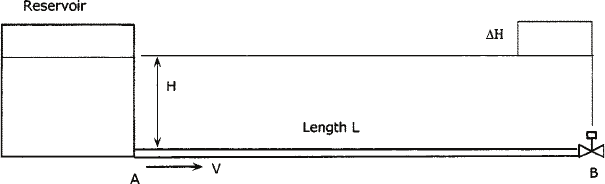
example of unsteady flow would be a situation when a downstream valve
on a pipeline is suddenly closed, as shown in Figure 11.1.
11.2 Transient Flow due to Valve Closure
To illustrate the effect of unsteady flow and transient pressure, we will
consider a simple pipeline system from a storage tank at A, to a valve at the
end of the pipe at B, as shown in Figure 11.1. The valve is located at a
distance L from the tank. The pipeline is assumed to be horizontal, with no
elevation changes and uniform diameter D. In order to simplify the
problem, we will further assume that the friction in the pipe is negligible.
Later we will consider friction and its effect on transient flow. Since
friction is ignored, the steady-state hydraulic gradient line is horizontal.
Let us assume that initially, at time t=0, the valve at B is fully open,
steady-state flow Q exists from A to B, and the liquid velocity throughout
the pipe is V. The tank head is assumed to be H. The velocity is assumed to
be positive in the downstream direction from A to B. If nothing changed
and the valve at B were left open long enough, the tank head H would be
dissipated by flow through the valve.
When we suddenly close the valve at B, we introduce a transient or
surge into the pipeline. As the valve closes, pressure, velocity, and flow
Figure 11.1 Transient with sudden valve closure.
Copyright © 2004 by Marcel Dekker, Inc.