
Menon E.S. Liquid Pipeline Hydraulics
Подождите немного. Документ загружается.

Unsteady Flow in Pipelines 203
variations occur both upstream and downstream of the valve. Since we are
only interested in the pipe section from A to B, we will ignore the effect
downstream of the valve at B. Closing the valve suddenly causes the
velocity of flow at B to become zero instantaneously. This sudden drop in
velocity at the valve causes the pressure head at B to increase suddenly by
some value ΔH. This pressure rise is equal to the change in momentum of
the liquid from a velocity of V to zero.
If the velocity changes from V to zero,
ΔV=0-V=-V
The negative sign indicates a decrease in velocity. The magnitude of ΔH is
given by
ΔH=aV/g (11.1)
where
a=Velocity of propagation of pressure wave, ft/s
V=Velocity of liquid flow, ft/s
g=Acceleration due to gravity, ft/s
2
If instead of closing the valve fully, we close it such that the velocity drops
from V to V
1
ΔV=V
1
-V
The corresponding head rise at the valve is
ΔH=a(V
1
-
V)/g (11.2)
The pressure head increase ΔH at B causes a slight expansion of the pipe
and also an increase in liquid density, which depends upon the bulk
modulus of the liquid, pipe size, and pipe material. For most pipelines, this
pipe expansion and increase in liquid density (decrease in liquid volume)
will be insignificant. Depending on the properties of the liquid and pipe,
the pressure increase propagates upstream from the valve at the speed of
sound (wave speed), a, generally in the range of 2000 to 5000 ft/s. The
wave traveling at the speed of sound reaches the tank in time L/a. At this
point in time the velocity of liquid throughout the pipe has become zero
and, correspondingly, the pressure everywhere has reached H+ΔH. The
consequence of this is that the liquid has compressed somewhat and the
pipe has stretched as well.
The above scenario is an unstable condition since the tank head is H but
the pipeline head is higher (H+ΔH). Due to this pressure differential, the
liquid starts to flow from the pipeline into the tank with velocity -V.
Copyright © 2004 by Marcel Dekker, Inc.
Chapter 11204
The velocity is thus changed from zero to -V which causes the pressure
to drop from (H+ΔH) to H. Therefore, a negative pressure wave travels
toward the valve B. Since friction is negligible, the magnitude of this
reverse flow velocity is exactly equal to the original velocity V.
At time t=2L/a, the pressure in the pipeline returns to the steady-state
value H, but reverse flow continues. However, since the valve is closed, no
flow can take place upstream of the valve. Consequently, the pressure head
drops by the amount ΔH, forcing the reverse flow velocity to zero. This
causes the pipe to shrink and the liquid expands.
At time t=3L/a, this transient has reached the tank and the flow velocity
is now zero throughout the pipe. The pipe pressure, however, has dropped
to a value ΔH below that of the tank. This causes flow from A to B equal to
the original steady-state flow. During this process the pipe pressure returns
to the original steady-state value.
Finally, at time t=4L/a, the pressure wave from A has reached the valve
at B and the flow velocity reaches the original steady-state value V. The
total time elapsed (4L/a) is defined as one wave cycle, or the theoretical
period of the pipeline. As the valve is completely closed, the preceding
sequence of events starts again at t=4L/a. Since we assumed a frictionless
system, the process continues indefinitely and the conditions are repeated
at an interval of 4L/a. However, in reality, due to pipe friction the transient
pressure waves are dissipated over a definite period of time and the liquid
becomes stationary with no flow anywhere and a pressure head equal to
that of the tank.
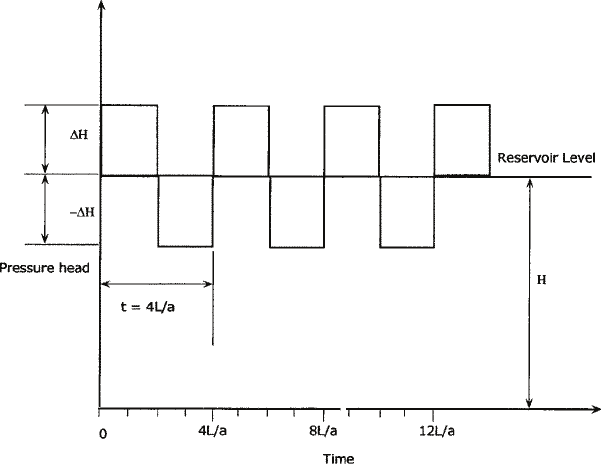
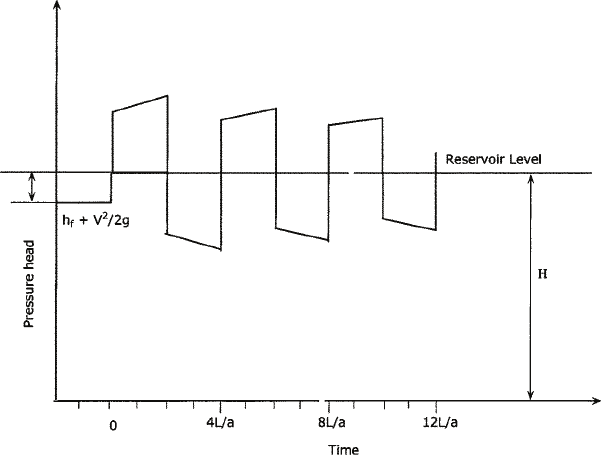
Figure 11.2 shows a plot of the pressures at the valve at various times,
beginning with the valve closure at time t=0 to time t=12L/a (three wave
periods). When friction losses are taken into consideration, the variation of
pressure at the valve with time will be as shown in Figure 11.3. It can be
seen from Figure 11.3 that, due to pipe friction, the transient pressure
waves will die down over a definite period of time and the liquid will reach
equilibrium with zero flow throughout the pipeline with the pressure head
exactly equal to the initial tank head.
As mentioned before, examples of unsteady flow include filling a
pipeline, power failure and pump shut-down, and opening and closing of
valves. In summary we can say that unsteady flow conditions occur when
the pipeline flow rate continually varies with time or variations in flow
between two steady-state conditions occur. Unsteady flow conditions may
be referred to as transient flow. Any change from a regular steady-state
flow condition can cause transients. Slow transients are called surges.
Depending on the magnitude of the transient and the rate at which the
transient occurs, pipeline pressures may exceed steady-state pressures and
sometimes violate the maximum allowable operating pressure (MAOP) in
Copyright © 2004 by Marcel Dekker, Inc.
Unsteady Flow in Pipelines 205
a pipeline. Design codes and federal regulations dictate that the pressure
surge cannot exceed 110% of the MAOP. Therefore, for a pipeline with an
MAOP of 1400 psi, during transient situations the highest pressure reached
anywhere in the pipeline cannot exceed 1400+140=1540 psi.
To control surge pressures and avoid pipeline overpressure, relief valves
may be used that are set to relieve the pipe pressure by allowing a certain
amount of flow to a relief tank.
11.3 Wave Speed in Pipeline
We have seen from Equation (11.1) that the instantaneous head rise due to
sudden stoppage of flow is
ΔH=aV/g
The above equation can be derived easily considering a control element of
flow in the tank-pipe example discussed in Section 11.2. However, we will
not attempt to derive the equation here. The reader is referred instead to
one of the fine books on unsteady flow listed in the References section. At
Figure 11.2 Pressure variation at valve: friction neglected.
Copyright © 2004 by Marcel Dekker, Inc.
Chapter 11206
this point we will assume that the above equation is correct and proceed to
apply it to some practical situations.
Since the transient head rise ΔH is directly dependent on the wave
speed a from Equation (11.1), we must accurately determine its value for
each pipeline.
It has been found that the wave speed in a liquid depends on the density
and bulk modulus of the liquid. It depends also on the elasticity of the pipe
material, pipe diameter, and wall thickness. Also, if the liquid contains free
air or gas, the wave speed will be affected by these. An approximate value
of the wave speed is calculated from
a=(K/ρ)
1/2
where
a=Wave speed, ft/s
K=Bulk modulus of liquid, psi
ρ=Density of liquid, slugs/ft
3
However, the above value of wave speed does not take into account
the elastic nature of the pipe. Hence in the following discussion the
Figure 11.3 Pressure variation at valve: friction considered.
Copyright © 2004 by Marcel Dekker, Inc.
Unsteady Flow in Pipelines 207
equation will be modified to account for the pipe material and its elastic
properties.
Consider an extreme case of a pipeline system where the pipe is
considered rigid and the liquid incompressible. Incompressible liquid
means infinite wave speed, which is impossible. Since no pipe is totally
rigid, the infinite wave speed situation is not possible.
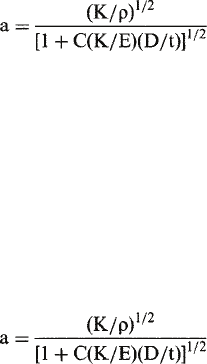
According to Wylie and Streeter (see References), a general equation
for calculating the wave speed in terms of liquid properties, pipe size, and
elasticity of pipe material is as follows:
(11.3)
where
a=Wave speed, ft/s
K=Bulk modulus of liquid, psi
ρ=Density of liquid, slugs/ft
3
C=Restraint factor, dimensionless
D=Pipe outside diameter, in.
t=Pipe wall thickness, in.
E=Young’s modulus of pipe material, psi
An equivalent formula in SI units is
(11.4)
where
a=Wave speed, m/s
K=Bulk modulus of liquid, kPa
ρ=Density of liquid, kg/m
3
C=Restraint factor, dimensionless
D=Pipe outside diameter, mm
t=Pipe wall thickness, mm
E=Young’s modulus of pipe material, kPa
The Young’s modulus is also referred to as the modulus of elasticity of the
pipe material.
The restraint factor C depends on the type of pipe condition. The
following three cases are possible:
Case 1: Pipe is anchored at the upstream end only
Case 2: Pipe is anchored against any axial movements
Case 3: Each pipe section is anchored with expansion joints
Copyright © 2004 by Marcel Dekker, Inc.
Chapter 11208
The calculated value of the wave speed depends on the restraint factor
C which in turn depends on the type of pipe support described above. It is
found that the restraint type has less than 10% effect on the magnitude of
wave speed.
The restraint factor C is defined in terms of the Poisson’s ratio µ of the
pipe material as shown below (see Wylie and Streeter in References):
C=1-0.5µ for case 1 (11.5)
C=1-µ
2
for case 2 (11.6)
C=1.0 for case 3 (11.7)
where µ=Poisson’s ratio for pipe material, usually in the range of 0.20 to
0.45 (for steel pipe µ=0.30).
It must be noted that the above values of the restraint factor C are
applicable to thin-walled elastic pipes with a pipe diameter to thickness
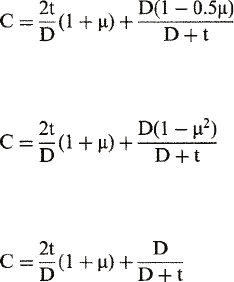
ratio (D/t) greater than 25. For thick-walled pipes with a D/t ratio less than
25, the following C values may be used (see Wylie and Streeter in
References):
Case 1
(11.8)
Case 2
(11.9)
Case 3
(11.10)
Example Problem 11.1
Water flows through a steel pipe at velocity of 6 ft/s. A valve at the end of
the pipe is partially closed and the velocity instantly reduces to 4 ft/s.
Estimate the surge pressure rise at the valve. Use a wave speed of 3000 ft/
s for the water in the pipe.
Copyright © 2004 by Marcel Dekker, Inc.
Unsteady Flow in Pipelines 209
Solution
From Equation (11.1):
Pressure rise=aV/g
=3000×(6-4)/32.2=186.33 ft
Example Problem 11.2
A steel pipe carries water at 20° C. The pipe diameter is 600 mm and wall
thickness 6mm. Assume Young’s modulus E=207 GPa and Poisson’s
ratio=0.3. Use 1000 kg/m
3
for the density of water and a bulk modulus
K=2.2 GPa. Calculate the wave speed through this pipeline considering the
three pipe constraints.
Solution
The D/t ratio is
600/6=100
therefore thin-walled pipe values for restraint factor C apply. Considering
the pipe to be completely rigid, the wave speed is
a=(K/ρ)
1/2
=(2.2×10
9
/1000)
1/2
=1483 m/s
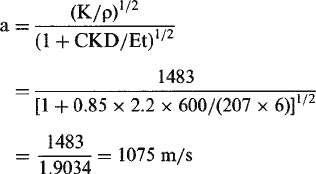
(a) For a pipe anchored at the upstream end only, from Equation (11.5):
C=1-0.5µ=1-0.5×0.3
or
C=0.85
Therefore,
Copyright © 2004 by Marcel Dekker, Inc.
Chapter 11210
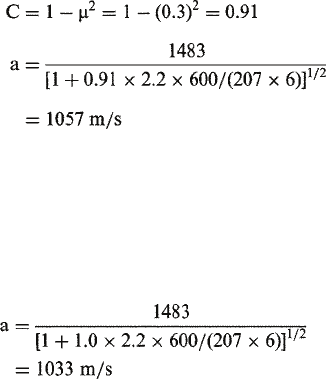
(c) For a pipe with each section anchored with expansion joints, from
Equation (11.7):
C=1
and
(b) For a pipe anchored against any axial movement, from Equation
(11.6):
11.4 Transients in Cross-Country Pipelines
Cross-country pipelines and other trunk pipelines transporting crude oil,
refined products, etc., are several hundred miles long and generally have
multiple pump stations located along the pipeline. Average pump station
spacing may be 30 to 60 miles or more. The pump stations are designed to
provide the necessary pressure to overcome friction in the pipeline
between pump stations and any static head lift necessary due to pipeline
elevation differences.
The study of transient pressures in long-distance pipelines, called surge
analysis, is fairly complex due to the fact that the frictional pressure drops
in the pipelines are large compared with the instantaneous pressure surge
due to sudden stoppage of flow.
A rigorous mathematical analysis of the pressure versus flow variations
due to transient conditions results in partial differential equations that need
to be solved with specified boundary conditions. Such solutions are
difficult, if not impossible, using manual methods, even with a scientific
calculator. However, over the years engineers and scientists have
simplified these equations using finite difference methods and other
mathematical approximations to result in the solution of simple
simultaneous equations at every nodal point along the pipeline. Of course,
the more the pipeline is subdivided, the higher is the accuracy of
Copyright © 2004 by Marcel Dekker, Inc.
Unsteady Flow in Pipelines 211
calculation. Today, with high-powered desktop computers, we can model
these transient pressures in pipelines using the Method of Characteristics,
which has proven to be quite accurate when compared with field tests.
Several commercial computer programs are available to model transient
pressures in pipelines due to valve closure, pump start-up and shut-down,
and other upset conditions.
The potential surge is the instantaneous pressure rise due to sudden
stoppage of a flow, such as closing of a valve at the end of the pipeline.
This pressure was shown from Equation (11.1) to be
ΔH=aV/g
The increase in storage capacity of a pipeline due to increase in pressure is
termed line packing. Line packing occurs when the flow in a pipeline is
changed by gradual or sudden closure of a valve. Consider a long crude oil
pipeline flowing at a steady flow rate of Q bbl/hr. Due to sudden closure of
a valve downstream there is a pressure rise immediately upstream of the
valve. A pressure wave with an amplitude of ΔH travels from the valve
upstream towards the pump station. Oil flows downstream of the wave
front, pressure rises gradually at the downstream end, and the hydraulic
grade line gradually reaches the horizontal level. During this time more oil
gets packed between the valve and the pressure wave, hence the term “line
pack.” The pressure rise at the valve is made up of two components:
1. The potential surge pressure, ΔH, from Equation (11.1) due to
instantaneous closure of the valve
2. The pressure rise due to line pack, ΔP
The pressure rise ΔP due to line pack in a long oil pipeline may be several
times the size of the potential surge ΔH, depending on the length of the
pipeline, its diameter, etc.
Attenuation is the process by which the amplitude of the surge pressure
wave is reduced as it propagates along the pipeline due to the reduction in
the velocity differential across the wave front. This is because, even though
the wave front has passed a certain location on the pipeline, the oil
continues to flow toward the valve. This causes a reduction in the velocity
differential across the wave front as the wave propagates upstream.
In addition, the amplitude of the surge is also decreased due to pipe
friction. This reduction, however, is a smaller component than that caused
by the velocity differential across the wave front.
For a detailed analysis of transient analysis in long pipelines, see Wylie
and Streeter in the References section.
Copyright © 2004 by Marcel Dekker, Inc.
Chapter 11212
11.5 Summary
In this chapter we have introduced the concept of unsteady flow in
pipelines. If the velocity, flow rate, and pressure at any point in a pipeline
change with time, unsteady flow is said to occur. Closing and opening
valves, starting and stopping pumps, and injecting volumes or changing
products all contribute to some form of unsteady flow. Some unsteady
flow situations can cause pressure surges or transients that, when
superimposed on the existing steady-state pressure gradient, may cause
overpressure of a pipeline. Design codes for petroleum pipelines dictate
that such transient overpressures cannot exceed 110% of the maximum
allowable operating pressure in a pipeline.
We illustrated the concept of unsteady flow using a simple example of a
tank connected to a pipe with a valve at the end. Sudden closure of the
valve causes a pressure rise at the valve and generates a pressure wave that
travels in the opposite direction of the flow at the speed of sound in the
liquid. It was shown that flow rate and pressure variations occur
throughout the pipeline due to the pressure wave traveling back and forth
until it is attenuated by friction and equilibrium is established after a
sufficient period of time. The wave speed depends mainly on the liquid
bulk modulus and density. It also depends upon the pipe size and the
elastic modulus of the pipe material.
Transient pressures developed in long-distance pipelines are generally
modeled using computer programs based on the method of characteristics.
This approach reduces the complex partial differential equations to simpler
simultaneous equations which are solved sequentially from node to node,
by subdividing the pipeline into equal segments. For more detailed
analysis of unsteady flow the reader is referred to one of the publications
listed in the References section.
11.6 Problems
11.6.1 Crude oil flows through a 16 in. diameter, 0.250 in. wall
thickness steel pipeline, at a flow rate of 150,000 bbl/day. A
valve located at the end of the pipeline is suddenly closed.
Determine the potential surge generated and the wave speed
in the pipeline assuming the pipe is anchored throughout
against axial movement. Bulk modulus of crude oil=280,000
psi, specific gravity=0.89. Modulus of elasticity of steel=30×
10
6
psi. Poisson’s ratio=0.3.
11.6.2 Compare the wave speed in a rubber pipeline 250 mm in
diameter, 6 mm wall thickness carrying water, with a similar
Copyright © 2004 by Marcel Dekker, Inc.