
Molina-Par?s C., Lythe G. (editors) Mathematical Models and Immune Cell Biology
Подождите немного. Документ загружается.

4 T Cell Activation and Function: Role of Signal Strength 93
shown that human T cells became more and more resistant to Treg suppression as
the SOS, in terms of anti-CD3 mode (soluble ‘vs’ plate-immobilised) and antigen
concentration, was increased [124]. Using this information, a model was proposed
according to which Tregs suppress T cells which receive low intensity signals but
not those that are activated with a stronger signal. The former would be the case
of autoreactive T cells binding to self-peptides and the latter of T cells binding
antigenic peptides derived from pathogens. This mechanism might help Tregs to
control autoimmunity and at the same time avoid suppressing pathogen specific T
cell responses that are essential for the host [125]. Another mechanism by which
Treg function is suppressed during infection is by IL-6 secretion by DCs in response
to Toll like receptor (TLR) ligands. Depletion of CD25
C
cells restores effector T cell
priming in Il-6
=
mice, suggesting a role for this cytokine in suppression of Treg
function [126]. This aspect is important during the generation of immune responses
during infections.
Role of Signal Strength in Effector and Memory
Phenotype Delineation
Retaining memory long after an infection has been cleared is an important hallmark
of the adaptive immune response. The frequency of a particular CD8
C
T cell clone
in a normal healthy individual is around 1 in 100,000. Once a clone is exposed to
a specific antigen, it undergoes a burst of expansion dividing several times so that
its numbers increase by about 50,000-fold. After expansion these cells migrate to
inflamed tissue, perform effector functions such as cytokine secretion and cytolysis.
Once the infection is cleared and the antigen is no longer present most (90–95%)
effectors die by apoptosis to maintain homeostasis and prevent damage to self tis-
sue. However, some survive and develop a memory phenotype and are capable of
providing protection during subsequent infections. This entire program of expan-
sion of effector cells and commitment to the memory phenotype requires 2–3 days
after first encounter with antigen. Memory T cells are much faster in responding to
an antigenic challenge compared to na¨ıve T cells. Unlike na¨ıve T cells, a fraction
of memory cells known as effector memory cells (CD62L
lo
CCR7
) resides in non-
lymphoid mucosal sites so that they can encounter antigen immediately. The other
subset is the central memory cells (CD62L
hi
CCR7
C
) that reside in secondary lym-
phoid tissue. The balance between effector and central memory cells is dependent
on the dose of antigen and frequency of TCR stimulation [127,128].
It is unclear whether effector and memory differentiation are coupled. Experi-
ments where effector cells were tagged and then tracked showed that these tagged
effectors appeared in the memory population [129]. However, in some cases it has
been seen that conditions during priming dictate effector/memory differentiation.
A combination of a primary and co-stimulatory signals in presence of cytokines
such as IL-12, IL-21 and IFN˛/ˇ early on during infection promotes effector cell
generation while the primary and secondary signals in absence of an inflammatory
94 A. Ahmed and D. Nandi
milieu, when antigen concentrations are lower, reduce the differentiation of memory
cells [130,131]. Also important during memory phenotype acquisition is help from
CD4
C
cells. CD8
C
memory cells which form without CD4
C
help are qualitatively
poor, do not respond efficiently to secondary antigenic challenge, and die by ac-
tivation induced cell death (AICD). CD4
C
T cell interaction with DCs generates
chemokines that attract CD8
C
cells to appropriate niches where they can receive
the entire gamut of signals essential for differentiation into the memory phenotype.
CD4
C
T cells are essential for long survival of memory cells as CD4 knock-out
mice show gradual decline in memory CD8
C
cells [127].
Qualitatively good and functional memory cells arise only under conditions of
optimal antigen dose. Chronic infection conditions, such as infection with My-
cobacterium tuberculosis or human immunodeficiency virus (HIV), result in the
persistence of antigens for a very long time. This condition leads to unresponsive
effector cells that are ‘exhausted’ and do not give rise to functional memory cells
but undergo deletion [132]. The degree of CD8
C
T cell exhaustion depends directly
on the persisting antigen load [127, 133] and with increasing antigen dose, CD8
C
effector T cells undergo more rounds of cell divisions and the frequency of memory
cells progressively decreases. Exhaustion results from interaction of programmed
death-1 (PD-1) with its ligand PD-L1, which is highly expressed on chronically in-
fected cells [134]. This line of therapy i.e. blockade of PD-1-PD-L1 interactions,
is being pursued to boost immune responses during vaccination and immunother-
apy [127,135].
Another important factor in memory cell generation is IL-7 because, in the ab-
sence of signalling by this cytokine, memory cells do not form in mice [136].
Memory cell precursors can be identified by the presence of IL-7R [137]. What has
also been found is that memory cell characteristics i.e. IL-7R˛ expression, prolifer-
ation and expansion in response to IL-7 via a PI3K dependent signalling pathway
are acquired as a function of increasing signal strength. However, the ability to pro-
liferate and secrete IL-2 in response to TCR stimulation decreases when high signal
strengths are used for priming. These results demonstrate that qualitatively good
memory cells arise when priming is done at intermediate signal strengths [138].
Long lived CD4
C
memory cells are very high avidity clones suggesting that,
during differentiation, cells which receive the strongest stimulus acquire the mem-
ory phenotype. The SOS during priming has a profound impact on the generation
of memory CD4
C
T cells. This was shown using a model of adoptive transfer
in which transgenic SMARTA cells specific for I-A
b
-restricted GP
61–80
epitope of
lymphocytic choriomeningitis virus were injected into normal C57BL/6 mice and
challenged with either the virus or Listeria monocytogenes expressing the viral pep-
tide. When these mice were challenged with virus, SMARTA cells along with the
endogenous viral specific CD4
C
T cells expanded normally, contracted and de-
veloped into long lived memory cells. However, when mice were injected with
a recombinant Listeria monocytogenes secreting GP
61–80
, unlike the endogenous
C57BL/6 CD4 population, SMARTA cells failed to develop memory cells after the
initial expansion. Also, post expansion SMARTA cells had high Bim and low Bcl-2
levels and eventually died by apoptosis. Compared to the endogenous CD4
C
T cell
4 T Cell Activation and Function: Role of Signal Strength 95
population SMARTA cells had lower affinity TCRs and the signals they received
during priming were, most likely, sufficient to drive proliferation but insufficient for
memory differentiation [139].
SOS Modulates the Outcome of Costimulatory Interactions
As mentioned earlier, CD28 by binding to CD80/CD86 molecules delivers the cos-
timulatory signal essential for clonal expansion of T cells and preventing anergy.
The strength of the CD28 signal can alter responses to weak and strong TCR sig-
nals. Increasing the strength of CD28 costimulation can change a weak signal and a
strong signal into a strong and super strong signal respectively [140]. On the other
hand, it has also been shown that absence of CD28 signals affects blastogenesis
and frequency of cell division equally in T cells activated with a weak and strong
signal [141].
As described earlier, several lines of evidence and the phenotype of Ctla4
=
mice suggest that CTLA4 is a negative regulator of T cell activation. On the other
hand there are several reports that suggest that there could be a degree of plasticity in
CTLA4 responses: First, CTLA4–CD80/CD86 interactions were found capable of
costimulating T cells [142]. Second, CTLA4 could be converted from a negative to
a positive costimulator by use of a recombinant single chain Fv ligand [143]. Third,
CTLA4 lacking the cytoplasmic domain was found to costimulate IL-2 production
in T cell hybridomas [144]. It has been found that the SOS is a key determinant
of effects downstream of CTLA4. Using an in vitro system where CD4
C
T cells
were activated with varying SOS, it was found that CTLA4 function switches from
positive to negative in terms of IL-2 production and cell cycle progression as the
strength of the primary signal is increased [145,146]. The downstream effectors of
CTLA4 in this system of study were found to be Ca
2C
and reactive oxygen species
(ROS) whose intracellular levels were found to be directly proportional to the SOS.
CTLA4, under both weak and strong activation conditions, increased intracellular
Ca
2C
and ROS levels but with distinct outcomes: T cells activated with a weak
signal possess low amounts of Ca
2C
and ROS and CTLA4–CD80/CD86 interac-
tion enhances activation. However, cells activated with a strong signal already have
substantially high levels of ROS and Ca
2C
and their further increase by CTLA4–
CD80/CD86 interactions lowers cell cycling [46].
It is possible that the plasticity displayed by CTLA4 in vitro also has physiolog-
ical roles. In a pool of heterogenous T cells, CTLA4 has differential effects: T cells
from multiple sclerosis patients when stimulated with myelin basic protein in the
presence of CTLA4 blockade showed unequal expansion of high and low affinity
clones. CTLA4 ligation enhances expansion of clones with low affinity TCRs but
inhibits that of high affinity TCRs [147]. In another in vivo mouse model of EAE,
immunization with a disease antagonist peptide along with CTLA4 blockade leads
to lowered frequency of clones reactive to the disease agonist peptide [148]. Taking
these results together, it is possible that CTLA4 inhibits expansion of high affinity
96 A. Ahmed and D. Nandi
TCR clones which might dominate the T cell response. It also enhances expansion
of low affinity clones which may promote the generation of a broader cross re-
active immune response that may play important roles to clear rapidly mutating
pathogens [149].
SOS Controls Survival and Death of T Cells in the Periphery
Circulating na¨ıve T cells are fairly long lived owing to cytokines such as IL-7, IL-6
and IL-15. When T cells encounter antigen, they undergo a phase of rapid expan-
sion which enables them to perform their effector functions and clear the infection.
Expansion is followed by contraction where most effectors are deleted to maintain
homeostasis and prevent conditions such as autoimmunity. From the expansion to
the contraction state, T cells become increasingly susceptible to apoptosis. There
are two apoptotic pathways operating during the contraction phase: activation in-
duced cell death (AICD) and activated T cell autonomous death or ACAD [150].
The former relies on extrinsic death signals transmitted through surface death recep-
tors such as Fas (CD95) and TNFR1 and occurs when pre-activated cells undergo
secondary stimulation. The role of CD95 in T cell homeostasis is observed in lpr
(mutated CD95 or Fas) and gld (mutated CD95L or FasL) mice which suffer from
autoantibody production and excessive lymphoproliferation. On the other hand,
ACAD relies on death signals arising from the mitochondria. Death in this case
depends on the ratio of pro- and anti-apoptotic proteins. However, both AICD and
ACAD pathways converge on caspase 3 activation and eventual cell death [150,151].
One of the factors that regulates resistance and sensitivity to death during expan-
sion and contraction is the cytokine milieu. IL-2, which is an important cytokine
during the expansion phase, is also responsible for priming cells for death by mod-
ulating expression of pro-apoptotic factors such as c-FLIP and CD95L [152]. IFN
limits expansion of activated cells and promotes apoptosis by upregulating caspases
[151, 153]. Once antigen is withdrawn, T cells become susceptible to death by ne-
glect and their survival depends on how well they are able to respond to survival
signals provided by ubiquitous cytokines IL-7 and IL-15. This ability of T cells to
survive post the expansion phase is termed as ‘T cell fitness’ and is directly propor-
tional to the SOS [154]. Human and mouse CD4
C
and CD8
C
cells activated with
a weak activating signal expand but die by neglect as soon as the antigen is with-
drawn because they are unable to respond to IL-15. On the other hand, cells which
receive a relatively strong signal not only proliferate during the expansion phase
but also survive in vitro and in vivo even in absence of the signal by upregulating
the anti-apoptotic protein, BclX
L.
In addition, IL-15R expression is enhanced so
that the response to IL-15 survival signals continues. Together, these mechanisms
ensure these cells are ‘fit’ [154]. However, there can be conditions where signals
can be weaker or stronger than those that are used. In some cases, T cells become
anergic whereas in other cases the cells die due to excessive activation [155–157].
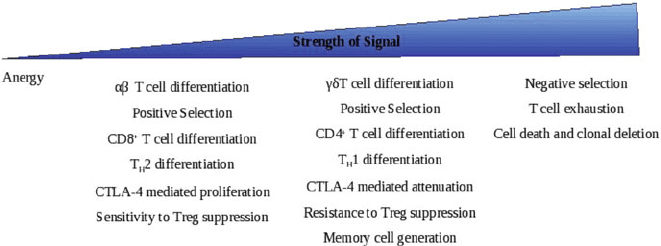
4 T Cell Activation and Function: Role of Signal Strength 97
Fig. 4.6 Summary of the effects of signal strength on T cell differentiation and function
Summary
The relative SOS perceived by a T cell is translated into differential amounts of
intracellular mediators, e.g. Ca
2C
, ERK etc, which leads to distinct responses. Con-
sequently, these changes decide the fate and nature of T cell responses in terms
of differentiation into various subsets, survival and death (Fig. 4.6). During thymic
differentiation, immature thymocytes which receive strong TCR signals are more
likely to become ı T cells compared to ˛ˇ T cells. CD4
C
CD8
C
thymocytes that
express low amounts of the ˛ˇ TCR and bind to self peptide–MHC complexes with
very high affinity, i.e high SOS, are negatively selected and die by apoptosis. This
process reduces the risk of auto-reactivity in the periphery. Only those thymocytes
that bind with the “right” affinity to self peptide–MHC complexes are positively
selected. Once again, SOS plays a role and those thymocytes that receive a strong
signal are likely to differentiate into CD4
C
T cells whereas those that receive a
weaker signal differentiate into CD8
C
T cell. Only SP thymocytes are mature and
enter the peripheral circulation.
In the periphery, a combination of TCR signal strength and local cytokine mi-
lieu determine T
H
1andT
H
2 differentiation pathways. Strong signals drive T
H
1
whereas weak signals result in generation of T
H
2 cells. During an ongoing im-
mune response, T cells activated with a strong signal are better equipped to survive
during the contraction phase and develop into memory cells compared to cells that
are primed with a comparatively weaker signal. There can be signals that are too
weak or too strong to drive productive T cell responses. In case of the former, cells
become unresponsive or anergic and the latter usually results in cell death. This
implies that a T cell should receive the optimal amount of signal (as determined
by antigen dose, receptor affinity and occupancy) for the desired response. This
aspect becomes important during vaccination and autoimmune disorders. There-
fore, the intensity/potency of the TCR signal is a simple and elegant mechanism to
regulate several T cell processes. It is possible that modelling of T cell responses
taking into account the role of SOS may be an important criterion to predict in
98 A. Ahmed and D. Nandi
vivo T cell responses. Further experimental verification of these modelling profiles
will be important in devising better immunotherapeutic strategies to enhance T cell
responses.
Acknowledgements The suggestions and comments by members of the DpN laboratory and col-
leagues from different institutions during our studies on T cell activation are greatly appreciated.
We thank the Department of Biotechnology, Government of India and the Commission of the
European Communities for financial support.
References
1. Zinkernagel R, Doherty P (1974) Immunological surveillance against altered self components
by sensitised T lymphocytes in lymphocytes choriomeningitis. Nature 251:547–548
2. Goldsby RA, Kindt TJ, Osborne BA (2000) Kuby immunology. WH Freeman, New York
3. Paul WE (Ed) (2008) Fundamental immunology. Lippincott Williams and Wilkins,
Philadelphia
4. Iwashima M (2003) Kinetic perspectives of T cell antigen receptor signaling. Immunol Rev
191:196–210
5. Lin J, Weiss A (2001) T cell receptor signalling. J Cell Sci 114:243
6. Lewis R (2001) Calcium signaling mechanisms in T lymphocytes. Annu Rev Immunol
19:497–521
7. Krummel M (2007) Immunological synapses: breaking up may be good to do. Cell 129:
653–655
8. Bretscher P, Cohn M (1970) A theory of self-nonself discrimination. Science 169:1042–1049
9. Harding FA, McArthur JG, Gross JA, Raulet DH, Allison JP (1992) CD28 mediated signaling
co-stimulates murine T cells and prevents induction of anergy in T cell clones. Nature 356:607
10. Gross J, St John T, Allison J (1990) The murine homologue of the T lymphocyte antigen
CD28. Molecular cloning and cell surface expression. J Immunol 144:3201
11. Riley J, Mao M, Kobayashi S, Biery M, Burchard J, Cavet G, Gregson B, June C, Linsley P
(2002) Modulation of TCR-induced transcriptional profiles by ligation of CD28, ICOS, and
CTLA-4 receptors. Proc Natl Acad Sci USA 99:11790
12. Martin M, Schneider H, Azouz A, Rudd C (2001) Cytotoxic T lymphocyte antigen 4 and
CD28 modulate cell surface raft expression in their regulation of T cell function. J Exp Med
194:1675
13. Jacobelli J, Andres P, Boisvert J, Krummel M (2004) New views of the immunological
synapse: variations in assembly and function. Curr Opin Immunol 16:345–352
14. Brunner-Weinzerl MC, Hoff H, Burmester GR (2004) Multiple functions for CD28 and
CTLA4 during different phases of T cell responses: implications for arthritis and autoimmune
disease. Arthritis Res Ther 6:45
15. Lucas P, Negishi I, Nakayama K, Fields L, Loh D (1995) Naive CD28-deficient T cells can
initiate but not sustain an in vitro antigen-specific immune response. J Immunol 154:5757
16. Carreno B, Collins M (2002) The B7 family of ligands and its receptors: new pathways for
costimulation and inhibition of immune responses. Annu Rev Immunol 20:29–53
17. Pag`es F, Ragueneau M, Rottapel R, Truneh A, Nunes J, Imbert J, Olive D (1994) Binding
of phosphatidyl-inositol-3-OH kinase to CD28 is required for T-cell signalling. Nature 369:
327–329
18. Yang W, Olive D (1999) Tec kinase is involved in transcriptional regulation of IL-2 and IL-4
in the CD28 pathway. Eur J Immunol 29:1842–1849
19. Michel F, Attal-Bonnefoy G, Mangino G, Mise-Omata S, Acuto O (2001) CD28 as a molec-
ular amplifier extending TCR ligation and signaling capabilities. Immunity 15:935–945
4 T Cell Activation and Function: Role of Signal Strength 99
20. Tivol E, Borriello F, Schweitzer A, Lynch W, Bluestone J, Sharpe A (1995) Loss of CTLA-
4 leads to massive lymphoproliferation and fatal multiorgan tissue destruction, revealing a
critical negative regulatory role of CTLA-4. Immunity 3:541
21. Waterhouse P, Penninger J, Timms E, Wakeham A, Shahinian A, Lee K, Thompson C,
Griesser H, Mak T (1995) Lymphoproliferative disorders with early lethality in mice defi-
cient in CTLA-4. Science 270:985
22. Chen Z, Stockton J, Mathis D, Benoist C (2006) Modeling CTLA4-linked autoimmunity with
RNA interference in mice. Proc Natl Acad Sci USA 103:16400
23. Ueda H, Howson JM, Esposito L, Heward J, Snook H, Chamberlain G, Rainbow DB,
Hunter KM, Smith AN, Di Genova G, Herr MH, Dahlman I, Payne F, Smyth D, Lowe C,
Twells RC, Howlett S, Healy B, Nutland S, Rance HE, Everett V, Smink LJ, Lam AC,
Cordell HJ, Walker NM, Bordin C, Hulme J, Motzo C, Cucca F, Hess JF, Metzker ML,
Rogers J, Gregory S, Allahabadia A, Nithiyananthan R, Tuomilehto-Wolf E, Tuomilehto J,
Bingley P, Gillespie KM, Undlien DE, Rnningen KS, Guja C, Ionescu-Trgoviste C,
Savage DA, Maxwell AP, Carson DJ, Patterson CC, Franklyn JA, Clayton DG, Peterson LB,
Wicker LS, Todd JA, Gough SC (2003) Association of the T-cell regulatory gene CTLA4 with
susceptibility to autoimmune disease. Nature 423:506–511
24. Chambers C, Kuhns M, Egen J, Allison J (2001) CTLA-4-mediated inhibition in regulation
of T-cell responses: mechanisms and manipulation in tumor immunotherapy. Annu Rev Im-
munol 19:565–594
25. Rudd C, Schneider H (2003) Unifying concepts in CD28, ICOS and CTLA4 co-receptor
signalling. Nat Rev Immunol 3:544–556
26. Teft W, Kirchhof M, Madrenas J (2006) A molecular perspective of CTLA-4 function. Annu
Rev Immunol 24:65–97
27. Rudd C (2008) The reverse stop-signal model for CTLA4 function. Nat Rev Immunol
8:153–160
28. Elgueta R, Benson M, de Vries V, Wasiuk A, Guo Y, Noelle R (2009) Molecular mechanism
and function of CD40/CD40L engagement in the immune system. Immunol Rev 229:152–172
29. Van Kooten C, Banchereau J (1997) Functions of CD40 on B cells, dendritic cells and other
cells. Curr Opin Immunol 9:330
30. Campbell K, Ovendale P, Kennedy M, Fanslow W, Reed S, Maliszewski C (1996) CD40
ligand is required for protective cell-mediated immunity to Leishmania major. Immunity
4:283–290
31. Lei X, Ohkawara Y, St¨ampfli M, Mastruzzo C, Marr R, Snider D, Xing Z, Jordana M (1998)
Disruption of antigen-induced inflammatory responses in CD40 ligand knockout mice. J Clin
Invest 101:1342
32. Dong C, Temann U, Flavell R (2001) Cutting edge: critical role of inducible costimulator in
germinal center reactions. J Immunol 166:3659
33. Iiyama R, Kanai T, Uraushihara K, Totsuka T, Nakamura T, Miyata T, Yagita H, Kushi A,
Suzuki K, Tezuka K, Watanabe M (2003) The role of inducible co-stimulator (ICOS)/B7-
related protein-1 (B7RP-1) interaction in the functional development of Peyer’s patches.
Immunol Lett 88:63–70
34. Kopf M, Ruedl C, Schmitz N, Gallimore A, Lefrang K, Ecabert B, Odermatt B, Bachmann M
(1999) OX40-deficient mice are defective in Th cell proliferation but are competent in gener-
ating B cell and CTL responses after virus infection. Immunity 11:699
35. Sharpe A (2009) Mechanisms of costimulation. Immunol Rev 229:5
36. Dawicki W, Bertram E, Sharpe A, Watts T (2004) 4-1BB and OX40 act independently to
facilitate robust CD8 and CD4 recall responses. J Immunol 173:5944
37. Nolte M, van Olffen R, Van Gisbergen K, van Lier R (2009) Timing and tuning of CD27-
CD70 interactions: the impact of signal strength in setting the balance between adaptive
responses and immunopathology. Immunol Rev 229:216–231
38. Wang N, Satoskar A, Faubion W, Howie D, Okamoto S, Feske S, Gullo C, Clarke K, Sosa M,
Sharpe A, Terhorst C (2004) The cell surface receptor SLAM controls T cell and macrophage
functions. J Exp Med 199:1255
100 A. Ahmed and D. Nandi
39. Nishimura H, Minato N, Nakano T, Honjo T (1998) Immunological studies on PD-1 deficient
mice: implication of PD-1 as a negative regulator for B cell responses. Int Immunol 10:1563
40. Watanabe N, Gavrieli M, Sedy JR, Yang J, Fallarino F, Loftin SK, Hurchla MA,
Zimmerman N, Sim J, Zang X, Murphy TL, Russell JH, Allison JP, Murphy KM (2003)
BTLA is a lymphocyte inhibitory receptor with similarities to CTLA-4 and PD-1. Nat
Immunol 4:670–679
41. Rodriguez-Manzanet R, DeKruyff R, Kuchroo V, Umetsu D (2009) The costimulatory role of
TIM molecules. Immunol Rev 229:259–270
42. Monney L, Sabatos CA, Gaglia JL, Ryu A, Waldner H, Chernova T, Manning S, Greenfield
EA, Coyle AJ, Sobel RA, Freeman GJ, Kuchroo VK (2002) Th1-specific cell surface pro-
tein Tim-3 regulates macrophage activation and severity of an autoimmune disease. Nature
415:536–541
43. McIntire J, Umetsu D, DeKruyff R (2004) TIM-1, a novel allergy and asthma susceptibility
gene. Springer Semin Immunopathol 25:335–348
44. Rachmilewitz J, Lanzavecchia A (2002) A temporal and spatial summation model for T-cell
activation: signal integration and antigen decoding. Trends Immunol 23:592–595
45. Wulfing C, Rabinowitz J, Beeson C, Sjaastad M, McConnell H, Davis M (1997) Kinetics and
extent of T cell activation as measured with the calcium signal. J Exp Med 185:1815
46. Ahmed A, Mukherjee S, Nandi D (2009) Intracellular concentrations of Ca2
C
modulate
the strength of signal and alter the outcomes of cytotoxic T-lymphocyte antigen-4 (CD152)-
CD80/CD86 interactions in CD4
C
T lymphocytes. Immunology 126:363
47. Kirchgessner H, Dietrich J, Scherer J, Isomaki P, Korinek V, Hilgert I, Bruyns E, Leo A,
Cope A, Schraven B (2001) The transmembrane adaptor protein TRIM regulates T cell recep-
tor (TCR) expression and TCR-mediated signaling via an association with the TCR chain.
J Exp Med 193:1269
48. Schade A, Levine A (2004) Cutting edge: extracellular signal-regulated kinases 1/2 function
as integrators of TCR signal strength. J Immunol 172:5828
49. Murphy L, Smith S, Chen R, Fingar D, Blenis J (2002) Molecular interpretation of ERK
signal duration by immediate early gene products. Nat Cell Biol 4:556–564
50. Guo Z, Clydesdale G, Cheng J, Kim K, Gan L, McConkey D, Ullrich S, Zhuang Y, Su B
(2002) Disruption of Mekk2 in mice reveals an unexpected role for MEKK2 in modulating
T-cell receptor signal transduction. Mol Cell Biol 22:5761
51. Colgan J, Asmal M, Neagu M, Yu B, Schneidkraut J, Lee Y, Sokolskaja E, Andreotti A, Luban
J (2004) Cyclophilin A regulates TCR signal strength in CD4
C
T cells via a proline-directed
conformational switch in Itk. Immunity 21:189–201
52. Tarakhovsky A, Kanner S, Hombach J, Ledbetter J, Muller W, Killeen N, Rajewsky K
(1995) A role for CD5 in TCR-mediated signal transduction and thymocyte selection. Sci-
ence 269:535
53. Azzam H, Grinberg A, Lui K, Shen H, Shores E, Love P (1998) CD5 expression is de-
velopmentally regulated by T cell receptor (TCR) signals and TCR avidity. J Exp Med
188:2301–2311
54. Park JH, Adoro S, Lucas PJ, Sarafova SD, Alag AS, Doan LL, Erman B, Liu X, Ellmeier W,
Bosselut R, Feigenbaum L, Singer A (2007) ‘Coreceptor tuning’: cytokine signals transcrip-
tionally tailor CD8 coreceptor expression to the self-specificity of the TCR. Nat Immunol
8(10):1049–1059
55. Hollander G, Gill J, Zuklys S, Iwanami N, Liu C, Takahama Y (2006) Cellular and molecular
events during early thymus development. Immunol Rev 209:28–46
56. Casetti R, Martino A (2008) The plasticity of ı T cells: innate immunity, antigen presenta-
tion and new immunotherapy. Cell Mol Immunol 5:161
57. Mathis D, Benoist C (2009) Aire. Annu Rev Immunol 27:287–312
58. Pennington D, Silva-Santos B, Hayday A (2005) ıT cell development having the strength to
get there. Curr Opin Immunol 17:108–115
59. Hayes S, Love P (2006) Strength of signal: a fundamental mechanism for cell fate specifica-
tion. Immunol Rev 209:170–175
4 T Cell Activation and Function: Role of Signal Strength 101
60. Lauritsen J, Haks M, Lefebvre J, Kappes D, Wiest D (2006) Recent insights into the signals
that control ˛ˇ/ı-lineage fate. Immunol Rev 209:176–190
61. Hayes S, Li L, Love P (2005) TCR signal strength influences ˛ˇ/ı lineage fate. Immunity
22:583–593
62. Haks M, Lefebvre J, Lauritsen J, Carleton M, Rhodes M, Miyazaki T, Kappes D, Wiest D
(2005) Attenuation of ıTCR signaling efficiently diverts thymocytes to the ˛ˇ lineage. Im-
munity 22:595–606
63. Fehling H, Gilfillan S, Ceredig R (1999) ˛ˇ/ı lineage commitment in the thymus of normal
and genetically manipulated mice. Adv Immunol 71:1–76
64. Hayes S, Shores E, Love P (2003) An architectural perspective on signaling by the pre-, ˛ˇ
and ı T cell receptors. Immunol Rev 191:28–37
65. Hayes S, Love P (2002) Distinct structure and signaling potential of the ıTCR complex.
Immunity 16:827–838
66. Garbe A, von Boehmer H (2007) TCR and Notch synergize in ˛ˇ versus ı lineage choice.
Trends Immunol 28:124–131
67. Hogquist K, Baldwin T, Jameson S (2005) Central tolerance: learning self-control in the thy-
mus. Nat Rev Immunol 5:772–782
68. Love P, Lee J, Shores E (2000) Critical relationship between TCR signaling potential and
TCR affinity during thymocyte selection. J Immunol 165:3080
69. van Oers N, Tohlen B, Malissen B, Moomaw C, Afendis S, Slaughter C (2000) The 21-
and 23-kD forms of TCR are generated by specific ITAM phosphorylations. Nat Immunol
1:322–328
70. Werlen G, Hausmann B, Palmer E (1999) A motif in the T-cell receptor controls positive
selection by modulating ERK activity. J Immunol 29:1912–1918
71. Mariathasan S, Zakarian A, Bouchard D, Michie A, Zuniga-Pflucker J, Ohashi P (2001) Du-
ration and strength of extracellular signal-regulated kinase signals are altered during positive
versus negative thymocyte selection. J Immunol 167:4966
72. McNeil L, Starr T, Hogquist K (2005) A requirement for sustained ERK signaling during
thymocyte positive selection in vivo. Proc Natl Acad Sci USA 102:13574
73. Dower N, Stang S, Bottorff D, Ebinu J, Dickie P, Ostergaard H, Stone J (2000) RasGRP is
essential for mouse thymocyte differentiation and TCR signaling. Nat Immunol 1:317
74. Fischer A, Katayama C, Pag`es G, Pouyss´egur J, Hedrick S (2005) The role of ERK1 and
ERK2 in multiple stages of T cell development. Immunity 23:431–443
75. He X, Kappes D (2006) CD4/CD8 lineage commitment: light at the end of the tunnel? Curr
Opin Immunol 18:135–142
76. Wiest D, Yuan L, Jefferson J, Benveniste P, Tsokos M, Klausner R, Glimcher L, Samelson L,
Singer A (1993) Regulation of T cell receptor expression in immature CD4
C
CD8
C
thymo-
cytes by p56lck tyrosine kinase: basis for differential signaling by CD4 and CD8 in immature
thymocytes expressing both coreceptor molecules. J Exp Med 178:1701
77. Hern´andez-Hoyos G, Sohn S, Rothenberg E, Alberola-Ila J (2000) Lck activity controls
CD4/CD8 T cell lineage commitment. Immunity 12:313–322
78. Yasutomo K, Doyle C, Miele L, Germain R (2000) The duration of antigen receptor signalling
determines CD4
C
versus CD8
C
T-cell lineage fate. Nature 404:506–510
79. Brugnera E, Bhandoola A, Cibotti R, Yu Q, Guinter T, Yamashita Y, Sharrow S, Singer A
(2000) Coreceptor reversal in the thymus: signaled CD4
C
CD8
C
thymocytes initially termi-
nate CD8 transcription even when differentiating into CD8
C
T cells. Immunity 13:59
80. Sarafova S, Erman B, Yu Q, Van Laethem F, Guinter T, Sharrow S, Feigenbaum L, Wildt K,
Ellmeier W, Singer A (2005) Modulation of coreceptor transcription during positive selection
dictates lineage fate independently of TCR/coreceptor specificity. Immunity 23:75–87
81. Mosmann T, Cherwinski H, Bond M, Giedlin M, Coffman R (1986) Two types of murine
helper T cell clone. I. Definition according to profiles of lymphokine activities and secreted
proteins. J Immunol 136:2348
82. Mowen K, Glimcher L (2004) Signaling pathways in Th2 development. Immunol Rev
202:203–222
102 A. Ahmed and D. Nandi
83. Bettelli E, Carrier Y, Gao W, Korn T, Strom T, Oukka M, Weiner H, Kuchroo V (2006)
Reciprocal developmental pathways for the generation of pathogenic effector Th17 and regu-
latory T cells. Nature 441:235–238
84. Chen Z, O’Shea J (2008) Th17 cells: a new fate for differentiating helper T cells. Immunol
Res 41:87–102
85. Bettelli E, Korn T, Kuchroo VK (2007) Th17: the third member of the effector T cell trilogy.
Curr Opin Immunol 19:652–657
86. Zhu J, Paul W (2008) CD4 T cells: fates, functions, and faults. Blood 112:1557
87. Secrist H, DeKruyff R, Umetsu D (1995) Interleukin 4 production by CD4
C
T cells from
allergic individuals is modulated by antigen concentration and antigen-presenting cell type. J
Exp Med 181:1081
88. Iezzi G, Scotet E, Scheidegger D, Lanzavecchia A (1999) The interplay between the duration
of TCR and cytokine signaling determines T cell polarization. Eur J Immunol 29:4092–4101
89. Constant S, Pfeiffer C, Woodard A, Pasqualini T, Bottomly K (1995) Extent of T cell recep-
tor ligation can determine the functional differentiation of naive CD4
C
T cells. J Exp Med
182:1591
90. Hosken N, Shibuya K, Heath A, Murphy K, O’garra A (1995) The effect of antigen dose on
CD4
C
T helper cell phenotype development in a T cell receptor-˛ˇ-transgenic model. J Exp
Med 182:1579
91. Tao X, Constant S, Jorritsma P, Bottomly K (1997) Strength of TCR signal determines the cos-
timulatory requirements for Th1 and Th2 CD4
C
T cell differentiation. J Immunol 159:5956
92. Sloan-Lancaster J, Allen P (1996) Altered peptide ligand-induced partial T cell activation:
molecular mechanisms and role in T cell biology. Annu Rev Immunol 14:1–27
93. Alberola-Ila J, Takaki S, Kerner J, Perlmutter R (1997) Differential signaling by lymphocyte
antigen receptors. Annu Rev Immunol 15:125–154
94. Boutin Y, Leitenberg D, Tao X, Bottomly K (1997) Distinct biochemical signals characterize
agonist-and altered peptide ligand-induced differentiation of naive CD4
C
T cells into Th1
and Th2 subsets. J Immunol 159:5802
95. Leitenberg D, Bottomly K (1999) Regulation of na¨ıve T cell differentiation by varying the
potency of tcr signal transduction. Semin Immunol 11:283–292
96. Badou A, Savignac M, Moreau M, Leclerc C, Foucras G, Cassar G, Paulet P, Lagrange D,
Druet P, Guery J, Pelletier L (2001) Weak TCR stimulation induces a calcium signal that
triggers IL-4 synthesis, stronger TCR stimulation induces MAP kinases that control IFN-
gamma production. Eur J Immunol 31:2487–2496
97. Dumont F, Staruch M, Fischer P, DaSilva C, Camacho R (1998) Inhibition of T cell activa-
tion by pharmacologic disruption of the MEK1/ERK MAP kinase or calcineurin signaling
pathways results in differential modulation of cytokine production. J Immunol 160:2579
98. Rincon M, Enslen H, Raingeaud J, Recht M, Zapton T, Su M, Penix L, Davis R, Flavell R
(1998) Interferon-gamma expression by Th1 effector T cells mediated by the p38 MAP kinase
signaling pathway. EMBO J 17:2817
99. Dong C, Yang D, Wysk M, Whitmarsh A, Davis R, Flavell R (1998) Defective T cell differ-
entiation in the absence of Jnk1. Science 282:2092
100. Yang D, Conze D, Whitmarsh A, Barrett T, Davis R, Rincon M, Flavell R (1998) Differenti-
ation of CD4 T cells to Th1 cells requires MAP kinase JNK2. Immunity 9:575–585
101. Finotto S, Neurath MF, Glickman JN, Qin S, Lehr HA, Green FH, Ackerman K, Haley K,
Galle PR, Szabo SJ, Drazen JM, De Sanctis GT, Glimcher LH (2002) Development of spon-
taneous airway changes consistent with human asthma in mice lacking T-bet. Science 295:336
102. Szabo S, Kim S, Costa G, Zhang X, Fathman C, Glimcher L (2000) A novel transcription
factor, T-bet, directs Th1 lineage commitment. Cell 100:655–669
103. Zhu J, Min B, Hu-Li J, Watson C, Grinberg A, Wang Q, Killeen N, Urban J, Guo L, Paul W
(2004) Conditional deletion of Gata3 shows its essential function in Th1-Th2 responses. Nat
Immunol 5:1157–1165
104. Brogdon J, Leitenberg D, Bottomly K (2002) The potency of TCR signaling differentially
regulates NFATc/p activity and early IL-4 transcription in naive CD4
C
T cells. J Immunol
168:3825