
Molina-Par?s C., Lythe G. (editors) Mathematical Models and Immune Cell Biology
Подождите немного. Документ загружается.

4 T Cell Activation and Function: Role of Signal Strength 103
105. Salomon B, Bluestone J (1998) Cutting edge: LFA-1 interaction with ICAM-1 and ICAM-2
regulates Th2 cytokine production. J Immunol 161:5138
106. W¨ulfing C, Sjaastad M, Davis M (1998) Visualizing the dynamics of T cell activation: intra-
cellular adhesion molecule 1 migrates rapidly to the T cell/B cell interface and acts to sustain
calcium levels. Proc Natl Acad Sci USA 95:6302
107. Sakaguchi S (2000) Regulatory T cells key controllers of immunologic self-tolerance. Cell
101:455–458
108. Sakaguchi S, Sakaguchi N, Asano M, Itoh M, Toda M (1995) Immunologic self-tolerance
maintained by activated T cells expressing IL-2 receptor alpha-chains (CD25). Breakdown
of a single mechanism of self-tolerance causes various autoimmune diseases. J Immunol
155:1151
109. Su L, Creusot R, Gallo E, Chan S, Utz P, Fathman C, Ermann J (2004) Murine CD4
C
CD25
C
regulatory T cells fail to undergo chromatin remodeling across the proximal promoter region
of the IL-2 gene. J Immunol 173:4994
110. Horwitz D, Zheng S, Gray J (2008) Natural and TGF-ˇ–induced Foxp3
C
CD4
C
CD25
C
regulatory T cells are not mirror images of each other. Trends Immunol 29:429–435
111. Jordan M, Boesteanu A, Reed A, Petrone A, Holenbeck A, Lerman M, Naji A, Caton A (2001)
Thymic selection of cd4
C
cd25
C
regulatory T cells induced by an agonist self-peptide. Nat
Immunol 2:301–306
112. Salomon B, Lenschow D, Rhee L, Ashourian N, Singh B, Sharpe A, Bluestone J (2000)
B7/CD28 costimulation is essential for the homeostasis of the CD4
C
CD25
C
immunoregu-
latory T cells that control autoimmune diabetes. Immunity 12:431–440
113. Tai X, Cowan M, Feigenbaum L, Singer A (2005) CD28 costimulation of developing thy-
mocytes induces Foxp3 expression and regulatory T cell differentiation independently of
interleukin 2. Nat Immunol 6:152–162
114. Yu P, Haymaker CL, Divekar RD, Ellis JS, Hardaway J, Jain R, Tartar DM, Hoeman CM,
Cascio JA, Ostermeier A, Zaghouani H (2008) Fetal exposure to high-avidity TCR ligand
enhances expansion of peripheral T regulatory cells. J Immunol 181:73
115. Liang S, Alard P, Zhao Y, Parnell S, Clark S, Kosiewicz M (2005) Conversion of CD4
C
CD25-cells into CD4
C
CD25
C
regulatory T cells in vivo requires B7 costimulation, but not
the thymus. J Exp Med 201:127
116. Kretschmer K, Apostolou I, Hawiger D, Khazaie K, Nussenzweig M, von Boehmer H (2005)
Inducing and expanding regulatory T cell populations by foreign antigen. Nat Immunol
6:1219–1227
117. Zheng S, Wang J, Stohl W, Kim K, Gray J, Horwitz D (2006) TGF-ˇ requires CTLA-4 early
after T cell activation to induce FoxP3 and generate adaptive CD4
C
CD25
C
regulatory cells.
J Immunol 176:3321
118. Malek T (2008) The biology of interleukin-2. Annu Rev Immunol 26:453–479
119. Fontenot J, Rasmussen J, Gavin M, Rudensky A (2005) A function for interleukin 2 in Foxp3-
expressing regulatory T cells. Nat Immunol 6:1142–1151
120. Sadlack B, Lohler J, Schorle H, Klebb G, Haber H, Sickel E, Noelle R, Horak I (1995) Gen-
eralized autoimmune disease in interleukin-2-deficient mice is triggered by an uncontrolled
activation and proliferation of CD4
C
T cells. Eur J Immunol 25:3053–3059
121. Beissert S, Schwarz A, Schwarz T (2006) Regulatory T cells. J Invest Dermatol 126:15–24
122. Hombach A, Kofler D, Hombach A, Rappl G, Abken H (2007) Effective proliferation of hu-
man regulatory T cells requires a strong costimulatory CD28 signal that cannot be substituted
by IL-2. J Immunol 179:7924
123. Beyersdorf N, Gaupp S, Balbach K, Schmidt J, Toyka K, Lin C, Hanke T, Hunig T, Kerkau T,
Gold R (2005) Selective targeting of regulatory T cells with CD28 superagonists allows ef-
fective therapy of experimental autoimmune encephalomyelitis. J Exp Med 202:445
124. Baecher-Allan C, Viglietta V, Hafler D (2002) Inhibition of human CD4
C
CD25
C
high reg-
ulatory T cell function. J Immunol 169:6210
125. Baecher-Allan C, Hafler D (2006) Human regulatory T cells and their role in autoimmune
disease. Immunol Rev 212:203–216
104 A. Ahmed and D. Nandi
126. Pasare C, Medzhitov R (2003) Toll pathway-dependent blockade of CD4
C
CD25
C
T
cell-mediated suppression by dendritic cells. Science 299:1033
127. Kalia V, Sarkar S, Gourley T, Rouse B, Ahmed R (2006) Differentiation of memory B and T
cells. Curr Opin Immunol 18:255–264
128. Williams M, Bevan M (2007) Effector and memory CTL differentiation. Annu Rev Immunol
25:171–192
129. Jacob J, Baltimore D (1999) Modelling T-cell memory by genetic marking of memory T cells
in vivo. Nature 399:593–597
130. Curtsinger J, Johnson C, Mescher M (2003) CD8 T cell clonal expansion and development of
effector function require prolonged exposure to antigen, costimulation, and signal 3 cytokine.
J Immunol 171:5165
131. Badovinac V, Porter B, Harty J (2004) CD8
C
T cell contraction is controlled by early inflam-
mation. Nat Immunol 5:809–817
132. Day C, Kaufmann D, Kiepiela P, Brown J, Moodley E, Reddy S, Mackey E, Miller J, Leslie
A, DePierres C, Mncube Z, Duraiswamy J, Zhu B, Eichbaum Q, Altfel M, Wherry EJ,
Coovadia HM, Goulder PJR, Klenerman P, Ahmed R, Freeman GJ, Walker BD (2006) PD-1
expression on HIV-specific T cells is associated with T-cell exhaustion and disease progres-
sion. Nature 443:350–354
133. Lim D, H¨ollsberg P, Hafler D (2002) Strength of prior stimuli determines the magnitude of
secondary responsiveness in CD8
C
T cells. Cell Immunol 217:36–46
134. Wherry E, Ha S, Kaech S, Haining W, Sarkar S, Kalia V, Subramaniam S, Blattman J, Barber
D, Ahmed R (2007) Molecular signature of CD8
C
T cell exhaustion during chronic viral
infection. Immunity 27:670–684
135. Barber D, Wherry E, Masopust D, Zhu B, Allison J, Sharpe A, Freeman G, Ahmed R (2005)
Restoring function in exhausted CD8 T cells during chronic viral infection. Nature 439:
682–687
136. Li J, Huston G, Swain S (2003) IL-7 promotes the transition of CD4 effectors to persistent
memory cells. J Exp Med 198:807
137. Kaech S, Tan J, Wherry E, Konieczny B, Surh C, Ahmed R (2003) Selective expression of
the interleukin 7 receptor identifies effector CD8 T cells that give rise to long-lived memory
cells. Nat Immunol 4:1191–1198
138. Lozza L, Rivino L, Guarda G, Jarrossay D, Rinaldi A, Bertoni F, Sallusto F, Lanzavecchia A,
Geginat J (2008) The strength of T cell stimulation determines IL-7 responsiveness, secondary
expansion, and lineage commitment of primed human CD4
C
IL-7Rhi T cells. Eur J Immunol
38:30
139. Williams M, Ravkov E, Bevan M (2008) Rapid culling of the CD4
C
T cell repertoire in the
transition from effector to memory. Immunity 28:533–545
140. Murtaza A, Kuchroo V, Freeman G (1999) Changes in the strength of co-stimulation through
the B7/CD28 pathway alter functional T cell responses to altered peptide ligands. Int Immunol
11:407
141. Bonnevier J, Mueller D (2002) Cutting edge: B7/CD28 interactions regulate cell cycle pro-
gression independent of the strength of TCR signaling. J Immunol 169:6659
142. Wu Y, Guo Y, Huang A, Zheng P, Liu Y (1997) CTLA-4-B7 interaction is sufficient to cos-
timulate T cell clonal expansion. J Exp Med 185:1327
143. Madrenas J, Chau L, Teft W, Wu P, Jussif J, Kasaian M, Carreno B, Ling V (2004) Conversion
of CTLA-4 from inhibitor to activator of T cells with a bispecific tandem single-chain Fv
ligand. J Immunol 172:5948
144. Hueber A, Matzkies F, Rahmeh M, Manger B, Kalden J, Nagel T (2006) CTLA-4 lacking the
cytoplasmic domain costimulates IL-2 production in T-cell hybridomas. Immunol Cell Biol
84:51–58
145. Mukherjee S, Ahmed A, Malu S, Nandi D (2006) Modulation of cell cycle progression by
CTLA4-CD80/CD86 interactions on CD4
C
T cells depends on strength of the CD3 signal:
critical role for IL-2. J Leukoc Biol 80:66
4 T Cell Activation and Function: Role of Signal Strength 105
146. Mukherjee S, Ahmed A, Nandi D (2005) CTLA4-CD80/CD86 interactions on primary mouse
CD4
C
T cells integrate signal-strength information to modulate activation with Concanavalin
A. J Leukoc Biol 78:144
147. Anderson D, Bieganowska K, Bar-Or A, Oliveira E, Carreno B, Collins M, Hafler D (2000)
Paradoxical inhibition of T-cell function in response to CTLA-4 blockade; heterogeneity
within the human T-cell population. Nat Med 6:211–214
148. Kuhns M, Epshteyn V, Sobel R, Allison J (2000) Cytotoxic T lymphocyte antigen-4 (CTLA-4)
regulates the size, reactivity, and function of a primed pool of CD4
C
T cells. Proc Natl Acad
Sci USA 97:12711
149. Egen J, Kuhns M, Allison J (2002) CTLA-4: new insights into its biological function and use
in tumor immunotherapy. Nat Immunol 3:611–618
150. Hildeman D, Zhu Y, Mitchell T, Kappler J, Marrack P (2002) Molecular mechanisms of acti-
vated T cell death in vivo. Curr Opin Immunol 14:354–359
151. Krammer P, Arnold R, Lavrik I (2007) Life and death in peripheral T cells. Nat Rev Immunol
7:532–542
152. Lenardo M (1991) Interleukin-2 programs mouse ˛ˇ T lymphocytes for apoptosis. Nature
353:858–861
153. Arnold R, Brenner D, Becker M, Frey C, Krammer P (2006) How T lymphocytes switch
between life and death. Eur J Immunol 36:1654–1658
154. Gett A, Sallusto F, Lanzavecchia A, Geginat J (2003) T cell fitness determined by signal
strength. Nat Immunol 4:355–360
155. Alexander-Miller M, Leggatt G, Sarin A, Berzofsky J (1996) Role of antigen, CD8, and cy-
totoxic T lymphocyte (CTL) avidity in high dose antigen induction of apoptosis of effector
CTL. J Exp Med 184:485–492
156. Critchfield J, Racke M, Zuniga-Pflucker J, Cannella B, Raine C, Goverman J, Lenardo M
(1994) T cell deletion in high antigen dose therapy of autoimmune encephalomyelitis. Science
263:1139
157. Lenardo M, Chan F, Hornung F, McFarland H, Siegel R, Wang J, Zheng L (1999) Mature T
lymphocyte apoptosis-immune regulation in a dynamic and unpredictable antigenic environ-
ment 1. Annu Rev Immunol 17:221–253

Chapter 5
The Cyton Model for Lymphocyte Proliferation
and Differentiation
Cameron Wellard, John F. Markham, Edwin D. Hawkins,
and Phillip D. Hodgkin
Abstract We discuss a stochastic model for lymphocyte population dynamics
based on the interaction of sub-cellular mechanisms responsible for cell death, di-
vision and differentiation. Competition between these mechanisms determines the
fate of an individual, and their stochastic nature allows a range of outcomes, gener-
ating the large-scale diversity that is characteristic of an immune response.
Mathematically the function of each mechanism can be expressed as a prob-
ability density function for the time for the particular event to occur, and it is
the parameters that define these distributions that are the free parameters of the
model.
We formulate the problem as a branching process, and derive an expression for
the probability generating function for the number of live cells of each type in all
divisions, as a function of time. This allows the calculation of arbitrary moments for
the live cell numbers, giving quantification not just of the mean system behaviour,
but of the random fluctuations that are a consequence of the stochasticity of the
underlying mechanisms.
Introduction
In this chapter we present a mathematical model for lymphocyte proliferation and
differentiation based on the notion that individual cellular processes are controlled
by independent molecular mechanisms. On a molecular level these mechanisms are
incredibly complex, however we find that for the purposes of describing their effect
on cell dynamics it is sufficient to take a statistical approach. In this way we can
ignore the complex molecular pathways responsible for apoptosis and simply use
an empirically derived probability density function (PDF) for the observed death
C. Wellard (
)
The Walter and Eliza Hall Institute of Medical Research, 1G Royal Parade, Parkville,
Victoria 3052, Australia
and
Department of Medical Biology, The University of Melbourne, Parkville, Victoria 3010, Australia
e-mail: wellard@wehi.edu.au
C. Molina-Par´ıs and G. Lythe (eds.), Mathematical Models and Immune Cell Biology,
DOI 10.1007/978-1-4419-7725-0
5,
c
Springer Science+Business Media, LLC 2011
107
108 C. Wellard et al.
times of a particular cell type. Thus we summarise each cellular function as a PDF
for the time-to-transformation, and each process is considered to act independently,
competing to determine the fate of the cell.
This approach naturally encompasses the observed diversity of immune re-
sponses, with the stochastic nature of the independent mechanisms ensuring dif-
ferent trajectories for individual cells, generating a diverse response from the
stimulation of a homogeneous population.
We begin with a discussion of the cyton model of the population dynamics of B
lymphocytes. Here we use the model to derive a set of integro-differential equations
for the expected number of cells in each division as a function of time. We apply the
theory of branching processes to the model, and derive a recursion relation for the
probability generating function (PGF) for the population size in each generation.
In addition to the mean population dynamics, the PGF allows description of the
fluctuations around the mean due to the stochastic nature of the cell dynamics. To
illustrate this we derive a set of integral equations for both the mean, and the stan-
dard deviation, of the population size of each generation as a function of time. We
introduce differentiation into the model, showing how the modules used to describe
division and death can be generalised to include various differentiation processes.
We then use the branching process approach to derive equations for the population
dynamics of each of the subsets defined by the differentiation process. Finally, we
briefly discuss some of the issues involved with direct simulation of such a system
using an agent-based approach.
Proliferation
CFSE and Cell Population Dynamics
The study of cell proliferation has been facilitated by the use of the fluorescent
dye Carboxyfluorescein diacetate succinimidyl ester (CFSE) [1]. CFSE is uniformly
distributed throughout the cellular cytoplasm and on division is distributed approx-
imately evenly between the two daughter cells. Thus each generation of cells has
approximately half the CFSE of the previous generation, and this will appear half
as bright when measured using flow-cytometry.
Stochastic Lymphocyte Division
CFSE studies have shown an element of randomness in the proliferation of lympho-
cytes. In a typical assay a system of lymphocytes are stained with CFSE and then
stimulated, the CFSE intensity is measured at various time-points after stimulation
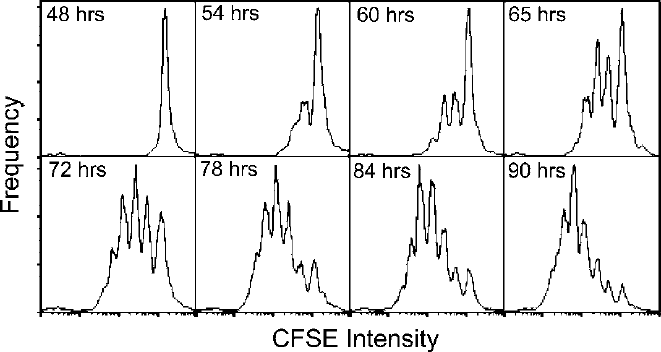
5 The Cyton Model 109
Fig. 5.1 Sample CFSE intensity profiles showing the asynchronous progression of cells through
divisions
using flow-cytometry. An example profile is shown in Fig. 5.1. Immediately after
stimulation the profile shows one distinct peak, indicating that none of the cells have
divided. At a later time however, it is generally found that the profile shows sev-
eral distinct peaks, indicating that not all of the cells in the culture have undergone
the same number of divisions. This implies some element of randomness control-
ling the process of cell division [2, 3], with the division time distributed according
to some probability density function (PDF), that may be characteristic of both the
cell type, and the experimental conditions.
Death and Division as Competing Random Processes
Similar to division, cell death is a stochastic process. This has been demonstrated
by measuring the survival curve of a system of cells and observing that individual
cells die in a non-deterministic fashion, and that the death times of a system of
cells describe some PDF. Often this PDF is, for mathematical convenience, treated
as exponential however evidence suggests that a right-skewed distribution gives a
better fit in many circumstances [4].
For the purposes of modelling, the processes of death and division can be treated
as competing random events. On stimulation, each cell randomly draws a time-to-
die and a time-to-divide from the relevant PDFs, and the earliest of these determines
the fate of the cell. On division these process clocks are reset, possibly from new
PDFs characteristic of the division number of the cell.
110 C. Wellard et al.
Division Destiny and Progressor Fraction
There is evidence that there exists a mechanism that intrinsically limits the maxi-
mum number of division rounds that cells will undergo in a response. Experiments
performed on cells in which the apoptotic machinery has been disabled show that
after a certain number of divisions, cells stop dividing and enter a state of quies-
cence [5]. The division destiny, the ultimate number of division reached by a cell in
a response, is not uniform but is usually distributed over several generations.
Division Dependence
In general the mechanisms for death and division within a cell seem to be dependent
on the number of division rounds that the cell has undergone since initial stimula-
tion. In particular, the average times for both death and division are much longer
for undivided cells, than they are for cells in subsequent generations. Further, the
progressor fraction, that is the fraction of cells that are division capable, is strongly
dependent on the generation number, tending to decrease as cells progress through
the response.
The Cyton Model
The cyton model [4] is a stochastic model for lymphocyte proliferation based on
these observations; namely that
– Death and division are stochastic processes, characterised by a PDF for the time
to divide or die respectively
– These processes are independent, and compete to determine the fate of the cell
– Division events reset the mechanism responsible for these processes
– Only a fraction of cells in each division are division capable
– These mechanisms are division dependent
Let
i
, called the progressor fraction, be the fraction of cells that, after i divisions,
are capable of further division. Let p
B
i
.t/; p
D
i
.t/ be the PDFs for the division and
death times of cells in generation i. Given that a cell arrives in generation i,the
probability that it dies at a time between t and t Cdt after the ith division is q
D
i
.t/dt,
where q
D
i
.t/ equals p
D
i
.t/ multiplied by the probability that no cell division occurs
before t :
q
D
i
.t/ D p
D
i
.t/
1
i
Z
t
0
p
B
i
./d
I (5.1)
5 The Cyton Model 111
Similarly, the conditional probability of cell division at a time between t and t Cdt
after the i th division is
q
B
i
.t/ D
i
p
B
i
.t/
1
Z
t
0
p
D
i
./d
: (5.2)
The cyton model can thus be expressed as a set of integro-differential equations for
the expected number of cells n
i
.t/, in division i, as a function of time:
Pn
0
.t/ Dn
0
.0/
q
D
0
.t/ Cq
B
0
.t/
(5.3)
and, for i > 1;2;:::;
Pn
i
.t/ D 2 Pn
B
i1
.t/ Pn
B
i
.t/ Pn
D
i
.t/;
Pn
B
i
.t/ D n
i
.0/q
B
i
.t/ C2
Z
t
0
Pn
B
i1
./q
B
i
.t /d;
Pn
D
i
.t/ D n
i
.0/q
D
i
.t/ C2
Z
t
0
Pn
B
i1
./q
D
i
.t /d: (5.4)
In this form the model is completely general. With judicious choice of the forms
of the PDFs in each division, as well as their defining parameters, and for the values
of the progressor fractions, this model could describe the mean population dynam-
ics of any cell system. Leaving all of these parameters free however, means that
the model is over parameterised for most data sets. To be of any use as a predictive
tool requires that we use system-specific knowledge to reduce the number of free
parameters.
Right Skewed Distributions for Division and Death Times
Many models of cell division use exponential rates for cell death and division,
usually for reasons of mathematical convenience rather than from any biological
motivation [6]. Such a choice implies that both processes are age-independent, and
are equally likely to occur in any given time-interval. Evidence suggests this is not
the case. In particular cells are much less likely to either die, or to divide, immedi-
ately after a previous division event [4]. Careful examination of the data suggests
that death and division times are well described by a right skewed distribution, such
as lognormal or gamma distribution [7]. For example, in Fig. 5.2 we show a plot
obtained from a course of tritiated thymidine pulses. The count rate is proportional
to the number of cells taking up the thymidine during DNA replication in S-phase.
Treatment with colcemid prevents divisions, preventing the pollution of the sig-
nal from further division. Thus the signal is proportional to the number of cells in
S-phase of the first mitotic cycle after stimulation, and the distribution is well de-
scribed by a lognormal PDF. Note that the proportion of cells participating in the
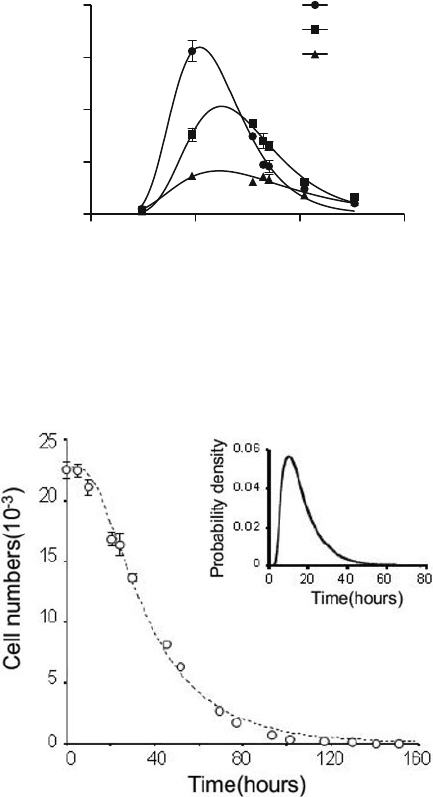
112 C. Wellard et al.
0 50 100 150
0
1000
2000
3000
4000
10 ug/ml
3.3 ug/ml
1 ug/ml
Time (hours)
CPM
Fig. 5.2 Distribution of division times for B cells stimulated with 10 g=ml;3:3g=ml;
1:1 g=ml of ˛-CD40 in the presence of IL4. The cells were cultured in the presence of colcemid,
and a time course of 1 h
3
H
thymidine pulses was conducted. The measured count rate (counts
per minute) is proportional to the number of cells in S-phase. The distributions are well fit by a
lognormal PDF. The figure is taken from [4]
Fig. 5.3 A survival curve for B cells isolated from lymph nodes. The data have been fit to a
lognormal survival curve, the corresponding distribution of death times is shown in the top right.
The figure is taken from [4]
response increases with increasing concentration of the mitogen, illustrating how
these PDFs can be changed by external signals. Similarly, the death times of undi-
vided lymphocytes can also be described using a lognormal PDF. Figure 5.3 shows
a survival curve for B cells isolated from a lymph node. The data have been fit to a
lognormal survival curve, with the corresponding PDF shown above.