
Molina-Par?s C., Lythe G. (editors) Mathematical Models and Immune Cell Biology
Подождите немного. Документ загружается.

6 Modelling Intravital Two-Photon Data 133
The applied agent-based model consists of the following three coupled levels:
(a) The first level contains the main lattice corresponding to the three-dimensional
physical space in which cells can migrate and interact. Each lattice point can
carry up to one biological cell that evolves according to reaction rates defining
a probability of action or interaction with neighboring cells on the lattice. In
addition, cells migrate according to a chemokine distribution that is calculated
on a separate lattice (see third level below).
(b) The second level refers to the antibody shape space, which is represented by
a four-dimensional lattice encoding the antibody type of each B cell. Somatic
hypermutation is represented by switching the antibody type to a neighboring
point in the shape space. Each point in the shape space is associated with an
antibody–antigen affinity and determines the binding probability of a B cell to
an antigen-presenting follicular dendritic cell.
(c) The third level deals with solving a system of reaction-diffusion equations for
the chemokines CXCL12 and CXCL13. The source for CXCL12 are stromal
cells at the border of the follicle in the dark zone, and follicular dendritic cells
in the light zone for CXCL13.
The essential feature of this agent-based model is that it captures the whole ger-
minal centre reaction comprising the population kinetics, cellular interactions, and
affinity maturation. This level of description allows to distinguish between centrob-
lasts, proliferating B cells that undergo somatic hypermutation, and centrocytes,
nondividing B cells with activated apoptosis competing for survival signals. The
included mechanisms follow, to a large extent, the classical model of the germi-
nal centre reaction [3] and the simulations are validated by numerous experimental
facts [7].
The preferred direction of B cell migration is defined by a polarity vector that is
renewed after the persistence time of 1:24 min, which was obtained from the statis-
tical cell track model that was discussed in Section “B Cell Trans-Zone Migration
in Germinal Centres”. The polarity vector consists of two contributions. A random
contribution according to the turning angle distribution as measured in two-photon
experiment [13] and a contribution that depends on the chemokine gradients.
The simulations predicted a novel migration model for B cells in germinal cen-
tres, referred to as “transient chemotaxis model” that reconciles all experimental
and theoretical data [7,8]. According to this model, most of the cells in the dark and
light zone actively perform persistent random walk migration. Centrocytes acquire
additional sensitivity to CXCL13 after or during differentiation from centroblasts
and orient toward the network of follicular dendritic cells in the light zone. In the
network, the centrocytes lose CXCL13 sensitivity. This might be induced by contact
with follicular dendritic cells, by overcritical CXCL13 concentrations and CXCR5
internalization, or simply by down-regulation of CXCR5 after a characteristic time.
Similarly, a return to the dark zone of positively selected centrocytes is facilitated by
a transient chemotactic sensitivity for CXCL12. However, random walk migration
remains the dominant pathway of re-polarization since B cells undergo directed mi-
gration only temporarily. Therefore, transient chemotaxis might well be hidden in
the experimental motility data that seemingly support pure persistent random walk
migration.
134 M.T. Figge and M. Meyer-Hermann
Furthermore, the functional analysis of germinal centre simulations revealed
insight about the interaction between B cells and follicular dendritic cells. Cen-
trocytes bind antigen on follicular dendritic cells to obtain survival signals and this
binding process is affinity dependent. Contacts observed in vivo have rarely been
found to be longer than 5 min [14]. In the agent-based model it was assumed that,
depending on the affinity of the encoded antibody, the B cells either contact fol-
licular dendritic cells in a static condition of 30 min or in a transient manner that
lasted until the B cell continued to migrate. A distribution of contact durations was
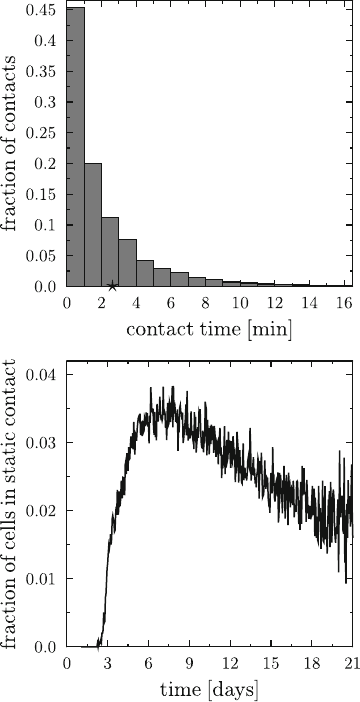
obtained from the simulations and is plotted in Fig. 6.3. It was found that the ma-
jority of B cells exhibit only short contacts with follicular dendritic cells, i.e. less
than 5 min (see Fig. 6.3a), and only 2–4% of the cells are in a static contact dur-
ing the germinal centre reaction (see Fig. 6.3b). These results of the simulations
are in agreement with the two-photon measurements [14]. Therefore, it cannot be
Fig. 6.3 Simulation results
on the overall contact time
and the number of static
contacts between centrocytes
and follicular dendritic cells.
(a) The vast majority of
contacts between centrocytes
and follicular dendritic cells
during a one-hour
measurement is of dynamic
nature and lasts around 3 min.
(b) During the germinal
centre reaction, the fraction of
centrocytes that drive the
affinity maturation and are in
static contact with follicular
dendritic cells for 30 min is
only 2–4%. (This figure was
modified after [7])
a
b
6 Modelling Intravital Two-Photon Data 135
concluded from the experimental contact data that centrocytesintegrate signals from
short contacts with follicular dendritic cells [14]. Instead, even though signal inte-
gration cannot be ruled out, the simulations were consistent with the idea that rare
static contacts are sufficient to drive affinity maturation.
Agent-Based Models of Cell Shape Dynamics
Two-photon microscopy data reveal that cell motility and cell shape are closely in-
terlinked with each other, since the re-polarization of cells involves the repositioning
of the cellular cytoskeleton. Several modelling approaches exists that capture the
shape dynamics of migrating cells [17, 18, 23]. In this chapter, we concentrate on
the approach that has been applied to analyze the experimentally observed shape
dynamics of migrating cells in lymphoid organs [23].
Two-photon data show a stochastic variation of lymphocyte motility that is
closely interlinked with the cell shape [10]. Therefore, to analyze these data, cells
cannot be treated as point particles but have to be modelled in a spatially resolved
fashion. This is realized by an agent-based model with a sufficiently high lattice
resolution that represents each cell by a collection of subunits corresponding to
connected lattice points. In addition, updating rules have to be implemented in the
agent-based model that mimic realistic shape deformations of migrating cells.
Cell Shape Dynamics of Migrating T and B Cells
Following a reductionalist point of view, cells may be represented by the cell vol-
ume, the cell polarity and a list of connected cell subunits that constitute the cell
shape on the lattice. The cell volume determines the number of cell subunits accord-
ing to the chosen space resolution, while velocity states translate into probabilities
of subunit movements in the direction of the cell polarity according to the chosen
time resolution.
Two main contributions of cell dynamics have been identified [23]:
(1) The rearrangement of subunits with respect to a virtually shifted barycentre of
the cell (active movement). A normalized polarization vector determines the di-
rection of the active movement of a cell, which in reality is a complex function
of the cytoskeleton organization as well as localized signalling pathways. This
vector is considered as an approximation for the direction in which cell protru-
sions are developed and is assumed to change randomly with a probability that
is associated with the persistence time.
(2) The rearrangement of the subunits with respect to the actual barycentre (re-
shaping forces). The subunit movement is realized according to heuristic rules
that are interpretable as physical quantities. This ingredient of the cell motil-
ity model concerns the cell shape stability. During the procedure of active
136 M.T. Figge and M. Meyer-Hermann
cell movement the details of forces that reshape the cell towards a sphere, i.e.
hydrostatic pressure, reduced actin filament assembly, actomyosin contraction,
or membrane surface tension, are ignored. Within a phenomenological approx-
imation, all these forces are included in a single reshaping force. This overall
elastic force drives the subunits of an elongated cell back to the current barycen-
tre and promotes a spherical shape.
The simulation of active movement was performed by the following procedure:
The barycentre of the cell is virtually shifted in the direction of the polarization vec-
tor towards the membrane of the cell. Then every subunit representing a membrane
point of the cell is moved in random order towards free lattice points near the virtual
barycentre. Moving a border subunit which is not a direct neighbor of its target point
(e.g. a subunit on the back of the cell) is considered to correspond to the cytosol shift
through the whole cell. Note that in this model all subunits carried the same proper-
ties and if the movement of a membrane subunit would have caused the subunits of
the cell to become disconnected this movement was suppressed. The displacement
of subunits was stopped when either no membrane subunit remained to be moved or
the barycentre of the cell was displaced by one lattice constant. In the new state the
cell had reorganized its membrane and thus changed its shape. Thereby the total cell
volume (or, the total cell area in a two-dimensional implementation) was conserved.
Thus, the movement of the cell barycentre was realized by subunit rearrangements,
and inherently coupled the cell movement to its deformation.
The comparison of the model results with experiment revealed that the two in-
gredients active movement and reshaping forces are sufficient in order to describe
lymphocyte motility data as found by two-photon imaging. Here, we concentrate
on the shape index that was calculated from the data obtained for T cell and B
cell migration in lymph nodes of mice [10]. Projecting the cell volume on a two-
dimensional plane, the area was approximated by an ellipse, which is characterized
by its two axes. The shape index s
i
.n/ of the i th cell was calculated as the ratio of
the long to the short axis at each time step t
n
, such that s
i
.n/ > 1 corresponds to an
elongated cell shape that becomes circular for s
i
.n/ D 1.
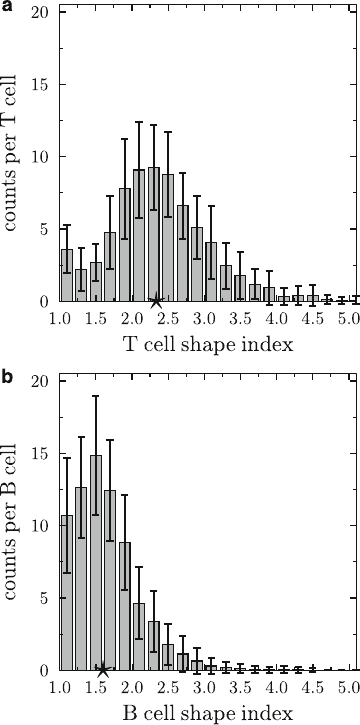
In Fig. 6.4 the shape index distributions are plotted as obtained from the mea-
surement of I D 46 T cells and B cells. The average shape index is around 2:3 for
T cells and 1:6 for B cells, indicating that the cellular elongation is about a factor
1:5 larger for T cells compared to B cells. The differences in the shape index are
in agreement with observations by two-photon microscopy [10]. It was speculated
that this may point to cardinal differences in the cytoskeleton dynamics of migrat-
ing T and B cells [23]. Nevertheless, in the simulations both cell types dynamically
round up and take a symmetric shape during the process of re-polarization. It should
be noted that this result has not been enforced by assuming a pausing time in the
agent-based model, as was done in the statistical cell track model combined with
the assumption of a single speed state for the cells. Rather, in the agent-based model
the shape index is a direct consequence of the reshaping forces that cells experience
while they are continuing to migrate and the shape index is closely connected with
a significant width in the underlying speed distributions [23].
6 Modelling Intravital Two-Photon Data 137
Fig. 6.4 Simulation results
on the distribution of the
shape index for 46 T cells and
B cells. The error bars
correspond to one standard
deviation and stars indicate
the mean values of the
distributions. (a) The T cell
shape index distribution has a
mean shape index of 2:3 and
shows that T cells reach
peak elongations between
4 and 5.(b) The B cell shape
index distribution has a mean
shape index of 1:6,which
corresponds to only 70%of
the mean value for T cells.
Peak elongations in B cells
occur between 2:5 and 3:5
Summary
Multi-photon microscopy is a powerful tool for imaging lymphocyte migration and
interaction in intact biological organs. Quantitative information on the cell motility,
shape dynamics and contact durations are derived from these data by mathematical
analysis that shape our interpretation of these data.
It is important to realize that mathematical analysis is not merely a descriptive
approach, rather, its valuable contribution is to constitute a predictive consistency
check of the working hypothesis that is underlying the interpretation of the experi-
mental data. For example, a simple statistical cell track model was used to analyze
the trans-zone migration of B cells in germinal centres. This revealed, on the one
hand, that the measured trans-zone frequency is in agreement with the working
138 M.T. Figge and M. Meyer-Hermann
hypothesis of B cells performing a persistent random walk migration in germinal
centres. On the other hand, the same analysis disclosed an inconsistency with re-
spect to the observed zonal morphology in germinal centres. This initiated further
analysis using an agent-based model approach that captures the functional aspects
of the germinal centre reaction. It then turned out that, hidden behind the experi-
mental data from which the working hypothesis was derived, transient chemotaxis
restores the zonal morphology in germinal centres. Since transient chemotaxis is
still compatible with the B cell motility data, this implied that the initial working
hypothesis of pure random walk migration with directional persistence time was ac-
tually formulated too narrow. This development of insight is a prime example for
experiment and theory working hand in hand [8].
A firm experimental data basis is the mandatory prerequisite for realistic models
of cellular dynamics in complex biological systems. Including more detailed aspects
of cell dynamics into mathematical models reveals new system features and is be-
coming more feasible due to the continuously growing computer resources in terms
of memory and processor speed. At the same time experimental techniques are de-
veloping fast and highly accurate data on cellular dynamics that are recorded over
several hours time can be expected in the near future. The real challenge, however,
is for modelers and experimentalists to keep pace in working hand in hand achieving
the highest benefit from the symbiotic effects of theory and experiment.
References
1. Mempel T, Henrickson S, von Adrian U (2004) T-cell priming by dendritic cells in lymph
nodes occurs in three distinct phases. Nature 427:154–159
2. Beauchemin C, Dixit NM, Perelson AS (2007) Characterizing T cell movement within lymph
nodes in the absence of antigen. J Immunol 178:5505–5512
3. MacLennan ICM (1994) Germinal centers. Annu Rev Immunol 12:117–139
4. Manser T (2004) Textbook germinal centers? J Immunol 172:3369–3375
5. Hauser A, Shlomchik M, Haberman A (2007) In vivo imaging studies shed light on germinal-
centre development. Nat Rev Immunol 7:499–504
6. Allen C, Okada T, Cyster J (2007) Germinal-center organization and cellular dynamics.
Immunity 27:190–202
7. Figge MT, Garin A, Gunzer M, Kosco-Vilbois M, Toellner KM, Meyer-Hermann M (2008)
Deriving a germinal center lymphocyte migration model from two-photon data. J Exp Med
205:3019–3029
8. Meyer-Hermann M, Figge MT, Toellner KM (2009) Germinal centres seen through the math-
ematical eye: B cell models on the catwalk. Trends Immunol 30:157–164
9. Cahalan M, Parker I (2008) Choreography of cell motility and interaction dynamics imaged by
two-photon microscopy in lymphoid organs. Annu Rev Immunol 26:585–626
10. Miller M, Wei S, Parker I, Cahalan M (2002) Two-photon imaging of lymphocyte motility and
antigen response in intact lymph node. Science 296:1869–1873
11. Miller M, Wei S, Cahalan M, Parker I (2003) Autonomous T cell trafficking examined in vivo
with intravital two-photon microscopy. Proc Natl Acad Sci USA 100:2604–2609
12. Miller M, Safrina O, Parker I, Cahalan M (2004) Imaging the single cell dynamics of CD4
C
T
cell activation by dendritic cells in lymph nodes. J Exp Med 200:847–856
13. Allen C, Okada T, Tang HL, Cyster J (2007) Imaging of germinal center selection events during
affinity maturation. Science 315:528–531
6 Modelling Intravital Two-Photon Data 139
14. Schwickert T, Lindquist R, Shakhar G, Livshits G, Skokos D, Kosco-Vilbois M, Dustin M,
Nussenzweig M (2007) In vivo germinal center imaging reveals a dynamic open structure.
Nature 446:83–87
15. Hauser A, Junt T, Mempel T, Sneddon M, Kleinstein S, Henrickson S, von Andrian U,
Shlomchik M, Haberman A (2007) Definition of germinal-center B cell migration in vivo re-
veals predominant intrazonal circulation patterns. Immunity 26:655–667
16. Meyer-Hermann M (2008) Delaunay-object-dynamics: cell mechanics with a 3D kinetic and
dynamic weighted Delaunay-triangulation. Curr Top Dev Biol 373–399
17. Beltman JB, Mar´ee AF, Lynch JN, Miller MJ, de Boer RJ (2007) Lymph node topolgy dictates
T cell migration behavior. J Exp Med 204:771–780
18. Beltman JB, Mar´ee AF, de Boer RJ (2007) Spatial modelling of brief and long interactions
between T cells and dendritic cells. Immunol Cell Biol 85:306–314
19. Meyer-Hermann M (2002) A mathematical model for the germinal center morphology and
affinity maturation. J Theor Biol 216:273–300
20. Meyer-Hermann M, Maini P (2005) Back to one-way germinal centers. J Immunol 174:2489–
2493
21. Figge MT (2005) Stochastic discrete event simulation of germinal center reactions. Phys Rev
E 71:051907
22. Meyer-Hermann M, Maini PK, Iber D (2006) An analysis of B cell selection mechanisms in
germinal centers. Math Med Biol 23:255–277
23. Meyer-Hermann M, Maini P (2005) Interpreting two-photon imaging data of lymphocyte
motility. Phys Rev E 71:061912

Chapter 7
Modelling Lymphocyte Dynamics In Vivo
Becca Asquith and Jos
´
e A.M. Borghans
Abstract Quantification of lymphocyte dynamics contributes greatly to our under-
standing of many fundamental processes in immunology, including homeostasis,
ageing, immunological memory and pathogenesis. Recently developed experimen-
tal techniques to label lymphocytes and mathematical models to interpret the re-
sulting data enable us to accurately measure the rate of T and B lymphocyte
proliferation and disappearance in humans in vivo. Here we describe some of the
experimental and mathematical techniques involved, including a discussion of the
advantages and disadvantages of the most popular methods available, as well as a
practical guide to modelling labelling data, and a discussion of future challenges in
this rapidly-moving area.
Why Quantify Lymphocyte Dynamics?
Lymphocytes are the key cells of our adaptive immune system and their dynamics
determine our health. The correct balance between the production of lymphocytes
(de novo in the thymus and by peripheral proliferation) and lymphocyte loss (by
cell death or differentiation) is essential for immune function. Dysregulation of
lymphocyte dynamics results in a broad spectrum of pathologies including AIDS
(precipitated by CD4
C
T lymphocyte loss), leukemia (aberrant growth of B or T
lymphocytes) and autoimmune conditions such as multiple sclerosis or arthritis
(inappropriate activity of self-reactive lymphocytes). Even though lymphocyte pro-
liferation and death rates are often regarded as textbook immunology, estimates of
these rates can easily vary by a 100-fold. Nevertheless, researchers are trying to un-
derstand how human diseases like HIV infection, and therapeutic interventions such
B. Asquith (
)
Department of Immunology, Wright-Fleming Institute, Imperial College London,
Norfolk Place, London W2 1PG, UK
e-mail: b.asquith@imperial.ac.uk
C. Molina-Par´ıs and G. Lythe (eds.), Mathematical Models and Immune Cell Biology,
DOI 10.1007/978-1-4419-7725-0
7,
c
Springer Science+Business Media, LLC 2011
141
142 B. Asquith and J.A.M. Borghans
as haematopoietic stem cell transplantation, affect lymphocyte kinetics. As long as
there is controversy about lymphocyte kinetics in healthy individuals, such ques-
tions will remain hard to address.
Why Are Mathematical Models Needed?
Thanks to recent experimental advances, including the application of stable isotope
labelling to label and trace cells that undergo proliferation, the time is now ripe to
determine these rates of lymphocyte turnover. Proper interpretation of labelling ex-
perimental data hinges upon the use of mathematical models. Without mathematical
models, labelling curves remain merely descriptive and do not yield the quantitative
turnover parameters that are needed. Moreover, mathematical modelling helps to ob-
tain insights into the complicated dynamical processes underlying the functioning
of the immune system.
Mathematical models are often criticized because of the assumptions that are
made. Indeed, as Lee Segel, a distinguished mathematical biologist himself, once
said “mathematical biologists are people who make oversimplified models”, but
importantly he added “and do not even feel embarrassed”. It is important to re-
alize, that any interpretation of data incorporates assumptions. The danger with
intuitive, model-free interpretations is that the assumptions are often implicit. Im-
plicit assumptions lack transparency and researchers themselves may be unaware
that they are making these assumptions and so their accuracy is never addressed.
Indeed, as will be repeatedly seen in the following examples, intuitive “assumption-
free” approaches that initially seem persuasive have frequently been demonstrated
to give incorrect results. The fact that mathematical models make their assumptions
explicit, and thereby visible, makes it easier to scrutinise them. Additionally, making
simplifications and eliminating free parameters has the considerable advantage that
it becomes possible to estimate key parameters such as lymphocyte proliferation and
disappearance rates with limited amounts of data, which would be impossible with
highly complex models (see the Section on Parameter Identifiability). Finally, sim-
plified models can provide real insights into complex and highly dynamical systems
such as the immune system.
Different Methods to Study Lymphocyte Dynamics
In recent decades, a large number of different methods have been applied to estimate
the rates of production and death of different lymphocyte populations. These meth-
ods differ widely and include the interpretation of “experiments of nature”, such as
lymphocyte reconstitution after severe lymphopenia, as well as different markers to
study lymphocyte populations that undergo proliferation and death. Some of those
markers occur naturally, including the expression of the proliferation marker Ki67,