
Molina-Par?s C., Lythe G. (editors) Mathematical Models and Immune Cell Biology
Подождите немного. Документ загружается.

17 Timescales of the Adaptive Immune Response 353
r
ρ(r)
√
4Dt
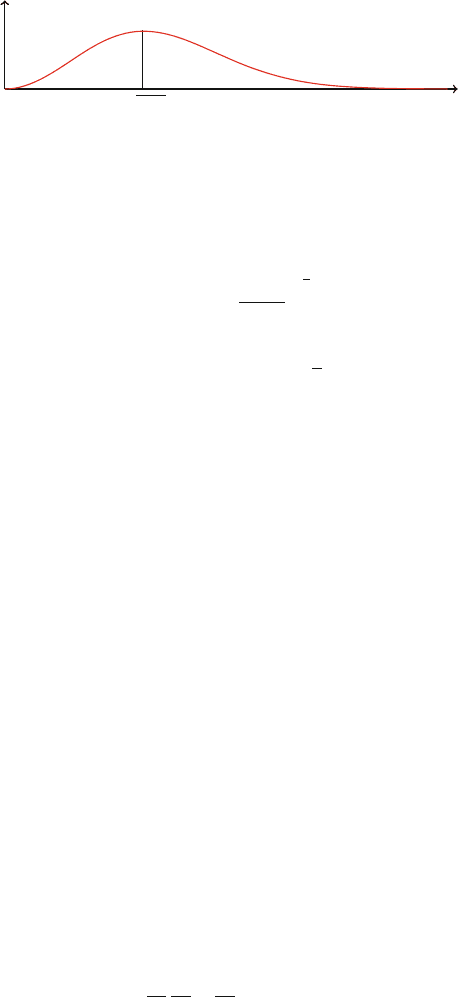
Fig. 17.1 The probability density of X
t
, the distance travelled in time t by a Brownian motion in
three dimensions with diffusivity D
The mean distance travelled in time interval t is
IE .X
t
/ D
16Dt
1
2
I
the variance of X
t
is IE.X
t
2
/ .IE .X
t
//
2
D .3
8
/2Dt. Note that IE.X
t
/ is not
proportional to t as t ! 0, so no well-defined velocity exists. Under the assump-
tion of Brownian motion, the appropriate quantity to report is the diffusivity D,
obtained by plotting mean displacement versus the square root of the time between
measurements [4, 18].
First Passage to a Sphere
We’ll suppose, in the spirit of the infamous spherical cow, that the lymph node, or
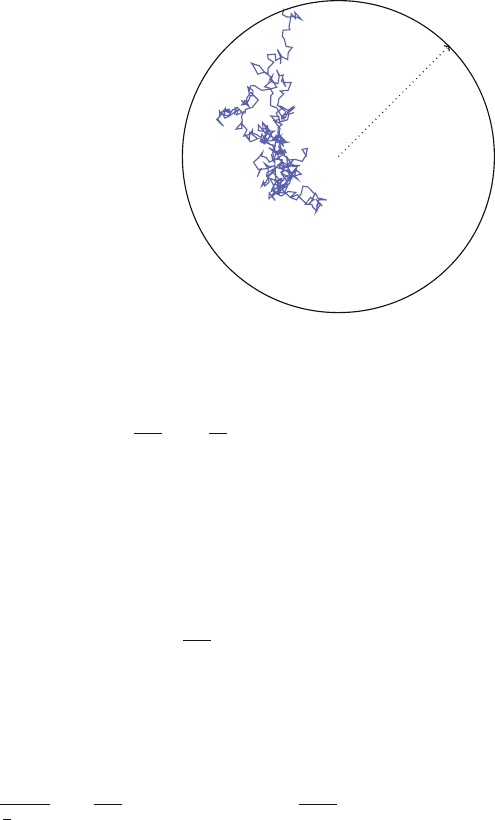
its T cell zone, is spherical with radius R. How long does it take a T cell, executing
Brownian motion in three dimensions with diffusivity D, to reach the edge of the
sphere (Fig. 17.2)? In general, the mean time T to hit the boundary of a region is
a function of the starting point, x
0
, that satisfies the partial differential equation
(PDE) known as Poisson’s equation [19]:
Dr
2
T.x
0
/ D1: (17.1)
The spherical approximation means that, instead of solving (17.1) by the general
method of separation of variables, we can look for a function of r
0
Djx
0
j only:
T.x
0
/ D F.r
0
/;
which satisfies
D
1
r
2
@
@r
r
2
@
@r
F.r/ D1: (17.2)
354 M. Day and G. Lythe
Fig. 17.2 Brownian motion
inside a sphere of radius R:
illustration of a sample path,
starting at x
0
x
0
R
The general solution is
F.r/ D
1
6D
r
2
c
1
r
C c
2
; (17.3)
where c
1
and c
2
are constants. Requiring that the mean time to reach the surface
starting from the centre of the sphere, F.0/, is not infinite, means that that c
1
D 0.
We also know that F.R/ D 0 because, if the starting point is already on the surface,
then the time to reach the surface is certainly zero. The mean time to hit the surface
of the sphere, starting a distance r
0
from its centre, is thus
T.x
0
/ D F.r
0
/ D
1
6D
.R
2
r
2
0
/: (17.4)
To derive a characteristic mean time that doesn’t depend on initial conditions, we
average (17.4) over all possible starting points in the sphere, by integrating over the
sphere, and dividing by the volume of the sphere:
D
1
4
3
R
3
Z
R
0
1
6D
.R
2
r
2
/4r
2
dr D
1
15D
R
2
:
Before moving on, we also consider the slightly more difficult question of where
the particle first hits the sphere. If the particle starts in the centre, then all parts are
equally likely to be hit; if not, the probability density is maximised at the point on
the surface closest to the initial condition.
Suppose the surface of the lymph node, S , contains a part that is special (an exit
for example). The probability that our Brownian particle, starting at position x, hits
apart,H , of the surface is a function, p.x/, that satisfies Laplace’s equation [19,20]
r
2
p.x/ D 0; (17.5)

17 Timescales of the Adaptive Immune Response 355
with boundary conditions
p.x/ D
(
1x2 H
0 elsewhere on S:
(17.6)
This applies whatever the shape of the lymph node, but we will continue to make
life easier for ourselves by considering it to be spherical.
A useful method for constructing solutions of equations like (17.1)and(17.5)is
as follows. The solution of
(
Dr
2
˚.x/ Dı.x x
0
/; jxj <R
˚.x/ D 0 jxjDR
(17.7)
is
˚.x/ D
1
4D
0
@
1
jx x
0
j
R=r
0
j
R
2
r
2
0
x
0
xj
1
A
: (17.8)
The solution ˚.x/ is called a Green function and may be written G.x; x
0
/ to em-
phasise that it is a function of the initial condition x
0
as well as of x.(Wehave
written it ˚.x/ because it is identical to the electric potential at x, due to a point
charge at x
0
, inside a grounded sphere.)
Once we have ˚.x/, we can calculate two quantities of interest. The mean exit
time (the mean time until a particle following Brownian motion started at x
0
hits the
sphere) is the integral
IE ./ D
Z
˚.x/dx; (17.9)
over the interior of the sphere. Thus ˚.x/ has the nice interpretation of an occupa-
tion density: to find the average amount of time spent in some region of the interior
of the sphere, before the sphere is hit, we integrate ˚.x/ over that region. To find
the total mean time, we integrate over the whole sphere, which is what (17.9) does.
The probability density of where on the sphere the first exit occurs is obtained by
differentiating ˚.x/ in the outward radial direction:
h.y/ DD
@
@r
˚.x/j
rDR
D
1
4R
R
2
r
2
0
jx yj
3
; (17.10)
where y is a position on the surface of the sphere. To obtain the probability that the
exit occurs in some region on the surface, we integrate the function h.y/ over that
region. Suppose that is the angle between the lines from the origin through x
0
and
x, r
0
Djx
0
j and r Djxj. Then, using jx x
0
j
2
D r
2
C r
2
0
2rr
0
cos ,
356 M. Day and G. Lythe
˚.x/ D
1
4D
0
B
B
@
1
r
2
C r
2
0
2rr
0
cos
1
2
R=r
0
R
4
=r
2
0
C r
2
2R
2
r
r
0
cos
1
2
1
C
C
A
:
For example, we can evaluate the probability that the first part of the sphere that is
hit is in the polar region with <
e
[19]:
PŒhit polar region D
1
4R
Z
e
0
R
2
r
2
0
.r
2
C r
2
0
2rr
0
cos /
3=2
2R
2
sin d
D
R
2
r
2
0
2r
0
1
R r
0
1
.R
2
C r
2
0
2Rr
0
cos
e
/
1=2
:
Escape Through a Small Hole
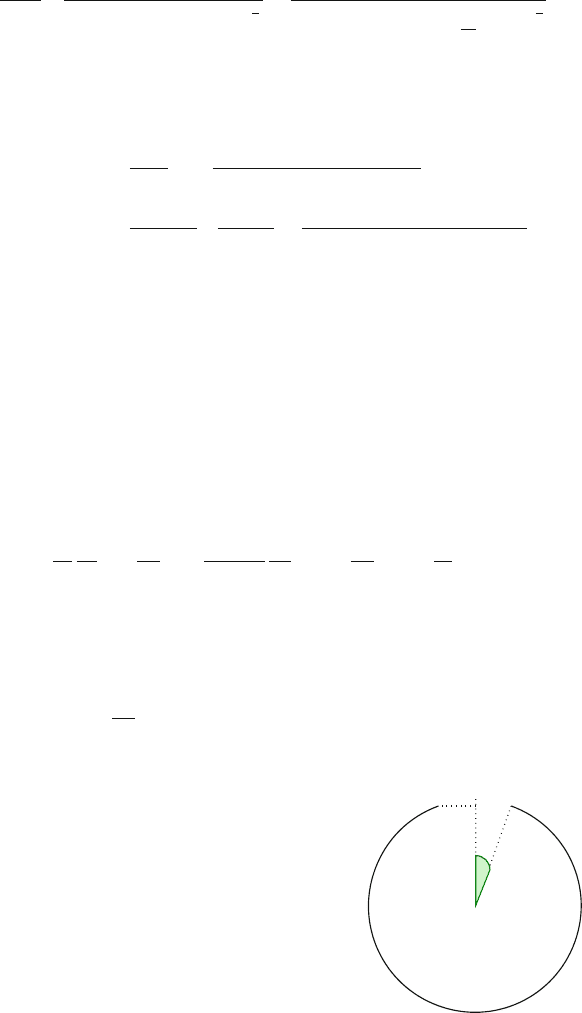
We can expand our model by adding an exit to the sphere. If a particle hits the exit,
it will leave; if it hits the surface anywhere else it will be reflected back into the
sphere (Fig. 17.3). This changes the boundary conditions in PDEs such as (17.7),
and means that there is no longer symmetry in one of the angles. We now need
T.x
0
/ D f.r;/such that
r
2
f D
1
r
2
@
@r
r
2
@f
@r
C
1
r
2
sin
@
@
sin
@f
@
D
1
D
; (17.11)
with boundary conditions
f.R;/D 0 if 0 <
e
@f
@r
.R; / D 0 if
e
;
Fig. 17.3 A simple model:
a sphere of radius R, whose
surface is reflecting except
in a polar region
a
θ
e

17 Timescales of the Adaptive Immune Response 357
where
e
is the angle of the exit, given by
e
D arcsin
a
R
(Fig. 17.3). We can
construct a solution using the Legendre polynomials:
f.r;/D
1
6D
.R
2
r
2
/ C
1
X
nD0
A
n
r
n
P
n
.cos /;
provided we can find coefficients A
n
such that
1
X
nD0
A
n
R
n
P
n
.cos / D00 <
e
(17.12)
1
X
nD0
nA
n
R
n1
P
n
.cos / D
1
3
R
D
e
<: (17.13)
For example, taking D 0 gives
X
n
A
n
D 0. D gives
X
n
.1/
n
nA
n
D
2
3
R
D
.
However, we will use the solution of a simpler problem. An exact solution exists
for the steady-state probability density in the case of a flat reflecting surface with a
circular absorbing hole, with radius a, using oblate spheroidal coordinates [21]. The
circular hole is z D 0, x
2
C y
2
<a
2
and the reflecting surface is the remainder of
the plane z D 0. The probability density is [22]
.x; y; z/ D
2
1
atan ;
which is constant along ellipsoids
x
2
C y
2
1 C
2
C
z
2
2
D a
2
:
On the absorbing circle, D 0. Elsewhere on z D 0, a
2
.
2
C 1/ D x
2
C y
2
and,
because the ellipsoids intersect the plane at right angles,
@
@z
D 0.Ontheabsorbing
circle
@
@z
D
2
1
x
2
C y
2
1
2
. Thus, the probability current [23] out of the hole,
obtained by integrating D
@
@z
over the disc x
2
C y
2
<a
2
, z D 0,is[21]
J D 4D
1
a: (17.14)
If a=R1 then (17.14) will be a good approximation to the mean exit time from
a volume V D
4
3
R
3
. A single particle, started at a random position inside the
lymph node, corresponds to a probability density equal to 1=V [24]. The probability
per unit time, or rate, of escape is thus
k D
4Da
V
D D
3
a
R
3
:
The next term, in the small parameter a=R, can also be calculated [25].
358 M. Day and G. Lythe
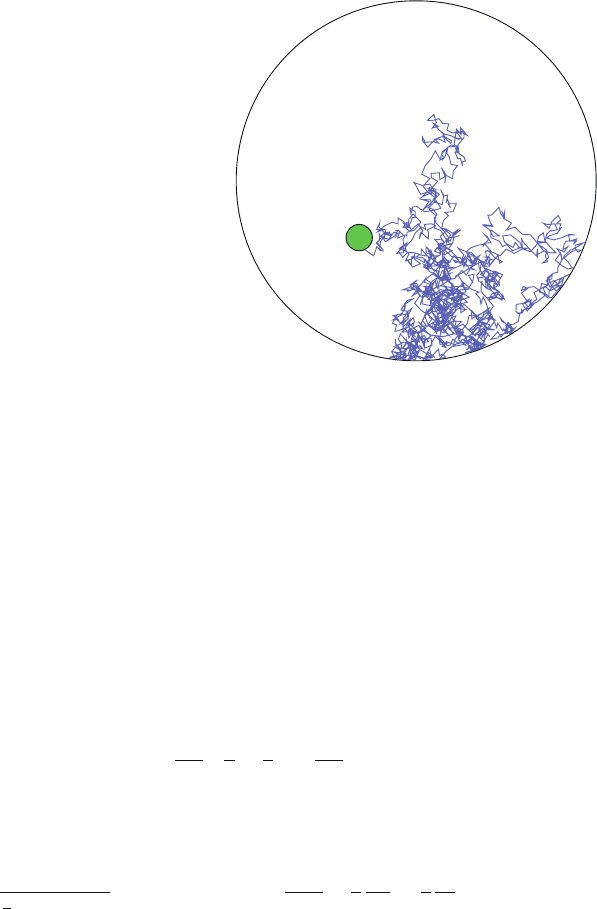
Fig. 17.4 Sample path of
Brownian motion, reflected
on the surface of the sphere,
run until hitting a spherical
zone of attraction (green)
Cell–Cell Encounters
If the surface of a lymph node is reflecting, how long does it take a T cell to find
an APC? A simple approximation can be obtained by assuming that the T cell is a
point particle, moving with diffusivity D, and the APC has radius b, is stationary and
situated at the centre of a spherical lymph node with radius R (Fig. 17.4). Then the
radially-symmetric version of the Poisson equation (17.2) and its general solution
(17.3), yields the mean time, but with the conditions
F.b/ D 0 and F
0
.R/ D 0:
The mean time to hit the stationary central cell with radius b, starting a distance r
from the centre, is
F.r/ D
R
3
3D
1
b
1
r
1
6D
.r
2
b
2
/:
We obtain the average over all starting positions by taking the integral, and expand-
inginpowersofb=R:
D
1
4
3
.R
3
b
3
/
Z
R
b
4r
2
F.r/dr D
R
3
3Db
3
5
R
2
D
C
2
3
b
2
D
C :::: (17.15)
Modelling Interactions
While Brownian motion will undoubtedly be only an approximate description of
lymphocyte motion, it has the advantage of simplicity. The only parameter is the
diffusivity, which has been estimated from analysis of imaging data in vivo as
17 Timescales of the Adaptive Immune Response 359
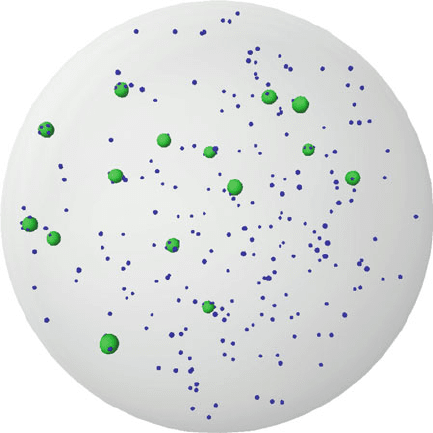
Fig. 17.5 Snapshot of a spatial model of cellular dynamics in a lymph node. The green spheres
represent the zone of attraction of an APC. The smaller blue spheres represent T cells
50–100m
2
min
1
[26–28]. It has also been reported that dendritic cells diffuse
less rapidly [4, 27]. The assumption of Brownian motion is convenient for the con-
struction of multi-cell lymph node models (Fig. 17.5).
In our computational model, T cells and DCs diffuse independently, unless they
collide, inside a sphere. In a timestep t, the position of each cell is moved in-
dependently, with a displacement in each of the three space dimensions that is
drawn from the zero-mean Gaussian distribution with variance 2Dt. Physical
contacts between cells are deemed to occur when two or more cells are closer
than a defined radius of attraction, that takes the sweeping effect of dendrites
and local effect of chemokines into account. When a T cell and a DC meet, they
remain together for a time that is an exponentially-distributed random variable:
Pr.
contact
>t/D exp.t/. The parameter is the inverse of the mean contact
time. The choice of exponential distribution corresponds to a constant probability
per unit time of the contact, if still formed, being broken.
With computational models it is possible to explore “sampling strategies” of
T cells in the lymph nodes [29–36], for example numerous, short, contacts ver-
sus longer contacts [13] and strategies that maximise the time that T cells spend
in the particular lymph node draining an infected site. It has been suggested that
T cell priming by DCs follows three sequential stages [26]. The first, activation,
phase is characterised by transient serial T cell–DC contacts, the second phase in-
volves longer contacts and cytokine production and the last phase is characterised by
high T cell motility and rapid proliferation. Three hypotheses have been proposed to
360 M. Day and G. Lythe
explain how T cell–DC contacts change from being transient to long-lived [10]. In
the first, DCs mature over time, increasing their expression of adhesion and costim-
ulatory molecules, and so gain the ability to establish long-lived interactions with
T cells. In the second, it is T cells that gain the ability to establish long-lived interac-
tions, by summing signals received during short contacts with DCs until a threshold
is reached. The third hypothesis is that, with a certain probability, each T cell–DC
encounter can become a stable, long-lived interaction.
We intend to extend the computational model of T cells and DCs and their con-
tacts to more realistic representations of lymph nodes, including reticular network
and internal partitions. We hope that stochastic modelling of this type will help to
identify relevant parameters that characterise T cells and their interactions with DCs
in the lymph nodes.
References
1. Celli S, Garcia Z, Bousso P (2005) CD4 T cells integrate signals delivered during successive
DC encounters in vivo. J Exp Med 202:1271–1278
2. Dustin M (2008) T-cell activation through immunological synapses and kinapses. Immunol
Rev 221:77–89
3. Bajenoff M, Egen J, Qi H, Huang A, Castellino F, Germain R (2007) Highways, byways and
breadcrumbs: directing lymphocyte traffic in the lymph node. Trends Immunol 28:346–352
4. Miller M, Wei S, Parker I, Cahalan M (2002) Two-photon imaging of lymphocyte motility and
antigen response in intact lymph node. Science 296:1869–1873
5. Zinselmeyer B, Dempster J, Gurney A, Wokosin D, Miller M, Ho H, Millington O, Smith
K, Rush C, Parker I, Brewer MCJ, Garside P (2005) In situ characterization of CD4
C
T cell
behavior in mucosal and systemic lymphoid tissues during the induction of oral priming and
tolerance. J Exp Med 201:1815–1823
6. Millington O, Zinselmeyer B, Brewer J, Garside P, Rush C (2007) Lymphocyte tracking and
interactions in secondary lymphoid organs. Inflamm Res 56:391–401
7. Hauser AE, Junt T, Mempel TR, Sneddon MW, Keinstein SH, Henrickson SE, von Andrian
UH, Shlomchik MJ, Haberman AM (2007) Definition of germinal-center B cell migration in
vivo reveals predominant intrazonal circulation patterns. Immunity 26:655–667
8. Allen CD, Okada T, Tang HL, Cyster JG (2007) Imaging of germinal center selection events
during affinity maturation. Science 315:528–531
9. Garside P, Brewer J (2008) Real-time imaging of the cellular interactions underlying tolerance,
priming, and responses to infection. Immunol Rev 221:130
10. Bousso P (2008) T-cell activation by dendritic cells in the lymph node: lessons from the movies.
Nat Rev Immunol 8:675–684
11. Beltman J, Henrickson S, von Andrian U, de Boer R, Mar´ee A (2009) Towards estimating the
true duration of dendritic cell interactions with T cells. J Immunol Methods 347:54–69
12. Beltman J, Mar´ee A, de Boer R (2009) Analysing immune cell migration. Nat Rev Immunol
9:789–798
13. Beltman JB, Mar´ee AFM, de Boer RJ (2007) Spatial modelling of brief and long interactions
between T cells and dendritic cells. Immunol Cell Biol 85:306–314
14. Maroof A, Beattie L, Kirby A, Coles M, Kaye P (2009) Dendritic cells matured by inflamma-
tion induce CD86-dependent priming of naive CD8+ T cells in the absence of their cognate
peptide antigen. J Immunol 183:7095
15. Beltman JB, Maree AF, Lynch JN, Miller MJ, de Boer RJ (2007) Lymph node topology dictates
T cell migration behavior. J Exp Med 204:771–780
17 Timescales of the Adaptive Immune Response 361
16. Baj´enoff M, Egen J, Koo L, Laugier J, Brau F, Glaichenhaus N, Germain R (2006) Stromal cell
networks regulate lymphocyte entry, migration, and territoriality in lymph nodes. Immunity
25:989–1001
17. Beauchemin C, Dixit N, Perelson A (2007) Characterizing T cell movement within lymph
nodes in the absence of antigen. J Immunol 178:5505
18. Worbs T, Mempel T, Bolter J, von Andrian U, Forster R (2007) CCR7 ligands stimulate the
intranodal motility of T lymphocytes in vivo. J Exp Med 204:489
19. Stirzaker D (2005) Stochastic processes and models. Oxford University Press, Oxford
20. Ito K, McKean Jr H (1974) Diffusion processes and their sample paths. Springer, New York
21. Berg H, Purcell E (1977) Physics of chemoreception. Biophys J 20:193–219
22. Hill T (1975) Effect of rotation on the diffusion-controlled rate of ligand-protein association.
Proc Natl Acad Sci USA 72:4918–4922
23. Gardiner CW (2004) Handbook of stochastic methods for physics, chemistry and the natural
sciences, 3rd edn. Springer, New York
24. Grigoriev I, Makhnovskii Y, Berezhkovskii A, Zitserman V (2002) Kinetics of escape through
a small hole. J Chem Phys 116:9574
25. Singer A, Schuss Z, Holcman D (2008) Narrow escape and leakage of Brownian particles.
Phys Rev E 78:51111
26. Mempel T, Henrickson S, Von Andrian U (2004) T-cell priming by dendritic cells in lymph
nodes occurs in three distinct phases. Nature 427:154–159
27. Miller M, Wei S, Cahalan M, Parker I (2003) Autonomous T cell trafficking examined in vivo
with intravital two-photon microscopy. Proc Natl Acad Sci USA 100:2604–2609
28. Miller M, Safrina O, Parker I, Cahalan M (2004) Imaging the single cell dynamics of CD4C
T cell activation by dendritic cells in lymph nodes I. Parker and MD Cahalan. J Exp Med
200:847–856
29. Catron D, Itano A, Pape K, Mueller D, Jenkins M (2004) Visualizing the first 50 Hr of the
primary immune response to a soluble antigen. Immunity 21:341–347
30. Textor J, Westermann J (2007) Modeling migration, compartmentalization and exit of naive T
cells in lymph nodes without chemotaxis. Lect Notes Comput Sci 4628:228
31. Riggs T, Walts A, Perry N, Bickle L, Lynch J, Myers A, Flynn J, Linderman J, Miller M,
Kirschner D (2008) A comparison of random vs. chemotaxis-driven contacts of T cells with
dendritic cells during repertoire scanning. J Theor Biol 250:732–751
32. Chavali A, Gianchandani E, Tung K, Lawrence M, Peirce S, Papin J (2008) Characterizing
emergent properties of immunological systems with multi-cellular rule-based computational
modeling. Trends Immunol 29:589–599
33. Bogle G, Dunbar P (2008) Simulating T-cell motility in the lymph node paracortex with a
packed lattice geometry. Immunol Cell Biol 86:676–687
34. Bogle G, Dunbar P (2010) Agent-based simulation of T-cell activation and proliferation within
a lymph node. Immunol Cell Biol 88:172–179
35. Baldazzi V, Paci P, Bernaschi M, Castiglione F (2009) Modeling lymphocyte homing and en-
counters in lymph nodes. BMC Bioinformatics 10:387
36. Linderman J, Riggs T, Pande M, Miller M, Marino S, Kirschner D (2010) Characterizing the
dynamics of CD4C T cell priming within a lymph node. J Immunol 184:2873