
Molina-Par?s C., Lythe G. (editors) Mathematical Models and Immune Cell Biology
Подождите немного. Документ загружается.


16 A Physicist’s Approach to Immunology 343
where X is the antigen or dendritic cell, for instance, Y the immune cell and Z the
complex X C Y , can be split into
X C Y $ XY $ Z; (16.3)
where the first reaction contains the transport information and the second one the
binding information. Let us consider both mechanisms separately.
Cell Motility
Cells (in general) are small bodies with sizes ranging from a few to a few tens of
microns (m), namely 10
6
10
5
m. The transport may be persistent (directed) or
diffusive (random). Let us explore the differences.
In the first case, the cells are directed towards larger gradients of some substances
(generically referred to as chemokines). The higher the gradient the higher the force
experimented by the cell.
On the contrary, if cells (or large molecules) move diffusively, they may be
locally in thermal equilibrium with their environment. Thus the erratic motion
(fluctuation) is closely related to the resistance of the environment to motion (dissi-
pation). Then, one can determine the diffusivity (assuming that the cell is an sphere
of radius R)as[3]:
D D
kT
6R
: (16.4)
Thus, the diffusion coefficient or motility (D) emerges as the capacity to extract
thermal energy from the environment and dissipate it producing motion. As mass
scales as M R
3
(assuming constant density), one would expect that diffusivity
scales as:
d M
1=3
: (16.5)
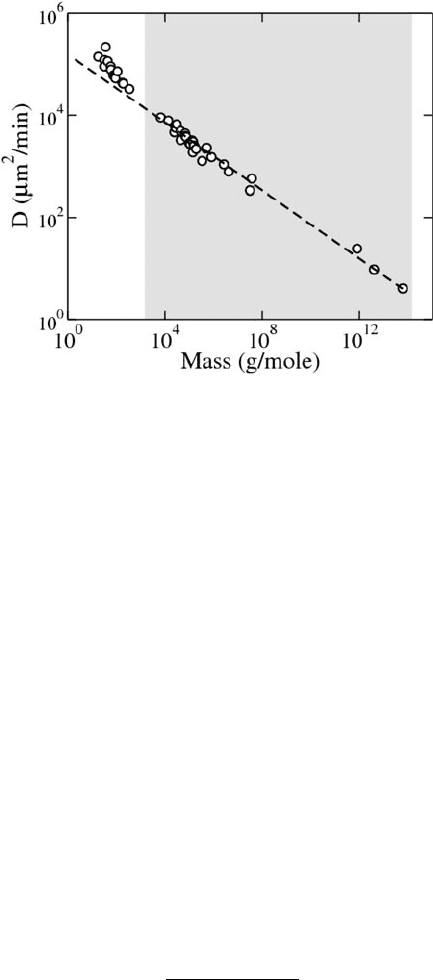
In Table 16.1, I collect some values of D for large molecules and cells taken from
[4]. In Fig. 16.1, I show that the agreement with (16.5) is remarkable (at least in the
shaded region).
However, for a dendritic cell with a typical size of 20 m, (16.4)givesD
DC
'
1m
2
min
1
and for a T cell, D
T
' 4m
2
min
1
. Those values are not close to
the values reported from the experiments [5], where D
T
' 50 100 m
2
min
1
.
Indeed this discrepancy must have a biological explanation. Two choices appear
naturally at those scales: the T cell is either advected (chemotaxis) to specific targets
or the diffusion theory must be refined. For instance, many bacteria diffuse randomly
but with some persistence in their motion.
If T cells respond to external signalling (e.g., chemokine gradients), the motion
would be less random and more directed. In addition, one would expect higher cell
velocities and, as a side effect, collective motion towards the source of chemokines

344 M. Castro
Table 16.1 Diffusivities of some molecules and cells. Adapted from [4]
M(gmole
1
) D(m
2
min
1
)Name M(gmole
1
) D(m
2
min
1
)Name
18 139,200 H
2
0 43,500 4,860 Ovalbumin
32 120,000 O
2
68,000 4,380 Hemogoblin
32 90,000 Methanol 68,430 3,900 Serum
36.5 216,000 HCl 74,000 3,720 Transferrin
44 114,000 CO
2
98,630 2,820 Gonadotropin
58.5 90,000 NaCl 109,000 2,700 Collagenase
60 78,000 Urea 130,000 3,180 Actin
75 60,000 Glycine 140,000 1,860 Plasminogen
89 57,000 ˛-alanine 143,000 3,000 Ceruloplasmin
89 58,200 ˇ-alanine 153,100 2,520 -globulin
92 52,800 Glycerol 158,500 2,520 immunoglobulin
111 72,000 CaCl
2
190,000 2,160 Glucose
180 42,600 Glucose 339,700 1,260 Fibrinogen
182 42,600 Mannitol 482,700 2,220 Urease
192 41,400 Citric 529,800 2,280 Cytochrome
342 32,400 Sucrose 820,000 1,500 ˛-macroglobulin
6,660 9,000 Milk 2,663,000 1,080 ˇ-lipoprotein
13,683 7,800 Ribonuclease 4,200,000 780 ribosome
24,430 4,620 Insulin 31,340,000 336 Tobacco
27,100 5,640 Somatotropin 8e C11 24.6 1 m nanodevice
30,640 6,600 Carbonic 4e C12 9.6 Platelet
44,070 3,240 Plasma 6e C13 4.1 Red blood cell
(because the signalling would be shared by many similar cells). Let us revise recent
evidence that supports this idea. In [5, 6], the authors showed that B and T cells
migrate as autonomous agents and there is no trace of collective motion that sup-
port the chemokine hypothesis. Paradoxically, they also report travelling persistence
times of 1–2 min (see also [7,8]).
What about the second choice? If pure diffusion is considered, persistent motion
is sustained with velocities of the order of D=R. For a T cell (using the experimental
D
T
75 m
2
min
1
and R 3:5 m) v 20 mmin
1
. This velocity means that
the persistence time is on the order of 1–2 s. So we need to consider persistence in
the description of the random motion. One simple approach is to assume that the
changes in the velocity of the cell are at an angle, , randomly chose from a given
distribution, P./ . In this case the diffusivity is corrected by:
Q
D
T
D
D
T
1 ˛
; (16.6)
where ˛ is mean value of the cosine of the angle between successive runs [9]. If the
distribution of successive angles is completely random ˛ D 0. If it is peaked at 0
(ballistic motion instead of diffusive motion), ˛ ! 1.
16 A Physicist’s Approach to Immunology 345
Fig. 16.1 Log–log plot of the diffusivity and the mass (data taken from Table 16.1). The dashed
straight line is a fit to D M
1=3
.Theshaded region is a visual help to identify where the scaling
law (16.5) is valid
At this point, we need to support or discard the hypothesis made through the
experiments. In summary,
1. There is a discrepancybetween the theoretical 4m
2
min
1
and the experimental
50–100m
2
min
1
diffusivities.
2. Persistence may be an essential ingredient behind pure diffusion.
Again, in [5] it is reported that the distribution of successive angles is not at
all random and that the cells can reach velocities about 25 mmin
1
, in good
agreement with our rough arguments. Moreover, agent based modelling [8]ofcell
diffusion with persistence produce excellent agreement with the experiments.
Biologically, this means that, in the short term, the cells are somehow directed
but at long times (distances) they seem to diffuse randomly. The quantitative separa-
tion between these scales deserves further experimental development. For instance,
chemokines could be introduced artificially in lymph nodes to change the variability
of, for instance, the parameter ˛. The heterogeneity if the lymph node needs also to
be taken into account as it can influence locally the value of the effective D.
Moreover, as shown in [1] the average time, , until first contact between the
lymphocyte and the antigen (or the dendritic cell), initially a distance R apart, is
given by:
D
R
3
3D
T
.R
T
C R
a
/
; (16.7)
where R
a
is the radius of the antigen. Thus, controlling D
T
can be an strategy to
control and consequently the mean response time of the adaptive immune system.
346 M. Castro
Another biological implication of this analysis is that T cells do not spend all
their available energy finding DCs or antigens. Thus, diffusion is an effective way
to explore (instead of self-propulsion, for instance). A simple energetic calculation
can illustrate this. The energy dissipated per unit time (power) by friction with its
surroundings is given by:
P D F
friction
V D 6RV
2
(W); (16.8)
where V is the mean velocity of the cell, R its size and the viscosity of the medium
(let us assume that it is mainly water). The order of magnitude of the latter quantity
is much smaller than the average power available per cell. This power can be roughly
estimated from the human metabolic rate (about 100 W) and its total number of cells
(about 10
14
)[10].
T Cell and Dendritic Cell Encounters
When a dendritic cell and a T cell meet, the latter scans the surface of the former in
the so called selection phase. Cells, unlike engineering devices, are not programmed
(in the common meaning of the expression) to localize a target. Instead, the process
is somehow driven by fluctuations (that’s why stochastic modelling is a promising
approach at this level of description, see Chap. 17). This scanning time can last from
a few minutes to hours [11]. This variability is due to the dynamics over the dendritic
cell surface.
Let us try to gain some insight in this number. If we assume that the T cell dif-
fusivity is D
T
D 75 m
2
min
1
, the average time for scanning without any kind
of binding is on the order of 1 h (assuming that the radius of a dendritic cell is
R
DC
D 20 m[5] and that its surface is 4R
2
DC
). If there were any kind of binding
between the T cell receptor and the pMHC complex (peptide-Major Histocompat-
ibility Complex) this time would be even larger. This suggest that the T cell do no
scan completely the surface of the dendritic cell or, alternatively, that the diffusiv-
ity of the T cell surrounding a dendritic cell is larger (an order of magnitude) than
moving freely. Notwithstanding, this second choice is less probable.
Then the conclusion is that the T cell do no scan completely the dendritic cell
in each encounter but, rather, it must do it in independent events. This speculation
seem to be supported by the experiments (see [12]).
Ligand–Receptor Dynamics
Ligand–receptor dynamics takes place at the level of the protein. As in other fields
in Biology, the structure and function of T cells depend crucially on the physical
interaction at the atomic level. Typical distances are about 2
ı
A and the energies

16 A Physicist’s Approach to Immunology 347
depend on the type of bond. For instance, covalent bonds are strong (on the order
of 80 kcal mol
1
). This strength guarantees that the proteins preserve their primary
structure. On the contrary, hydrogen bonds are about 1=20th of the energy of the co-
valent ones. Thus, translations, rotations, twisting and deformations are statistically
probable. The factor 1=20 is important because, at temperatures that are relevant for
life, a population of proteins will have enough energy to break that bond even in the
absence of a tensile forces.
Being more specific, I am interested in the binding process which, schematically,
can be written as
XY $ Z
The left and right reactions have independent rates k
on
and k
of f
. Traditionally, the
most important factor is the affinity
K D
k
on
k
of f
(M
1
): (16.9)
Thermodynamically, it depends on temperature and the so-called free-energy of as-
sociation through the relation
K D e
F =RT
; (16.10)
where R D 8:31 JK
1
mol
1
is the perfect gas constant.
The free energy F has both energetic and entropic contributions. The former
are related with the binding energies and the latter with the number of possible
configurations of the rotation, translation, vibration and conformation degrees of
freedom.
In addition,
F D E TS (16.11)
(if we consider that process is at constant pressure, F ! G D H TS,where
H D E C PV is the enthalpy).
Equation (16.10) is quite useful since it allows to calculate microscopic prop-
erties (E and S) from kinetic experiments and, in addition, it emphasized that
bond rupture is a stochastic event (16.10) can be seen as a probability of an event to
happen).
From the point of view adopted here the entropic term makes the estimation
rather complicated. Notwithstanding I shall adopt the same divide-and-conquer
strategy as before. The following steps are more involved so I will anticipate that
strategy.
1. The free energy difference F has two contributions. Binding energetic are on
the order of magnitude of 5 kcal mol
1
(typical of hydrogen bonds), so it is rea-
sonable to expect that energies are that of 1 or 2 bonds (typical of TCR-pMHC
binding). Thus E is the range Œ10; 0 kcal mol
1
(the negative sign is because
binding energies are negative).

348 M. Castro
2. Statistical Mechanics allows to calculate F in some ideal cases. Those cases
will help me to set upper bounds to entropic calculations under certain restrictive
assumptions.
3. Finally, using the latter estimations, I will provide some orders of magnitude of
variation of the affinity and, more importantly, emphasize the way in which this
particular problem should be addressed.
From an Statistical Mechanics perspective, when the pMHC and the TCR bind,
there are, apparently a loss of degrees of freedom related to the lack of relative
motion between them. Thus, a possible approach to estimate the free energy change
is consider what happens when the, for instance, pMHC goes from free to bound.
For simplicity, I will consider that it is a rigid molecule (and discuss the implications
of relaxing this assumption below).
All the statistical information is contained in the so-called partition function, Z.
The partition function is related to the free energy as:
F Dk
B
T log Z; (16.12)
where k
B
is the Boltzmann’s constant and T the temperature in Kelvin.
Thus, following any basic textbook in Statistical Mechanics we find that the par-
tition function of the translational degrees of freedom.
Z D
1
NŠh
3N
Z
dp
N
exp
jp
i
j
2
2mk
B
T
(16.13)
So it can deduced that the variation of the free energy is:
F Dk
B
T log
"
.2 mk
B
T=h
2
/
3=2
V
p
#
k
B
T (16.14)
The molecular weight of the TCR-pMHC can be on the order of 10
6
and the typical
length scales around 3 nm [13]so,atT D 310 K, F ' 6 kcal mol
1
. This is the
contribution of the translational degrees of freedom.
The rotational degrees of freedom can be computed provided that the principal
moments of inertia of the ligand are known. From our hand-waving perspective, we
can assume that each rotational mode carries the same change in the free energy than
the translational (because the moment of inertial approximately massdistance
2
and
the calculation of the partition function are the same).
So, I have found that, if the ligand–receptor complex is rigid, the total change in
the free energy is about
F ' 6 C3 6 D 24 kcalmol
1
:
Finally, from that value, S is in the range Œ110; 80 cal mol
1
K
1
.Thevalue
of F estimated from Statistical Mechanics is large compared to E so, at the
light of the experiments, we will be able to determine if its really so large or if it
16 A Physicist’s Approach to Immunology 349
is an overestimate. In the latter case it would mean that, despite the loss of trans-
lational and rotational degrees of freedom, new configurational degrees of freedom
are relevant (presumably vibrational). If that is the case, S could even take pos-
itive values, thus supporting the idea of the relevance of other degrees of freedom
that compensate the loss of translational and rotational mobility.
At this point the heuristic approach cannot be stressed further so experimental
data is need to test the assumptions made. In [14] some values of S are reported
and S ranges, typically, between 90 to 40 cal mol
1
K
1
.
In the most negative case, (S D90), the value calculated from the partition
function is in good agreement, but note that the agreement seems to break down in
general. As I mentioned above, this would indicate that the flexibility (as opposite
to rigidity) and the vibrational modes are key ingredients in the theory. In [14]some
other mechanisms are discussed but, again, the heuristic method of reasoning has
provided some hypotheses that are worth studying experimentally.
Conclusion
In this introductory chapter, the main message that I want to convey is that, far from
the useless reductionism of traditional Physics or the quest for universal laws in
Biology, Physics often address the problems by combining different tools: separa-
tion of scales (divide and conquer) and coarse-grained modelling. Here, I have only
illustrated the surface of this fruitful strategy with simple arguments.
The choice of problems in this chapter has been made to emphasize that the
underlying physical principles are valid at many different scales. Other simple argu-
ments such as scaling can be used to determine the connection between experiments
in mice and humans (see, for instance [1]and[15]).
So, Theoretical Biology models can be enriched with this knowledge: finding
mathematical relationships between biological quantities (for instance, differential
equations) is the main task of Theoretical Biology but, in many situations, those
relationships may be full of physical meaning.
Mathematics and Physics are already part of other disciplines of Biology, such
as Ecology or Neurology. In those fields, it is customary to include mathematical
concepts even in textbooks. Thus, Lotka–Volterra or Hodgkin–Huxley models co-
exist with biological descriptions. In the case of Immunology, it appears that this
symbiosis between fields is emerging. It is our hope in this book to establish roots
that could help the field evolve in that direction. Hopefully, in a few years we could
find some of the ideas, experiments and theories collected in the present book in
general textbooks of Immunology.
The naive approach presented here tries to exemplify the formulation of sim-
ple hypotheses and some basic methods to grant those hypotheses useful physical
meaning.
350 M. Castro
References
1. Wiegel FW, Perelson AS (2004) Some scaling principles for the immune system. Immunol
Cell Biol 82:127–131
2. Mason D (1998) A very high level of crossreactivity is an essential feature of the T-cell recep-
tor. Immunol Today 19:395–404
3. Einstein A (1956) Investigations on the theory of the Brownian movement. Dover, Mineola
4. Freitas RA (1999) Nanomedicine, vol I. Basic capabilities. Landes Bioscience
5. Miller MJ, Wei S, Cahalan M, Parker I (2003) Autonomous T cell trafficking examined in vivo
with intravital two-photon microscopy. Proc Natl Acad Sci USA 100:2604–2609
6. Miller MJ, Wei S, Parker I, Cahalan M (2002) Two-photon imaging of lymphocyte motility
and antigen response in intact lymph node. Science 296:1869
7. Beltman JB, Mar´ee AFM, Lynch JN, Miller MJ, de Boer RJ (2007) Lymph node topology
dictates T cell migration behavior. J Exp Med 204(4):771–780
8. Beltman JB, Mar´ee AFM, de Boer RJ (2007) Spatial modelling of brief and long interactions
between T cells and dendritic cells. Immunol Cell Biol 85:306–314
9. Berg HC (1993) Random walks in biology. Princeton University Press, Princeton
10. Purcell E (1977) Life at low Reynolds number. Am J Phys 45:11
11. Gunzer M, Schfer A, Borgmann S, Grabbe S, Znker KS, Brcker E, Kmpgen E, Friedl P (2000)
Antigen presentation in extracellular matrix: interactions of T cells with dendritic cells are
dynamic, short lived, and sequential. Immunity 13:323–332
12. Stoll S, Delon J, Brotz TM, Germain RN (2002) Dynamic imaging of T cell-dendritic cell
interactions in lymph nodes. Science 296:1873–1876
13. Murphy KM, Travers P, Walport M (2007) Janeway’s immunobiology (immunobiology:
the immune system (Janeway)), 7th edn. Garland Science
14. Sturtevant J (1977) Heat capacity and entropy changes in processes involving proteins. Proc
Natl Acad Sci USA 74:2236–2240
15. Borghans JA, Noest AJ, de Boer RJ (1999) How specific should immunological memory be? J
Immunol 163:569–575

Chapter 17
Timescales of the Adaptive Immune Response
Mark Day and Grant Lythe
Abstract We discuss continuum (lattice-free) and inherently stochastic models
of immune cellular interactions, using the simplest hypothesis, that cells follow
Brownian paths. The timescale for a cell to explore a volume such as a lymph node is
L
2
=D,whereL is the radius of the region andD the diffusivity of a cell. The average
time a cell spends in a volume with an exit is proportional to L
3
=aD,wherea is the
radius of the exit. The mean time before a cell encounters a zone of attraction with
radius b around, for example, an antigen presenting cell, is proportional to L
3
=bD.
Introduction
Interactions between T lymphocytes and antigen-presenting cells (APCs) in lymph
nodes are an essential step in the initiation of cell-mediated immune responses.
T cells need to come into physical contact with APCs [1, 2]. In fact, the antigen-
specific T cell can become activated only if it encounters an APC bearing cognate
antigen in the midst of millions of unspecific lymphoid cells [3].
In the twenty-first century, observation of cell–cell contacts and cell migration
in lymphoid tissues has become possible in vivo, with the technique of intravital
two-photon microscopy [4–10]. Pioneering in vivo studies have raised a new set of
questions, relating to cell–cell dynamics in secondary lymphoid organs and to the
data sets produced in imaging experiments [11,12]. What happens during the day or
days that a T cell spends in a lymph node? What is the role of the reticular network
in the movement of T cells? How do T cells collect and integrate signals from
cognate antigen? Is a long (hours) contact with a Dendritic Cell (DC) necessary
for activation, or is a series of short-lived (minutes) encounters sufficient [13]?
To what extent do molecular mechanisms (amount and quality of peptide–MHC
ligands) govern the length of time spent in contact? What are the roles of adhesion
G. Lythe (
)
Department of Applied Mathematics, University of Leeds, LS29JT, UK
e-mail: grant@maths.leeds.ac.uk
C. Molina-Par´ıs and G. Lythe (eds.), Mathematical Models and Immune Cell Biology,
DOI 10.1007/978-1-4419-7725-0
17,
c
Springer Science+Business Media, LLC 2011
351
352 M. Day and G. Lythe
molecules, co-stimulatory molecules and strength of affinity? Does clustering of
T cells play a role in mounting an immune response? What controls differentiation
into effector and memory cells? In the case of infection, what strategies can be used
to maximise the time that lymphocytes spend in the particular lymph node draining
the currently infected site? What is the role of inflammation [14] and expansion of
the vascular input?
We will think of a lymphocyte as a particle undergoing Brownian motion inside
a lymph node. Brownian motion is imagined here as the result of many constantly-
changing influences that jostle the cell, without any consistently preferred direction.
It can be expected, from the central limit theorem, to be a quantitatively correct
description of T cell movement on some timescales, and most analyses of in vivo cell
movement data seem to support this [4]. However, there are reasons to suspect that
other descriptions may be needed, on short timescales (less than a minute in a lymph
node) and perhaps on longer timescales, if phenomena such as microstreaming [15]
and a preference for moving along the stromal network [16] are widespread. Even
so, the end result will still appear to be Brownian motion if the stromal network or
microstreams are themselves randomly-oriented [17].
The purpose of this chapter is to calculate timescales from the simple hypothesis
that T cells move, and may encounter APCs, along Brownian paths. By not attempt-
ing to explicitly model the crowded environment of a lymph node, timescales are
expressed in terms of very few parameters: the diffusivity of a cell, the size of the
volume that the cell explores, and the radii of the efferent vessel (or other exit) and
of the zone of attraction of an APC.
Brownian Motion
Each of the Cartesian components of a Brownian motion in three dimensions is
independent. We use x to represent a position in three-dimensional space, and r
its distance from the point .0;0;0/. If the position at time t of a cell undergoing
Brownian motion is denoted by B
t
, and if there is no preferred direction and there
are no boundaries or barriers, the probability density function of B
t
is
P
.n/
.x; t/ D .4Dt/
3=2
exp
r
2
=4Dt
:
The parameter D is the diffusivity.
The total distance travelled in a time t is X
t
DjB
t
j (Fig. 17.1). This is a random
variable with probability density, .r/ D
d
dr
PŒX
t
<r,givenby
.r/ D
r
2
2
p
.Dt/
3=2
e
r
2
=4Dt
: