
Molina-Par?s C., Lythe G. (editors) Mathematical Models and Immune Cell Biology
Подождите немного. Документ загружается.


Chapter 19
Viral Immunity and Persistence
Stephen Hickling and Rodney Phillips
Abstract Viruses survive and propagate in human populations, despite the
anti-viral immune response. Viruses have developed two principal mechanisms
in order to persist within populations. Some viruses, such as measles, are highly
infectious and quickly spread through susceptible populations. However measles is
rapidly cleared by the immune response. In contrast other less transmissible viruses
such as Epstein-Barr Virus (EBV) have developed a strategy of persisting within a
population by subverting or escaping from the host immune response.
The immune response has a number of defensive layers, which inhibit viral repli-
cation. The innate response is non-specific and mediated by cytokines that prevent
the spread of virus through tissues and promote the initiation of highly specific
adaptive immune responses. The adaptive response consists of antibodies, which
bind and neutralise free virus, and CD8
C
T cells that identify virally infected cells
and eradicate them.
Different immune mechanisms can by evaded by viruses. Cytokines can be in-
hibited either through preventing cytokine expression or reducing cytokine potency
through the production of viroreceptors. Additionally, immune evasion can occur
through antigenic variation. The adaptive immune response may cope with anti-
genic variation but some variability can defy the capacity of the response. Human
Immunodeficiency Virus (HIV) escapes adaptive immune responses by generating
antigens unrecognizable by CD8
C
T cell and antibody responses.
The interaction between the virus and host is a constant evolutionary struggle,
which imposes forces that drive out adapted viruses. The ability of viruses to adapt
allows them to persist and propagate within different populations.
Viruses are obligate intracellular parasites that hijack the infected cell machinery
in order to replicate and be transmitted. The balance between the pathogenicity of a
virus infection and its resolution by the immune response shapes viral survival strat-
egy. It is not to the viruses’ advantage to be highly pathogenic, as rapidly killing the
R. Phillips (
)
Peter Medawar Building for Pathogen Research, University of Oxford, South Parks Road,
Oxford OX1 3SY, UK
e-mail: rodney.phillips@ndm.ox.ac.uk
C. Molina-Par´ıs and G. Lythe (eds.), Mathematical Models and Immune Cell Biology,
DOI 10.1007/978-1-4419-7725-0
19,
c
Springer Science+Business Media, LLC 2011
383
384 S. Hickling and R. Phillips
host would prevent transmission and survival within a population. However, the
virus needs to be sufficiently pathogenic in order to replicate and be transmitted in
a population, so a balance needs to be achieved. Consequently viruses have evolved
two principal strategies for promoting their survival within a population, which can
acquire immunity. Some viruses such as Morbilivirus (Measles) have a survival
strategy described as hit and run [1]. They are able to infect a large number of
potential hosts before being resolved by the immune response [2,3]. However, other
viruses have evolved the alternative strategy of persistence. These viruses such as
the Herpes viruses have low transmissibility but are generally poorly resolved by the
immune response. This tactic allows them to persist within a population. Countering
viral proliferation is the host immune response. The antiviral immune response con-
sists of both innate and adaptive immune responses. In terms of antiviral immunity
the innate response refers to the action of cytokines and natural killer cells (NK).
The adaptive immune response to viruses includes the production of specific antivi-
ral antibodies by B cells and the CD8
C
T lymphocyte response, which eliminate
virally infected cells.
Immunological Mechanisms in Antiviral Responses
The innate immune response to viral infection is mediated through the action of cy-
tokines. Cells of the innate immune response, such as macrophage and monocytes,
produce a range of antiviral cytokines. The most important being Interleukin-1, -2,
Tumour Necrosis Factor (TNF), Interferon (IFN)-˛ˇ and [4–6]. The action of
these cytokines can promote an antiviral state in bystander cells, inducing the
expression of proteins that destroy viral genomes and inhibit replication [6–8].
Cytokines such as IFN can also upregulate the surface expression of Major His-
tocompatibility Complex molecules (MHC) – termed Human leukocyte antigens
(HLA) in humans [9].
The innate immune response also comprises NK cells. These cells are able to kill
virally infected cells. NK cells act by killing targets that lack HLA molecules which
act as the inhibitor self signal [10]. This is important for viral infections that attempt
to subvert the CD8
C
T cell response by downregulation of HLA class I molecules.
Adaptive Immune Responses
The adaptive immune response, unlike the innate response, is highly specific. The
production of antibody by B cells is an important effector of the adaptive im-
mune response [11, 12]. Specific antibody can bind to viral surface glycoproteins
or viral capsids [11]. Antibody binding can promote viral destruction either by an-
tibody dependent cell mediated cytotoxicity or induction of phagocytosis [11,12].
Additionally, antibody binding can inhibit viral entry by physically blocking viral
receptors binding to complementary receptors [12].
19 Viral Immunity and Persistence 385
The role of antiviral antibody is crucial for protection from a particular virus
upon repeated exposure, such as measles [2, 3]. The importance of the protective
effect of antibody is highlighted by the fact that all successful viral vaccinations
induce protective antibody responses. In addition to antibody, CD8
C
T lympho-
cytes are crucial to the adaptive antiviral immune response. CD8
C
T lymphocytes
are able to kill cells infected with viruses. CD8
C
T cells recognise virally infected
cells because HLA Class I molecules display viral peptide antigens on the cell
surface [13]. Class I HLA molecules are found on the surface of all nucleated
cells. The CD8
C
T lymphocyte recognises this epitope/HLA complex through its
unique T Cell Receptor (TCR) [14, 15]. This interaction can result in CD8
C
T cell
activation. Activated CD8
C
T lymphocytes are able to kill the target cell (express-
ing the Class I HLA with viral epitope) and are termed Cytotoxic T lymphocytes
(CTL) [13].
The CTL response is crucial for protection from viral infections, highlighted by
individuals with Severe Combined Immunodeficiency disease and DiGeorges syn-
drome who lack CTL. These individuals are extremely susceptible to viral infections
which are non-pathogenic in healthy people (reviewed in [16]).
HLA Class 1 Molecules and the Presentation of Viral Epitopes
to the Adaptive Immune Response
Structure of the HLA Molecules
The critical role that Class I murine MHC molecules play in the presentation of en-
dogenous, nonself peptides was first identified in 1982 [13]. At this time it became
clear that Class I molecules present only short fragments of peptides, termed epi-
topes, to CD8
C
T lymphocytes. This was later confirmed in 1987 when the crystal
structure of HLA Class I molecules was resolved [17].
HLA molecules are encoded within the highly polymorphic major histocompata-
bility complex loci, located in chromosome 6p. This complex spans over 3.6 Mbp
and contains approximately 118 genes. In addition to HLA Class I, the MHC also
encodes Class II HLA molecules as well as a number of cytokines and elements of
the innate immune system.
Since the initial discovery of HLA Class I molecules it became evident that there
is huge diversity in HLA Class I molecules, with 702 alleles identified to date. These
alleles can be further divided into HLA Class IA, IB and IC isotypes. Each individ-
ual has the potential to express up to two different HLA molecules of each isotype,
six in total. It is thought that most CTL are reactive against peptides presented on
HLA-A and B molecules.
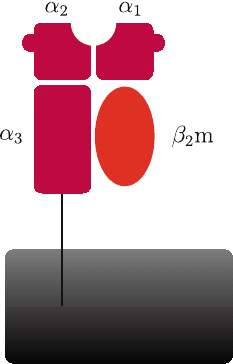
The HLA Class I molecule is a non-covalently linked trimer (Fig. 19.1). The
trimer consists of the polymorphic heavy chain (encoded in the MHC), ˇ
2
mi-
croglobulin (ˇ
2
m) and the bound epitope [17]. The heavy chain consists of three
386 S. Hickling and R. Phillips
Fig. 19.1 Structure of HLA class 1 molecule. The HLA heavy chain is shown in purple (˛
1
, ˛
2
and
˛
3
domains). The Heavy chain forms a binding groove, where the specific peptide binds, between
the 1 and 2 domains. The Heavy chain/peptide complex is associated with 2 microglobulin (ˇ
2
m),
shown in red
domains ˛
1
, ˛
2
and ˛
3
with a molecular weight of approximately 43 kDa. The ˛
3
domain spans the cell membrane [17]. The ˛
1
and ˛
2
domains form eight ˇ-pleated
sheets, upon which sit two anti-parallel ˛ helices [17]. This structure forms a plat-
form with a groove, within which the epitope sits [17, 18]. It is the ˛
2
and ˛
3
domains that form this structure which have highly polymorphic regions, allowing
a greater range of peptides to bind the groove [18].
The structure of the groove places biochemical restrictions on the peptides that
can stably bind. The groove can only accommodate peptide between 8 and 12 amino
acids in length [18]. The peptide and HLA groove interact through the formation of
hydrogen bonds at both the N- and C-terminals. The residues in the peptide that
form the hydrogen bonds are termed anchor residues.
These anchor residues are determined by the amino acids found both in the ˇ-
pleated sheets and ˛ helices of the HLA molecule. The amino acid sequence in the
rest of the bound peptide interact with the groove, however there is much greater
flexibility in these amino acid sequences [17,18].
HLA Class I Antigen Presentation
Presentation of peptides on HLA Class I molecules is crucial for an effective im-
mune response. The cellular process for the production and presentation of optimal
peptides is a highly orchestrated process, which can be broadly divided into peptide
cleavage and HLA loading and surface expression (Fig. 19.2).
19 Viral Immunity and Persistence 387
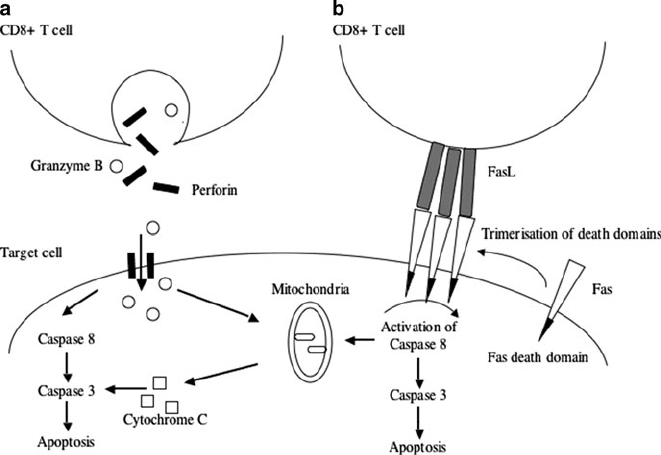
Fig. 19.2 Mechanisms of CD8
C
T cell killing. (a) Schematic showing the granzyme exocytosis
model of killing. Granzyme B enters the target cell by perforin. Granzyme triggers the pro-
apoptotic caspase cascade in the target cell. (b) Schematic depicts receptor mediated target cell
death. Engagement of receptors containing death domains (such as Fas) with the appropriate lig-
and on the CTL causes trimerisation of death domains, which triggers the pro-apoptotic caspase
cascade
The majority of peptides loaded into HLA Class I molecules are derived from
the cytoplasm including self-peptides [20]. In non-infected cells, proteins are con-
stitutively cleaved into peptide fragments by the cylindrical proteasome, also called
the 20S or core particle proteasome [21]. The 20S proteasome cleaves proteins into
oligo-peptides between 3 and 15 amino acids in length [22]. The proteasome’s cylin-
drical shape is formed from two ˛ rings, between which are two ˇ rings [21, 23].
Each ring is composed of either seven ˛ or seven ˇ subunits [23]. The ˇ1,ˇ2 and ˇ5
subunits of the 20S proteasome have peptidylglutamyl, trypsin and chymotrypsin
activities, which primarily act at the C terminus of the peptide [24, 25]. The re-
maining ˇ subunits are N-terminal acting threonine proteases [25]. The ˛ rings
are thought to control the entry of peptides into the catalytic ˇ rings, with poly-
ubiquitinated peptides being preferentially cleaved [21].
Under the influence of IFN, the 20S proteasome is modulated by the addition of
19S subunits, which can bind to either one, or both ends of the 20S proteasome [21].
IFN also upregulates the expression of other catalytic subunits, LMP2, LMP7 and
MECL-1 [26, 27]. These subunits are incorporated into the ˇ rings, replacing the
ˇ1, ˇ2 and ˇ5 subunits. This IFN induced complex forms the 26S immunopro-
teasomes. The modified ˇ subunits alter the peptide cleavage specificity of the
immunoproteasome [26, 27]. The trypsin and chymotrpsin activity is increased at
388 S. Hickling and R. Phillips
the carboxy side of basic and hydrophobic residues while caspase activity at acidic
residues is reduced. This consequently causes the immunoproteasome to produce
longer peptides, which have more hydrophobic and basic residues at the Carboxy
termini [26,27]. Residues with these biochemical characteristics tend to have higher
binding affinity for HLA Class I molecules [17, 28]. Since basic and hydrophobic
residues are more likely to form anchor residues.
Peptides produced by the immunoproteasome are transported into the Endoplas-
mic Reticulum (ER) [29]. The ER is where newly synthesised HLA Class I heavy
chains are located. Peptides are actively transported into the ER via the Trans-
porter Associated with Antigen presentation (TAP) [29]. TAP is a transmembrane
heterodimer, encoded in the MHC [30] which preferentially transports basic and
hydrophobicpeptides into the ER lumen [30,31]. In the ER peptides are further opti-
mized at the N-terminus by ER amino-peptidase (ERAAP) [32,33]. ERAAP cleaves
peptides of different lengths at different rates. 10mers are cleaved at higher rate then
9mers and little activity is directed against 8mers. This hierarchy of ERAAP activity
increases the production of optimal peptides for HLA Class I loading [34,35].
TAP is also a crucial component in the peptide loading complex (PLC) [36]. The
PLC allows HLA Class I heavy chains to maintain structural conformation before
peptide loading [36]. The complex comprises TAP, unloaded Class I Heavy chain
associated with ˇ
2
m and the molecular chaperone tapasin [37]. This complex is al-
ways found with the same stoichiometry of 1 TAP: 4 tapasin: 4 heavy chains [38].
Binding of the optimal peptides to the PLC confers conformational change, re-
leasing the Class I trimer complex from the PLC. This release consequently allow
trafficking of peptide loaded Class I HLA molecules to the cell surface, to be sam-
pled by patrolling CD8
C
T lymphocytes [39].
Activation of CD8
C
T Lymphocytes and Killing of Virally
Infected Cells
Interaction of MHC Class 1 and the TCR
Loaded HLA Class I molecules expressed on the cell surface are sampled by CD8
C
T lymphocytes. The CD8
C
T lymphocyte TCR transiently binds the surface of HLA
Class I molecules, contacting both the ˛
2
and ˛
3
domains and the epitope [14,15].
When a particular TCR encounters its complementary HLA Class I-epitope com-
plex, CD8
C
T lymphocyte activation can occur (Fig.19.3).
Despite TCR engagement, TCRs lack the ability to initiate intracellular sig-
nalling. To overcome this TCRs are non-covalently associated with the trans-
membrane CD3 complex [40]. The CD3 complex is composed of single and ı
sub-units in addition to two and two subunits [40, 41](Fig.19.4). Each CD3
associates with two TCR dimers [40]. Consequently the overall structure of the com-
19 Viral Immunity and Persistence 389
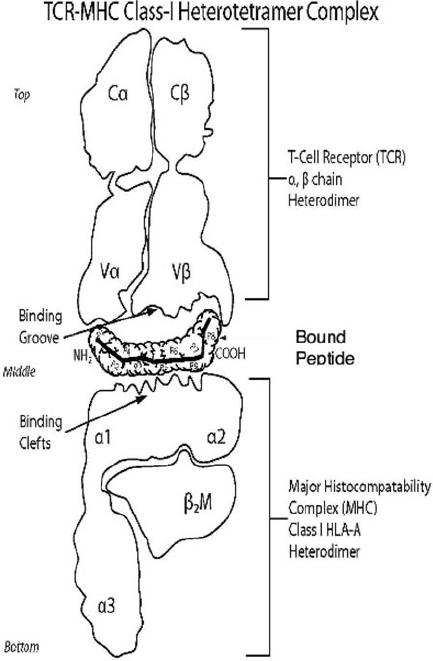
Fig. 19.3 The CD8
C
T cell interacts with the HLA class I molecule through its T cell receptor
(TCR). The TCR binding groove, formed by the V˛ and Vˇ chains of the TCR, contact the surface
of the HLA/peptide molecule. The TCR contacts the HLA heavy chain ˛
1
, ˛
2
and the presented
peptide. (Picture taken and modified from: Atlas of Genetics and cytogenetics Atlasgeneticsoncol-
ogy.org/Deep/mapping Author Gerald. J. Mizejewski)
plex is TCR
2
CD3ı
2
2
[42]. The cytoplasmic domains of CD3 subunits contain
immuno-receptor tyrosine based motifs (ITAMS). These ITAMS can phosphorylate
intracellular kinases, which facilitate intracellular signalling [43,44].
The TCR–HLA interaction alone however is not sufficient to activate CD8
C
T lymphocytes. A substantial number of other receptors, termed co-receptors, are
also involved; CD8 itself is involved in amplifying the signal [45]. The CD8 co-
stimulatory molecule localizes to the engaged TCR and amplifies CD8
C
T cell acti-
vation [46]. This occurs through CD8 binding in an epitope independent manner to
the ˛
3
domain of the HLA Class I molecule so prolonging cell engagement [45,46].
The degree that the CD8 interaction influences activation is thought to be a func-
tion of the affinity of the TCR for the HLA-epitope complex [47, 48]. TCR/HLA
390 S. Hickling and R. Phillips
ζζ
δγ
αβ
TCR
CD3 CD3
ITAMs
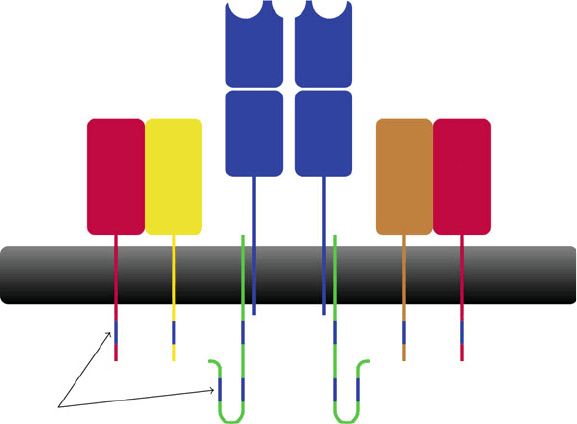
Fig. 19.4 The TCR complexes with CD3, that comprises of single and sub-units in addition to two
and two subunits. The overall structure of the complex is TCR
2
CD3ı
2
2
. The cytoplasmic
domains of CD3 subunits contain immuno-receptor tyrosine based motifs (ITAMS) which facilitate
intracellular signalling
and co-receptor engagement leads to surface protein rearrangement [49]. HLA
molecules and co-receptors tend to be polarized to the point of initial HLA/TCR
engagement [49, 50]. This leads to multiple HLA/TCR engagements. These multi-
ple interactions form an immunological synapse, bringing the CD8
C
T lymphocyte
and the target cell membranes into close contact [49,50]. Multiple molecular inter-
actions promote CD8
C
T cell activation [51].
Mechanisms of CTL Killing
Once activated, CD8
C
T lymphocytes have cytotoxic capability and are conse-
quently termed cytotoxic T Lymphocytes (CTL). Both CTL and NK cells employ
a number of different mechanisms in order to destroy virally infected cells. Cy-
totoxicity is mediated by direct cellular interactions such as granule exocytosis or
engagement of death domains [52,53]. All these mechanisms direct target killing by
inducing cellular apoptosis.
Apoptosis is an energy dependent, highly ordered process of cell death. Apopto-
sis causes cells to detach from the local environment, condense and lose membrane
integrity. Apoptosis is orchestrated by a subset of proteases called caspases [54].
19 Viral Immunity and Persistence 391
Caspases cleave substrates at C-terminal aspartate residues, and disrupt intracellu-
lar structure and DNA integrity [54]. This highly controlled process limits cell death
to the target. This is in contrast to necrosis, which results in uncontrolled cellular
damage resulting in inflammation (reviewed in [55]).
Granule Mediate Cytotoxicity
CTL contain granules containing effector molecules that can induce apoptosis to
the target cells. The most important of these are perforin and granzyme B, members
of the caspase family [56]. When CTL interact with target cells the lytic granules
are polarized towards the contact point with the target [57]. This led to the granule
exocytosis model of CTL-induced killing, which postulates that the CTL exocytose
perforin and granzyme B into the cleft between the T cell membrane and the tar-
get cell. It was originally hypothesised that perforin monomers polymerise in the
target cell membrane in the presence of Ca
2C
[58–60]. This results in the forma-
tion of transmembrane pores in the target, allowing activated granzyme B to enter
the target cell cytoplasm [61]. However, in perforin deficient mice, CTL can still
kill target cells via granzyme B [62]. This, along with other observations, has led
to the hypothesis that granzyme B can be internalised into target cells by recep-
tor mediated endocytosis, with perforin playing a role in granzyme B release from
vesicles [63, 64].
Granzyme B cleaves procaspase-3 and procaspase-8 [65,66]. Both these procas-
pases require cleavage for activation, and form part of the caspase cascade which
induce apoptosis. However, granzyme B can also induce apoptosis in a caspase in-
dependent manner [67]. Granzyme B signals through the mitochondria, disrupting
energy metabolism resulting in the release of cytochrome c, a pro-apoptotic pro-
tein [67].
Although granzyme B is the main effector molecule for the induction of apop-
tosis other granzymes (A–H) and serine esterases are also released into the cell
cytoplasm. These effector molecules are also members of the caspase family and
help to induce apoptosis though cleavage of their molecular targets [67, 68].
Signalling Induced Apoptosis
In addition to the granule exocytosis model of cyotoxicity, it has been shown that
CTL can kill targets independently of granzyme B, by receptor mediated cytotox-
icity [52, 53]. This mechanism of cytotoxicity is principally used in lymphocyte
selection, but has recently been associated with auto-immunity [69].
CTL kill through the CD95 (Fas) pathway [52]. Fas is a member of the tumour-
necrosis factor receptor family of death receptors [70, 71]. Fas is expressed on the
surface of many cell types; however, Fas ligand (FasL) is only expressed on the
392 S. Hickling and R. Phillips
surface of activated CTL [52]. Ligation of Fas by FasL causes trimerization of Fas
on the cell surface. Each Fas molecule has an intracellular death domain, which
recruits and activates caspase 8, inducing the caspase signalling cascade [71].
Viral Persistence and Subversion of the Immune Response
Viral Subversion of the Immune System
The coexistence of the viral pathogen and the host is an extremely fine balance. The
virus needs a large enough host population in order to survive and propagate, so
rapidly killing the host is not a successful evolutionary strategy. Viruses with low
transmission rates tend to be poorly resolved by the immune response. Thee viruses
persist within hosts in order to survive. In order to do this viruses have developed
strategies, which can interfere with the immune response designed to eliminate it.
Interference occurs against both the innate and the adaptive responses.
Subversion of Cytokine Action
Cytokines are critical for immune signalling and promoting immunological re-
sponses. Consequently, viruses have evolved a varied number of strategies to either
inhibit cytokine production or prevent their action [66]. The most common cytokines
targeted are inevitably the cytokines with the most potent antiviral effects. These in-
clude Interleukin (IL)-1, -2, Tumour necrosis factor (TNF), Interferon (IFN)-˛-ˇ
and [4,6,8].
IFN signalling causes the induction and expression of a number of genes,
termed IFN stimulated genes (ISG). This occurs through IFN regulatory factor 3
(IRF-3), that translocates to the nucleus and binds the transcription co-activator
CBP [72]. The Adenovirus E1A protein binds to and inhibits the IRF–CBP inter-
action preventing ISG expression [72]. Hepatitis B employs a similar strategy with
the terminal protein inhibiting the IRF–CBP interaction [73].
In addition to reducing the production of cytokines, a number of other viruses
prevent their action. One mechanism, employed by the Pox family of viruses, is the
secretion of viroreceptors [74]. Viroreceptors can mimic the receptor for a given
cytokine and have potent cytokine binding capability [74]. The myxoma virus vi-
roreceptor, M-T2, and cowpox virus crmB both mimic the TNF receptor [75, 76].
Viroreceptors compete with and sequester secreted TNF [75]. This consequently
reduces the influence of TNF. Other viroreceptors, such as MT-7 produced by myx-
oma are thought to be promiscuous for a number of cytokines including IFN,IL2
and IL5 [77, 78].