
Muga G. Time in Quantum Mechanics - Vol. 2
Подождите немного. Документ загружается.


112 J. Mu
˜
noz et al.
5.5.1 The Harmonic Oscillator and Systems with Bound States
If we were to try the direct application of definition (5.1) to the case of the harmonic
oscillator we would soon run into trouble due to divergent integrals. A natural option
is to restrict the total time to one period of the system, as follows:
.
T
D
=
T/2
−T/2
dτ e
i
.
Hτ/
χ
D
(.x)e
−i
.
Hτ/
, (5.47)
where the Hamiltonian is .p
2
/2m + mω
2
.x
2
/2 and T = 2π/ω. We can thus write
the dwell-time operator, restricted to one period, as
.
T
D
= T
∞
n=0
"
n
χ
D
(.x)
n
|
n
n
|
. (5.48)
The eigenvalues, T
"
n
χ
D
(.x)
n
, can be understood as the period times the propor-
tion of that period spent by the particle in the stationary state in the region D.This
suggests an alternative useful quantity for systems whose Hamiltonian has a purely
point spectrum. Define
.τ
D
= lim
T →∞
1
T
T/2
−T/2
dτ e
i
.
Hτ/
χ
D
(.x)e
−i
.
Hτ/
. (5.49)
Let the Hamiltonian be given by
.
H =
n,α
E
n
|
E
n
,α
E
n
,α
|
, (5.50)
with α a degeneracy index. Then it is easy to compute
.τ
D
=
n,α,β
|
E
n
,α
E
n
,α
|
χ
D
(.x)
|
E
n
,β
E
n
,β
|
, (5.51)
that is to say, the operator that gives us the fraction of time spent in region D is
diagonal in the energy basis, up to degeneracy in energy.
5.5.2 Times of Residence
The construction above suggests an extension to the time of residence, which is an
analog of the dwell time valid for systems in which the concept of a region in space
is not applicable. The question we now purport to answer is the following one: how
much time has a system spent in a state
|
ψ
? Or, alternatively, from time 0 to T , what
is the proportion of time the system has spent in that state? Let then the projector

5 Dwell-Time Distributions in Quantum Mechanics 113
associated with the state
|
ψ
be denoted by P and the unitary evolution operator by
U(t). We define the time-of-residence operator as
.τ
ψ
(0; T) =
T
0
dtU
†
(t)PU(t) . (5.52)
For example [45], consider a two-level system with Hamiltonian
.
H =
2
0 Ω
Ω 0
(5.53)
and the state
|
ψ
=
1
0
. The time of residence gets written as
.τ
ψ
(0; T) =
⎛
⎝
T
2
+
1
2Ω
sin
(
ΩT
)
−i
2Ω
(
1 − cos
(
ΩT
))
i
2Ω
(
1 − cos
(
ΩT
))
T
2
−
1
2Ω
sin
(
ΩT
)
⎞
⎠
. (5.54)
This entails that the measurement of this quantity would inevitably lead to one of
the following two (eigen)values:
τ
±
=
T
2
±
sin
(
ΩT/2
)
Ω
. (5.55)
The fact that only two values can be obtained in each realization of the experiment,
and not a continuous distribution of time of presence in the state
|
ψ
=
1
0
, has
been attributed to a predictive character of the measurement involved, as opposed to
an observation that extends over time through the coupling with a weakly interacting
clocking system [45].
As a matter of fact, the average time spent by a particle prepared at instant 0 in
a generic state ranges from τ
−
to τ
+
for the eigenstate of P. Represent a generic
pure or mixed state ρ by a vector in or on the Bloch sphere, ρ = (1 +r ·σ )/2; then
the average time of residence in state
1
0
over the time interval [0, T ]isT/2 +
1
(1 − cos
(
ΩT
)
)r
y
+sin
(
ΩT
)
r
x
2
/2Ω, which, as stated, ranges over [τ
−
,τ
+
].
It should be noticed that the operator of time of residence from instant 0 to instant
T is generically not stationary; for the example at hand we have
1
.
H,.τ
ψ
(0; T)
2
=
i
2
1 − cos
(
ΩT
)
i sin
(
ΩT
)
−i sin
(
ΩT
)
−1 + cos
(
ΩT
)
. (5.56)
Notice that whenever T = 2nπ/Ω, with n a natural number, the corresponding time
of residence does indeed commute with the Hamiltonian; this is in keeping with the
expressions of Sect. 5.5.1.

114 J. Mu
˜
noz et al.
5.5.3 Multiparticle Systems
Definition (5.1) admits a straightforward extension to systems of many particles,
using the formalism of second quantization, in which we perform the substitution
χ
D
(.x) →.n
D
=
D
dx .a
†
x
.a
x
, (5.57)
where .a
x
is the annihilation operator at point x. For free particles, that is to say, for
a Hamiltonian of the form
.
H =
∞
−∞
dk
2
k
2
2m
.n
k
=
∞
−∞
dk
2
k
2
2m
.a
†
k
.a
k
, (5.58)
with .a
k
the operator that annihilates a particle with wavenumber k, we can compute
the dwell-time operator as
.
T
D
=
∞
−∞
dk
mL
|k|
.a
†
k
.a
k
+
1
kL
e
ikL
sin
(
kL
)
.a
†
−k
.a
k
. (5.59)
It is also feasible to write a dwell-time density operator, which for the free case
reads
.
Π
a
(t) =
∞
−∞
dk
1
2
1
δ
(
t −t
+
(k)
)
+δ
(
t −t
−
(k)
)
2
a
†
k
a
k
+
e
−ikL
2
1
δ
(
t −t
+
(k)
)
−δ
(
t −t
−
(k)
)
2
a
†
k
a
−k
. (5.60)
It is easy to see that ψ|
.
Π
a
(t)|ψ reduces to the dwell-time density for the one-
particle marginal wavefunction. The real multiparticle aspect of this construction
will only be accessible through dwell-time–dwell-time correlation functions, for
which a suitable operational interpretation needs to be built.
In addition, we note that for multiparticle systems, the alternative question might
be posed as what is the time during which a given number of particles n can be
found in the region D. This naturally leads to the introduction of the dwell-time
operator for n particles:
.
T
D
(n) =
∞
−∞
dt
.
U
†
(t)δ
.n
D
,n
.
U(t)
=
1
2π
∞
−∞
dt
2π
0
dθ
.
U
†
(t)e
iθ(.n
D
−n)
.
U(t) , (5.61)
where .n
D
is the density operator restricted to the region D, defined in Eq. (5.57).
Letting .ρ be the density matrix describing the state of the system, it is convenient to
introduce the characteristic function

5 Dwell-Time Distributions in Quantum Mechanics 115
F(θ; t) = Tr[.ρ
.
U
†
(t)e
iθ
ˆ
n
D
.
U(t)] , (5.62)
whose Fourier transform is the atom number distribution in the region D [21]:
P
D
(n, t) =
1
2π
2π
0
e
−inθ
F(θ; t)dθ, (5.63)
with n ∈ N. The meaning of P
D
(n, t) is precisely the probability for n particles to
be found in the spatial domain D at time t.
Knowledge of the atom number distribution can be used to compute the average
dwell time for different number of particles, namely
.
T
D
(n)=
∞
−∞
dtTr[.ρ(t)δ
.n
D
,n
] =
∞
−∞
dtP
D
(n, t) . (5.64)
5.6 Relation to Flux–Flux Correlation Functions
This section follows [35] and examines a link between the dwell time and flux–flux
correlation functions (ffcf) that have been considered mostly in chemical physics to
define reaction rates for microcanonical or canonical ensembles [24]. The motiva-
tion for this exercise is to relate the dwell-time distribution, and not just the average
value, to other observables.
5.6.1 Stationary Flux–Flux Correlation Function
Pollak and Miller [38] have shown a connection between the average stationary
dwell time and the first moment of an ffcf. They define a quantum microcanonical
ffcf C
PM
(τ,k) = Tr{Re
.
C
PM
(τ,k)} by means of the operator
.
C
PM
(τ,k) = 2π[
.
J(x
2
,τ)
.
J(x
1
, 0) +
.
J(x
1
,τ)
.
J(x
2
, 0)
−
.
J(x
1
,τ)
.
J(x
1
, 0) −
.
J(x
2
,τ)
.
J(x
2
, 0)]δ(E −
.
H) , (5.65)
where
.
J(x, t) = e
i
.
Ht/
1
2m
[.pδ(.x −x)+δ(.x −x).p]e
−i
.
Ht/
is the quantum mechanical
flux operator in the Heisenberg picture, and .p and .x are the momentum and position
operators.
This definition is motivated from classical mechanics: Eq. (5.65) counts flux cor-
relations of particles entering D through x
1
(x
2
) and leaving it through x
2
(x
1
) a time
τ later. Moreover, particles may be reflected and may leave the region D through
its entrance point. This is described by the last two terms, where the minus sign
compensates for the change of sign of a back-moving flux. Note that these negative
terms lead to a self-correlation contribution that diverges for τ → 0.
116 J. Mu
˜
noz et al.
We shall first derive the average correlation time and show its equivalence with
the average dwell time. We shall only consider positive incident momenta and define
.
C
+
PM
by substituting δ(E −
.
H)byδ
+
(E −
.
H):= δ(E −
.
H)Λ
+
, where Λ
+
is the
projector onto the subspace of eigenstates of H with positive momentum incidence.
By means of the continuity equation
−
d
dx
.
J(x, t) =
d
dt
.ρ(x, t) , (5.66)
where.ρ(x, t) = e
i
.
Ht/
δ(.x−x)e
−i
.
Ht/
is the (Heisenberg) density operator,
.
C
+
PM
(τ,k)
can be written as
.
C
+
PM
(τ,k) =−2π
d
dτ
.χ
D
(τ )
d
dt
.χ
D
(t)
t=0
δ
+
(E −
.
H) . (5.67)
By a partial integration and using the Heisenberg equation of motion, the first
moment of the Pollak–Miller correlation function is given by
Tr
∞
0
dττ
.
C
+
PM
(τ,k)
= Tr
2π
∞
0
dτ.χ
D
(τ )
1
i
[.χ
D
(0),
.
H]δ
+
(E −
.
H)
.
(5.68)
Boundary terms of the form lim
τ →∞
τ
γ
.χ
D
(τ ),γ = 0, 1, 2, are omitted here and
in the following. The contribution of these terms should vanish when an integration
over stationary wavefunctions is performed to account for the wavepacket dynamics,
as it is done explicitly in the next section. For potential scattering the probability
density decays generically as τ
−3
, which assures a finite dwell-time average, but for
free motion it decays as τ
−1
[32], making τ
D
infinite, unless the momentum wave
function vanishes at k = 0 sufficiently fast as k tends to 0 [11], as we have discussed
before.
Writing the commutator explicitly and using the cyclic property of the trace give
Tr
∞
0
dττ
.
C
+
PM
(τ,k)
= Tr
2π
∞
0
dτ
−
d
dτ
.χ
D
(τ )
.χ
D
(0)δ
+
(E −
.
H)
, (5.69)
and integration over τ yields the final result:
Tr
∞
0
dττ
.
C
+
PM
(τ,k)
= 2π Tr
.χ
D
(0)δ
+
(E −
.
H)
= T
kk
. (5.70)
Expressing the trace in the basis |φ
k
gives back the stationary dwell time of
Eq. (5.6), i.e., the diagonal element of the on-the-energy-shell dwell-time operator,
T
kk
.

5 Dwell-Time Distributions in Quantum Mechanics 117
The calculation of the average in [38] is different in some respects: (a) The coor-
dinates x
1
and x
2
are taken to minus and plus infinity, but it can be carried out for
finite values modifying Eq. (8) of [38] accordingly; (b) Formally there are no explicit
boundary terms at infinity but a regularization is required in Eq. (16) of [38], which
is justified for wave packets; (c) δ(E −
.
H) is used instead of δ
+
(E −
.
H). This
simply provides an additional contribution for negative momenta parallel to the one
obtained here for positive momenta; (d) In our derivation the average correlation
time is found to be real directly, even though
.
C
+
PM
(τ,k) is not self-adjoint, whereas
in [38] the real part is taken. (The discussion of the imaginary time average in [38]
is based on a modified version of Eq. (5.65).)
Next, we will show that the second moment of the Pollak–Miller ffcf equals the
second moment of T. This was not observed in Ref. [38]. Proceeding in a similar
way as above, we start with
I = Tr
∞
0
dττ
2
.
C
+
PM
(τ,k)
. (5.71)
Integrating by parts twice, neglecting the term at infinity, using Heisenberg’s equa-
tion of motion and the fact that φ
k
is an eigenstate of
.
H, the real part is
I + I
∗
2
=
2πm
k
∞
0
dτ φ
k
|[.χ
D
(τ ).χ
D
(0) +.χ
D
(0).χ
D
(τ )]|φ
k
. (5.72)
Introducing resolutions of the identity,
ReI =
2πm
k
∞
0
dτ
∞
−∞
dk
x
2
x
1
dx
x
2
x
1
dx
e
i(E−E
)τ/
φ
∗
k
(x)φ
k
(x)φ
∗
k
(x
)φ
k
(x
)
+c.c., (5.73)
where c.c means complex conjugate. Making the changes τ →−τ and x, x
→
x
, x in the c.c-term, it takes the same form as the first one, but with the time inte-
gral from −∞ to 0. Adding the two terms, the τ -integral provides an energy delta
function that can be separated into two deltas which select k
=±k to arrive at
Tr
Re
∞
0
dττ
2
.
C
+
PM
(τ,k)
=
4π
2
m
2
2
k
2
x
2
x
1
dx |φ
k
(x)|
2
!
2
+
x
2
x
1
dx φ
∗
k
(x)φ
−k
(x)
2
= (T
2
)
kk
. (5.74)
In other words, the relation between dwell times and flux–flux correlation functions
goes beyond average values and C
+
PM
(τ,k) includes quantum features of the dwell
time: note that the first summand in Eq. (5.74) is nothing but (T
kk
)
2
, whereas the
second summand is positive, which allows for a nonzero on-the-energy-shell dwell-
time variance (T
2
)
kk
− (T
kk
)
2
. We insist that the stationary state considered has
118 J. Mu
˜
noz et al.
positive momentum, φ
k
(x), k > 0, but this second term implies the degenerate
partner φ
−k
(x) as well, and is generically nonzero.
We shall see in the next section with a more general approach that these connec-
tions do not hold for higher moments.
5.6.2 Time-Dependent Flux–Flux Correlation Function
A time-dependent version of the above flux–flux correlation function can be defined
in terms of the operator
.
C(τ ) =
∞
−∞
dt
1
.
J(x
2
, t +τ )
.
J(x
1
, t) +
.
J(x
1
, t +τ )
.
J(x
2
, t)
−
.
J(x
1
, t +τ )
.
J(x
1
, t) −
.
J(x
2
, t +τ )
.
J(x
2
, t)
2
, (5.75)
which leads to the flux–flux correlation function
C(τ ) =Re
.
C(τ )
ψ
, (5.76)
where the real part is taken to symmetrize the nonself-adjoint operator
.
C(τ )as
before.
As in the stationary case, Eq. (5.76) counts flux correlations of particles entering
D through x
1
or x
2
at a time t and leaving it either through x
1
or x
2
a time τ later.
Moreover we integrate over the entrance time t. It can be shown that the first moment
of the classical version of Eq. (5.75), where
.
J is replaced by the classical dynamical
variable of the flux, gives the average of the classical dwell time.
As in Eq. (5.67), we may rewrite
.
C(τ )as
.
C(τ ) =−
∞
−∞
dt
d
dτ
.χ
D
(.x, t + τ)
d
dt
.χ
D
(.x, t) . (5.77)
From here we note that the ffcf C(τ ) is not normalized:
∞
0
dτ
.
C(τ ) =
∞
−∞
dt .χ
D
(t)
d
dt
.χ
D
(t) = 0 , (5.78)
as a result of the self-correlation.
Next we derive the average of the time-dependent correlation function. With a
partial integration one finds
∞
0
dττ
.
C(τ ) =
∞
−∞
dt
∞
0
dτ .χ
D
(.x, t + τ)
d
dt
.χ
D
(.x, t) .
A second partial integration with respect to t replacing d/dt by d/dτ and integrating
over τ gives

5 Dwell-Time Distributions in Quantum Mechanics 119
∞
0
dττ
.
C(τ ) =
∞
−∞
dt .χ
2
D
(.x, t) =
∞
−∞
dt .χ
D
(.x, t) =
.
T
D
, (5.79)
where .χ
2
D
= .χ
D
has been used. Equation (5.79) generalizes the result of Pollak and
Miller to time-dependent dwell times.
A similar calculation can be performed for the second moment of C(τ ). After
three partial integrations with vanishing boundary contributions to get rid of the
factor τ
2
one obtains
∞
0
dττ
2
.
C(τ ) = 2
∞
−∞
dt
∞
0
dτ .χ
D
(.x, t + τ).χ
D
(.x, t) .
Making the substitutions t + τ → t and τ →−τ in the complex conjugated term,
we find
Re
∞
0
dττ
2
.
C(τ ) =
.
T
2
D
. (5.80)
5.6.3 Example: Free Motion
For a stationary flux of freely moving particles with energy E
k
, k > 0, described
by φ
k
(x) =x|k=(2π)
−1/2
e
ikx
, the first three moments of the ideal dwell-time
distribution on the energy shell are given by
T
kk
=
mL
k
, (5.81)
(T
2
)
kk
=
m
2
L
2
2
k
2
&
1 +
sin
2
(kL)
k
2
L
2
'
, (5.82)
(T
3
)
kk
=
m
3
L
3
3
k
3
&
1 + 3
sin
2
(kL)
k
2
L
2
'
. (5.83)
As proved above, the first two moments agree with the corresponding moments of
the Pollak–Miller ffcf, but for the third moment we obtain instead
Tr
Re
∞
0
dττ
3
.
C
+
PM
(τ,k)
=
m
3
L
3
3
k
3
1 −
3[1 + cos
2
(kL)]
k
2
L
2
+
3sin(2kL)
L
3
k
3
.
(5.84)
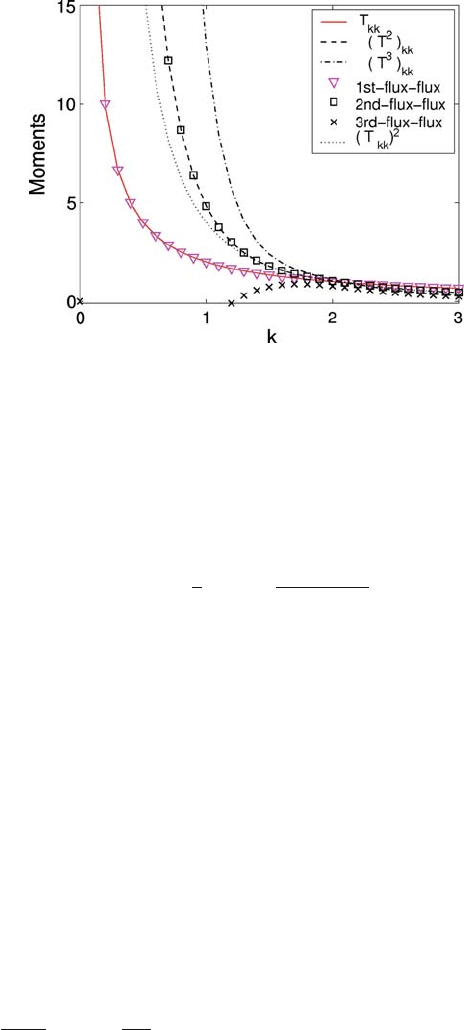
In Fig. 5.5 the first three moments are compared. The agreement between (T
3
)
kk
and Eq. (5.84) is very good for large values of k, but they clearly differ for small k.
Nevertheless, the agreement of the first two moments suggests a similar behavior of
Π(τ ) and C(τ ).
120 J. Mu
˜
noz et al.
Fig. 5.5 (Color online) Comparison of the first three moments: T
kk
,(T
2
)
kk
and (T
3
)
kk
,withthe
corresponding moments of the flux–flux correlation function, for a free-motion stationary state
with fixed k.(
T
kk
)
2
is also shown. = m = 1andL = 2
To calculate Π
ψ
(τ ) for a wavefunction
0
ψ(k):=k|ψwith only positive momen-
tum components we use Eq. (5.11) and the explicit forms of the eigenvectors,
Eq. (5.14) and eigenvalues t
±
, Eq. (5.15):
Π
ψ
(τ ) =
1
2
j
γ =±
|
0
ψ(k
γ
j
(τ ))|
2
|F
γ
(k
γ
j
(τ ))|
, (5.85)
where the j-sum is over the solutions k
γ
j
(τ ) of the equation F
γ
(k) ≡ t
γ
(k) −τ = 0
and the derivative is with respect to k.
We use the following wavefunction [27]:
0
ψ(k) = N(1 − e
−αk
2
)e
−(k−k
0
)
2
/[4(Δk)
2
]
e
−ikx
0
Θ(k) , (5.86)
where N is the normalization constant and Θ(k) the step function. For the free
flux–flux correlation function we write
C(τ ) = Re
∞
0
dk
∞
0
dk
0
ψ
∗
(k)
0
ψ(k
)k|
.
C(τ )|k
, (5.87)
and C
kk
(τ ) =k|
.
C(τ )|k
in the free case
C
kk
(τ ) =
m
2πk
δ(k − k
)
d
2
dτ
2
#
2g(kτ/m) − g(kτ/m − L) − g(kτ/m + L)
$
,
(5.88)
5 Dwell-Time Distributions in Quantum Mechanics 121
where
g(x) =−2e
imx
2
/(2τ )
iπτ
2m
1/2
+iπ x erfi
&
im
2τ
x
'
. (5.89)
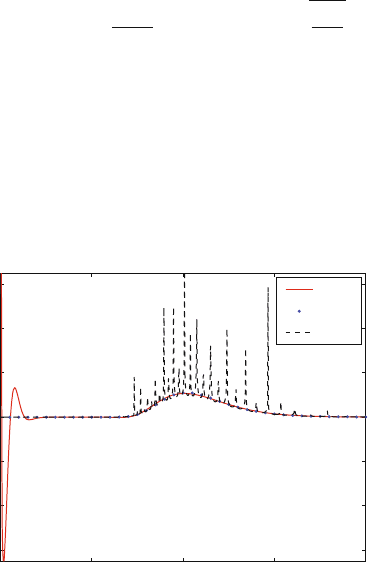
The result is shown in Fig. 5.6. The ffcf shows a hump around the mean dwell time
but it oscillates for small τ and diverges for τ → 0. As discussed above, this is
due to the self-correlation contribution of wavepackets which are at x
1
or x
2
at the
times t and t + τ without changing the direction of motion in between. A similar
feature has been observed in a traversal-time distribution derived by means of a path
integral approach [14].
0 10203040
−0.6
−0.4
−0.2
0
0.2
0.4
0.6
τ
Dwell Time Distribution
C(τ)
π(τ)
Π(τ)
Fig. 5.6 (Color online) Comparison of dwell-time distribution Π(τ )(dashed line) and flux–flux
correlation function C(τ )(solid line) for the freely moving wave packet (5.86). Furthermore, the
alternative free-motion dwell-time distribution π(τ ), Eq. (5.27), is plotted (circles). We set
=
m = 1and|x
0
|large enough to avoid overlap of the initial state with the space region D = [0, 45].
k
0
= 2, Δk = 0.4, and α = 0.5
In contrast, Π
ψ
(τ ) behaves regularly for τ → 0, but shows peaks in the region of
the hump. This is because the denominator of Eq. (5.85) becomes zero if the slope
of the eigenvalues t
±
(k) is zero, which occurs at every crossing of t
+
(k) and t
−
(k).
The distribution π
ψ
(τ ), see Eq. (5.27), is also computed: it agrees with C(τ )in
the region near the average dwell time and it tends to 0 for τ → 0. However, it does
not show the resonance peaks of Π
ψ
(τ ).
In the absence of a direct dwell-time measurement, the physical significance of
.
T
D
and
.
t
D
depends on their relation to other observables. The present results indicate
that the second moment of the flux–flux correlation function is related to the former
and not to the later, providing indirect support for the physical relevance of the
dwell-time resonance peaks, but other observables could behave differently.