
Muga G. Time in Quantum Mechanics - Vol. 2
Подождите немного. Документ загружается.

6 The Quantum Jump Approach and Some of Its Applications 143
From this one obtains an understanding of the light and dark periods as follows.
Let |λ
i
be (nonorthogonal) eigenvectors of H
IL
cond
/ (in case of degeneracy one has
to consider limits) and let λ
i
| be the dual basis, defined by
λ
i
|λ
j
=δ
ij
. (6.64)
Then one can write, for initial state |1,
exp{−iH
IL
cond
t/}|1=
3
j=1
e
−iλ
j
t
|λ
j
λ
j
|1 . (6.65)
Since |λ
1,2
are mainly a superposition of |1 and |2 and |λ
3
is close to |3,thelast
term in the sum is negligible for times of the order A
−1
2
and Ω
−1
1
, while for times
much larger than A
−1
2
and Ω
−1
1
, the first two terms become exponentially small, and
the third term, though small, remains.
As in (6.38) the probability density for the first photon is
w(t) =−P
0
(t)
=1|exp{iH
IL†
cond
t/}
A
2
|22|+A
3
|33|
exp{−iH
IL
cond
t/}|1
=A
2
2|exp{−iH
IL
cond
t/}|1
2
+ A
3
3|exp{−iH
IL
cond
t/}|1
2
.
(6.66)
By the preceding argument, the first term is close to the two-level expression in
(6.42). It dominates for small times and then becomes exponentially small. For large
times the other, small, term remains which then slowly drops off with a very small
exponential exponent.
For the two-level system the waiting time between two photons is of the order
of A
−1
2
and Ω
−1
1
and waiting times much larger than this practically never happen.
One can therefore now define what one can reasonably understand as a dark period.
One can pick a time T
0
satisfying
A
−1
2
,Ω
−1
2
T
0
A
−1
3
,Ω
−1
3
. (6.67)
Then, if the waiting time between two photons is larger than T
0
, this is called a dark
period.
For the temporal behavior of a single atom and its associated quantum trajectory
one has now the following situation. One starts in |1, one quickly has a photon, is
back in |1, again a quick photon, and so on. In a very rare event there is no photon
within a time interval of length T
0
. Once this has happened there is only a very small
probability density for the next photon and the total waiting time is much larger
than T
0
.
The probability of no photon within time T
0
is
P
0
(T
0
)
∼
=
||e
−iλ
3
T
0
|λ
3
λ
3
|1||
2
. (6.68)
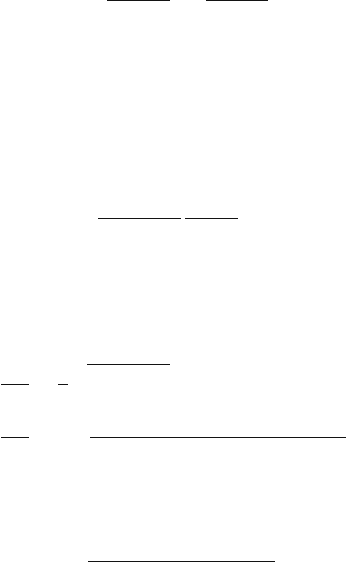
144 G.C. Hegerfeldt
The exponential is close to 1 while the remainder is small. Thus, after each photon
there is a small probability, i.e., P
0
(T
0
), for a dark period. Therefore a dark period
occurs after an average number of 1/P
0
(T
0
) photons; the latter form a “light period.”
Note that if P
0
(T
0
) is too small a dark period may in practice never occur. This
clearly depends on the parameters chosen.
The probability density, w
D
(t), for the length of a dark period is the same as the
probability density for the first photon to occur after a time interval of length T
0
.
Thus one has from (6.66), after normalization,
w
D
(t) = w(t)Θ(t − T
0
)/
∞
T
0
dt
w(t
)
∼
=
2|Imλ
3
|e
−2|Imλ
3
|t
Θ(t − T
0
)/e
−2|Imλ
3
|T
0
,
(6.69)
and this is essentially an exponential distribution. Here Θ(t) is the step function
which vanishes for t < 0 and is 1 for t > 0. The mean duration, T
D
, of a dark
period is then
T
D
= T
0
+
1
2|Imλ
3
|
∼
=
1
2|Imλ
3
|
. (6.70)
Since after each photon from the 1–2 transition the probability for a dark period
is P
0
(T
0
), one needs on the average P
0
(T
0
)
−1
tries, i.e., photons, before a dark period
occurs. Therefore the mean duration, T
L
, of a light period is approximately the num-
ber of these needed photons multiplied by the mean waiting time between photons
for the two-level system, i.e., by τ from (6.43). Hence one has
T
L
∼
=
2Ω
2
+ A
2
AΩ
2
1
P
0
(T
0
)
. (6.71)
For a quantitative treatment one has to calculate the eigenvalues λ
i
which can, in
principle, be done in a complicated closed form. Simpler approximate expressions
are [49]
λ
1,2
∼
=
−
iA
2
4
±
1
4
4Ω
2
1
− A
2
2
,
λ
3
+Δ
2
∼
=
−
iA
3
2
−iΩ
2
2
A
2
Ω
2
1
+2iΔ
2
(Ω
2
1
−4Δ
2
2
− A
2
2
)
2(Ω
2
1
−4Δ
2
2
)
2
+8A
2
2
Δ
2
2
.
(6.72)
With this one obtains from (6.70)
T
D
={A
3
+
Ω
2
2
Ω
2
1
A
2
(Ω
2
1
−4Δ
2
2
)
2
+4A
2
2
Δ
2
2
}
−1
. (6.73)
For the parameters

6 The Quantum Jump Approach and Some of Its Applications 145
Ω
1
= A
2
= 10
8
s
−1
,Ω
2
= 10
4
s
−1
, A
3
= 1s
−1
, and Δ
2
= Ω
1
/2 (6.74)
this gives
T
D
= 0.5s. (6.75)
In order to make sure that these long dark periods do not occur too seldom one
has to make sure that P
0
(T
0
) is not too small. To determine P
0
(T
0
) one can avoid the
calculation of the eigenvectors by using
|λ
3
λ
3
|=
(H
IL
cond
/ − λ
1
)(H
IL
cond
/ − λ
2
)
(λ
3
−λ
1
)(λ
3
−λ
2
)
. (6.76)
This identity and its cyclic variants are easily checked by applying it to the eigen-
vectors |λ
i
. Neglecting the exponential in (6.68), which is close to 1, one finds
P
0
(T
0
)
∼
=
Ω
2
2
A
2
2
+4Δ
2
2
(Ω
2
1
−4Δ
2
2
)
2
+4A
2
2
Δ
2
2
. (6.77)
Intuitively one would expect a maximum for the frequent occurrence of dark periods
if the driving is on resonance (Δ
2
= 0), but contrary to this, when Ω
1
is large, the
dark periods are most frequent for Δ
2
close to Ω
1
. This was already noticed in [15].
For the above parameters the mean duration of a light period is T
L
= 1.5 s so that
light and dark periods have a similar mean duration.
From (6.65) and (6.76) another curious effect follows. In a dark period the atom
is essentially in the state |λ
3
which can be calculated by applying (6.76) to |1
and then normalize the resulting vector to 1. The eigenvector |λ
3
has a very small
second component and therefore the next photon after a dark period can also come
from a 2–1 transition, not only from a 3–1 transition as suggested by a rate-equation
approach. For the parameters in (6.74) the probability for this strange effect is an
astonishing 1/2 [49]!
6.4 The General N-Level System and Optical Bloch Equations
6.4.1 The Conditional Hamiltonian
In the general case, the Hamiltonian for the complete system, N-level atom plus
quantized electromagnetic field, is again given by an expression as in (6.10), only
with ω
0
|22| replaced by
H
0
A
=
i
ω
i
|
i
i
|
. (6.78)
In the rotating-wave approximation the Hamiltonian then becomes

146 G.C. Hegerfeldt
H =
i
ω
i
|
i
i
|
+ H
0
F
+
#
e
ˆ
D
(−)
·E
(+)
ext
(t) +h.c.
$
+
#
e
ˆ
D
(−)
·
ˆ
E
(+)
+h.c.
$
≡ H
0
A
+ H
0
F
+ H
AL
(t) + H
AF
, (6.79)
where now
ˆ
D
(−)
=
i> j
D
ij
|ij| ,
D
ij
=i|X|j (6.80)
and where i > j means ω
i
>ω
j
. The expression for
ˆ
E is the same as in (6.13). We
introduce the notation ω
ij
= ω
i
−ω
j
.
One can now proceed as in Sect. 6.2. Instead of the single correlation functions
κ(τ ) in (6.23) one can introduce correlation functions of the form
κ
jim
(τ ) ≡
kλ
e
2
ω
k
2ε
0
V
(D
ji
·ε
kλ
)(ε
kλ
·D
m
) e
−i(ω
k
−ω
m
)τ
. (6.81)
The correlation function has an effective width of the order of ω
−1
m
around τ = 0,
and for Δt ω
−1
m
one can, similarly as in the N = 2 case, extend a time integration
in the second-order contribution to infinity [2]. This amounts to the replacement
t
−t
i
0
dτ e
i(ω
m
−ω
k
)τ
∼
=
πδ(ω
k
−ω
m
) + iP
1
ω
k
−ω
m
(6.82)
and corresponds to the usual Markov approximation in the derivation of the optical
Bloch equations [38, 43]. Again, the principal-value term corresponding to a level
shift will be omitted.
Then one finds that the conditional Hamiltonian for an N -level atom with no
photon detection until time t is, on the coarse-grained timescale, given in the
Schr
¨
odinger picture by
H
cond
(t) = H
0
A
+ H
AL
(t) −i
ˆ
Γ , (6.83)
where the damping operator
ˆ
Γ is defined by
ˆ
Γ ≡
ij
i,> j
Γ
ijj
|i| (6.84)
and the generalized damping constants Γ
ijk
by
Γ
ijk
≡
e
2
6πε
0
c
3
D
ij
·D
k
|ω
k
|
3
. (6.85)
6 The Quantum Jump Approach and Some of Its Applications 147
Note that, similar to (6.27), for i > j, one has
Γ
ijji
= A
ij
/2 , (6.86)
where A
ij
is the Einstein coefficient for the i– j transition.
6.4.2 The Reset Operation
One can again proceed as in Sect. 6.2 to determine the state after a photon detection,
but additional complications can arise unless all optical transition frequencies ω
ij
and ω
m
are far apart or unless two optical transition frequencies are very close so
that |ω
ij
− ω
m
|Δt 1. The latter case can lead to interesting coherence effects
which were discussed for the Λ system in [31]. In general, oscillatory terms can
appear, but it was shown in [34] that for photon counting these can be omitted. The
result of [23, 34] is
Rρ =
ijm
i> j,>m
Γ
jim
+Γ
mji
|ji|ρ|m| . (6.87)
In the sum, only transitions from higher to lower atomic levels appear. This is phys-
ically reasonable since, with a classical laser, one is detecting spontaneous photons
only. Anyway, if the laser photons were also treated quantum mechanically then
photons from stimulated emissions would have the same direction as the incident,
stimulating, laser photons and would therefore not be observed.
As in Sect. 6.2.4, tr(Rρ) Δt is the probability to find a photon in Δt, and the
analog of (6.54) again gives the probability density for the first photon.
6.4.2.1 Examples
(i) Two-level system. Then D
ij
= 0 unless i or j equals 1, the ground state. Then
Rρ = A ρ
22
|11|, by (6.87). This means that after a photon detection the
atom is in the ground state as expected and as already found in Sect. 6.2.4.
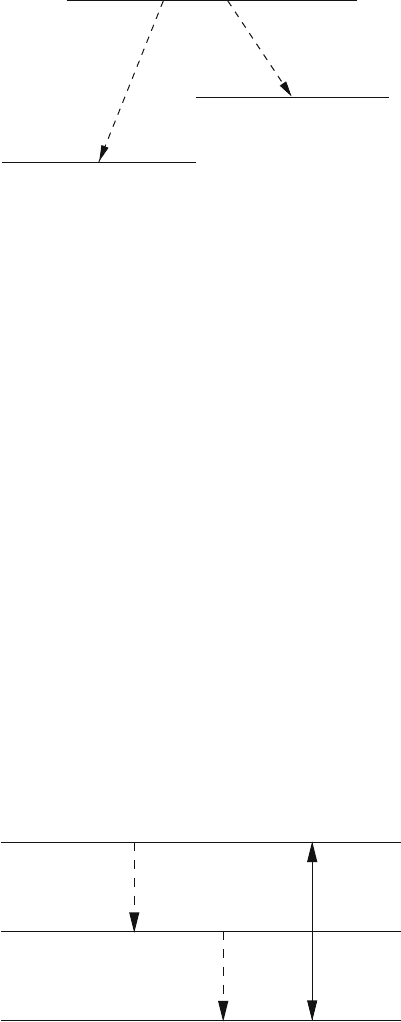
(ii) Λ-system, two ground states | 1 and | 2, excited state | 3 (cf. Fig. 6.6): only
D
13
, D
31
, D
23
, and D
32
are nonzero. Then one has, with the Einstein coefficients
A
31
and A
32
and in matrix notation,
Rρ = ρ
33
⎛
⎝
A
31
Γ
1332
+Γ
3213
0
Γ
2331
+Γ
3123
A
32
0
000
⎞
⎠
. (6.88)
Therefore, the normalized reset matrix is always the same and given by the
matrix divided by its trace. The off-diagonal terms vanish only if D
31
·D
23
= 0.
For levels 1 and 2 sufficiently far apart the off-diagonal terms can be neglected
for most questions so that the atom can be taken to be either in state | 1 or | 2
148 G.C. Hegerfeldt
A
31
A
32
1
2
3
Fig. 6.6 The Λ configuration. The upper level 3 can decay to the lower levels 1 and 2. In addition
there may be driving of the 1–3 and 2–3 transitions
after a photon detection. On the other hand, for levels 1 and 2 close together
the off-diagonal terms lead to interesting coherence effects such as dark peri-
ods [29, 32] and quantum beats in the correlation function g
(2)
(τ ) even under
illumination with incoherent light [30].
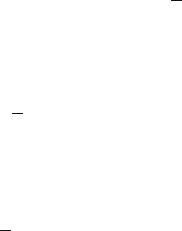
(iii) Three-level cascade system. This level system is shown in Fig. 6.7. In matrix
notation one obtains from (6.87)
Rρ =
⎛
⎝
A
21
ρ
22
(Γ
1232
+Γ
3212
)ρ
23
0
(Γ
2321
+Γ
2123
)ρ
32
A
32
ρ
33
0
000
⎞
⎠
. (6.89)
Here the normalized reset matrix depends on ρ. For a quantum trajectory the reset
matrix will therefore in general depend on the time of the resetting since matrix
elements of the conditional density matrix elements vary with time if both D
21
and
D
32
are nonzero. The dependence on the state prior to detection, and thus on time, is
easy to understand for large level separation. If, for example, the atom were in state
| 2 there would only be a transition to | 1, while if it were in a superposition of
| 2 and | 3 it could go to | 1 or | 2 or a mixture thereof.
A
32
A
21
3
2
1
Fig. 6.7 The three-level cascade configuration
6 The Quantum Jump Approach and Some of Its Applications 149
6.4.3 Quantum Trajectories and Recovering the Bloch Equations
It will now be shown that the collection of all quantum trajectories of an N-level
system with the same initial state yields a solution of the usual Bloch equations for
the system.
We consider a large ensemble of systems (atoms) interacting with the quantized
radiation field and an external field. After taking a partial trace over the photons, the
system alone is described by a density matrix, ρ(t). To each individual atom there
corresponds a quantum trajectory, each starting with the initial state ρ(t
0
) and with
jumps at different times. Now consider a time t.Atafixedtimet, each trajectory is
in a particular mixed or pure state, which depends on its history. Let the incoherent
weighted sum of these states be denoted by ρ
(traj)
(t). Then in the time interval (t, t +
dt) a particular subensemble of systems will have no jumps (photon detections), and
this subensemble is described, including its relative size, by
U
cond
(t +dt, t) ρ
(traj)
(t) U
†
cond
(t +dt, t), (6.90)
since the state of each individual trajectory satisfies such an equation and (6.90) is
just the weighted incoherent sum of all these. Similarly, the subensemble of systems
with a jump is described, including its relative size, by
R(ρ
(traj)
(t)) dt . (6.91)
Hence, with
U
cond
(t +dt, t) = 1 −
i
H
cond
dt (6.92)
one has
ρ
(traj)
(t +dt) = ρ
(traj)
(t) −
i
{H
cond
ρ
(traj)
−ρ
(traj)
H
†
cond
}dt +R(ρ
(traj)
(t)) dt (6.93)
and this gives
˙ρ
(traj)
=−
i
{H
cond
ρ
(traj)
−ρ
(traj)
H
†
cond
}+Rρ
(traj)
. (6.94)
This coincides with the quantum optical Bloch equations (which are usually written
in a somewhat different way [38, 43]). Since the initial condition is the same, one
has that ρ
(traj)
(t) yields a solution of the optical Bloch equations.
Therefore, the QJA lends itself to a numerical solutions of the Bloch equations
by simulations of quantum trajectories. If R always resets to pure states, one can
work in dimension N instead of N
2
for the Bloch equations. For large N this is a
tremendous numerical advantage. On the other hand, if R resets to a density matrix
150 G.C. Hegerfeldt
this advantage would be lost; however, as indicated in Sect. 6.6 one can always reset
to (auxiliary) pure states.
There are quite efficient ways to derive master equations like the Bloch equations.
Hence, for given Bloch equations, one can read off from (6.94) either H
cond
or Rρ
if the other is known, or one can make an educated guess for both from the form of
the Bloch equations.
If one is only interested in simulating solutions of the Bloch equations there
are alternative schemes to achieve this, e.g., trajectories of diffusion processes
[22, 46]. Still another type of trajectories has been used in [3], see Chap. 10 to
study photonic crystals and band gap materials where the Markov property does not
hold.
6.5 Quantum Counting Processes
The QJA will now be used to determine the statistics of broadband photon counting
for a general N-level atom and, more generally, for systems with jumps (with reset
operation R) and a conditional time development between jumps. To be completely
general we use density matrices.
6.5.1 Counting Statistics
For a density matrix the conditional time development is given by a superoperator,
T
cond
, defined by
T
cond
(t, t
0
) ρ(t
0
) ≡ U
cond
(t, t
0
) ρ(t
0
) U
†
cond
(t, t
0
) . (6.95)
If ρ(t
0
) is normalized, its trace gives the probability P
0
(t) ≡ P
0
(t; ρ(t
0
)) of finding
no photon (jump) between t
0
and t.
The subensemble with (i) no photon found between t
0
and t and (ii) a photon
at t + Δt is described by RT
cond
(t, t
0
) ρ(t
0
) since R performs the resetting. The
size of the subensemble relative to the original ensemble, and thus the probability
w
1
(t, t
0
; ρ(t
0
))Δt to find the first photon after t
0
at t +Δt, is the trace of this times
Δt , i.e.,
w
1
(t, t
0
; ρ(t
0
)) = tr
RT
cond
(t, t
0
) ρ(t
0
)
, (6.96)
which is the analog of (6.54).
Analogously, the subensemble for which photons are found in the intervals
[t
1
, t
1
+Δt],...,[t
n
, t
n
+Δt] but none in between and none between t
n
+Δt and t
is described by
T
cond
(t, t
n
) RT
cond
(t
n
, t
n−1
) ··· RT
cond
(t
1
, t
0
) ρ(t
0
) , (6.97)
6 The Quantum Jump Approach and Some of Its Applications 151
where T
cond
(t
i
, t
i−1
+ Δt) has been approximated by T
cond
(t
i
, t
i−1
). The size of this
subensemble relative to the original one is the trace times (Δt)
n
, and it gives the
probability for this event. Going over to the coarse-grained timescale we have that
the probability density w(t
1
,...,t
n
;[t
0
, t]) for finding exactly n photons at times
t
1
< t
2
···< t
n
in the interval [t
0
, t] is given by
w(t
1
,...t
n
;[t
0
, t]) = tr
T
cond
(t, t
n
) RT
cond
(t
n
, t
n−1
) ··· RT
cond
(t
1
, t
0
) ρ(t
0
)
.
(6.98)
Putting t = t
n
the superoperator T
cond
(t, t
n
) drops out and one obtains the prob-
ability density, w(t
1
, ···, t
n
), for finding n photons at t
1
< ··· < t
n
and none in
between,
w(t
1
,...t
n
) = tr
RT
cond
(t
n
, t
n−1
) ··· RT
cond
(t
1
, t
0
) ρ(t
0
)
. (6.99)
This can be rewritten as follows. We denote by ˆρ
i
the normalized reset matrix at
time t
i
. Then one has, by (6.96),
RT
cond
(t
1
, t
0
) ρ(t
0
) =w
1
(t
1
, t
0
; ρ(t
0
)) ˆρ
1
,
RT
cond
(t
2
, t
1
)RT
cond
(t
1
, t
0
) ρ(t
0
) =w
1
(t
1
, t
0
; ρ(t
0
)) RT
cond
(t
2
, t
1
)ˆρ
1
=w
1
(t
1
, t
0
; ρ(t
0
)) w
1
(t
2
, t
1
;ˆρ
1
)ˆρ
2
,
(6.100)
and so on. In this way one obtains
RT
cond
(t
n
, t
n−1
) ···RT
cond
(t
1
, t
0
) ρ(t
0
) = w
1
(t
1
, t
0
; ρ(t
0
)) ···w
1
(t
n
, t
n−1
;ˆρ
n−1
)ˆρ
n
(6.101)
and therefore
w(t
1
,...t
n
) = w
1
(t
1
, t
0
; ρ(t
0
)) w
1
(t
2
, t
1
;ˆρ
1
) ··· w
1
(t
n
, t
n−1
;ˆρ
n−1
) .
(6.102)
This result can also be obtained directly by considering quantum trajectories and the
probability densities after the jumps.
For the two-level system, the V system and the Λ system, in example (ii) of Sect.
6.4 the reset matrix is always the same. In general, if after each jump the system is
always reset to the same normalized state or density matrix, ˆρ
r
say, i.e., if for any ρ,
one has
Rρ = λ
ρ
ˆρ
r
= tr(Rρ)ˆρ
r
, (6.103)
then the memory is lost after each detection. In this case (6.99) factorizes into single-
photon probabilities:
w(t
1
,...,t
n
) = tr
RT
cond
(t
n
, t
n−1
)ˆρ
r
···tr
RT
cond
(t
1
, t
0
)ρ(t
0
)
= w
1
(t
n
, t
n−1
;ˆρ
r
) ··· w
1
(t
2
, t
1
;ˆρ
r
) w
1
(t
1
, t
0
; ρ(t
0
)) .
(6.104)
152 G.C. Hegerfeldt
In this case the analysis becomes particularly easy and many quantities can be cal-
culated by Laplace transform as in [49] for the case of a single ground state.
It is also of practical interest to consider the probability density, denoted by
p(t
1
,...,t
n
), associated with trajectories for which jumps (i.e., photons from the
corresponding atom) are found in the intervals [t
1
, t
1
+ Δt],...,[t
n
, t
n
+ Δt] and
arbitrarily many jumps in between. To describe this subensemble, denote the time-
development superoperator for the optical Bloch equations by T
B
(t, t
0
), i.e.,
ρ(t) = T
B
(t, t
0
) ρ(t
0
) .
(6.105)
Then starting at time t
0
with ρ(t
0
), the time development goes with T
B
(t, t
0
) until
t = t
1
, then there is the reset operation R to those trajectories with a jump, after
that the time development with T
B
(t
2
, t
1
), reset, and so on. The subensemble of
trajectories for which jumps are found in the intervals [t
1
, t
1
+Δt],...,[t
n
, t
n
+Δt]
and arbitrarily many jumps in between and later is therefore described at time t > t
n
by the density matrix
T
B
(t, t
n−1
) RT
B
(t
n
, t
n−1
) ··· RT
B
(t
1
, t
0
) ρ(t
0
) , (6.106)
and the relative size of the subensemble is given by the trace of this times (Δt)
n
.
Therefore the probability density, p(t
1
,...,t
n
), for finding jumps (photons from the
atom) at times t
1
< ···< t
n
, with arbitrarily many jumps in between and at later
times, is given by
p(t
1
,...,t
n
) = tr
RT
B
(t
n
, t
n−1
) ··· RT
B
(t
1
, t
0
) ρ(t
0
)
. (6.107)
The superoperator T
B
(t, t
n−1
) in (6.106) has dropped out since it conserves the trace.
The above probability densities determine a classical stochastic process whose
sample paths are given by the photon detection times of a single radiating atom.
Without external pumping these paths terminate. Ergodicity allows one to replace
time averages over a single trajectory by ensemble averages. In many cases the latter
can be computed analytically.
6.5.2 Converse: From Bloch Equations to the Conditional Time
Development
In this section it will be shown that one can derive the conditional time develop-
ment directly from the Bloch equations and the reset operation, without using the
projection machinery from Sects. 6.2.1 and 6.4.1.
We start at time t
0
and consider an ensemble of trajectories of radiating atoms
whose incoherent sum of states at time t is described by a density matrix ρ(t). It is
assumed that ρ(t) obeys the Bloch equations. We denote by ρ
0
(t) the density matrix
for the subensemble of trajectories for which no jump (no photon detection) has