
Muga G. Time in Quantum Mechanics - Vol. 2
Подождите немного. Документ загружается.


6 The Quantum Jump Approach and Some of Its Applications 163
H
cond
=
ˆ
P
2
/2m + ω
0
|22|−
i
2
A|22|+
2
Ω(
ˆ
X)|21|e
−iω
L
t
+h.c.,
(6.139)
which is the analog of (6.34).
The reset operation looks somewhat different if cm motion is included. The
atomic density operator ρ now describes both the cm motion and the internal two-
level degrees of freedom. Therefore, if one takes matrix elements with momentum
eigenvectors of the cm motion, then
ρ(p, p
) ≡p|ρ|p
(6.140)
becomes an operator for the internal degrees of freedom, which corresponds to a
2 × 2 matrix in case of a two-level system. The reset operation R is again given
by the general expression in (6.49), but now with the Hamiltonian from (6.131). As
before, in first-order perturbation theory the external field drops out and one obtains
instead of (6.50)
RρΔt =
Δt
0
dt
Δt
0
dt
kλ
e
i(ω
k
−ω
0
)(t
−t
)
e
2
ω
k
2ε
0
V
|ε
kλ
·D
21
|
2
e
−ik·
ˆ
X(t
)
|12|ρ|21|e
ik·
ˆ
X(t
)
.
(6.141)
Similarly as before one can replace
ˆ
X(t
) and
ˆ
X(t
)by
ˆ
X, by (6.136). Note that since
2|ρ|2 is a cm operator, it does not commute with
ˆ
X. Now one can proceed as in
(6.51) to split the double integral and use the property of the correlation function.
Again this gives a πδ(ω
k
−ω
0
) which allows to perform the k
2
dk integration. This
gives
Rρ = A|11|
dΩ
k
|D
21
|
2
−|
ˆ
k · D
21
|
2
|D
21
|
2
e
−ik·
ˆ
X
2|ρ|2e
ik·
ˆ
X
,
(6.142)
where the angular integration is over the unit vectors
ˆ
k. In momentum space one has
e
ik·
ˆ
X
|p=|p + k (6.143)
and this gives with (6.142)
p|Rρ|p
=A|11|
dΩ
k
&
1 −
|
ˆ
k · D
21
|
2
|D
21
|
2
'
2|p + ω
0
ˆ
k/c| ρ |p
+ω
0
ˆ
k/c|2 .
(6.144)
The first factor in the integral is the usual dipole emission characteristics and the
terms ω
0
ˆ
k/c yield momentum conservation after the photon emission. We note
164 G.C. Hegerfeldt
that the resulting reset matrix is a pure state only for internal degrees of freedom but
not for the cm variables, even if the density matrix before the photon detection is a
pure state.
Instead of asking for the detection of any photon one may ask for a photon detec-
tion in a given direction
ˆ
k. Then the reset operation, R
ˆ
k
, is given by
p|R
ˆ
k
ρ|p
=A|11|(1 −
|
ˆ
k · D|
2
D
2
)2|p + ω
0
ˆ
k/c| ρ |p
+ω
0
ˆ
k/c|2 ,
(6.145)
which reflects the dipole emission characteristics. If ρ is a pure state in momentum
space this is again a pure state. The probability to detect a photon with direction in
the solid angle dΩ
k
in the time interval dt is given by
tr R
ˆ
k
ρ dΩ
k
dt . (6.146)
Integrating (6.145) over all directions gives the reset matrix in (6.144).
Similarly, one may ask for a photon detection in a given direction
ˆ
k and given
polarization λ. The corresponding reset operation, R
ˆ
kλ
, is then given by
p|R
ˆ
k
λ
ρ|p
=A|11|
|ε
kλ
·D
21
|
2
D
2
2|p + ω
0
ˆ
k/c| ρ |p
+ω
0
ˆ
k/c|2 .
(6.147)
Again, if ρ is a pure state in momentum space this is again a pure state, and the
analog of (6.146) holds.
In simulations of quantum trajectories of a two-level system with cm one can
work with the reset operation R
ˆ
k
or with R
ˆ
k
λ
and thus with pure states when one
starts in a pure state [45]. In this case one does not need the more complicated
procedure of Sect. 6.6.
6.7.2 Application to Quantum Arrival Times
An important open problem in quantum theory is the question of how to formulate
the notion of “arrival time” of a particle, such as an atom, at a given location, i.e., the
time instant of its first detection there. This is clearly a very physical question, but
when the extension and spreading of the wave packet is taken into account, a satis-
factory formulation is far from obvious. The problem of time in quantum mechanics,
both for time instants and time durations such as dwell time, has received a great
deal of theoretical attention recently [40]. When the translational motion of the par-
ticle can be treated classically, a full quantum analysis of arrival time is in fact not
necessary. This is the case for fast particles, and therefore arrival times are presently
measured mostly by means of time-of-flight techniques, whose analysis is carried
6 The Quantum Jump Approach and Some of Its Applications 165
out in terms of classical mechanics. Problems, though, arise for slow particles for
which the finite extent of the wavefunction and its spreading become relevant, such
as for cooled atoms dropping out of a trap. Then a quantum theoretical point of view
is needed. It is therefore important to find out when the classical approximations
fail and to propose measurement procedures for arrival times in the quantum case.
Since the theoretical definition of a quantum arrival time is still subject to debate it
is necessary to determine what exactly such measurement procedures are measuring
and to compare such operational approaches with the existing, more abstract and
axiomatic, theories.
An experimentally very natural approach to determine the arrival time of an atom
is by quantum optical means. A region of space may be illuminated by a laser and
upon entering the region an atom will start emitting photons. The first photon emis-
sion can be taken as a measure of the arrival time of the atom in that region.
It is easiest to first study the 1D case and use the corresponding equations of Sect.
6.7.1. Then (6.139) simply becomes 1D in p and x. Illuminating the half axis x > 0
perpendicularly by a laser, the Rabi frequency Ω(x) becomes a multiple of the step
function Θ(x). In [18] the corresponding conditional time development has been
solved explicitly and the distribution of the first-photon times have been calculated.
If one deducts by a deconvolution technique the delays due to the finite pumping
time, one obtains in the limit of weak pumping a surprising result for the arrival
time distribution, namely the usual well-known quantum mechanical probability
flux. More details can be found in Chap. 4.
Another model for arrival times will be discussed in Sect. 6.8. This model couples
the center-of-mass motion to spins which in turn are coupled to bosons. The arrival
of the particle induces a spin flip which in turn induces the emission of a boson.
6.8 Extension to Spin-Boson Models
In this section it will be shown in an example that the QJA can be extended to a
system which is coupled to a bath I which in turn is coupled to another bath, bath
II. Measurements are taken on bath II and from these one can infer properties of the
small system. Bath I serves as an amplifier to enhance the signal and can be viewed
as a part of the measuring apparatus, a part which is treated quantum mechanically.
The model to be considered here consists of a moving particle coupled to a spatial
array of spins which in turn are coupled to bosons [21]. This model recently has been
used to study arrival times as well as passage times [27, 28]. In places where the par-
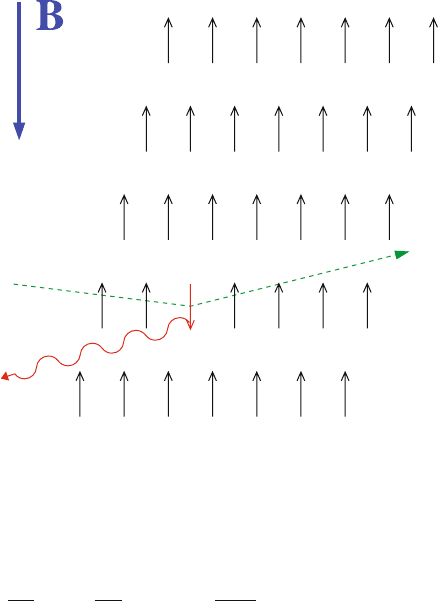
ticle wavefunction overlaps with a spin there is a high spin-flip probability. Initially
the spins are in the (metastable) up state. When the particle passes a spin there is
a very high probability for a single spin flip, accompanied by a boson emission, as
depicted in Fig. 6.12. The spin flip leads to a large energetic gain for neighboring
spins and therefore to a large spin-flip probability of the neighboring spins. By a
domino effect, this leads to a sudden flip of all spins, accompanied by a burst of
bosons, which can be detected.
166 G.C. Hegerfeldt
Fig. 6.12 (Color online) Array of spins in a metastable state in a weak magnetic field B. A passing
particle produces a single spin flip, accompanied by a boson emission. By a domino effect, the spin
flip causes all spins to flip, accompanied by an avalanche of bosons
The Hamiltonian is taken as
H =
ˆ
P
2
2m
+
j
ε
( j)
2
ˆσ
( j)
z
−
j< j
J
( jj
)
2
ˆσ
( j)
z
⊗ ˆσ
( jj
)
z
+
ω
l
ˆ
a
†
ˆ
a
+
j
l
γ
( j)
l
e
i f
( j)
l
ˆ
a
†
ˆσ
( j)
−
+h.c.
!
+
j
χ
( j)
(
ˆ
x
)
g
( j)
l
e
i f
( j)
l
ˆ
a
†
ˆσ
( j)
−
+h.c.
!
. (6.148)
The individual terms are the free Hamiltonian for the particle, the spin Hamiltonian
with ferromagnetic interaction, the free boson Hamiltonian, a small permanent spin-
bath coupling which induces very rare spontaneous spin flips, and a further spin-bath
coupling which is strongly enhanced if the particle is close to a spin, i.e., |g
( j)
l
|
|γ
( j)
l
|, where χ
( j)
(x) is a sensitivity function, e.g., equal to 1 in a neighborhood of
the jth spin, while e
i f
( j)
l
are possible phase factors which will later be put to 1.
It should be noted that the Hamiltonian conserves the excitation number, which
is the sum of up spins and bosons. Hence a boson detection indicates a spin flip,
which in turn indicates that the particle has passed close to a spin (unless one has an
extremely rare exceptional spontaneous spin flip). Therefore, one can consider the
time of a boson detection as a signal for the arrival of the particle at the spin array so
that this model can be regarded as a model for arrival times [27, 28]. The motivation
6 The Quantum Jump Approach and Some of Its Applications 167
for this model comes from the desire to minimize the backreaction of the detection
on the particle by employing the intermediary spin system.
To illustrate how the QJA works for this model we use a simple example in one
space dimension, with a single spin and N discrete boson modes, where later N is
taken to infinity. The modes ω
and coupling constants g
are taken as
ω
= ω
M
n/N, n = 1, ···, N ,
g
=−iG
/
ω
/N , (6.149)
where ω
M
is the maximal boson frequency. The particle wave packet is assumed
to come in from the left. The probability, P
disc
1
(t) (“disc” stands for “discrete”), of
finding the detector spin in state |↓at time t is given by
P
disc
1
(t) =
∞
−∞
dx
|
x ↓ 1
|
Ψ
t
|
2
(6.150)
≡ 1 − P
disc
0
(t) .
As long as no recurrences occur (i.e., no transitions |↓ 1
→|↑ 0) one can
regard
w
disc
1
(t) =
d
dt
P
disc
1
(t) =−
d
dt
P
disc
0
(t) (6.151)
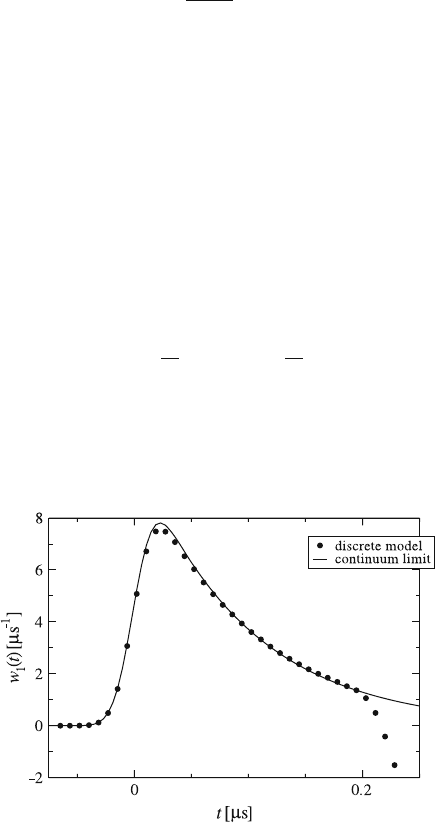
as the probability density for a spin flip (i.e., for a detection) at time t.In
Fig. 6.13 the dots represent results of a numerical calculation of the spin-flip prob-
ability density of N = 40 spins, for a sensitivity function χ(x) = Θ(x) and for
Fig. 6.13 Dots: spin-flip probability density for incoming Gaussian wavefunction, N = 40,
χ(x) = Θ(x), where Θ is the step function; solid line: QJA result for continuum limit (N →∞),
the numerical evaluation is much faster

168 G.C. Hegerfeldt
an incoming Gaussian wavefunction. Numerically the calculation is extremely time
consuming.
Quantum jump approach: In the continuum limit, N →∞, the QJA can be
employed and leads to significant numerical simplifications if the coupling constants
are such that the Markov property holds. This means here that for the correlation
function κ(τ ), now defined as
κ(τ ) ≡
|
g
|
2
e
−i(ω
−ω
0
)τ
, (6.152)
there is a small correlation time τ
c
such that
κ(τ ) ≈ 0ifτ>τ
c
.
Then one can define A and δ
shift
, the analogs of Einstein coefficient and level shift,
by
A ≡2Re
∞
0
dτκ(τ ) ,
δ
shift
≡ 2Im
∞
0
dτκ(τ ) .
(6.153)
Proceeding as in Sect. 6.2, but now with Δt τ
c
, one obtains that the time devel-
opment under the condition of no boson detection (i.e., no spin flip) is given by the
conditional Hamiltonian
H
cond
=
ˆ
P
2
/2m + /2(δ
shift
−iA)χ (
ˆ
x)
2
, (6.154)
where χ(x) is the sensitivity function. Formally, H
cond
is seen to contain a position-
dependent absorption and energy shift. The imaginary part leads to a decrease of the
wavefunction norm which physically means a decrease of the no-detection proba-
bility.
On a coarse-grained timescale one then finds, as in (6.38), for the probability
density of the first boson (i.e., first spin flip)
w
1
(t) =−
d
dt
P
0
(t)
=
i
ψ
cond
(t)|H
cond
− H
†
cond
|ψ
cond
(t)
=A
dx χ(x)|x|ψ
cond
(t)|
2
.
(6.155)
If χ(x) is the characteristic function of an interval, where the spin is located, this is
just the decay rate A of the excited state of the detector multiplied by the probability
that the particle is inside the detector but is not yet detected – a very physical result.
6 The Quantum Jump Approach and Some of Its Applications 169
This result has been used to calculate w
1
(t), the solid curve in Fig. 6.13, for the
continuous version of (6.149), with χ (x) = Θ(x) and otherwise the same parame-
ters as for the discrete case. Up to the time of revivals – due to the discrete nature of
the bath – the agreement between the discrete version and the QJA result is excellent.
The numerical evaluation of the QJA result, however, is much faster.
Incidentally, it should be noted that for the discrete example one did not calculate
the probability for no boson detection until time t but rather the probability of no
boson detection at time t. Figure 6.13 shows that until the occurrence of revivals for
the discrete case and in the limit of infinite boson modes this makes no difference.
Reset operation: If ρ
tot
denotes the density matrix for the total system when the
particle is in the state ρ
p
, the spins are up and no bosons present, then R is now
given by
Rρ
p
·Δt ≡ tr
spin
tr
bath
P
1
U(Δt, 0)ρ
tot
U
†
(Δt, 0) P
1
, (6.156)
where P
1
≡
|1
1
| and where the partial trace is now over both spins and
bosons.
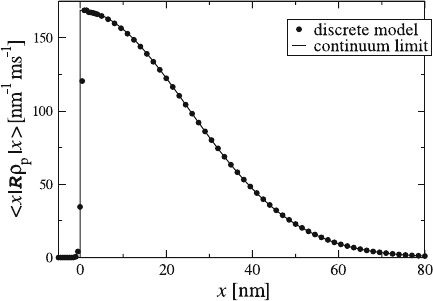
For discrete case, with N = 15 boson modes and χ(x) = Θ(x), the dots in
Fig. 6.14 represent numerical results for
"
x
Rρ
p
x
for a Gaussian state ρ
p
=
|ψψ|. The dots are obtained by a very time-consuming calculation.
In the continuum limit, with the Markov property, and a pure state ρ
p
=|ψψ|
the reset state is again pure and one obtains
Rρ
p
=|ψ
reset
ψ
reset
| , (6.157)
with
|ψ
reset
≡A
1/2
χ(
ˆ
x)|ψ . (6.158)
Fig. 6.14 Dots: N = 15 discrete boson modes, χ(x) = Θ(x); reset state
"
x
Rρ
p
x
for a Gaussian
state ρ
p
=|ψ ψ|; solid line: Same with QJA for continuum limit, N →∞, the numerical
evaluation is much faster
170 G.C. Hegerfeldt
This means that after its detection, which is equivalent to the detection of a boson,
the particle state is localized in the region of the detector (given by the sensitivity
function χ (x)). This is a physically very appealing result since a position measure-
ment should localize the particle.
For the continuum limit of the discrete case in Fig. 6.14, the solid curve displays
"
x
Rρ
p
x
=|x|ψ
reset
|
2
. The agreement between the discrete version and the QJA
result is excellent. The numerical evaluation of the QJA result, however, is again not
only much faster but almost trivial, by (6.158).
These results and their extensions to many spins have been applied to the study
of arrival and passage times in [27, 28, 41] where more details can be found. In par-
ticular the backreaction of the detection of a boson on the particle has been studied
by the QJA. Somewhat surprisingly it turns out that in spite of the presence of the
spin system mediating between boson and particle this backreaction is not trivial
and of similar nature as in the atom–photon model of Sect. 6.7.2.
6.9 Discussion
In general, a quantum mechanical description of the time development of a sin-
gle system is not possible since quantum mechanics deals with ensembles. But
for a single fluorescing system, like an atom in a trap, which is driven by a light
source and on which photon detections are performed, this is at least partially fea-
sible and it is just accomplished by the quantum jump approach (QJA). Technically
it is achieved by reverting back to an ensemble description. Besides the statisti-
cal properties of the photon detections the QJA also allows one to calculate the
temporal state of the single system depending on the, in principle unpredictable,
stochastic detection times, with a smooth “conditional” time development by a con-
ditional complex Hamiltonian between detections and a reset operation (“jump”)
of the state right thereafter. From this one can determine the statistical proper-
ties of a single radiating system. The temporal succession of continuously chang-
ing states and sudden state reset operations (jumps) of the state at random times
form a quantum trajectory of a given single system. Correspondingly, an ensemble
of many radiating systems determines an ensemble of quantum trajectories. The
related question of whether a single quantum trajectory cannot just be viewed as a
preparation of an ensemble by repetition after each jump or reset will be discussed
below.
In principle one should also realize that there is a distinction between the state-
ments “no photon until time t” and “no photon at time t.” From the theoretical
point of view one therefore has to make sure that there are no photons in between
detections. To ensure this one would, in principle, have to use continuous measure-
ments. In order to avoid this complication and to simplify the approach, the deriva-
tion is proceeded by rapidly repeated, hypothetical (“gedanken”) measurements at
times Δt apart and then invoked temporal coarse graining. Ideally, of course, one
would like to let Δt tend to 0, but with the reduction rule of von Neumann and
L
¨
uders employed here this is not possible, due to the so-called quantum Zeno effect.
6 The Quantum Jump Approach and Some of Its Applications 171
Therefore, one has to ensure that, within a certain range, the results are independent
of the particular choice of Δt. This can indeed be verified if the Markov property
holds for the system coupled to the photons (or to another bath). In the derivation
presented in Sect. 6.2 this became particularly transparent because in second-order
perturbation theory the interaction with the bath produced, by the Markov property,
a term proportional to Δt and not to (Δt)
2
. The latter form of dependence only
sets in for Δt → 0 and gives rise to the quantum Zeno effect. As mentioned in
Sect. 6.2, however, the use of perturbation theory is not essential to the derivation
and that therefore possible errors do not add up for the hypothetical measurements.
Moreover, after the calculation is performed, the probability of finding no photon
until and at time t turns out to be the same. Physically this can be understood as the
fact that once the photon is away from the atom it is not reabsorbed. Again this can
be shown mathematically to be a consequence of the Markov property, and it would
not hold in a cavity where revivals can occur.
If the Markov property does not hold and if one uses a sequence of gedanken
measurements which are some more or less arbitrary time Δt apart, one will usu-
ally be led to nonphysical results. As another example, in addition to cavities, the
Markov property also does not hold for photonic crystals, due to a photonic band
gap.
When one applies the QJA in simulations it is not necessary to simulate each
of the rapidly repeated individual measurements at times Δt apart, but one can
rather use the conditional Hamiltonian to calculate the waiting time distribution and
generate the detection (or jump) times. Only if this is too complicated, e.g., for a
large number of degrees of freedom coming from many levels or from inclusion of
the atomic motion, one will simulate each time step Δt. The advantage of the QJA
for simulations becomes particularly pronounced if one can work with pure states
because this reduces the dimension to N, i.e., to the number of levels, compared to
N
2
for density matrices as in the optical Bloch equations. As has been pointed out
in Sect. 6.6 it is always possible to go over to pure states, even if the reset operation
originally gave a density matrix. The ensemble of quantum trajectories correspond-
ing to an ensemble of radiating systems provides a solution of the optical Bloch
equation for the system, and hence in this respect simulations can be extremely
useful for large N.
The hypothetical, gedanken, measurements employed in the derivation of the
QJA are obviously highly idealized. A realistic photon detector misses many pho-
tons, be it by an efficiency less than 1, be it by an aperture less than 4π . The under-
lying assumption is that in such a case the experimental probability distribution is
obtained from the ideal jump (detection) trajectory by assigning, as in [6], probabil-
ities for the recording of the jumps and that one does not need to model the actual
detector in detail.
A variant of the QJA arises in the investigation of the frequency spectrum in a
light period of the Dehmelt system in Fig. 6.1. Here the theoretical problem is that
in order to make sure that one is in a light period one has to detect the photons.
This detection possibly changes the spectrum. In [33] this problem was solved by
measuring the light period through photons emitted in a half space and using it to
172 G.C. Hegerfeldt
trigger a spectrometer in the other half space. This procedure bypasses the time–
energy uncertainty relation.
There is an interesting application of the QJA to an experiment on the quantum
Zeno effect. In the experiment [36] a large number of ions with a V configuration
as in Fig. 6.1 were stored in a Penning trap. The time development was given by
a so-called π pulse of length T
π
connecting the ground state 1 and the metastable
state 3. Intermittently the ground state population was measured by a very short
pulse of a probe laser coupling level 1 with level 2, where emission of photons
would indicate the ground as measurement outcome and level 3 otherwise. This
was regarded in [36] as a measurement to which the projection postulate could be
applied. With up to 64 probe pulses (“measurements”) during a π pulse agreement
was found, within the error bars, with the quantum Zeno predictions for the level
populations. In an application of the QJA [5], on the other hand, the probe pulse was
directly included into the dynamics and it was shown by means of the QJA that the
probe pulse can indeed be regarded as a measurement which at least approximately
satisfies the projection postulate. It was also possible to calculate the errors which
arise when one replaces the probe pulse by an ideal measurement satisfying the
projection postulate.
This is an example of a Heisenberg cut, where part of the measurement apparatus
is included in the dynamics, the actual measurement then being on the photons.
Of course, in the QJA one also employs the projection postulate, but only for the
photons, and the photons are, so to speak, at the very end of the chain. The spin-
boson detector model presented in Sect. 6.8 can be regarded as another example for
a Heisenberg cut. Here the bath of spins can be either viewed as part of the apparatus
or as part of the quantum mechanical system. The spin-boson detector model also
illustrates the fact that the QJA can be applied to a variety of systems which are
coupled to a chain of baths and where the gedanken measurements are performed
on the last member of the chain.
When the resetting in a quantum trajectory is always done to the same state, e.g.,
to the ground state, and if the light source is constant in time, then the trajectory
parts between jumps can be viewed as a preparation of an atomic ensemble by repe-
tition, albeit at random times and of different lengths. There is also a non-Hermitian
conditional time development in this part which is not given by the usual Hermi-
tian Hamiltonian. Such a part of a quantum trajectory corresponds to a complete
system consisting of the driven atom interacting with the quantized radiation field
on which rapidly repeated photon measurements are performed with null outcome.
The resetting of the system after the detection of a photon at some random time can
be regarded as a new preparation. In view of the non-Hermitian time development
between resettings this particular ensemble cannot be regarded as a usual ensemble
of atoms plus field developing in time since the successive, rapidly repeated, null
measurements between photon detections change the time development. When the
reset operation is not always to the same state, but rather dependent on the condi-
tional state immediately before a photon detection and thus dependent on the prior
history of the trajectory, then the trajectory parts between jumps can also be regarded