
Muga G. Time in Quantum Mechanics - Vol. 2
Подождите немного. Документ загружается.

7 Causality in Superluminal Pulse Propagation 183
spectrally narrow wavepackets into quantized amplifying media can give rise to
transient tachyonic wavepackets. Kuzmich et al. [47] have studied limitations on
information transfer in fast-light situations based on quantum effects. Wynne [48]
has argued theoretically that information cannot be transmitted superluminally and
that claims to the contrary are the result of incorrect reasoning. Tanaka et al. [49]
have observed negative group velocities in a Rb vapor. Ruschhaupt and Muga
[50] have shown theoretically that the peak of an electromagnetic pulse can arrive
simultaneously at different positions in an absorbing waveguide. Clader et al. [51]
have shown that instabilities often associated with superluminal propagation can be
avoided through use of sufficiently short pulses.
The surprising behavior discussed above can be illustrated with some examples.
Under conditions of sufficiently large anomalous dispersion, the group index can
take on negative values (recall the definition n
g
= n + ω dn/dω). This possibility
raises the question of what it means for a group velocity ν
g
= c/n
g
to become
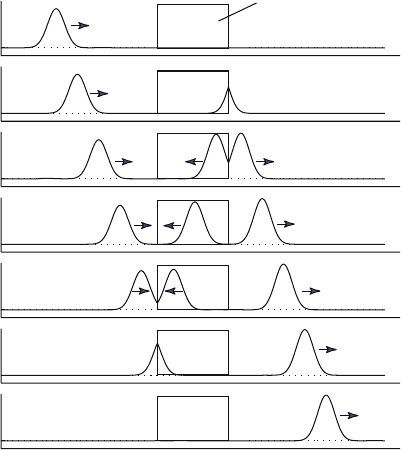
negative. Figure 7.2 shows a numerical simulation of the propagation of a pulse
through a material possessing a negative value of the group velocity. The influence
of gain, absorption, or group velocity dispersion is not included in this model, and
thus the simulation is based simply on performing a numerical integration of the
reduced wave equation
field amplitude
propagation distance
region of negative
group index
Fig. 7.2 Numerical simulation of pulse propagation through a material with a negative value of
the group velocity
184 R.W. Boyd et al.
∂ A
∂z
−
1
v
g
∂ A
∂t
= 0 (7.1)
for the pulse amplitude A(z, t) for the situation in which the group velocity is neg-
ative. One sees from Fig. 7.2 that the pulse appears to leave the material before
it enters and that the pulse appears to move backward within the material. How
behavior of this sort can possibly be physical and consistent with the concept of
causality is a matter that we will deal with in later sections of this chapter. For the
present, we simply point out that an input pulse in the form of a Gaussian waveform
has wings that extend from plus infinity to minus infinity. In this sense, even in
the top frame of Fig. 7.2, the input pulse already has a contribution at the output,
and there is no possibility for a violation of causality to occur. Alternatively, we
can consider superluminal pulse propagation to represent a special form of pulse
reshaping, in which the pulse form is retained but shifted earlier in time.
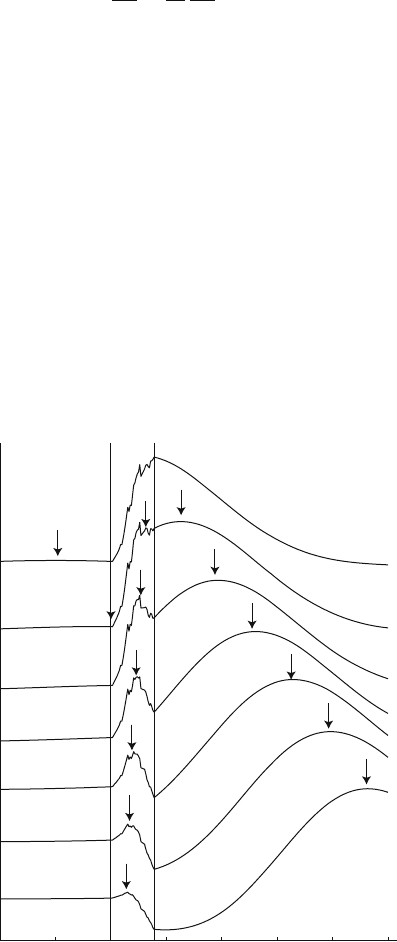
Experimental verification of this sort of behavior has been reported by Gehring
et al. [24] in an experiment that studied pulse propagation through an erbium-doped
optical amplifier. A negative value of the group index was obtained by means of the
CPO effect described above. Some of the experimental results are shown in Fig. 7.3.
0
2 × 10
5
1–1
normalized length |n
g
| z (m)
t=0
t=9 ms
t = 18 ms
t = 27 ms
t = 36 ms
t = 45 ms
t = 54 ms
pulse intensity
Fig. 7.3 Experimental results demonstrating the reality of negative group velocities [24]. The
arrows point to the peak of each pulse
7 Causality in Superluminal Pulse Propagation 185
Note that the peak of the pulse clearly is moving in the backward direction (right to
left) inside the material, even though outside the material the pulse is moving left to
right. Because the experiment was performed through use of an amplifying medium,
the output pulse is larger than the backward-going pulse within the material.
7.4 The Concept of Simultaneity
As we mentioned earlier, a primary concern of this chapter is to examine how the
superluminal pulse propagation can be compatible with the concept of causality. But
to understand what is meant by causality, one must first understand what it means
for events to occur simultaneously. In this section, we present an examination of the
concept of simultaneity. Much of the subtlety involved in considerations of causality
involves the concept of what it means for two events to be simultaneous [52].
We begin by distinguishing local simultaneity from distant simultaneity. There
are subtleties involved in each concept. We first consider the case of local simultane-
ity, as it is the more basic concept. One says that two events, A and B, located at the
same point in space, are simultaneous if they occur at the same time. The subtlety of
this definition is that it presupposes that one understands what one means by time.
If the events are not simultaneous, either A occurs before B or it occurs after B.
The distinction between “before” and “after” implies that there is a direction of the
flow of time. We know from everyday experience that time flows in one direction
(from the past to the future), but this point remains unsettling in part because it is
not obvious what physical process breaks the symmetry between earlier and later
times. This thought can be made more precise by noting that most of the laws of
physics are symmetric upon the reversal of the sign of the time coordinate. The
existence of certain laws which do not obey this property, such as the tendency of
entropy to increase monotonically, may lead to some understanding of the origin of
the direction of the flow of time [53].
In considerations of causality and simultaneity, one conventionally defines an
“event” as a process that occurs at a given location with coordinates x, y, and z at
a given time t. One can thus define an event in terms of its space–time coordinates
(x, y, z, t). As noted above, the time coordinate of the event has a very different
character from the spatial coordinates, in that there is a sense of directionality to the
time coordinate not present in the spatial coordinates.
So how does one define time? One definition is that put forth by Kant, as reported
by Jammer [52]. Kant says that if event A could cause event B, then A is said to
occur before B. This thought is very much consistent with modern views of phys-
ical causality, but has the disadvantage that one cannot then examine the relation
between causality and the flow of time if time has been defined in terms of causality.
Perhaps a better procedure is to follow the lead of Einstein and define time simply
to be what a clock measures. We assume that we place a “clock” at the point (x,
y, z) and define the unit of time to be the interval between successive ticks of the
clock. From this point of view, a good clock is one for which the laws of classical
186 R.W. Boyd et al.
mechanics are well satisfied with time defined in this manner. To summarize this
point, we conclude that two events both occurring at the same spatial point (x, y, z)
are said to be simultaneous if both events occur at the same time t, with t defined as
above.
Somewhat more subtle is the concept of distant simultaneity. The underlying
question here is, what does it mean for two events to be called simultaneous if
they do not occur at the same point in space? Philosophical discussion of this point
goes back at least as far as the golden age of Greece. This issue certainly possesses
a technological component (How could one hope to measure distant simultaneity
without the help of reliable clocks?), but also addresses the conceptual issue of what
it means for two separated events to be said to be simultaneous.
One impetus for these discussions occurred within the field of astrology, which
holds that one’s future depends on the configuration of the stars and planets at the
time of one’s birth. It thus became important to know the state of the heavens at
the moment of a child’s birth, even if the heavens were obscured by cloud cover
or rendered unobservable by daylight. It is interesting to note that Saint Augustine
argued against the validity of astrology by means of the following argument [54].
He considered the hypothetical situation in which two women located in different
households were to give birth at approximately the same time. One woman had
great wealth, whereas the other was a servant. The child of the wealthy woman
would almost certainly be more successful in life than the child of the poor woman.
If these children were born simultaneously, this occurrence would contradict the
predictions of the laws of astrology. But how would one establish the simultaneity
of the two births, occurring at separated points? In a manner that foreshadows that of
Einstein some 1500 years later, Augustine proposes the following procedure. Two
messengers are employed and they are selected so that they run at the same speed.
One messenger is stationed near each expectant mother, and at the moment that
the child is born the messenger is told to run to the other household to announce
the birth. If the messengers meet en route, the exact location of their meeting is
recorded, and if this spot is exactly equidistant between the two households the
births are said to have occurred simultaneously.
Within modern physics, one defines distant simultaneity in terms of synchro-
nized clocks. One assumes that two clocks of identical construction are located at
spatial points A and B. Being of identical construction, these clocks are, therefore,
assumed to run at the same rate. If the clocks can be synchronized, then the concept
of distant simultaneity becomes meaningful, in the sense that two events are said to
be simultaneous if the event at A occurs at a time measured by the clock at A, that
is, the same time as the time of event at B as measured by the clock at B.
Eddington [55] describes two possible procedures for synchronizing distant
clocks. One method is to transport clock A to point B, set the clocks to read the
same time, and then transport clock A back to its original location. Of course, an
auxiliary clock can alternatively be used for this purpose. Because of relativistic
time dilation, the clock needs to be moved very slowly in order for this procedure to
be valid. In principle, one can always perform this procedure, because time dilation
effects are second order in the ratio ν/c (here ν is the velocity of the clock), whereas
7 Causality in Superluminal Pulse Propagation 187
the time required for the transport scales as 1/v. This method also presupposes that
the clock maintains its accuracy during the time intervals of acceleration needed to
change its velocity.
The second method, described by Einstein in his 1905 paper, is based on signal-
ing using light beams. Several variations of this method exist. One is for A to send
a light pulse to B, where it is reflected back to A. B sets its clock to some reference
time (for instance t = 0) at the moment that the pulse arrives at B. A waits until the
light pulse returns, and then sets its clock to the reference time at a moment exactly
halfway between the time t
1
at which the pulse left A and the time t
2
at which the
pulse returned. Many authorities have argued that while this procedure provides an
acceptable procedure for synchronizing the two clocks, the synchronization thus
achieved is simply one of arbitrary convention. They argue that A could set the
reference time of its clock to any time in the interval (t
1
, t
2
) and thereby establish an
entirely consistent form of clock synchronization. The reason for this arbitrariness
is that there appears to be no definitive proof that the velocity of light c
+
along the
positive x-direction (for instance) is the same as the velocity c
−
along the negative
x-direction. The argument is that measurements of the velocity of light actually
yield only the average of c
+
and c
−
, and it is this quantity that is conventionally
known as c. This unexpected conclusion follows from the fact that it is possible to
measure the one-way velocity of light only if one already has synchronized clocks
at both ends of the beam path, which cannot be possible if one’s intent is to develop
a procedure for clock synchronization.
7.5 Causality and Superluminal Pulse Propagation
The key to understanding why fast-light pulse propagation is consistent with the
special theory of relativity is to investigate what is meant by a signal, as described
above in Sect. 7.2 and its connection to an event. In Einstein’s public discussions
of the theory [56], he focuses on the concept of an “event,” such as a spark caused
by a lightning bolt, and how the event (or multiple events) would be observed by
people at various locations. He was especially interested in observers moving with
respect to a coordinate system that is stationary with respect to the events. A detailed
description of his findings is not needed for our present discussion, as it is necessary
to consider only the properties of a single event in a single coordinate system.
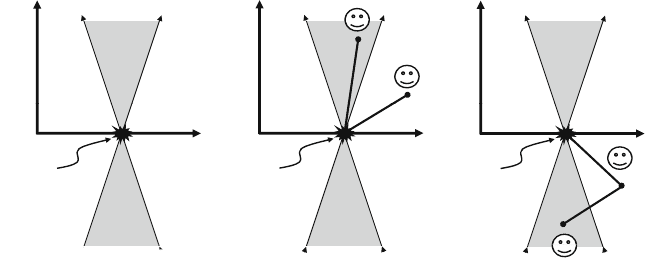
A convenient way to discuss the flow of information from an event is to use
a space–time diagram (Minkowski diagram), where the horizontal axis is a single
spatial coordinate and time is plotted along the vertical axis (see Fig. 7.5). Accord-
ing to the special theory of relativity, the fastest way that knowledge of the event
can reach an observer is if it travels at the speed of light in vacuum; the lines that
connect points in a space–time diagram that follow vacuum speed-of-light propa-
gation define the light cone – the shaded region in Fig. 7.5(a). The inverse of the
slope of lines drawn in a space–time diagram is equal to the velocity. Observers at
space–time points within the shaded cone (e.g., observer A in Fig. 7.5(b)) are able
188 R.W. Boyd et al.
to see the event and those outside the cone cannot (e.g., observer B in Fig. 7.5(b)).
Note that the cone extending for times preceding the event represents the space–time
regions where light could reach the location of the event. That is, an observer (not
shown) in this region can affect the event but cannot see the event.
On the other hand, hypothetical faster-than-light propagation of information is
relativistically acausal. Acausal means that there is no direct time-ordered link
between a cause and an effect. An example of a hypothetical faster-than-light com-
munication scheme is shown in Fig. 7.5(c), where we assume that it is possible
to transmit information with a speed that is less than zero (negative velocity). If
such superluminal signal was possible, information could be transmitted from the
positive-time light cone to a person at position D. This observer could change the
outcome of the event (e.g., prevent it from happening) because she is located within
the light cone leading to the event, but at a time before the event happens. Thus, she
can change the outcome of the event.
t
t
A
t
a)
b)
c)
A
x
event
x
event
B
x
event
C
D
Fig. 7.4 The light cone associated with an event. (a) Space–time diagram of an event. (b) Observers
at space–time points A and B. In a world that is relativistically causal, A observes the event, but
B does not. (c) Communication in a hypothetical acausal world. If relativistic causality could be
violated, a person at C could observe the event and transmit information to a person at D using a
superluminal communication channel. The person at D could then change the outcome of the event
To address whether fast-light pulse propagation provides a mechanism for rela-
tivistically acausal communication, it is necessary to define a signal. As discussed
briefly in Sect. 7.2, Sommerfeld [30] defined a “signal” as a wave that is initially
zero and suddenly turns on to a finite value, which is known as a step-modulated
pulse. In terms of the special theory of relativity, the moment that the wave turns on
corresponds to the event.
In an analysis conducted by Sommerfeld and Brillouin [30], they used Maxwell’s
equations to predict the propagation of a step-modulated electromagnetic wave,
which was coupled to a set of equations that described how it modifies the dis-
persive material. For the dispersive material, they assumed that it consisted of
a collection of Lorentz oscillators. A Lorentz oscillator is a simple model for
7 Causality in Superluminal Pulse Propagation 189
an atom that describes its resonant behavior when interacting with light. Each
oscillator consists of a massive (immoveable) positive core and a light negative
charge that experiences a restoring force obeying Hooke’s Law. Furthermore, they
assumed that the negative charge experiences a velocity-dependent damping so that
any oscillations set in motion will eventually decay in the absence of an applied
field.
Conceptually, an incident electromagnetic wave polarizes the material (causes
a displacement of the negative charges away from their equilibrium position), and
this polarization acts back on the electromagnetic field to change its properties (e.g.,
amplitude and phase). The coupled Maxwell–Lorentz-oscillator model is known
to possess spectral regions of anomalous dispersion where the group velocity υ
g
takes on negative values or values greater than c thus should be able to address the
controversy. The model is so good that it is still in use today for describing the linear
optical response of dispersive materials.
Using asymptotic methods to solve the pertinent inverse Fourier integral, Som-
merfeld was able to predict what happens to the propagated field for times immedi-
ately following the sudden turn-on of the wave, that is, what happens in the vicinity
of the pulse front. He was able to show that the velocity of the front is always equal
to c. In other words, the front of the pulse coincides with the boundary of the light
cone shown in Fig. 7.5, even though the pulse is propagating through the dispersive
dielectric material.
Sommerfeld gave an intuitive explanation for his prediction. When the electro-
magnetic field first starts to interact with the oscillators, they cannot immediately
act back on the field via the induced polarization because they have a finite response
time. Thus, for a brief moment after the front passes, the dispersive material behaves
as if there is nothing there – as if it were vacuum. From the point of view of infor-
mation propagation, one should be able to detect the field immediately following
the front and hence observe information traveling precisely at c.
After the front passes, mathematical predictions are very difficult to make because
of the complexity of the problem. Brillouin extended Sommerfeld’s work to show
that the initial step-modulated pulse, after propagating far into a medium with a
broad resonance line, transforms into two wavepackets (now known as optical pre-
cursors) and is then followed by the bulk of the wave (what Brillouin called the
“main signal”). They found that the precursors tend to be very small in amplitude
and thus it would be difficult to measure information transmitted at c; rather, it
would be easiest to detect at the arrival of the main signal, which they found travels
slower than c. The term precursor is somewhat confusing because it implies that the
wavepacket comes before something; in this usage, the precursors come before the
main signal, but after the pulse front.
One aspect of Sommerfeld and Brillouin’s result that can lead to confusion is the
possible situation when one or more of these wavepackets travel faster than c. What
is implied here is that a velocity can be assigned to the precursors and the main
signal to the extent that they do not distort and that these velocities can all take on
different values. In a situation where the velocity of a wavepacket exceeds c, it will
eventually approach the pulse front (which travels at c), become much distorted (so
190 R.W. Boyd et al.
emitted waveform
transmitter
transmitter
transmitter
receiver
receiver
receiver
vacuum propagation
fast-light propagation
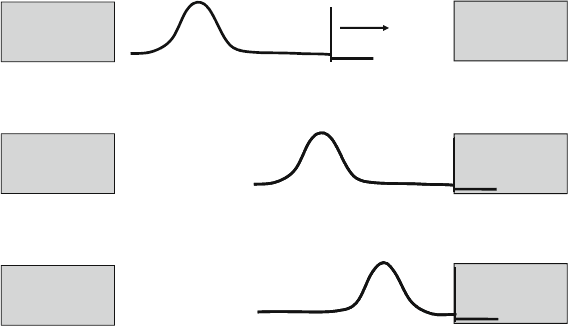
Fig. 7.5 In a typical experiment, the emitted waveform has the shape of a well-defined pulse.
Nonetheless, the waveform has a front, the moment of time when the intensity first becomes non-
zero. When such a waveform passes through a fast-light medium, the peak of the pulse can move
forward with respect to the front, but can never precede the front. Thus, even though the group
velocity is superluminal, no information can be transmitted faster than the front velocity, which is
always equal to c
that assigning it a velocity no longer makes sense), and either disappear or pile up
at the front.
Sommerfeld and Brillouin’s research appeared to satisfy scientists in the early
1900s that “fast light” does not violate the special theory of relativity. Yet there
continue to be researchers who question various aspects of their work. One point of
contention is that some people believe that it is impossible to generate a waveform
in the lab that has a truly discontinuous jump (e.g., there is no electromagnetic field
before a particular time and then a field appears). Yet having something appear at a
particular space–time point is precisely what is meant by an event described above.
Thus, if one does not believe in discontinuous waveforms, then the very conceptual
framework of the special theory of relativity and the associated light cone shown
in Fig. 7.5 would need to be thrown out. Many scientists are unwilling to do so.
Also, the existence of optical precursors has been questioned because Sommerfeld
and Brillouin made some mathematical errors in their analysis concerning the prop-
agated field for times well beyond the front, although recent research suggests that
precursors can be readily observed in experimental setups similar to that used in
recent fast-light research [44, 57].
So how can the data shown in Fig. 7.1 be consistent with the special theory of
relativity? To answer this question, we need to make a connection between Som-
merfeld’s idea of a signal and the data shown in the figure. In the experiment, a
pulse was generated by opening a variable-transmission shutter (an acousto-optic
modulator); only a segment of the pulse is shown in the figure. At an earlier time
not shown in the figure, the light was turned from the off state to the on state, but
7 Causality in Superluminal Pulse Propagation 191
with very low amplitude. The moment the light first turns on coincides with the
pulse front (the event). At a later time, the pulse amplitude grows smoothly to the
peak of the pulse and then decays.
As far as information transmission is concerned, all the information encoded on
the waveform is available to be detected at the pulse front (although it might be
difficult to measure in practice). The peak of the pulse shown in Fig. 7.5 contains no
new information. Thus, the fact that the peak of the pulse is advanced in time is not
a violation of the special theory of relativity, so long as it never advances beyond
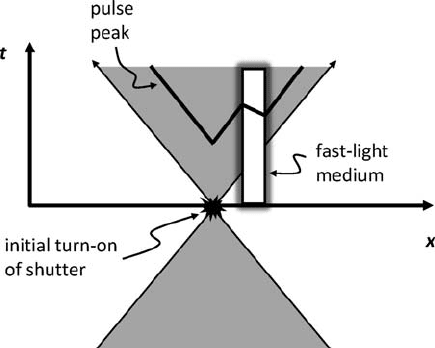
the pulse front. Figure 7.6 shows a schematic of the light cone for such a fast-light
experiment.
Fig. 7.6 Pulse propagation in a fast-light medium with a negative group velocity. The space–time
diagram shows that the peak is advanced as it passes through the medium, but the pulse front
is unaffected. The opening angle of the light cone is drawn differently from that in Fig. 7.5 for
illustration purposes only
In our opinion, all experiments to date are consistent with the special theory of
relativity, even though it may be difficult to show this. In some experiments, the
pulse shape is such that it is exceedingly difficult to detect the pulse front and hence
it may appear that the special theory has been violated. In other experiments espe-
cially designed to accentuate the pulse front, it has been shown that the information
velocity is equal to c within the experimental uncertainties in both fast-light [42]
and slow-light regimes [43].
7.6 Quantum Mechanical Aspects of Causality and Fast Light
Quantum mechanics provides a mechanism that at first glance seems to imply the
possibility of superluminal communication, even for propagation through vacuum.
This mechanism is the simultaneous collapse of the wave function at all points in
192 R.W. Boyd et al.
space caused by a measurement performed on the system at one particular point in
space. This is an effect that does not occur in classical physics and hence deserves
further consideration with regard to the possibility of superluminal communication.
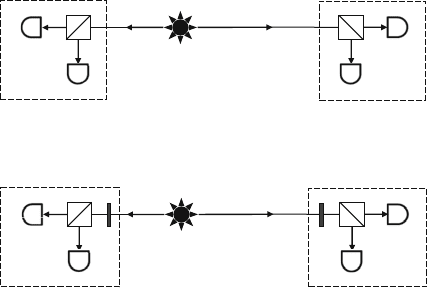
Let us consider a hypothetical superluminal communication system based on
this effect [58–60], as illustrated in Fig. 7.7. We consider entangled particles gener-
ated by an Einstein–Podolsky–Rosen (EPR) source. For concreteness, we consider
a system that generates two correlated photons that travel in opposite directions and
carry zero total spin angular momentum. Furthermore, two observers, Alice and
Bob, are located on opposite sides of and at large distances from the source. They
are equipped with optical components that can analyze the state of polarization of
the arriving photons. Bob is slightly further away from the source than Alice, and
we want to establish a one-way superluminal communication link from Alice to
Bob.
Entangled-Photon
Source
Alice
Bob
H
V
H
V
Entangled-Photon
Source
Alice
Bob
R
L
R
L
λ/4
λ/4
Linear Basis
Circular Basis
Fig. 7.7 Potential superluminal quantum communication scheme. A source produces pairs of
entangled photons, where one photon is sent to Alice and the other to Bob. In the linear mea-
surement basis, a polarizing beam splitter and two single-photon detectors determine whether
the photons are horizontally (H) or vertically (V) polarized. In the circular measurement basis, a
quarter-wave plate is inserted before the beam splitter, allowing for the measurement of left (L) or
right (R) circularly polarized photons. Bits are communicated by inserting or not the quarter-wave
plate in the setups, as described in the text
In one scenario, Alice places a polarizing beam splitter that spatially separates
one state of linear polarization (say vertical, V ) from the other state of polarization
(horizontal, H). The output ports of the polarizing beam splitter are directed to
single-photon detectors. Bob has an identical apparatus, which is at a great distance
from Alice, and he aligns the axis of his polarizing beam splitter the same as Alice’s.
Because of the fact that their total angular momentum of the photons is zero, when-
ever Alice measures V , the bi-photon wave function collapses and Bob is assured
of measuring H essentially instantaneously after Alice performs her measurement.