
Muga G. Time in Quantum Mechanics - Vol. 2
Подождите немного. Документ загружается.

12 Optimal Time Evolution for Hermitian and Non-Hermitian Hamiltonians 347
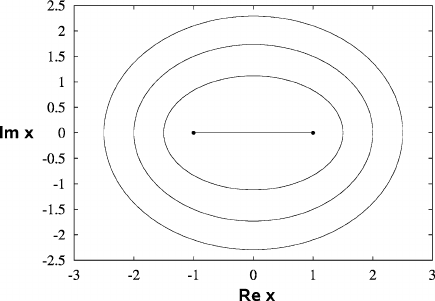
Fig. 12.1 Classical trajectories in the complex-x plane for the harmonic oscillator whose Hamil-
tonian is H = p
2
+ x
2
. These trajectories represent the possible paths of a particle whose energy
is E = 1. The trajectories are nested ellipses with foci located at the turning points at x =±1. The
real line segment (degenerate ellipse) connecting the turning points is the usual periodic classical
solution to the harmonic oscillator. All closed paths have the same period 2π
x = a. This trip will take less time because the particle travels faster along the
ellipse in the complex plane.
We have arrived at the surprising conclusion that if the classical particle enters
the parabolic potential V (x) = x
2
immediately after it begins its voyage up the real
axis, its time of flight will be exactly half a period, or π . Indeed, by traveling in the
complex plane, a particle of energy E = 1 can go from the point x =−a to the
point x = a in time π, no matter how large a is. Evidently, if a particle is allowed to
follow complex classical trajectories, then it is possible to make a drastic reduction
in its time of flight between two given real points.
12.4 Hermitian Quantum Brachistochrone
The quantum brachistochrone problem, as described briefly in Sect. 12.1, is similar
to the classical counterpart except that the optimization takes place in a Hilbert
space. Specifically, we are given a pair of quantum states, an initial state |ψ
I
and
the final state |ψ
F
, and we would like to find the one-parameter family of unitary
operators {U
t
} that achieves the transformation |ψ
I
→|ψ
F
=U
t
|ψ
I
in the
smallest possible time t. Since a one-parameter family of unitary operators can be
formed in terms of a Hermitian operator H as U
t
= exp(−iHt/), the problem
is equivalent to finding the Hermitian operator H that realizes the transformation
|ψ
I
→|ψ
F
in the shortest possible time.
The Hermitian operator H can be thought of as representing the Hamiltonian, so
the quantum brachistochrone problem is equivalent to finding the optimal Hamil-
tonian H satisfying exp(−iHt/)|ψ
I
=|ψ
F
. However, it is intuitively clear that
if we are allowed to have access to an unbounded energy resource, then the time

348 C.M. Bender and D.C. Brody
required for the relevant transformation, irrespective of whether the Hamiltonian is
optimal or not, can be made arbitrarily small. Hence, for a quantum brachistochrone
problem to possess a nontrivial solution, some form of constraint is needed. The
simplest constraint is to assume that the energy is bounded so that the difference
between the largest and the smallest energy eigenvalues has a fixed value ω:
E
max
− E
min
= ω. (12.4)
A short calculation shows that if the Hamiltonian H is bounded, then (i) the standard
deviation of the energy is bounded according to
ΔH ≤
1
2
(E
max
− E
min
) , (12.5)
and (ii) the state with maximum energy uncertainty is (|E
max
+|E
min
)/
√
2. It
follows that the energy constraint (12.4) is equivalent to a constraint on energy
uncertainty.
The brachistochrone problem of this type has been analyzed recently and a solu-
tion was obtained by means of a variational method [27]. It has also been solved in
terms of a more elementary approach making use of the geometry of quantum state
space [20, 21]. We shall follow closely the latter approach here.
Let us now state the simplest form of the quantum brachistochrone problem:
We have a quantum system represented by an N -dimensional Hilbert space H and
a prescribed pair of states |ψ
I
and |ψ
F
on H. The problem is (a) to find the
Hamiltonian H satisfying the constraint (12.4) such that the unitary transformation
exp(−iHt/)|ψ
I
=|ψ
F
is achieved in the shortest possible time and (b) to find
the time required to realize such an operation.
A little geometric intuition allows us to find the solution to this problem with
minimum effort. Recall that the time required for transporting a state along a path in
His given by the distance divided by the speed. Hence, all we have to do is first iden-
tify the shortest path and measure its length and then allow the state to evolve along
the path with the greatest possible speed without violating the constraint (12.4).
In quantum mechanics the notion of distance is closely linked to the notion of
transition probability [22, 43]. In particular, by looking at the transition probability
between neighboring states we can derive the expression for the metric on the space
of quantum states. This allows us to measure distances between states. The idea can
be sketched as follows: Consider a state |ψin Hand a neighboring state |ψ+|dψ.
The transition probability between these states is
cos
2
1
2
ds
=
(ψ|+dψ|)|ψψ|(|ψ+|dψ)
ψ|ψ(ψ|+dψ|)(|ψ+|dψ)
, (12.6)
where ds defines the line element on the space of pure states. By using
cos
2
1
2
ds
≈ 1 −
1
4
ds
2
, (12.7)

12 Optimal Time Evolution for Hermitian and Non-Hermitian Hamiltonians 349
expanding the right side of (12.6), and retaining terms of quadratic order, we find
that the line element is
ds
2
= 4
ψ|ψdψ|dψ−ψ|dψdψ|ψ
ψ|ψ
2
. (12.8)
This line element is known in geometry to arise from the Fubini–Study metric [47]
and it can be used to measure the distance of the shortest path joining a pair of points
on the space of pure quantum states.
If the Hilbert space is two dimensional, then a generic normalized state vector
|ψ can be expressed in the form
|ψ=
⎛
⎝
cos
1
2
θ
sin
1
2
θ e
iφ
⎞
⎠
. (12.9)
A short calculation then shows that the Fubini–Study line element (12.8) reduces in
this case to the expression
ds
2
= dθ
2
+sin
2
θ dφ
2
, (12.10)
which we recognize as the line element on the Bloch sphere S. (The Bloch sphere
is the state space of two-level systems.)
In the case of an N-dimensional Hilbert space H, if we are given a pair of dis-
tinct states |ψ
I
and |ψ
F
, then the linear span of these two states forms a two-
dimensional subspace of H. It should be intuitively clear that the shortest path join-
ing |ψ
I
and |ψ
F
should lie on this two-dimensional subspace. Thus, irrespective of
the dimensionality of H the solution to our quantum brachistochrone problem can
be obtained by analyzing the two-dimensional subspace spanned by |ψ
I
and |ψ
F
.
Even when we restrict our attention to this subspace, there still remain infinitely
many unitary orbits that realize the transformation |ψ
I
→|ψ
F
=U
t
|ψ
I
.How-
ever, since the two-dimensional state space is just the Bloch sphere S endowed with
the spherical metric (12.10), we see that there is a unique great circle arc that joins
|ψ
I
and |ψ
F
on S. (This assumes, of course, that |ψ
I
and |ψ
F
are not antipodal
points of the sphere. Otherwise, there are infinitely many such paths.) In this way
we have identified the shortest path joining |ψ
I
and |ψ
F
. The shortest distance
s
min
between these two points of S is thus given by
s
min
= 2 arccos
|ψ
I
|ψ
F
|
√
ψ
I
|ψ
I
ψ
F
|ψ
F
. (12.11)
This result can also be obtained by integrating the line element (12.10) along the
great circle arc on S.
Having obtained the distance of the shortest path we proceed to find the max-
imum speed at which the state can evolve unitarily. For the evolution of the state

350 C.M. Bender and D.C. Brody
we must consider the general Schr
¨
odinger equation, but we also need to express the
equation in the correct form. This is the so-called modified Schr
¨
odinger equation
d|ψ
t
dt
=−
i
˜
H|ψ
t
. (12.12)
In this equation the mean-adjusted Hamiltonian
˜
H is given by
˜
H = H −H , (12.13)
where
H=
ψ|H|ψ
ψ|ψ
. (12.14)
Note that
˜
H=0 and that according to (12.12) the tangent vector
d
dt
|ψ
t
is every-
where orthogonal to the direction of the state [46]. Since the energy expectation H
depends on the state |ψ, the modified Schr
¨
odinger equation appears to be nonlinear.
However, this is not the case. The point is that the expectation value of the Hamil-
tonian is a constant of the motion under the Schr
¨
odinger dynamics. Thus, given the
initial state |ψ
I
, we calculate H in this state and subtract this number from the
Hamiltonian. Since the Hamiltonian in quantum mechanics is defined only up to
an additive constant, this modification does not alter the physics in any way. It is
worthwhile noting that the modified Schr
¨
odinger equation (12.12) is canonical and
reduces to the standard eigenvalue problem when the state |ψ
t
is time independent
without one having to evoke the correspondence principle [22].
If the initial state vector |ψ
I
is normalized, then the evolution (12.12) preserves
the norm. It follows that ψ|dψ=0. Since the speed v of quantum evolution is
given by v = ds/dt, we find from (12.8) and (12.12) that
v
2
=
4
2
ψ
t
|(H −H)
2
|ψ
t
=
4
2
ψ
I
|(H −H)
2
|ψ
I
. (12.15)
This shows that the speed of quantum evolution is given by the energy uncer-
tainty. The expression (12.15) for the speed of quantum evolution is known as
the Anandan–Aharonov relation [1]. Since we know from (12.5) that under the
constraint (12.4) the energy uncertainty ΔH is bounded by
1
2
ω, we find that the
maximum speed of quantum evolution is given by
v
max
=
ω
. (12.16)
By using the results in (12.11) and (12.16) we deduce that the minimum time
required for realizing the unitary transportation |ψ
I
→|ψ
F
=U
t
|ψ
I
is given
by the ratio s
min
/v
max
. In particular, if |ψ
I
and |ψ
F
are orthogonal, then they
correspond to antipodal points on the Bloch sphere S, and we have s
min
= π .In
12 Optimal Time Evolution for Hermitian and Non-Hermitian Hamiltonians 351
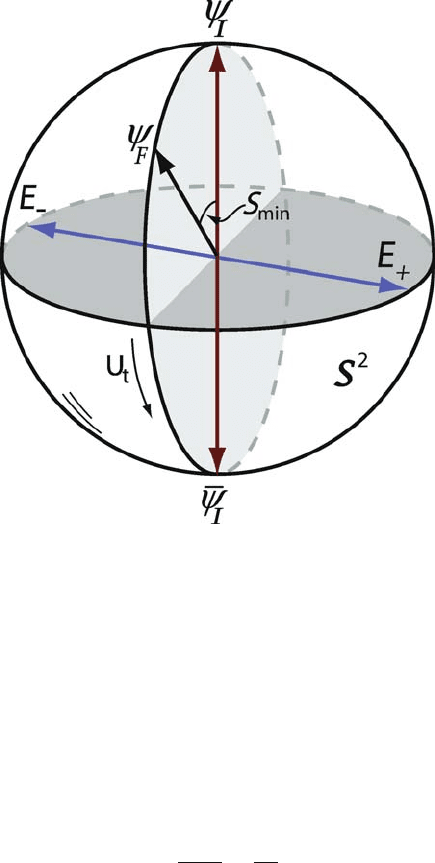
Fig. 12.2 (Color online) Optimal Hamiltonian for quantum state transportation. The two-
dimensional complex Hilbert space spanned by the initial state |ψ
I
and the final state |ψ
F
can be
visualized in real terms as a Bloch sphere S. The two states |ψ
I
and |ψ
F
can then be identified
as a pair of points on S. Assuming that these two points are not antipodal, there exists a unique
great circle arc joining these two points, which determines the shortest path joining the two states.
The optimal way of unitarily transporting |ψ
I
into |ψ
F
is therefore to rotate the sphere along the
axis orthogonal to the great circle. The axis of rotation then specifies two quantum states: |E
−
and
|E
+
. These states are the eigenstates of the optimal Hamiltonian H
this case, the minimum time required to orthogonalize the state (that is, for the state
to evolve into a new state that is orthogonal to the original state) is known as the
passage time τ
P
[19, 59]. The passage time is explicitly
τ
P
=
π
2ΔH
=
π
ω
. (12.17)
The passage time (12.17) provides the bound in Hermitian quantum mechanics for
transporting a state into an orthogonal state and is sometimes referred to as the
Fleming bound [33].
The ratio s
min
/v
max
gives the solution to part (b) of our quantum brachistochrone
problem. To solve part (a), that is, to find the optimal Hamiltonian, we argue as
follows: Since the problem is confined to a two-dimensional subspace of H,the
solution can be obtained by elementary trigonometry on the Bloch sphere S.The

352 C.M. Bender and D.C. Brody
key idea is to recall that the shortest path joining |ψ
I
and |ψ
F
is a great circle
arc on S. Without loss of generality, we can assume that |ψ
I
and |ψ
F
lie on the
equator of S with respect to a suitable choice of axis. Then, the unitary motion
along the shortest path can be generated by the rotation of S along this axis. Since
the eigenstates of the Hamiltonian H that generates such a rotation correspond to
the antipodal points along this axis, the pair of states |ψ
I
and |ψ
F
can both be
expressed as equal superpositions of the eigenstates of H with the relative phase
shifted by s
min
. Writing |E
+
and |E
−
for the normalized eigenstates of H and
using α = s
min
/2, we can express the initial and final states in the form
1
√
2
|E
−
+e
−iα
|E
+
=|ψ
I
and
1
√
2
|E
−
+e
iα
|E
+
=|ψ
F
. (12.18)
Solving these equations for |E
+
and |E
−
, we obtain
|E
−
=
i
√
2sinα
e
−iα
|ψ
F
−e
iα
|ψ
I
(12.19)
and
|E
+
=−
i
√
2sinα
|ψ
F
−|ψ
I
. (12.20)
These are the eigenstates of the optimal Hamiltonian H that generate the unitary
motion |ψ
I
→|ψ
F
=U
t
|ψ
I
along the shortest path. The eigenvalues of the
optimal H can be arbitrary as long as condition (12.4) is satisfied. Without loss of
generality, we may assume H to be trace free, and we obtain the solution to part (a)
of the quantum brachistochrone problem:
H =
1
2
ω|E
+
E
+
|−
1
2
ω|E
−
E
−
| . (12.21)
This is the “minimal” solution to the problem in the sense that H acts only on the
two-dimensional subspace of H while leaving the rest of H unperturbed.
As a special example, consider the problem of a spin flip, that is, turning a spin-up
state into a spin-down state unitarily. In this case the initial and final states can be
written as
|ψ
I
=
1
0
and |ψ
F
=
0
1
(12.22)
in the spin-z basis. Substituting these into (12.19) and (12.20), we find that the
eigenstates of the optimal Hamiltonian are
|E
−
=
1
√
2
1
1
and |E
+
=
i
√
2
1
−1
(12.23)
because in this case we have α = π/2. Substituting this result into (12.21) yields

12 Optimal Time Evolution for Hermitian and Non-Hermitian Hamiltonians 353
H =
1
2
0 −ω
−ω 0
(12.24)
for the optimal Hamiltonian. By using the relation
e
iφσ·n
= cos φ1 + isinφσ ·n , (12.25)
where n is a unit vector and
σ
1
=
01
10
, σ
2
=
0 −i
i 0
, σ
3
=
10
0 −1
(12.26)
are Pauli matrices, we obtain the following expression for the optimal unitary oper-
ator:
U
t
=
⎛
⎝
cos
ωt
2
−isin
ωt
2
−isin
ωt
2
cos
ωt
2
⎞
⎠
. (12.27)
It follows at once that the optimal unitary orbit |ψ
t
=U
t
|ψ
I
is given by
|ψ
t
=
&
cos
ωt
2
−isin
ωt
2
'
. (12.28)
We find that the first time at which |ψ
t
reaches |ψ
F
is given by the condition
ωt/2 = π/2, that is, when t = τ
P
, where τ
P
is the passage time given in (12.17).
We have seen how the simplest form of a quantum brachistochrone problem
can be solved in Hermitian quantum mechanics by considering a two-dimensional
Hilbert subspace combined with elementary geometric constructions on it. In a more
general situation the unitary motion may be constrained further so that the opti-
mal Hamiltonian (12.21) may not be implementable. For example, the constraint
may enforce the path of the unitary evolution to lie in a three- rather than two-
dimensional subspace. To determine what happens let us work out the passage time
for this example.
Since in this case the minimal solution H to the brachistochrone problem is a
three-dimensional matrix, we can express the initial state |ψ
I
in terms of the three
eigenstates of H according to
|ψ
I
=cos α|E
i
+sin α cos βe
iφ
|E
j
+sin α sin βe
iϕ
|E
k
, (12.29)
where α, β are angular coordinates, φ, ϕ are phase variables, and we assume that
E
i
< E
j
< E
k
. If a unitary operator U
T
transforms this state into an orthogonal
state, then the condition
cos
2
α +sin
2
α cos
2
βe
−iω
ji
T/
+sin
2
α sin
2
βe
−iω
ki
T/
= 0 (12.30)

354 C.M. Bender and D.C. Brody
must be satisfied, where ω
ji
= E
j
− E
i
and ω
ki
= E
k
− E
i
. To render the anal-
ysis more tractable, we simplify this constraint by assuming that α = β = π/4.
Then (12.30) implies that a necessary condition for the state |ψ
I
to evolve into an
orthogonal state is given by the relation
ω
ki
ω
ji
=
2m − 1
2n − 1
, (12.31)
where m, n are natural numbers such that m = n.
Thus, the solution to the brachistochrone problem must be such that the eigen-
values of H satisfy condition (12.31) as well as the constraint E
max
− E
min
≤ ω.
Assuming that these constraints are indeed satisfied, the initial state evolves into
an orthogonal state |ψ
F
. The first time that |ψ
I
evolves into a state orthogonal to
|ψ
I
, in particular, is given by
T =
π
ω
ji
=
3π
ω
ki
. (12.32)
However, since in this case U
t
|ψ
I
does not describe a geodesic path, T will be
larger than Fleming’s passage time τ
P
given in (12.17). Indeed, without loss of gen-
erality we may set E
i
= 0. Then, it is straightforward to verify that T =
√
6τ
P
.This
follows from the fact that under the constraint ω
ki
= 3ω
ji
that comes from (12.32),
the squared energy dispersion in the state (12.29) with α = β = π/4 is given by
ΔH
2
=
3
2
ω
2
ji
.
12.5 Non-Hermitian Quantum Brachistochrone
We have seen how the solution to the simple brachistochrone problem can be
obtained in the Hermitian quantum theory. What happens if we extend the quantum
theory into the complex domain by looking at a PT-symmetric theory? We saw ear-
lier that in classical mechanics if we were to allow for a complex path interpolating
a pair of real points of the coordinate space, then it is possible (at least mathemati-
cally) to transport a particle across a large distance in virtually no time. It turns out
that an analogous situation emerges in the PT-symmetric theory. Here we present
a simple algebraic calculation of the optimal evolution time from an initial state to
a final state by using a simple 2 × 2 Hamiltonian. As we have remarked above,
the 2 × 2 model suffices to cover general cases because in the case of our simple
brachistochrone problem the solution is found on the two-dimensional subspace of
the Hilbert space spanned by the initial state |ψ
I
and the final state |ψ
F
.Inthe
case of a PT-symmetric Hamiltonian the variational approach gives a more direct
way to handle the brachistochrone problem. Thus, we shall first briefly revisit the
Hermitian case but expressed in the variational formalism and then we will compare
the result to its PT-symmetric counterpart.

12 Optimal Time Evolution for Hermitian and Non-Hermitian Hamiltonians 355
12.5.1 Hermitian 2 × 2 Matrices
We choose a basis so that the initial and final state vectors take the form
|ψ
I
=
1
0
and |ψ
F
=
a
b
, (12.33)
where the condition that |ψ
F
be normalized is |a|
2
+|b|
2
= 1. The most general
2 × 2 Hermitian Hamiltonian is
H =
sre
−iθ
r e
iθ
u
(r, s, u,θreal) . (12.34)
For this Hamiltonian the eigenvalue constraint (12.4) takes the form
ω
2
= (s − u)
2
+4r
2
. (12.35)
To find the optimal Hamiltonian satisfying this constraint, we rewrite H as a
linear combination of Pauli matrices:
H =
1
2
(s +u)1 +
1
2
ωσ·n , (12.36)
where
n =
1
ω
(2r cos θ,2r sin θ,s − u) (12.37)
is a unit vector. Then by the use of identity (12.25) the evolution equation |ψ
F
=
e
−iHτ/
|ψ
I
can be expressed in the form
a
b
= e
−
1
2
i(s+u)t/
⎛
⎝
cos
ωt
2
−i
s−u
ω
sin
ωt
2
−i
2r
ω
e
iθ
sin
ωt
2
⎞
⎠
. (12.38)
The second component of this equation gives |b|=
2r
ω
sin
ωt
2
, which allows us to
find the required time of evolution:
t =
2
ω
arcsin
ω|b|
2r
. (12.39)
We must now minimize the time t over all r > 0 while maintaining the energy
constraint in (12.35). This constraint tells us that the maximum value of r is
1
2
ω.At
this value we have s = u. Because H can be made trace free, we can set s = u = 0.
The variable θ in (12.36) does not affect the eigenvalues, so we may set θ = π. Then
we recover the optimal Hamiltonian obtained in (12.24). As regards the minimum
evolution time τ we have

356 C.M. Bender and D.C. Brody
τ =
2arcsin |b|
ω
. (12.40)
In the special case for which a = 0 and b = 1 so that |ψ
I
and |ψ
F
are orthogonal,
we recover the passage time τ = τ
P
= π/ω, the smallest time required for a spin
flip .
Although the form of the result in (12.40) resembles the statement of the uncer-
tainty principle, it is merely the statement indicated above that rate ×time=distance;
the maximum speed of evolution is given by ΔH, and the distance between |ψ
I
and |ψ
F
, assuming they are normalized, is given by 2 arccos(|ψ
F
|ψ
I
|). Since
|ψ
F
|ψ
I
| = |a| and |a|=
/
1 −|b|
2
, we obtain (12.40) from the relation
arccos
/
1 −|b|
2
= arcsin|b| . (12.41)
12.5.2 Non-Hermitian 2 × 2 Matrices
We now show by direct calculation that for a PT-symmetric Hamiltonian, τ can be
arbitrarily small. This is because a PT-symmetric Hamiltonian whose eigenvalues
are all real is equivalent to a Hermitian Hamiltonian via
˜
H = e
−Q/2
He
Q/2
, where
Q is Dirac Hermitian. The states in a PT-symmetric theory are mapped by e
−Q/2
to the corresponding states in the Dirac Hermitian theory. But, the overlap distance
between two states does not remain constant under a similarity transformation. We
can exploit this property of the similarity transformation to overcome the Hermitian
lower limit on the time τ . (The detailed calculation is explained in [14].)
We consider the general class of PT-symmetric 2 × 2 Hamiltonians having the
form
H =
r e
iθ
s
sre
−iθ
(r, s,θreal) . (12.42)
The time-reversal operator T performs complex conjugation and the parity operator
in this case is given by
P =
01
10
. (12.43)
The two eigenvalues
E
±
= r cos θ ±
/
s
2
−r
2
sin
2
θ (12.44)
are real if s
2
> r
2
sin
2
θ. This inequality defines the region of unbroken PT sym-
metry. The unnormalized eigenstates of H are