
Muga G. Time in Quantum Mechanics - Vol. 2
Подождите немного. Документ загружается.

368 R. Wynands
1960 1970 1980 1990 2000 2010
−30
−20
−10
0
Year
Time difference (s)
UT1 − TAI
UTC − TAI
)
(
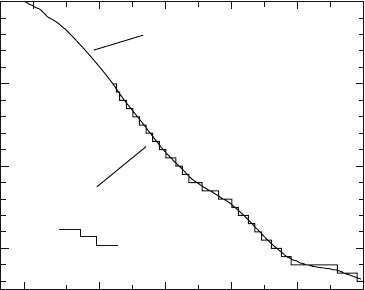
Fig. 13.3 The difference between UTC and TAI over the last decades (step-like curve)andthe
time lag of Earth’s rotation phase UT1 with respect to TAI (smooth curve). The data beyond July
2008 are an extrapolation calculated by IERS
accuracy over more than a few months. A leap second is announced about half a year
in advance by a bulletin of the International Earth Rotation and Reference Systems
Service (IERS) [8]. For instance, Issue 36 of Bulletin-C of the IERS published on
04 July 2008 announces another leap second at 23:59:60 h UTC on 31 December
2008 [14]. From then on UTC will lag TAI by 34 s – until the next leap second.
More information on the history and present situation regarding timescales can
be found in a review [15].
13.3 What Is a Clock?
From the clock-maker’s perspective, which we are assuming in this chapter, a prac-
tical description of a clock is this: It is a combination of a frequency standard and
a counter. The frequency standard (think of the pendulum in a pendulum clock)
provides a periodic sequence of events with a period of known length. The counter
(the clockwork consisting of cogs and wheels in the case of a pendulum clock)
counts the number of oscillation periods that have passed since some initial moment
in time and translates this into a suitable display of the passing of time, for instance,
by moving clock hands around a dial.
In the example of a quartz wrist watch the frequency standard is formed by a
specially shaped quartz crystal oscillating at 32,768 Hz. The counter is an electronic
circuit that counts off 32,768 periods and then advances the display by 1 s. Even
the good old hour glass fits the above definition. The period is given by the time
the grains of sand or egg shell need to trickle through into the lower compartment,
while the counting is done by a human operator reversing the hour glass once all
grains have trickled through.
13 Atomic Clocks 369
All the clockmaker’s expertise goes into ensuring that the period of the frequency
standard remains constant, not only when the clock itself ages but also when the
conditions around it change. For instance, in an ill-constructed pendulum clock the
oscillation period might increase when a temperature rise leads to a lengthening of
the pendulum. Issues of air pressure, humidity and also aging properties of materials
and greases need to be taken into account and compensated. In an atomic clock,
other effects can lead to a change of the period, like changes in magnetic fields or
collisions of atoms among themselves or with the walls of a container.
Let us define a few technical terms here for use in the remainder of this chapter
(for the full formal definitions of metrological terms, see [16]). When the clock
period is different from its nominal value, this is called a frequency bias. Such a
bias is typically caused by a systematic effect, for instance, by the Zeeman effect
shifting an atomic energy level in the presence of a magnetic field. The uncertainty
of a frequency standard describes how sure we can be that the period matches its
expected or nominal value, for instance, how well a clock reproduces the length
of the SI second. Of course there will always be a certain amount of period-to-
period fluctuation (noise) in the length of the period, as characterized by the standard
deviation of the noise; this is called the instability of the standard. If a clock is
switched off and switched on again at a later time the reproducibility specifies how
well the new clock output frequency matches the previous one; this last parameter
is sometimes called frequency retrace in technical specifications of commercially
available atomic clocks.
The terms primary and secondary frequency standards both denote a device that
has been thoroughly characterized such that all potential frequency biases are either
excluded or, if they cannot be avoided, at least understood so well that one can
correct the standard’s output by a corresponding amount. If such a standard is based
on the very transition used to define the length of the SI second, it is called a primary
standard.
Note that from a pragmatic point of view a clock with a bias is just as usable for
precise timing as a clock without bias, provided the bias is known with sufficient
precision. All one needs to do is to correct the clock’s display by the daily bias
multiplied by the number of days that have passed. This only works as well as the
value of the bias is known – as quantified by the uncertainty of the clock. Deter-
mining and minimizing this uncertainty is perhaps the major task of the atomic
clock-maker: thinking about effects that could lead to a frequency bias, avoiding
them or correcting for them, and ensuring that operating conditions and corrected
frequency biases remain constant.
13.4 How an Atomic Clock Works
Simply put: Just like any other clock! The underlying phenomenon of known
duration in this case is the period of oscillation of an atomic transition moment
between two quantum states or of the electromagnetic wave needed to induce it. The
clockwork in general consists of sophisticated electronic circuitry, although lasers
are coming more and more into play.
370 R. Wynands
oscillator
output
signal
resonance
signal
oscillator
frequency
spectroscopy
detector
servo system
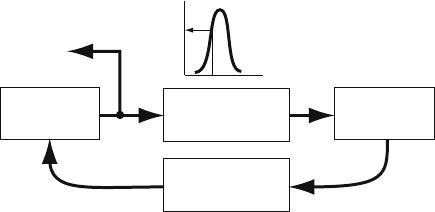
Fig. 13.4 Principle of operation of the atomic frequency standard. The output of an oscillator
probes a spectral feature and a detector registers the response of the system. A servo loop uses this
signal to retune the oscillator to the desired working point along the spectral feature. The external
output of the oscillator is thus referenced to an internal feature of the atom (or molecule or ion)
In an atomic clock the frequency standard is based on a transition between
energy levels in a quantum system, for instance, an atom, an ion or a molecule.
By stabilizing the frequency of an oscillator to this transition frequency one can
counteract technical noise, aging or other sources of drift of the oscillator fre-
quency. Figure 13.4 shows the main principle of operation of such an atomic fre-
quency standard. The oscillator not only provides the output signal of the stan-
dard but also is used to interrogate a spectral feature in the quantum system.
This spectral line is used as a frequency discriminator. A frequency excursion of
the oscillator leads to a change in detected signal. A servo loop then tunes the
oscillator back to the desired working point along the profile of the spectral fea-
ture, for instance an atomic absorption line. The output of the frequency standard
therefore serves as a macroscopic representation of a microscopic property of the
atom in question, for instance, the energy difference between two particular energy
levels.
In order to characterize and quantify the frequency instability of a clock one
could in principle just compute the standard deviation of a sequence of clock read-
ings relative to a perfect (or at least a much better) clock. The smaller the number,
the more stable the clock is. However, using this definition a clock with a very stable
bias would erroneously be assigned a high instability. Even worse, this standard
deviation grows with time!
Instead, the time-and-frequency community uses the two-sample relative Allan
standard deviation σ
y
, or its square, the Allan variance σ
2
y
[17], which will be
described in the following. Consider the sequence of time intervals x
i
between the
“tick” of the clock under test and the “tick” of a perfect clock, taken at regular time
intervals τ . Next compute the normalized instantaneous frequency
y
i
= (x
i+1
− x
i
)/(2πν
0
τ ) , (13.1)
where ν
0
is the clock’s nominal tick frequency. Normalizing the instantaneous fre-
quency by the nominal one has the advantage that the relative stabilities of oscilla-
tors running at very different frequencies can be compared in a meaningful way.

13 Atomic Clocks 371
The variance of the sequence of y
i
estimated from a sample of size N –the
N-sample variance – is
s
2
y
=
1
N −1
A
N
i=1
(y
i
−
¯
y)
2
B
, (13.2)
where
¯
y = (
N
i=1
y
i
)/N is the average value of the instantaneous frequency. For
the characterization of frequency stability it has turned out [17] that the two-sample
variance possesses particularly useful properties. It is obtained by setting N = 2in
Eq. (13.2):
σ
2
y
(τ ) =
1
2
"
(y
2
− y
1
)
2
, (13.3)
where the τ dependence is implicit in the y
i
and the angle brackets indicate the
ensemble average.
Equation (13.3) basically represents (except for the factor of 1/2) the average
value of the squared relative frequency changes from sample point to sample point.
A convenient feature of this definition is that σ
2
y
(τ ), called the Allan variance in
the time-and-frequency community [17], is insensitive to a constant frequency bias
between the reference oscillator and the oscillator under test. In that sense the Allan
variance is a representative measure of the fluctuations of a frequency around its
mean value. The square root of this variance is called the relative Allan standard
deviation (or “Allan deviation” for short). Note that in the special case of pure white
frequency noise σ
y
(τ ) coincides with the standard deviation of the Gaussian distri-
bution describing the frequency fluctuations.
In practice, of course, one does not have an infinite series of measurements x
i
or
y
i
at one’s disposal, so a finite approximation is used:
σ
2
y
(τ ) =
1
2(k −1)
k−1
i=1
(y
i+1
− y
i
)
2
, (13.4)
with k sufficiently large to get a meaningful estimate. Lesage and Audoin have pub-
lished a series of papers dealing with the question of what the uncertainty of that
estimate is [18, 19]. For instance, the relative uncertainty in the case of pure white
frequency noise is
Δ(σ
2
y
)
σ
2
y
=
3k − 4
(k − 1)
2
(13.5)
Δ(σ
y
)
σ
y
=
√
3k − 4
2(k −1)
(13.6)

372 R. Wynands
for the Allan variance and the Allan deviation, respectively. So typically one should
have k ≥ 19 to reach a 20% relative uncertainty for the Allan deviation, which
means a measurement of total duration 20τ .
By looking at the changes in instantaneous frequency from data point to data
point one removes the influence of a constant bias from the estimate σ
y
of the clock’s
instability. Of course, the Allan variance is still influenced by changes of a bias,
for instance, so in general σ
2
y
depends on averaging time τ . For white noise, this
dependence takes the form of τ
−1
for the Allan variance or τ
−1/2
for the Allan
standard deviation . When 1/ f noise is present the Allan deviation will level off at
some higher τ or even start to increase in the case of drift.
For the case of white frequency noise, which should govern the behaviour of a
good primary or secondary frequency standard, the Allan standard deviation can be
written as
σ
y
(τ ) =
1
π
Δν
ν
0
1
S/N
T
cycle
τ
. (13.7)
Here Δν is the width of the atomic transition line of resonance frequency ν
0
, S/N
is the signal-to-noise ratio of the detection process, T
cycle
is the period at which any
corrections to the clock frequency are applied and τ is the averaging time.
It is clear from Eq. (13.7) that it only makes sense to build an atomic clock when
the frequency discriminator has a narrow linewidth Δν. This implies a steep slope at
the side of the resonance (or a sharp extremum at the centre of the resonance when
a modulation technique is used), so that already a very small frequency excursion of
the oscillator gives a detectable signal change.
One also sees that the actual resonance frequency ν
0
should be as high as possi-
ble. The choice of caesium is a good one in this respect because not many elements
provide a conveniently accessible microwave transition at a frequency as high as
9.2 GHz. The influence of ν
0
is one important reason why the clocks of the future
in all probability will be optical clocks. With a ν
0
of hundreds of THz one easily
gains several orders of magnitude compared to caesium. Of course, ν
0
is not the
only factor determining the instability of a clock, and the other factors can work for
or against the various candidate optical clocks. This will be discussed in more detail
in Sect. 13.9.
13.5 The “Classic” Caesium Clock
The publication in 1955 by Essen and Parry [20] is regarded as the birth of the
caesium atomic clock. Performance has greatly increased since then, but the work-
ing principle has remained the same even in today’s commercial caesium-beam
clocks.
13 Atomic Clocks 373
13.5.1 Why Caesium?
Choosing the alkali metal caesium for an atomic clock offers a number of advan-
tages. All radioactive isotopes of caesium have rather short half-lives, so naturally
occurring caesium only contains the only stable isotope,
133
Cs. As an alkali metal,
it has a
2
S
1/2
ground state, which simplifies the hyperfine structure, even though
the nuclear spin is characterized by spin quantum number I = 7/2 (Fig. 13.5).
Since
133
Cs is bosonic there exists a pair of ground states with magnetic quantum
number m
F
= 0. Those two states show a Zeeman frequency shift in response to an
external quasi-static magnetic field only in second order, which allows an essential
relaxation of the experimental requirements for the stability and homogeneity of
such an external field. Due to selection rules this “clock transition” can be induced
only by an alternating magnetic field polarized along an external static magnetic
field.
From Eq. (13.7) we have seen that one wants a transition with a high-resonance
frequency. Caesium is well suited in this regard, because its 9-GHz ground state
hyperfine splitting is among the largest of all elements and not too large to be con-
veniently reached by microwave equipment available in the 1950s when the caesium
clock was invented. As an alkali atom, caesium easily parts with its outer electron, so
a hot-wire ionization detector can provide a high detection efficiency. Other prac-
tical advantages are that caesium can be evaporated at a sufficient rate already at
rather modest temperatures, that caesium is not poisonous and it is readily available,
too.
In retrospect, the choice of caesium was an extremely fortunate one. Cae-
sium arguably is the chemical element that is most easily laser-cooled and laser-
manipulated, due to the fact that its level scheme is rather simple and that the 852-nm
wavelength of its D
2
line falls right into the range where silicon photodiodes are
most efficient and laser diode is available commercially at high powers and with a
F = 3
F = 4
F' = 5
F' = 4
F' = 3
F' = 2
repumping
cooling
6
2
P
3/2
6
2
S
1/2
m = 0
m = 0
clock transition (M1)
m = +3m = −3
m = +4m = −4
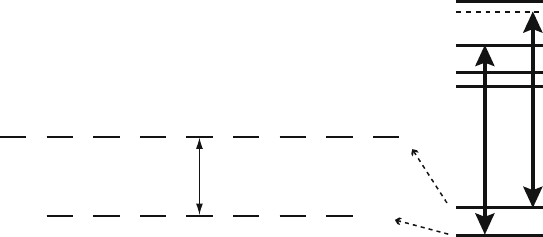
Fig. 13.5 Right: Simplified
133
Cs energy level diagram (not to scale) showing the hyperfine split-
ting of the 6
2
S
1/2
ground state and the 6
2
P
3/2
excited state. The excitation lines for laser cooling
and repumping, used in the caesium fountain clock, are indicated by arrows. Left: Blow-up of the
ground states, indicating the 16 Zeeman sublevels and the clock transition, a magnetic dipole (M1)
transition
374 R. Wynands
narrow linewidth. This has made it possible to switch from the thermal-beam clocks
to be described next to the fountain clocks described further below. The introduction
of fountain clocks reduced the uncertainty in the realization of the length of the SI
second by more than an order of magnitude over the very best thermal-beam clocks,
and perhaps another order of magnitude in the near future. It is hard to imagine a
similar success and a similar improvement in the realization of the unit of time had
Essen and Parry chosen another chemical element for their atomic clock.
13.5.2 The Thermal-Beam Caesium Clock
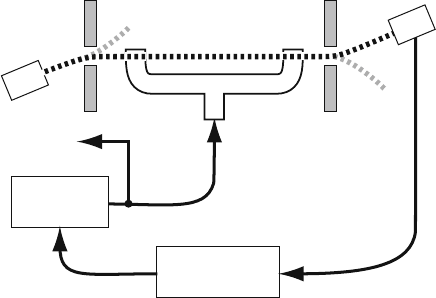
Caesium atoms emanate from an oven at typically 170
◦
C and cross a first inhomo-
geneous magnetic field (Fig. 13.6). In PTB-CS1 and PTB-CS2, for instance, this
field can be produced by a cylindrical quadrupole or a hexapole or a combination of
both. Roughly speaking, atoms in state |F = 4 are collimated by the magnet and
those in |F = 3 defocused and lost from the beam. There are some tricky details
here which are described in the literature (see [21] and references therein).
microwave
oscillator
output
signal
microwave
cavity
oven
detector
polarizer
magnet
analyzer
magnet
servo system
Fig. 13.6 Principle of operation of the “classical” caesium atomic clock making use of a thermal
beam of atoms emanating from an oven. The atoms are spin selected by a multipole magnet, then
traverse a microwave resonator structure, before a second magnet separates the atoms that did make
the transition from those that did not. A servo loop adjusts the microwave frequency such that an
optimum number of atoms arrive at a hot-wire detector. In later versions the magnets and detector
have been replaced by suitable laser excitation zones, the so-called optically pumped thermal-beam
clocks
The net result is that after the magnet the caesium beam is spin polarized and
then crosses the microwave interaction region. The peculiar two-pronged shape of
the microwave cavity is explained in the next section. Note that the microwave inter-
action has to take place inside a resonant cavity because only in this way the phase
13 Atomic Clocks 375
of the microwave radiation can stably be controlled over the whole cross section and
interaction length of the atomic beam.
A second magnet deflects atoms that made the transition to |F =3 onto a hot-
wire detector (“flop-in configuration”), where the atoms are ionized and a small
current (≈ 10 pA) is registered. So the fact that atoms are arriving at the detector is
an indication that the microwave frequency is approximately correct. An electronic
servo loop then adjusts the frequency to the optimum value, as registered in the
detected signal.
The output signal of the clock consists of a microwave signal of frequency 9,
192, 631, 770 Hz. In other words, 1 s is over once the microwave has completed 9,
192, 631, 770 periods of its oscillation – just as the definition of the SI second says.
The microwave signal feeding the cavity for probing of the atomic transition
is typically synthesized from a low-noise voltage-controlled quartz crystal oscilla-
tor (VCO). Usually the VCO is weakly phase-locked to a hydrogen maser which
serves as a frequency reference for the caesium clock. By proper multiplication and
mixing of the VCO frequency with the frequency of a radio frequency synthesizer
the 9.2-GHz microwave signal for the interrogation is generated. By square-wave
frequency modulation of the synthesizer output frequency with an amplitude of half
the linewidth, the atoms are probed alternatively at the left and the right sides of the
resonance line. The difference Δp of the two transition probabilities for each side is
a measure of the offset of the microwave carrier frequency from the centre of the res-
onance line. If it is not 0, the synthesizer frequency is corrected accordingly. In this
case the series of correction values gives the relative frequency difference between
the clock and the frequency reference. Alternatively Δp can be used directly to
control the frequency of a VCO in a servo loop. In this case the VCO output directly
represents the clock frequency.
The measured clock frequency differs from the unperturbed caesium transition
frequency ν
0
= 9, 192, 631, 770 Hz by the sum of all frequency biases. For exam-
ple, this sum is of the order of 2 Hz in the case of PTB-CS2, a thermal-beam clock
in operation since 1985. The correction amounts to about 1 mHz in the case of PTB-
CSF1, a fountain primary clock in operation since 1999.
13.6 The Ramsey Technique
The microwave cavity of a caesium atomic beam clock is not a simple rectangular or
cylindrical box (Fig. 13.6). Instead, the microwave cavity is split into two interaction
zones, so that the Method of Separated Oscillatory Fields can be employed. This
method is usually called the Ramsey method, after Norman Ramsey who invented
it in 1949 [22] and received the 1989 Nobel Prize in Physics for it (and for his
contributions to the hydrogen maser, to be discussed in Sect. 13.8.2).
A big problem facing the atomic clock-maker is posed by the uncertainty relation
between energy (or frequency) and time [23]. If we want to determine the exact
transition frequency in an atom with ever higher accuracy, we need to achieve ever

376 R. Wynands
smaller linewidths Δν. This means we need to observe the unperturbed transition
moment over ever longer time Δt. For the simplest microwave cavity, a cylindrical
box roughly one-half wavelength long, the interaction time for caesium atoms with
a velocity selected around v ≈ 100 m/s (as in PTB-CS1) would lead to an observed
linewidth Δν of about 10 kHz.
It was found by Ramsey, however, that one could split the interaction zone into
two parts separated by some longer distance L and obtain a resonance feature with
a width inversely proportional to the transit time L/v. For a thermal-beam clock the
Ramsey method provides a linewidth reduced by l/L, which could amount to one
or two orders of magnitude. In the following we will look at the resulting line shape
in more detail.
If we assume for simplicity that the microwave, as seen by the atom, is switched
on and off instantaneously when the atom enters each arm of the cavity and that
its amplitude is constant within each interaction zone, the transition probability is
given by the expression [2]
P(δ) =
4b
2
Ω
2
sin
2
(Ωτ/2)
×
cos(Ωτ/2) cos[(δT +φ)/2] −
δ
Ω
sin(Ωτ/2) sin[(δT +φ)/2]
2
.
(13.8)
Here τ and T are the transit times of an atom through one interaction region and
through the space between the two regions, respectively. The detuning δ is positive
when the frequency of the microwave is higher than the resonance frequency of the
atom, and Ω =
√
b
2
+δ
2
.TheRabi frequency b = μB
m
/ is a measure of the
strength of the interaction, containing both the magnetic dipole moment μ of the
transition and the amplitude B
m
of the microwave magnetic field.
Figure 13.7 shows an example of the resulting line shape as a function of δ.The
graph of Ramsey transition probability as a function of frequency detuning looks
just like the graph of the light intensity as a function of position in the far field
of a double-slit diffraction pattern in optics. Of course, this is not a coincidence
because in both cases there are two pathways along which the system can reach
the same final state from the same initial state. While in the optical diffraction case
the photon can have gone through one slit or the other, so to speak, here the atom
can undergo the transition in the first or in the second Ramsey zone. Since the end
results are indistinguishable, the rules of quantum mechanics state that one has to
add the probability amplitudes for the two pathways and square the result to obtain
the outcome seen on the detector, leading to interference fringes. The atomic clock
with Ramsey excitation therefore constitutes a quantum-mechanical device, an atom
interferometer.
One recognizes the dotted line as the line shape when only one zone of twice
the length is present, i.e. T = 0 in Eq. (13.8) with properly adjusted b. Under
this envelope the transition probability oscillates rapidly with detuning. This is
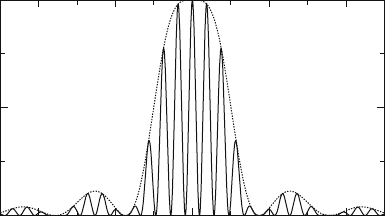
13 Atomic Clocks 377
–200 –100 0 100 200
0.0
0.5
1.0
Frequency detuning (Hz)
Transition probability
Fig. 13.7 Examples of a calculated Ramsey interference pattern as a function of frequency detun-
ing δ. The parameters used in Eq. (13.8) are τ = 11.12 ms, T = 40 ms, b = 141.21/s. The dotted
line is the envelope of the fringe pattern, obtained by averaging over rapidly oscillating terms in
(13.8)
analogous to the optical case where the double-slit diffraction pattern consists of
high spatial-frequency fringes under an envelope given by the diffraction pattern for
a single slit of the same width.
The Ramsey technique has a number of advantages even over a single interaction
zone of the same total length 2l + L, some of which are listed here without further
comments:
• The central Ramsey fringe is actually narrower almost by a factor of 2 than if the
interaction time would have been 2τ + T in a single long zone.
• For a laterally extended beam of atoms susceptible to Zeeman shift of the res-
onance frequency, each atom only has to see the same average magnetic field
along its trajectory. As long as this condition is fulfilled one need not fulfil the
much harder condition that the field is constant everywhere on and off axis.
• When the phase difference of the microwave fields in the two zones is constant
there is no first-order Doppler shift or broadening.
There are other useful features of the Ramsey technique that are important in
other fields of physics. They have been omitted here because they have less rele-
vance for the application of the method in atomic clocks.
Although there is no first-order Doppler broadening of the central Ramsey fringe
there is nonetheless a large influence of the velocity distribution of the atoms
(Fig. 13.8). In a thermal-beam clock, fast atoms experience a shorter time T between
the two parts of the Ramsey interaction, resulting in a larger fringe width than for
slower atoms with larger T . As a result, the fringe contrast washes out with increas-
ing detuning from the central fringe. This is once again completely analogous to the
optical case, with the role of the atomic velocity distribution played by a limited
coherence length of the light illuminating the double slit. The background that the
remaining fringes sit on is called the Rabi pedestal; it corresponds to the resonance