
Muga G. Time in Quantum Mechanics - Vol. 2
Подождите немного. Документ загружается.

388 R. Wynands
decreasing launch height [78]. These balls never meet in the free-flight zone above
the cavity where collisions would lead to a frequency shift. But they all come
together in the detection zone – where cold collisions do not matter anymore –
to produce a strong signal. This idea has been tested at NIST [79] and is envisioned
to be implemented in NIST-F2 [80].
Another avenue is the “juggling fountain” [81] where several balls are launched
with a time separation smaller than the flight time of an individual cloud. When tim-
ing and launch velocities of the individual clouds are chosen such that each time two
of them meet their relative energies fulfil the condition for a Ramsauer resonance,
they pass through each other basically without scattering, i.e. without additional
collisional shifts. It is straightforward to do this with just two “balls”, but amazingly
it can also be done with more than two balls [82]. The multi-ball scheme requires a
precise control of the launch times, velocities and densities of the individual balls.
Furthermore it relies on a delicate cancellation of the collisional shifts in successive
two-ball collisions, making use of the energy dependence of sign and amplitude of
the shift [82].
The Dick effect can be all but eliminated when the fountain clock is operated
in a continuous mode rather than pulsed [83, 84]. At the same time, because of the
continuous detection a lower density beam can be used, reducing the uncertainty
due to cold collisions. However, a continuous fountain poses a number of technical
and experimental challenges. First of all, since the preparation and the detection
zones have to be spatially distinct the atoms have to fly along a parabolic path. This
requires a special geometry for the main cavity. Unfortunately, in this way one loses
one of the big advantages of the pulsed fountain design, where the atoms retrace
their path through the microwave field and thus mostly cancel any end-to-end phase
shifts in the cavity. In the continuous fountain FOCS-1 a special device allows one
to rotate the cavity around the vertical axis by precisely 180
◦
, so that an effective
beam reversal occurs [85], in analogy to the procedure in thermal-beam clocks [21].
Furthermore, the suppression of stray light from the preparation zone becomes
more complicated. Unlike in the pulsed case the laser light cannot be switched off
during the free-flight phase of the atoms, so for the continuous fountain one resorts
to mechanical shutters inside the vacuum vessel. A wheel with partially overlapping
filters absorbing the laser radiation is rotating rapidly through the atomic beam in
such a way that the direct line of sight from the detection zone into the free-flight
zone passes through at least one filter at any one time. Not only does this chop thin
slices out of the continuous atomic beam but also does one have to have a motor
inside the ultra-high vacuum system – which also has to be nonmagnetic!
Details of all design issues can be found in the thesis by Joyet [85]. The first such
clock, METAS-FOCS1, is now being commissioned at METAS [57, 47], with an
improved version FOCS2 being under development [86]. Design goals are a relative
short-term instability of 7 × 10
−14
(τ/s)
−1/2
(using a quartz oscillator as a local
oscillator for the 9-GHz synthesis chain) and a relative uncertainty of 10
−15
.
Obtaining a small frequency instability is indispensable for the evaluation of sys-
tematic uncertainty contributions at the level of 10
−15
or below. Even an instability
13 Atomic Clocks 389
of only 10
−13
(τ/s)
−1/2
still results in a 3.4 × 10
−16
statistical uncertainty after one
full day of measurement.
13.7.2.2 Systematic (Type B) Uncertainties
To a large degree the sources of frequency bias in a fountain clock are very simi-
lar to those in a thermal-beam clock. The latter are described in great quantitative
detail in the book by Vanier and Audoin [2]. The fact that now one has a state-
selected, monokinetic sample of laser-cold atoms greatly reduces some of these
biases but also introduces two new ones: the light shift and the cold-collision shift.
Here we will present just an overview and refer the reader to the review [55] and
the published formal evaluations of the individual fountain clocks, for example, in
[76, 40, 38, 42–45].
(1) Second-Order Zeeman Effect
The applied static magnetic bias field (“C-field”) results in a second-order
shift of the clock transition by f
c
= 0.0427 Hz×(B
C
/μT)
2
, where B
C
is
the magnetic flux density of the C-field, so that almost 5 × 10
−14
relative
frequency shift is obtained for the typical B
C
∼ 0.1 μT. One can use the
atoms themselves as probes for the mean C-field strength, its inhomogeneity
and its temporal stability by measuring the resonance frequency f
Z
of the
first-order field-sensitive transition |F = 4, m
F
= 1→|F = 3, m
F
= 1.In
contrast to a conventional beam clock, an atomic fountain provides the advan-
tageous possibility of mapping the C-field by launching the atoms to different
heights h
max
. For a given h
max
the measured f
Z
is an average over B
C
(z)
encountered by the atom cloud, weighted with the z- and h
max
-dependent
dwell time of the cloud. The series of f
Z
(h
max
) can be deconvoluted to
obtain B
C
(z)[87].
(2) Majorana Transitions
Majorana transitions (ΔF = 0,Δm
F
=±1) between the m
F
substates within
a hyperfine ground state |F = 4 or |F = 3 can be induced near zero cross-
ings of the magnetic field strength [88]. In real caesium clock cavities it cannot
be avoided that due to the field geometry some ΔF =±1,Δm
F
=±1
transitions occur besides the designated clock transition, albeit with a small
probability. In connection with Majorana transitions large frequency shifts can
occur [89] because atoms can end up in superposition states with the same
F quantum number but different m
F
quantum numbers. For these states the
hyperfine transition frequency is in general different from the clock transition
frequency, with a resulting overall frequency shift. For a well-controlled mag-
netic field geometry the uncertainty estimate due to Majorana transitions is
typically stated as less than 10
−16
.
(3) Cavity-Related Shifts: Residual First-Order Doppler Effect and Cavity Pulling
A general advantage of an atomic fountain is that the atoms cross the same
microwave cavity twice in opposite directions. If the atomic trajectories were
390 R. Wynands
perfectly vertical, frequency shifts due to axial and radial cavity phase
variations would be perfectly cancelled as each atom would interact with the
field first with velocity v (upwards) and later with −v (downwards). Due to
the transverse residual thermal velocity and a possible misalignment of the
launching direction atoms in general do not retrace their upward trajecto-
ries on the way down, so a first-order Doppler frequency shift can remain.
Uncertainty contributions of the order of at most several 10
−16
are estimated
typically [76, 40, 38, 42–45].
The frequency shift due to cavity pulling is usually negligible because atom
numbers are still rather low. Furthermore, since cavity pulling is proportional
to atom number it is corrected for automatically when the collisional shift
correction (see below) is applied.
(4) Rabi and Ramsey Frequency Pulling
Frequency shifts due to Rabi and Ramsey frequency pulling [2] can occur in
the presence of nonzero and asymmetric (with respect to m
F
= 0) popula-
tions of the |F, m
F
= 0 substates when the atoms enter the Ramsey cavity.
However, the state selection process in a fountain clock strongly reduces the
impact of these frequency pulling effects to well below 10
−16
.
(5) Microwave Leakage
The presence of microwave radiation outside the cavities can lead to large
frequency shifts despite the partial cancellations due to the near-symmetry of
the up-down motion of the cloud. The spread of the cloud, combined with
the fundamentally unavoidable radial microwave power variation inside the
cavity, makes the atoms see different effective microwave powers during the
two cavity passages. This greatly increases the clock’s susceptibility to stray
field-induced frequency bias [90]. Typical uncertainties evaluated so far fall in
the low 10
−16
range once all microwave devices, cables and connectors have
been shielded carefully.
(6) Electronics and Microwave Spectral Impurities
The low total systematic uncertainty of a fountain clock requires tight spec-
ifications for any electronic subsystems in order to avoid frequency bias
caused by servo offsets or microwave spectral impurities [91, 92]. Recent
improvements on other systematic uncertainties have prompted several groups
to upgrade their microwave electronics so that they no longer limit further
progress [93–96].
(7) Light Shift and Optical Pumping/Heating
All lasers must be completely blocked while the atoms are in or above the
Ramsey cavity. Otherwise, the shift of the atomic energy levels by the AC
Stark effect (light shift) [61] will lead to a frequency bias – nanowatts of
residual laser power can already be too much. Once the atoms have fallen
through the Ramsey cavity they still must be protected from stray light until
they have passed the detection zone to avoid heating of the cloud [97] and a
reduced contrast of the Ramsey fringe [98]. With combinations of large laser
frequency detuning and of acousto-optical and mechanical shutters the corre-
sponding uncertainty can be reduced to below 10
−16
.

13 Atomic Clocks 391
(8) Blackbody Shift
AC Stark shift of a different origin is induced by the thermal radiation of
the vacuum enclosure. Assuming that this radiation follows the spectral power
density distribution of a black body the clock transition frequency is shifted by
f
bb
=−1.579 × 10
−4
Hz
T
300 K
4
×
1 + 0.013
T
300 K
2
(13.10)
for a vacuum enclosure at temperature T [99–103, 63]. Hence, for a cae-
sium clock at room temperature the relative frequency shift is of the order of
−17 ×10
−15
. A corresponding correction must be applied. Its relative uncer-
tainty lies below 10
−16
when the thermal environment seen by the atoms is
known within 0.2 K or so. The NIST-F2 and the NRC-FCs1 fountains under
development will all but eliminate this shift when they are operated at liquid-
nitrogen temperature [80, 52].
(9) Collisional Shift
A major source of uncertainty is the frequency shift due to collisions among
the cold atoms in the cloud [104]. The collisional cross section was found to be
strongly dependent on energy (i.e. the average temperature of the cloud) [105].
The problem is particularly serious for caesium because it was found that its
collisional cross section is unusually large at the low cloud temperatures used
in a fountain. Conceptually the simplest solution would be to choose another
element. For instance, in rubidium the collisional cross-section is almost two
orders of magnitude lower [106, 107]. Indeed, rubidium fountain clocks have
been built where the reduction of collisional shift uncertainty was one of the
motivations [108, 109].
A number of schemes have been devised to reduce the collisional shift or at
least its contribution to the uncertainty budget of the caesium fountain clock,
for instance, by lowering the density of the atomic cloud and therefore the
collision rate. A reduced number of atoms, however, reduce the detected signal
and therefore the signal-to-noise ratio and the short-term stability (Eq. 13.9).
Recent developments are helping to ease this trade-off problem for the case
of caesium. The problem of loss of signal for low-density clouds can be cir-
cumvented by controlling the preparation of the atoms such that more than
one low-density cloud at a time is travelling through the vacuum system, as
discussed above in connection with the Dick effect. The continuous fountain
also allows one to reduce the influence of collisional shift because it spreads
the atoms over the whole trajectory instead of concentrating them in a high-
density cloud.
The more traditional approach is to measure the clock’s output frequency
for two or more effective densities of the atomic cloud and then extrapolate
to zero density. Since the frequency shift due to cold collisions is linear in
effective atom density, one can extrapolate the measured frequencies obtained
with clouds of different densities to zero density using a linear regression.
This is the method currently employed by all primary fountain clocks. Since
392 R. Wynands
the actual density of the cloud is not readily accessible in the experiment, one
substitutes the number N
at
of detected atoms instead. This, of course, assumes
that there is a strict proportionality between N
at
and effective density. The
actual experimental practice in the various laboratories differs in the way that
clouds of different densities are prepared. One way is to vary the loading
time of the MOT/OM to determine the proportionality factor between atom
number and output frequency [55]. In all subsequent frequency measurements
one continuously monitors the atom number and scales it with this factor to
extrapolate to the zero density value [40]. A disadvantage of this method is
that one cannot exclude a difference in the spatial distribution of the atoms
within the cloud for the two atom number regimes, which in general could
change the proportionality factor between effective density and detected atom
number. An additional contribution therefore needs to be included into the
uncertainty budget.
As an alternative, the collisional shift can be monitored during the course
of a frequency evaluation, by switching between two different atom numbers
every few shots [43] or every hour [42]. The switching is done by varying
the microwave power or detuning for the state-selection pulse. Once again
it cannot be excluded that the density distribution of the state-selected cloud
changes between high and low atom number due to inhomogeneities of the
microwave excitation.
When a very stable local time reference, for instance, a maser ensemble,
is available, one can also run the fountain at extremely low atom number (i.e.
very low collisional shift) and just average over a longer time interval [110].
Perhaps the most elegant way is to use the technique of rapid adiabatic
passage during the preparation stage (Figs. 13.12c and 13.13c) in the state-
selection cavity [111]. This method relies on the fact that the population of
state |F = 4, m
F
= 0 can be transferred with 100% efficiency into state
|F = 3, m
F
= 0 when both frequency and amplitude of the microwave
radiation inside the selection cavity are ramped with just the right timing
[112]. Details of the technique can be found in [112, 111, 113]. Basically,
the microwave detuning is ramped from (ideally) minus infinity to infinity,
while the amplitude goes from 0 to a maximum (at detuning zero) and back to
0 again. One has to ensure that the rate of change of the microwave frequency
has to be much lower at all times than the square of the Rabi frequency (which
is proportional to microwave power).
When the pulse is switched off abruptly at detuning δ = 0 the atoms
are left in an exactly equal superposition of both states. The important fea-
ture of the rapid adiabatic passage is that this happens independently of the
actual Rabi frequency an atom sees, i.e. it does not depend on where an atom
passes through the field inside the cavity (the field amplitude decreases across
the aperture when going away from the centre). The pushing beam therefore
removes exactly half of all atoms, without changing the density distribution,
temperature or velocity of the cloud – in contrast to the other methods where
such changes cannot be excluded.
13 Atomic Clocks 393
At SYRTE the ratio of 1 : 2 can be prepared and maintained with an accu-
racy of 10
−3
[76], allowing for a very precise determination of the collisional
shift rate and its correction. The precise control over atomic populations in
SYRTE-FO2 has also made it possible to detect Feshbach resonances in the
dependence of the collisional shift on magnetic quantum number m
F
[64].
Surprisingly, these resonances occur already for flux densities of 2 μTor
less.
Finally, under certain circumstances one can actually run a caesium foun-
tain clock under operating conditions where the total collisional shift experi-
enced by the cloud is 0 [114]. A typical Cs fountain standard operates with
atoms cooled down to 1–2 μK at the time of launch. As the cloud expands
during its ballistic flight, correlations build up between atomic position and
velocity, an effect particularly pronounced for atoms initially trapped in a
small cloud (like in a MOT). Basically, atoms sort themselves spatially into
concentric shells of very nearly the same velocity. This means that the effec-
tive collisional energy decreases down to a few hundred nanokelvins even
before the first Ramsey interaction [115]. At low energies the collision rate
coefficients for the clock states |F = 3, m
F
= 0 and |F = 4, m
F
= 0 differ
in sign, which gives rise to a strong variation of the collisional shift if the
relative weights of the clock states in the superposition state prepared during
the first Ramsey interaction are varied.
This could be confirmed experimentally and theoretically for two inde-
pendent primary standards [114]. The fraction of the population in a given
clock state (e.g. |F = 4, m
F
= 0) was changed by adjusting the amplitude
0.0 0.2 0.4 0.6 0.8 1.0
Fraction of |F = 4〉 atoms
Relative collisional frequency shift
−2×10
−14
−1×10
−14
0
1×10
−14
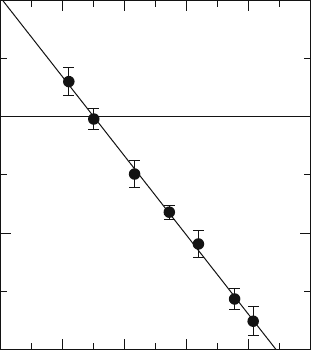
Fig. 13.15 Measurement of the collisional frequency shift in PTB-CSF1 as a function of the pop-
ulation composition during the Ramsey time. The experimental data are fitted by a linear function
394 R. Wynands
of the microwave field in the Ramsey cavity. The collisional frequency shift
for atoms captured in a MOT varies linearly with the population fraction
(Fig. 13.15). For PTB-CSF1 the collisional frequency shift is cancelled for
a 30% fraction of |F = 4, m
F
= 0 atoms, which can be achieved experimen-
tally with only a minor reduction of the fringe contrast and short-term stability
of the fountain clock.
The practical details of this method have been considered in detail in [116];
under certain circumstances a shortening of the averaging time to reach a cer-
tain statistical uncertainty of about an order of magnitude was predicted. So
far, this method is not yet applied routinely.
(10) Background Gas Collisions
At typical vacuum pressures in the ballistic flight region in the low 10
−7
Pa
range the effect of collisions of cold caesium atoms with residual gas atoms is
estimated to be well below 10
−16
.
(11) Time Dilatation: Relativistic Doppler Effect
Relativistic time dilatation reduces the clock frequency observed in the lab-
oratory frame by f
D
≈ ν
0
v
2
/(2c
2
), with v
2
the mean quadratic veloc-
ity of the atoms above the microwave cavity and c the velocity of light.
Typically f
D
/ν
0
is of the order of 10
−17
, so that in contrast to thermal-
beam clocks time dilatation and the associated uncertainty contribution can be
neglected.
(12) Gravitational Redshift
Even though the gravitational redshift [117] of about −1.1×10
−16
per metre of
elevation above the geoid is not relevant for the realization of the proper sec-
ond of a clock and for local frequency measurements at the same gravitational
potential, its knowledge is necessary for comparing remote clocks, for instance
when contributing to international atomic time (TAI). Hence the mean height
of the atoms above the geoid during their ballistic flight above the microwave
cavity centre has to be determined with a typical uncertainty of 1 m, corre-
sponding to a frequency uncertainty of 10
−16
. In principle, a limitation is given
by the accuracy with which the local gravitational potential can be determined.
Even for high-altitude laboratories like NIST in Boulder (≈ 1630 m above sea
level) the correction can be determined with a relative uncertainty of 3×10
−17
[118]. At this relative uncertainty the gravitational redshift will probably not
become a limiting factor for clocks based on microwave transitions. This is in
contrast to the case of future optical clocks.
(13) Other Systematic Effects
There are other frequency-shifting effects (dc Stark shift, Bloch–Siegert shift)
[2], which can be estimated to be less than 10
−17
in a fountain clock, or the
microwave recoil shift at around 10
−16
[119].
In conclusion it can be stated that the main contributions to the systematic uncer-
tainty are of the order of a few 10
−16
or less. As the individual systematic uncer-
tainty contributions can be assumed to be linearly independent, the resulting total
systematic uncertainty is the square root of the sum of squares of the individual
contributions.
13 Atomic Clocks 395
13.7.3 State of the Art
Worldwide, as of July 2008 there are nine primary fountain clocks in operation that
have been used to contribute to the international timescales. The individual clocks
have very different characteristics, depending on the design choices made by the
teams developing and operating them. Which of the fountains is the “best one” right
now? Well, that depends on the criterion chosen.
• Stability
In terms of stability the SYRTE fountains FO1 and FO2 with σ
y
(1 s) = 2×10
−14
are unsurpassed. This low instability is achieved by referencing the 9-GHz
microwave to an ultrastable cryogenic sapphire oscillator (CSO) [75, 76, 69].
So far, the other groups have shied back from the enormous technical and finan-
cial effort involved in the operation of a CSO at liquid-helium temperature. New
developments in the field of femtosecond laser frequency combs have opened up
the possibility of using such a comb “in reverse”, by locking it to a narrow opti-
cal Fabry–Perot resonance and deriving a phase-stable 9-GHz microwave signal
from it. Performance similar to that of a CSO has been reported [77].
• Uncertainty
SYRTE-FO1, SYRTE-FO2 and NIST-F1 can now be run under conditions of
3,...,4 × 10
−16
relative uncertainty [76, 110, 120], with most other fountain
clocks currently in the range of 10
−15
or slightly below. There appears to be
room for substantial reductions in the uncertainties of collisional shift, cavity-
related effects and electronics by a more stringent control of operating parameters
and a better theoretical understanding of microwave cavities. However, it will be
difficult to drive the relative uncertainty much below 1,...,2 ×10
−16
.
That is because reducing the uncertainty of the black-body shift appears rather
difficult for the existing fountains since it would require a sufficiently detailed
knowledge of the effective thermal environment of the atoms during their free-
flight phase. This includes not only the actual inner-wall temperature to within
better than 0.2 K but also reliable values for the emissivity of the inner surfaces
of the vacuum tube (which might change due to physisorption or chemisorption
of caesium or residual gases over the years of operation) as well as the influence
of radiation coming in through windows and other openings. Any substantial
progress on this front might require the cooling of the walls of the vacuum tube.
This is exactly what is intended for NIST-F2 and NRC-FCs1, which are currently
under construction [80, 52].
• Robustness
Although not as “sexy” as the other two criteria, the operational robustness of
a clock is important for its application in the generation of timescales, be it on
a local or on an international level, although depending on circumstances some
dead time can be tolerated. No fountain can yet run with the same round-the-
clock unattended operation as the thermal-beam clocks PTB-CS1 and PTB-CS2
have been doing for decades. The main problem here is the stability of the oper-
ating parameters of the laser sources over days and weeks, in particular slow
drifts into less favourable operational regimes or even mode hops. Using standard
396 R. Wynands
extended-cavity diode lasers with feedback from an external diffraction grating it
is possible today to run a fountain clock with better than 99.8% availability over
weeks. This is, for instance, the case with PTB-CSF1, where the small amount
of dead time is entirely due to scheduled laser parameter checks [121]; recently,
completely unattended and uninterrupted operation for about 3 weeks has been
tried successfully.
New laser sources, like the extended-cavity lasers developed for the ACES
project [122] or the high-power narrow linewidth DFB laser diodes now available
commercially, might simplify long-term operation of fountain clocks. Dead times
due to unintended laser dropouts can be minimized by automated laser relock
systems, although these cannot always deal with mode hops.
13.8 Other Types of Atomic Clocks
A discussion of atomic clocks would not be complete without at least a brief discus-
sion of some other types of atomic clocks. Out of the many possibilities only two are
selected here: the vapour-cell clock, which trades uncertainty for a smaller size, and
the hydrogen maser which trades uncertainty for superior short- and medium-term
stability.
13.8.1 Vapour-Cell Clocks
Vapour-cell atomic clocks are perhaps the most influential type of atomic clock
for everyday life – or if they are not yet, they soon will be. This is because it is
rubidium-vapour clocks that work aboard the GPS satellites, helping us navigate
unfamiliar terrain, and that are gradually finding their way into cell phone network
base stations. With the development of the chip-scale atomic clock even battery-
operated, handheld devices like the GPS receivers or the cell phones themselves
might soon contain their own atomic clock. And would not an atomic wrist watch
be ever so cool?
13.8.1.1 Microwave Vapour-Cell Clock
Caesium and rubidium have two big practical advantages that distinguish them from
almost all other chemical elements. They can easily be manipulated with read-
ily available diode laser sources, and the vapour pressure above solid caesium or
rubidium is high enough to do useful spectroscopy even at room temperature. It is
therefore possible to place a small crumb of Cs or Rb into an evacuated glass cell,
shine a light beam through the cell and observe a spectroscopic signal (typically the
transmitted power) shaped by the optical properties of the atomic vapour.
In the simplest embodiment this light actually does not come from a laser but
from a spectral lamp containing the element of interest, typically rubidium. Natural
13 Atomic Clocks 397
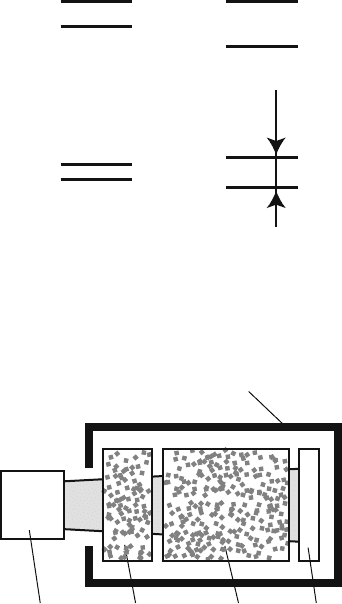
rubidium consists of a mixture of two isotopes,
85
Rb and
87
Rb (Fig. 13.16). Most
of the light given off by the lamp corresponds to the D
1
and D
2
lines at 794 and
780 nm wavelength, respectively. By a lucky coincidence, the Doppler-broadened
|F = 3→|F
absorption line in
85
Rb overlaps the |F = 2→|F
absorption
line in
87
Rb; this is true both for the D
1
and the D
2
lines. The |F = 2→|F
light component emitted by an isotopically pure
87
Rb lamp is therefore absorbed in
an isotopically pure
85
Rb “filter” cell (Fig. 13.17), leaving a transmitted light beam
that can only interact with the |F = 1→|F
absorption line in the main
87
Rb
cell. Atoms in ground state |F = 1 are optically excited and then decay into either
one of the ground states. Atoms in state |F = 2 are trapped because they cannot be
excited by the filtered lamp light anymore. State |F = 2 is therefore called a “dark
state” for this particular light spectrum.
F = 1
F = 2
h × 6.8 GHz
F' = 2
F' = 1
87
Rb
F = 2
F = 3
F' = 3
F' = 2
5
2
P
1/2
85
Rb
5
2
S
1/2
Fig. 13.16 Level scheme for the D
1
excitation line of the two naturally occurring rubidium isotopes
87
Rb
lamp
85
Rb
filter cell
87
Rb
main cell
Magnetic shield,
microwave cavity,
bias field solenoid
Photo diode
Fig. 13.17 Set-up of a compact optical-pumping rubidium microwave clock. The typical volume
of such a clock is 250 cm
3